
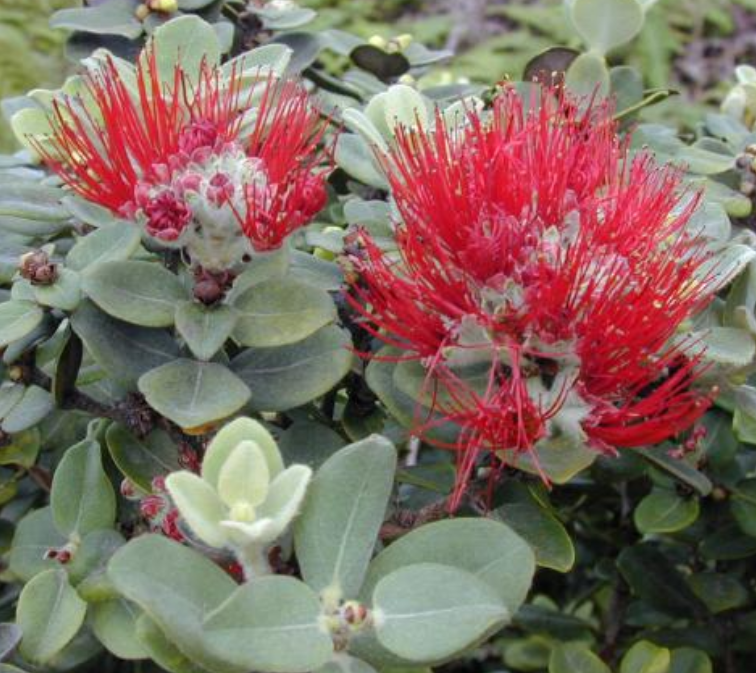
Metrosideros polymorpha, known in Hawaii as ʻŌhiʻa lehua It sometimes fills a heavy super with light honey in January.
I’d really like to have this in my back yard because that would mean I would be living in Hawaii.
photo in Public Domain via Wiki
In my podcast, I’ve been trying to focus on one, or maybe two or three, flower species each month. September was goldenrod. That one was easy. Goldenrod does a good job of reminding us that the growing season is ending and that everything, sooner or later, dies. That podcast episode also pointed to the end of life, as we know it, on Earth. Have a listen.
Choosing a flower a month turns out to be harder than it sounds. Bee plants don’t follow neat schedules. In the northern hemisphere, the flowers that actually power colonies only bloom for a few months of the year, and when they do bloom, there are usually several at once, all demanding attention. Then there is winter. From November through January, there is often very little to say at all. So, for my most recent podcast, I struggled to find something to look at for the month of January.
For beekeepers in North America, January is the nervous month. We usually can’t open our colonies, so we don’t know if they are dead or alive. I can’t imagine a cattle rancher being comfortable not knowing how many cows will make it to spring, having no idea whether a thousand head have quietly dwindled to a handful. Beekeepers live with that uncertainty as a normal condition. In most places, it’s too bleak to peek. Opening a live hive just to confirm that it is alive can kill it. So we accept that our bees are both alive and dead at the same time. That’s today’s quantum physics lesson, courtesy of Schrödinger’s cat. I do, in fact, have a physics degree (geophysics, to be precise).
Honey bees survive winter by managing what they stored, and what we fed them, months earlier. They don’t turn their blood into antifreeze the way bumble bees do. Instead, they cluster. They generate heat by consuming honey and twitching their wing muscles. Ten thousand bees doing that at once is enough to keep the center of the cluster warm, even when it is bitterly cold outside.
Across most of the United States, and certainly across Canada, there is no meaningful nectar flow in January. What forage exists is limited to the southern United States (and maybe the southwest and west coast) and depends entirely on short stretches of mild weather. Florida is the best example. Along rivers, wetlands, and low wooded ground, willow can bloom in January. Willow is mainly a pollen source, but it also provides some nectar. The pollen is high quality and often marks the beginning of brood rearing. Oaks add large amounts of pollen as well—easy to collect, nutritionally mediocre, but useful. Maple can bloom surprisingly early, sometimes by mid-January in central Florida. When I kept bees there, I remember seeing fresh, white wax holding dark, uncapped honey. There was never enough to harvest, but it helped the bees considerably.
Those early natural sources often need help. Once brood rearing begins, it must be supported. If feeding stops and the weather turns bad, bees will abandon brood and sometimes eat it. Bees can sometimes be pestilent little cannibals.
Citrus gets most of the attention. In unusually mild winters, citrus may bloom in January and provide some nectar and pollen. But when it blooms that early, it is unreliable and short-lived. Early citrus can stimulate brood expansion that requires supplemental feeding to sustain it. If citrus waits a few weeks, blooming in late February or March, there is sometimes a good orange blossom crop.
January in Hawaii is entirely different. There is no real winter shutdown. ʻŌhiʻa lehua can bloom year-round and often provides nectar in January, especially at mid and higher elevations. Kiawe, or Hawaiian mesquite, blooms during the dry season and can produce significant honey, particularly on leeward coasts. Macadamia (a non-native) contributes nectar and pollen, and Christmas berry (another non-native) can support colony growth and honey storage. In Hawaii, it’s not the month, but the microclimate that determines the honey flow. Move a colony a few kilometers and everything changes.
Back on the mainland in South Texas and the desert Southwest, we might see sweet acacia or desert lavender during warm spells. Southern California has eucalyptus, manzanita, and scattered ornamentals. Farther north, including coastal British Columbia, January forage essentially disappears. Bees may fly, but they are not finding nectar, they are probably looking for a toilet.
With cold weather and frozen flowers out there, supplemental feeding can be important in January. Liquid syrup is usually a bad idea because of the effort bees use to process it and because of the moisture it introduces into a hive. Fondant or candy boards are better. Protein feeding is risky because it can get brood rearing started too early.
January nectar exists, but only in pieces and only in certain places. Bees survive winter not because January gives much to the bees, but because preparations happened long before winter arrived.
This was an excerpt from this podcast episode.
There are already over 75 episodes of About Bees, Culture, and Curiosity. And you can listen to all of them completely free. I’m amazed that I have so many already. Sort of like when you are extracting honey. At first, just a few drops piddle out of the extractor, then a few hours later, you have some containers filled. Soon, a big truck arrives to haul off a semi load of 65 big steel drums of honey. It’s been like this with the podcast.
By now, almost everyone knows how to access a podcast. Mine – About Bees, Culture, and Curiosity – can be found on Apple Podcasts, Spotify, Podbean, iHeart Radio, Player FM, Deezer, and a dozen other places – including this special website for my podcast. Go to your favourite app on your phone or computer and enjoy.

 Bad Beekeeping Blog
I keep honeybees on Southern Vancouver Island. On days above 50 degrees F, my bees gather pollen from the hazelnut trees in our orchard.
LikeLiked by 1 person
I love Vancouver Island!! It’s almost tropical. Sorry I didn’t mention it in my podcast. I think it would be a great place to raise a few queens as a retirement project. I didn’t know about the hazelnut nuts and their pollen!
Thanks for sharing this. Ron
LikeLike
Tried and failed to buy a bee outfit on the Big Island, late 80s……I’d still be there….
LikeLiked by 1 person
I would have done that, too. Instead I ended up in the north country.
LikeLike