The most important beekeeper you never hear of

🐝 🐝 🐝 🐝

You probably know that Karl von Frisch figured out how honey bees use their waggle-dance to communicate. He won the Nobel Prize for that and for other studies of bee behaviour. I think it was well-deserved and his experiments withstood criticism and independent confirmation. (Although there are still a few distinguished scientists who contest the theory.) His discovery was intuitive and required hundreds of replicated experiments conducted over years of work in personally risky circumstances in Nazi Germany. (Von Frisch had some Jewish heritage.) But there is another scientist who came close to figuring out many of the things which von Frisch discovered. The other scientist did his experiments in America, decades earlier. But he’s mostly unknown, largely forgotten.

Charles Turner is likely the most important biologist you’ve never heard of. Charles Henry Turner (February 3, 1867 – February 14, 1923) published at least 70 papers, mostly on animal behaviour. Years before von Frisch realized that bees possess colour vision and can recognize and remember patterns, Turner had published his own results on exactly the same thing. Turner also published the first research showing that insects can learn and solve problems. At the time, in 1900, it was generally believed that invertebrate activity was due to reaction to chemical and physical stimuli, without the need for neural discernment. Following Turner’s discoveries, we have seen that insects of all sorts exhibit signs of personality and certainly demonstrate problem-solving skills. Turner’s experiments created a new field of science focused on cognitive ability in insects and other invertebrates.

Turner’s father, from Canada, was a church custodian. A church custodian who was known as a master of debate and who – in the 1870s – owned several hundred books. Charles Turner’s mother, who was from Kentucky, was a nurse. Our budding scientist was born in Cincinnati where he attended public schools and graduated as class valedictorian. Charles Turner studied biology at the University of Cincinnati, graduating in 1891 – the same year he published his first paper (“Morphology of the Avian Brain”) in the Journal of Comparative Neurology. He followed that with another avian neurology paper, this time published in the prestigious magazine Science. He earned his MSc just a year later. His research moved from dissections and interpretations of bird nervous systems to spiders, river shrimp, and insects. Turner was also the first to demonstrate Pavlovian conditioning in an insect. In 1907, Turner became one of the first African-Americans to receive a graduate degree from the University of Chicago. His doctorate, “The Homing of Ants: An Experimental Study of Ant Behavior,” was emblematic of his work in the learning and thinking patterns of invertebrates.

One of Turner’s biggest discoveries involved honey bees, which he trained to recognize shapes and patterns and which – he discovered – could remember the colours of hidden trays of sugar syrup, returning to the correct colours even when tray positions were scrambled.

Dr Charles I. Abramson, a professor at Oklahoma State, investigated Charles Turner’s life. Abramson, in his piece “A Study of Inspiration” describes Turner’s honey bee research:

“Turner begins the paper with a scholarly review of the literature in which the various theories of why bees should see colors are enumerated, followed by a discussion of the limitations of the existing data.

“To investigate the problem, he studied honey bees in O’Fallon Park in St. Louis. He designed various colored disks, colored boxes,and “cornucopias” into which the bees were trained to fly. Thirty-two experiments were designed, and controls for the influence of odor and brightness were instituted. The results of his experiments showed that bees see colors and discriminate among them. It is interesting that in considering the results of his experiments, he believed that bees may be creating, in his words, “memory pictures” of the environment. The idea of memory pictures is certainly contemporary.

“The second paper of the series on honey bee learning was stimulated by the color vision paper. The methods used were identical to those in the color vision paper with the exception that various patterns were used, as were colors. The use of patterns and colors on the same target is the first use, in my opinion, of the compound-conditioning methods popular in contemporary studies of animal discrimination learning. The study contains 19 experiments and the results show that honey bees can readily distinguish patterns.”

Although he earned his PhD as a magna cum laude graduate at the University of Chicago, Turner didn’t find the sort of work that such a brilliant scientist would be expected to receive. He ended up with no laboratory to direct, no grad students to mentor, and no position at any research university. He applied to various universities, but was routinely rejected due to his race. Consequently, Turner spent most of his career as a high school science teacher at the Negro Sumner High School, conducting his experiments at a city park, paying for his spare-time research out of his own pocket.

Historian W.E.B. Du Bois wrote:

Charles Turner “became a teacher in a small colored Methodist school in South Atlanta which had at the time about a dozen college students, no laboratories and few books. He received inadequate pay and a heavy teaching load . . . but the only appointment carrying a living wage that he was able to get was in the Negro Sumner High School in St. Louis. There he stayed until he died of overwork. He was a promising scientist; with even fair opportunity he ought to have accomplished much; but his color hindered him.”

Charles Henry Turner died young from a heart attack, passing away in 1923 at the age of 56. For a comprehensive biography and an analysis of the science behind Turner’s work, I invite you to read “A Study of Inspiration” by Charles I. Abramson.

Most of the material in today’s blog comes from various papers by Abramson, who has researched Turner’s life for years. You can download Dr Abramson’s biography about Dr Turner, see a brief review in Nature, or read more about Turner (and see some family photos) at Abramson’s Charles Henry Turner website. It would be a nice tribute to Charles Henry Turner if you could read more of his story on this anniversary of Dr Turner’s birth.

🐝 🐝 🐝 🐝 🐝🐝 🐝 🐝 🐝 🐝

Posted in Bee Biology, Books, Culture, or lack thereof, History, People, Science | Tagged , | 1 Comment

What’s Blooming in January?


Metrosideros polymorpha, known in Hawaii as ʻŌhiʻa lehua It sometimes fills a heavy super with light honey in January.

I’d really like to have this in my back yard because that would mean I would be living in Hawaii.

photo in Public Domain via Wiki

In my podcast, I’ve been trying to focus on one, or maybe two or three, flower species each month. September was goldenrod. That one was easy. Goldenrod does a good job of reminding us that the growing season is ending and that everything, sooner or later, dies. That podcast episode also pointed to the end of life, as we know it, on Earth. Have a listen.

Choosing a flower a month turns out to be harder than it sounds. Bee plants don’t follow neat schedules. In the northern hemisphere, the flowers that actually power colonies only bloom for a few months of the year, and when they do bloom, there are usually several at once, all demanding attention. Then there is winter. From November through January, there is often very little to say at all. So, for my most recent podcast, I struggled to find something to look at for the month of January.

For beekeepers in North America, January is the nervous month. We usually can’t open our colonies, so we don’t know if they are dead or alive. I can’t imagine a cattle rancher being comfortable not knowing how many cows will make it to spring, having no idea whether a thousand head have quietly dwindled to a handful. Beekeepers live with that uncertainty as a normal condition. In most places, it’s too bleak to peek. Opening a live hive just to confirm that it is alive can kill it. So we accept that our bees are both alive and dead at the same time. That’s today’s quantum physics lesson, courtesy of Schrödinger’s cat. I do, in fact, have a physics degree (geophysics, to be precise).

Honey bees survive winter by managing what they stored, and what we fed them, months earlier. They don’t turn their blood into antifreeze the way bumble bees do. Instead, they cluster. They generate heat by consuming honey and twitching their wing muscles. Ten thousand bees doing that at once is enough to keep the center of the cluster warm, even when it is bitterly cold outside.

Across most of the United States, and certainly across Canada, there is no meaningful nectar flow in January. What forage exists is limited to the southern United States (and maybe the southwest and west coast) and depends entirely on short stretches of mild weather. Florida is the best example. Along rivers, wetlands, and low wooded ground, willow can bloom in January. Willow is mainly a pollen source, but it also provides some nectar. The pollen is high quality and often marks the beginning of brood rearing. Oaks add large amounts of pollen as well—easy to collect, nutritionally mediocre, but useful. Maple can bloom surprisingly early, sometimes by mid-January in central Florida. When I kept bees there, I remember seeing fresh, white wax holding dark, uncapped honey. There was never enough to harvest, but it helped the bees considerably.

Those early natural sources often need help. Once brood rearing begins, it must be supported. If feeding stops and the weather turns bad, bees will abandon brood and sometimes eat it. Bees can sometimes be pestilent little cannibals.

Citrus gets most of the attention. In unusually mild winters, citrus may bloom in January and provide some nectar and pollen. But when it blooms that early, it is unreliable and short-lived. Early citrus can stimulate brood expansion that requires supplemental feeding to sustain it. If citrus waits a few weeks, blooming in late February or March, there is sometimes a good orange blossom crop.

January in Hawaii is entirely different. There is no real winter shutdown. ʻŌhiʻa lehua can bloom year-round and often provides nectar in January, especially at mid and higher elevations. Kiawe, or Hawaiian mesquite, blooms during the dry season and can produce significant honey, particularly on leeward coasts. Macadamia (a non-native) contributes nectar and pollen, and Christmas berry (another non-native) can support colony growth and honey storage. In Hawaii, it’s not the month, but the microclimate that determines the honey flow. Move a colony a few kilometers and everything changes.

Back on the mainland in South Texas and the desert Southwest, we might see sweet acacia or desert lavender during warm spells. Southern California has eucalyptus, manzanita, and scattered ornamentals. Farther north, including coastal British Columbia, January forage essentially disappears. Bees may fly, but they are not finding nectar, they are probably looking for a toilet.

With cold weather and frozen flowers out there, supplemental feeding can be important in January. Liquid syrup is usually a bad idea because of the effort bees use to process it and because of the moisture it introduces into a hive. Fondant or candy boards are better. Protein feeding is risky because it can get brood rearing started too early.

January nectar exists, but only in pieces and only in certain places. Bees survive winter not because January gives much to the bees, but because preparations happened long before winter arrived.


This was an excerpt from this podcast episode


There are already over 75 episodes of About Bees, Culture, and Curiosity. And you can listen to all of them completely free. I’m amazed that I have so many already. Sort of like when you are extracting honey. At first, just a few drops piddle out of the extractor, then a few hours later, you have some containers filled. Soon, a big truck arrives to haul off a semi load of 65 big steel drums of honey. It’s been like this with the podcast.

By now, almost everyone knows how to access a podcast. Mine – About Bees, Culture, and Curiosity – can be found on Apple Podcasts, Spotify, Podbean, iHeart Radio, Player FM, Deezer, and a dozen other places – including this special website for my podcast. Go to your favourite app on your phone or computer and enjoy.

Posted in Honey Plants, Beekeeping, Podcasts | Tagged , , , , | 4 Comments

Podcast: Ten Best Bee Predictions for 2026

Well, no one can fully predict the future. But we can all try. I just released a new podcast that looks into the crystal ball of bees and beekeeping for 2026. Listen to this short (30 minute) selection of ten likely stories you will be following and hearing about during 2026. Here’s a link to this episode.

Ten bee predictions for 2026

Here we go. I might be wrong more than right, but it’s still worth a think.

1. I expect more bees declines, but not kept honey bees.

2. Honey bee colony numbers will surprise researchers.

3. Climate-driven phenological mismatches will dominate ecology news.

4. In the USA, lax rules will allow easier registration of agriculture chemicals, resulting in more pollinator deaths.  

5. I predict pollinator restoration projects will be big.

6. I expect a new pathogen jump from honey bees to wild bees.

7. In 2026, I think that there will be bee stories regarding extreme weather.

8. I expect at least one article titled something like “Tiny robots are replacing bees as pollinators.”

9. Not a wild prediction, but I think bees will be less common on social media in 2026.

10. Robotic androids will not replace beekeepers in the field during 2026.

Listen to the podcast to see how I explain these predictions.

Recorded in Calgary, Alberta, Canada in January 2026.

Finally: email your questions, comments, and angst:  miksha@gmail.com


This episode was recorded in January 2026. 


There are already over 70 episodes of About Bees, Culture, and Curiosity. And you can listen to all of them completely free. I’m amazed that I have so many already. Sort of like when you are extracting honey. At first, just a few drops piddle out of the extractor, then a few hours later, you have some containers filled. Soon, a big truck arrives to haul off a semi load of 65 big steel drums of honey. It’s been like this with the podcast.

By now, almost everyone knows how to access a podcast. Mine – About Bees, Culture, and Curiosity – can be found on Apple Podcasts, Spotify, Podbean, iHeart Radio, Player FM, Deezer, and a dozen other places – including this special website for my podcast. Go to your favourite app on your phone or computer and enjoy.

Posted in Beekeeping, Podcasts | Tagged , | Leave a comment

Podcast: 2025 – Ten Bee News Stories

A lot happened in 2025, so I’m ending the About Bees, Culture & Curiosity podcast year (Season 6 Episode 12) with stories from bee news that you might enjoy. Listen to this short (30 minute) collection of some of the science and practical beekeeping pieces from the past year. Here’s a link to this episode: Here!

Links to our featured news stories from 2025:

62% Bee Losses Honey Bee Health  https://honeybeehealthcoalition.org/survey-reveals-over-1-1-million-honey-bee-colonies-lost-raising-alarm-for-pollination-and-agriculture/

Washington State study on colony losses  https://news.wsu.edu/news/2025/03/25/honey-bee-colony-declines-grow-as-wsu-researchers-work-to-fight-losses

USDA pinpoints reason for colony collapse  https://www.dvm360.com/view/usda-pinpoints-cause-of-recent-mass-honeybee-collapse

Michigan State  https://www.canr.msu.edu/news/reports-of-high-honey-bee-colony-losses-and-how-farmers-and-growers-can-support-honey-bees

USDA study shows virus magnification via mites  https://www.ars.usda.gov/news-events/news/research-news/2025/usda-researchers-find-viruses-from-miticide-resistant-parasitic-mites-are-cause-of-recent-honey-bee-colony-collapses/

UBC Pheromone signalling reduced by viruses, leading to supercedure  https://www.med.ubc.ca/news/ubc-research-reveals-why-honey-bees-overthrow-their-queen/

Developmental and Caste Regulation (weak queen resistance to pesticides)  https://d197for5662m48.cloudfront.net/documents/publicationstatus/241858/preprint_pdf/b569fa5471ba21b61111b60552fd7aa0.pdf

California Almond Growers PDF https://www.almonds.org/sites/default/files/2021-07/Cover%20Crops%20Best%20Management%20Practices%20BMPs_0.pdf

Frontiers in Sustainable Food Systems – natural mix of pollens leads to better bee success  https://www.frontiersin.org/journals/sustainable-food-systems/articles/10.3389/fsufs.2025.1555238/full

Engineered yeast provides rare but essential pollen sterols for honeybees. Nature   https://www.nature.com/articles/s41586-025-09431-y

First continent-wide bee strategy (Canada and USA) plan to protect bees  https://honeybeehealthcoalition.org/NABS/

Recorded in Calgary, Alberta, Canada in December 2025.

Please subscribe, like, love, and follow.

Podcast website: https://sites.libsyn.com/540327/site
About Ron Miksha: https://about-bees.org/about-ron/

Finally: email your questions, comments, and angst:  miksha@gmail.com


This episode was recorded in December 2025. 


There are already over 70 episodes of About Bees, Culture, and Curiosity. And you can listen to all of them completely free. I’m amazed that I have so many already. Sort of like when you are extracting honey. At first, just a few drops piddle out of the extractor, then a few hours later, you have some containers filled. Soon, a big truck arrives to haul off a semi load of 65 big steel drums of honey. It’s been like this with the podcast.

By now, almost everyone knows how to access a podcast. Mine – About Bees, Culture, and Curiosity – can be found on Apple Podcasts, Spotify, Podbean, iHeart Radio, Player FM, Deezer, and a dozen other places – including this special website for my podcast. Go to your favourite app on your phone or computer and enjoy.

Posted in Beekeeping, Commercial Beekeeping, Culture, or lack thereof, Ecology, Pesticides, Podcasts, Science | Tagged , , , , | 1 Comment

Podcast: Is All Manuka Honey Fake?

In this podcast episode, I explore whether all mānuka honey is “fake,” tracing its unusual rise from an obscure (and unpopular) New Zealand honey to a globally coveted, heavily counterfeited product. The story begins with a look at the antibacterial properties of honey, which is largely explained by natural hydrogen peroxide produced through glucose oxidase. Mānuka, however, contains an additional antimicrobial factor: methylglyoxal (MGO), derived from dihydroxyacetone (DHA) in the nectar of the mānuka tree, Leptospermum scoparium.

We follow how a New Zealand science teacher, Kerry Simpson, and a researcher, Peter Molan, first demonstrated mānuka’s unique non-peroxide antibacterial activity in the 1980s. Their findings initiated decades of research showing mānuka’s clinical usefulness, especially in wound care. As demand exploded, fraud followed. At one point, far more “mānuka” honey was sold globally than New Zealand could produce, leading to recalls and prosecutions for adulteration with synthetic MGO and DHA.

In response, New Zealand’s Ministry for Primary Industries (I love that name!) created the world’s strictest honey authentication system: four chemical tests and one DNA test are required for any exported mānuka honey, distinguishing monofloral from multifloral batches. Additional grading systems, like UMF™, incorporate MGO levels, DHA, DNA, and heat-damage markers such as HMF, ensuring quality and traceability.

The episode closes with thoughts on mānuka’s thixotropic texture, distinctive flavor, and my own experiences using it on minor wounds. While not a cure-all, mānuka honey emerges as a scientifically-supported specialty honey with genuine antimicrobial properties and a product that requires rigorous science and regulation to protect its authenticity.


This episode was recorded in November 2025. 


There are already over 60 episodes of About Bees, Culture, and Curiosity. And you can listen to all of them completely free. I’m amazed that I have so many already. Sort of like when you are extracting honey. At first, just a few drops piddle out of the extractor, then a few hours later, you have some containers filled. Soon, a big truck arrives to haul off a semi load of 65 big steel drums of honey. It’s been like this with the podcast.

By now, almost everyone knows how to access a podcast. Mine – About Bees, Culture, and Curiosity – can be found on Apple Podcasts, Spotify, Podbean, iHeart Radio, Player FM, Deezer, and a dozen other places – including this special website for my podcast. Go to your favourite app on your phone or computer and enjoy.

Posted in Beekeeping, Commercial Beekeeping, Culture, or lack thereof, Honey, Podcasts | Tagged , , , , | 4 Comments

Podcast: Philosopher-Beekeeper Richard Taylor

Each November, I like to remind myself that one of my favourite beekeepers has had another birthday anniversary. The beekeeper is Dr. Richard Taylor and he would have been 106 years old on November 5th. But the great philosopher-beekeeper died over 20 years ago.

This November’s Richard Taylor memorial is on the podcast, About Bees, Culture, and Curiosity. You can listen to this episode on this podcast’s website, Apple Podcasts, Spotify, and other podcast places. Hope you enjoy it!


This episode was recorded in November 2025. 


There are already over 60 episodes of About Bees, Culture, and Curiosity. And you can listen to all of them completely free. I’m amazed that I have so many already. Sort of like when you are extracting honey. At first, just a few drops piddle out of the extractor, then a few hours later, you have some containers filled. Soon, a big truck arrives to haul off a semi load of 65 big steel drums of honey. It’s been like this with the podcast.

By now, almost everyone knows how to access a podcast. Mine – About Bees, Culture, and Curiosity – can be found on Apple Podcasts, Spotify, Podbean, iHeart Radio, Player FM, Deezer, and a dozen other places – including this special website for my podcast. Go to your favourite app on your phone or computer and enjoy.

Posted in Beekeeping, Commercial Beekeeping, Honey, People, Podcasts | Tagged , , , | 1 Comment

Repost: Bumblebees of Iceland.

Posted in Native Bees, Reblogs | Tagged , | 1 Comment

Podcast: Chilean Beekeeping with Francisco Rey

Francisco Rey, left, with Ron Miksha. This photo, from 2012, was taken at one of my apiaries in Alberta, Canada, while Francisco was visiting here.

Today’s podcast episodeChile for Avocado Pollination, Queen Production, and Adventure – talks about the country of Chile, Francisco’s 43 years of commercial beekeeping, queen breeding, Francisco’s friendship with researcher John Kefuss, Francisco’s family-run bee farm, avocado pollination, avocado honey, exporting queens, and we talk about why you should visit Francisco in South America.

Some interesting points in this Chilean episode:

  • It takes a lot of bees to pollinate avocados – at least 5 colonies per acre
  • There are 1.2 million colonies of bees in Chile (vs 2.5 million in the USA)
  • Encourage your crew to be very, very artistic when they paint mating nucs
  • Bees in Chile pollinate kiwi, cherries, apples, almonds, avocados, and garden seeds
  • Without pollination, a lot of Chilean beekeepers would have to quit – they need the money
  • Avocado pollen is too heavy to blow in the breeze, so bees have to carry it
  • Chile is one of the world’s biggest producers of cherries
  • Apples and cherries need about 500 hours of cold weather every year
  • Chile exports queens to Canada, France, Lebanon, Jordan, Spain, Italy…..

This episode was recorded in August 2025. 


There are already over 50 episodes of About Bees, Culture, and Curiosity. And you can listen to all of them completely free. I’m amazed that I have so many already. Sort of like when you are extracting honey. At first, just a few drops piddle out of the extractor, then a few hours later, you have some containers filled. Soon, a big truck arrives to haul off a semi load of 65 big steel drums of honey. It’s been like this with the podcast.

By now, almost everyone knows how to access a podcast. Mine – About Bees, Culture, and Curiosity – can be found on Apple Podcasts, Spotify, Podbean, iHeart Radio, Player FM, Deezer, and a dozen other places – including this special website for my podcast. Go to your favourite app on your phone or computer and enjoy.

Posted in Beekeeping, Commercial Beekeeping, Friends, Honey, Honey Plants, Podcasts, Pollination, Queens, Travels | Tagged , , , , , , | Leave a comment

Podcast: Chief Crowchild and the Bees

Season 2 Episode 1: About Bees, Culture & Curiosity Podcast – Chief Crowchild and the Bees 
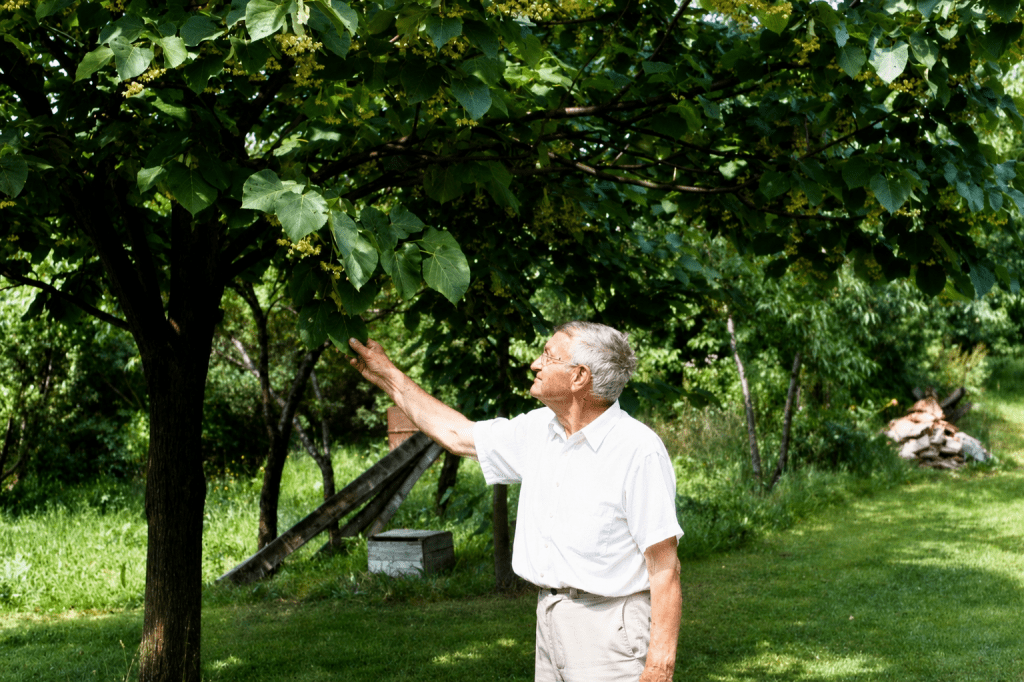
Chief Lee Crowchild of Tsuut’ina Nation is a member of a family designated as the Keepers of the Bees. He tells us of childhood summers spent sleeping in a tent that carried the symbol of the bee. But it was not until later in life that he tasted honey from a hive behind his house when he realized how deeply bees were embedded in his life. 

In this episode, we learn a bit about the culture of the Tsuut’ina people and the Chief’s honey bee apiary that helped build respect for the bees and skills, knowledge, and self-esteem for people at Tsuut’ina. You will also hear about a bee-welcoming smudge ceremony that still fills Ron with wonder.

Please subscribe, like, love, subscribe, and follow. We live or die by your adulation.

Podcast website: https://sites.libsyn.com/540327/site
About Ron Miksha: https://about-bees.org/about-ron/
Watch the podcast:  https://www.youtube.com/@ABCCPodcast

Finally: email your questions, comments, and angst:  ron@aboutbees.net

Posted in Beekeeping, Culture, or lack thereof, Friends, Outreach, People, Podcasts | Tagged , , , | Leave a comment

Podcast: Season 2 Trailer

Well, we said it couldn’t be done! We said our podcast would never make it to season two. But look at what negative thinking can do for a person’s success!

Hope you enjoyed the first 12 episodes of the About Bees, Culture, and Curiosity podcast. Season 2 continues with more great aimless rambles about bees and beekeeping. The next 12 episodes have guests talking about 300-pound honey crops, helping bumble bees find a home, controlling granulation, beekeeping at Tsuu’tina Nation with Chief Crowchild, raising queen cells on Canada’s westcoast, amazing BeeCube technology, and, of course Plato.

Please subscribe, like, love, and follow. We live or die by your adulation.

Episode website: https://sites.libsyn.com/540327/season-2-trailer
About Ron Miksha: https://about-bees.org/about-ron/
Watch the podcast:  https://www.youtube.com/@ABCCPodcast

Finally: email your questions, comments, and angst:  ron@aboutbees.net

Posted in Beekeeping, Podcasts | Tagged , , | 1 Comment