
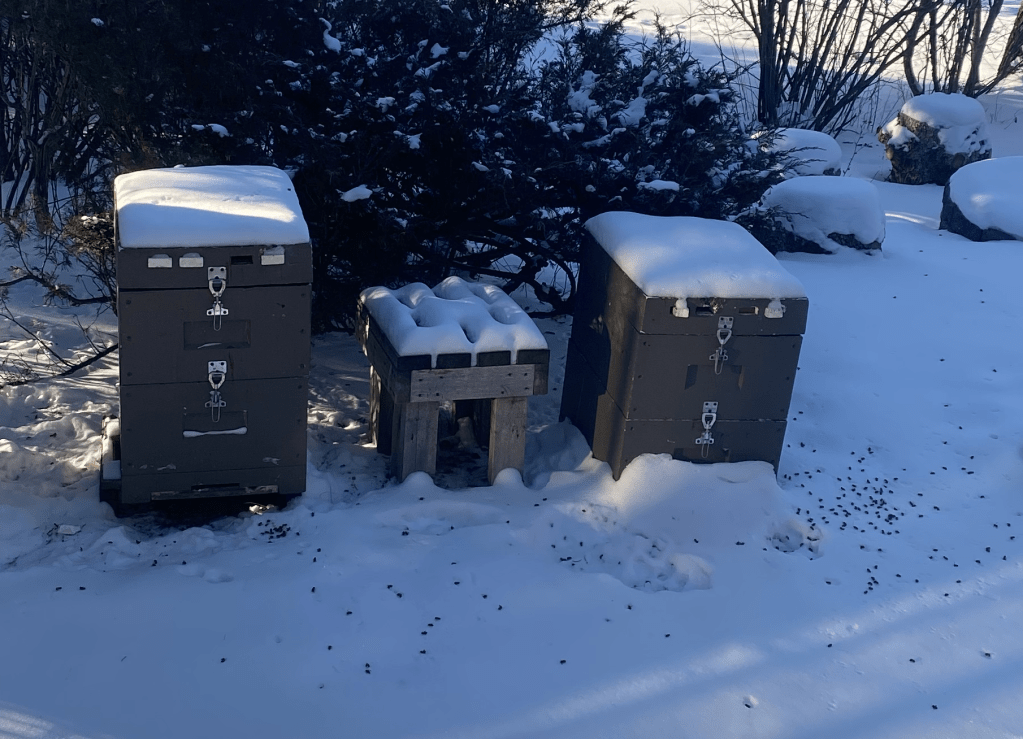
Lots of worrying going on this week, especially after the heavy snow that fell across much of North America. New beekeepers (and some of us old ones) worry when we see ‘lots’ of bees in the snow during winter. The black dots (above) are frozen stiffs – bees that left their hive and didn’t make it back, or maybe bees that died inside and were carried out by undertaker bees. To me, this is a really sad sight, but not a disturbing one.
If we assume that northern hemisphere honey bee colonies drop their populations from 30,000 bees in late October to 15,000 in late February, that’s over one hundred dead bees every day. We’d much rather see them outside the hive than piled up on the bottom board. One might argue that the dead bees in front of the hive might have lived all winter. Perhaps they were otherwise healthy bees looking for winter flowers. That’s possible. It’s also possible that these were weakly bees taking cleansing flights (honey bees will not defecate inside their hive unless the entire colony is weak and dying). The poor insects were not strong enough to make it home after visiting the bushes.
Regardless the cause, a few dozen bees in the snow does not generally mean trouble for the wintering colony. More worrisome is a prolonged cold spell. When it’s especially cold, the bees don’t even try to fly out to exercise their monthly constitution. That’s when we should worry.

 Bad Beekeeping Blog
If you watch returning bees on a sunny winter day, you’ll see that they fly normally at higher altitudes, but as they reduce elevation on approach the hive entrance, if there is bright sunshine on the snow in front of the hive, they will flip over in flight and dive bomb straight into the snow. Not everyone agrees, but to me it seems clear that their sense of “up” is linked to whatever part of their surroundings is brightest — and on a clear winter day, the dark blue sky above can’t compete with the blinding white snow below.
LikeLiked by 1 person
That’s an interesting observation. Honey bees, of course, orient by a few sensory inputs. Polarization of light might be the most important. I don’t know how reflection off snow affects polarized sunlight, but you probably have a good point! Thanks for sharing this idea.
LikeLike