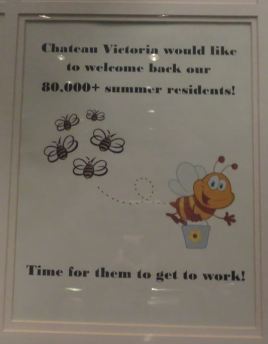
“The bees are coming!” said the hotel.

If you have been a beekeeper for a long time, you will remember the days when you had to hide your nasty habits (and your nasty bees) from the public. Bees were once very uncool. The Africanized bees terrorized America. One wasp at a picnic was a swarm of angry honey bees in the eyes of ordinary concerned citizens. But times have changed. (Except at the White House lawn – see the story just below.) Last month, I spent a weekend on Vancouver Island, partly a business trip, partly a family holiday. Our hotel – the Chateau Victoria – was fine, reasonably underpriced, and close to the work I needed to do. It is an 18-story building in the Inner Harbour area and it has a restaurant and resident hives of bees. I didn’t see the bees, but I saw a sign about them. It was posted in one of the elevators and I reproduced it for you here.

In the recent past, a hotel would not announce the arrival of bees. It might not even admit that bees sometimes visit flowers on the property. But these days, the executive chef serves locally produced honey (very locally produced – the bees are kept at the hotel) and guests are invited to celebrate the arrival of the buzzers. And to buy hotel honey.

This is progress. Another piece of progress worth celebrating is a fantastic garden a few minutes’ drive north of downtown Victoria. Butchart Garden’s beautiful spring flowers – lots of hyacinths, tulips, azaleas, daffodils – were a delight. But I was intrigued with the history of Butchart Gardens. One hundred years ago, the Butcharts made a fortune by digging a huge hole in their backyard. They excavated limestone, set up furnaces, and produced cement. When mixed with beach sand and stream gravel, the family’s cement made the concrete that built Victoria. Mrs Butchart found the dig rather unsightly. The family had lots of money and a nice mansion, but Mrs Butchart was surely the first person to have said, “Not in my backyard” when the limestone quarry started.

NIMBY (Not-in-my-back-yard) is a common enough expression these days when citizens try to keep drug rehab centres and recycling stations out of their neighbourhoods – while admitting this are good and necessary things that should be built in some other neighbourhood. Mrs Butchart of the Gardens was stuck with her ugly stone pit so she went about decorating it. She turned the quarry into a ‘Sunken Gardens’ and hired a native of Japan to design the nearby Japanese Gardens. An Italian landscaper built the Italian Gardens while elsewhere on the property someone named Rose planted a rose garden. That was a century ago. Today, people pay thirty dollars or so to stroll around the grounds for a day. It has become the iconic Canadian gardens and it proves that abandoned stone quarries can become things of beauty. As Mrs Butchart might have said, “If someone hands you a hole in the ground, plant a garden.” Of course, it helps if that hole in the ground made you a millionaire.

sunkengardens

Butchart Garden’s Sunken Gardens – the old limestone quarry
Posted in Beekeeping, Strange, Odd Stuff | Tagged , , | 2 Comments

Bees are Good.

This is one of the best things I’ve seen on the news in a long time. The American president is on the lawn on a beautiful spring afternoon. He’s reading Where the Wild Stings Are to a hundred kids who are distracted by . . . a BEE. Goodness. From the screaming, you’d think Obama was presenting medical insurance to Congress. Then the president says the three coolest words of his six years in the White House. “Bees are good.”

I’d like to say that the kids settled down upon hearing the soothing tone and wise words of their president. But, as I suggested earlier, this was a Congressionalish crowd of children. One screamed out, “I’m scared.” Certainly, the child was scared. Where does that come from? Perhaps a parent who has trained the child to fear things that could be beneficial. But, as the American president said, “Bees are good.” On this, hopefully we can all agree with him.

Posted in Humour, Stings | Tagged , | 2 Comments

What’s wrong with this picture?

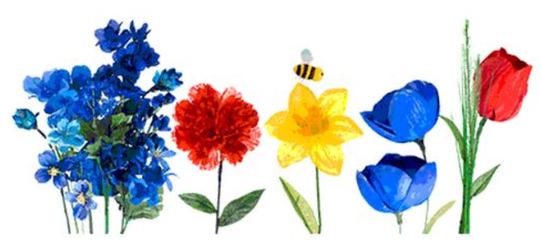
To celebrate spring, Google’s Doodle uses an artsy little bumblebee disturbing some pretty flowers. As a beekeeper I am always happy to see bee thingies, but I wish that such artists would consider a wee dab of natural science in their creations. It is a common myth that bees like garden flowers. Usually they do not.
Although bees and flowers partnered up about 100 million years ago, not every flower is enticing to every bee. Among the 20,000 bee species, there are specialized bees (long-tongued bees, early-morning bees, etc.) filing ecological niches matched by specialized flowers (deeply recessed nectaries, early-morning bloomers, etc.). The flowers that are the most attractive to bees seldom match the flowers selected by human eyes to beautify parks and gardens.

I am not a botanist, but it seems to me that the bumblebee in the Google Doodle would have little interest in the flowers shown. The most identifiable, the tulip farthest on the right, is certainly a spring flower, but I have rarely seen any bee on a tulip – unless she is tired, lost, or confused. In the Google image, the tulip is red (as is a flower near the center, which appears to be a carnation). Bee vision is spectrum-shifted. Red (to us) appears black to a bee and is not attractive at all, while the colour we perceive as boring white is often a very attractive ultra-violet in the bee’s mind.

Nevertheless, I know it is all the rage to “Save the Bees” (even though they are not disappearing) and it is a fine gesture on the part of the Google Doodlers to show the flowers and the bee. Even if their science is a bit amiss.

Posted in Ecology, Honey Plants | Tagged , | Leave a comment

You, me, the bee, and the wind

Saturday was Windsday here. The forecast claimed we would see record high temperatures and some wind. They were almost right with the temps – it was close to a record and continued the trend of the past two months: warm and dry. T-shirt weather, in the winter, in Canada. But the weather folks were a bit subtle when they told us to expect some wind. It was the wind that legends are made of.


What happens to bees on a windy day? Even though it was quite mild and honey bees would normally enjoy a bit of exercise, windy-day bees stay home, eat honey, and play cards. Or they become argumentative grumps like the rest of us. Beekeepers know that bees are aggressive on windy days. This weekend, it would have been impossible to work bees anyway. The smoker couldn’t be tamed and lids and frames would be airlifted to other apiaries. But it is windy-day aggression that intrigues me at the moment.

Decades ago, scientists noted that flat, expansive, windy places have sadder people. Statistically, North Dakota leads the nation in both depression and dusty wind. Abroad, Hungary has long been studied as Europe’s nation with the highest rate of suicide and depression. (Hungary is a land-locked, mostly flat country with a huge windy prairie.) Is there a link between the wind and depression statistics, or are these just coincidental? The Swiss Meteorological Institute believed the link and looked into health problems appearing during spells when the Foehn Winds blew down from the Alps. The people at the institute attributed stress, anxiety, depression, exhaustion, fatigue, dizziness, and body aches to the winds, resulting in increased rates of suicide and highway accidents. It seems winds can sometimes bring misery and chaos. But why?

Why does the wind make us sad and make our honey bees aggressive? Some research points to the tendency for dry dusty places to have more particulate ionization during windy weather. The friction of moving air with and against dust ionizes the particles. An excess of positive ions occurs in some windy conditions and it seems that the positive ions are not a very positive thing when it comes to human moods. Possibly related are the effects of living near wind turbines, which may stir the air and further ionize it. Complaints have been coming from people living near large wind farms (you can read a CBC news story here) with people citing depression, elevated blood pressure, and mood swings – although it may simply be the result of the noise and the unsightly turbine views.

Medically, the increased positive ions around our heads may be enough to disrupt neural activity. Even at a very minor level, such disruption could make it harder to concentrate, think, and even motivate movement. The brain may compensate for the stress by working harder, bringing on headaches, fatigue, and sleeplessness. All this may sound like pseudo science (and maybe it is), but there probably is some general malady at play. Obviously, not everyone responds the same and the grumpiness is not universal. Personally, I am not prone to depression, but when I farmed in southern Saskatchewan, my motivation and energy were invariably sapped on windy days.

How about the bees? People and insects don’t always respond the same way to similar external pressures, of course. It’s not usually safe to extend our attitudes and motivations to our bees – that’s a tendency called anthropomorphism and it leads to comments like, “Hey, look at that bee on the clover – do you see that? She’s smiling!” It may be true that ionic particulates make bees aggressive, but it may be a stretch to believe their lips are sweetly curled on nice days. However, it is pretty good advice to avoid working bees on days when it is so windy that both the smoker and the smoke become airborne.

Posted in Climate, Science | Tagged | 2 Comments

Knowing Nothing

He might teach you something.

When I wrote my book Bad Beekeeping, the title came to me as a response to meeting a pompous, self-absorbed beekeeper. You know the sort – the person with a year or two experience who has an undeservedly inflated ego. Such a fellow is likely to write a book about his idea of brilliant beekeeping. But if he persists at keeping bees, he may eventually discover that he doesn’t really know very much. My favourite beekeeping adage is “Beekeeping is an activity where you start out knowing everything and as the years pass, you figure out you know less and less. Eventually, you realize that you don’t know anything at all.” The next time you meet a beekeeper who confidently has all the answers, remind yourself of that adage. Then slowly back away from that expert’s fountain of wisdom.

If you would like to avoid the pitfalls of knowing everything, there are two things that might fix you. (1) You can keep blundering along with an attitude of smarty-pants-ness and after enough years, your confidence will break and you will become a better beekeeper. Or (2) you can seek out a local beekeeper who seems to have a humble demeanor and years of experience. Marry him/her. If that’s not to your liking, see if you can be adopted. Whatever it takes, stick around like granulated honey. Offer to carry a hive tool. Smoke her bees. There is really no better or faster way to learn to be a beekeeper. Our local bee club has a mentor program. Perhaps yours does, too. You can hook up with someone who needs help and offers training. Good luck with your education. May you one day discover that you know nothing. And that’s not such a bad thing. It keeps beekeeping interesting.

Posted in Beekeeping, Humour | Tagged | Leave a comment

Airport Honey

Looking for a noisy place to keep some bees? Urban beekeepers struggle to find spots to set landing boards for their hives. Most towns and cities have limits on the number of hives that can be kept in the backyard. Three? OK. Thirty? Probably not. But there are a few areas tucked within some city boundaries where as many as 75 colonies are comfortably kept. Big city airports.

I had not thought of this before, but apparently the idea has been around for at least 15 years. Airports want to be noticed as the eco-friendly green patches that they think they are, so inviting bees on the property gets some positive attention. Sometimes the honey is sold at the airports’ gift shops, boosting the airports’ meagre profits.

Bee hives next to busy airports has probably been happening ever since the Kitty Hawk Apiaries were established in December 1903, but according to a New York Times article, the modern trend dates back to Hamburg, Germany, in 1999. At least a dozen other airports in Europe have also welcomed beekeepers. America’s O’Hare has 75 hives, making it both the busiest and the buzziest airport on the continent. Prominently featured in the NY Times is Montreal’s Mirabel which has 6,000 beckoning acres. The airport authorities reached out to Montreal’s Miel Montreal, a honey makers’ cooperative. The group responded with the five hives of bees now kept at the airport.

You might wonder how the bees feel about their new location. It’s almost certainly a good thing. The hives are kept out of sight, somewhere on the back 6,000. They aren’t going to bother anyone – no one ever wanders around on a commercial airfield and any pilot who runs into the hives has bigger problems to think about than the hives he just hit. The fields at most airports are not farmed so pesticides are not likely an issue. What about the noise? The bees won’t complain – they don’t have ears.

Posted in Bee Yards, Beekeeping | Tagged | Leave a comment

Thermo-Zapper-Gun

My 12-year-old ordered a laser gun from Amazon. Apparently it could burn your eyes out, but we are hoping not to test that. It’s a thermometer. The laser part is just a pointer, the laser actually has nothing to do with gauging heat or cold. It just helps you know you are pointing the gun at the right thing. We’ve tested it on snow (-2C), boiling water (94C here along the Rockies), armpits (34C). It seems accurate and it’s certainly easy to use. It’s not a toy. Maybe you know all about it already – I heard it’s available at Costco. (I wouldn’t know about that because I was expelled from their campus the day I cleaned out their week’s sugar supply.) This gun cost my boy less than $20, delivery included, from Amazon.ca

I can see a lot of beekeeping applications for the thermal gun. It could be a quick way of checking the temperature of honey tanks and wax melters. When people ask me about heating honey before straining it, I’d always say, “make it hot, but not too hot.” 140 Fahrenheit (60 C) is good, then strain the honey and cool it as quickly as you can. (Containers into cold water usually does the trick.) But lacking a thermometer, I’d suggest making the tank so hot you could just barely keep your hand on it – and not any hotter than that. But then I found out my palms are pretty thick and can take more heat than those of some other folks. The thermo-gun removes ambiguity. If you make a freezer to store your comb honey, you can check all the corners to see that the temp is consistent and heat is not leaking in anywhere. I am also thinking that you might use it to check your hives mid-winter. Shining the red laser beam into a hive’s top entrance should result in a temperature warmer than ambient air. You might have to do a number of hives to see if any are anomalously cold (which might be dead) or warm (the bees might already be up in the top chamber and may soon be hungry). I won’t collect a commission on this device, but you might make use of it, so here are links to (Canada) Amazon.ca and (USA) Amazon.com. If you think of some other uses, let me know.

Posted in Tools and Gadgets | Tagged | 1 Comment

Honey on tap?

In the past, I’ve written rather cynically about the various kickstarter projects aimed at people who care about bees. Entrepreneurs have been sucking up cash to “Save the Bees” and to sponsor new beehive designs for quite a few years. Here’s another. I won’t go all cynical on you yet – I’ll give these people a chance to prove themselves first. Watch their video. If for nothing else, for the inspiring music, the resurrected 1960s hippies, and the three-year-old girl dipping her finger into the honey. The video is expertly (and I guess, expensively) designed to tug at your heart and your purse. But there is a fundamental flaw in the whole scheme.

If it works at all, the honey flow beehive (www.honeyflow.com) deems to separate us yet another step away from our food supply. Rather than becoming intimate with the makers of our honey, we conceal them in a magic box – the ultimate in “Black-box Technology.” No need to get your hands dirty, to become aware of the harm – or good – you may be doing to the hive of bees as their honey is being “tapped”. (In the southern USA, where I lived for ten years, it was called “robbing the bees” which helps the beekeeper remember what his role really is during harvest.) Don’t misunderstand me – I produced over a million pounds of honey from my bees, wrestling with my little colleagues for each ounce. I care about bees, I love honey, I know how to produce it, and I have done the battle. But it was hands-on. If a hive was short of honey and didn’t have what it needed for winter, I gave the colony honey. Getting your hands dirty while harvesting gives you a chance to be sure you are not hurting the bees and over-harvesting. It helps you appreciate what the bees did for you more than turning a tap ever will. This honeyflow hive allows us to be much more casual about the process. Perhaps it would be like leading a calf into a box, pushing a lever, and watching hamburgers and hotdogs drop out the other side. OK, that was a bit cynical – I think it was the soundtrack of the video that got to me. Also Sprach Zarathustra would have been more subtle. But if you’d like to support them, “Like our Facebook page, join our mailing list, and stay in the loop,” says hive maker Cedar Anderson.

Posted in Strange, Odd Stuff, Tools and Gadgets | Tagged , | 1 Comment

The Ultimate Valentine

Honey hearts.

I know, beekeepers usually are not sentimental. For most of us, Saint Valentine was some mythical character built upon Lupercalia, an occasion observed by the Romans for three days (February 13–15) each year, and intimately connected to fertility. Like many Roman customs Lupercalia was borrowed by a start-up church in Rome almost 2,000 years ago. They used the holiday to remember a sainted martyr named Valentino who would grow a new heart every night and give his old heart to anyone who was sick, feeble, or heartless. Or maybe those were chocolate hearts for some favourite pigsneys. Anyway, that’s about all most beekeepers know about Valentine’s Day. But at least one beekeeper – someone whom I shall probably never meet – employed enormous energy and talent to make the really cool heart-shaped comb in today’s picture. I ran across it on a Polish language bee-talk forum where members were showing various comb-honey gadgets. I couldn’t understand very much of what I read on that site, but the pictures are great. (I have grandparents from Slavic countries and I studied Russian at university, but the Polish language is many degrees above my abilities.) If you have seen these heart-combs before or know the person who makes them, please drop me a note so I can credit the appropriate craftsman. Until then, maybe you can make a few of these yourself. You know, just before taking your special honey out to dinner.

Posted in Comb Honey, History, Hives and Combs | Tagged | Leave a comment

Journeys in Books

A reader of this blog asked if I would add his two books to the ones you see floating around the left edge of this page. I like beekeeping books and own several. Several hundred. A few are ancient classics, written and printed over three hundred years ago. My copy of Bee Treatise (1593) by Thomas Hill predates Shakespeare. Except for edges singed during the Great London Fire, it is in pretty good shape and makes entertaining reading. Sort of like a Shakespearean beekeeping manual. Some 15 generations of beekeepers have held this book.
My Hungarian in-laws have given me a number of central European classics: one is Méhész Naptár (1856), a prized beekeeping manual in my collection. It was printed on the exact same printing press that inked the 1848 declaration of Hungarian independence from Austria. (That revolution failed and its leaders were executed.) Among my other foreign language books is a first edition volume of Nouvelles Observations sur les Abeiles (1792) written by the blind beekeeper Francois Huber, the fellow who figured out how queen bees mate. It is a brilliant and practical book. (Huber describes an observation ‘leaf-hive’ with frames that flip like pages of a book – a precursor of Langstroth’s moveable frame hive.) For easy reading, an account of Huber’s story is told by Sara George in The Beekeeper’s Pupil (2002), a romantic novel based on the lives of Huber, his wife, and his beekeeping assistant. By the way, that paperback novel was a bit cheaper than the gilded Huber original I picked from a bin of old books on a trip long ago.

I like these unique and vintage bee books, but most of my beekeeping volumes are modern. They resemble text books and have titles like The Bee Craftsman, The Art of Beekeeping, and The Behaviour and Social Life of Honeybees. There are also dozens of specialized books on things like raising queens, producing comb honey, and diagnosing diseases of honeybees. These are all good instructive volumes, but my favourite beekeeping books are the ones that tell stories about beekeepers. That’s part of the reason that I wrote Bad Beekeeping back in 2004. I like stories about the failures and successes of beekeeping, especially when told from a personal perspective. Bad Beekeeping, released eight years ago, tells the story of my younger days as a commercial beekeeper and it (as I have been told) has become something of a minor classic in the bee literature. I am grateful for that, but I have encountered a number of much better books that tell better yarns about beekeeping of yore.

My favourite personal-account beekeeping book is Fifty Years among the Bees (1911) by C.C. Miller. That book is a true classic. Like me, Miller was from western Pennsylvania and headed west to become a commercial beekeeper. That’s pretty much where the similarities end. CC, as most people called Dr Miller, was brilliant – arguably the best beekeeper of his generation. He lived during the “Golden Age of Beekeeping” – an era about a hundred years ago when good beekeepers managed 300 hives, produced 50,000 comb sections a year, and made a comfortable living of it. CC originally trained as a physician. He gave that up because he was in constant fear of making a mistake that might kill someone. He kept bees instead. Fifty Years is a fantastic story, a very personal tale of how one can live a good life as a beekeeper. If you can’t find a decent hard-cover edition (Years ago, my father gave me his copy.), you can download it online as a PDF here at Archive.org. The book was published over a hundred years ago, the copyright has expired, and over a thousand people have likewise downloaded Dr Miller’s informative and amusing story.

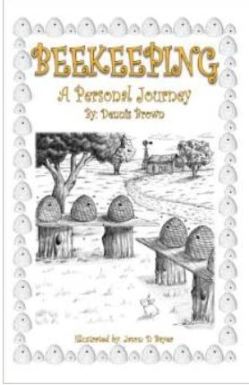
The reader of this blog who asked if I would link his work is Dennis Brown. He runs a website at Lone Star Farms and he offers two books: a question and answer collection and a personal journey tale. I can’t say if Mr Brown’s book, Beekeeping: A Personal Journey, is as good as Dr CC Miller’s Fifty Years, but the title is promising. And if you follow the link to Amazon, you can “Look Inside” and read a few sample pages. I did and I decided to order a copy of the Personal Journey so I can read the rest of the story. I hope I find it interesting. Sometimes the most useful lessons are taught by people who have made a few mistakes and then shared their experiences. It’s certainly less painful than creating one’s own stupid follies and then trying to recover from them.

Posted in Books, History | Tagged , , | Leave a comment