
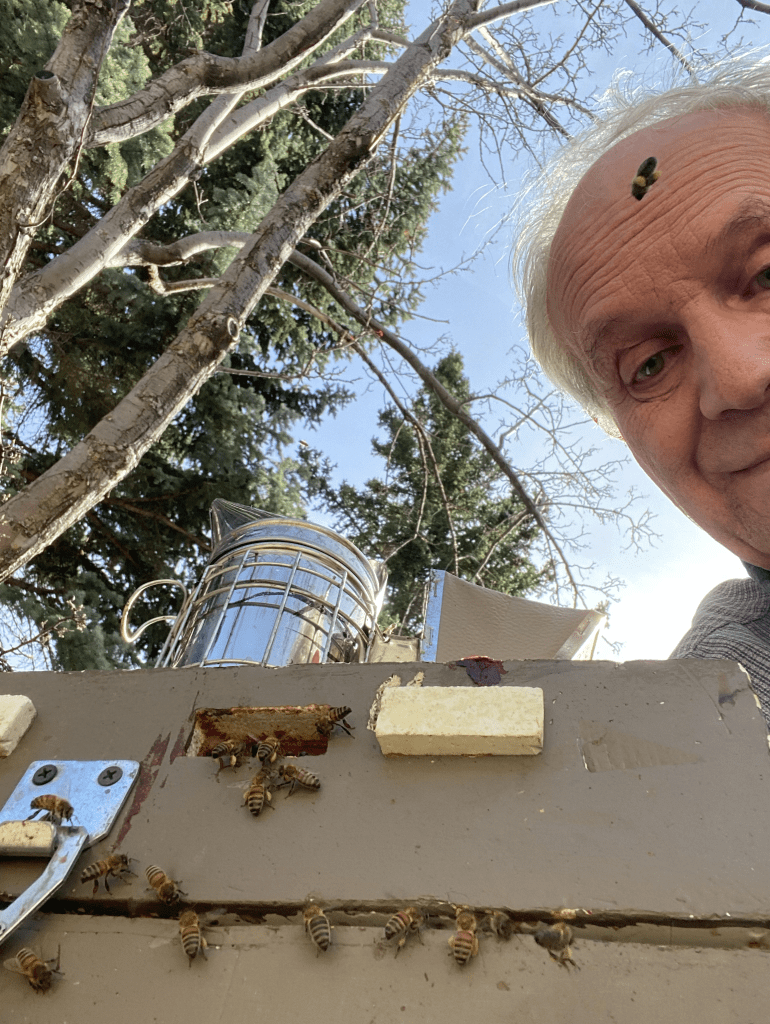
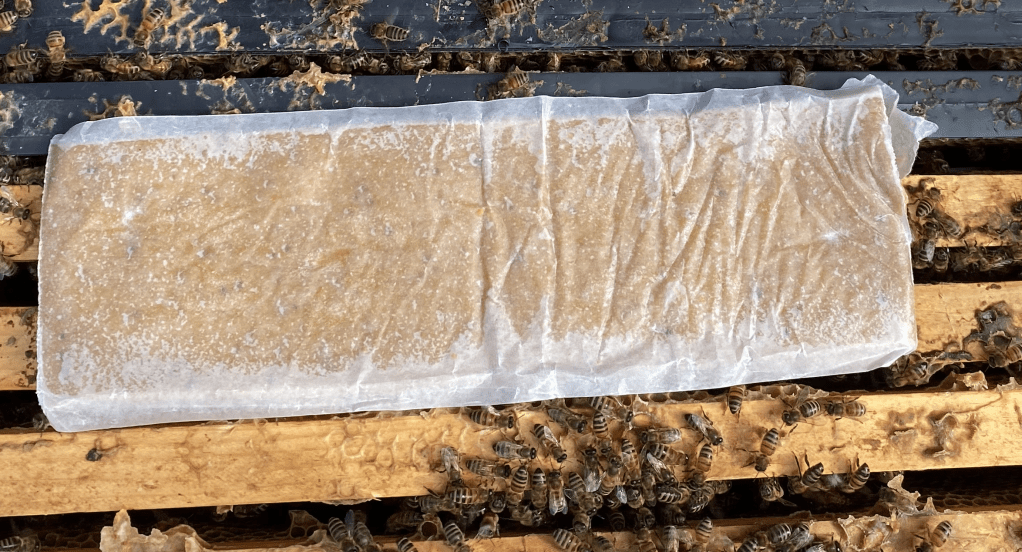
April 7. Our backyard hives are collecting real pollen! Last week, I showed you some fake pollen coming into the colonies. Nothing beats the real stuff. Although desperate honey bees will carry worthless sawdust as a pollen supplement, nothing inspires a colony like a bit of natural pollen and nectar.
My honey bees and I are a long way north, high in elevation, and affected by vagaries of our continental climate. We are in Calgary, a thousand metres above sea level with some rocky mountains in sight along our western horizon. Our semi-prairies, semi-foothills location invites wide fluctuations in weather. For instance, in the past week we’ve been as cool as minus 11C and as warm as plus 21C. (12F to 70F).
The colonies average 6 frames at least 3/4 brooded, which means populations should be up 25,000 more workers in the next three weeks. And there are a lot of fuzzies – I would guess that more bees are already emerging than are dying of old age. This is a critical time for this change-over in bee demographics, with new replacing old. Beekeepers often lose wintered colonies at this time of year when cool wet weather keeps bees from foraging, reduces food resources, and induces nosema. If they get through this, the honey bees will probably be fine.
To help them, I make sure they have enough honey in reserve. Syrupy sweets can push them to expand their brood nest. I also give them all the pollen cakes they’ll take. That’s about two pounds every week. If you choose to pollen-supplement your bees, don’t stop until the weather is stable and the bees are collecting enough natural pollen. When there is a consistent, reliable abundance of natural forage, honey bees will quit eating your supplement. But if you stop feeding the bees too soon, they will likely not be able to feed their developing larvae, which will die. Although honey bees are usually vegetarians, they have been caught eating their own young when food is scarce.
Another reason to feed pollen supplement is that honey bees strip an awful lot of pollen from their neighbourhood’s flowers, potentially leaving less for other bee species. In the spring, when flowers are scarce and foraging days few, your nests of honey bees will need about 200 grams of pollen each day to feed the developing brood. That’s four pounds every ten days. Maybe more. If you feed a high-quality supplement, you do the local wild (non-Apis) bees a small favour because your honey bees don’t need to collect as much from flowers, leaving more for the natives.

 Bad Beekeeping Blog
Funny how some beekeepers choose breeds of bees based on the fact they can shut down brood rearing and conserve resources during dearth and poor weather, but they just put patties and syrup on all year. Don’t honeybees also strip all the nectar leaving less for other bee species? A good reason to feed syrup :0).
LikeLike
Thanks for the comments.
I don’t know of any beekeepers who “put patties and syrup on all year.” Never heard of anyone doing that, though a few queen producers may, though I never met any who did during all my years of beekeeping/queen rearing in Florida. I’d love to hear your examples.
I feed syrup/fondants/soft candy, depending on the colony and weather conditions. This reduces my bees’ impact on the environment during times of the year when resources are thin and need to be shared with native bees. I have not seen any natives out in Calgary yet, but I expect queen bumble bees will make an appearance soon.
LikeLike
Thanks, Ron. Never thought about feeding as way to preserve resources for other species. The ladies are non-native, after all, so makes sense. I do not feed pollen due to laziness and small hive beetles. The SHB like to lay eggs underneath the patties where the bees can’t reach so you have to be careful and monitor accordingly. Native bees tend to forage in cooler temperatures as well, so hopefully they get to the resources first. Just justifying my behavior, of course, its an interesting thought.
LikeLiked by 1 person
I never considered small hive beetles, as we don’t have them this far north. So, that’s certainly something to consider. Also in our area, we see some species of native bees foraging all day long, so there will be some competition, especially in the spring when feed sources are scarce. By the way, we’ve been hit by more sub-freezing temperatures and there is quite a bit of snow on the ground, so no flowers today!
LikeLiked by 1 person
Dear Ron
A two-part reply…
1. I have used patties more and more in recent years. I’m based over in the United Kingdom, in the county of Wiltshire. It’d good bee keeping land with a huge 100,000 acre Salisbury Plain in the middle which is used by the Military.(sadly I don’t have access to keep bees on it …yet!) I have used pre-mixed patties, ultrabee seems to be particularly well liked. I also have some own brand makes to try, and also use CandiPollene which I think is made by EnoLapi of Italy.
I tend to use them in the Spring but a beefarmer friend of mine feeds pollen subs in mass feeding open bins in the spring and also feeds between flows (syrup)
I keep around 100 colonies as an average. I’m considering expanding the operation as I love beekeeping having kept them for over 30 years since I was a young lad. However with some current mental health issues brought on by my main work environment and access issues with my children, I find I am turning more and more to the bees to zone out from the world.
In the past I’ve been both Chairman of our local beekeeping association and our larger umbrella County organisation, Wiltshire Beekeepers. I’ve learned that, sadly, the differing views and very forthright opinions from generally ‘old in the tooth’ individuals doesn’t make for very harmonious meetings. It makes me laugh really when many have between 1 and 3 hives, and some have none having managed to kill them off. Again.
We constantly battle here with varroa. Although I have to say this Spring, my colonies are the heathiest I’ve seen them for a while, having treated with Amitraz and an older Fluvalinate. I’m not an advocate of ‘leave alone’ beekeeping. As a beefarmer I have an exemption for checks as I have completed the Disease Assurance Scheme (DASH) which involves a two day in depth training at our National Bee Unit at Sand Hutton in York. It does empower me to make decisions especially around European Foulbrood (inform) but we still destroy AFB. Luckily (touch wood/lucky charm) I have not had either in my apiaries yet, although both are in the vicinity.
Your Book – Bad Beekeeping. There’s a story here…I went to a local beekeeping auction in Taunton before Easter and I successfully bid for two trays of beekeeping books. Quite an eclectic collection and apart from one, all new to my own library. Amongst them was your book which according to the inscription had been given as a present to ‘Dad from Theresa in 2008’. While reading it over the past two weeks, I realised it was written as a memoir about your early experiences in beefarming and it ended mid-1980s. I did wonder ‘is Ron still around’ or is he keeping bees somewhere with the choir invisible ? At the end of the book was the link to your old website and then to here. Phew. He’s still here he posted a blog entry 3 days ago…!
I enjoyed your memoir. It harks of a freedom and a life just doing your thing that I wonder if is lost in this day and age. While beekeeping myself during lockdown, I did feel I was the only human left as I went out to check on my bees back in 2020 when lockdown was enforced. No cars, no plane trails, no noise. It was a bit surreal, but my bees kept me sane in my recovery from a very bad case of Covid early 2020, and helped balance the stress of work at the time. Now I find I’m returning to them again to do the same thing. Maybe there’s a moral here ?
Anyway, I also have a blog of sorts. On the UK beekeepingforum.co.uk I write under the moniker Somerford if you’re ever passing. It’s a very big forum now.
Well, Best wishes and I’ll subscribe to this for sure.
KR
Stephen
White Horse Honey (@whitehorsehoney on instagram)
LikeLike