
Long ago (about 1975), there was an amazing beekeeper, now a legend, in northeast Saskatchewan. He consistently had 300-pound/hive crops. This was Dr. Don Peer (PhD, 1955, U Wisconsin). Peer once told us “If I were king of the world, I’d make a law that every beekeeper had to own one more super for each hive of bees“.
This photo, taken in Wisconsin by my brother David, shows the extreme production from well-managed colonies. Unfortunately, the picture shows neither Dr Peer, who did much to promote expert beekeeping in Wisconsin, nor my brother. Maybe another day for that.
The point, of course, should be lost on no one – it takes supers to make big honey crops.
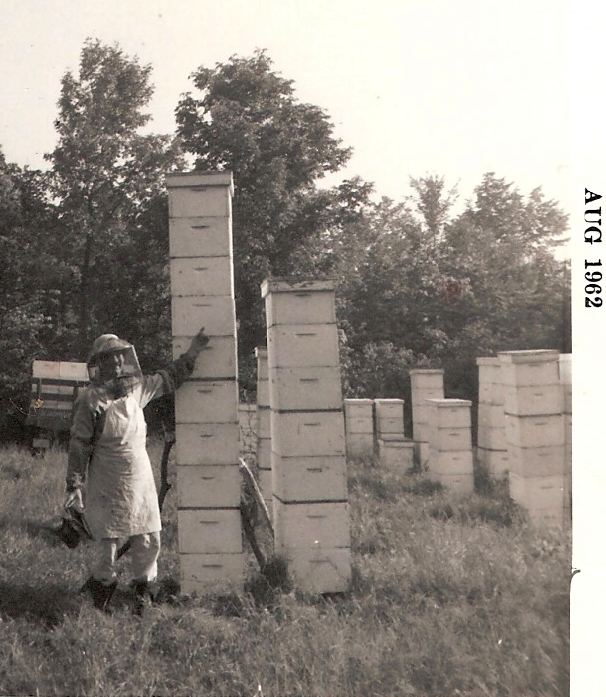

Don Peer kept about 1000 colonies in a remarkable honey domain. Bees could collect 30 pounds of cured honey in a single day. That required a lot of open comb space to deposit the nectar that was being reduced. Peer quit using 2-queen colonies after a few years because it was impossible to stack the supers high enough. His crew tried parking flatbed trucks close to the colonies so lids could be pried off and heavy honey boxes replaced with empties. Handling monstrous 2-queeners wasn’t efficient, so it was back to single-queen colonies.
But the key message – lots of supers on the hive – remains the same. We all do that out here on the Canadian prairies. Most years are an embarrassment of riches.
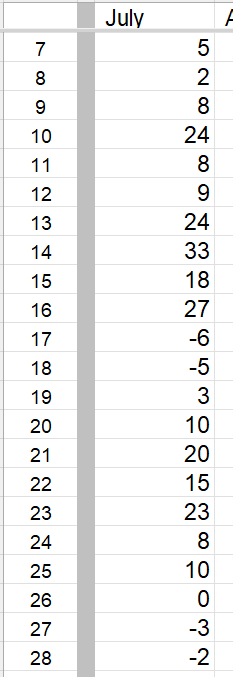
This table shows records from my western Canadian scale-hive. A lot of honey can be stored in just a few days. For this example, from July 10 (24 pounds net gain) to July 16 (27 pounds net gain) the hive averaged 20 pounds/day. It takes about a super to hold the nectar that becomes 20 pounds of honey each day.
Knowing that it takes many supers to make honey, I was stunned to learn that China and southeast Asia produce over a billion pounds of honey each year without using supers. Everything is operated in single-storey colonies. At harvest time, a single box serves as brood chamber and honey box. The result is a mess. The bees are shaken from all the combs (even the ones with brood) and then reinserted into the singles. This video shows a typical beekeeping set up. Around the three-minute mark, you can see that the entire brood nest is extracted, including frames with brood. :-(
Here in Canada, we caution hobby beekeepers to never extract brood frames. Spinning in an extractor can’t be good for brood. And, during the flow, a lot of the stuff flying out of the combs is raw nectar, which can easily lead to fermentation if it isn’t dried out. These days, the accumulation of hive chemicals that are applied in brood chambers increases contamination risk when brood combs are spun. So, please don’t extract brood frames.
Keeping bees in singles and removing honey comb-by-comb may have a role in some systems. In the 1940s, my father spent a year working for Al Winn in Petaluma, California. Winn was mostly a queen breeder, but during pollination gigs and off-season (when the bees were taken to the mountains), the singles would sometimes fill up. This restricted the expansion of brood and made colonies heavy to haul around. The solution was to remove frames 1, 2, 9, and 10 (the edge frames), extract them, split the tight brood nest between frames 5 and 6, then insert four empty combs in the centre of the nest. Al Winn and crew avoided extracting the brood. Even if a bit of nectar was encountered, the California climate was hot and dry. Wet honey (nectar) wasn’t a problem. This system of opening the brood nest to make space kept hives from swarming and allowed brood expansion, resulting in good colonies for building mating nucs.
I have long wondered why Asian beekeeping continues to shake all the bees out of the single box and extract every comb, brood and all. Why not use the California system, described above, or simply use supers and stack ’em high? I think the use of single-storeys is a matter of inertia and some convenience. Colonies are frequently moved (by hand) and singles are lighter. Supers don’t have to be owned and then stored off-season. Finally, there is the Apis cerana legacy. Commercial Asian beekeepers almost exclusively use the western honey (Apis mellifera), but their grandparents used cerana. These bees build smaller nests and reside comfortably in singles. Grandpa used singles, so . . .
But things are changing. Supers have arrived in China! Here’s a fascinating video that you must watch. Why does China stick to the path of common prosperity? was produced by the Chinese government. I imagine that there is a series of these videos dedicated to agricultural modernization. With the CCP advocating supers on hives, it might be just a decade or so before China’s eight million colonies are operated using western methods. Chairman Xi is not “king of the world” (to borrow Dr. Peer’s phrase), but if Xi suggests stacking ’em high, it will likely happen.
Get some popcorn, enjoy the film, and contemplate the future.

 Bad Beekeeping Blog
Hello Ron
In Spain (and perhaps other parts of Southern Europe, but I’ve only seen them in Spain) the beekeepers often use Layens hives. These are single boxes, usually with a hinged lid, taking about 20 frames, 13 inches wide and 16 inches deep. It’s the same hive type that Leo Sharashkin promotes. I’ve always wondered about the brood during extraction. I think the idea is you harvest frames to the side of the brood nest once the brood nest starts to contract, so there are empty cells underneath the capped honey. Frames of that size must be heavy, and you would need a large tangential extractor or more patience than I’ve got to crush and strain the honey.
And don’t get me started on extracting from miticide-contaminated frames … !
Cheers
David
LikeLike
Around a decade ago Dr. Meghan Milbrath reported to our local bee club about her trip to China and their beekeeping practices. None of her talk seems to be online so we have only faulty memories upon which to rely.
While not remembering which part of China she was observing, we recall that two box systems were used for Apis mellifera (size of boxes unremembered) as well as a wall cavity or two for Apis cerana. The lower box was for the brood and bees while the upper was for whatever bee product they wanted, not always honey. They never supered above the second box, just removing it to harvest and replacing it with an empty.
The purpose of the Apis cerana colony was to track the seasons. The cerana queen would stop laying when winter approached while the mellifera queen, still on a nonlocal schedule, would carry on. When the beekeepers noted the cerana stop brood rearing they would catch each mellifera queen and put a tiny condom around her abdomen to prevent her laying. They would then remove it in spring once cerana started up again.
We also recall that farmers would come, usually on a bicycle, and buy a box of bees to take back for pollination. They did not become beekeepers and these bees were treated as disposable. Otherwise most pollination was done by hand.
The lack of free pollinators was probably due to the terrible pollution. Dr. Milbrath was particularly struck by it when she realized that she had not seen a single bird in all her stay.
There was more and it was all fascinating but this is all we remember.
LikeLike