
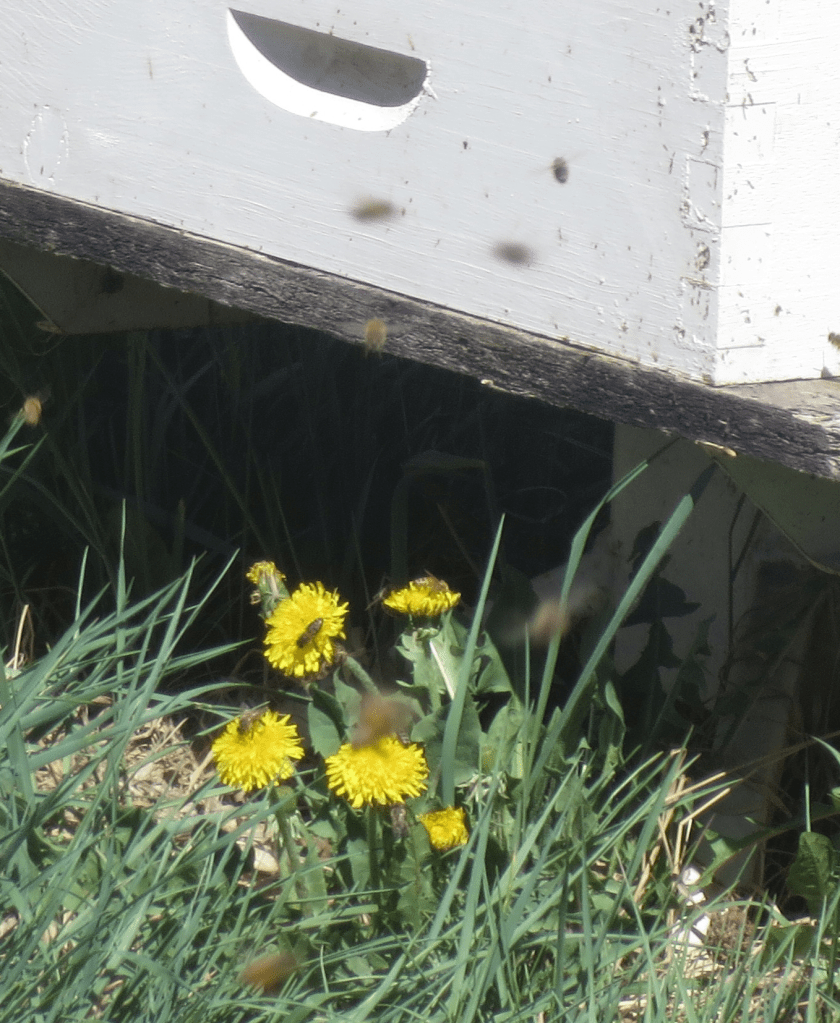
Some things I didn’t know about dandelions until today: Dandelions don’t need bees. Or any other pollinators – not even wind or gravity to move their pollen. Each dandelion flower is made up of a hundred florets, each an individual mini-flower that gives up the plant’s own tissue to create a seed. Each seed is unpollinated, a clone, identical in genetics to the original dandelion that arrived in North America centuries ago. Looking at a field of dandelions is the same as looking at a field of clones and it’s the same as looking at the same flower that our ancestors saw.
Dandelions don’t need bees at all. Most common dandelions reproduce through apomixis. They produce seeds without pollination. No pollen transfer. No fertilization. Each plant creates clones of itself. So while bees visit dandelions for nectar and pollen, they aren’t helping the plant reproduce.
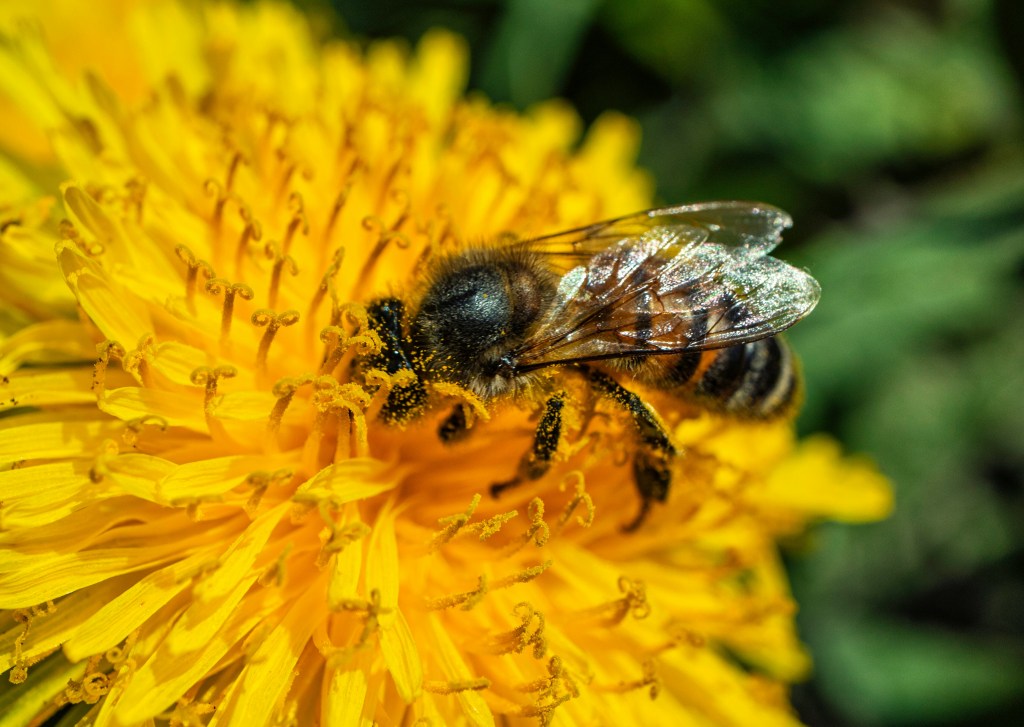
That runs against the usual story we tell about flowers and pollinators. In this case, the relationship is one-sided. The bees take what they need, and the plant carries on without them.
Dandelions show up early. In many places, they’re the first thing people notice in spring. Bright yellow, everywhere at once, and full of bees. It’s easy to assume they are the first and best food source for honey bees. They aren’t.
Before dandelions bloom, bees are already working. Alders, maples, willows, elms, and even skunk cabbage come first. These plants provide much of the early pollen that gets colonies moving again after winter. Dandelions arrive a bit later, and by then, the colony is already expanding.
Even then, dandelion pollen is not ideal food. It is abundant and easy for bees to collect, but it lacks a complete balance of essential amino acids. Bees can use it, but they do better when it’s mixed with pollen from other plants.
As a honey plant, dandelion is inconsistent. In some years and places, bees may store a modest surplus. The honey is strong, deep yellow, and granulates quickly. Most of the time, it’s not worth extracting.
But dandelion arrives at the right time. It provides nectar and pollen when colonies are building. It helps bridge the gap between early trees and later flows.
Dandelions are not invasive in the ecological sense. They are naturalized. They prefer disturbed ground like lawns, roadsides, compacted soils. They follow human activity rather than reshape ecosystems. You don’t see them taking over intact prairies or forests. You see them where people have already changed the land. That’s a twist, isn’t it? Dandelion is a species that does better because of people, not worse.
Dandelions are also useful to people. The leaves can be eaten, especially when young. The flowers can be made into wine or syrup, or sewn together to make temporary sweaters. The roots can be roasted and brewed as fake coffee. For centuries, they were carried around the world as a medicinal plant, which explains how they spread so widely.
If you’d like to hear more about this amazing yellow and green weed, listen to this episode of the About Bees, Culture, and Curiosity podcast.
I hope you enjoy this blog and the podcast episode – available everywhere you get your podcasts, and at this link.
https://podcasts.apple.com/us/podcast/dandelion-the-bee-plant-that-doesnt-need-bees/id1760959092?i=1000762147786


