Podcast: Honey Harvest Time

Season 1 Episode 9: About Bees, Culture & Curiosity Podcast – Honey Harvest Time

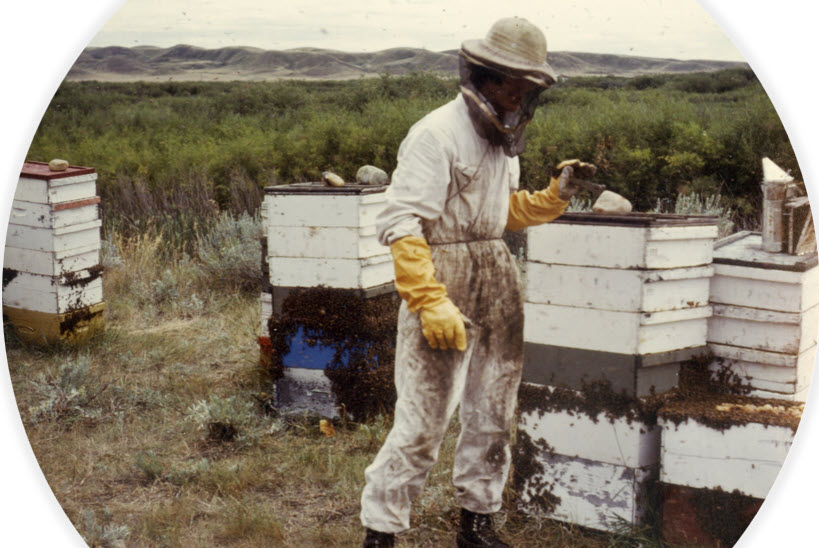
After a few minutes pondering how some carpenter ants in Florida choose the profession of surgeon (sawing off sick comrades wounded legs), Bidzina and Ron settle into a honey harvest discussion.

This episode is packed with ideas and suggestions that describe four legal ways to harvest honey and one illegal way.  Then it wraps up with talk about amazingly big crops and the three disastrous ones that helped persuade Ron to move on to a new life. It’s a wild ride, so let’s go!

Please subscribe, like, love, and follow. We live or die by your adulation.

Listen here: https://sites.libsyn.com/540327/site
About Ron Miksha: https://about-bees.org/about-ron/
Watch the podcast:  https://www.youtube.com/@ABCCPodcast

Finally: email your questions, comments, and angst:  ron@aboutbees.net

Posted in Beekeeping, Commercial Beekeeping, Hive Products, Honey, Podcasts, Tools and Gadgets | Tagged , , , , , , | 1 Comment

Podcast: Dogs that smell bees

Season 1 Episode 8: About Bees, Culture & Curiosity Podcast – Dogs That Smell Bees

We talk to Rose-Anne Bouffard, a bee enthusiast who trains dogs to find and rescue wayward bumblebee nests and to locate colonies with American Foulbrood (AFB). 

Dog breeds and their amazing scent sensitivity are discussed. Bloodhounds are best for sniffing out bumblebee nests and honeybee diseases, but that’s not what Rose uses. Humans have five million scent receptors and can smell AFB, but dogs have three hundred million receptors. Dogs also use their floppy ears to stir up scents. The bee-rescuing dogs were trained through find-reward-repeat sessions. We discuss training a tracking dog to find AFB and the huge economic value that brings.

Talking about stings, Rose finds that controlling her breath and going into a meditative state when working around bees is essential. Without the proper mindset, apparently Preparation H helps with the bee stings you will get.

The questions of bee consciousness and a bees’ ability to sense pain come up. We agree that bees probably feel pain.

Finally, there is a big shout out to Alberta Native Bee Council, the Suzuki Butterflyway Project, iNaturalist, and the urgency for action. Rose’s bee and dog projects are looking for collaborators so check out her website to learn how to get involved!

Rose’s website address for Dogs Find Bees is https://dogsfindbees.com/   Let’s go!

Please subscribe, like, love, and follow. We live or die by your adulation.

Podcast website: https://sites.libsyn.com/540327/site
About Ron Miksha: https://about-bees.org/about-ron/
Watch the podcast:  https://www.youtube.com/@ABCCPodcast

Finally: email your questions, comments, and angst:  ron@aboutbees.net

Posted in Bee Biology, Beekeeping, Commercial Beekeeping, Diseases and Pests, Friends, Podcasts | Tagged , , | Leave a comment

Podcast: A Beekeeper’s Journey – Cameroon to Calgary

Season 1 Episode 7: About Bees, Culture & Curiosity Podcast – Cameroon to Canada – Patrick’s Bee Journey

In this episode of About Bees, we are joined by Patrick Tefouet Tonlio, who was an agriculture community organizer and teacher in the African nation of Cameroon. Patrick now lives in Calgary where he keeps honey bees and has been working on farm and bee projects with the Calgary Catholic Immigration Society’s Land of Dreams (https://ccisab.ca/land-of-dreams/).
 
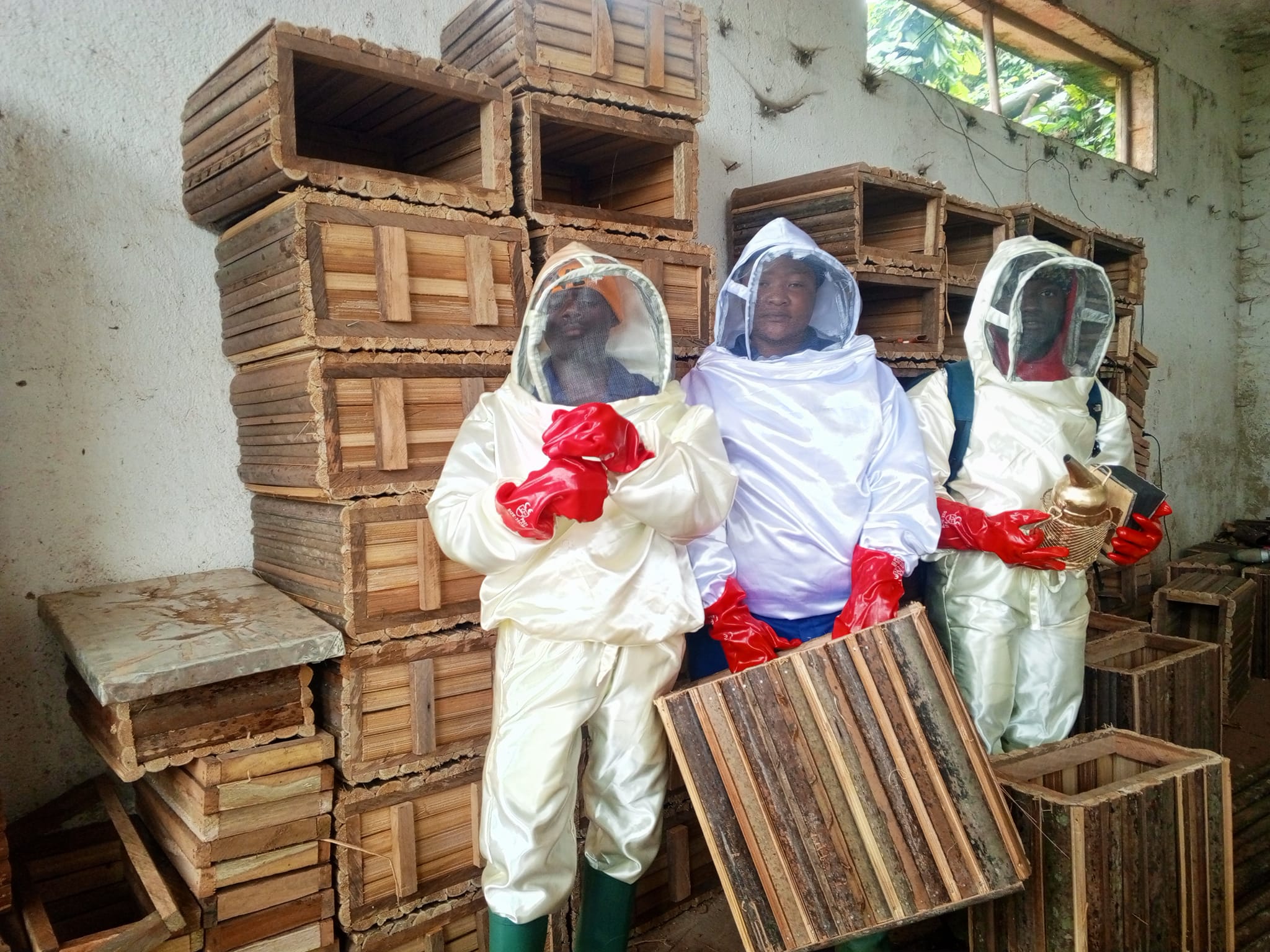
During his last year of high school, Patrick learned to work with bees from his grandfather when Patrick moved from the capital city to live in his grandfather’s village. Honey bees in Cameroon are extremely defensive, so most traditional beekeeping consists of making small bamboo hives, coating the boxes with propolis and wax as a lure, then putting the empty hives in trees about 3 metres (ten feet) above ground level. After wild bees occupy the boxes and after the nectar season, honey is harvested. 

Cameroon has commercial beekeepers, including the Fabasso family, friends of Patrick, who operate 15,000 hives. Mr. Fabasso has designed a hive, also made of bamboo, similar to Langstroth hives. The Fabasso honey crop is squeezed by a press invented by the Fabasso family. Pressing the honey yields a high-quality honey that doesn’t need to be extracted and is never heated during processing.(https://teca.apps.fao.org/en/technologies/10140/).  

Beekeepers may harvest 20 kilograms (45 pounds) of honey each year from traditional hives in Cameroon. But the ethnic group sometimes known as Pygmy people (Baka) harvest directly from wild colonies. To reduce stings, they use a special secret herb, rubbed on their skin. The herb? It’s a secret.

Please subscribe, like, love, and follow. We live or die by your adulation.

Podcast website: https://sites.libsyn.com/540327/site
About Ron Miksha: https://about-bees.org/about-ron/
Watch the podcast:  https://www.youtube.com/@ABCCPodcast

Finally: email your questions, comments, and angst:  ron@aboutbees.net

Posted in Beekeeping, Commercial Beekeeping, Ecology, Friends, History, Hives and Combs, Honey Plants, Podcasts | Tagged , , , , , , | Leave a comment

Podcast: America’s other weed

Season 1 Episode 6: About Bees, Culture & Curiosity Podcast – Sweet Clover: America’s other weed

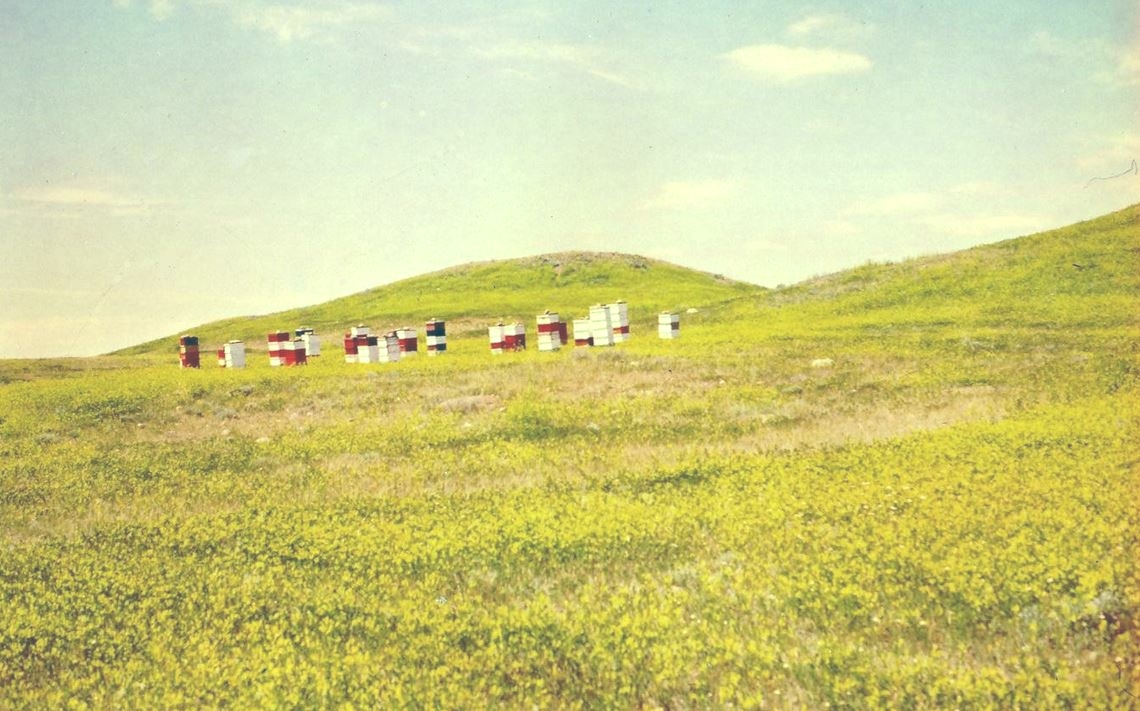
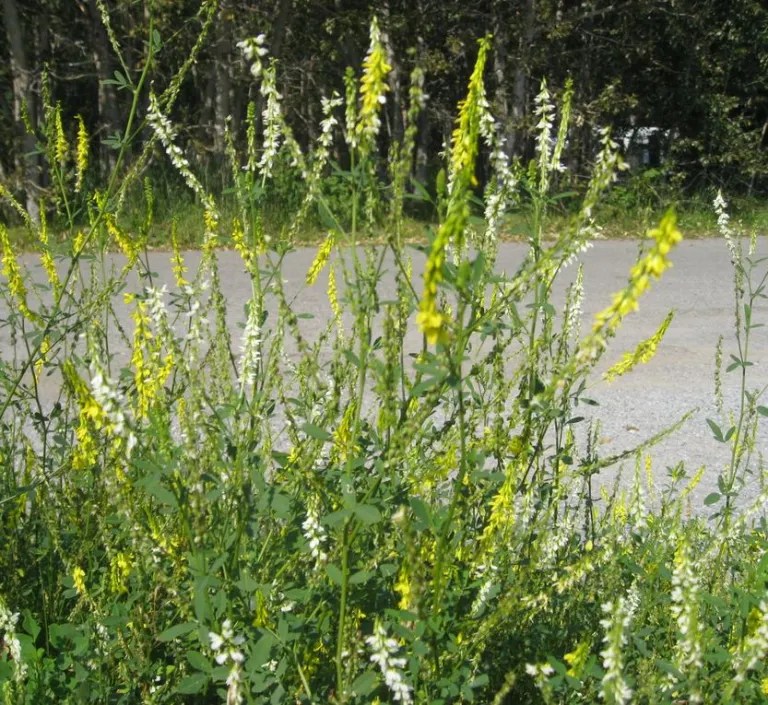
Legal. Illegal. Legal. Illegal again. Sweet clover has quite a history. Introduced into North America from Europe about 300 years ago, farmers were once fined for having it in their fields. It can be used to feed cattle, but improperly stored, it can become a blood thinner and kill cows. On the other hand, the state of Kentucky was saved from bankruptcy by sweet clover. And so were some beekeepers.

Every acre of sweet clover yields as much as one-thousand pounds of honey from its nectar. Along with alfalfa and a few other choice nectar-producers, it’s a winner in the nectar sweepstakes. But this podcast also looks at an Australian beekeeper who found an even better plant. But we circle back to sweet clover and Bidzina reads a list of “Ten surprising facts about sweet clover.” Number eight is amazing.

Mostly we discuss sweet clover, but bees, horned toads and tobacco are mentioned. Let’s go!

Please subscribe, like, love, and follow. We live or die by your adulation.

Podcast website: https://sites.libsyn.com/540327/site
About Ron Miksha: https://about-bees.org/about-ron/
Watch the podcast:  https://www.youtube.com/@ABCCPodcast

Finally: email your angst:  ron@aboutbees.net

Posted in Beekeeping, Commercial Beekeeping, Ecology, History, Honey Plants, Podcasts | Tagged , , , , , | Leave a comment

Podcast: from Beyonce to bee forage and beyond

Season 1 Episode 5: About Bees, Culture & Curiosity Podcast – Some Bee Buzz

In today’s podcast episode, we jump from moving bees between Alberta and British Columbia to examining a recent paper about the ecology of disappearing bee species. Then, of course, we chat about Beyonce and Hex Art.

Bidzina describes conditions in British Columbia and why he avoided going farther into the mountains to make fireweed honey but instead split his colonies, doubling their number. He tells us a little about moving his bees back to Alberta, driving through the night with a trailer through the Rocky Mountains. In Alberta, he loses most of those hives over the next winter. But two survivor colonies are resilient and develop into strong colonies.

We discuss removing honey by letting the supers stay in the apiary, separated from the hives, allowing the bees to drift out of the honey supers and back to their homes, abandoning the honey. Bidzina also mentions nuisance bees at a wedding held where he was extracting.

Then, Ron talks about his two backyard hives. Both were replacements for colonies that died over winter. One was a package, the other a nuc. It was surprising to see that there was very little difference in strength between them by mid-July.

We drift to talking about trains and the enormous size of Canada. It’s a 7,500-kilometre road trip from Pacific to Atlantic. Maybe it should be tackled by train, not car or plane. Trains are good.

We explore a recent paper about land use changes (farming, urbanization) that are related to declining populations of native and imported bees. Across a huge temperate area, scientists broadly divided landscapes into forested, herbaceous, agricultural, and urban. One of those areas were better for bee health and survival. The results surprised me a little. We discuss the study’s results. See: “Land use changes associated with declining honey bee health across temperate North America”   https://iopscience.iop.org/article/10.1088/1748-9326/acd867

Other news bits include the collapse of insect species diversity, which leads us to wonder about the 2024 reversal of a ban on neonicotinoids in England and the implications for bee survival. Then we lighten up with a visit to Beyonce (the Queen Bey) and a glance at a paper on the prevalence of bees throughout the history of art – have you noticed that hexagons seem to be everywhere we look these day?

Please subscribe, like, love, and follow. We live and die by your adulation.

Podcast website: https://sites.libsyn.com/540327/site

About Ron Miksha: https://about-bees.org/about-ron/

Watch the podcast:  https://www.youtube.com/@ABCCPodcast

Posted in Bee Biology, Culture, or lack thereof, Ecology, Native Bees, Personal, Podcasts, Strange, Odd Stuff | Tagged , , , , , | Leave a comment

Podcast: The Bees’ Ears

Our latest podcast rambles around the bees’ ears. Available everywhere you grab your podcasts. Enjoy.

Season 1 Episode 4: About Bees, Culture & Curiosity Podcast – The Bees’ Ears

In this episode, we discover that insects, including bees, can hear. They have three ways of picking up sound – through their antennae, their feet, and through their armour (exoskeleton). Since bees can hear, does music calm the bees and reduce stings? And since bees can hear, does the old tradition of “Telling the Bees” make sense? Is that why, upon Queen Elizabeth’s death, the royal bees were told about her passing by the royal beekeeper? Why?

How do  bees buzz? Do they hear their own buzzing? Is the tone of a happy hive (261 Hz, middle C on a piano) the basis for all western music? If bees aren’t dancing at a party, do they feel left out and get sad? Is it wrong for us to attribute human thoughts and emotions to bees? Should there be bee insect sanctuaries? Where? How would that work? When Asian honey bees do their flash dance, is it noisy?

Finally, why don’t honey bees pollinate tomatoes? They can’t, but bumble bees can. It’s got everything to do with insect size, weight, and something called buzz pollination. Listen to this episode as we compare their buzzing skills.

Podcast website: https://sites.libsyn.com/540327/site
About Ron Miksha: https://about-bees.org/about-ron/
Watch the podcast:  https://www.youtube.com/@ABCCPodcast

Posted in Bee Biology, Culture, or lack thereof, History, Podcasts, Pollination, Science, Strange, Odd Stuff | Tagged , , , | Leave a comment

Podcasting about bees

I considered launching a podcast several times over the past few years. However, I had been a guest on half a dozen shows, so I recognized the enormous amount of effort and time that hosting a podcast entails. It’s a lot of work. The work would be interesting, but my hesitance was due to a lack of time. I have too many fires on my iron.

Then I was a approached by a young fellow here in Calgary, a casual acquaintance in the beekeeping world. We met a couple months ago. He asked if I’d like to co-host a beekeeping podcast. He would take half the work, so why not?

So, the friend – Bidzina Mosiashvili – lined up a studio while I researched the topics and created script outlines. Bidzina is the technical/recording producer and has been loading our chats to our YouTube videocast. Meanwhile, I created the podcast space, found an appropriate platform and edited the audio for the podcasts. Watch our videos if you can put your feet up, otherwise let the podcasts entertain your ears while you are driving, working, or in need of a quick bedtime sedative.

Bidzina and I make a good presentation combination. Bidzina is young and in the start-up years of his life and his beekeeping; meanwhile, after 65 years of bee infatuation, I am phasing out of life and out of bees. Our differing perspectives on everything from bees to philosophy, climate, business, religion, native species, history, literature, and unorthodox beekeeping habits make a lively, interesting discussion on those wide-ranging, fascinating subjects. Bidzina’s refreshing ideas make this podcast great. He’s not afraid to ask simple questions and then, a moment later, make profoundly deep comments.

On August first, we launched these four episodes:
1) Our introduction to the About Bees podcast;
2) A look at the ridiculous myths a lot of us beekeepers believe;
3) The savagery of robber bees from Leo Tolstoy's perspective; and,
4) A discussion about whether bees feel pain. (Sorry, you have to listen to that podcast to find out what happens in a bee's brain when it gets injured.)

A new episode will be set free every week until all the bees in the world go extinct. Then, during mankind’s final four years, we will podcast about Einstein or something.

The About Bees, Culture & Curiosity podcast is easy to find on Apple Podcasts, Spotify, GaanaAndroid, Deezer, or wherever you have entrusted your listening habits. Just search About Bees, Culture & Curiosity.

Be forewarned: this is an unusual “bees” podcast. There are a lot of other bees/beekeeping podcasts out there. This one is different. You’ll see. Let me know what you think about this new podcast by commenting below, please.

Posted in Beekeeping, Friends, Personal, Podcasts | Tagged | 7 Comments

Who’s afraid of a few bees?

Yesterday’s New York Times had a lengthy first-person account of the disturbing tale of a home invasion1. Dozens came in, none left alive. According to the author, Sarah Kliff, “Honey bees invaded my house, and no one would help.” This nightmare escalated. The family evacuated to the safe-haven of a hotel.

Ms Kliff carries us along from the first sighting, a bee which she crushed with a cookbook (honey recipes?), through an adventure that ends when the family sucks up the bees with a vacuum cleaner. Along the way, the writer discovers that honey bees are not going extinct, don’t need “saving”, can’t be chased away by the smell of citronella or the sound of Alexa making beeping noises, but may end up becoming permanent residents in her house. She was lucky, the bees moved on, unlike the colony I found in this old house on a Pennsylvania homestead fifty years ago.

The writer also discovers that most people believe that honey bees are endangered – exterminators wouldn’t kill them, but they recommended retrieval by beekeepers. Beekeepers wouldn’t help when they discovered that the bees seemed settled inside the walls of the house, a messy situation that requires a bee rescuer who is also a carpenter. (Beekeepers prefer capturing swarms from low-hanging tree branches.) They also surmised that the bees were scouts, not a settled colony.

Two things in the little article seemed important to me. One was the author’s discovery that honey bees are not disappearing from the planet. They aren’t going extinct. She talked to both Tom Seeley and Vox editor Bryan Walsh about it. Walsh was especially forthcoming when he admitted that his 2013 Time magazine article about the impending disappearance of honey bees had, shall we say, fallen short of apocalyptic expectations. Today, we aren’t living in a world without honey bees. In fact, ten years after that famous cover piece, the world has more honey bees than ever. Bryan Walsh has owned up to the poor prediction that brought worldwide attention. You can read his Vox update here.

The Times author had done her homework and learned that the honey bees in her house wouldn’t tip the balance of the world’s ecological stability, whether they lived or died. However, not all of her neighbours got that memo.

I had a vague sense that honey bees needed saving, and some of my neighbors felt strongly about the issue.“They are so important to our ecosystem,” one neighbor advised on WhatsApp.“Their number is dwindling.” She suggested we call a beekeeper.

The other important take away from the article, for me, was Sarah Kliff’s reminder that not everyone is as comfortable as me when it comes to hanging out with bees. I usually forget about the real fright (and legitimate threat) that bees cause for most people. As we enter another bee season, I’ll try my best not to scoff at folks who are so uncomfortable around bees that they spend a couple hundred dollars and two nights away (with family and dog) to escape a potential mortal threat. I know how I’d feel if several dozen two-legged flightless animals invaded my house and looked intent on staying. I doubt that a cookbook would be enough of a defense, nor would I be returning after just two nights at a hotel.

  1. Thanks to Thomas S. for telling me about this NYT piece! ↩︎
Posted in Beekeeping, Outreach, Save the Bees, Stings | Tagged , , , | 6 Comments

Stack ’em High

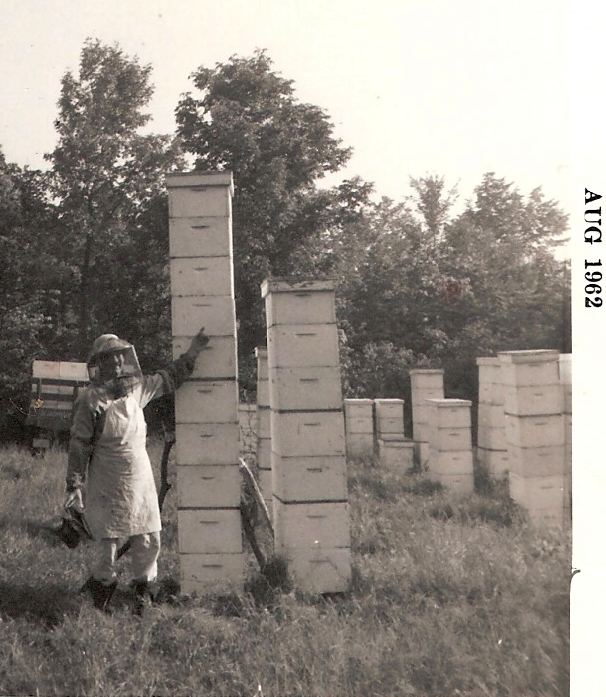
Long ago (about 1975), there was an amazing beekeeper, now a legend, in northeast Saskatchewan. He consistently had 300-pound/hive crops. This was Dr. Don Peer (PhD, 1955, U Wisconsin). Peer once told usIf I were king of the world, I’d make a law that every beekeeper had to own one more super for each hive of bees“.

This photo, taken in Wisconsin by my brother David, shows the extreme production from well-managed colonies. Unfortunately, the picture shows neither Dr Peer, who did much to promote expert beekeeping in Wisconsin, nor my brother. Maybe another day for that.

The point, of course, should be lost on no one – it takes supers to make big honey crops.

Don Peer kept about 1000 colonies in a remarkable honey domain. Bees could collect 30 pounds of cured honey in a single day. That required a lot of open comb space to deposit the nectar that was being reduced. Peer quit using 2-queen colonies after a few years because it was impossible to stack the supers high enough. His crew tried parking flatbed trucks close to the colonies so lids could be pried off and heavy honey boxes replaced with empties. Handling monstrous 2-queeners wasn’t efficient, so it was back to single-queen colonies.

But the key message – lots of supers on the hive – remains the same. We all do that out here on the Canadian prairies. Most years are an embarrassment of riches.

This table shows records from my western Canadian scale-hive. A lot of honey can be stored in just a few days. For this example, from July 10 (24 pounds net gain) to July 16 (27 pounds net gain) the hive averaged 20 pounds/day. It takes about a super to hold the nectar that becomes 20 pounds of honey each day.

Knowing that it takes many supers to make honey, I was stunned to learn that China and southeast Asia produce over a billion pounds of honey each year without using supers. Everything is operated in single-storey colonies. At harvest time, a single box serves as brood chamber and honey box. The result is a mess. The bees are shaken from all the combs (even the ones with brood) and then reinserted into the singles. This video shows a typical beekeeping set up. Around the three-minute mark, you can see that the entire brood nest is extracted, including frames with brood. :-(

Here in Canada, we caution hobby beekeepers to never extract brood frames. Spinning in an extractor can’t be good for brood. And, during the flow, a lot of the stuff flying out of the combs is raw nectar, which can easily lead to fermentation if it isn’t dried out. These days, the accumulation of hive chemicals that are applied in brood chambers increases contamination risk when brood combs are spun. So, please don’t extract brood frames.

Keeping bees in singles and removing honey comb-by-comb may have a role in some systems. In the 1940s, my father spent a year working for Al Winn in Petaluma, California. Winn was mostly a queen breeder, but during pollination gigs and off-season (when the bees were taken to the mountains), the singles would sometimes fill up. This restricted the expansion of brood and made colonies heavy to haul around. The solution was to remove frames 1, 2, 9, and 10 (the edge frames), extract them, split the tight brood nest between frames 5 and 6, then insert four empty combs in the centre of the nest. Al Winn and crew avoided extracting the brood. Even if a bit of nectar was encountered, the California climate was hot and dry. Wet honey (nectar) wasn’t a problem. This system of opening the brood nest to make space kept hives from swarming and allowed brood expansion, resulting in good colonies for building mating nucs.

I have long wondered why Asian beekeeping continues to shake all the bees out of the single box and extract every comb, brood and all. Why not use the California system, described above, or simply use supers and stack ’em high? I think the use of single-storeys is a matter of inertia and some convenience. Colonies are frequently moved (by hand) and singles are lighter. Supers don’t have to be owned and then stored off-season. Finally, there is the Apis cerana legacy. Commercial Asian beekeepers almost exclusively use the western honey (Apis mellifera), but their grandparents used cerana. These bees build smaller nests and reside comfortably in singles. Grandpa used singles, so . . .

But things are changing. Supers have arrived in China! Here’s a fascinating video that you must watch. Why does China stick to the path of common prosperity? was produced by the Chinese government. I imagine that there is a series of these videos dedicated to agricultural modernization. With the CCP advocating supers on hives, it might be just a decade or so before China’s eight million colonies are operated using western methods. Chairman Xi is not “king of the world” (to borrow Dr. Peer’s phrase), but if Xi suggests stacking ’em high, it will likely happen.

Get some popcorn, enjoy the film, and contemplate the future.

Posted in Beekeeping, Commercial Beekeeping, Culture, or lack thereof, Hives and Combs, Honey | Tagged , , , , | 2 Comments

Bees and frequencies

Hi, Everyone!

Chief Lee Crowchild and I have been asked to present at the Calgary Science Centre for an upcoming Indigenous Science Night. Attendance will be up to about 1700 people and the event is just a few weeks away, so I thought that I would reach out to readers for a little help.

The way the science program works, a ‘mainstream western scientist’ (me) is teamed up with an Elder (a Knowledge Keeper) from a nearby Nation. Fortunately, I was able to select my own presentation partner, Chief Crowchild, whom I have worked with for years – and who is a beekeeper on Tsuut’ina Nation. (We have taught courses together and we hang out every few weeks.)

The organizers have chosen the topic of “Wavelength and Frequency” as the evening’s theme. Our part of the presentation lasts about one hour and deals with bees. The Chief will decide how his portion will overlap with my discussion of wavelength and frequency, as related to bees. I am in the process of selecting my subject lines.

Here’s what I have in mind so far.

  1. The organizers suggested bee vs human eyesight with a discussion of the light spectrum. Bees see ultraviolet, which appears white to humans; humans see red, which appears black to bees.
  2. Wing-beat frequency varies with the angry buzz of disturbed bees to the gentle pitch of a humming happy hive.
  3. The speed of a scout’s dance loop (frequency – loops per minute) as it relates to distance of flower patch from hive.

I would love to hear ideas from readers. We will have plenty of time to include more than these three examples, slides and images, and corresponding indigenous observations. Our focus will be on native bees, but knowledgeable honey bee keepers may have some ideas that transfer to some species of native bee.

Many thanks! ~Ron

Posted in Culture, or lack thereof, Friends, Native Bees, Science | Tagged , , , , , , , | 8 Comments