Honey Bee Highways

This is how Canadians set out baskets of flowers along the road for bees.

This is how Canadians set out baskets of flowers for bees.

Norway – the 2nd most liveable country in the world* – has yet another feather in its woolly cap. Or super on its hive, if you will. The Norwegians have a Honey Bee Highway.  That’s a trail of flower pots brimming with bee-friendly plants. (As opposed to bee-unfriendly plants like venus flytraps.) But no highway is ever perfectly paved, so there is a website which Oslo residents may visit to learn where the gaps in the beeway are. (The site is hosted by little Polli Pollinator, a nondescript creature who introduces herself with: “Hei! Jeg er Polli Pollinator!“)   The idea of the bee highway is to provide bees with natural pollen at stations located no more than 250 meters apart.

Very well, then. Norway’s honey bee highway is strewn with stuff that Polli is expected to love. The Oslo Garden Society apparently felt that roving bands of peripatetic wild bees might feel hungry and distressed in Norway’s capital. Members of the garden club have been setting out pots of blooming nourishment at helpful intervals to prevent starvation as the bees maraud the city. (I wonder, is anyone doing the same thing for the hungry visiting reindeer?)  Polli the Bee is not only demanding free food, but is also asking for overnight accommodation and insect hotels and hostels (overnattingssteder humlekasser og insekthotell). Polli is what many of us would call an aggressive bee.

I like the interactive map that the friends of Polli the Pollinator have placed on the internet, and I hope you will check it out. It looks perfect for wild bees with internet access. Sitting around the hive on date night, wondering where to eat, wild bees might pull up this web page and discover that a lovely box of flowers is waiting on the northwest edge of the city. There are no Yelp!-like reviews, but the pictures are worth a thousand raves. Here is a pollinatorpassasjen map with flower spots and a sample menu:

Oslo flowers

I don’t know about you, but I doubt the wild bees will get very excited about a dried floral arrangement. But the Oslo garden club deserves credit for thinking of the bees and developing the program and its accompanying website. However, I’m not sure that their method will be as successful as the one that Josephine and Earl Emde used in northern Saskatchewan – a cold, far north place in Canada that’s not remarkably different from Norway.

The Emdes were elderly friends of mine back in the ’80s. They ran 500 hives of bees near Big River, a town that started where the paved road ended in those days (it’s surfaced now). Josephine drove their big 3-ton flatbed while Earl sat on the back, legs dangling over the edge, seed sower on his lap. He spun the crank and sweet clover seeds shot out alongside the highway while Jo slowly drove in the predawn darkness. They probably planted a million flowers which then re-seeded themselves and still add to Saskatchewan’s scenery. I’m sure descendants of those first biennials continue to delight bees thirty years later. If you are going to make a “honey bee highway” then use a real highway and for goodness sake, use flowers that bees actually like to visit.
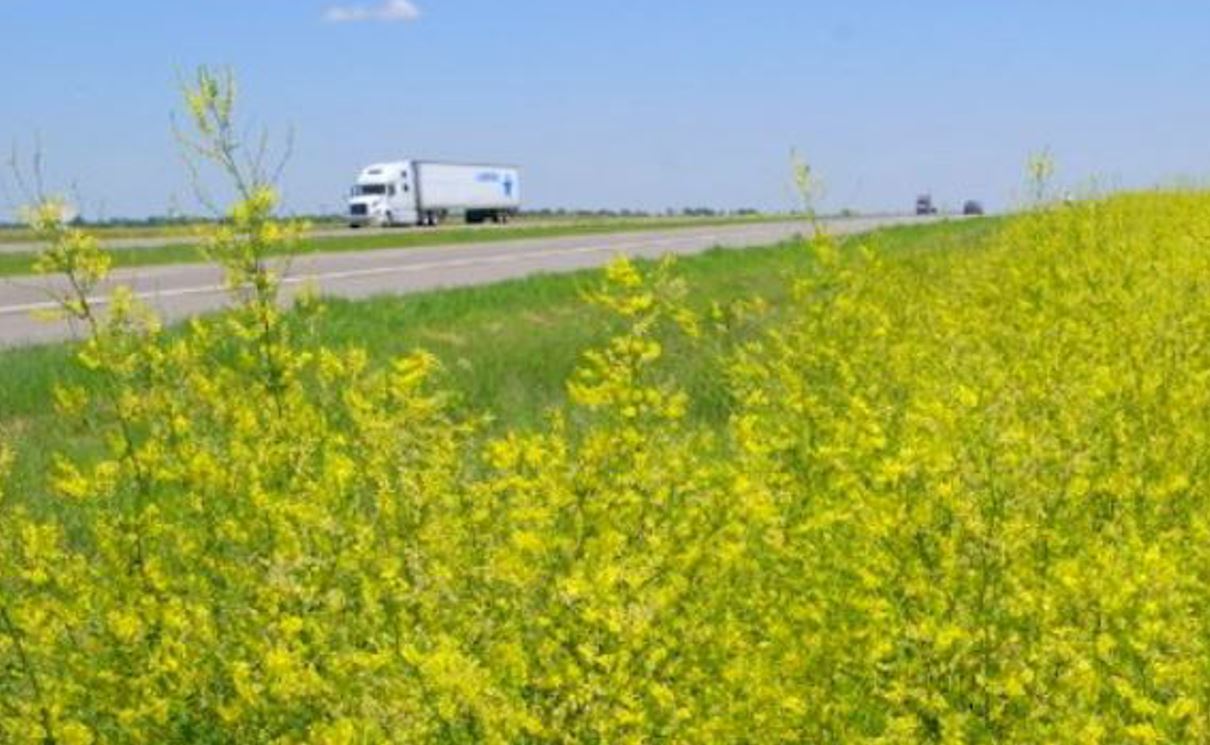
Roadside sweet clover - the sort Jo and Earl Emde planted.

Roadside sweet clover – the sort of bee-friendly plant Jo and Earl Emde once let loose in northern Saskatchewan.

*Norway is number two.  Stories about the most liveable country in the world can be seen here.

Posted in Culture, or lack thereof, Ecology, Friends, Honey Plants, Humour, Save the Bees | Tagged , , , , | 2 Comments

How Honey Bees Discovered Vaccines

vaccine shotLast week, the popular press was claiming that honey bees discovered vaccines millions of years before humans did. It makes great lead paragraphs for news stories, but the tale is slightly off the mark. Honey bees don’t have scientists. They have queens, drones, and workers. They don’t invent things in the way Discovery.com (Queen Bees Vaccinate All of Their Babies) may have us believe.

Even the staid Washington Post gets rather silly on this story: “Humans like to brag about their brilliant advent of vaccinations to prevent diseases, but bees just roll their eyes and shrug. After all, they’ve been doing it naturally for much longer.”  I have to admit, the thought of honey bees rolling ten thousand compound eyes in unison made me smile, even if the idea is creepy. So, thanks, Washington Post, for that image.

kid in mud

Acquiring natural immunity.

The news story that bees have developed ‘vaccines’ comes from research (done by humans) published last week in PLOS Pathogens. The three authors title their paper Transfer of Immunity from Mother to Offspring Is Mediated via Egg-Yolk Protein Vitellogenin. You will notice that they do not use the word ‘vaccine’ – probably because we aren’t really talking about vaccinations here. What is happening is that the mother (the queen bee) passes some immunity response through proteins in the offspring egg. It seems that this is not so different from human mothers passing along immunity to human babies. And perhaps not far removed from children acquiring immunity from allegens and bacteria when they are allowed to wallow like pigs in mud.  Only once in 12 pages is the word vaccine used – and that’s in the context of potentially maybe someday developing an application using the protein vitellogenin (Vg): “Vg-mediated transfer of pathogenically inactive bacterial fragments could provide a platform for the development of vaccines for beneficial insects.” In other words, humans might make vaccines for insects by feeding inert pathogens to expectant mom-insects who would pass resistance to offspring. Maybe. Someday.

How the immunization process works: In the case of the honey bee, workers encounter pathogens which get mixed into the food they serve to their majesty, which gets into the queen’s liver (actually ‘fat bodies‘ in bees), which combines the pathogen in a protein called vitellogenin, which enters the queen’s blood stream and migrates to eggs as they are laid. This ultimately may give the offspring immunity to some pathogens. But, as we will see, it doesn’t work on one of the honey bees’ worst diseases.

strong_hiveWhen you consider that 50,000 individual bees are crammed into a smallish hot damp hive, it is amazing that pathogens don’t decimate colonies within minutes. The discovery of the mother-to-child immunization process may explain how the developing larvae usually survive and mature in conditions that pathogens love. Unfortunately, this does little to alleviate things like foulbrood (AFB and EFB), viruses, nosema, chalk brood, sac brood, nor syndromes such as Colony Collapse Disorder, and mite infestations. However, perhaps there are other pathogens which would thrive in the hive if the vitellogenin-immunization system didn’t exist.

American foulbrood, major scourage of beekeeping

American foulbrood, major scourge of beekeeping

The researchers found that gram-negative E. coli is transferred to the egg, but surprisingly, so is Paenibacillus larvae – the gram-positive bacterium causing American foulbrood disease (AFB). Obviously, this transfer system is not stopping the development of AFB, a major killer of honey bees. I am not sure if this means the immunity transfer is not always effective or if Paenibacillus larvae is somehow different. However, the presence of AFB – which will destroy a colony within weeks – suggests that the ‘vaccine’ the queen provides her offspring is far from effective. This implies that the researchers may have discovered the way pathogens can be transferred to offspring – infecting the unborn rather than protecting them. An anti-vaccine, at least in the case of AFB, spreading disease instead of stopping it.

What will become of this research? According to the published paper and subsequent news reports, vitellogenin-mediated transfer of pathogenically inactive bacterial fragments might provide a platform for the development of vaccines for beneficial insects. Or, as in the example of AFB, perhaps some equivalent pathogen could be slipped into a pest insect’s vitellogenin pathway, infecting its progeny and spreading disease among pesky bugs. This might replace pesticides in some cases. The researchers claim, “In sum, such applications could be highly beneficial in agriculture.” It will likely take years to create such applications, but you can be sure someone is working on it at this moment.

Posted in Bee Biology, Diseases and Pests | Tagged , , , , , | 3 Comments

Uncommon Ancestory

Honey bees and bumblebees are genetically less similar than dogs and cats.

Honey bees and bumblebees have more genetic differences than dogs and cats.

Creatures change with time. You might believe that God controls, guides, or designs those changes or you may have the opinion that random acts in the environment create mutations which change a species. The former idea is accepted by the majority of Christians while the latter is the basis of modern evolutionary biology. You might even combine these ideas (as many people do) and believe that God intelligently engineers genetic changes through radiation and chemicals, which mutates creatures and causes evolution. Either way, you are with the majority that agrees that species change with time.

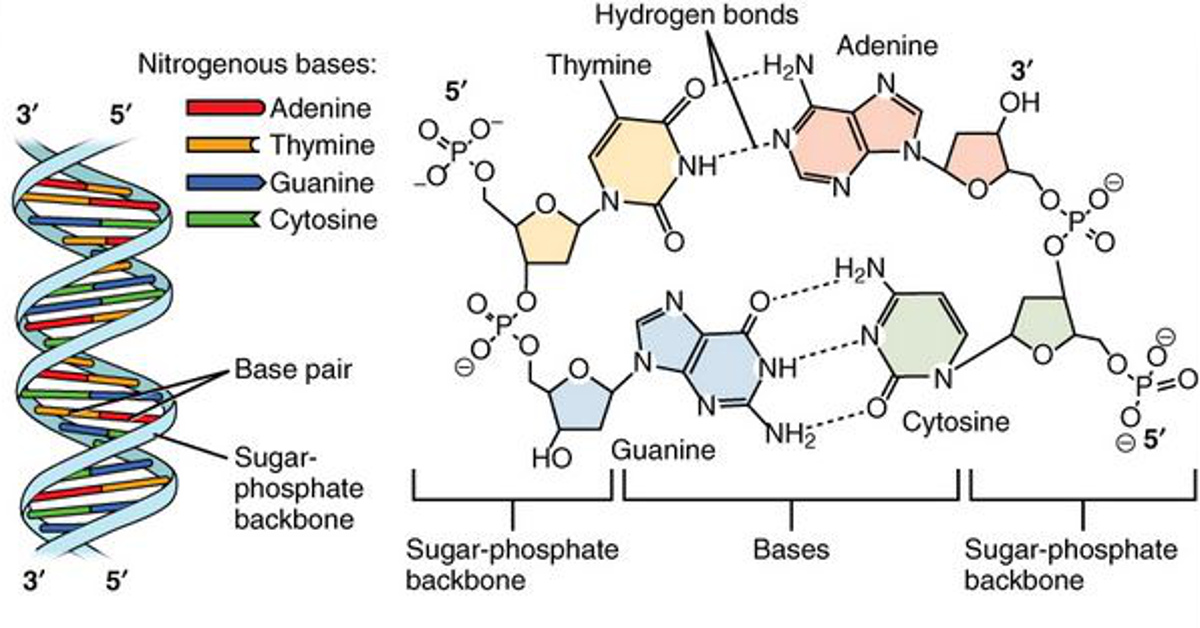
Part of the idea of the evolution of species is that similar creatures had common ancestors at some point in the past. The date of common ancestry can be calculated by looking at the differences in the DNA between two species and counting the number of bases (T, A, G, C) that are different. Through controlled experimentation, biologists have found that out of each set of 30 million DNA base pairs, roughly one mutates each generation. (At this rate, humans accumulate a total of 200 to 300 mutated base pairs each generation.) Most of these mutations occur in bits of DNA material that (as far as biologists can determine) have no function. They help create RNA which builds 3-base codons that do not produce any proteins –  they are like the white space on a printed page.

RNA codonOther mutations in a base pair may change the RNA’s codon into one which makes a protein identical to the non-mutated codon. This is really common, too, because many of the triple-groups of base nucleotides (codons) create the same protein. For example, both CCA and CCG are codons that make the same protein, proline. So if a mutation causes the final ‘A’ in that string to be replaced by a ‘G’, the resulting protein would nevertheless be the same. That particular mutation would have no effect on the offspring.  But other mutations may be detrimental. They result in new codons that make a protein that may cause a nervous system to lack connections or a stomach to lack a lining, for example. Such killer mutations end up in non-viable offspring, believed to cause roughly one-half of spontaneous  miscarriages in mammals. If a creature survives with a disadvantaged mutation, it likely will have few (if any) offspring and the bad mutation may die out.

DNA structureThis leaves a small number of mutations that occur in important stretches of DNA where a change can result in a permanent positive difference in the offspring. In recent decades, scientists have learned how to accelerate such changes by irradiating millions of seeds and then germinating them, observing the mutated plants that result (many will never germinate or will die early, due to detrimental mutations). The genetic engineers will occasionally find some plants with desired new traits – pest or drought resistance, for example. They save seeds from those offspring. The seeds of the mutated offspring continue to carry the mutation. It is now a permanent part of the DNA sequence of all future generations. In this way, new colours of begonias were developed and frost-resistant tomatoes have been created.

There is more to this story and the development of genetic diversity than I have just covered. I haven’t mentioned how the detrimental mutations are washed from the present DNA data set nor have I indicated the ways in which mutations may be accelerated in nature. A great starting point for a better explanation of how scientists have calculated the rate of species diversification is found in Genomic clocks and evolutionary timescales by S. Blair Hedges and Sudhir Kumar, a highly readable article available free in PDF format.

Darwin's Original Sketch of the Tree of Life, 1837

Darwin’s Original Sketch of the Tree of Life, 1837

The theory that genetic alteration occurs at a predictable rate has been tested and observed thousands of times. Mutations cause permanent changes in offspring and those changes are occasionally helpful to offspring survival. By examining the DNA of any two creatures – let’s say European honey bees (Apis mellifera) and bumblebees (Bombus distinguendus) – we can count the number of differences in a bit of DNA and calculate how long it would have taken the two species to have diverged from a common ancestor. In the case of a bumblebee and a honey bee, the two had a common ancestor about 108 million years ago. This is according to results of observations by 5 different research teams at 5 different labs, doing DNA examinations between 2007 and 2011. They did not all get the exact same result – Chenoweth, et al. calculated 90 million years while Litman et al. found it took 121 million years for the observed mutations to occur. The other three research teams had intermediate results. The consensus based on all five is 108 million years (the median of the 5 studies is 93 million years). This tells us a couple of things. It took an awful long time for the changes to add up. And there must be a heck of a lot of differences between these two insects. Surprisingly, there are more observed DNA differences between bumblebees and honey bees than between dogs and cats. (Dogs and cats had a common ancestor 55 million years ago – they have only half the genetic changes in their DNA as honey bees and bumblebees.)

In the past decade, there have been thousands of independent calculations made for various species divergences. I recommend the website The Time Tree of Life which has categorized 2,000 studies and 50,000 different creatures. They operate an interesting and informative site with an easy to use interface where you can enter your favourite creatures and find out the amount of time that has passed since those creatures had a common ancestor.  Using data from their site, here are a few other species and the calculated time (in millions of years) of their last common ancestry:

Last Common Ancestry between Honey Bees and various other Species

common name species million years ago
Asian honey bee Apis cerana 18.5
great yellow bumblebee Bombus distinguendus 108
leaf cutter bee Megachile rotundata 122
house fly Musca domestica 348
European bee-eater bird Merops apiaster 847
alfalfa Medicago sativa 1,515 (1.5 billion years)
AFB (American foul brood) Paenibacillus larvae 4,290 (4.3 billion years)

Posted in Bee Biology, Genetics, Science | Tagged , , , , | Leave a comment

Mr Holme’s Bees

Sherlock Holmes is more than an ordinary beekeeper – as you’ll find out in this summer’s new movie, Mr Holmes. I watched it at a Calgary theatre with my wife this evening. I’m glad we went. We don’t get out enough and generally find films too loud, too violent, too silly, or too sappy. Mr Holmes was none of these.

mr holmes78-year-old actor Ian McKellen (recently the wizard Gandalf in the Lord of the Rings trilogy) plays 93-year-old Sherlock Holmes, a long-retired detective. As many of you know, author Sir Arthur Conan Doyle forced Sherlock Holmes into a beekeeping retirement in the south of England. According to Doyle, Holmes toiled at bee farming and even wrote a popular beekeeping manual. The drama-mystery movie Mr Holmes (2015, BBC Films, et al.) stays quite true to beekeeping. The last film I’d seen that ties bees so nicely and accurately into the thread of a drama was Ulee’s Gold (1997, Orion Films). If you’re a beekeeper you will appreciate the finer details – the distinction between wasps and honey bees, the mystery of some disappearing bees, and the way Holmes lights his bee smoker with a roll cut from an old burlap sack. At one point in the movie, Sherlock Holmes took a book from his shelf and removed a significant photograph of a young woman. The book was Root’s 1945 ABC & XYZ of Beekeeping. I recognized it – I have the same edition in my own home library.

But don’t let me mislead you. This is not a beekeeping documentary. Or even a beekeeping movie. It is mostly a story of the redemption of an old man who regrets many of the things of his past and who is struggling to revive old memories. It’s a touching, well-acted drama. It’s not likely to stay in the theatres long, so get out and enjoy it with a friend or spouse before its run is over.

Posted in Culture, or lack thereof, Movies, People | Tagged , , , | 2 Comments

Bees Prey at Church

In one of the most clever news headlines I have ever seen, editor Darcy Cheek of Ontario’s Recorder.ca writes: Honey bees go to Lyn church to prey. Any editor/reporter who can come up with a lede-line like that deserves mention. It caught my attention.

Here’s his story: Last week, a swarm settled into an Anglican parish church in farm country, Ontario. The priest’s assistant called for help. With approval from Ontario’s Ministry of Environment and Climate Change (yes, folks, climate change is real enough to have a ministry), the bees were exterminated.  That’s right – killed, destroyed, poisoned, and made dead. Later, a local beekeeper named Debbie Hutchings of Debbee’s Bees near Newboro, Ontario, heard about the honey bee liquidation event. She was upset. Ms Hutchings felt that more of an effort could have been made to save the bees. She is likely right.

European dark bees, photographed by Miksha in Ireland, 2005.

European dark bees, photographed by Miksha in Ireland, 2005.

I have a couple of thoughts on this. First, Ms Hutchings sounds like the sort of beekeeper we all want to know. She runs a small bee farm and sells bee supplies and honey. She rescues bees. She cares about bees. Her great-grandfather’s ancestors were beekeepers and brought bees with them in the mid-1800s when they took a slow boat from England to Canada.

I have to admit that I scoffed when I read that she told reporter Darcy Cheek that she still has honey bee stock that has been in the Hutchings family for 195 years. Of course not, I thought. Two hundred years ago, the bees that her ancestors imported (probably without CFIA approval) would have been black in colour, small in size, and would have had trouble wintering in Ontario, but if they survived, they would build up quickly in the spring. These bees are sometimes called black bees, European dark bees, or Apis mellifera mellifera. Almost everywhere in North America, they have been replaced by more productive Carniolan, Caucasian, and Italian races. The last time I saw the European dark bees in North America was in 1976, along the Pee Dee River at the apiary of a remote South Carolina beekeeper, a friend of mine who kept about ten gum boxes stocked with black bees. It seemed highly improbable that Ms Hutchings had such bees. But I am wrong.

Debbie Hutchings describes her bees on her website:

“[My grandparents] brought the honeybees with them from England. I can’t say that within the last 100 or so years the Hutchings bee hasn’t interbred with other breeds of honeybees, but we have not intentionally cross bred them. I still put my best breeder hives in the basement of the old homestead when winter comes a knocking, just like my Grandfathers did.  They are gentle, little dark bees that winter in small clusters that explode when spring comes.

Sounds like European dark bees to me. Kudos to Debbie Hutchings for recognizing this and keeping the bees going in the traditional way.

johnbaptistcereal

John the Baptists’ breakfast cereal. Available at fine churches everywhere.

And speaking of traditions… The church in Lyn, Ontario, that had the bees destroyed is Saint John the Baptist Anglican parish church. I’ve read the Bible. Twice, in fact. John was the wildman who lived in the desert. He survived (according to The Book) by eating locusts and honey.  I think the Ontario church missed a great opportunity to cash in on the amazing miracle of the honey-dripping ceiling. Churches these days are struggling to survive. Attendance is way down. But even I would go to a church that handed out little bowls of locusts and then queued worshipers under a dripping ceiling where fresh honey drizzled down on the locusts. For a really authentic experience, they could even offer camel-skin robes. But alas, the bees were killed. What would John the Baptist say about that?

Posted in Culture, or lack thereof, Humour, Save the Bees, Strange, Odd Stuff | Tagged , , , , | 1 Comment

Timeless

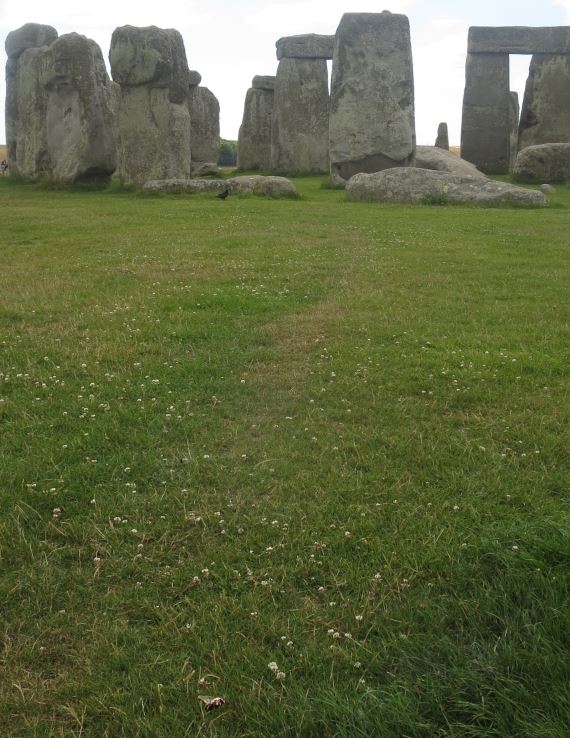
I was in England last week and saw some of the usual sights: Stonehenge, the Magna Carta at Salisbury Cathedral, King’s College along the river Cam, JRR Tolkien’s grave. To me, these represent timelessness. Tolkien, sleeping in eternity. The stones of Stonehenge, eroding forever. Even our creations – Salisbury’s statement of democracy; Cambridge’s seven hundred years of learning – are perhaps no less enduring. And everywhere I went, I saw bees.

Spot the bee?

Spot the bee? (She’s flying front and center.)

Bees are nearly ubiquitous, yet so ephemeral. Their time is brief. At first blush, they don’t have the agelessness of rocks and institutions. Bees come and go. The bumblebees which I saw flittering between clovers at Stonehenge build a summer nest of a hundred workers, then, in late autumn, most of the bees abruptly die.

One (or a few) mated queens find solitary wintering sites, wait for spring, then start anew. I want to believe that at least a few queen bumblebees shelter each winter alongside a Stonehenge rock where the igneous doleritic bluestone meets the soil. A bees’ time is brief – a few months – but starting anew each spring has been repeated for millions of years. On the Salisbury Plain, bees have been drawing nectar and raising brood almost forever.

And yet, we know that nothing lasts forever. Although bees may have brooded a hundred million summers (as some scientists believe), they and their environment have changed dramatically. Worshipers  erected rocks at Stonehenge almost 5,000 years ago. Before that, ice covered much of the northern hemisphere and bees were forced south, following the receding flowers. Much further back in time, North America and Europe were attached and the Caledonian mountain range stretched from Scotland to Alabama. Eventually the continents parted (in a final Pangean breakup, about 60 million years ago) and still later, our favoured honey bees, relative late-comers,  arose in the Middle East. (This is why bumblebees are found in the Americas and Europe while honey bees, speciated after the Atlantic formed, were isolated from America. The continents had separated before honey bees arose.  The American continents didn’t have any honey bees until humans carried them as livestock in the 16th century, but earlier bee species had spread before the continents parted.)

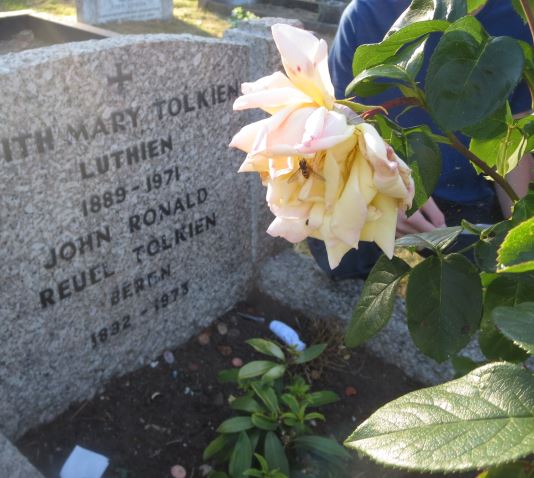
JRRT beeLater in England, at JRR Tolkien’s cemetery, I found an entirely different hymenoptera working a yellow rose blossoming atop the great writer. Some sort of wasp, I suppose. Or perhaps one of the 23,249 species of bee which I don’t recognize. Such creatures, it seems, are everywhere.

Tolkien, whose grave is across the road from an Oxford guesthouse we slept in last week, will be dead forever. Perhaps death is the thing that endures. Yet, even in death the body is restless and changing. Tolkien signed a 50-year contract (costing $2,000) to keep his cemetery plot for half a century. Unless someone renews that contract – made between the city of Oxford, the Wolvercote Cemetery, and Professor Tolkien – his spot will be sold to someone newly dead. It is likely that the great writer’s heirs will renew the agreement and Tolkien will remain at peace for at least another 50 years. Else, like the eroding stones at Stonehenge, Tolkien himself will be moved to other soil, allowing even more roses to blossom.

It all has to do with time. For the humans who drafted the documents at the Wolvercote Cemetery, fifty years is long enough for most people to be remembered. And then forgotten – unless one is perhaps JRR Tolkien.

Posted in Books, Culture, or lack thereof, Ecology, People, Strange, Odd Stuff | Tagged , , , | Leave a comment

Drones Deliver Beer

honey beer launch

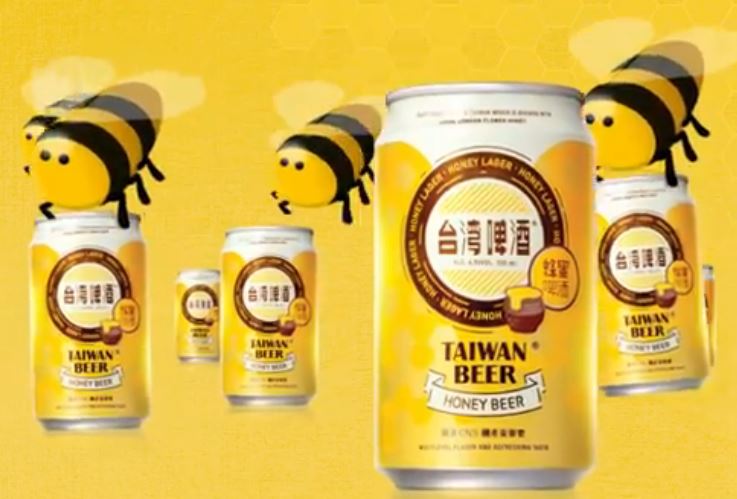
Drones get no respect. If not accused of lounging around the hive, their mechanical doppelgängers get accused of corporate espionage because they spy into office windows. Finally, a people-friendly use for drones that makes sense. A Taiwanese brewery will use drones to deliver its Honey Beer brand to your next party (if it’s held on the island of Taiwan).

Using drones to delivery beer is an imaginative publicity stunt performed by Wunderman Taiwan, a promo-company that knows how to create a lot of buzz. A Wunderman VP (Jeff Wen) says it is hard to break a new product into the Taiwan market. It looks like they found a way. You can read more at this link –  Drone ‘Bees’ Deliver Honey Beer Brand to Taiwanese Office Workers – and here’s a video:

.

Posted in Culture, or lack thereof, Honey, Strange, Odd Stuff | Tagged , | Leave a comment

A Bee Won’t Hurt You If . . .

edmontonThe city of Edmonton, Alberta, is telling its citizens that bees are good. People sometimes forget. Not long ago, Obama was trying to calm screaming kids on the White House lawn when one child spotted a bee and dozens panicked. That was D.C.  Edmonton (though it has a million people) has rural routes. It’s the capital of the biggest honey regime in Canada. The chief apiary guy (Medhat Nasr) lives and works in Edmonton. Lots of Edmontonians have uncles and aunts and grandparents still out on the farm. The agricultue minister (Oneil Carlier) lives on the edge of the city. Yet, the city would like people to chill out about pollinators.

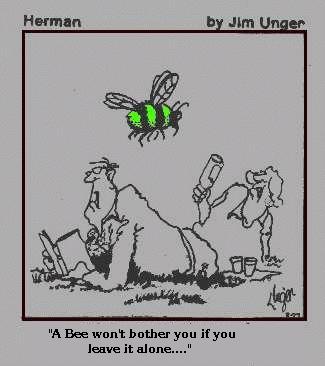
A story in the Edmonton Journal (City releases new videos to clear up buzz about bad bees) tells us that since urban beekeeping is legal and popular in the city, a series of 5 short videos are being produced and released to the public. The first, comparing bees to wasps, is just 33-seconds long, but may help people realize that bees aren’t the nasty, ugly, aggressive war-machines that wasps are. Bees are gentle and sweet. And will usually leave you alone if you don’t bother them. Here is the bee-promo, produced by contractors working for the City of Edmonton:

By the way, the film project hired Edmonton-based Amplomedia (for $5,000) to make the 5 pro-bee videos. The company specializes in getting messages across in a minute or less. A good idea since attention spans need to be be measured in milliseconds these days.

ungerUrban Beekeeping was legalized in March by Edmonton’s city council. As part of the education package, city dwellers are being reminded that bees are natural, bees are pollinators, and bees may displace meaner and less manageable stinging insects. That last point, made by  Hani Quan, a planner with the Edmonton Food Council, is dubious and double-edged. Quan, according to the Edmonton Journal, said, “The more bees we have, the less wasps we have.” It is highly debatable that honeybees displace wasps, resulting in fewer of the meaner hymenoptera. The two groups occupy quite different ecological niches and eat entirely different groceries. Further, honeybees have been named as culprits in chasing out lesser bees – native bees such as various bumble bee species which are disappearing.

Nevertheless, keeping honeybees assures pollination of a range of flowers in Edmonton. Beekeepers serve a role in maintaining the city’s diverse avocations. Beekeepers are usually among the most sensitive promoters of a clean, healthy environment. The activity is licensed and regulated in Edmonton and the new education program also helps urban beekeepers know their responsibilities. To help with that, the city has issued this Urban Beekeeping Guidelines flyer which beekeepers everywhere may find useful..

Posted in Beekeeping, Ecology, Outreach, Stings | Tagged , , , , | 1 Comment

Plight of the Bumblebees

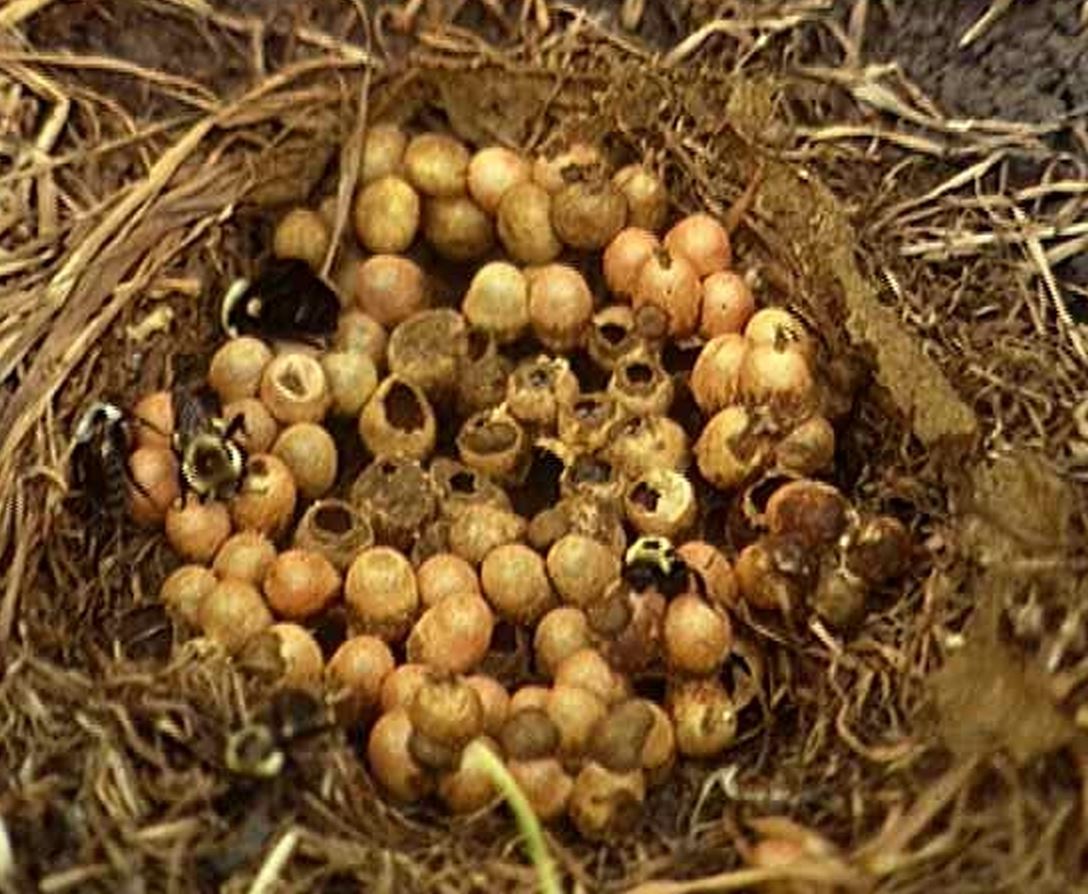
Bumblebee nest, Ocala Forest, Florida, 1974

Bumblebee nest, near Ocala National Forest, Florida, 1974   (Photo: Ron Miksha)

Forty years ago, near Florida’s Ocala National Forest, I took the photos seen in today’s blog. This is a bumblebee nest, accidentally uncovered and exposed on the forest floor, in the winter of 1974 in central Florida. You can see a few bees and about 90 cups, or pots, built by them. The pots hold pollen, nectar, and future generations of bees. If today’s news about bumblebee habitat is true, you might not find these particular insects in that particular woods anymore.

A study published in the journal Science (and reported by the New York Times, Time magazine, CTV, and Globe & Mail among many others) warns that the warming climate is making life miserable for bumblebees. The paper, with Jeremy Kerr and Alana Pindar of the University of Ottawa as principle authors, relates that some species of northern hemisphere bumblebees have lost 300 kilometres of southerly range. The researchers believe this is most likely due to climate change. As the climate warms up, certain plants disappear or are crowded out by invaders. It is also possible that warmer days hinder the bees’ mating or foraging abilities. One would expect that the bees would simply spread further north to take advantage of new locations that become warmer and habitable. But that doesn’t seem to be happening.

A highly immobile bumblebee nest.

A highly immobile bumblebee nest.

Unfortunately, most bumblebee species do not reproduce nor spread fast enough to head northward into new habitat. Instead, the bees are being trapped, or “squeezed in a vice” (as Dr Kerr describes it) – unable to populate areas to the north, unable to continue to live in areas to the south.

By examining nearly half a million scientific observations of 67 species of bumblebees from the past 109 years, the authors of Climate change impacts on bumblebees converge across continents have presented an overwhelming indictment of our likely future. Their study may be the most in-depth analysis conducted so far on the impact of climate change on an entire complex group of important native species. This is a “big data” study and nothing like it has been done before.

This was indeed a comprehensive analysis. Only observations that definitively identified species and placed them in documented locations at specific years comprised the 423,000 geotagged data points. The 67 species of bumblebees were mapped and their changing territories were noted over the years. For each of the sightings, the species, year and location was noted. For most species, range of habitat is significantly shrinking.

The 14 scientists involved in the study were determined to discover the cause of the diminishing bumblebee range. With such a huge data set, it was possible to learn that pesticides and urbanization (paving over forage and nesting sites) were not significant causes of the plight of the bumblebees. For example, the study found that the use of neonicotinoids, which can be harmful to bees, does not account for the widespread loss of bumblebee range. Instead, climate change was correlated as the most consistent cause of the bees’ shrinking territory. Within the bumblebee habitat, the average temperature increased 2.5 degrees Celsius during the century investigated. That’s bad news for bees.

Unfortunately, the bumblebees are not migrating north quickly enough to maintain the size of their former range. Although new potential homelands are heating up, bumblebees don’t move fast enough to keep up with the changing climate. The bees become our polar bears, adrift chunks of ice, clinging to what they know, unable to move to safer places. To migrate 300 kilometres in 100 years, the bees would need to colonize new territory at a rate of 3 kilometres (2 miles) each year. But bumblebees do not migrate in hefty swarms the way their honey-making cousins do. Honey bees may send colonizing swarms a dozen kilometres. We know this from observations of honey bee swarms crossing lakes, and also from the intrepid settlements established by Africanized honey bees which traversed 9,000 kilometres in 30 years during the last century. Bumblebee biology is vastly different. At the end of each season, all the workers die. Then a few mated queens establish new colonies, typically within a few hundred metres of the preceding year’s nest. Bumblebees are not known to conquer vast stretches of new habitat.

Instead of spreading rapidly northward, bumblebees are mostly stuck in their ancestral settlements. The only real exception to that is an upward migration – in the study some species of bumblebees were discovered migrating to higher elevations (hills and mountains) where that option was available. The Kerr, Pindar, et. al., paper showed that after a 300-metre elevation gain, some species began to occupy better terrain. Apparently, an elevation rise of 300 metres may equal a climate change found by traveling 300 metres north. But it is much easier for bumblebees to relocate 300 metres higher up in a hundred years than to fly 300 kilometres north.

Assisting a bumblebee migration.

Assisting bumblebee migration.

Short of reversing climate change, other methods of saving the imperiled bumblebees are being considered. One possibility is assisted migration.

Assisted migration would involve relocating enough bumblebees to a new habitat so that the reproductive viability of the insects is ensured. The relocations would be further north in ecological niches that are similar to the bees’ former, but disappearing, habitats. In this scheme, the bumblebees would be scooped up, loaded into vans, seat-belted if necessary, and then released in better pastures.

Unfortunately, artificial assisted migration is a more likely fix for the plighted bumblebees than a return to a cooler climate.

Posted in Bee Biology, Climate, Ecology, Save the Bees | Tagged , , , , , | 4 Comments

Russian plane attacked by bees

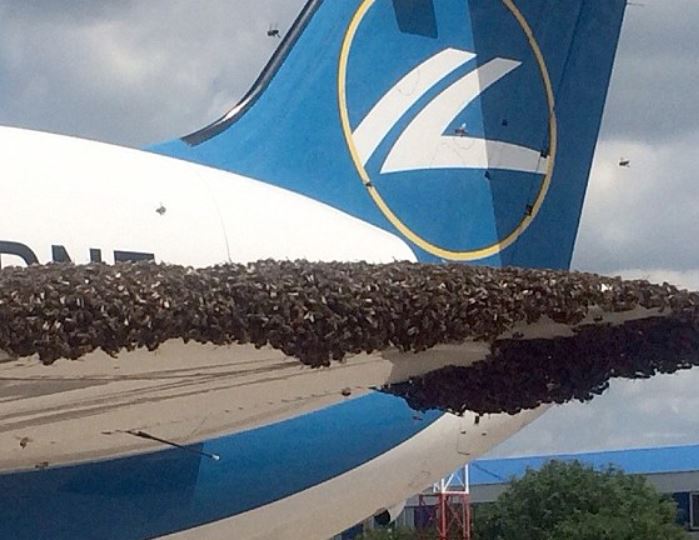
beesonrussianplaneThe newspaper call it an attack. But we know better. The story being carried around the world yesterday is that a group of honey bees decided to attack a passenger plane (an Airbus-319, no less… that’s just a small step down from the Airbus-320) as it was preparing to embark for St Petersburg. I guess people were frightened by the bees. But the bees were not engaged in an attack. It was a harmless swarm, rather common at this time of year. It is doubtful they planned to entomb the plane in wax and honey or turn it into a hive.

I find it more frightening that two ambulances were called. This, said the airport, was in case the bees managed to get into the cabin. You know, through rusty holes in the fuselage, rips in the metal where seams are coming undone, or maybe broken passenger windows. I have a friend who has travelled aboard regional carriers in Russia. Some are a bit relaxed about inspection and safety standards – in my friend’s case, his seat belt didn’t work, there was no preflight safety announcement, and his plane limped badly down the runway until the pilot finally brought it back for a tire change. (Yesterday’s incident involved a different carrier, one with a much better reputation. They probably have a sturdy plane.)

What motivated the swarm to attack yesterday’s passenger jet? According to a Russian news source, that question was posed to a local agriculture scientist and bee expert. Timiryazev Anatoly Kochetov explained, “Bees are very fond of silence, and I assume that they attacked the plane as a source of noise.”  That sounds unlikely. The scientists more plausibly added that the bees were swarming from some suburban apiary and were migrating through the airport.

The migrants didn’t fare well. Airport staff “removed them” from the plane. The bees would not have survived clinging to the wing for the entire 800-kilometre trip from Moscow to St Pete. They would have flitted off, one by one, icy cold. It’s also doubtful that the bees survived the removal at the airport if they were hosed off with water as I suspect they were.

Posted in Strange, Odd Stuff, Swarms | Tagged , , , , | 7 Comments