Burt’s Bee Buzz

Arguably, the most famous beekeeper in all history was an unlikely hippie living off the land in Maine’s remote woodlands. Burt Shavitz died this weekend. He was living the good life, a reclusive member of the back-to-nature, granola-chewing crowd. In his case, Burt Shavitz had left New York City for a self-imposed exile in the northeast corner of America. He was seeking solitude and the chance to live a life of hard independent work. It was a primitive, subsistence life. In the 1980s, while in his 40s, he was living in a turkey coop. To earn a small bit of cash, he kept bees.

There is a movie about this peculiar man. Burt’s Buzz, a 2014 documentary film about Burt Shavitz, reminds me a bit of Forrest Gump. Like Forrest, Burt seems to have appeared at the right place and time with neither scheming forethought nor greedy desire. Also like Gump, Burt seems oblivious to the world around him, yet he rocks it like an ocean liner rocks lesser boats on the sea. It’s an interesting, but odd film. The highlight of the documentary, for me, was when Burt, on  a promo trip to Taiwan, skypes his dog back in Maine and the two begin howling in harmony. Not that other parts of the film weren’t charming. We learn that at age 78, Burt is comfortable in a house without hot water. Running water is, in fact, a step up from the way he spent most of his earlier life.

In the end, he led a strangely divided existence. He clearly loved his frugal life on his Maine farm. But he also relished the attention he received as Mr Burt’s Bees – a walking, talking corporate mascot. When he wasn’t lighting his wood stove or feeding wild birds, he roamed the world while managers pampered him. Burt Shavitz was paid to promote the corporation’s products, nearly all of which still sport his bearded face on the packaging.  But he was more than a human mascot or an unwitting parody of the Burt on the lip balm sticks.

Burt wasn’t always Maine’s most famous bee man. He was a staff photographer for a New York Jewish weekly, then Time Life gave him credentials to freelance for them. He sold pictures of John Kennedy and Malcolm X, among many others. At 35, he tired of New York City, borrowed an ex-girlfriend’s van, loaded some books and a mattress, and headed to upstate New York, then Maine. He worked odd jobs until a swarm of bees appeared. He housed the bees in equipment given to him by a friend. One hive grew into 26. ““It’s a way to make a living if you’ve got a strong back and a strong mind and good eyes,” said Shavitz.  About beekeeping and neighbourliness, Burt told a Times reporter that he was lucky, “. . . that there was a man who was patient, knowledgeable and even-tempered to teach me beekeeping. He told me to stand back and watch what he did.”

Soon after, Burt met Roxanne Quimby. She was hitchhiking. He stopped his flatbed truck to give her a lift. Roxanne was a single mom with 6-year-old twins when they came together in 1984. It seems Burt was infatuated with the young woman. “She could do anything. Chop wood, grow beans…she was strong.”

Roxanne could also make candles from Burt’s beeswax. And she knew how to sell them. She had the business brains in their union. She experimented with face creams, lip balm, treatments for cold sores. Though the products sold well because the ingredients were purportedly natural, it was probably the packaging and the logo that really created the billion dollar company. Success came when Roxanne started marketing a lifestyle – Burt’s lifestyle. His image became the company’s icon and the wholesome self-reliant vegetarian zen of a man was part of the package. In a dozen years, the company’s annual sales grew from $22,000 to $23 million.

Burt and Burt’s Bees parted shortly after the company was moved from Maine to North Carolina, in 1994. He tried to work in the south for the big outfit which he had inadvertently helped create, but Burt left amid a situation of a personal nature. He never really felt at home at the huge corporation – so distant psychically and physically from his woods in Maine. Within those years of unbridled growth, Roxanne and Burt grew apart. In a dispute that seemed to leave both Burt and Roxanne feeling betrayed, Burt was allegedly paid $130,000 and given 37 acres of land for his share of the company. Roxanne later gave Burt four million dollars more. By then the company was sold for $935 million. The new owners hired Burt to represent the company at store openings and promotional events around the world. All he had to do was dress like Burt, act like Burt, and say very little. It was corporate publicity and it worked well for everyone involved.

(Roxanne, by the way, has been generally maligned in the press as an aggressive business woman. But she created the company and ran it with progressive ecologically and socially enlightened guidelines. After receiving hundreds of millions of dollars for the Burt’s Bees company, she purchased 120,000 acres of Maine forest which she is preserving and trying to give to the state as a sanctuary and park. She is also very active in a number of Portland charities. Seems she never really needed money, either.)

I began this piece by mentioning that Burt Shavitz may have been the most famous of all beekeepers. After watching the documentary of his life, I suspect he didn’t mind the fame, even though he loved his solitude. (“A good day is when no one shows up and I don’t have to go anywhere.”)

For Burt, it was never about money.  His settlement gave him some cash, plus a home in Maine. He lived another twenty years, undoubtedly more content as a chopper of wood and a friend of animals than as a manager of men in the business world. Although the corporation was sold for a billion dollars a few years after Burt left, he wasn’t disappointed that he had missed out on a fortune. As he once said, he never aspired to a life as a yuppie, with a trophy wife, a trophy car, and a trophy house. His life was very much what he wanted it to be – an old retired hippie on a farm in Maine.

Posted in Hive Products, Movies, People | Tagged , , , , | Leave a comment

Some Mountain Beekeeping

Catching Ron in his natural element.

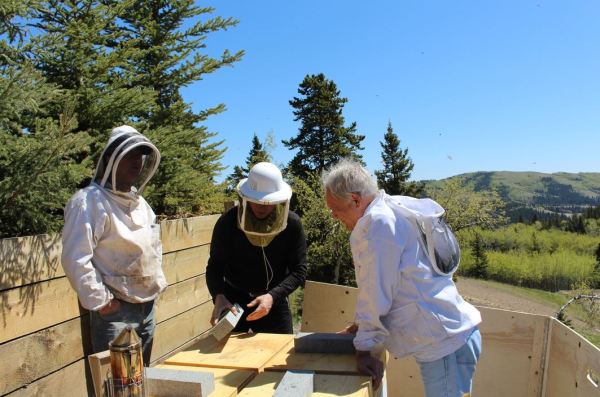
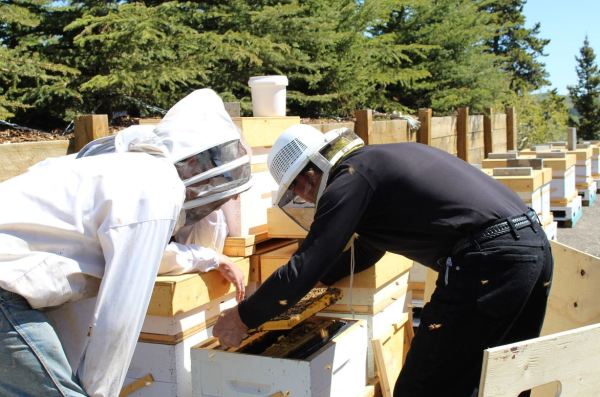
A month ago, friends invited me to see some bees at a ranch up in the foothills of the Canadian Rockies. Beekeeper Stephen, a fellow geophysicist, guided us as we meandered the secondary roads west of Calgary. We gradually gained a bit of elevation (from 1,100 metres at my home to nearly 1,500 metres at the ranch). I was curious to see how bees might survive in that largely forested locale – remote from large fields of alfalfa and canola, and in an area where grizzly bears roam and frost and snow are possible intruders even during the summer months. The bees I saw were not merely surviving, they were thriving.

The resident beekeeper, Mike, had installed 20 packages. The first round of brood was hatching and the bees looked great. They were smartly provided a perch beside the workshop, overlooking a broad valley spotted with hay pastures. Dandelions were blooming and nectar and pollen were arriving by airborne express. I wondered about the grizzlies, the potentially windy exposure, and the fact that the best forage was down in the valley, about a hundred metres below us. But Mike had been keeping bees at this spot for a few years. They did well, in both quantity and quality of honey. This bee yard had produced honey that won Best of Show at three different competitions last year. I reminded myself that not every location is perfect and you work with what you have. Here are a few pictures from last month’s expedition.

Who has seen the queen?

Stephen, Mike, and Ron

Ron and Mike

Quite a view, eh? But as usual, beekeepers can only see bees whenever bees are around.

Quite a dramatic location, isn’t it? In the pictures above, you see an easily moveable plywood windbreak that Mike made. This doesn’t stay in the bee yard. It is just in place for a few moments to help calm the bees and to keep smoke from whiffing away in a sudden gust. The blocks that you see hold the lids down when it gets windy. Their orientation is a reminder to the beekeeper if something is amiss. If this sounds a bit odd, it actually stops the beekeeper from roaring through the hives, lifting lids and forgetting that one hive or another had supersedure queen cells or any other issue that should bring caution to the hivetool. It was a great day, and a wonderful feast was provided by Brenda Peatch. Brenda also took all of the photos you see in today’s posting. Many, many thanks to everyone!

Posted in Bee Yards, Beekeeping, Friends | Tagged , , , | Leave a comment

How Fast is your Honey?

Honey has velocity. But you knew that, didn't you?

Honey has velocity. But you knew that, didn’t you?

We don’t usually think of honey in terms of speed. One of the coolest things about beekeeping is that the craft encourages the crafty to learn about everything. Honey, pollination, wax, social behaviour of insects, ecology, and much more is there for the amateur to discover and experiment upon. I’ll tell you how fast honey moves in a moment. But first, a hint – it’s not slower than molasses in January.

I just returned from the Science Writer’s Conference in Saskatoon. The author of The Velocity of Honey, Jay Ingram, was everywhere at the meeting. He is a hard-working guy. You may remember Jay from Discovery Channel’s Daily Planet (a science-news TV program). He was the host for 15 years, until 2011. If you are old as I am, you may also remember that Jay Ingram first burst upon the national scene with the CBC’s weekly science radio broadcast, Quirks and Quarks, in 1979. These days, you may have a chance to catch Jay giving a lecture – don’t pass up such an opportunity.

Although Jay Ingram is a whiz at explaining every type of science – from physics and chemistry to the latest medical breakthroughs – he was in Saskatoon at the writer’s conference to help attendees become better science communicators. He also introduced his new book, The End of Memory: A Natural History of Aging and Alzheimer’s. The Alzheimer’s lecture had great imagery of plaques and tangles and fascinating stories such as the case of nuns led by Sister Mary (It’s all in his book.) The next day Jay spoke of the art of science story-telling and he held a workshop. Among other details, we were reminded to write at a conversational level when writing for a general audience. (Am I doing OK with that?) Jay Ingram stayed the length of the conference, spending a lot of his time with science students. Even on Sunday morning when most of us were boarding planes and automobiles, he was in a session with those young men and women, instilling valuable writing tips and fostering skills that sharpen science reporting.

jayingram2

Jay Ingram and the art of
science communication.

So, what is the velocity of honey? Usually pretty slow. But it will catch up with falling stars if dropped from a high enough altitude. For a more detailed answer, I’ll refer you to Jay Ingram’s book, The Velocity of Honey And More Science of Everyday Life, a collection of science essays covering topics from spinning coins and skipping stones to math-literate animals and dripping honey.

Until you have a chance to read it, here is something to experiment with, and it comes from Jay’s book. Honey is more viscous than water, so it flows more slowly. You could place a piece of toast on a plate and slowly pour a stream of water on the toast. Great, you’ve ruined your toast. But in the meanwhile, you might have noticed that the water didn’t pile up on the toast. Instead, it raced off in all directions and sort of randomly flooded the plate and floor. Now get a new piece of toast. Drip some liquid honey on the toast. If your honey spoon is close to the toast, you may have a slow moving stream that bulges upwards toward the spoon. Slowly elevate the spoon and the stream narrows as the velocity of honey increases. Pay attention to the type of bulge you are now creating on your toast. Depending on the dispenser, you may find a ribbon that wobbles back and forth or perhaps a circle that loops around and around. Experiment with height, which increases the velocity of the honey as you make it fall from a higher position. There are some pretty cool things going on but you would never see them if you used water instead of viscous honey. You get more interesting effects with honey. And much better toast.

Posted in Books, Science | Tagged , | 2 Comments

Science Writers Writing Science

My ultimate destination on the weekend was the place you see above, Marquis Hall at the University of Saskatchewan. In three days, I spent twenty hours in this room, absorbing much-needed writing skills. And eating, for it is in this room that an endless supply of some of the best muffins and worst coffee I’ve ever encountered were served. Overall, it was a comfortable venue with well-managed acoustics and well-spoken participants.

I knew no one here, except the fellow who helped me and my wheelchair get around the campus. Gerhard Maier is a good friend, and both the city of Saskatoon and this meeting were of some interest to him. Gerhard is a science writer, having published African Dinosaurs Unearthed. His book is an in-depth chronicle of the century-old discovery of the biggest dino dig in Africa. Without Gerhard’s help and the excellent work of the organizers at the Canadian Science Writer’s Association I probably would not be here. The organization had brewed up an irresistible roster of speakers and topics. We would hear Jay Ingram, a tireless science communicator who once hosted CBC’s Quirks and Quarks and Discovery Channel’s Daily Planet. Also, from Brooklyn via Skype, we learned how to latch on to news trends by one of the proprietors of Mashable. There were various panels – food security, critical thinking, clear writing – which included about 50 scientists and panelists. There were tours on the South Saskatchewan River, and in the University of Saskatchewan’s dairy research centre, vaccine centre, and the Canadian Light Source synchrotron, Canada’s brightest light, which is used to decipher RNA code among many other things. There was much more, of course. Lunch speakers, more tours, and some obscure thing called “networking” which I couldn’t figure out very well.

I had joined the science writer’s organization less than a year ago. I have spent the past couple of years trying to learn how to communicate science, but it has been a haphazard education. I picked up a few good writing books (Steven Pinker’s Sense of Style, for example) and I read articles and blogs about writing whenever I could. I had heard that incessant writing builds skill, so I try to publish a blog piece every week at this site and at my geophysics blog, The Mountain Mystery. The idea that becoming a writer requires a lot of practice was confirmed by some grizzled reporters at the conference. I also gleaned some clever tools to help me write more clearly. Science writing for a general audience, for example, should be similar to story-telling in a conversational tone. Try to avoid high-falutin words like apiarist when beekeeper says the same thing in a simpler way. Emotional appeal, humour, and personal perspectives are encouraged when conveying science messages. Analogs are useful tools but caution should be exercised to be certain they are accurate enough. (One example is the now discredited and over-used analogy of the atom drawn and explained as if it were a miniature solar system. It isn’t.)

It was a great conference, but don’t expect this blog to suddenly blossom into a phenomenal work of art with well-written witty tales about beekeeping. I will try, but I don’t anticipate miracles will happen. Not for a few days, anyway.

Posted in Science | Tagged , , , | Leave a comment

Saskatchewan’s University

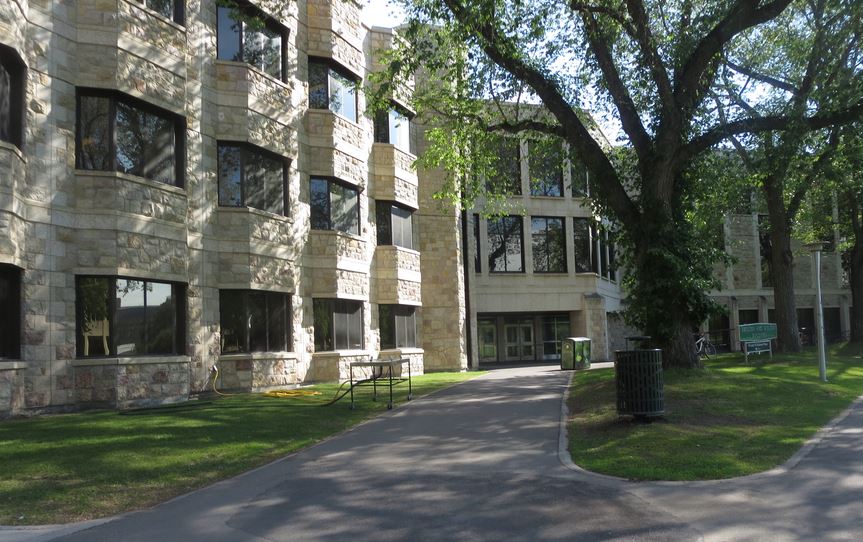
The doors that led to my geophysics career.

The doors that led to my geophysics career.

Today, I am at the University of Saskatchewan. I am here to attend the 44th annual conference of the Canadian Science Writer’s Association.  I hope to learn to be a better writer (maybe this Bad Beekeeping Blog will become less of an invidious palaver). But I am also here – at the U of S – to visit my alma mater, the campus where I earned my geophysics badge 25 years ago. I had not seen the campus in 20 years. The last time I was here, I was interviewing science graduates and trying to entice them with promises of fun, games, and money at a company I worked for in Calgary. That was 20 years ago. The intervening years were busy: I was diagnosed with motor neuron disorder, I married, had two more children (they are now 8 and 13), and I built a honey farm near Calgary, then sold it. I also traveled at least once to Chile, Vietnam, Peru, Croatia, Hungary, England, Ireland, and nine other countries. But I had not come back to the university. Until today.

I met two of my favourite profs. Jim Merriam, my geophysics mentor, and Chary Rangacharyulu, my main physics professor. Both became heads of their respective departments while I was away. Surprisingly, they both recognized me, though I’m afraid that I changed much more than either of them. My 25 years out of school were rough, and it shows. But these gentlemen – and other professors I met today – looked like they had just finished a lecture they taught me and my mates in 1991. We chatted about the school, their lives and families. It was a great visit. I met others who remembered me at the school, too, though many of my associates had retired. We are aging.

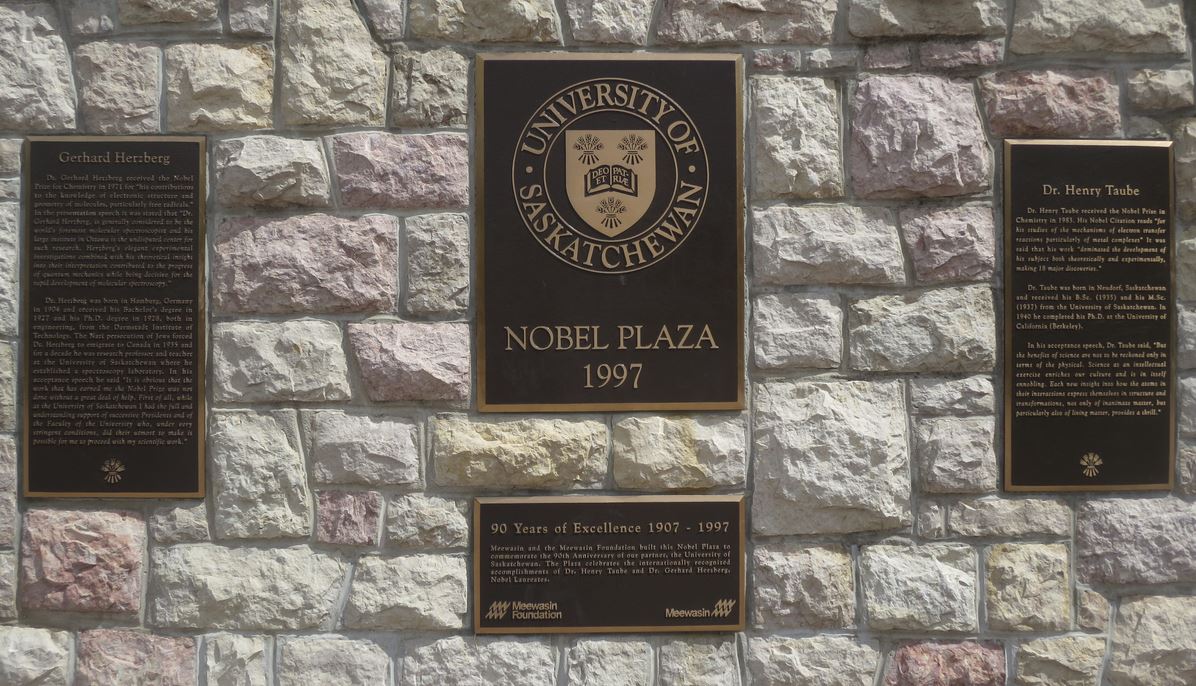
usask2nobelsThe University of Saskatchewan is a beautiful campus. There are gorgeous trees, expansive green stretches, and most of the buildings here are constructed from sandstone blocks – many of them chiseled a hundred years ago from local rock. The school may seem obscure to you because it sits in a small city in the middle of a big province in a big country. You would be surprised to discover that two Nobel Laureates did their research here. The school has North America’s finest veterinarian college and has produced oodles of ag-scientists and geologists.

Someone who works on the Arts and Sciences Scholarship Committee at the University of Saskatchewan told me that they had received a nice grant a few years ago. (I was not told the source of the money.) It was to be used for a scholarship open to any student, in any area of study, unless the recipient was a bad beekeeper. The university committee realized at once that the bad beekeeper was me. They likely thought it was quite funny, as do I. I knew that a few people from among the Saskatchewan bee community were wary of my success. I never thought they would immortalize me in such a charming way. I’ll have to learn more about this so I can contribute to that fund myself.

Posted in Friends, Science | Tagged , , , , | 1 Comment

The Long Road to Saskatoon

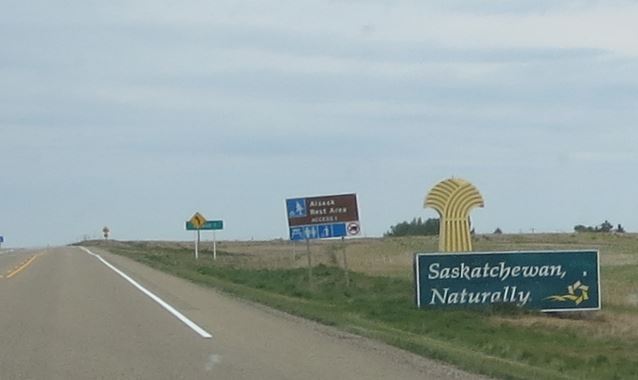
I am heading off to Saskatoon today. It has been 20 years since I was last there. Rather shameful delay, actually, since I earned my geophysics badge in Saskatoon and was treated really well by all the professors at the University of Saskatchewan. (In other words, none of them failed me.) I should have not waited twenty years to return for a visit, but it is an eight-hour drive from my home in Calgary. That makes it too far to drive, yet too close to fly. So, I just don’t go there. However, with the help of a good friend, I finally drove up to the city named for a bright blue low-hanging fruit. The route between the two cities is a rather monotonous trail. Lots of wheat and canola. And hundreds of ranches with alfalfa and clover – great nectar sources that make the area one of the best in the world for honey production. Today’s blog posting is simply a few pictures from the drive.

Not all of Alberta’s energy is sucked from the ground.

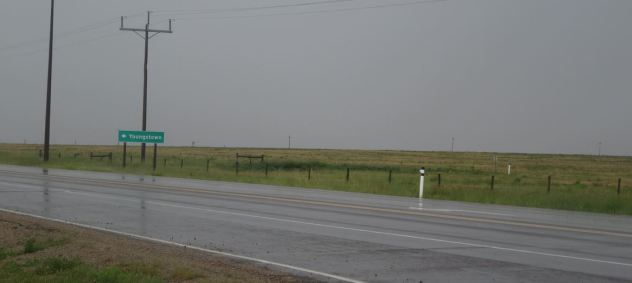
Youngstown, Alberta. There is another Youngstown (in Ohio) not far from
my childhood home in Pennsylvania. (I have heard it is also losing population.)

Saskatchewan in Sight


Posted in Beekeeping | Tagged | Leave a comment

Pure Sweet Honey and the ALS Run

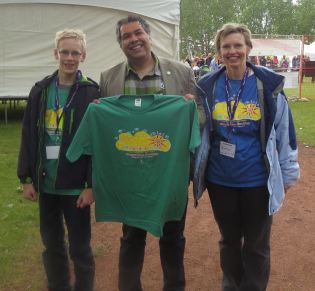
Left, my son Daniel and my wife Eszter – Daniel is giving Calgary Mayor Nenshi his runner’s T-Shirt.
Right, Co-ordinator Jane tries to defend the mayor from an apparent Star Wars attacker.

Once again, our friends at Pure Sweet Honey Farm have made a wonderful contribution to Calgary’s ALS fundraiser – a walk/run/roll called Betty’s Run. Here is a great big THANK YOU to Willi and Stan at Pure Sweet. They help this organization a lot. The money raised each year by the ALS Society in Calgary helps with all sorts of equipment and aids to daily living for victims of the disease. Contributions to the society also supports research. It is all appreciated so much!

For all my readers and friends (Man, there are a lot of you!), I’ll do my annual quality-of-life update. I’m OK. My type of ALS is really, really slow. Diagnosed 14 years ago, but I can still walk a little, still drive my van, still write my blogs, and still do my geophysics. The quality-of-life department includes family and friends and they have all been a great support. Thank you!

Left, Stan and I with Helen (sporting rabbit ears)
Right, Back side of Mayor Nenshi’s T-shirt. Can you spot the Pure Sweet Honey label?
Posted in Friends | Tagged , , | 1 Comment

Your Dead Bees are in the Mail

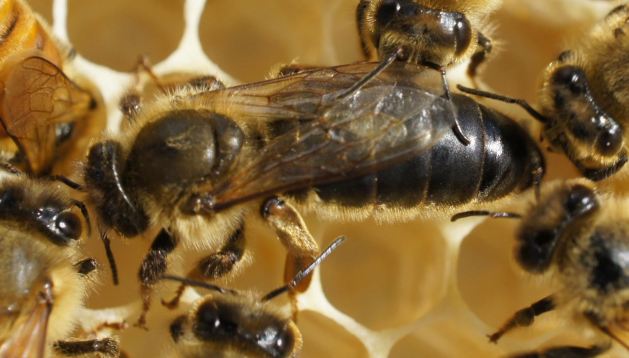
Canadian Queen – photo by Stephen Bennett, Calgary


Well, this is pretty sad. Canada Post killed some bees. Queen bees are in short supply in Canada. Because of our late springs and short seasons, most queen bees are imported from warmer climates – Hawaii, New Zealand, and Chile are prime sources. These are used to replace colonies that have died over winter or to increase a beekeeper’s number of hives. It would be great if Canadian beekeepers raised queens and sold them to other beekeepers, but Canadian beekeepers sell fewer than one-tenth of the 300,000 or so imported queens used here each year. The rest arrive from far away. Beekeepers order the queens months in advance, send full payment in advance, and wait for the overworked and harried queen-producers to send the queens during the Canadian spring. The queens are fragile – they can’t survive in a parcel for long. So, when a batch of them go missing, it is a rather tough problem.

Canada Post lost one hundred queens! They all died. The most probable cause of the deaths of these insects was heat exhaustion, the result of being confined without proper ventilation and air circulation. It’s also possible they simply ran out of food, though the shippers would have likely provided enough honey or supplements to last a couple of week. The really sad twist to this story is that these queens were not coming from the other side of the world. This bunch of queens was raised in Canada – out in the eastern townships of Quebec. They were only being mailed as far as Montreal. Canada Post found the parcel after five days – the (now dead) queens and their attendant bees were in a warehouse instead of in the beekeeper’s hands. The post office is willing to refund the $200 freight they had charged. But they are not willing to pay the thousands of dollars that the post’s negligence cost the beekeepers who ordered the queens, even though they admitted internal miscommunication had caused the loss. However, Canada Post wrote to the beekeeper and said, “We sincerely apologize for the results of this experience.” They are very, very sorry.

Posted in Queens | Tagged , , | Leave a comment

Teaching the Bees to Speak

“I keep the Welsh language alive through bees,” Welsh beekeeper Wil Griffiths told a Financial Times reporter. This could be a huge scientific break-through. Around the world, linguists have been alarmed with the rapid loss of many of the world’s 6,000 languages. They expect half of those languages will suffer an unspeakable future by the end of this century. The Welsh language could be among them.

Teaching bees to speak might stop that decline. Already, bees communicate to each other through their fancy dances and they communicate to us through their angry buzzes. Maybe they can learn Welsh. Unless, of course, Mr Griffiths means something else when he talks about keeping his language alive through bees. You can check out the whole story here. Maybe you will find an interesting story about a bee club in Wales that holds its meetings in Welsh (instead of English) in order to keep the endangered language alive. “Pob lwc iddynt!” as my Welsh neighbour used to say when he heard about something that was going to be hard to do.

Posted in Humour | Tagged , , | Leave a comment

The Ultimate Bee Beard


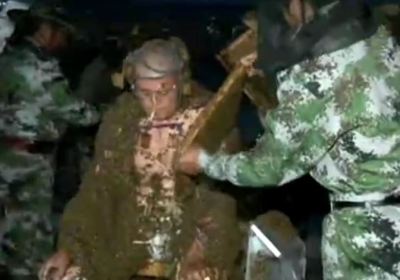
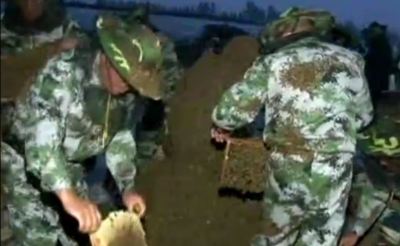
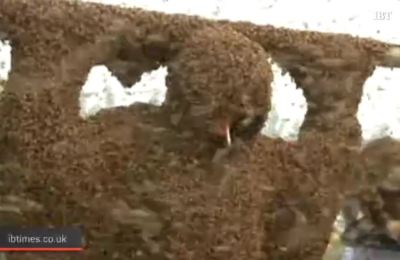
 Perhaps “National Cover Yourself in Bees Day” is underway in China. This 55-year-old beekeeper (seen smoking, center of the pictures) from Shandong Province was assisted in growing the ultimate bee beard by a team wearing army camouflage fatigues. His helpers can be seen shoveling honey bees over the beekeeper (literally – watch for the shovel near the end of this video). The beekeeper set a new record – 1,100,000 bees, weighing 110 kilograms (about 250 pounds), cover the man as he seems to bear a cross in the last scene of the film. It took an hour to pile on the bees. The insects were probably not hurt, but would have been rather confused. To keep them on the beekeeper and not on the Chinese Army, the beekeeper had “dozens of queens” strapped to his clothing. When not performing stunts, the million plus bees can normally be found foraging for nectar and pollen.


Posted in Strange, Odd Stuff | Tagged , | Leave a comment