About time

Ever wonder why it’s called Savings Time? Ben Franklin, America’s first  inventor/publisher/scientist/states-man/postmaster proposed the idea back in 1760 as a way to save money. You see, his father had been a candle maker so little Ben realized from an early age how expensive it is to light a house at night. Instead of “early to bed and early to rise” making a man wealthy, Ben Franklin figured pushing the clocks ahead could do the same trick without requiring new sleeping habits. So, he invented Savings Time.

It should be easy to remember – “Spring Forward; Fall Back.” Easy, unless you are Toronto’s part-time mayor and full-time clown. Rob Ford’s Twitter-feed mistakenly advised Torontonians last night to set their clocks back instead of ahead. This might be a good plan if you want to fall into Ford’s tactless, homophobic, drug and booze-crazed world. The rest of us will spring forward, if you don’t mind.
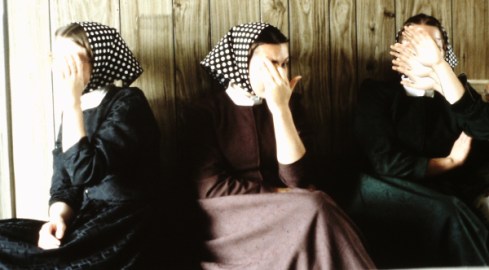
Hutterite girls three monkeys

Saskatchewan Hutterites – photo by Miksha

Maybe you are not moving your clocks at all? When I was a beekeeper in southwestern Saskatchewan, I was proudly sticking to Standard Time year-round, just like the rest of the province. Saskatchewan is one of the few northerly places that doesn’t bother with Savings Time. It’s a cow thing – the cows don’t wear wrist watches (or any jewelry or Rob Ford-ish bling) so the cows of Saskatchewan vetoed the idea when it was proposed in legislature back in the old days. Saskatchewan does have a sub-population of timely dissenters: The Hutterites. These good people were among my friends when I was their Honig Mensch, many years ago. But I was cautious not to show up at their huge communal farm during daily prayers, which were offered at 5 – slow time. This Mennonite-type group set their clocks back an hour from the rest of Saskatchewan, so they could coordinate church times with other Hutterite colonies across North America. This also put their clocks at the same time as the Eastern Time Zone, i.e. Toronto Time. (So perhaps Rob Ford was trying to put Toronto on Hutterite time. I think that city’s mayor would benefit greatly if he were to spend a year or two on a Hutterite colony – farming, learning to do real work, learning to share, maybe authentically having the “Jesus Moment” he claimed to have had six months ago.)

Saskatchewan is not the only place that keeps its clock fixed.  There are numerous enclaves of other-time peoples. Arizona does not change to Savings Time when the rest of the United States does. However, within Arizona, the Navajo Nation does move clocks ahead to Savings. However, within the Navajo borders, the Hopi Reservation does not change its clocks. However, living on a ranch in Hopi country is a family where the mother works on the Navajo Reserve, so that house moves its clock. Resulting in a complicated situation where a family’s clock is ahead of the neighbours’ clocks which are behind a surrounding community which is ahead of a state that is behind a country that moves ahead.

If you are among the shifters, rather than the shiftless, enjoy your extra hour of evening sunlight. It is a gift that will dramatically cut your candle-consumption. If you live near the western edge of your time zone, the savings will really pile up. However, considering Saskatchewan bees have the highest annual per colony honey production in North America (about 180 pounds per hive) we need to consider that keeping the bees on a stable clock has its advantages, too. So maybe let them keep track of their own time.
Posted in Friends, History | Tagged , | Leave a comment

Cold, eh?

March 1st. Saskatchewan, Canada.

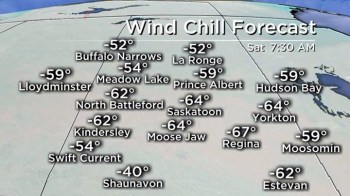
Well this is a bit unfortunate. It was minus 31 in Calgary this morning, the wind picked up and it felt like minus 50. That’s about the same weather whether Fahrenheit or Celsius – the scales meet at -40. So, minus 40 Fahrenheit is also minus 40 Centigrade. Cold in any system. Finger-shattering, lip-splitting cold. Even inside our house – it was 12 degrees in one of our bedrooms this morning. Of course it would have been more uncomfortable had we been camping out this weekend.

Global warming? Just like politics, all weather is local. Yes, we are getting a cold start to March. But it’s not even a record for us – it was once -36 C on March 1st. Meanwhile, the southern hemisphere is finishing off one of their hottest summers. The severe droughts, grass fires, and dust-bowl conditions are being exasperated by extreme heat. An article titled “Australian Summer Melts Records,” published yesterday by the Australian Associated Press and featured in The Guardian, says records for sustained heat have been brutally burnt. Adelaide, for example, had 5 days in a row of over 42C. They haven’t had that before.

Today in Calgary, people didn’t stray far from home. Nor did the bees. March is usually the worst month for winter losses in this area. Bees might survive (even queenlessly) for the span from November through late February, possibly eating as little as forty pounds of honey, but then with longer days they become restless. Queenless and weak hives lose population through drifting on mild days while robust survivors suddenly consume vast amounts of winter stores by rearing brood. At about the same time, honey bees which became adults in September or October are approaching their ‘Best-Before’ date and are expiring. Sometimes dropping like flies. Not sure what this last blast of arctic chill will do to the bees, but it would have been better for everyone if it had turned mild instead of bitterly cold.

Posted in Climate | Tagged , | Leave a comment

Sochi Beekeepers

Circassian Honey Shop

As I was watching the CBC evening national news, I was startled to see a piece on beekeeping near Sochi, Russia. The reporter talked about a group of folks called the Adyghe (Ah-dee-gee), or Circassian, people who have lived in the Caucasus Mountains just north of Sochi for thousands of years. They were among the indigenous people pushed further into hiding when the Russians expanded their empire in the eighteenth and nineteenth centuries. The news piece reported how the natives were left out of the opening ceremonies and left out of the billions spent on infrastructure in Sochi. Instead, the mountain people were given no new roads, no train station, no attention – even though they are just 50 kilometres from the Olympic venue.

Nevertheless, the Circassians hoped the games would draw some tourists up the mountains. With that in mind, they built a beautiful honey museum and shop – bees, honey, and wax have long been part of the culture and trade of these people. The CBC reporter and camera crew drove up to the villages of Bolshoy (Big) Kishmai and Mali (Little) Kishmai and found they were the only visitors. There were no tourists. As safety is a valid concern throughout Russia, and because there are no decent roads and no promotion of the Circassian area inside the Sochi Games site, visitors simply did not head up into the hills to learn about the indigenous culture. Or to buy honey. It was pretty depressing to see.

Posted in Culture, or lack thereof | Tagged , , , | 1 Comment

Madonna and Bee?

Madonna and honey beeAndy Warhol proved that the mundane soup can qualifies as art. In some people’s eyes. A friend sent to me a link to an E-Bay art sale: Madonna and Bee. I suspect the less I say about this, the more respectful I will be. But what the heck. I’ve seen a lot of Marys in my travels. They tend to look like the girl in this image. Young, very pale-skinned – just like the European artists who create her. So, this E-Bay special is not atypical. Except perhaps for the bee she is cuddling. And the rather mischievous look on her face. And the halo – certainly not your typical 16th century Madonna halo. Other than that, it’s not so different from anything else you’ve seen.

I don’t know anything about the artist of Madonna and Bee. But if he/she is reading this blog entry, please send me a note – and explain yourself! Did you create this lovely print just for the money and fame, or is there a deep philosophical message? Or is this simply a celebration of two of the most beloved characters in western civilization? For the rest of you reading this, I’m sure you want a copy. It’s just $5. Plus $2.50 shipping. Mounted in a $60 frame (which you need to supply yourself) you will have an heirloom which future generations will fondly remember you by. Get out your credit card and follow this link!

There are only 10 prints left, so hurry. Unless you’d prefer the Laughing Jesus print, also available on E-Bay.

Posted in Culture, or lack thereof | Tagged , | Leave a comment

Great Reception

honey bee monitor device

How many channels does it get?

Tasmania, respected as the last strong-hold for the Devil and as Australia’s main apple-picking state, has something new to boast about. Scientists are outfitting 5,000 bees with electronic tracking devices. The glued-on sensors are RFIDs (Radio Frequency Identification Devices) which activate monitor stations whenever the bees buzz by. This makes them similar to the vehicle passes you may have hung on your car’s mirror for tollway access, especially in Europe. (I’m not sure if the technology has arrived in North America yet.) But it is nothing like the GPS tracker inside Fido’s collar or my slippers. Those actively broadcast location information. That level of technology is still a bit too cumbersome and too expensive to burden either a bee or a beekeeper’s budget. So instead, this is a simpler passive program.

The system is a swarm-sensor array, although this doesn’t mean the researchers are expecting to track swarms. Rather, it means vast amounts (swarms) of data are amassed at a large number of points the bees might frequent – such as apple orchards, watering holes, sugar refineries. It’s a brilliant project. Not much of a fashion statement for the hapless honey bees involved, but a brilliant research project, nevertheless. During the past century, we used to sit by the beehive and grab a bee by the wings, affix a dab of colour on her thorax, make a few notes in the journal, then run around to the orchards and watering holes with butterfly nets, trying to retrieve a few samples. It worked, but the sample set was certainly not a swarm of 5,000. This new technique, developed by Dr Paulo de Souza of Australia’s CSIRO Commonwealth Scientific and Industrial Research Organization, is expected to provide useful data suggesting the way bees interact with the environment, encounter pesticides, and spend free afternoons. The system may even anticipate strategies to combat Colony Collapse Disorder.

According to research leader de Souza, “This is a non-destructive process and the sensors appear to have no impact on the bee’s ability to fly and carry out its normal duties.” This obviously reduces the perception that some bees are being hurt to help other bees. (Although that last sentence sums up the essence of the bees’ communal society.) It is also essential that the monitor not encumber the forager at her chores, else the data might be meaningless. De Souza is probably right thinking the sensors don’t interfere with the bees’ work. Honey bees are amazing animals. Carrying a backpack would not send the worker off to school nor is she likely to sit at home trying to incorporate the device into her hive’s satellite television receiver.

Posted in Bee Biology, Science, Strange, Odd Stuff, Tools and Gadgets | Tagged , , | Leave a comment

Ground Hog Day

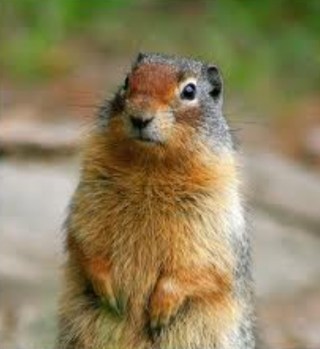
Calgary’s Groundhog Doppelgänger

Pork burgers, anyone? Today is Groundhog Day, which makes me think of ground beef, hamburger helper, and ground hog. And the weather. We, of course, are far too sophisticated to depend on a rodent for our long-range forecast, even if the animal’s prediction is roughly as accurate as a room filled with big blue computers crunching the weather service’s latest data through their most promising algorithms.

Can bees predict weather? There are plenty of stories of beekeepers in the apiary noticing that all the bees are suddenly heading home, none going out to forage. The beekeepers look up and a cyclone or hail storm or lightning ball or wall of water is rushing towards them. That’s likely true. The bees probably respond to rapidly dropping barometric pressure by heading for shelter. They don’t like being caught in the rain any more than a beekeeper does.

But what about competing with Punxsutawney Phil by making a long-range forecast? Again, I have heard beekeepers claim a tighter broodnest and extra bee glue (propolis) filling cracks between the boxes means a rough winter is ahead. I don’t know. A congested broodnest is likely because of a late-season nectar flow while excess propolis means the gummy parts of pines and poplars that secrete resin have been extra active – and the bees have been extra busy hauling the stuff home. Do they sense a tough winter? I’m not sure what clues bees see that we don’t. But my mind is open on this one.

There is also the legend that honey bees nest higher up in trees when they anticipate a winter with lots of snow. This one is extremely unlikely because wild bees swarm in the spring, many months before winter snows are expected. And here in western Canada, hives buried under a meter of snow actually survive better with the extra insulation than hives sitting out bare and exposed on the windy prairie.

By the way, the Calgary groundhog (or Richardson’s Ground Squirrel, in our case) faced a dark shadow all day. According to the myth, we will have only six more weeks of winter. That places spring near March 20th. No big surprise. That’s what the calendar says, too.

Posted in Bee Biology, Climate, Culture, or lack thereof | Tagged , | Leave a comment

Bees Drink Wine, Live Long, Stay Slim

Bees enjoy a bit of red wine. That’s something you don’t think about everyday. Do insects (specifically bees) enjoy a bit of the grape juice? Researchers in Arizona aren’t telling us that honey bees like wine, but they do say bees that have been asked to kick back and have a sip of red wine from time to time will definitely live longer. About 35% longer. Let’s see, for a human that would mean forget 82, but think of 106 as the new norm – with your daily shot of resveratrol.
Not only do the bees live longer, according to the research, they also enjoy a sleeker, more slender physique – no more unsightly body fat for the bee that imbibes. Somehow, say the desert state researchers, red wine triggers a “moderation effect” that switches on while the bee is eating. Sort of like being told they have eaten enough. Ok, so you don’t think the research that says red wine curbs a bee’s appetite and extends its life is directly transferable to humans? Well, apparently the red wine has been working its magic on everything from yeast to mice – all reportedly live longer (and more raucous) lives with a few drops of the Bacchus sauce.

So, should we give our bees a bottle? One of the surest ways to make a bumper crop is to have healthier, longer-lived bees. If you could be sure the bees would live one-third longer lives, I am guessing they would make about 50% more honey since it is the older bees who do the most gathering. And since they would be skinnier, they would fly faster (less air resistance) and more of them could slip in and out the hive entrance at the same time.

Posted in Bee Biology, Humour | Tagged , | Leave a comment

Start the New Year with Miksha (the Norwegian Band!)

Yikes! If you listen to the clip above, you are braver than I. The video is from the metal band Miksha, which claims it named itself for me. Perhaps. Their website said “Miksha is named after the Bad Beekeeper who developed poisons for the American Army in Vietnam.” Well, they spelled my name right, anyway. And that clip is your New Year’s gift from me. It is a chance to expand your cultural exposure.

We are already halfway through a new month, and into a new year. It’s winter in Calgary. The bees are resting. It is not as if beekeeping takes a holiday in Canada during the winter. Well, actually, it does. But writing this blog shouldn’t, though for a month I’ve written nothing. I would say that I have been really busy with pressing issues, but then it sounds like this blog is not important. It is, at least to me. The truth is, I have been on another secret mission for the government, similar in urgency to the one that got me noticed by that heavy metal Norwegian rock band – here is the background to that story. Anyway, I’ll post every week or two from now on, even if it is nothing much more than a quick note that claims I am still alive. Sort of like this one.

Posted in Culture, or lack thereof, Strange, Odd Stuff | Tagged , | Leave a comment

Candid Camera

Alberta bees beehives animals lions bears grizzly moose beekeeping mountains

Bee Yard Photo-Bombed! (photo used by permission of L. Goldie)

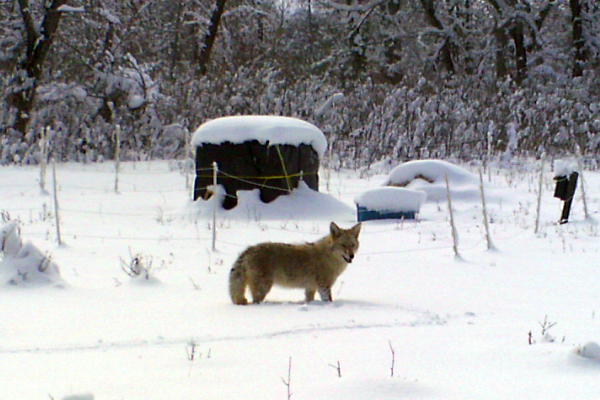
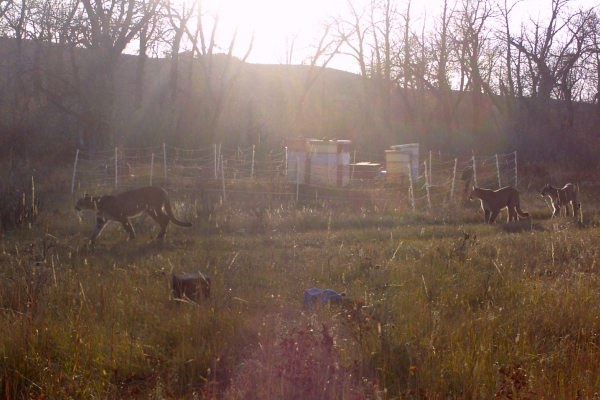
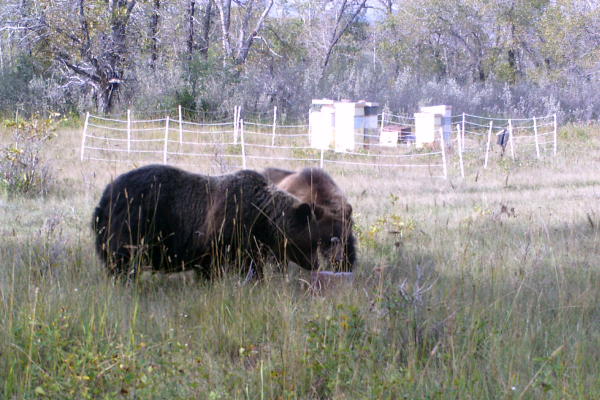
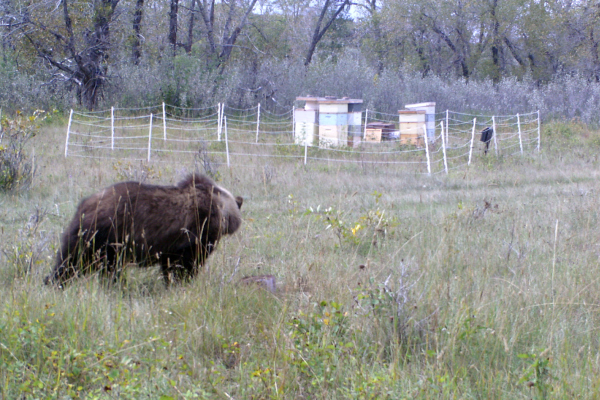
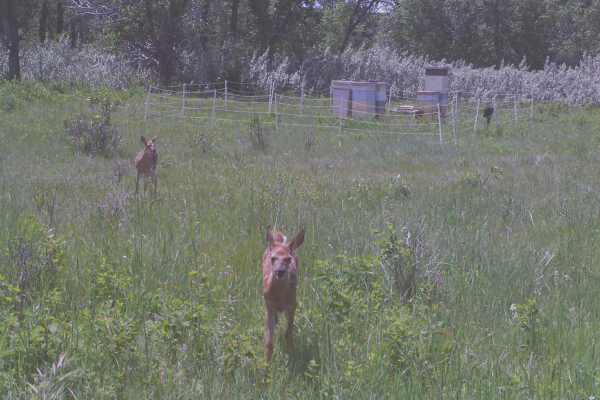
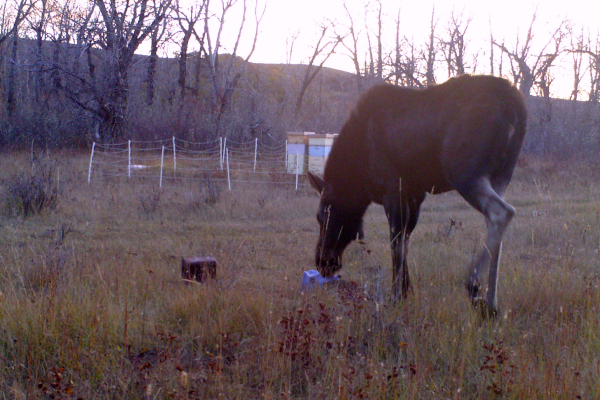
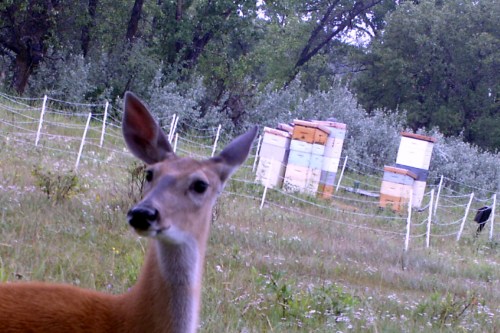
We live close to the Rocky Mountains. One of our friends, Liz Goldie of Calgary, keeps some of her bees in an apiary in the foothills. As you can see in these pictures, our area is flush with interesting large animals. All the photos in this blog entry are Liz’s pictures, used by permission. If you would like to re-post any of these, send a note to me first so we can see if permissions can be extended to your use. These pictures were taken with a Primos Truth Cam 46, a motion-sensitive camera with a flash.

This is one active beeyard! Part of the attraction is a salt lick, placed near the beeyard – it is set out for cattle, the wildlife are uninvited usurpers. Not surprisingly, the salt has the attention of the moose, but unexpectedly, grizzly bears are also tasting it. The bears have not noticed the bees, which are guarded by an electric fence, or they would certainly be rummaging through the hives. The photos are from this year, 2013, the oldest picture is the wolf in the snow, photographed in late April, and the most recent are the lions, from October 15, 2013. Mountain lions are rare here, so this image of a mother teaching her almost-mature cubs how to keep bees is priceless.

Alberta bees beehives animals wolf beekeeping mountains

Wolf, April, 2013 (photo by permission L. Goldie, Calgary)

Alberta bees beehives animals mountain lion cougar puma beekeeping mountains

Mountain Lions, October, 2013 (photo by permission L. Goldie, Calgary)

Alberta bees beehives animals bears grizzly beekeeping mountains

Grizzly Bears, September, 2013 (photo by permission L. Goldie, Calgary)

Alberta bees beehives animals bears grizzly beekeeping mountains

Grizzly Bear, September, 2013 (photo by permission L. Goldie, Calgary)

Alberta bees beehives animals deer beekeeping mountains

Deer, June 2013 (photo by permission L. Goldie, Calgary)

Alberta bees beehives animals moose beekeeping mountains

Moose, October, 2013 (photo by permission L. Goldie, Calgary)

Posted in Bee Yards, Diseases and Pests | Tagged , , , , | 1 Comment

What are these bees thinking?!?

winter bees snow ice wrapped hives

Bad Bee Beehaviour

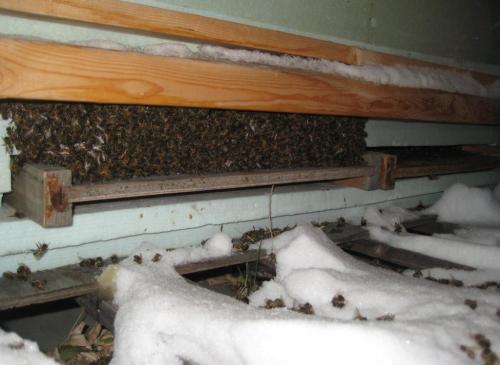
A beekeeper in Winnipeg sent some photos of her hives. Her bees are misbeehaving. They broke cluster at minus 8 degrees (around 20 F), masses of bees are hanging out at the entrance, and she wants to know why. Sadly, unusually high numbers of dead bees are lying in the snow near her hives. Here is the background: She has two colonies. Both were reasonably strong, but one, of course, was the star performer, the other just a bit weaker. Each were fed 25 kilos (55 pounds) of sugar dissolved in water in a thick solution. They also had autumn pollen supplements ten weeks ago. Mite counts were low and they were treated with formic acid in the early fall. They are queen-right and had a normal summer season.

I thought maybe skunks were the problem – or some other creature (or stress) was making the colonies come to the entrances and investigate. But when she sent the pictures I’ve posted here, I realized that’s not it. The beekeper is certain it is not a varmint (neither mouse, skunk, nor Winnie the Pooh or some other Winnipeg bear). The bees are guarded by fences and protected from the wind. Could it simply be that the bees became warm, are super-strong, and had to hang out? But then, why the dead near the entrance – and on the bottom board, as you see in the center photo below.

If you can guess why these winter-packed hives are suddenly hanging out like this on a cold wintery day, please send me a note.

Should bees act like this in December?

Posted in Beekeeping, Climate, Strange, Odd Stuff | Tagged , , | Leave a comment