
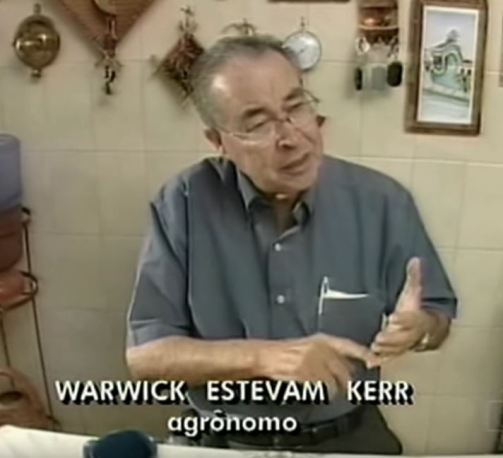
Today (September 9) is the 94th birthday of Warwick Estevam Kerr, the man who made the Killer Bees. Just like his bees, Kerr comes from hot, tropical Brazil. And just like his bees, Dr Kerr has been much maligned and misunderstood in the popular press. But Kerr did more to help his country’s agriculture than perhaps any other individual.
When the Africanized hybrid honey bee entered our awareness in the 1970s, the bee was described as a killer bee (in Brazil, they called it the assassin). The man who brought African honey bees to South America was turned into a mysterious fiend who had “disappeared from sight” after “he turned killer bees loose”. Well, he did disappear for a while. He was in prison. But not for any reason you might guess. First, some background.
What was Kerr’s crime?
Dr Warwick Kerr brought Africanized genetic stock to South America in 1956. In today’s context, importing an alien creature from another continent seems horribly reckless. In Dr Kerr’s day, the importation of bees from Africa was hardly daring. First, recall that all honey bees in the Americas are imported from somewhere else. Honey bees are not native to the western hemisphere. Second, Kerr was not introducing a new species. The African bee (Apis mellifera scutellata) is a cousin of a common European honey bee, Apis mellifera iberiensis, which was in Brazil when the African queen bees arrived. Kerr’s importation of 26 queen bees from Tanzania is in league with importing Clydesdales long after Arabians and Morgans were already established. Kerr’s goal was to improve the non-tropical honey bees which farmers were using in Brazil. He rightly assumed that tropical genetic stock would be more successful in his tropical country.
Warwick Kerr’s sour reputation came directly from the Brazilian government. Although he was a geneticist and was at first entrusted with developing a better bee for Brazil’s farmers, the Brazilian military dictatorship attacked Kerr’s stand on civil rights. He was imprisoned in 1964 when he publicly fought government corruption. In 1969 he was re-arrested, this time for protesting that Brazilian soldiers who had raped and tortured a nun went unpunished. Sister Maurina Borges, who ran the Ribeirão Preto Orphanage, was an activist; the soldiers were part of Brazil’s military dictatorship, committing crimes encouraged by the government. [See page 16 of this 2005 interview with Kerr.] Most of the western press didn’t bother to investigate the reasons behind the Brazilian government’s dismissal of Kerr’s work and his qualifications.
Creating a clown
All of this is lost on most people who write about this subject. For example, this is from a blog promoting a book called The Animal Review: A Report Card. The writer calls Dr Kerr a clown:
“It is strange and unfortunate that there is not a Nobel Prize for Really Bad Mistakes In Science. This international award could be presented annually in Stockholm by a sad clown wearing a lab coat and goggles, giving scientists that much more of an incentive to get things right for once. Brazilian geneticist Warwick Estevam Kerr would have made a fine nominee. For it was Mr. Kerr who introduced Africanized honey bees (Apis mellifera scutellata) to the Americas. Oops. Bring in the clowns…
“The full scope of the blunder was not immediately apparent to Kerr. Being a brilliant geneticist, he brilliantly assumed the African queen fugitives would breed with feral bees — thus diluting their infamous aggression.
“But on the bright side, Africanized honey bees pollinate plants and plants are crucial to agriculture production everywhere in the blah, blah, blah, blah.”
” Warwick Estevam Kerr, Grade: F- ”
Almost everything in the preceding story is wrong, but I put it here to illustrate how the popular press saw Dr Kerr – a clown deserving an F- grade. In fact, it’s the lazy reporters who earn a big Fail.
Here’s another example: National Geographic blunders portraying Dr Kerr in their 2006 documentary, Attack of the Killer Bee. “Incredibly, nearly one trillion killer bees can all be traced back to just one man…” [I’ll bet you know who they’re talking about.] In Africa, says NG, Kerr “chose the best specimens he could find, but he noticed something disturbing.” (At this point, the actor playing Kerr gets stung on the finger and yelps “Ouch!” in pain. “Doctor Kerr was wrong. Very wrong. And the western hemisphere is still paying a steep price.” This is verbiage that sells.
You should watch the first few minutes of the NG fantasy. The devilish portrayal of the black Africans who sold Kerr the ‘deadly’ bees is also vile National Geographic reporting, but that’s fodder for a whole different story. I have the video below queued up to start at 3 minutes – that’s where an actor playing Kerr gets ready to leave for Africa. Don’t bother to watch more than a minute of this.
The Killer Bees
Warwick Kerr was responsible for bringing African genetic stock to Brazil in 1956. As a geneticist, he wanted to improve the health and hardiness of the European honey bee which came from Portugal in 1834. That European strain was poorly adapted to the tropics, so the Italian honey bee (Apis mellifera ligustica) was imported in the 1880s, but it wasn’t much better. A few farmers and monks kept the languid bees, mostly to collect beeswax for church candles.
In 1956, Brazil’s annual honey production from the European honey bees was just 15 million pounds. Brazilian agriculture was expanding and needed a tropical honey bee for pollination and honey production. After the African bees arrived, Brazil’s beekeepers produced 110 million pounds. Brazil went from 43rd in the world to 7th largest honey producer. By 1994, L.A. Times headlined: “Brazil’s honey production has soared since the ornery invaders took over beekeepers’ hives”. Today, most of the world’s organic honey is produced by Africanized honey bees in Brazil’s forests.
Honey bees with African genes are more aggressive than European bees. Beekeepers in Brazil had to learn appropriate management techniques. Although the venom is the same, more bees attack if their colony is disturbed. People have died from massive stings. Those deaths are sorrowful and this story about Dr Kerr’s bees should not dishonour personal tragedies. Some of the traits which make Africanized bees exceptional pollinators (refined olfactory sense, quicker movements, flights in inclement weather, superior navigation skills) also make them more likely to sting. However, they are managed by farmers and beekeepers. Indiscriminate killers they are not.
Decoding sex among stingless bees
At first, Warwick Kerr worked with Melipona bees, not honey bees. Some of Brazil’s poor and indigenous were wild honey gatherers, or meleiros. Meleiro, isolated and rural, is named for the meleiros, who are named for Melipona honey trees. There are only 7,000 meleiros, but their precarious existence in the 1940s – which included raiding Melipona bee trees – concerned Dr Kerr during his bee research. He hoped that his work would draw attention to the importance of preserving Melipona and their habitat. Understand and help the Melipona, and you help the meleiros, figured Kerr.
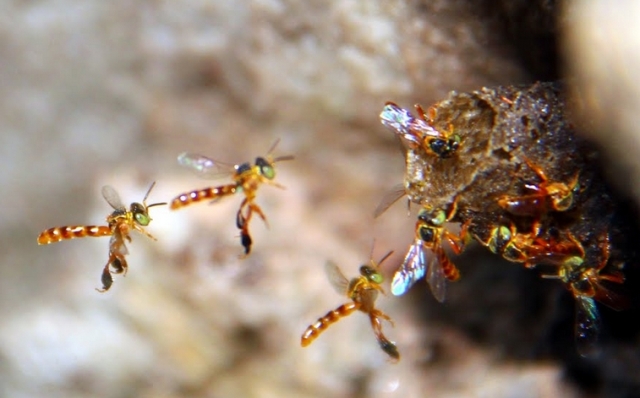
Melipona quadrifasciata of the meleiros (João Henrique Dittmar Filho)
Melipona quadrifasciata is a eusocial stingless bee, native to southeastern coastal Brazil. The meleiros call it Mandaçaia, which means “beautiful guard,” as there are always guard bees defending the narrow entrance of their colony. Brazil’s Melipona builds mud hives inside hollow trees. These have narrow passages allowing just one bee to pass at a time. Stingless bees, they can give a nasty bite, but their intricate passage system also defends against predators.
Dr Kerr’s first influential paper, “Genetic Determination of Castes in Melipona” (1949), researched the development of males, females, and workers among Brazil’s common stingless bee. Kerr found that their caste development was different from honey bees. Drones in both species are haploid, but in Melipona, things get weird for the girls.
In Apis mellifera, “a larva develops into a queen or into a worker depending upon the food it receives. In Melipona, on the other hand, caste determination is genotypic. Fertile females (queens) are heterozygous in some species for two, and in other species for three, pairs of genes, homozygosis for any one of which makes the individual develop into a worker.” – Kerr, 1949.
For the exotic Melipona quadrifasciata, alleles (one-half of a gene that controls an inheritance, for example the ‘b’ in a ‘Bb’ gene) determine caste. Drones (as in honey bees) are haploids with a single set of chromosomes; queens and workers are diploid (two sets of chromosomes, one from each parent), but queens have some specific alleles that are different, or heterozygous (for example, AaBb), while workers have identical, or homozygous, caste-determining genes (AABB, AAbb, aaBB, or aabb combinations). If you find this confusing, imagine sorting it out with 1940s technology.
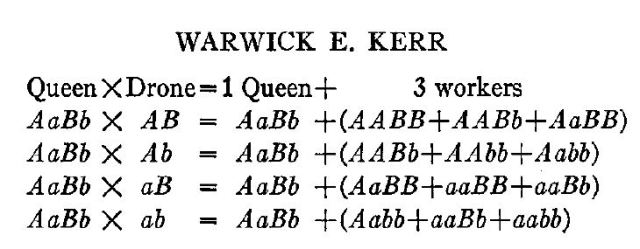
From Kerr’s 1950 Melipona paper
The real Warwick Kerr
Kerr was born in São Paulo, Brazil, in 1922, into a middle class family with Scottish and American roots. He received an agricultural engineering degree, then specialized in genetics. His work as an entomologist spanned decades, with research that included genetics of honey bees and native Brazilian bees, as we’ve just seen.
Warwick Kerr’s education included post-doc research at the University of California, Davis (1951), and at Columbia University in New York, under the renowned evolutionary biologist Theodosius Dobzhansky. One of Kerr’s influential papers, “Experimental Studies of the Distribution of Gene Frequencies in Very Small Populations of Drosophila melanogaster“, cites Dobzhansky as an adviser and is co-authored by a University of Chicago genetics statistician. This fruit fly research was done way back in 1954 and the paper was one of the first to deal with the nascent field of genetics statistics. Kerr published 620 research papers during his 60-year career.
Warwick Kerr is largely responsible for establishing the study of genetics in Brazil. He was a director of the National Institute for Research in the Amazon and worked at the University of São Paulo. Later, at the Universidade Estadual do Maranhão, he created the Department of Biology and served as Dean of the University.
Warwick Kerr says that his most important work was developing staff, technicians, teachers, and researchers in his country. At the University of São Paulo, he established a department of genetics which focuses on entomological and human genetics, using mathematical biology and biostatistics. Kerr has memberships in the Brazilian Academy of Sciences, the Third World Academy of Science, and the US National Academy of Sciences.
I’ll end with a pleasant little video made three years ago. In it, you will see that his interests have shifted to botany. The film is in Portuguese, but even if you don’t understand the language, you’ll get a good idea of Warwick Kerr’s enthusiasm and curiosity.


Reblogged this on msamba.
LikeLike
Is this real? I can’t wrap my head around it..
LikeLike
100% real. Kerr was a geneticist. The story is all facts – I included links so you could go to the original sources. Any specific questions?
LikeLike
Pingback: The Man Who Made Killer Bees — Bad Beekeeping Blog | Beekeeping 365
Hi, Ron—just discovered your bee blog from Googling info about Prof Kerr. He is of great interest to me since I live in Southern California and only keep feral survivor stock from cutouts, swarms and trapouts. These bees are referred to me for re-homing since they are living in conflict with human habitation, but folks are learning there are better answers than extermination. I am so glad to see you correct some of the horrible press on Kerr. The world of managed honey bees is strongly bifurcated between those keeping feral stock and those keeping “poodle bees” or breeder bees that require chemical supports against varroa and its vectored diseases, or they die. I have 28 colonies of bees, mostly kept in 4 or more deep boxes, no foundation, no excluders, no feeding sugar or fake pollen, no treatments. They are all mutts and vary in color and size. They are very tractable, in contrast to the mythology of AHB being aggressive. Just aint’ true. I have several client hives I manage and my honey harvests are very respectable. I have been beeking for 6 years, ferals from the beginning.
Peter Borst of Cornell came to speak to our bee club a couple years ago and showed us a laudatory book by Brazilian beeks about AHB, and this was my first exposure to a different narrative. The Hollywoodization of AHB still has most beeks and the public firmly in its grip, but some loosening is starting to appear as the acaricides become ever more ineffective, the package bees die even with treatment, and the fitness of the Italians plunges ever lower. Writing to many researchers and scientists about the innate resilience and vigor of AHB, most of them dismiss it as “anecdotal” and are not interested. I think much of the disinterest stems from the pursuit of microgenetic manipulation to discover a way to patent and own the genetics of varroa resistant bee stock. The fact that Darwinian concepts of selective pressure and adaptation is really the BEST way and is eminently displayed in the ferals I and thousands of others are keeping treatment free is scientific obstinancy of the highest order.
LikeLiked by 1 person
Hi,
Thanks so much for your comments! Your description of the Africanized Honey Bee and the bee’s potential as a natural way to reduce the effects of varroa is brilliant. I wish that all beekeepers were as well-informed, concerned, and interested in the welfare of honey bees. I am extremely impressed with your success – but I am not surprised. I know that this is the sort of beekeeping that’s possible and it’s great to hear first-hand from someone who is succeeding. 28 hives and six years is an accomplishment and puts you in the class of experienced beekeepers.
I enjoyed researching and writing the piece about Dr Kerr. The more I learned, the more impressed I became with his scientific expertise and his commitment to social justice. His work would have been given much more respect but his opposition to Brazil’s military dictatorship led that government to vilify him. Our media were much too quick (and too lazy) to consider any story except the Killer Bees tale. Of course, killer bees sell more NGM advertising spots than any nuanced reports would.
Your work at promoting sensible beekeeping is exactly what is needed these days. You will find that my blog posts express ideas that are all over the board respecting chemicals, migratory beekeeping, and genetics, but I agree that reduction of chemicals (inside and outside the hive) are the best way forward. It will be people like you (and Randy Oliver and a few others) who may help solve the problems we have built for our bees.
Thank you for following this blog. I hope that you will continue to comment (and disagree when you need to) on these pages.
Ron
LikeLiked by 1 person
oh . . . . . . . . . . . . . . . . . Thanks !
LikeLiked by 1 person
Sorry, I missed the articles with headlines reading: “Clydesdales interbred with Arabians and Morgans swarm and kill over a thousand humans from South to North America” – please post reference to these in the comment section so we can fully understand the argumentative weight of your analogy. Of course as a scientist you will defend another scientist; that’s in your genes to do. He played God (as many scientists do) and his reputation is rightly tarnished for it, despite your juvenile attempt to dismiss the damage he did by mentioning that honey production in Brazil improved. Tell that to the families of the more than 1,000 innocent victims of the attacks. Heck, by your logic and argument from business improvement (hardly a pure scientific view), we might as well increase taking species specific to one part of the world and transplant them to another and defend the results (which might feed dollars into industry) – like the Nile Perch in Lake Tanganyika, the Asian Carp in U.S. Rivers, the Lionfish on our coral reefs. And the absolute stupidity – not to mention academic mendacity – of your saying, “Well, honeybees themselves are not native to the Americas.” No, but they were not scientifically interbred, as Kerr precisely did interbreed European bees with African ones. As a scientist myself, and a bee aficionado, I get angry when: (1) scientists play God, and then (2) other scientists defend them in their tragic hubris. I wouldn’t say he deserves the Clown Nobel. I’d say he deserves the Science Crime Nobel – of course, he’d have a large cohort of prizewinners to keep him company.
LikeLike
One more thing, as my anger still simmers. You mention at the very beginning of the article: “Well, he did disappear for a while. He was in prison. But not for any reason you might guess. First, some background.” As a dabbler in study of narrative technique, this is a tried and true method, and in this instance a gimmicky one, in building up suspense in the reader, and here to deflect what the public and professionals have accused him of. If, as you are implying, a person should not be criticized who stands up bravely against a corrupt regime, then of course we shouldn’t criticize Kerr, because he did do that. I was a strong supporter of Amnesty International and learned of South and Central American political nightmares and anyone like Kerr should be applauded for his bravery. But that doesn’t take away from the bad science he performed. Moreover, and you’ll need to think on this part, even though you are seeming to want to claim (1) he didn’t do bad science, and (2) if her did do bad science, it had good business results for Brazil, you are actually (in narrative technique) admitting he did do bad science by your appeal to (unrelated to the bee fiasco) his political bravery. In other words, your article actually screams: maybe what he did with the bees was bad, but his political bravery proves he wasn’t/isn’t a bad evil human being. No, not a bad human being – in fact a brave, good human being proven by his political bravery and sacrifice; he is just a bad scientist doing what arrogant science often does: evil things in the world by trying to improve on nature (which you imply he did – improve on nature).
LikeLike
I’d love to read your thought on John Hammond, I bet you watched those movies completely differently than the rest of us.
LikeLike
I think you are referring to the Jurassic Park movies, the fantasy of a man wealthy enough to buy an island but still greedy for more. There is no parallel with your straw-man fiction and the actual events in Brazil. Dr Kerr’s first allegiance was to improve the lives of Brazil’s poorest people. He did this by first working with the native bees, then sought a way to improve the genetics of the European bee, an invasive species brought from a temperate climate and used in agriculture by the country’s farmers for pollination. Kerr rightly recognized that using tropical honey bees would help those farmers. He was right and his work replaced one race of invasive bees with another, greatly improving the welfare of his country.
I know that it is tempting to be seduced by the sensational headlines about ‘killer bees’ and for some people, it’s hard to separate fiction (like Jurassic Park) from fact. That’s certainly a sign of our times – fake news indeed sells. But please take a few minutes to read the responses of people closer to the action than folks sitting on the plains of Nebraska, as you are. For example, see the comment above by Susan who keeps African Honey Bees in California – she finds them more resilient (especially against varroa) than European bees. In the comment, she mentions having 28 colonies, now she has 44, which you can read about here, where she writes:
LikeLike
Prairie Medical Acupuncture Clinic
Published by Priscila Kerr · September 15 at 10:41 AM ·
I am very sad to tell my grandfather Prof Dr Warwick Estevam Kerr a man who lived by his big heart and love by science and his family who helped Brazil to develop their agricultural power in so many ways passed away this morning at 7:07 am ( Winnipeg time zone – brasil 🇧🇷 was 9:07 am ) with 96 years of good life being loved by his family , his students and professionals who admired him! He was my rocky , my mirror who gave me the drive to fight for my dreams , to immigrate to Canada 🇨🇦 11 years ago and to be a woman connected with science , as I studied very hard to be a physician and never forgot his words to try to always be a better Person the next day , finding a way to improve the health of my patients and be kind to who are in need. He was a honored man who was ahead of our time ! I have sweet memories of him , he was a socialist by heart and executed his beliefs in every day of his life. He would wake up us super early on the weekends to go to the poorest neighborhood to teach the Bible and teach the kids quick moments of science and bring them meals . He believed in the power of equal rights , including man and women and he believed in the power of kindness, the power of share the knowledge to make other people to grow and money was only a consequence not his goal. he was a professional of crazy energy and even in the most relaxing barbecue moments he would take us for a walk in the nature and explain the scientific names of plants , explain their properties and show the 🐝 working their way to get the pólen ! In our summer vacation in his beautiful house he asked all his grandkids to work and help him on his bees research and we all had duties …we felt important!!!! But if we got tired and complained he would say :- let’s go kids !!!! – “we have the life to work and the eternity to rest. “ I loved you . I will never forget you.You will be always in my memories. Say hello to grandma Lygia ! May your memory be a blessing to generation to generation!
LikeLike
That is the note from of Dr Kerr passing away that the direct family shared with me : “communicate with extreme regret the passing of our father, Prof. Warwick
Estevam Kerr, active citizen and one of the great bee specialists
The world. Was the first scientific director of fapesp (foundation of
Amparo is a member of the state of São Paulo.
Research of the Amazon), Rector of surprisingly (State University of
Maranhão). Graduated from esalq (higher school of agriculture luiz de
Queiroz – USP), where he also exercised teaching functions in
Genetics, was founder of the biology departments of the faculty of
Philosophy, science and letters of rio claro – state university
São Paulo, the university of Rio de Janeiro.
Biology of the federal university of maranhão and contributed
Marked with the development of the institute of genetics and biochemistry of
Federal University of uberlândia, among numerous academic actions
He was a good man. He was also president of sbpc (society
Brazilian for the progress of science) and of (Brazilian society
Of genetics), member of ABC (Brazilian Academy of sciences), member
3th World Academy Holder and the first Brazilian scientist to be
Elected foreign member of the National Academy of sciences (USA)
Recognition of his academic production. Was always involved with
Research that yielded advances in the management and amansamento of bees
African, today very important in the production Brazilian honey, and that
They escaped to the environment when he introduced them to Brazil in
1956. Always acted under the principle of sustainablemanagement between teaching,
Research and extension, constantly seeking to establish relations with the population and social movements, to transfer them directly
Knowledge and research results. His socialist convictions earned him two arrests during the military dictatorship established in 1964 and constant surveillance by the dictatorial security bodies at that time. His generous spirit from an early age made him embrace the socialist utopia, acting by building a fair and egalitarian society where science and other knowledge are at the service of the majority of the population. He died in ribeirão preto at the age of 96
Respiratory arrest, 9 P.M. This September 15, 2018.
Florence, Lucy, Américo, jacira, Ligia Regina and Tania .”
LikeLike
Dr Kerr should be in prison for life and every person kilked by these africanized bees should be a murder charge upon Dr. Kerr.
LikeLike
Hello Gregory Clifton,
Since Dr Kerr died a month before you posted your comment, putting him in jail for life wouldn’t make much sense. Where shall we put him? In a cell next to the Wright brothers whose invention “murdered” millions? Kerr saved a lot more lives than were killed by AHB. When he died, his country mourned by lowering flags for three days. I hope that you achieve something as outstanding as the Wrights or Kerr. It takes fortitude and bravery to try to help people and improve the world. Not so much to sit back and complain about things.
LikeLike
This man did a bunch of amazing things in his lifetime. Including developing the Africanized honeybees. He pretty much saved man kind! When all our native and kept bees are all done from diseases, parasites and pesticides. We can only pray the Africanized honeybees prevails. He was a science pioneer, geniuse and never got the credit he deserved!
LikeLiked by 1 person
We can’t say that he “saved mankind” but he certainly helped the people of Brazil. Africanized stock are good pollinators and honey producers in most of Latin America.
LikeLike
Ron, I am just reading a story in ABJ concerning the hybridization of the AHB with the locals. The story parallels what we see here in South Florida. They are a better bee! I have a question. Do we know what percentage, genetically, the original hybrids Dr.Kerr raised that were released mistakenly by one of his graduate students?
Ron, I am hoping you have this answer so we can begin to get the “scientists” who make ridiculous rules and laws to realize this bee is a blessing not a curse.
Bee Well, Lee
LikeLike
Hi Lee,
According to Kerr, in 1956, he brought stock directly from the Pretoria region of South Africa. Pure African (A.m. adansonii) stock was accidentally released in 1957. Kerr found that Italian-adansonii hybrids did especially well and could become reasonably gentle if the most aggressive were culled. He pointed out that in 1966, AHB was widespread yet ‘only’ 6 people died out of 16 million residents of Sao Paulo (centre of the AHB distribution). Kerr encouraged hybridization between African and European stock, distributing 5,000 queens in 1965-1967.
Ron
LikeLike
Really enjoyed reading this and learning a history I had no clue of.
There is far to much misinformation out there about so many things but it feels so great to stumble across something like this that is attempting to set the record straight.
Great work!
LikeLike
My 10 yr old grandson came to me with information that was not quite 100% accurate, so we googled, read your info and we both learned a lot. Thanks.
LikeLiked by 1 person
Pingback: Bye ’21: Don’t let the door hit you. . . | Bad Beekeeping Blog
Hi, I know its been a while since this was posted, but do you have any sources or further information about the meleiros, because I can’t find any anywhere.
LikeLike
Dr Kerr referred to his assistants as meleiros, people who weren’t really beekeepers in the European sense, but knew how to find wild colonies, remove the bees, harvest the honey. They were traditional folks, described in Portuguese-language beekeeping histories.
LikeLike