Arrested for importing three bottles of honey

This gripes me.  Here’s a guy, holding down two jobs (construction and cleaning) who had his life destroyed by US Customs because he brought three jars of honey home from Jamaica while returning from holidays.  He declared the honey in Baltimore when he landed (as one must). But customs insisted he had ‘liquid meth’ after a sniffer dog made a mistake.  After the man was arrested, jailed for almost three months, and lost his jobs, the results came back that the stuff was honey.  No controlled substances. The officers wouldn’t believe their own labs’ results (but they believed the dog), so they ran the tests again while the guy waited in prison.  Same results – no smuggled drugs of any kind.

“Someone dropped the ball somewhere,” Haughton’s lawyer said. “An innocent man spent 82 days in jail for bringing honey into the United States.”

Meanwhile, millions of pounds of rice-sugar honey are smuggled through circumvented routes and the offenders get…. nothing.  When will people wake up, insist their guards enforce the laws that need enforcing, and leave the average Joe alone?

Full story:

Innocent man spent months in jail for bringing honey back to United States

Posted in Culture, or lack thereof, Honey, Strange, Odd Stuff | 3 Comments

Photographs of readers

Evolutionary biologist Jerry Coyne (U of Chicago) has posted a piece on my research on his own website. This will help catch up the followers of my blog who have been wondering how I’ve been spending my summer!   – Ron

whyevolutionistrue's avatarWhy Evolution Is True

Well, I’ve run out of readers with fancy sports cars, but we have plenty of other interesting people on tap. One is Ron Miksha, who shows us that you can be a grad student at any age. All it takes is curiosity.

I’m a bee ecology grad student at the University of Calgary. I am  working with Lawrence Harder, a bee and plant ecologist, investigating  the effects that non-native honeybees may have on native bees. Here in  Calgary, the urban honeybee hobby grew from 120 backyard bee hives to  about 1300 in the past ten years. That growth may be displacing local native bees. We are measuring bee reproductive success compared to honeybee colony density around the city. We are also researching direct resource competition.

Although I am getting up in age and using a wheelchair to get around, this photo shows me doing what I like best.  It was…

View original post 71 more words

Posted in Uncategorized | 3 Comments

National Honey Bee Day

I haven’t quite recovered from World Bee Day (May 20th) and here it is, World Honey Bee Day, which coincides with National Honey Bee Day, as it’s practiced in the USA. Clever that they both fall on the same third Saturday of August. But both of the August honey bee days compete with the bigger, far more important May 20th world bee day. (And mid-way between these celebrations is Don’t Step on a Bee Day.)

I’ll not complain that bees are celebrated twice each year with special holidays – schools closed, solemn parades, TV specials. At dinners across the land, Einstein will be invited to stand up and say a few words about the plight of mankind if the bees all die. Meanwhile, the little pollinators go about their tireless sacrifices, pollinating with careless abandon, assuring that the apples and cherries are there for all those pies baked on Bee Day. The whole world celebrates.

Or am I the only one who has heard of this holiday?

I asked colleagues if they will party for the bees, but they looked at me as if I’m weird, maybe a beekeeper or something.  They seem oblivious and are a bit surprised to learn that there is such a holiday. Same with my calendar, which doesn’t recognize Bee Day – it’s not pre-printed on any of my calendars, in fact. Maybe the publishers haven’t recognized the importance of the day. (Halloween is on the calendar. And Christmas. Why not Bee Day?)

In the USA, the holiday started out as National Honey Bee Awareness Day about ten years ago. That worked out so well that they had to drop ‘Awareness’ from the name. (How can you build awareness for an insect that everyone is already aware of?)

If you are wondering how one celebrates August 19th’s Honey Bee Day, I found a website that offers some suggestions. Here a couple of their ideas and my reasons why these are bad ideas:

1) Collect local wildflower seeds and spread them to where nothing is growing.  Me: It sounds like a good idea – in mid-August, you sow your wild seed ‘where nothing is growing’ – like on a highway or in a lake. But seriously, planting seeds in August?

2) If you can’t raise bees, talk to your friends who have space and get them interested in raising bees.  Me: If you can’t talk yourself into raising bees, do you really have the skill to talk someone else into raising bees?

3) Encourage beekeepers to open their apiary to friends.  Me: Yes! Bring your own jar and pick your own honey. Doubt you’ll see those friends again.

4) Buy some mead and learn about this amazing drink!  Me: OK. This one’s a winner. Celebrate Bee Day with some authentic fermented nectar of the gods.

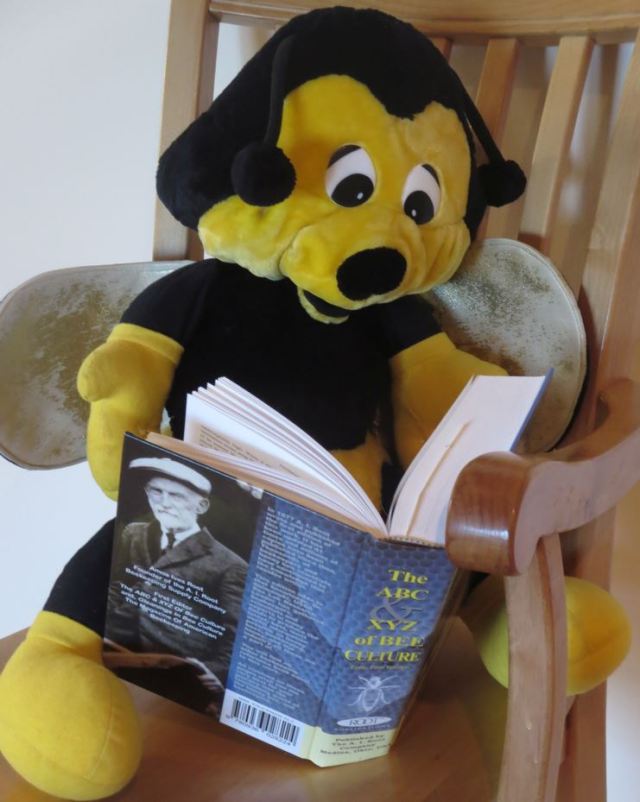
Out of celebration ideas? On these lazy summer days (unless you’re a hard-working beekeeper), you might lie in the shade with a good bee book.

Posted in Culture, or lack thereof, Humour, Save the Bees, Strange, Odd Stuff | Tagged , | 5 Comments

Ulee Jackson has died

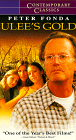
Peter Fonda died today. Most accolades will mention his starring role in 1969’s Easy Rider. I won’t. Instead, I’ll talk about his performance in Ulee’s Gold. That movie gave Fonda his only Oscar nomination (he lost to his friend Jack Nicholson, in As Good as it Gets).

In addition to being a powerful drama about the sort of situations too many families fall into, Ulee’s Gold portrays the beekeeping lifestyle with clarity, accuracy, and compassion. From a beekeeper’s perspective, movies just don’t get any better. If you want to peek inside a beekeeper’s life a little, or introduce the beekeeping world to friends or relatives who don’t seem to quite understand it, this movie is the perfect vehicle to make that connection happen. Peter Fonda, in the role of Ulysses Jackson, acts as if he had kept bees for thirty years. This strong, inward-looking character is so completely believable that the Florida Beekeeper’s Association gave Peter Fonda their highest recognition – he was named Beekeeper of the Year when the movie came out.

The plot is entirely plausible, at times a bit measured, but the slow pace is necessary to build the drama and to keep the tale believable. A wayward son, an addicted daughter-in-law, a wild teen-aged granddaughter, an introverted younger granddaughter, a divorced (twice) neighbour, and more bee work than he can manage, make up Ulee’s immediate world. His internal world is haunted by friends he lost in Viet Nam and a wife who died six years earlier. The story becomes rough, with some crude language, as Ulee faces his son’s accomplices in crime. Parents may feel the language and some of the scenes – especially of the drug withdrawal – are too graphic for younger audiences. Despite these minor caveats (by today’s standards, the movie is tame and there are no gratuitous scenes of violence or sex) it is an excellent, powerful drama.

Ulee’s Gold opened among the top ten films in North America on its release week, with gross weekend ticket sales of almost one million dollars. The movie was not heavily advertised, so we might assume that many of the audience attended because of the absolutely stellar praise the media lavished on this work. IN Jersey called the movie “Pure Gold”. Variety described this movie as “A gem of rare emotional depth and integrity… graced by a completely unexpected performance from Peter Fonda that is by far the best of his career.” The New York Times Review called Fonda’s performance the best in his entire career.  Entertainment Weekly agreed, saying, “Peter Fonda gives the performance of his life… playing with almost biblical rectitude…with a hint of tenderness that can wrench your heart out.” Among Entertainment Weekly’s praises were a nod to Van Morrison’s closing credits tune Tupelo Honey, which the reviewer describes as “a gift to the audience”.

As a beekeeper (who kept bees in Florida), I was especially enamoured by the dialog:

When describing his work to his neighbour lady-friend, Ulee says, “What with moving bees, pulling honey. chasing bears… it’s pretty hard work. Most young folks wouldn’t be bothered. But don’t get me going talking about bees…”

In a scene where you would expect Ulee to crack someone’s skull, Ulee’s nemesis, Eddie Flowers, says, “I always thought it was a stupid business, messin’ with bees.”  Well, Eddie, you’re not far off the mark.

When his imprisoned son asks how the bees are doing, Ulee says, “Mites are choking them, pesticides are killing them, the drought’s starving them… they’re fine.”

The movie was written and directed by Victor Nunez, who says that he got the idea from a chance glance at a newspaper with a photo of a beekeeping family on the front page. Ulee’s Gold was featured as the Centerpiece Premiere at the Sundance Film Festival when it came out in 1997. Peter Fonda won a Golden Globe Award for his performance.

I’ll close this post with a gift to my audience: Here’s Van Morrison with the movie’s theme song:

PS: A second gift: I recommend that you see this movie. My family will be watching it again tonight.

Posted in Commercial Beekeeping, Culture, or lack thereof, History, Movies, People | Tagged , , | 8 Comments

Coconut Monkeys

Some years ago, I had a job that I didn’t like. The money was good, but the work was bad. I was stuck in “Coconut Monkey” syndrome.

Farmers in south India are sometimes plagued by monkeys stealing their crops. The bright little thieves raid fields en masse, grabbing anything edible. The peasants chase the animals, but the monkeys always come back.

According to a tale I read in Robert Pirsig’s Motorcycle Maintenance book, one farmer had an idea. [Trigger warning: Monkeys die just ahead.] The farmer hollowed out a coconut, leaving a small hole, just big enough for a monkey to stick a hand in. A bit of rice was dumped inside it and the coconut was chained to a stake.  Here’s the trick. A monkey will reach in, collect rice in its fist, but not be able to pull its clenched fist out of the small hole without releasing the rice inside the coconut. A monkey won’t drop free food, even if a farmer is running at him with a club.

I’ll admit that I’ve been a coconut monkey more than once in my life. I just can’t let go of a ‘good thing’, even if I know it could kill me. I’m trying to learn that lesson, but sometimes I forget. I was reminded of the tale a couple days ago when I heard about those marauding monkeys again. This time, they were environmental refugees.

A troop of monkeys, climate-change refugees fleeing an intense monsoon, were stealing coconuts and breaking into homes for food. They had figured out that they could by-pass locked doors by climbing up on the roof, peeling off a few roof tiles, then dropping into the pantry. And what a mess. Even worse, the desperate little hooligans ripped up 55 beehives in a nearby apiary.

Those monkeys were hungry, having been displaced by the vagaries of climate. Monsoons have happened for generations, but they are becoming worse – except in the years that they don’t show up. This leads me back to human coconut monkeys. If climate is running at us with a club, but we are busy clinging to our allegorical rice, do we let go or do we stay the course and suffer the consequences?

Posted in Culture, or lack thereof, Ecology, Strange, Odd Stuff | Tagged | 4 Comments

Bees in Space

Fifty years ago, I was a kid, glued to the TV, fascinated by man’s first frolic on the moon. Grainy black and white images from the moon filled our grainy black and white television. It was a signal from the space, beamed to NASA’s earth-bound receivers, relayed to KDKA in Pittsburgh, then sent as an analog wave of organized static to the antennae on a 15-foot post clamped to the side of our rural farmhouse on the edge of the Appalachians. As a geeky youngster with thick glasses, I misunderstood the moon mission’s purpose.  I thought it was all about science and exploration. Soon, a moon  base would be built, then the flight to Mars, then Alpha Centauri, where I’d meet English-speaking aliens with huge heads and tiny bodies. That’s the way it was supposed to go.

But three years later, the moon flights ended. We haven’t ventured back. What went wrong? Nothing. Now I realize that my expectations were mistaken. The American space effort, “landing a man on the Moon and returning him safely to the Earth,” as President Kennedy said, was the real goal. Not science. The moon mission proved to the world (and Russia), that no one messes with the USA. Americans could set a goal, commit billions of dollars, muster huge technological expertise, and see an enormous task through to completion. Mission accomplished. A few more rock-picking excursions followed, but there was no political reason to return.

Bees in space, examined by James van Hoften, crewman on the Challenger. 1984: NASA.

Scientists at NASA always understood that science was a lunar tag-along. To foster public interest in space exploration (and to help their plea for future flight funding),  several down-to-earth experiments were widely publicized. High schools were invited to propose science investigations. One proposal led to bees in space.

In 1984, over ten years after the last moon walk, an experiment suggested by Waverly, Tennessee, high school student Daniel Poskevich, was carried aboard the Challenger Space Shuttle. His experiment included 3,400 honey bees in a glass-windowed aluminum observation hive. A similar hive was kept on Earth as a control. What would space bees do?

In their log book, the crew recorded: “Day 7, comb well-developed, bees seemed to adapt to 0-g pretty well. No longer trying to fly against top of box. Many actually fly from place to place” within their observation hive.  During the mission, worker bees produced a mere 30-square-inch comb (in the same hex-pattern as ordinary Earth-comb) and the queen laid just 35 eggs in the new comb.  None of those eggs hatched.

And? Well, if a space-queen’s eggs don’t hatch, this doesn’t bode well for the future of weightless honey production. I guess this is good to know before some California beekeeper ships a semi-load of bees upwards. Flowers might be an issue, too, though I’ll bet real crypto-currency that someday, in a greenhouse on Mars, tomatoes will be pollinated by bumble bees. And they will flourish.

I know. These are Martian potatoes. They don’t need bees. But the concept is the same.

.

Posted in History, Queens, Science, Strange, Odd Stuff | Tagged , , | 2 Comments

Saturday at the Hive

Mark, host for a bee gathering in his back yard.

A new beekeeper learns best by clinging to the leg of an experienced beekeeper. That’s how I learned, but I was four years old at the time. For you older folks, you need a mentor, someone who’s actually a better beekeeper than they claim to be, and is familiar with your geography, climate, and flowers. Good mentors are in short supply.

An alternative to a mentor might be a gathering of neo-keepers converging on a friendly, experienced paleo-keeper’s back yard. Hopefully by invitation. Our Calgary bee club offers a Saturday at the Hive event – something your local club might consider. You just need a lovely back yard and a willing host.

Mark’s four hives by the hedge in the back. In the front are honey samples,
including Mark’s prize winning entries from honey shows.

Here in Calgary, members of the bee club let an organizer know that they are able and interested in opening up their home, gardens, and bees to beekeeping visitors. The intention is announced and potential visitors – first come, first served – sign up. These Saturday at the Hive bashes fill up quickly. That was the case when my friend Mark hosted such a party in his yard.

Mark describing the oxalic-acid method of mite control.

Mark invited me to ‘co-host’ but the planning, work, setup, and bees were his. As were the wholesome summertime BBQ and fixin’s.  I was mostly furniture, except in the role of talking about bees and answering bee questions.  The party also gave me an audience of over 20 people to update about my University of Calgary bee ecology project. One of my undergrad research assistants presented a nice overview of our work.  (I’ll have more about that in a future blog post.)

I am near the centre of this scene, examining a piece of experimental bee equipment, which I will place in the hive. To the right is Mark, the host at this party.

Guests  gathered in a big semi-circle around Mark’s neatly arranged apiary of four hives. We worked our way through the colonies, making some timely adjustments. One colony needed a brood boost, another took an extra honey super. As we did this work, the visitors took a few pictures and many took notes. For the newest beekeepers, it can be daunting trying to understand the mechanics of the equipment and the dynamics of the living hive.

It was a great experience, lovely to have so many people gathered around, exhibiting keen interest in flowers, landscapes, and bees. I leave with this very short clip of the visitors to this week’s Saturday at the Hive.

Posted in Bee Yards, Beekeeping, Friends | Tagged , | 2 Comments

Apimondia: Will you be there?

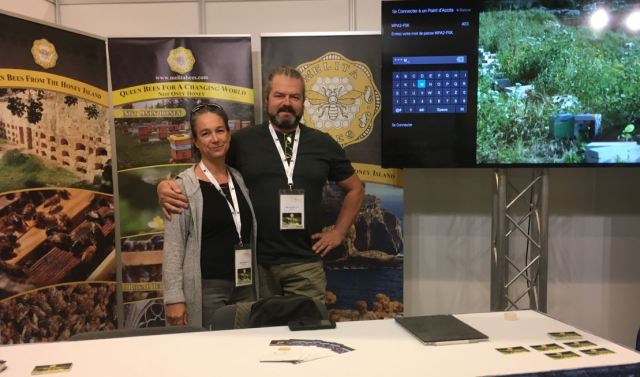
This year’s 46th Apimondia International Apicultural CongressAPIMONDIA 2019 MONTRÉAL – begins September 8 in Montréal, Canada. This is the big bi-annual beekeepers’ and bee researchers’ bash. I’m hoping that many of the readers of this blog will be able to make it. Since most of you are in Canada and the USA, airfare should be less than most Apimondia events, yet the French- (and English-) speaking city of Montréal is exotic enough to make you feel like you’ve left Kansas.

People attend Apimondia to check out new beekeeping tools and toys and to catch up on research. You’ll hear a range of presentations – genomics, pesticides, pollinator news, honey fraud, bee breeding, and stuff you can’t even imagine.  The Apicultural Congress is also a great opportunity to meet old friends and make some new ones.

I’ll be there. I’m doing research work at the University of Calgary in bee ecology. I submitted two abstracts and both were accepted. My oral presentation considers the difficulty in determining the foraging distances of honey bees, bumble bees, and leafcutter bees. My paper, Foraging distances of commercially deployed bees: a meta-analysis, draws on hundreds of studies and examines the typical range that these bees fly while gathering resources, with the intent of helping land managers determine optimal pollination while avoiding commercial pollinator spillover into natural areas where other bee species might be impacted.

I’ll also have a poster on quite a different topic, Demographic and socio-economic influences of urban beekeeping. This is a study of the types of urban people who become beekeepers. Are they typically wealthy or poor? Family guys or bachelorettes? Do they usually hold doctorates in metaphysics or (like my father, who was a beekeeper) a Grade-Eight primary-school certificate? As you know, it takes a diverse village to raise a hive of bees, but some groups are more likely to be beekeepers, at least in a big city. You’ll see what I mean if you drop by and see my poster. By the way, I’ll be assigned a time that I’m supposed to stay close to my poster and that will be a good opportunity to catch me and say hello. I’ll post the schedule and poster location when I’m given the information.

Jardin Botanique Montréal – Montréal’s Botanical Gardens

Posted in Culture, or lack thereof, Outreach, Travels | Tagged , | 6 Comments

It’s Canada Day

It’s Canada Day. I moved to Canada in the 70s to keep bees. It was a good move for me. Yesterday, I noticed that the conservative news magazine, US News and World Report, has placed Canada as number one (for the fourth year in a row) out of 80 countries they studied for Quality of Life. They calculated nine measures – safety, health care, job availability, environment, political stability, income equality, affordability, quality public education, family friendly – to determine national ranking.  Canada is far from perfect. But apparently it is closer than any other country, in terms of overall quality of life.

I’m also pleased that my home city, Calgary, has regularly placed first in the world among all cities for ‘environment’ – a quality you don’t think about much unless you travel and see the world’s other options. Environment is measured by the Mercer Group as clean air and water, public parks and greenspaces, and so on.  I’ll probably stay.

Finally, a treat, the late Stompin’ Tom Connors with his rousing Canada Day song:

Posted in Culture, or lack thereof | Tagged , , | 2 Comments

A good day in the bees

Friends at Tsuut’ina Nation Apiaries, just outside Calgary, invited me to visit their main apiary today. The indigenous bee project was started by Chief Lee Crowchild two years ago. While I visited, the Tsuut’ina beekeepers worked 35 hives at this bee yard. These hives all started as packages in late April. The honey bees, housed in new equipment, have been drawing a lot of comb, but are growing rapidly. Second brood chambers were added about ten days ago. Those chambers were all foundation, though a drawn comb was brought up from the lower chamber for each. I was impressed with how uniform and generally strong the colonies are and how much new wax they have created.

The bees were pleasant. I had just one sting (on my hand) and it happened on the last hive. You can see, in the video above, that the bees were as gentle as kittens while I sat among them. The apiary is in a wooded area on Tsuut’ina Nation, not far from the Rocky Mountains. Bears abound, hence the tall fence that surrounds the bee yard.

The colonies are booming, filling their boxes with honey, pollen, and brood. The first honey supers were put on today, so I was happy to be able to participate in this exciting event.  The main flow is just starting and, weather permitting, will last about six weeks. With good conditions and just a touch of luck, the Tsuut’ina colonies should each make over 100 pounds of honey.

Sharon, one of the Tsuut’ina beekeepers, is checking for queen quality, hive strength, and adding honey supers. The bees are still drawing foundation in the second broods, but it was still time to put on the first honey supers.

Posted in Beekeeping, Friends | Tagged , , | 3 Comments