A Year of Backyard Beekeeping

Regular readers of this blog know that I once kept hundreds of hives in Florida and Saskatchewan. That was a long time ago. Now that I’m all grown up, I’ve got just two colonies in my Calgary backyard. Much more fun.

I teach a lot of beekeeping workshops. Some are advanced courses, but the most challenging are our beginning beekeeping programs. That’s because beginners begin at the beginning, but as we age and gain experience (I’ve done both) we become removed from the spirit and green freshness of the enthusiastic newbie’s blank slate. To be a better – and ‘more connected’ – instructor, I figured that I should try to practice what I teach. I decided to start as a beginner beekeeper would start – with a couple of backyard hives.

During the past year, my 16-year-old and I started hobby beekeeping with two packages in new equipment. We had some of the same problems that beginners have, nevertheless, we made some honey – just as most beginners do. Today, I am posting a photo essay of our year of backyard beekeeping.

I instruct new beekeepers to start with two colonies. S0, we also started with two. That was a wise choice, as we would discover a few weeks into our project.  More on that in a moment. I also instruct new beekeepers about the perfect apiary location – an aspiration seldom achieved. More about that later, too.

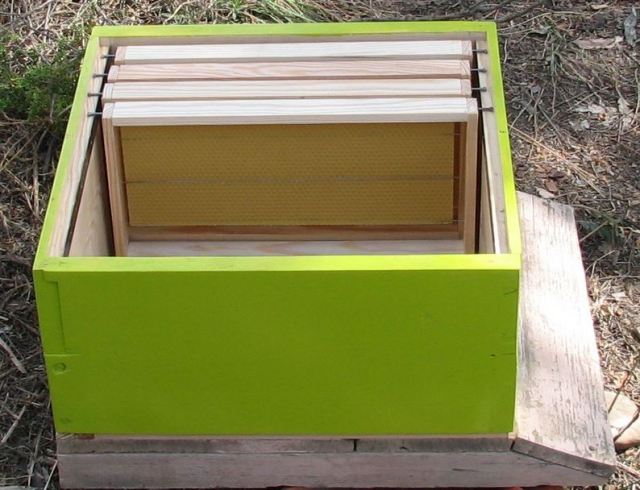
Since this was a fresh start, I decided to try something different with our backyard hives. We live in a short-season, cold-climate, high-elevation locality, so we wrap hives with insulation each fall. I’ve thrown winter-long-johns on hives each autumn for many years, but never enjoyed the chore. I’d grown tired of handling sheets of asbestos, or whatever it was I used, to protect bees from arctic winds. I heard about thick-walled polystyrene hives. So, I bought four new brood chambers made of the stuff from the local Apihex store. The boxes came in the traditional beehive colour. We masked the white with a durable exterior latex camouflage colour.  Since the bees would be in our backyard, surrounded by a million Calgarians, it seemed prudent to hide the hives so that our neighbours wouldn’t sneak over at night and steal honey from the hives. The earth-tone paint blends into the backyard (except in winter) and keeps pesky neighbours away.

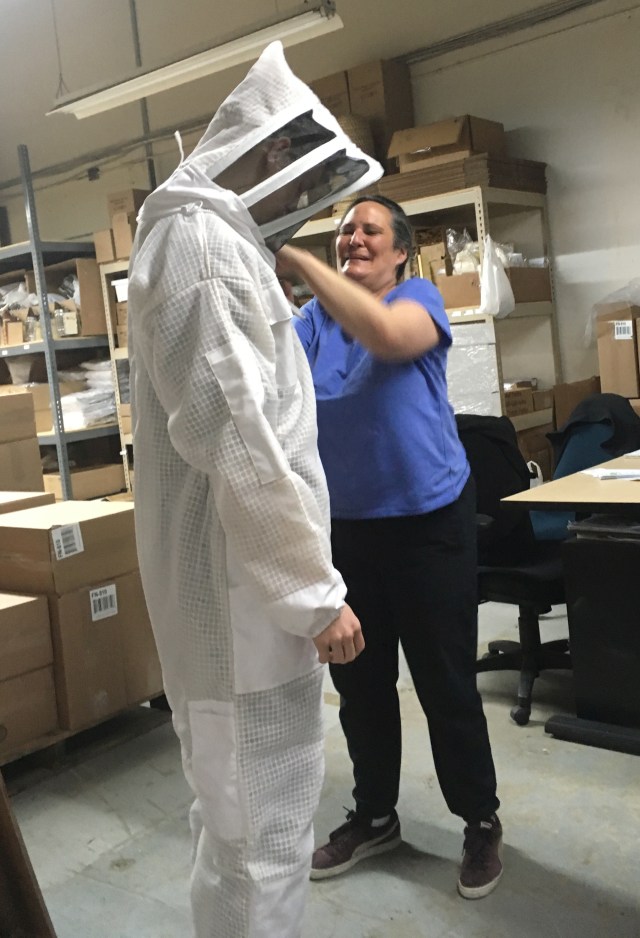
Before receiving the packages, I figured my son should have a bee suit. When Daniel was young, we let him traipse amongst the bees without bee gear. Now that he has grown to be an intelligent, hard-working young man, we can see he has some economic value. So why risk a bad bee sting?  We took him to a bee suit tailor who properly attired him. You can see the transformation from ten years ago to today.

OK. Hives painted, boy properly suited. Time to get some packages.  Here in Calgary, Alberta, Canada, a lot of beekeepers start with packages from New Zealand. So, we did, too. Usually the bees arrive through  commercial beekeepers (in our case, Reece and Echo Chandler of Scandia Honey). They have the skill it takes to haul bees from afar. Our Calgary and District Beekeepers’ Association worked with the Chandlers, who imported bees from New Zealand.  Here are  packages of bees arriving in the city, being distributed by the bee club.

Two package cages became ours. At home, we pulled apart the cages, which were aggressively stapled together back in New Zealand, where the bees were reared.

In the picture above, you can see a hive in the background. Before installing the bees, we prepared their new homes with combs, new foundation, and a feeder. You can start a package on totally new combs of foundation, but it helps enormously if you can get a few clean drawn combs from a reliable, inspected source. Our choice was again the Chandlers at Scandia Honey. We knew that they sold safe, disease-free equipment.

Below, you can see one of the boxes, ready for installing bees. From the top left are the division-board feeder (filled with sugar water), two drawn frames, a gap, one drawn frame, and two black-coloured new frames of foundation. Bees from the package will be released into the gap. Once the bees are in, we add three more drawn combs in the gap.
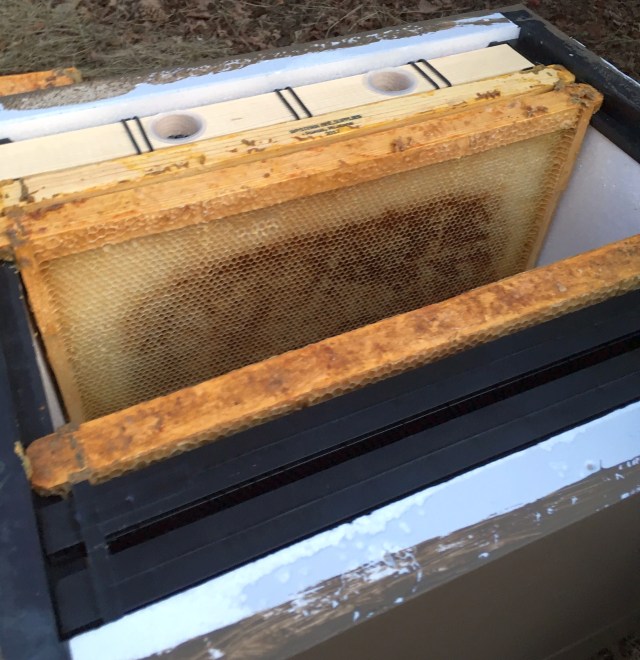
If this is all new to you, here’s a look at one of the frames of foundation. We could have bought white frames but I wanted black so we could spot the eggs and young larvae more easily. Other than the colour, there’s no difference.

All of this took place this year, April 27, 2018, at 9 in the evening. The sun was setting, it was becoming dark. Time to release the bees.

Daniel holds the package cage (above) and releases the bees. I reach in and retrieve the caged queen. As soon as most of the bees are freed, I lower my hand just above the mass of bees in the gap, open the queen cage, and release the queen among the workers. Since it is evening, most of the bees don’t fly but instead settle into the box with the queen.

We give the bees a few minutes to get comfortable in their new home, then gently place three drawn combs to fill the gap. At this point, we have 6,500 workers and one mated queen in a big empty box. I installed my first packages over 40 years ago, have done this procedure thousands of times, yet every single time I suffer doubt that a small cluster of bees can become a honey-making hive. It’s April 27th. Do I really expect to harvest honey in about two or three months? That seems highly improbable. But the bees usually surprise me. Nevertheless, take a look at the next picture. You may be able to see Daniel’s expression. This will make honey? Are you kidding?

So, we have installed two packages. The queen would likely begin to lay eggs the next day. It takes three weeks from egg-laying to fully-developed adult worker bees. So, from Friday, April 27 until perhaps Saturday, May 19, the new hives will lose population everyday as the New Zealand workers age and die. The colonies will become weaker and look even less promising until new bees emerge. For now, though, we let the bees get used to their new home. The feeder holds about a gallon (4 litres) of sugar syrup. The food is so the bees won’t starve if it turns cold and wet. For the next few days, we don’t touch the hives. Unexpected disturbances at this critical adaptation time might stir the bees into attacking and killing their new queen. So, we stifle our curiosity and allow nature to run her course for a bit. The next morning, as if to welcome the bees, nature wandered into our yard. You can spot the yearling.

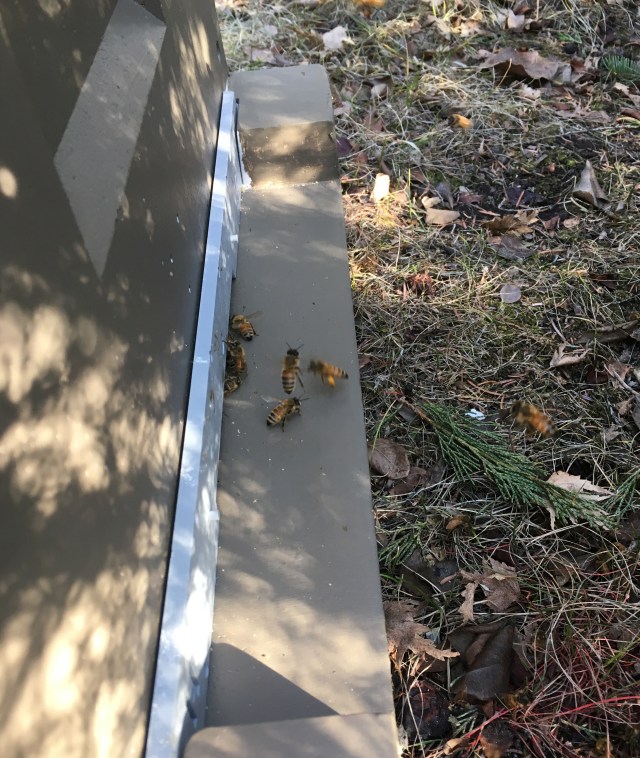
We left the package cages near the hives for the next morning so that stray bees would find their way into their new homes. Later, we cleaned up the yard, careful not to touch the hives, lest we disturb them and make the bees anxious. This location is not bad for bees, but there are things going on here which we usually advise against. The hives are heavily shaded most of the day. The entrances are tight against juniper bushes. But our yard slopes southward and has good air drainage. The bees are close to the house, so that’s easy access for me. Since they are close to the house, I’ve faced the entrances into the brush so bees don’t buzz our ankles when we mow the grass or walk nearby. Hive placement is always a trade-off. Not every location is perfect. But our goal with these bees was to learn and have fun, without being a nuisance to neighbours and family. We don’t need a ton of honey. Although the spot isn’t perfect, we were thrilled to see pollen arriving the day after installing the bees.
A week after giving the bees their new home, we couldn’t contain our curiosity any longer. We opened the hives – quickly, gently, with little disturbance – and checked for brood. Or, as Richard Taylor put it, beekeeping success demands “a certain demeanor. It is not so much slow motion that is wanted, but a controlled approach.”  With Tayloresque finesse, we opened the hives and viewed plump larvae on Saturday, May 5th!

… and on May 8th, just eleven days after the bees arrived, the first sealed brood:
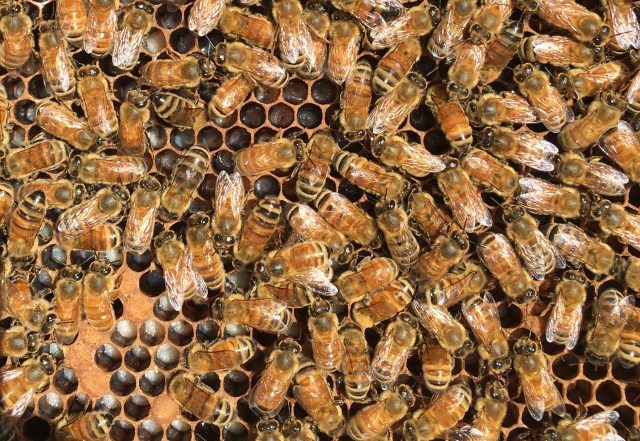
We were not intentionally looking for the queens – it’s enough to see eggs and larvae. But, here is one of the queens, surrounded by her courtly entourage. Notice how the workers’ antennae are stretched toward her:

Things were going along rather well. There was lots of pollen in the newly established hives by May 11:

Unfortunately, our first disaster struck. Near the middle of the pollen frame, above, you can see a queen cell plug. Most colonies have these, but it’s sometimes a sign of trouble. The bees may be considering supercedure. Or the queen may be dead. There were still eggs in this hive, but we checked again three days later and found only pearl brood. The queen had died.

These days, this happens too often with packages. During the 1970s, when I reared my own queens in Florida and drove truckloads of packages to western Canada, I would have nearly one-hundred percent of my queens leading good colonies all summer. In 2010, with 500 hives in Alberta, I was buying packages from New Zealand and finding one-third had lost their queens within a month. Other beekeepers have reported the same problem. I don’t know if it’s due to the way those queens were reared in New Zealand or some local environmental issue, but losing a queen these days isn’t unexpected. It’s disappointing, but not surprising.

Anticipating the possibility of queen loss, we started the year with two hives. The second colony had a fine queen and four frames. I moved a frame of young brood from the good hive and put it into the queenless one to see if they would raise a new queen on their own. We could have purchased a new queen, but this beekeeping was pedagogical. My 16-year-old was learning. Weakening a good hive early in the season while hoping that the queenless one would sprout a new egg-layer is risky. Atop that, we were drawing mostly foundation – the second brood chamber and all honey supers would be entirely new wax. Still, I was hoping that we’d make a little honey. I convinced myself that the season was early and bees are resilient. We forged ahead.

Now some good news. Probably one of the most awe-inspiring sights for any beekeeper comes with the arrival of fuzzy new bees emerging from their cells. It’s especially exciting when the new workers are the first bees in a package hive. Until May 19, every bee in the hive was a New Zealand citizen. But the Kiwis were getting old. Many were past their best-before date. But along came the Canadian newborns. Below, you can see fuzzy, whitish workers that are just a few minutes old. And, looking closely, you will also see a couple of cells being opened by youngsters, their eyes and antennae greeting the world:
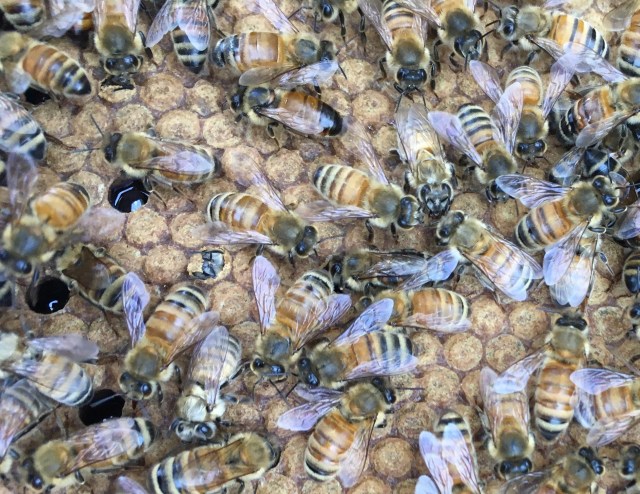
On May 23rd, we added second brood chambers. The good hive filled the entire first box. It needed a second. Our second brood chambers were entirely foundation so we pulled a couple of drawn combs from the lower box to help the bees occupy the second storey.

The queenless unit now had a few nice queen cells. (I removed the ones that were not so nice.) We stole one more frame with brood from the queenright colony and gave it to the queenless one. I put a second brood chamber atop the queenless hive. This isn’t recommended, but I felt that the hive, though weak, would eventually use the space. The dandelion flow was just starting. The thick-walled styro boxes conserve broodnest heat. And, I would not be looking at the queenless hive for a month, allowing the new queen to develop, emerge, mate, and begin egg-laying without my oversight. So, I gave both hives space.

Second brood chambers are on the hives:

Then, June 10, we did something really fun. Again, not standard procedure. But our good hive was really good. Below is a frame that was just a sheet of foundation a  month earlier. We brought it into the house.
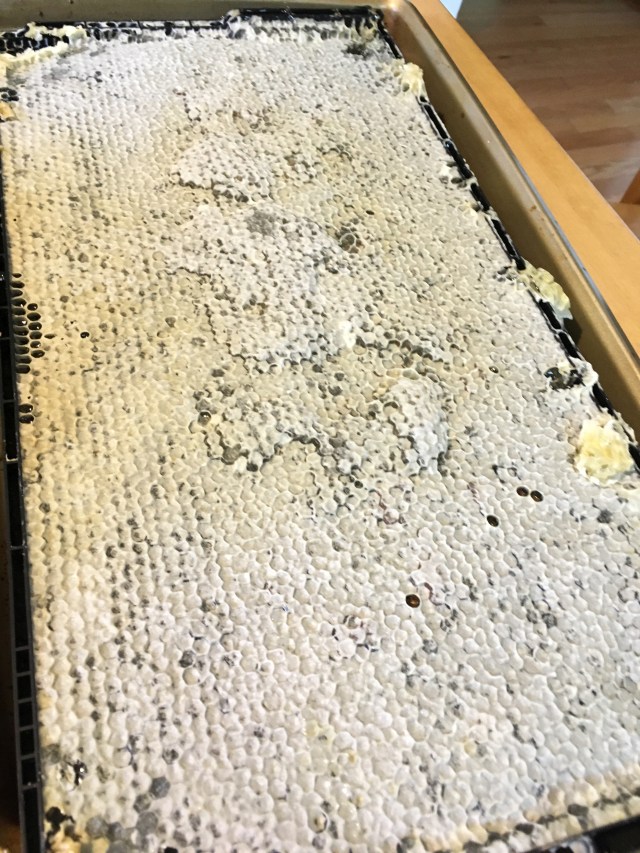
This solid one-piece plastic frame has a wax-coated plastic base to which bees added comb. It’s possible to scrape honey from the frame without wrecking the foundation. That’s what we did.

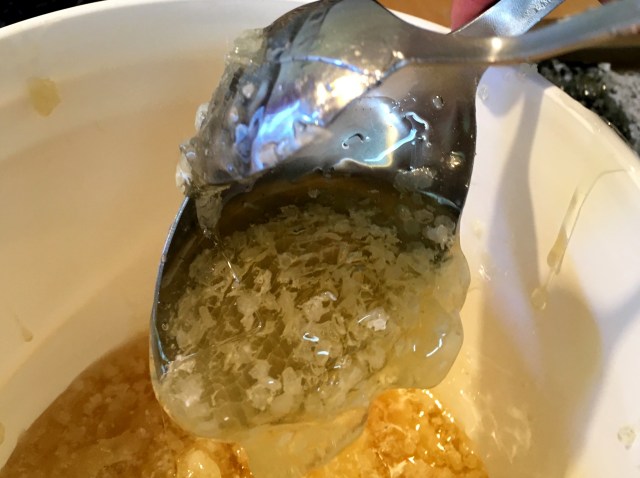
We ended up with a few pounds of very nice spring honey. This harvest system was tedious and messy but it satisfied the household sweet-tooth until the main crop would be harvested in August.
July 10th, we added honey supers. Our queenless colony, left, produced its own queen but wasn’t very strong. It received one honey super. We gave our good hive two supers.

Things progressed normally through July. The bees gained strength. The bees were drawing out combs and filling them with honey. But now we had another problem. Wasps. Large carnivorous wasps can destroy a colony. The carnivores eat bees. I bought some wasp traps and we hung them near the hives. The wasps quickly disappeared. Here are the sort of wasps we battled. At least, this is what they seemed like to us:

And here are the traps that we used. These traps worked really well. They attracted wasps but not bees or other pollinators.

It became rather dry and hot in early August. In fact, on August 10, the city of Calgary hit a record-high. Partly as a joke, and partly out of sincere bee-welfare concern, Daniel set up a garden hose and drenched the hives with ice-cold glacier water from the nearby Rockies:

By mid-August, it was apparent that the honey season was ending. Beekeepers across Alberta reported a ‘nice’ July for honey production, but August was too hot and too dry. On August 17, one week after the record-breaking heatwave, we removed the surplus honey.

We pulled honey right after lunch. If you have just a few hives, use a bee brush to remove the honey. On a warm day, bees are active and a brush is a harmless way to separate bees from honey. We kept everything covered to prevent robbing. Taking honey from two hives, brushing one comb at time, took less than one hour. Daniel carried all the frames to the garage where we’d set up the extractor in the morning.

If at all possible, remove surplus honey and extract the same day. The honey will be warm from the hive and much more willing to fling from the combs and flow to the buckets.

Daniel carried the honey, one bucket at a time, into the kitchen and carefully poured it into our honey tank. Although extracting is preferably done quickly after harvesting, bottling should wait a few days. That’s so pollen, air bubbles (churned into the honey during extracting), and bees’ knees have time to float to the top of the tank. On August 20, three days after extracting, we bottled the honey.

Making lots of honey was not our main motivation. Experiencing the joy of beekeeping was the objective. But we ended up with over seventy pounds of beautiful honey. Admittedly, that was a joy, too.

Our joy was short-lived. Skunks arrived to inspect our mini-apiary. They stayed for supper. Meanwhile, I was out of the country, checking out bees in Iceland. Daniel and our daughter Helen were with me, but my wife had stayed in Calgary. We Skyped from Reykjavik. She and our dog had spotted an entire family of skunks – a mum and a bunch of kits – pawing at the hives and eating bees. What should she do?

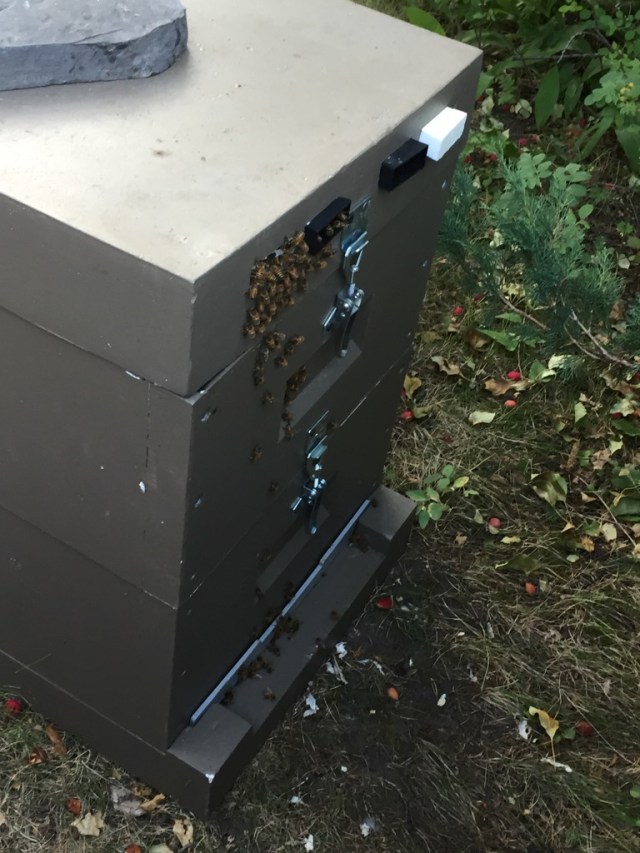
It was late afternoon in Calgary so I suggested that she go out in the evening and completely close the lower entrances – a relatively easy task that required removing the entrance reducer and flipping it over. Unfortunately, the skunks had irritated the bees so much that our normally placid charges were rather defensive. Eszter did what she needed to do but bees followed her all the back to the house. She didn’t get stung and the trick worked. The skunks could scratch the ground, trying to draw out bees to eat, but the upper entrances were 25 inches above ground level and that was now the bees’ only way out. A skunk’s tongue isn’t long enough to reach the upper entrance and the bees wouldn’t crawl down the front of the hive en masse to check out the skunk’s nocturnal pawing. Unfortunately, when she got home from work the next day, Eszter discovered another problem. The hive tops were covered with bees. We had confused them and the warm late-August weather made the bees cluster around the top entrance. They were no longer being gobbled up by skunks, but they were a bit hot.

My suggestion was that the bees should have a bigger upper entrance, so my wife brushed aside the bees and opened more air vents. It worked. The bees soon disappeared into their homes. Below, you can see the upper entrances. Most of the bees had gone inside.

Also, notice how the skunks had scratched the grass, hoping to entice bees to come out and be eaten. Some folks place their hives on tall stands to keep skunks from reaching the entrances. That would work, too, but now the hives weighed about 150 pounds each, so they stayed on the ground.
Well, that was our year with two hobby hives in the backyard. It was a great learning experience and helped me connect to novice beekeepers. Our adventure included queen loss, wasps, heat, and skunks as well as harvesting 70 pounds (35 kilos), drawing out 50 new combs from foundation, and leaving enough honey for the bees to survive the winter.

And speaking of winter, here is one last photo of our backyard apiary where the bees are as snug as bugs in polystyrene hives.  Have a nice winter, everyone. The bees will.

Posted in Bee Yards, Beekeeping, Honey | Tagged , , , , , , , , | 9 Comments

Celebrating the Gifts of Langstroth

I’m repeating a blog which I post each Christmas Day, Langstroth’s birthday. With his movable frames and his brilliant beekeeping book, Langstroth was one of the founders of modern beekeeping.

Langstroth

Langstroth, 1810-1895

He invented the modern beehive, making it easier, more productive, and less stressful for bees. However, Lorenzo Lorraine Langstroth earned nothing from his invention and suffered severely from self-doubt, melancholy, and clinical depression. Yet, he changed beekeeping to its core. On his birthday anniversary (Christmas Day!), we give homage to the most important beekeeper America ever produced.

Langstroth was born December 25, 1810. That was some Christmas gift to the world, wasn’t it? His childhood seems to have been typical for a kid who spent a lot of time on his hands and knees on the streets of Philadelphia, trapping bugs and ants with table scraps. “I was once whipped because I had worn holes in my pants by too much kneeling on the gravel walkways in my eagerness to learn all that I could about ant life,” Langstroth wrote.

He built paper traps for beetles and flies, leading to a traumatic experience when his grammar school teacher – fed up with six-year-old Lorenzo’s ‘wasted’ bug time – smashed his paper cages and freed his flies. Lorenzo was sent to cry himself to sleep inside a dark cupboard at the school. The teacher’s reform strategy worked. Langstroth gave up his passion for insects and became a preacher instead.

Langstroth's Andover church

Langstroth’s Andover church

Langstroth studied theology at Yale. At 25, he was offered a job as pastor at the South Church in Andover, Massachusetts. Even in Langstroth’s day, it was an old prestigious church. In 2011 it celebrated its 300th anniversary. The plum assignment as pastor at South Church was a recognition of the young man’s abilities.

While visiting a parish member, Langstroth noticed a bowl of comb honey. He said that it was the most beautiful food he had ever seen. He asked to visit his new friend’s bees. Langstroth was led to the fellow’s attic where the hives were arranged near an open window. “In a moment,” Langstroth remembered, “the enthusiasm of my boyish days seemed, like a pent-up fire, to burst out in full flame. Before I went home I bought two stocks of bees in common box hives, and thus my apiarian career began.” Langstroth had been infected by the bee bug.

Head troubles

Throughout his lifetime, Langstroth suffered badly from manic-depression. In the mid-nineteenth century, there was little anyone could do to help a person afflicted with mental illness. The only solace was temporary and usually came to Langstroth when he was with his bees.

The young minister felt that he wasn’t an effective parson because of his recurring dark days, so he quit preaching and became principal of a women’s school instead. By all accounts, he was a empathetic minister and a dedicated teacher, but bouts of depression forced him to cancel sermons and classes. He needed a change. Bees were the only thing he knew that could give him peace, comfort, and meaningful work while fitting into a life disrupted by debilitating illness. But sometimes not even bees could stop what he called his “head trouble” when darkness crept upon him.

He built an apiary and hoped to make his living from bees. But during his first beekeeping summer, severe depression returned and lasted for weeks. He sold all his colonies in the fall. Then he started with the bees again. His life would turn over again and again with periods of manic enthusiasm and productivity followed by gloomy months of despondency. During his depressed phases, Langstroth took shelter in a bed in a dark room. He would remain there, immobile, for days. “I asked that my books be hidden from my sight. Even the letter “B” would remind me of my bees and instill a deep sadness that wouldn’t leave.”

When he was finally able to return to his bees, Langstroth made great strives at increasing efficiency in his apiary. He made his tasks more effective. He never knew when depression would return, so he worked day and night during productive manic periods.

Eureka!

The major inefficiency in his apiary was the design of the boxes which held his bees. The boxes were usually simple wooden crates with solid walls and small holes which the bees used as entrances. During harvest of a hive, the lid was lifted from the crate. Attached to the lid were wax combs that the bees had built in haphazard jumbles. The combs cracked and broke during the beekeeper’s excavation, causing a sticky mess and disturbing the excited bees. It was a messy, nasty way to inspect bees and harvest honey.

Langstroth noticed that bees often left a small space around the edge of their combs. Sometimes, upon lifting the lids, he would find wax attached to both the lid and the walls inside the hive, while at other times the hanging combs were not stuck to the hive walls at all. Langstroth’s brilliant insight (his Eureka! moment) was noticing that the space was about 3/8 of an inch when the combs hung freely. If a comb were closer than that to a wall, the bees would attach it to the walls. But at 3/8 inch (actually, between 6.35 and 9.53 mm), the bees always left a space. He had discovered “bee space”.

Langstroth’s next step was brilliant. He made wooden frames that held the wax combs, designing them so they dangled within the hive’s box with their wooden edges always 3/8 of an inch from anything that might touch them: the lid, the interior box walls, the box bottom, other frames. Positioned like this, the bees neither waxed the frames together nor stuck them to the sides or bottom of the hive. The result was a beehive with movable frames. Combs could be lifted, examined, and manipulated. It was 1851 and modern beekeeping had begun.

Langstroth frames, the heart of his invention

Langstroth frames, the heart of his invention (Source: R. Engelhard)

Colonies could be handled more gently. Frames could be inspected for disease, queen quality, and honey and pollen reserves. Movable frames meant queen bees could be produced and strong hives split (by sharing frames between two or more new hives), thus increasing colony numbers while preventing swarming. It was a new era in beekeeping. The next few decades were “The Golden Age of Beekeeping“.

Easy to use, easy to make, easy to copy

L.L. Langstroth was not alone in figuring out bee space and inventing applications for it. About the same time, some European beekeepers (Huber, in Switzerland and Dzierzon in Poland/Germany, Prokopovich in the Ukraine) had made similar discoveries. But Langstroth created a simpler hive. His Langstroth beehive was a fine example of North American utilitarian craftsmanship. Efficient, practical, and cheap.

Langstroth’s invention was so simple and inexpensive that his patent was readily violated. Minor modifications were touted as significant improvements to Langstroth’s original design, circumventing the patent. Langstroth began a number of lawsuits against the more flagrant violators, but when the court cases began, his “head troubles” returned.

He dropped the litigation when he realized he could not win and when his illness prevented a spirited defense. Realistically, it was impossible to stop imitations and adaptations. Beekeepers – who were often handy farmers and carpenters – quickly built one or two hives with frames for themselves. Langstroth sought one dollar to license each box, which was a huge price in those days. But his real discovery was “bee space” which could not be patented. His position was like trying to patent sails for ships after discovering wind. Even Langstroth’s supporters wrote that Langstroth should have simply allowed the idea to flourish in the public domain. Trying to enforce the patent was expensive. It left Langstroth nearly bankrupt.

Frames, dangling in a hive. (Source:

Frames, dangling in a hive. (Source: D. Feliciano)

With a plethora of modifications and similar boxes being designed in Europe, Langstroth’s great contribution may have entered the world anyway and without credit to him. But the retired minister had one other major contribution to society. It earned him much-deserved praise and even a bit of money. In one feverish six-month manic spell, Langstroth wrote the greatest beekeeping book ever published.

Hive and Honey Bee

Langstroth's Hive and Honey-Bee, first published in 1853

Modern copy of Langstroth’s 1853
Hive and Honey-Bee

In 1852, working for six hectic months with almost no sleep, Langstroth wrote The Hive and the Honey-Bee. This book, revised and expanded in more than 40 subsequent editions, is still a reliable source for beekeepers. When Langstroth wrote it, there were other good bee primers on the market, but his book moved to the top spot. You may read the original 1853 book on-line. I’ve read and re-read my 1859 copy with its 409 pages of fading text protected by orange hardboard covers. It earned its place in my library. Within the book are chapters on Loss of the Queen (and what to do about it), Swarming, Feeding, Wintering, and Enemies of the Bees. It’s a very practical guide to keeping bees and much of it is still relevant today.

Langstroth never found lasting peace from his cycles of manic depression, though in his 60s he travelled to Mexico and discovered that the stimulation and change of scenery gave him an unexpected respite from depression. The illness returned when he returned to his home, but he remembered the break from head troubles with great appreciation. He lived long enough (85 years!) to see his work appreciated, his name honored, and his book sell hundreds of thousands of copies. Despite his life-long disability, he had a long, full life, three children, and interesting work. And he made a phenomenal contribution to beekeeping.

Merry Christmas and Happy Birthday,
Lorenzo Loraine Langstroth!

Posted in Beekeeping, Books, History, Hives and Combs, People | Tagged | 7 Comments

David Attenborough and the tired bumblebee

Back in July, I posted about some cute stories which were filling social media. Vignettes described people rescuing tired, hungry-looking (how can you tell?) bumblebees by giving them a spoonful of sugar water. I have reposted that July blog piece just below. I understand the urge to be nice (I’m Canadian) – but seriously, aren’t you playing God with nature? What if the bumblebee is sick, laden with viruses or parasites, and you’re helping it get home to die among its comrades and infect them?

On Facebook, some of those social media pleas featured Sir David Attenborough, the documentarian specializing in films about amazing wonders of nature. I doubted that the 92-year-old nature expert would have urged anyone to stuff the face of a bee. He’s smarter than that. Well, BBC, which derives its name from two bees and an ocean, and hires Attenborough, has forced Facebook to “remove fake news which claimed Sir David Attenborough advised feeding bees a spoonful of water and sugar.”  Attenborough never said anything of the sort. According to UK’s Telegram:

The fake post encouraged good samaritans to help tired bees, but experts quickly dispelled the advice revealing it can be harmful and reduce pollination.

The now deleted post quoted the naturalist [Attenborough] as saying: “If bees were to disappear from the face of the earth, humans would have just four years to live. [Hey, didn’t Einstein say that?]

“If you find a tired bee in your home, a simple solution of sugar and water will help revive an exhausted bee.”

Atteborough never offered that advice. So, we learn that fake news on Facebook can be removed. And maybe that bumblebee doesn’t need our sugary handouts.

🐝 🐝 🐝 🐝 🐝 🐝 🐝 🐝🐝 🐝 🐝 🐝 🐝 🐝 🐝 🐝

From my July posting:

Feeding bumblebees that are resting in a garden has become a thing. I’ve seen some twitter tweets with concerned citizens gallantly virtue signalling their good deed – giving a bee a drink of sugar water. Here’s a sample:

You can find tweets and posts like this all over the place. Kindly folks want to help tired/sick bees. A bit of sugar water might indeed revive a hungry bee. But should we?

Should you feed tired bees? Is that interfering with wildlife? Are you changing the evolved social fabric which will result in advantages to bees willing to hang out with humans? That’s how wolves became dogs. And, it’s the way Carniolan bees became docile – the strain was kept on porches and in gardens for centuries. Mean bees were destroyed and mellow ones thrived, creating gentle Carniolans through human selection.

Should you feed wild bumblebees? Let’s ignore your inadvertent genetic manipulation and look at something more serious. What if the bee looks tired and hungry but is actually infested with viruses or parasites? Are you doing a favour if you help a sick bee return to her colony where she spreads her malady to all her friends?

Good or bad? I’m not sure, but I don’t like seeing any animal in distress. I might be tempted to whip out some highly processed white sugar, dissolve it in chlorinated tap water, and feed it to a suffering bee. But is it really the right thing to do?


Posted in Humour, Reblogs, Save the Bees | Tagged , | 1 Comment

A 70-year-old beekeeper

This looks like one of those “Write your own caption” contests.
Any suggestions?

The king-in-waiting (that sounds dreadful) is celebrating his 70th birthday today. The current controversy surrounding Prince Charles is a question over how his role as an environmentalist and erst-while supporter of occasionally odd pseudoscience may interfere with his job as the future king. In the past, he has sent letters to UK cabinet members regarding such things as alternative medicine and a proposed badger culling. So, some Brits have expressed concern that he will voice controversial opinions in public if he becomes king. He even has the power to dissolve parliament (and call a new election) if he becomes disenchanted. The Prince, however, has reassured us.  “I’m not that stupid,” he said, indicating that he intends to act entirely differently if he becomes king.

Most of the Prince’s causes have been helpful and all have been sincere. Among the work that his charities support are sustainability, community development, architecture form, conservation, and employment training. I certainly hope that he does not stop advocating for the environment and bees. Bees and beekeeping (“the sport fit for a king”) have been longtime interests for Prince Charles.

I’m not sure how engaged he is (does he light the smoker or carry the hivetool?), but honey bees have been part of his estates and organic gardens for years.

Thanks, for that, Prince Charles.  May you have a sweet 70th!

Like so many couples, the prince and his wife have a good-natured rivalry. Here, the Duchess of Cornwall is selling honey produced from her private garden’s bees while the prince competes by selling honey from his own hives, packaged under the label Highgrove Honey.

Posted in Culture, or lack thereof, People | Tagged , , | 11 Comments

Where poppies grow…

In much of the old British Empire, November 11 is commemorated as Remembrance Day. The warring parties, which had sent their young people into trenches to shoot each other, finally created a cease-fire. It was set to begin at 11 am on November 11th in Europe’s bloody battle fields. The armistice held and the Great War, or World War I as we now know it, was over.   Seventy million soldiers had been mobilized. Nine million of them died, along with seven million civilians. After the war, genocides, famine, and influenza killed one hundred million more.

In Canada, and many other parts of the world, the symbol of remembrance and respect for the people who died is an artificial poppy pinned to the lapel. The poppies are given away by veterans’ groups and others who accept a donation in return.

Why the poppy? It started with Lieutenant-Colonel  John McCrae, a Canadian physician who was in Ypres, a town in West Flanders, Belgium, during World War I. A few years ago, I was in Flanders and visited the trenches and spent an evening wandering about in the cemetery where McCrae’s friend, Alexis Helmer,  was buried. It was mid-July when I was there, the sun was setting late and the place was deserted, except for me and my 13-year-old boy, my oldest son.

There were no poppies that day, but a hundred years earlier, in May 1915, John McCrae had seen row on row of the red flowers, waving in the breeze. The loss of his friends in battle, the poppies, and the fatigue of war caused McCrae to pen a short poem of tribute.  Here are first lines:

In Flanders fields the poppies blow
Between the crosses, row on row,
That mark our place; and in the sky
The larks, still bravely singing, fly
Scarce heard amid the guns below.

We are the Dead. Short days ago
We lived, felt dawn, saw sunset glow,
Loved and were loved, and now we lie
In Flanders fields.

A few months after he wrote it, the Canadian soldier’s poem was published in a British magazine. John McCrae did not survive the war and never saw the effect his words about poppies and the fallen dead would have upon the next generations.  Here in Canada, school children memorize “In Flanders Fields” and the poppy represents the solemn loss of soldiers.

The poppy is one of the earliest plants that I remember from my childhood. My mother grew many of the bright red lanky flowers in her gardens near the pond. Much later, I became intrigued by the red flower with its black center. It gives no nectar but yields black pollen to bees willing to work hard and shake the flower until bits of black dust fall off. Add to that the fact that ‘red’ appears ‘black’ to a bee. To a bee, then, the poppy is an unattractive black flower with black pollen and no nectar. The flower seems more appropriate as a symbol of death – with just a tiny hint of a hard-won future (those black pollen grains) embedded. An appropriate choice for a war remembrance symbol.

My older son – the one who was 13 when he and I visited the battlefields of Flanders – is now an articling lawyer. This weekend, he participated in a special ceremony at the Calgary courthouse. It has been 100 years since the war ended. During the Great War, 37 young Calgarians who were law students or articling (doing their apprentice work) went off to fight in Europe and never returned. The Calgary law society posthumously welcomed those fallen soldiers to the bar. They were symbolically represented by young people, and family members, wearing poppies on their lapels.

Posted in Culture, or lack thereof, History, Honey Plants | Tagged , , , | 4 Comments

The Metaphysical Beekeeper

richard-taylor

As I continue to plod along with my Master’s in bee ecology at the University of Calgary, I feel obligated to apologize for the infrequency of these bad beekeeping posts. Sorry. But I’m not going to apologize for occasionally repeating a posting from the past – especially this one, which celebrates the great commercial beekeeper, writer, and philosophy professor, Richard Taylor.  He would have been 99 years old on November 5th. I last published this piece two years ago. I wonder what he’d think of our messed-up world if he were alive and philosophizing today…

Today is the anniversary of the birth of one of my beekeeper-heroes, Professor Richard Taylor. He was an early champion of the round comb honey system, a commercial beekeeper with just 300 hives, and he was a philosopher who “wrote the book” on metaphysics. Really, he wrote the book on metaphysics – for decades, his college text Metaphysics introduced first-year philosophy students to the most fundamental aspect of reality – the nature of cosmology and the existence of all things.

Although his sport of philosophy was speculative, unprovable, and abstract to the highest degree, Richard Taylor was as common and down-to-earth as it’s possible to become. I will write about his philosophy and how it shaped his politics, but first, let’s celebrate his beekeeping.

Richard Taylor and his twin brother were born November 5th, 1919. This was shortly after their father had died. That left a widowed mother to raise an impoverished family during the Great American Depression. Richard was fourteen when he got his first hive of bees in 1934 – the year that a quarter of Americans were unemployed and soup-lines leading to Salvation Army kitchens stretched for blocks. He began beekeeping that year, and except for submarine duty as an officer during World War II, he was never far from bees. He respected honest hard work and the value of a penny, but he nevertheless drifted, trying college, then quitting, and taking on various uninspiring jobs.

Evenings, on his bunk in his navy sub, Richard descended into the gloomy passages of Arthur Schopenhauer. Somehow the nihilistic philosopher appealed to Taylor and ironically gave him renewed interest in life. Because of this new interest, Taylor went back to school and became a philosopher himself.

Richard Taylor earned his PhD at Brown University, then taught at Brown, Columbia, and finally Rochester, from which he retired in 1985 after twenty years. He also held court as a visiting lecturer at Cornell, Hamilton, Hartwick, Hobart and William Smith College, Ohio State, and Princeton. His best years were at Rochester where he philosophized while his trusted German shepherd Vannie curled under his desk. Richard Taylor sipped tea and told his undergrads about the ancient philosophers – Plato, Epicurus, Aristotle, Xeno, and Thales. In the earlier days, he often drew on a cigar while he illuminated his flock of philosophy students. Those who attended his classes remarked on his simple, unpretentious language. They also noted that he was usually dressed in bee garb – khakis and boots. He and Vannie quickly disappeared to Richard Taylor’s apiaries as soon as the lecture ended and the last student withdrew from the hall.

The hippie beekeeper

It’s probably unfair to call Dr Richard Taylor a hippie beekeeper, but perhaps he was exactly that. As a beekeeper, he was reclusive. He refused to hire help. Rather than deal with customers, he set up a roadside stand where people took honey and left money on the honor system. Taylor disdained big noisy equipment. He claims to have sometimes taken a lawn chair and a thermos of tea to his apiaries so he could relax and listen to the insects work, but I doubt that he did this much. Through the pages of American Bee Journal, Bee Culture, and several beekeeping books, he described best beekeeping practices as he saw them – and those practices required hard work and self-discipline more than relaxed lawn-chair introspection.

how-to-do-it-book-coverRunning 300 colonies alone while holding a full-time job and writing a book every second year demands focus. His bees were well-cared for, each producing about a hundred pounds every year in an area where such crops are rare. By 1958, he was switching from extracting, which he disliked, to comb honey production, which he loved. Comb honey takes a more skilled beekeeper and better attention to details, but in return it requires less equipment, a smaller truck, and no settling tanks, sump pumps, whirling extractors, or 600-pound drums. “Just a pocket knife for cleaning the combs,” he wrote.

Summit Comb in useTo me, it’s surprising that Richard Taylor embraced the round comb honey equipment called Cobanas. The surprising thing is that the equipment is plastic. Reading Taylor’s books, one realizes his affinity for simple tools and old-fashioned ways. Plastic seems wrong. But it’s not.

In the past, comb honey sections were square-shaped and made from wood. That required the destruction of forests of stately basswood (linden) trees, something that did not appeal to Taylor. Plastic lasts forever, a real benefit for a person as frugal as Richard Taylor. It is light-weight, durable, and ultimately very practical for bee equipment. He advocated making comb honey and he was sure that the Cobana equipment, invented by a Michigan physician in the 1950s, would lead the way. He was so enthused that in 1958, living in Connecticut, he wrote his first beekeeping article about the new plastic equipment for the American Bee Journal. Here’s the photo that accompanied his story.

randy-with-combs

Richard Taylor’s son, Randy, packing round comb honey, 1958. (Photo from ABJ).

One final thing about Richard Taylor, the beekeeper. He was financially successful. In today’s dollars, his comb honey bee farm returned about $50,000 profit each year – a tidy sum for a hobby and more than enough spare change to indulge his habit of frequenting farmer’s auctions where he’d delight in carrying home a stack of empty used hive bodies that could be had for a dollar.

Taylor, the teacher

Richard Taylor immensely enjoyed teaching and lamented what he called “grantsmanship” which arose in America while he was a professor. Grantsmanship is the skill of securing funding for one’s projects while possibly ignoring the fundamental duties of teaching. This, of course, can eventually lead to big dollars flowing to researchers who are willing to claim that sugar, for example, does not contribute to obesity and cigarette smoke does little more than sharpen one’s senses. Richard Taylor saw the conflict and regretted the demise of good faculty instructors replaced “largely by graduate students, some from abroad with limited ability to speak English. Lecturers who simply read in a monotone from notes are not uncommon,” he wrote.

Meanwhile, the (sometimes unethical) pursuit of grants was accompanied by the rise of the “publish or perish” syndrome. In his own field, Taylor pointed out that academic philosophers engaged in “a kind of intellectual drunkenness, much of which ends up as articles in academic journals, thereby swelling the authors’ lists of publications.” Taylor wrote extensively on this in 1989, saying that there were 93 academic philosophy journals published in the USA alone that year – seldom read, seldom good, but filling mailboxes with material to secure a professor’s promotions.

This was not the academic world that Richard Taylor sought when he began his career in the 1950s, but it was the world he eventually left. Although he wrote 17 books – mostly philosophical essays but also several rather good beekeeping manuals – he didn’t publish many academic papers. He spent more time in the lecture halls and with his bees than he did “contemplating the existential reality of golden mountains” and writing papers about them, as he put it.

The philosopher and the bee

I am only going to give this one short passage about Richard Taylor, the philosopher. He studied and taught metaphysics and ethics. His essays on free will and fatalism are renowned and influential, even today. I’ve never taken a philosophy course, so anything I say about the subject will probably embarrass me. But a few years ago, during a winter trip to Florida, I carried Taylor’s Metaphysics with me. I read every word and I think that I understood it at the time. For me, most of it was transparent common sense. Since it was well-crafted and interesting, Taylor may have lulled me into believing that I understood his metaphysical description of the universe, even with just this cursory introduction. At any rate, I felt that what he wrote wasn’t different than what I’d come to discover on my own, although it was much more elegantly presented than I could ever manage.

Taylor-made politics

taylor-c-1980When I saw Richard Taylor – just once, at a beekeepers’ meeting – I indeed thought that he was a hippie, a common enough form of beekeeper in the 1970s. His belt was baler twine and a broad-rimmed hat hid his face. I was surprised to later discover that Richard Taylor identified as a conservative and voted Republican. But he was also an atheist, advocated for women’s rights, and late in life (though proud of his military service) he became a pacifist, “coming late to the wisdom,” he said. I guess he would be a libertarian today. He valued hard work, self-sufficiency, and independence. He disliked Nixon, but gladly voted for Reagan. He even wrote a New York Times editorial praising Reagan’s inaugural address while offering insight on what it means to be an introspective conservative in the 1980s.

At age 62, still a professor of philosophy at the University of Rochester, and the recent author of the book Freedom, Anarchy, and the Law, he wrote a widely-circulated New York Times opinion piece. Taylor wrote that in Reagan’s inaugural address, Reagan reminded us that “our government is supposed to be one of limited powers, not one that tries to determine for free citizens what is best for them and to deliver them from all manner of evil.” Richard Taylor then goes on to warn that “political subversion . . . is the attempt to subordinate the Constitution to some other philosophy or creed, believed by its adherents to be nobler, wiser, or better.”

Taylor warned of anti-constitutional subversion in American politics, “if anyone were to try to replace the Constitution with, say, the Koran, then no one could doubt that this would be an act of subversion . . . Similarly, anyone subordinating the principles embodied in the Constitution to those of the Bible, or to those of one of the various churches or creeds claiming scripture as its source, is committing political subversion.”

Taylor tells us that conservative spokesmen of Reagan’s era – he mentions Jerry Fallwell and others – are right saying that “it is not the government’s function to pour blessings upon us in the form of art, health, and education, however desirable these things may be.” Nor, he claims, is it constitutional for “the Government to convert schoolrooms into places for prayer meetings, or to compel impoverished and unmarried girls, or anyone else, to bear misbegotten children, to make pronouncements on evolution, to instruct citizens on family values, or to determine which books can and cannot be put in our libraries or placed within reach of our children. . . it can never, in the eyes of the genuine conservative, be the role of Government to force such claims upon us. The Constitution explicitly denies the Government any such power.”

taylor-mosaicI think that Richard Taylor would be politically frustrated today. The Republicans have drifted ever-further from small government and have expanded their reach into personal affairs while the Democrats have pushed forward extensive safety nets. A true libertarian party, such as Taylor seems to wish for, gathers little support in America today.

I hope that my summary of Richard Taylor’s political philosophy has not offended his most ardent followers. I’ve tried to distill what Taylor thought about good government – I agree with much of it, but disagree with some. It is presented as just one facet of his personality. Taylor was complicated. His last book, written in his 80s while he was dying from lung cancer, is about marriage – yet his own marriages had heartbreaks.

He showed other complicated and unexpected quirks. For example, he was an avowed humanist, yet showed a spiritual nature. In his office, he mounted a certificate which honored him as a laureate of the International Academy of Humanism, one of the few people chosen over the years. Others included Carl Sagan, Christopher Hitchens, Isaac Asimov, Richard Dawkins, Richard Leakey, Steven Pinker, Salman Rushdie, E.O. Wilson, Elena Bonner, and Karl Popper. He was in extremely elevated intellectual company. Taylor belonged there among the other atheists, even if he once metaphorically wrote in his most popular bee book, “the ways of man are sometimes, like the ways of God, wondrous indeed.”

Taylorisms in the bee yard

the-joys-of-beekeepingRichard Taylor was complicated for a simple man. It is said that he could not stand complacency, vanity or narcissistic behavior, yet he seemed to get along well in gatherings of beekeepers where such attitudes are often on display. He had a love of paradox and Socratic whimsy, yet he was disciplined and direct as a writer. He delighted in the pessimism of Schopenhauer, yet he was not a pessimist himself. Instead, he was quite a puzzle.

I will end this little essay with wisdom from Richard Taylor, beekeeper. Richard Taylor’s finest bee book, The Joys of Beekeeping, is replete with homey truisms that every aspiring beekeeper should acknowledge and embrace. The book itself is slim, entertaining, personal, and very instructive of the art of keeping bees. Or, as Taylor himself calls beekeeping, “living with the bees. They keep themselves”.

Here, then, are some select Taylorisms:

Beekeeping success demands “a certain demeanor. It is not so much slow motion that is wanted, but a controlled approach.”

“…no man’s back is unbreakable and even beekeepers grow older. When full, a mere shallow super is heavy, weighing forty pounds or more. Deep supers, when filled, are ponderous beyond practical limit.”

“Some beekeepers dismantle every hive and scrape every frame, which is pointless as the bees soon glue everything back the way it was.”

“There are a few rules of thumb that are useful guides. One is that when you are confronted with some problem in the apiary and you do not know what to do, then do nothing. Matters are seldom made worse by doing nothing and are often made much worse by inept intervention.”

. . . and my own favourites . . .

“Woe to the beekeeper who has not followed the example of his bees by keeping in tune with imperceptibly changing nature, having his equipment at hand the day before it is going to be needed rather than the day after. Bees do not put things off until the season is upon them. They would not survive that season if they did, so they anticipate. The beekeeper who is out of step will sacrifice serenity for anxious last-minute preparation, and that crop of honey will not materialize. Nature does not wait.”

“Sometimes the world seems on the verge of insanity, and one wonders what limit there can be to greed, aggression, deception, and the thirst for power or fame. When reflections of this sort threaten one’s serenity, one can be glad for the bees…” – The Joys of Beekeeping

taylor-inscription

Posted in Books, Comb Honey, Commercial Beekeeping, Culture, or lack thereof, History, People | Tagged , , | 12 Comments

Sue Hubbell and her Bees

One of the first really good beekeeping story tellers whom I remember encountering was Sue Hubbell. Her books, A Country Year: Living the Questions (1986) and  A Book of Bees and How to Keep Them (1988) showed me that books about beekeeping don’t need to be dry renditions of mechanics and simplified biology. They can be entertaining, motivating, and thought-provoking, while also providing the truth about real-world bee management challenges.

Sue Hubbell died last week at the age of 83. Her beekeeping began when she and her husband spent a year (1972) roaming America and ended up in the Missouri Ozarks, suddenly owning 90 acres and 300 hives of bees. Her beekeeping really began when Mr Hubbell moved on, leaving Sue divorced and the sole proprietor of all those bees.

She ran the farm alone, learning to fix machinery and manage the bees and honey sales. She wrote about her midlife adventures in American Bee Journal in the late 1970s and later in her books. At the time, I was a no-nonsense commercial beekeeper with little time for fun stories about hippie-style beekeeping. But that wasn’t Hubbell’s style at all – and her message was all about hard work, common sense,  and love of nature. I actually enjoyed her articles in ABJ and sought out her books. I wasn’t disappointed. You can find a long list of her work (8 books and a hundred articles) here, and you’ll see that she wrote for New York Times, The New Yorker, The Smithsonian Magazine, Time, Harper’s, and Discover, among others.

From my own copy of Sue Hubbell’s Book of Bees, this is how she starts her story:

“For a long, long time – for nearly forty years – I never had any bees. I can’t think why. Everyone should have two or three hives of bees. Bees are easier to keep than a dog or cat. They are more interesting than gerbils. They can be kept anywhere. A well-known New York City publisher keeps bees on the terrace of his Upper East Side penthouse, where they happily work the flowers in Central Park.
I have had bees for fifteen years, and my life is the better for it. I operate a beekeeping and honey-producing farm in the Ozark Mountains of southern Missouri. I keep three hundred hives of bees, separated into groups of ten or twelve…”

You want to read the rest, don’t you?

Posted in Books, People | Tagged , | 14 Comments

Canada Goes Legal (Wait ’til you taste the honey!)

Yesterday, October 17, 2018, Canada legalized possession and consumption of weed, pot, grass, cannabis, marijuana, or as my father called it, Mary-Ja-Wanna.  Parliament voted overwhelmingly in favour of the motion proposed by the justice minister a year ago. It took a year to get ready. Now it’s the law.  This makes Canada the second country in the world (Uruguay was first) to make the stuff as legal as whisky. Some health workers are concerned legalization sends the wrong message to youngsters. It does. But it doesn’t saddle an errant 18-year-old (or 78-year-old) with a criminal record. The police favoured the new law as it reduces time spent ticketing small possessions. Police and legislatures hope that decriminalization will cut into gangster revenue. Organized (and disorganized) crime had been collecting six billion dollars a year in Canada from their cannabis trade. Libertarians in Canada were also pushing for the change, believing that less government is better government.

I’ve never used weed and probably won’t ever use it, though people have been urging it on me for decades. However, I became curious about marijuana honey. Does the plant secrete nectar which honey bees could collect? And should I be worried that my backyard hives might access my neighbour’s deck next summer and her home gardening might include a few blooming buds, and my bees might collect MJ nectar, which my bees might turn into cannabis honey and I might mail a jar to my sister in the USA, and a Homeland Security hound might sniff out the cannabis in the honey, and I might be arrested for international drug smuggling?

I can relax. My neighbour only grows tomatoes on her deck.  But even more important, marijuana is wind pollinated. The plant doesn’t secrete nectar to attract pollinators because this weed has been married to the wind forever. No nectar, no honey. Does cannabis have extrafloral nectaries or other body parts that ooze sugary THC? None have been convincingly documented.

Bees can’t make honey from weed. Weeds, perhaps. Weed, no. However, there has been a weed and honey operation of a sort going for a while in France. The operator’s claim is that he has ‘trained’ his bees to collect ‘resin’ from cannabis which the bees ‘add’ to the honey they make. I don’t want to sound skeptical, but I doubt it.  You can read about Nicolas Trainerbees and his trained bees here and here. Training bees to collect marijuana resin would be akin to training bees to collect propolis. I don’t think it’s possible. However, here’s a video of his ‘trained’ bees. What do you think?

Posted in Honey, Honey Plants, Strange, Odd Stuff | Tagged , , , | 16 Comments

Bees on Ice

I’m holding this Icelandic bumblebee so I can slip an RFID tag on her front left leg (if she’s right-handed; use the right leg for left-handed bees). It’s similar to tagging a passenger pigeon.
(Actually, I just wanted to get a closer look.)

So much has happened in the weeks since my last post: I started an MSc (in bee ecology); my son and I pulled our honey crop;  I presented a talk at the first-ever United Beekeepers of Alberta conference; I began to TA (teach) a university computer lab on statistical biology; I wrote a feature about the late Warwick Kerr (see it in the November 2018 American Bee Journal); we winterized our hives; and, I had almost three hours of sleep. I will write posts on some of these things in the future, but first I have to keep a promise.

Back in August, when I returned to Calgary from Iceland, I said that my next post would be about the bees I saw in Iceland. It wasn’t. Dr Warwick Kerr (“The Man Who Created Killer Bees”) died in early September, so I posted about him instead. Writing about Kerr became a priority (When was the last time a country lowered its flags because a bee research scientist died?).  My posts about Kerr led to my American Bee Journal article which needed written within a few days to meet the journal’s publishing deadline.

I was in Iceland in late August. Previously, I posted a bit about beekeeping there. Honey bees are scarce in the Viking Republic. A few beekeepers try to keep a few hives, nursing them along through months of cold snowy darkness and then feeding the bees to prevent starvation if the summer is cold and wet – as it was this year. I visited Iceland in late summer when honey bees should have been foraging. They would normally collect some honeydew from small trees and bushes at that time, but this year, they didn’t. It was a disaster for honey bees, as might be expected during the coldest Icelandic summer in 100 years.

It was too cold for honey bees. However, I saw bumblebees. Big, fat, bumbling insects that took wing by the thousands when the weather improved. After days of intermittent showers and temperatures around 10C (50F) the sky cleared and Reykjavikians pulled off sweaters and faced the sun, like prairie gophers on a mild winter day. Or bumblebees on a sunny day in Iceland.

Ever seen two bees sleeping in a flower? 

The sight of two bumblebees sharing a flower was definitely a Kodak moment. This was the first time that I’d seen such a sight. It had been cool and wet. These bumblebees snuggled in the rain. Then the sun came out. It became bright and almost warm. The bees began to dry. Within minutes, they revived from motionless to twitching to shaking as their muscles generated heat. Then they flew off.

Bumblebees lived in Iceland long before people arrived 1200 years ago. They adapted to Iceland’s flowers and the flowers adapted further to attract bumblebees. Honey bees, on the other hand, are not native to Iceland. They only survive when kept by humans and will surely die out when the people of Iceland all move away. In Iceland, honey bees need to be kept, making Icelandic enthusiasts true bee ‘keepers’.

Bumblebees survive the long winters when solitary queens find dens and burrows to slumber through the cold in a dormant state, patiently awaiting mild weather. When it comes, they rapidly build nests, populate them with a few hundred bees, and pollinate the native flowers of Iceland. In late summer, a few females mate and then find solitary dens and burrows to once again slumber until the coming spring’s mild weather. And so it goes.

I was lucky to meet so many nice Icelandic bumblebees. Here are some of them:

Reykjavik, Iceland’s capital, is full of bees.

Posted in Climate, Ecology, Travels | Tagged , , , | 19 Comments

City Mourns Loss of Beloved Beekeeper

Dr Warwick Kerr and his granddaughter, Dr Priscilla Kerr in the professor’s garden.

The Amazon River city of Manaus has begun three days of official mourning for the death of a beekeeper. He was the beekeeper, research scientist, geneticist, educator, and political activist, Dr Warwick Kerr.  The mayor of Manaus declared the tribute and the city’s two million residents were reminded of the man who worked tirelessly to improve the welfare of the people of the rainforest  and all of Brazil.

Brazilian flag at half-mast honouring the late Professor Kerr

Most people will know of Dr Kerr for bringing Africanized genetic stock to Brazil to replace the less-adapted European bees which were not doing well in the tropics. His work resulted in a vast increase in Brazil’s honey production (from 15 million to 110 million pounds per year). I wrote about Dr Kerr on Saturday, the day he died, but as we take one last look at Professor Kerr’s life, I will share part of his family’s official statement. I received it from Warwick Kerr’s granddaughter and I have copy-edited it just a bit. The granddaughter, Dr Priscilla Kerr, also sent photographs, so I am sharing two of them here.

We report with extreme regret the death of our father, Professor Warwick Estevam Kerr, an engaged citizen-scientist and one of the world’s foremost experts in bees. He was the first scientific director of FAPESP (São Paulo State Research Foundation), Director of INPA (Amazon National Research Institute), and Rector of UEMA (State University of Maranhão). He graduated from ESALQ (Advanced School of Agriculture Luiz de Queiroz), while holding a teaching position in the Department of Genetics. He founded departments of Biology in the Faculty of Philosophy, Science and Literature in the State University of São Paulo at Rio Claro, in the Faculty of Medicine in the University of São Paulo at Ribeirão Preto, Biology in the Federal University of Maranhão, and contributed substantially to the development of the Institute of Genetics and Biochemistry in the Federal University of Uberlândia, among numerous other academic accomplishments.

He served as president of the SBPC (Brazilian Society for the Progress of Science) and the SBG (Brazilian Society of Genetics). He was a member of the ABC (Brazilian Academy of Sciences), Member of the Third World Academy and the first Brazilian scientist to be voted a member of the US National Academy of Sciences in recognition of his scientific productivity.

Throughout his life he was involved with research that yielded advances in the management and taming of African bees, that escaped from captivity after he brought them to Brazil in 1956, and are now very important in Brazilian honey production. Dr. Kerr worked under the principle of the inseparability of teaching, research and service, seeking to establish long-term relations with the community and with social movements, in order to transfer capacity and the results of research.

His socialist convictions led to two arrests during the military dictatorship established in 1964 and constant surveillance from authorities during the dictatorship. His generous spirit from early in his life led him to embrace socialism, and to act to build a just and egalitarian society where science and other knowledge are at the service of the majority of the population.

He died in Ribeirão Preto at age 96, of respiratory arrest at 9:00 hours on September 15, 2018.

He is survived by his children Florence, Lucy, Américo, Jacira, Ligia Regina and Tânia, 17 grandchildren and 17 great-grandchildren.


Dr Kerr, right, with his son, physics professor Dr Amerigo Sansigolo Kerr. 
They are at the amphitheatre housing Warwick Kerr’s laboratory.

Posted in History, People | Tagged , , , | Leave a comment