The Metaphysical Beekeeper

richard-taylor

As I continue to plod along with my Master’s in bee ecology at the University of Calgary, I feel obligated to apologize for the infrequency of these bad beekeeping posts. Sorry. But I’m not going to apologize for occasionally repeating a posting from the past – especially this one, which celebrates the great commercial beekeeper, writer, and philosophy professor, Richard Taylor.  He would have been 99 years old on November 5th. I last published this piece two years ago. I wonder what he’d think of our messed-up world if he were alive and philosophizing today…

Today is the anniversary of the birth of one of my beekeeper-heroes, Professor Richard Taylor. He was an early champion of the round comb honey system, a commercial beekeeper with just 300 hives, and he was a philosopher who “wrote the book” on metaphysics. Really, he wrote the book on metaphysics – for decades, his college text Metaphysics introduced first-year philosophy students to the most fundamental aspect of reality – the nature of cosmology and the existence of all things.

Although his sport of philosophy was speculative, unprovable, and abstract to the highest degree, Richard Taylor was as common and down-to-earth as it’s possible to become. I will write about his philosophy and how it shaped his politics, but first, let’s celebrate his beekeeping.

Richard Taylor and his twin brother were born November 5th, 1919. This was shortly after their father had died. That left a widowed mother to raise an impoverished family during the Great American Depression. Richard was fourteen when he got his first hive of bees in 1934 – the year that a quarter of Americans were unemployed and soup-lines leading to Salvation Army kitchens stretched for blocks. He began beekeeping that year, and except for submarine duty as an officer during World War II, he was never far from bees. He respected honest hard work and the value of a penny, but he nevertheless drifted, trying college, then quitting, and taking on various uninspiring jobs.

Evenings, on his bunk in his navy sub, Richard descended into the gloomy passages of Arthur Schopenhauer. Somehow the nihilistic philosopher appealed to Taylor and ironically gave him renewed interest in life. Because of this new interest, Taylor went back to school and became a philosopher himself.

Richard Taylor earned his PhD at Brown University, then taught at Brown, Columbia, and finally Rochester, from which he retired in 1985 after twenty years. He also held court as a visiting lecturer at Cornell, Hamilton, Hartwick, Hobart and William Smith College, Ohio State, and Princeton. His best years were at Rochester where he philosophized while his trusted German shepherd Vannie curled under his desk. Richard Taylor sipped tea and told his undergrads about the ancient philosophers – Plato, Epicurus, Aristotle, Xeno, and Thales. In the earlier days, he often drew on a cigar while he illuminated his flock of philosophy students. Those who attended his classes remarked on his simple, unpretentious language. They also noted that he was usually dressed in bee garb – khakis and boots. He and Vannie quickly disappeared to Richard Taylor’s apiaries as soon as the lecture ended and the last student withdrew from the hall.

The hippie beekeeper

It’s probably unfair to call Dr Richard Taylor a hippie beekeeper, but perhaps he was exactly that. As a beekeeper, he was reclusive. He refused to hire help. Rather than deal with customers, he set up a roadside stand where people took honey and left money on the honor system. Taylor disdained big noisy equipment. He claims to have sometimes taken a lawn chair and a thermos of tea to his apiaries so he could relax and listen to the insects work, but I doubt that he did this much. Through the pages of American Bee Journal, Bee Culture, and several beekeeping books, he described best beekeeping practices as he saw them – and those practices required hard work and self-discipline more than relaxed lawn-chair introspection.
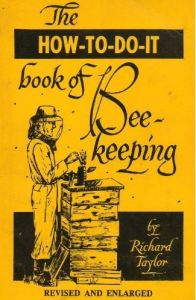
how-to-do-it-book-coverRunning 300 colonies alone while holding a full-time job and writing a book every second year demands focus. His bees were well-cared for, each producing about a hundred pounds every year in an area where such crops are rare. By 1958, he was switching from extracting, which he disliked, to comb honey production, which he loved. Comb honey takes a more skilled beekeeper and better attention to details, but in return it requires less equipment, a smaller truck, and no settling tanks, sump pumps, whirling extractors, or 600-pound drums. “Just a pocket knife for cleaning the combs,” he wrote.

Summit Comb in useTo me, it’s surprising that Richard Taylor embraced the round comb honey equipment called Cobanas. The surprising thing is that the equipment is plastic. Reading Taylor’s books, one realizes his affinity for simple tools and old-fashioned ways. Plastic seems wrong. But it’s not.

In the past, comb honey sections were square-shaped and made from wood. That required the destruction of forests of stately basswood (linden) trees, something that did not appeal to Taylor. Plastic lasts forever, a real benefit for a person as frugal as Richard Taylor. It is light-weight, durable, and ultimately very practical for bee equipment. He advocated making comb honey and he was sure that the Cobana equipment, invented by a Michigan physician in the 1950s, would lead the way. He was so enthused that in 1958, living in Connecticut, he wrote his first beekeeping article about the new plastic equipment for the American Bee Journal. Here’s the photo that accompanied his story.

randy-with-combs

Richard Taylor’s son, Randy, packing round comb honey, 1958. (Photo from ABJ).

One final thing about Richard Taylor, the beekeeper. He was financially successful. In today’s dollars, his comb honey bee farm returned about $50,000 profit each year – a tidy sum for a hobby and more than enough spare change to indulge his habit of frequenting farmer’s auctions where he’d delight in carrying home a stack of empty used hive bodies that could be had for a dollar.

Taylor, the teacher

Richard Taylor immensely enjoyed teaching and lamented what he called “grantsmanship” which arose in America while he was a professor. Grantsmanship is the skill of securing funding for one’s projects while possibly ignoring the fundamental duties of teaching. This, of course, can eventually lead to big dollars flowing to researchers who are willing to claim that sugar, for example, does not contribute to obesity and cigarette smoke does little more than sharpen one’s senses. Richard Taylor saw the conflict and regretted the demise of good faculty instructors replaced “largely by graduate students, some from abroad with limited ability to speak English. Lecturers who simply read in a monotone from notes are not uncommon,” he wrote.

Meanwhile, the (sometimes unethical) pursuit of grants was accompanied by the rise of the “publish or perish” syndrome. In his own field, Taylor pointed out that academic philosophers engaged in “a kind of intellectual drunkenness, much of which ends up as articles in academic journals, thereby swelling the authors’ lists of publications.” Taylor wrote extensively on this in 1989, saying that there were 93 academic philosophy journals published in the USA alone that year – seldom read, seldom good, but filling mailboxes with material to secure a professor’s promotions.

This was not the academic world that Richard Taylor sought when he began his career in the 1950s, but it was the world he eventually left. Although he wrote 17 books – mostly philosophical essays but also several rather good beekeeping manuals – he didn’t publish many academic papers. He spent more time in the lecture halls and with his bees than he did “contemplating the existential reality of golden mountains” and writing papers about them, as he put it.

The philosopher and the bee

I am only going to give this one short passage about Richard Taylor, the philosopher. He studied and taught metaphysics and ethics. His essays on free will and fatalism are renowned and influential, even today. I’ve never taken a philosophy course, so anything I say about the subject will probably embarrass me. But a few years ago, during a winter trip to Florida, I carried Taylor’s Metaphysics with me. I read every word and I think that I understood it at the time. For me, most of it was transparent common sense. Since it was well-crafted and interesting, Taylor may have lulled me into believing that I understood his metaphysical description of the universe, even with just this cursory introduction. At any rate, I felt that what he wrote wasn’t different than what I’d come to discover on my own, although it was much more elegantly presented than I could ever manage.

Taylor-made politics

taylor-c-1980When I saw Richard Taylor – just once, at a beekeepers’ meeting – I indeed thought that he was a hippie, a common enough form of beekeeper in the 1970s. His belt was baler twine and a broad-rimmed hat hid his face. I was surprised to later discover that Richard Taylor identified as a conservative and voted Republican. But he was also an atheist, advocated for women’s rights, and late in life (though proud of his military service) he became a pacifist, “coming late to the wisdom,” he said. I guess he would be a libertarian today. He valued hard work, self-sufficiency, and independence. He disliked Nixon, but gladly voted for Reagan. He even wrote a New York Times editorial praising Reagan’s inaugural address while offering insight on what it means to be an introspective conservative in the 1980s.

At age 62, still a professor of philosophy at the University of Rochester, and the recent author of the book Freedom, Anarchy, and the Law, he wrote a widely-circulated New York Times opinion piece. Taylor wrote that in Reagan’s inaugural address, Reagan reminded us that “our government is supposed to be one of limited powers, not one that tries to determine for free citizens what is best for them and to deliver them from all manner of evil.” Richard Taylor then goes on to warn that “political subversion . . . is the attempt to subordinate the Constitution to some other philosophy or creed, believed by its adherents to be nobler, wiser, or better.”

Taylor warned of anti-constitutional subversion in American politics, “if anyone were to try to replace the Constitution with, say, the Koran, then no one could doubt that this would be an act of subversion . . . Similarly, anyone subordinating the principles embodied in the Constitution to those of the Bible, or to those of one of the various churches or creeds claiming scripture as its source, is committing political subversion.”

Taylor tells us that conservative spokesmen of Reagan’s era – he mentions Jerry Fallwell and others – are right saying that “it is not the government’s function to pour blessings upon us in the form of art, health, and education, however desirable these things may be.” Nor, he claims, is it constitutional for “the Government to convert schoolrooms into places for prayer meetings, or to compel impoverished and unmarried girls, or anyone else, to bear misbegotten children, to make pronouncements on evolution, to instruct citizens on family values, or to determine which books can and cannot be put in our libraries or placed within reach of our children. . . it can never, in the eyes of the genuine conservative, be the role of Government to force such claims upon us. The Constitution explicitly denies the Government any such power.”
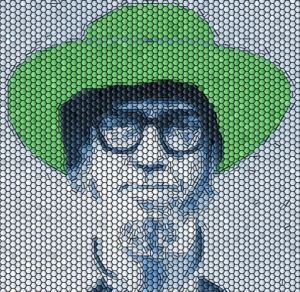
taylor-mosaicI think that Richard Taylor would be politically frustrated today. The Republicans have drifted ever-further from small government and have expanded their reach into personal affairs while the Democrats have pushed forward extensive safety nets. A true libertarian party, such as Taylor seems to wish for, gathers little support in America today.

I hope that my summary of Richard Taylor’s political philosophy has not offended his most ardent followers. I’ve tried to distill what Taylor thought about good government – I agree with much of it, but disagree with some. It is presented as just one facet of his personality. Taylor was complicated. His last book, written in his 80s while he was dying from lung cancer, is about marriage – yet his own marriages had heartbreaks.

He showed other complicated and unexpected quirks. For example, he was an avowed humanist, yet showed a spiritual nature. In his office, he mounted a certificate which honored him as a laureate of the International Academy of Humanism, one of the few people chosen over the years. Others included Carl Sagan, Christopher Hitchens, Isaac Asimov, Richard Dawkins, Richard Leakey, Steven Pinker, Salman Rushdie, E.O. Wilson, Elena Bonner, and Karl Popper. He was in extremely elevated intellectual company. Taylor belonged there among the other atheists, even if he once metaphorically wrote in his most popular bee book, “the ways of man are sometimes, like the ways of God, wondrous indeed.”

Taylorisms in the bee yard

the-joys-of-beekeepingRichard Taylor was complicated for a simple man. It is said that he could not stand complacency, vanity or narcissistic behavior, yet he seemed to get along well in gatherings of beekeepers where such attitudes are often on display. He had a love of paradox and Socratic whimsy, yet he was disciplined and direct as a writer. He delighted in the pessimism of Schopenhauer, yet he was not a pessimist himself. Instead, he was quite a puzzle.

I will end this little essay with wisdom from Richard Taylor, beekeeper. Richard Taylor’s finest bee book, The Joys of Beekeeping, is replete with homey truisms that every aspiring beekeeper should acknowledge and embrace. The book itself is slim, entertaining, personal, and very instructive of the art of keeping bees. Or, as Taylor himself calls beekeeping, “living with the bees. They keep themselves”.

Here, then, are some select Taylorisms:

Beekeeping success demands “a certain demeanor. It is not so much slow motion that is wanted, but a controlled approach.”

“…no man’s back is unbreakable and even beekeepers grow older. When full, a mere shallow super is heavy, weighing forty pounds or more. Deep supers, when filled, are ponderous beyond practical limit.”

“Some beekeepers dismantle every hive and scrape every frame, which is pointless as the bees soon glue everything back the way it was.”

“There are a few rules of thumb that are useful guides. One is that when you are confronted with some problem in the apiary and you do not know what to do, then do nothing. Matters are seldom made worse by doing nothing and are often made much worse by inept intervention.”

. . . and my own favourites . . .

“Woe to the beekeeper who has not followed the example of his bees by keeping in tune with imperceptibly changing nature, having his equipment at hand the day before it is going to be needed rather than the day after. Bees do not put things off until the season is upon them. They would not survive that season if they did, so they anticipate. The beekeeper who is out of step will sacrifice serenity for anxious last-minute preparation, and that crop of honey will not materialize. Nature does not wait.”

“Sometimes the world seems on the verge of insanity, and one wonders what limit there can be to greed, aggression, deception, and the thirst for power or fame. When reflections of this sort threaten one’s serenity, one can be glad for the bees…” – The Joys of Beekeeping

taylor-inscription

Posted in Books, Comb Honey, Commercial Beekeeping, Culture, or lack thereof, History, People | Tagged , , | 12 Comments

Sue Hubbell and her Bees

One of the first really good beekeeping story tellers whom I remember encountering was Sue Hubbell. Her books, A Country Year: Living the Questions (1986) and  A Book of Bees and How to Keep Them (1988) showed me that books about beekeeping don’t need to be dry renditions of mechanics and simplified biology. They can be entertaining, motivating, and thought-provoking, while also providing the truth about real-world bee management challenges.

Sue Hubbell died last week at the age of 83. Her beekeeping began when she and her husband spent a year (1972) roaming America and ended up in the Missouri Ozarks, suddenly owning 90 acres and 300 hives of bees. Her beekeeping really began when Mr Hubbell moved on, leaving Sue divorced and the sole proprietor of all those bees.

She ran the farm alone, learning to fix machinery and manage the bees and honey sales. She wrote about her midlife adventures in American Bee Journal in the late 1970s and later in her books. At the time, I was a no-nonsense commercial beekeeper with little time for fun stories about hippie-style beekeeping. But that wasn’t Hubbell’s style at all – and her message was all about hard work, common sense,  and love of nature. I actually enjoyed her articles in ABJ and sought out her books. I wasn’t disappointed. You can find a long list of her work (8 books and a hundred articles) here, and you’ll see that she wrote for New York Times, The New Yorker, The Smithsonian Magazine, Time, Harper’s, and Discover, among others.

From my own copy of Sue Hubbell’s Book of Bees, this is how she starts her story:

“For a long, long time – for nearly forty years – I never had any bees. I can’t think why. Everyone should have two or three hives of bees. Bees are easier to keep than a dog or cat. They are more interesting than gerbils. They can be kept anywhere. A well-known New York City publisher keeps bees on the terrace of his Upper East Side penthouse, where they happily work the flowers in Central Park.
I have had bees for fifteen years, and my life is the better for it. I operate a beekeeping and honey-producing farm in the Ozark Mountains of southern Missouri. I keep three hundred hives of bees, separated into groups of ten or twelve…”

You want to read the rest, don’t you?

Posted in Books, People | Tagged , | 14 Comments

Canada Goes Legal (Wait ’til you taste the honey!)

Yesterday, October 17, 2018, Canada legalized possession and consumption of weed, pot, grass, cannabis, marijuana, or as my father called it, Mary-Ja-Wanna.  Parliament voted overwhelmingly in favour of the motion proposed by the justice minister a year ago. It took a year to get ready. Now it’s the law.  This makes Canada the second country in the world (Uruguay was first) to make the stuff as legal as whisky. Some health workers are concerned legalization sends the wrong message to youngsters. It does. But it doesn’t saddle an errant 18-year-old (or 78-year-old) with a criminal record. The police favoured the new law as it reduces time spent ticketing small possessions. Police and legislatures hope that decriminalization will cut into gangster revenue. Organized (and disorganized) crime had been collecting six billion dollars a year in Canada from their cannabis trade. Libertarians in Canada were also pushing for the change, believing that less government is better government.

I’ve never used weed and probably won’t ever use it, though people have been urging it on me for decades. However, I became curious about marijuana honey. Does the plant secrete nectar which honey bees could collect? And should I be worried that my backyard hives might access my neighbour’s deck next summer and her home gardening might include a few blooming buds, and my bees might collect MJ nectar, which my bees might turn into cannabis honey and I might mail a jar to my sister in the USA, and a Homeland Security hound might sniff out the cannabis in the honey, and I might be arrested for international drug smuggling?

I can relax. My neighbour only grows tomatoes on her deck.  But even more important, marijuana is wind pollinated. The plant doesn’t secrete nectar to attract pollinators because this weed has been married to the wind forever. No nectar, no honey. Does cannabis have extrafloral nectaries or other body parts that ooze sugary THC? None have been convincingly documented.

Bees can’t make honey from weed. Weeds, perhaps. Weed, no. However, there has been a weed and honey operation of a sort going for a while in France. The operator’s claim is that he has ‘trained’ his bees to collect ‘resin’ from cannabis which the bees ‘add’ to the honey they make. I don’t want to sound skeptical, but I doubt it.  You can read about Nicolas Trainerbees and his trained bees here and here. Training bees to collect marijuana resin would be akin to training bees to collect propolis. I don’t think it’s possible. However, here’s a video of his ‘trained’ bees. What do you think?

Posted in Honey, Honey Plants, Strange, Odd Stuff | Tagged , , , | 16 Comments

Bees on Ice

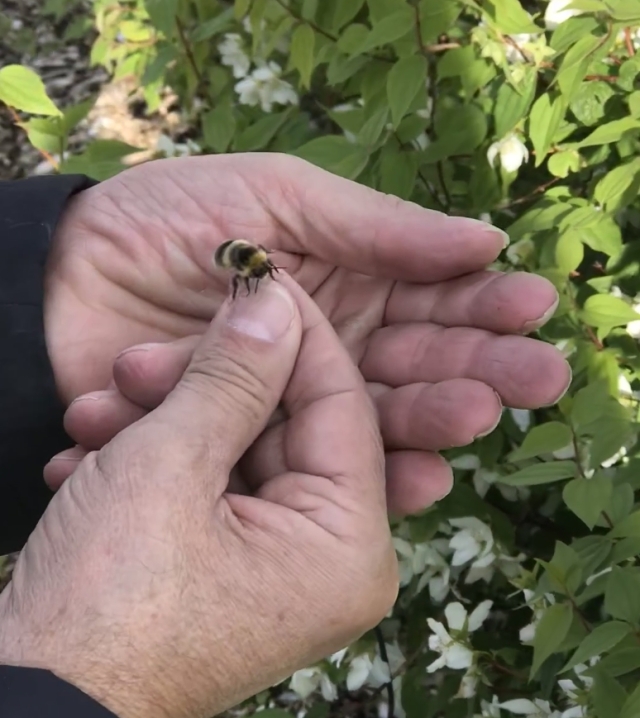
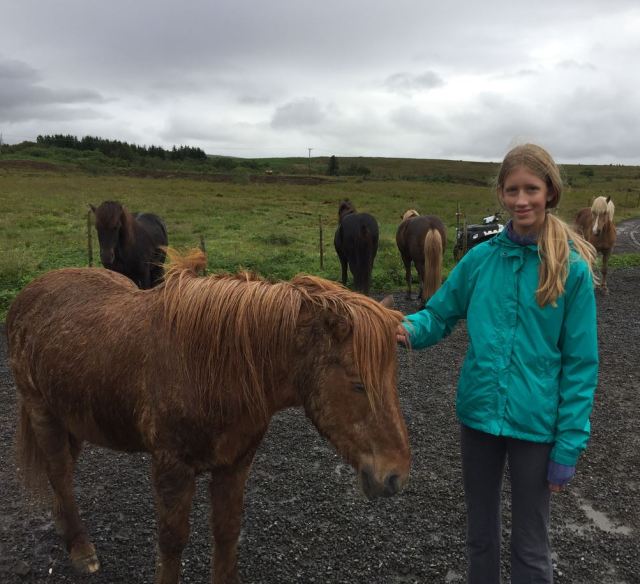
I’m holding this Icelandic bumblebee so I can slip an RFID tag on her front left leg (if she’s right-handed; use the right leg for left-handed bees). It’s similar to tagging a passenger pigeon.
(Actually, I just wanted to get a closer look.)

So much has happened in the weeks since my last post: I started an MSc (in bee ecology); my son and I pulled our honey crop;  I presented a talk at the first-ever United Beekeepers of Alberta conference; I began to TA (teach) a university computer lab on statistical biology; I wrote a feature about the late Warwick Kerr (see it in the November 2018 American Bee Journal); we winterized our hives; and, I had almost three hours of sleep. I will write posts on some of these things in the future, but first I have to keep a promise.

Back in August, when I returned to Calgary from Iceland, I said that my next post would be about the bees I saw in Iceland. It wasn’t. Dr Warwick Kerr (“The Man Who Created Killer Bees”) died in early September, so I posted about him instead. Writing about Kerr became a priority (When was the last time a country lowered its flags because a bee research scientist died?).  My posts about Kerr led to my American Bee Journal article which needed written within a few days to meet the journal’s publishing deadline.

I was in Iceland in late August. Previously, I posted a bit about beekeeping there. Honey bees are scarce in the Viking Republic. A few beekeepers try to keep a few hives, nursing them along through months of cold snowy darkness and then feeding the bees to prevent starvation if the summer is cold and wet – as it was this year. I visited Iceland in late summer when honey bees should have been foraging. They would normally collect some honeydew from small trees and bushes at that time, but this year, they didn’t. It was a disaster for honey bees, as might be expected during the coldest Icelandic summer in 100 years.

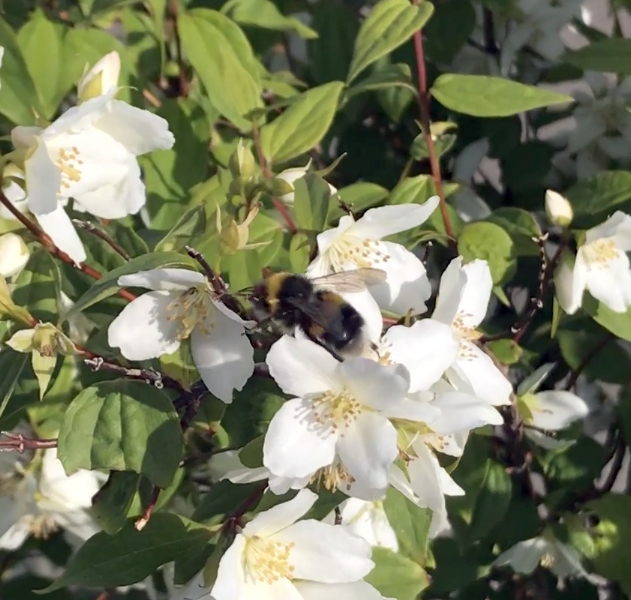
It was too cold for honey bees. However, I saw bumblebees. Big, fat, bumbling insects that took wing by the thousands when the weather improved. After days of intermittent showers and temperatures around 10C (50F) the sky cleared and Reykjavikians pulled off sweaters and faced the sun, like prairie gophers on a mild winter day. Or bumblebees on a sunny day in Iceland.

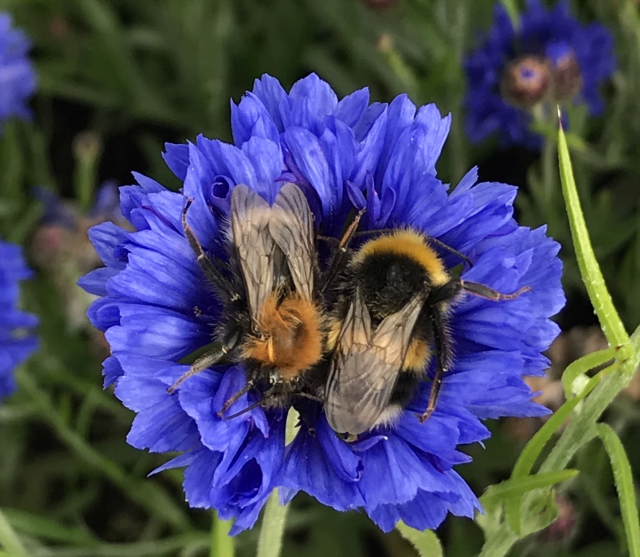
Ever seen two bees sleeping in a flower? 

The sight of two bumblebees sharing a flower was definitely a Kodak moment. This was the first time that I’d seen such a sight. It had been cool and wet. These bumblebees snuggled in the rain. Then the sun came out. It became bright and almost warm. The bees began to dry. Within minutes, they revived from motionless to twitching to shaking as their muscles generated heat. Then they flew off.

Bumblebees lived in Iceland long before people arrived 1200 years ago. They adapted to Iceland’s flowers and the flowers adapted further to attract bumblebees. Honey bees, on the other hand, are not native to Iceland. They only survive when kept by humans and will surely die out when the people of Iceland all move away. In Iceland, honey bees need to be kept, making Icelandic enthusiasts true bee ‘keepers’.

Bumblebees survive the long winters when solitary queens find dens and burrows to slumber through the cold in a dormant state, patiently awaiting mild weather. When it comes, they rapidly build nests, populate them with a few hundred bees, and pollinate the native flowers of Iceland. In late summer, a few females mate and then find solitary dens and burrows to once again slumber until the coming spring’s mild weather. And so it goes.

I was lucky to meet so many nice Icelandic bumblebees. Here are some of them:

Reykjavik, Iceland’s capital, is full of bees.

Posted in Climate, Ecology, Travels | Tagged , , , | 19 Comments

City Mourns Loss of Beloved Beekeeper

Dr Warwick Kerr and his granddaughter, Dr Priscilla Kerr in the professor’s garden.

The Amazon River city of Manaus has begun three days of official mourning for the death of a beekeeper. He was the beekeeper, research scientist, geneticist, educator, and political activist, Dr Warwick Kerr.  The mayor of Manaus declared the tribute and the city’s two million residents were reminded of the man who worked tirelessly to improve the welfare of the people of the rainforest  and all of Brazil.

Brazilian flag at half-mast honouring the late Professor Kerr

Most people will know of Dr Kerr for bringing Africanized genetic stock to Brazil to replace the less-adapted European bees which were not doing well in the tropics. His work resulted in a vast increase in Brazil’s honey production (from 15 million to 110 million pounds per year). I wrote about Dr Kerr on Saturday, the day he died, but as we take one last look at Professor Kerr’s life, I will share part of his family’s official statement. I received it from Warwick Kerr’s granddaughter and I have copy-edited it just a bit. The granddaughter, Dr Priscilla Kerr, also sent photographs, so I am sharing two of them here.

We report with extreme regret the death of our father, Professor Warwick Estevam Kerr, an engaged citizen-scientist and one of the world’s foremost experts in bees. He was the first scientific director of FAPESP (São Paulo State Research Foundation), Director of INPA (Amazon National Research Institute), and Rector of UEMA (State University of Maranhão). He graduated from ESALQ (Advanced School of Agriculture Luiz de Queiroz), while holding a teaching position in the Department of Genetics. He founded departments of Biology in the Faculty of Philosophy, Science and Literature in the State University of São Paulo at Rio Claro, in the Faculty of Medicine in the University of São Paulo at Ribeirão Preto, Biology in the Federal University of Maranhão, and contributed substantially to the development of the Institute of Genetics and Biochemistry in the Federal University of Uberlândia, among numerous other academic accomplishments.

He served as president of the SBPC (Brazilian Society for the Progress of Science) and the SBG (Brazilian Society of Genetics). He was a member of the ABC (Brazilian Academy of Sciences), Member of the Third World Academy and the first Brazilian scientist to be voted a member of the US National Academy of Sciences in recognition of his scientific productivity.

Throughout his life he was involved with research that yielded advances in the management and taming of African bees, that escaped from captivity after he brought them to Brazil in 1956, and are now very important in Brazilian honey production. Dr. Kerr worked under the principle of the inseparability of teaching, research and service, seeking to establish long-term relations with the community and with social movements, in order to transfer capacity and the results of research.

His socialist convictions led to two arrests during the military dictatorship established in 1964 and constant surveillance from authorities during the dictatorship. His generous spirit from early in his life led him to embrace socialism, and to act to build a just and egalitarian society where science and other knowledge are at the service of the majority of the population.

He died in Ribeirão Preto at age 96, of respiratory arrest at 9:00 hours on September 15, 2018.

He is survived by his children Florence, Lucy, Américo, Jacira, Ligia Regina and Tânia, 17 grandchildren and 17 great-grandchildren.


Dr Kerr, right, with his son, physics professor Dr Amerigo Sansigolo Kerr. 
They are at the amphitheatre housing Warwick Kerr’s laboratory.

Posted in History, People | Tagged , , , | Leave a comment

Dr Warwick Kerr, the “Man Who Created Killer Bees”, has died

It is with regret that we report that the humanitarian, geneticist, and scientist, Professor Warwick Kerr, passed away this morning, September 15, 2018. He was six days past his 96th birthday.  Dr Kerr, a Brazilian bee scientist, had one of the most maligned lives of any research scientist. He will be remembered by some as the man who gave us ‘Killer Bees’ – the African-European bee known for its (sometimes) aggressive behaviour. The Africanized Honey Bee, a hybrid which Dr Kerr was largely responsible for creating, helped turn his impoverished homeland of Brazil from a backwater of agriculture and honey production into one of the most prolific honey and agriculture countries in the world.

Dr Kerr was born in Brazil. He developed an early sympathy for his country’s poverty-stricken aboriginal hunters and farmers who supplemented their families’ diets with honey from native stingless bees. He also saw how other farmers struggled to pollinate their crops and produce honey with the imported European honey bees. Those bees originated in Portugal and were not well-adapted to Brazil’s tropical climate. His goal was to improve the lot of farmers. In the 1950s, he brought African bee stock to Brazil. He was an accomplished geneticist and planned to breed a tropics-adapted bee that would be successful in Brazil.  A technician mistakenly removed queen excluders from the breeding hives and 26 imported queens swarmed.

They spread slowly at first, but there was no way to put them back in the box once they escaped into the rainforest. It seemed like an unmitigated disaster. As it happened, at the same time, Brazil was ruled by a vicious military dictatorship which Kerr vocally opposed. He was in deep trouble and imprisoned in 1964 when he publicly fought government corruption. In 1969 he was re-arrested, this time for protesting that Brazilian soldiers who had raped and tortured a nun went unpunished. Sister Maurina Borges, who ran the Ribeirão Preto Orphanage, was an activist; the soldiers were part of Brazil’s military dictatorship, committing crimes encouraged by the government. [See page 16 of this 2005 interview with Kerr.] He helped her and he protested, drawing attention to himself. The military couldn’t kill Dr Kerr as he had a powerful international reputation as a brilliant geneticist. So, the Brazilian government set about destroying the reputation of the great scientist, claiming that he had created assassin bees. He hadn’t, but it sold newspapers. The press ran with the story. Shamefully, that includes the North American press.

Before we return to the Africanized bees, it’s appropriate to highlight Kerr’s work as a geneticist. He had studied at the University of California then Columbia University, working under the fabled geneticist Theodosius Dobzhansky in 1952. Dr Kerr discovered the incredibly complicated caste system of the Brazilian stingless bee, Melipona.

Sex among stingless bees

Warwick Kerr first worked with Melipona bees, not honey bees. Some of Brazil’s poor and indigenous were wild honey gatherers, or meleiros. Meleiro, isolated and rural, is named for the meleiros people, who are named for the Melipona honey trees. There are only 7,000 meleiro people, but their precarious existence in the 1940s – which included raiding Melipona bee trees – concerned Dr Kerr during his bee research. He hoped that his work would draw attention to the importance of preserving Melipona, their habitat, and the people who lived off those bees. Understand and help the Melipona, and you help the meleiros, figured Kerr.

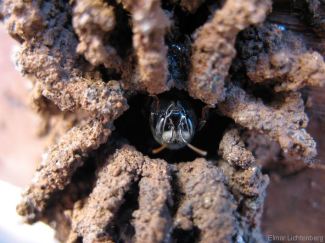
Melipona quadrifasciata,
photo by
Elinor Lichtenberg

Kerr studied Melipona quadrifasciata, a eusocial stingless bee, native to southeastern coastal Brazil. The indigenous meleiros call it Mandaçaia, which means “beautiful guard,” as there are always guard bees defending the narrow entrance of their colony. Brazil’s Melipona builds mud hives inside hollow trees. These have narrow passages allowing just one bee to pass at a time. Stingless bees, they can give a nasty bite, but their intricate passage system also defends against predators.

Dr Kerr’s first influential paper “Genetic Determination of Castes in Melipona” (1949) researched the development of males, females, and workers among Brazil’s common stingless bee. Kerr found that their caste development was different from honey bees. Drones in both species are haploid, but in Melipona, things get weird for the girls.

In Apis mellifera, “a larva develops into a queen or into a worker depending upon the food it receives. In Melipona, on the other hand, caste determination is genotypic. Fertile females (queens) are heterozygous in some species for two, and in other species for three, pairs of genes, homozygosis for any one of which makes the individual develop into a worker.” – Kerr, 1949.

For the exotic Melipona quadrifasciata, alleles (one-half of a gene that controls an inheritance, for example the ‘b’ in a ‘Bb’ gene) determine caste. Drones (as in honey bees) are haploids with a single set of chromosomes; queens and workers are diploid (two sets of chromosomes, one from each parent), but queens have some specific alleles that are different, or heterozygous (for example, AaBb), while workers have identical, or homozygous, caste-determining genes (AABB, AAbb, aaBB, or aabb combinations). If you find this confusing, imagine sorting it out with 1940s technology, as Kerr did.

From Kerr’s 1950 Melipona paper

African Honey Bees

Warwick Kerr was responsible for bringing African genetic stock to Brazil in 1956. As a geneticist, he wanted to improve the health and hardiness of the European honey bee which came from Portugal in 1834. That European strain was poorly adapted to the tropics, so the Italian honey bee (Apis mellifera ligustica) was imported in the 1880s, but it wasn’t much better. A few farmers and monks kept the languid bees, mostly to collect beeswax for church candles.

In 1956, Brazil’s annual honey production from the European honey bees was just 15 million pounds. Brazilian agriculture was expanding and needed a tropical honey bee for pollination and honey production. After the African bees arrived, Brazil’s beekeepers produced 110 million pounds. Brazil went from 43rd in the world to 7th largest honey producer. By 1994, L.A. Times headlined: “Brazil’s honey production has soared since the ornery invaders took over beekeepers’ hives”. Today, most of the world’s organic honey is produced by Africanized honey bees in Brazil’s remote forests. The honey is doubly organic – produced in areas untouched by pesticides and produced in Africanized hives which are naturally resistant to varroa – so mite meds aren’t used in those colonies.

Honey bees with African genes are more aggressive than European bees. Beekeepers in Brazil had to learn appropriate management techniques. Although the venom is the same, more bees attack if their colony is disturbed. People have died from massive stings. Those deaths are sorrowful and this story about Dr Kerr’s bees should not dishonour personal tragedies. Some of the traits which make Africanized bees exceptional pollinators (refined olfactory sense, quicker movements, flights in inclement weather, superior navigation skills) also make them more likely to sting en masse. However, they can be managed by farmers and beekeepers. Indiscriminate killers they are not.

It may surprise some readers to learn that Kerr’s Africanized stock is now preferred by many beekeepers, even in the United States where its resistance to the deadly varroa mite and its superior honey production has made it a favourite. I correspond regularly with a southern California beekeepers who tells me that she would not want to keep any other type of honey bee.

The real Warwick Kerr

Kerr was born in São Paulo, Brazil, in 1922, into a middle-class family with Scottish roots. He received an agricultural engineering degree, then specialized in genetics. His work as an entomologist spanned decades, with research that included genetics of honey bees and native Brazilian bees, as we’ve just seen.

Warwick Kerr’s post-doc research was at the University of California, Davis (1951), and at Columbia University in New York, under the renowned evolutionary biologist Theodosius Dobzhansky. One of Kerr’s influential papers, “Experimental Studies of the Distribution of Gene Frequencies in Very Small Populations of Drosophila melanogaster“, cites Dobzhansky as an adviser and is co-authored by a University of Chicago genetics statistician. This fruit fly research was done way back in 1954 and the paper was one of the first to deal with the nascent field of genetics statistics. Eventually, Kerr published 620 research papers during his 60-year career.

Warwick Kerr was largely responsible for establishing the study of genetics in Brazil. He was a director of the National Institute for Research in the Amazon and worked at the University of São Paulo. Later, at the Universidade Estadual do Maranhão, he created the Department of Biology and served as Dean of the University.

Warwick Kerr said that his most important work was developing staff, technicians, teachers, and researchers in his country. At the University of São Paulo, he established a department of genetics which focuses on entomological and human genetics, using mathematical biology and biostatistics. Kerr had memberships in the Brazilian Academy of Sciences, the Third World Academy of Science, and the US National Academy of Sciences.

I’ll end with a pleasant little video made five years ago. In it, you will see that Dr Warwick Kerr’s interests had shifted to botany. The film is in Portuguese, but even if you don’t understand the language, you’ll get a good idea of the enthusiasm and curiosity which had filled Warwick Kerr’s life.

Posted in Bee Biology, Culture, or lack thereof, Genetics, People, Queens, Science | Tagged , , , , | 36 Comments

Finally, Iceland

In late August, I returned to Canada after a few days in Iceland. I’ve wanted to travel there ever since I was a kid and I quit being a kid decades ago. So, it was about time that I’d made my pilgrimage. Growing up on a farm where bees were kept, I figured I’d be a beekeeper. Maybe in Iceland. I was probably 12 years old when I sent a letter to the Iceland Embassy asking if anyone kept honey bees in their country. The reply was a terse “No, it is not possible,” though the consular sent a small book listing flowers growing in his country. My naive reaction was “No beekeepers in Iceland! I can be the first!” A more seasoned response would have been, “Oh, it sounds like it’s not possible.”

I never gave it a try. Instead of Iceland, I moved to western Canada to make a life of bees. Nevertheless, the idea of Iceland tugged me from time to time. Finally, after years of wondering about the bees of Iceland, I finally did a ‘bucket list’ journey to resolve my curiosity. It was a wonderful visit, taking in some of the geophysical attractions – volcanoes, geysers, the exposed mid-oceanic rift, as well as the best of geology and geography – waterfalls, basalt columns, glaciers, black sand beaches, and the quaint fishing village that became the wealthy national capital, Reykjavik.

But it was bees that I really wanted to see.  As it is for beekeepers everywhere, the vagaries of climate are Iceland’s principal impediment to successful beekeeping. This summer – 2018 – was repeatedly described to me as “the worst in a hundred years” and indeed, the Icelandic meteorologists have claimed that the last miserable summer which was worst than the present miserable summer was over a hundred years ago. There was almost no sunshine in June, July, and August, temperatures were cool (highs around 12C / 54F), and drizzle was almost daily.  Iceland Magazine ran a story, “So far the summer of 2018 is the worst on record in Reykjavík” which understates the gloom.

Can honey bees make honey in a summer such as Iceland had in 2018?

No. As it turns out, there are a handful of tough Vikings keeping bees in Iceland. The few whom I spoke with won’t be extracting anything at all in 2018. Vintage 2018 Hunang (as honey is called in Iceland) won’t exist. Instead, Iceland’s beekeepers will have to feed their colonies to keep them alive.

In the best of summers, a colony might collect 30 kg but 20kg (45 pounds) would be more typical. In a normal year, it takes 45 kg of sugar/honey stores for a colony to survive Iceland’s long winter. Consequently, on their own, honey bees would not survive. Here in Alberta, on the other hand, honey bees gather an average 70 kg and consume 40 – in a sheltered location, a feral honey bee colony could survive and reproduce in Alberta. But not in Iceland.

The main nectar sources in Iceland are willow, dandelion, and a few wildflowers. Some years, most of the honey is actually honeydew, collected from aphids sucking birch trees. Without flying weather and strong sunshine, honey dew wasn’t produced this year. Well, I suppose Iceland’s beekeepers are well aware of what beekeepers everywhere know: Next year will be the big crop.

Later, I’ll post about one bee that is successful in Iceland – the bumblebee. Meanwhile, here are a few pictures from the trip. I took my two youngest kids and my sister, Jane, flew up from San Diego to join us.

Volcanic black sands at Iceland’s southernmost point.

My sister and I at Skógafoss, the Skóga River Falls.

Here I am with “The Nameless Bureaucrat” – a statue of the unsung (usually despised) paper-shufflers of the world. In Reykjavik


My my sister and two of my kids on the rainbow road in Reykjavik

This building is the Harpa, Reykjavik’s beautiful $250 million-dollar theatre.

My 16-year-old took off for a day and hiked up this mountain north of Reykjavik.

My daughter, inspecting one of the stars of the Game of Thrones series.

The tallest geyser we saw was Strokkur which erupts every five minutes or so and is close in height to Old Faithful at Yellowstone

Hot springs and mud pots. — in Hruni, Arnessysla, Iceland.

The mid-Atlantic rift, the tectonic divide between North America and Europe. We are standing in North America, but that ridge in the distance is Europe.

Most agriculture is sheep and horse ranching, hay and pastures, some dairy cows, and large ranges for grazing. I saw one huge field of cabbage. Geothermally heated greenhouses supply tomatoes and bananas. (Iceland has Europe’s largest banana plantation – 15 plants under glass..)

Sheep ranch, nestled nicely between a glacier and waterfalls. The glacier sits atop the volcano that became known as Eyjafjallajökull. When it erupted in April 2010, it stopped all air traffic in most of Europe for a week. We were supposed to fly from Hungary to Canada during the eruption, so we were stuck in Hungary. Our nemesis was dormant when we finally met this summer!

If you spot the wheelchair, you’ll see me. If you see me, you’ll see my 11-year-old daughter – she’s pushing me through the gravel so I can get closer to the waterfalls! — in Akurey, Rangarvallasysla, Iceland.

You’ve probably noticed that the countryside photos show no alfalfa or sweet clover. Farmers use local grasses for their hay crops. There are some yellow buttercup-ish flowers in the foreground of this picture, but there’s not much here for honey bees.


Here we are at Gullfoss. The water is from a nearby glacier – we were at a higher elevation and near the glacier so it was pretty chilly.

Next post: The bumblebees of Iceland!

Posted in Friends, Honey Plants, Travels | Tagged , | 11 Comments

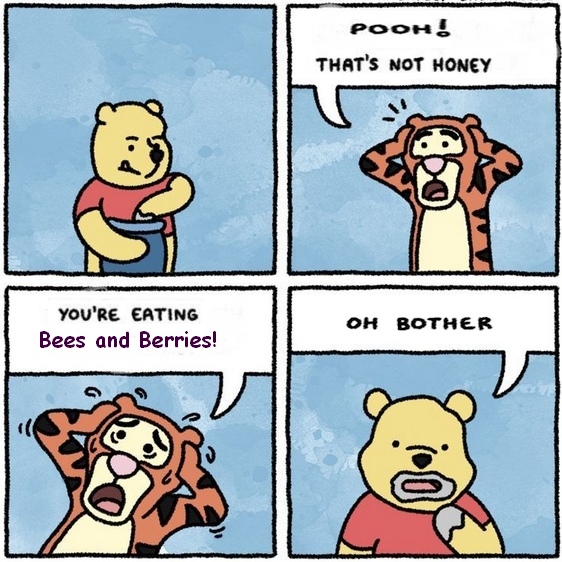
Surviving on Bees and Berries

A 40-year-old Ohio man was lost for six days and nights in the Pacific Northwest. Rescuers found him in reasonably good shape. His family says that he was always interested in nutrition so they weren’t surprised that he survived by eating bees and berries.  (And you thought that bees were only good for making honey and pollinating flowers!)

Here’s the full story from UK’s Evening Standard.

h/t Andony

Posted in Humour, Strange, Odd Stuff | Tagged | 1 Comment

More on High Temperatures and Bees

At 25 cents each, it might pay to put one of these 1908-dairy thermometers in each hive.
I wonder if they are Wi-Fi compatible?

A couple of days ago, I posted about our all-time record high temperature. It was 37 ºC (98.6 ºF) – a temp that’s not too extravagant for many beekeepers, but the city of Calgary had never seen such a hot day. It wasn’t just a record for the date; it was a record for any date since the city’s records began, about 120 years ago. (Calgary is a young town.)

Since 37 ºC was our hottest ever, that tells you that it is normally much cooler here, even in the summer. Usually, it’s pleasantly mild. Sometimes, our summers are really cold. For example, on August 3rd, 2002, Calgary had 5 cm (2 inches) of snow. In mid-August 1993, we had a good, old-fashioned foot of snow and kids went tobogganing and snow-shoeing in Calgary. Today, just three days after nearly hitting 100 ºF, we had 44 ºF in the morning, though we are headed for a high of 68º (20 ºC) this afternoon.

But enough about cold Calgary. Today I wanted to write about heat and bees. My hot blog post on Friday received about twenty comments with advice on how to help bees survive a heatwave. If you haven’t had a chance to read that entry, I think that you’ll find the comments from readers better than the original post which I’d written!  I wrote about spraying cold water on hot hives. No one reader came to the unequivocal defense of my ‘hose the bees down with ice water until they chill’ idea, though two people mentioned that they had had wax combs melt inside their hives, breaking and falling.
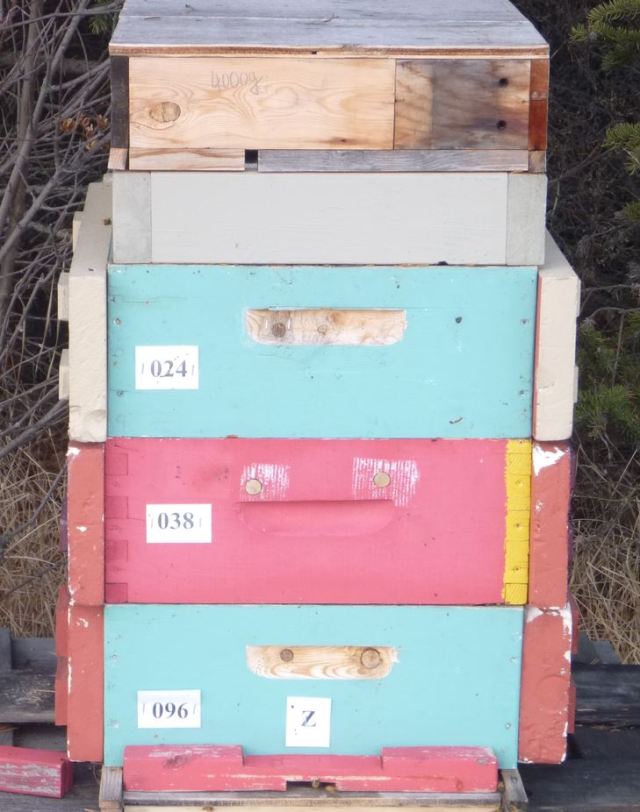
Heat can bad. Wax melts at around 145º to 147º Fahrenheit (63º to 64º Celsius). Although ambient temperature has never been that hot on Earth (not yet, anyway), it’s possible for heat to become wax-puddling hot inside a box. A friend (Earl Emde) once lost the top boxes on an open-carry truck load of honey supers which he’d pulled on a hot day in the southern California deserts. The temperature doesn’t have to reach the wax-melt point to damage comb, of course. Heat softens combs long before that. The weight of bees and honey can make soft wax stretch and plop to the bottom of the hive, especially with top bar hives (as Erik mentioned on Friday) or with foundationless comb (as Susan wrote).

On Twitter, someone told me that bees know how to manage things on their own and don’t need our garden hose trick. That’s certainly true of wild bees living in trees where thick insulating bark, light breezes, and deep tree cavities mitigate the heat. But most of us no longer climb trees to harvest honey. Our beekeeping is quite unnatural in many ways, including the use of boxes of various shapes and styles. So, we have a responsibility to our bees to take care of them and reduce some of the effects of our unnatural beekeeping.

Here’s a very brief summary of suggestions made by beekeepers. They all offered advice on how to keep bees cooler when it’s hot.

Screens.  Susan: “The heat is now so intense in summer that I have not only SBBs but fully ventilated screened tops under the top boards.”  ALSO, from JFBeekeeper: “Others use a shin with screened vent holes. Some have bottom boards that you can change between solid and screened bottoms depending upon the season.”

Moving.  avwalters: “We moved the hives from an open meadow to an area of filtered sunshine up in the pines.”

Shade. Ray: “I find shade to be the most beneficial so for your hot days and two hives I would erect a nice big sun parasol”

Ventilation. Sassafrasbeefarm: “…others use upper shims with screened port holes which act as a ventilated attic. For those on a budget, a penny or popsicle stick between the inner and outer cover works to vent some of the heat.”  ALSO, from Deb Corcoran: “We crack the outer covers up in the back so it reston the inner cover. “

Good air circulation. Steve Williams: “I make sure that my hives are in a place that allows plenty of air circulation around the hive.”

Reflective colour.  Deb Weyrich-Cody: “the first thing I’d be doing is paint those hives white.”

These are great suggestions. Our two backyard hives aren’t paying attention to most of this advice, so I’ll have a talk with them – as soon as it gets hot again.  Meanwhile, I had a comment on Facebook that hosing bees is dangerous because wet bees will die. They certainly might. My son was watering the hive backs and sides, not the entrances. But I think we might be a little over-concerned about water. Water removes a lot of heat in a hurry. Those of us who have trucked loads of packages in vans have sprayed water everywhere inside the van. Some of it accidentally gets through the package screens. It’s an absolute lifesaver for bees which are overheating. Same with semi-loads of bees – a lot of migratory beekeepers carry hoses to cool their bees off. This is especially important if an emergency stop at a garage is needed and the hives would otherwise bake in the sun.

Our concern about wet bees is valid, but bees are more resilient than you might think. Here’s an experiment that I don’t recommend: Put ten bees into a sealed jar of water. Swish it around and wait a few minutes. The bees will look dead. Maybe they are. Drain the water and drop the clump of wet bees on some paper towels. In a few minutes, they will (probably) twitch, wiggle, crawl, fly up, and sting you in your face for your meanness.

Finally, I want to include a nice email which I got from Dieter. He wanted to send his half-penny’s worth of suggestions, based on Langstroth’s 150-year-old Hive and Honey Bee book.

Langstroth says:
“It should afford suitable protection against extremes of heat and cold, sudden changes of temperature, and the injurious effects of dampness. The interior of a hive should be dry in winter, and free in summer from a pent and almost suffocating heat.

Dieter notes:  “Suffocating heat wasn’t new to Langstroth. He addresses this, however, by hive design and not with the water hose.”   [RMM: I’m sure that Reverend Langstroth would have suggested a water hose if they had been in common use in the 1860s!]

Langstroth also says,
“I am well aware of the question which many of my readers have for some time been ready to ask me. Can you make one of your well-protected hives as cheaply as we construct our common hives? I would remind such questioners that it is hardly possible to build a well protected house as cheaply as a barn. . . . If they are not built of doubled materials they can be made for as little money as any other patent hive, and yet afford much greater protection, as the combs touch neither the top, bottom, nor sides of the hive.

I recommend, however, a construction which, although somewhat more costly at first, is yet much cheaper in the end. Such is the passion of the American people for cheapness in the first cost of an article, even at the evident expense of dearness in the end, that many, I doubt not, will continue to lodge their bees in thin hives in spite of their conviction of the folly of doing, . . . .”

Dieter added, “I have insulated my hives for 3 or 4 years now, long before I found this [Langstroth] reference. When I shared this with other beekeepers in the club they all said it is going to be too hot in the hives in the summer.  I tried in vain to explain that the insulation does not only keep the bees warmer in the winter but also keeps the heat out in the summer.”

Here’s the photo which Dieter sent of his own nicely insulated hive:

Posted in Beekeeping, Books, Climate, Commercial Beekeeping | Tagged , | 8 Comments

Our Hottest Day

My home town, Calgary, Alberta, Canada, just set a record for heat. In all the past decades of weather-watching here, we’ve never been as hot as it was today. Ever. (In recorded history.) Officially, it reached 37C, which is over 98F.  I know that a lot of my readers are doing a big yawn – you’ve probably see that over and over again during your summers. But at our latitude and our elevation, this was a hot day.

So, for those of you much more experienced at being in heat than I am, help me out a bit. Our two hives were in the sun this afternoon when the local thermometers boiled over. Daniel went out with a garden hose to soak the lids and sides (but not the entrances) of our hives. Good idea or bad? What do you do in hot climates on hot days?

Posted in Beekeeping, Climate | Tagged , | 35 Comments