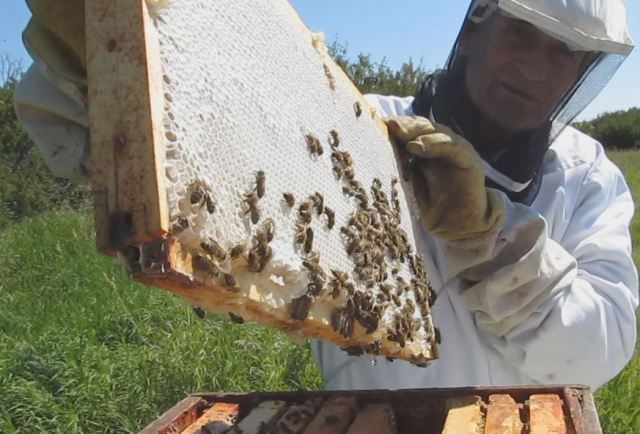
Our friend Jacques, inspecting our hives a few years ago.
This post will be disappointing to anyone hoping for a quick and easy way to predict what the honey flow will bring. There is no substitute for experience. It may take years to gain the knowledge you’ll need because every season is different. You will eventually learn to read the tea leaves – but even then, the tea will often be murky.
Nevertheless, we have to be able to make plans. What’s an ‘average’ honey crop? How many supers do we need? When do we remove the last boxes before fall/winter? Although there can be wild fluctuations around the average, we gain some sense for what to expect. You don’t need to rely only on your own experiences- beekeepers are notoriously helpful and willing to share what they know. I’ve had commercial honey farms in six different areas over the years (Appalachian Pennsylvania, Florida, Wisconsin, grasslands southern Saskatchewan, parkland central Saskatchewan, mountain foothills in Alberta) and I am very grateful for the advice which smarter and older beekeepers have given me. I would have never lived long enough to learn beekeeping in six vastly disparate geographies. I needed the help of locals.
However, for predicting the future, I’ve found a useful and unexpected tool. A hive scale. An average hive, sitting on an old fashioned platform scale, can tell you a lot. If you keep records of the daily change in weight, you will have real-time data to guide you. If you keep those records for a few years, you can spot trends which will help you predict your crops.

The scale hive can give you some interesting and useful information. What’s the most honey your colony might make in one day? In our area, it’s 35 pounds. That’s if you have  enough boxes piled on the hive. When is the peak flow? For us, on average, it’s late July. What’s the longest dearth period in the summer? In Alberta, a mid-summer dearth is rare but we’ve had up to ten days of cold windy rainy weather when (according to the scale hive) the bees lost a pound a day. What’s the earliest date the bees had a substantial flow (gaining over ten pounds a day)? Here, it was June 22nd. What’s the most honey your hive might store in a year (my scale hive gained 441 pounds one year) and the least (13 pounds – a year with a severe drought). Those last two numbers help you know how many supers you’ll need and how much money to put away for a bad year. Individual results may vary. That’s why you should consider setting up your own scale hive.
Last week, I wrote a short piece for the United Beekeepers of Alberta Council. (If you are an Alberta beekeeper – commercial, sideline, hobby – you may participate in this new organization!) I am repeating my original article below. It will be most useful to beekeepers on the North American plains and prairies, but it illustrates how scale hive results can be useful for long-term planning and crop predictions. Here’s the story from the UBAC Newsletter:
What to expect in August in Alberta, Canada
By late-July, you’ve harvested some honey. But you’re hoping for more. The first cut of hay has been baled, canola is fading, but you still expect more honey. It’s not yet August, so you’re probably right. How optimistic can you be?
Over the years, I’ve kept a few hives on scales, weighing colonies each evening for nine years. That was in the southern prairies. Meanwhile, a close friend kept a scale hive going in the parklands, at the northern edge of farming, for seventeen years. These are quite different areas, but there are some similarities in production. During June and September, the scale hives usually gained a little weight – on average, about 20 pounds in June; 10 in September. July was almost always the best month, but occasionally, in both locations, August produced the biggest part of the crop. Here’s a chart with the actual numbers, averaged over the years:
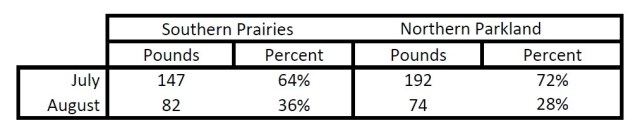
From these data, you might expect between two-thirds and three-quarters of your crop to arrive in July. Between the two locations, north and south, I have 26 years of records. Only three times was a bigger part of the crop gathered during August. You might extract most of your honey in August, but a lot of that was produced during July. Using a scale hive, you can actually tell when the bees gathered it – mostly, in July.
How you use this information depends on your management goals. If you don’t like to feed bees for winter, then you must start to reduce the number of honey boxes significantly in early August, forcing more honey into the brood nest and leaving more stores for winter. If you are concerned about wintering your hives on canola and/or fall honey and want to maximize your crop, then keep the supers piled on.
Of course, there’s only one place to put honey supers if you want the bees to fill them – and that’s not in a corner of the shed. If the flow ends on August 10th, as sometimes happens, it doesn’t take much energy to haul empties back to the shop. If the flow continues strongly, the extra space helps keep the brood nest open for the queen to lay late-summer eggs. That brood will become the bees you’ll see next April. Many Alberta beekeepers remember September 2007 when second-bloom alfalfa, good moisture, and hot weather gave an enormous late flow. We raced around in mid-September, sticking three completely empty drawn frames into the middle of each brood nest to give the queen room. Folks who wintered with plugged brood nests lost their bees.
Besides preventing a jammed brood nest during August, extra supers inspire the bees to collect more nectar. If honey supers are more than 80% full, bees slow down gathering, even if nectar is abundant. If you stack a bunch of empties on the hive, the bees keep working hard if the weather and flowers cooperate.

Dr Don Peer,
Nipawin beekeeper
(Photo: David Miksa)
One of the legendary beekeepers of western Canada, Don Peer, a Nipawin beekeeper with an entomology PhD, once told us at a bee meeting, “If I were king of the world, I’d make a law that every beekeeper had to own one more super for each hive of bees.” Bees need comb space to hold wet nectar. Dr Peer was astonishingly successful. At first, he ran two-queen colonies from packages. According to Dr Eva Crane (from her book Making a Beeline), Don Peer’s hives made up to 40 pounds a day. I saw his outfit and stood on the back of a truck to reach the top supers. Such tall hives made him switch back to single-queen hives, but even then he stacked supers as high as he could reach. “Bees need space,” he said.
As August approaches, keep in mind that the bees might yet store a hundred pounds. If you are trying to maximize your honey crop, the hives still need three, four, or five medium supers. But watch the weather. When the flow ends, remove those boxes as quickly as you can and start your fall chores.











 Humans experience satiation when we (for example) start munching a box of chocolates. The first chocolate is great, but by the time we finish all 24 in the box, we’ve had it. Our stomach might be able to hold another package or two, but our tongue and brain are hopefully telling us that we’ve had enough. However, if you were a social bee, you’d want to completely fill your honey tummy because you’re not just eating for yourself – it’s your duty to tank up with as much sweet stuff as you can hold and then pilot your blimp-body back to the hive. [A honey bee weighs 90 mg (0.0002 lb) but her stomach can hold about 50 mg of nectar – that’s like a 200-pound person eating 110 pounds of chocolates.]
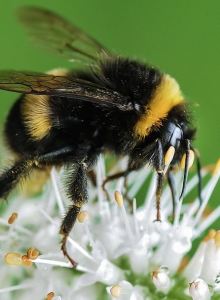 (similar to our own) that says “Sweet”. But then, a second neuron switches on and overrides the pleasure neuron. The second is an inhibitor neuron which quickly shuts itself off, allowing the first neuron to take control again, giving the bee the taste of sweetness all over again, as if it were the first time she has tasted that flower’s nectar. The intermittent (burst) firing of the second neuron prevents the bee from experiencing sweetness satiation (adaptation). This research is captured in a paper called
 Bad Beekeeping Blog