Foulbrood – Still Smelling Foul

bee offWith so much attention on varroa destructors and nicotine-flavoured pesticides, we sometimes forget some of the other scourges of modern beekeeping.  Not long ago,  American Foulbrood (AFB) was the worst thing that could happen to your bees. If you were caught with the disease, an inspector might set your colonies upon a pit of fire. Your equipment – and bees – would burn, then collapse into the hole where the charcoal and melted wax would be buried under moist soil. I know. I was one of the bee inspectors, deputized by the state of Pennsylvania, and I was assigned the grizzly task of destroying infected colonies. It is little wonder that I was met several times by shotguns at farmers’ fences in the remote Appalachian hills.

That was the mid-1970s – I wasn’t yet twenty years old. Antibiotics (sulfathiazole and terramycin) had been discovered 30 years earlier and those chemicals usually put an end to the symptoms of the brown rotten smelly brood that gives foulbrood its name. But not all farmers cared to check their hives or invest in the inexpensive medicines. As a last resort, irresponsibly kept apiaries with irrecoverably sick bees were given the fire treatment. The bees were nearly dead anyway. If the equipment was not destroyed, healthy bees from miles around would find the dying hives, scoop up any remaining honey, and carry the disease back to their colonies. The robbing that ensued spread an AFB epidemic. Ugly as the burn-and-bury treatment seems, it was necessary. (A diligent beekeeper might shake the infected bees into new boxes with new equipment and foundation and perhaps save the bees. But a diligent beekeeper would not allow hives to collapse to the state that required destruction. When bees were seriously infected it almost always meant they were owned by a disinterested beekeeper who would not clean up the hives and keep them healthy. They (the bees, not the beekeeper) had to be destroyed.)

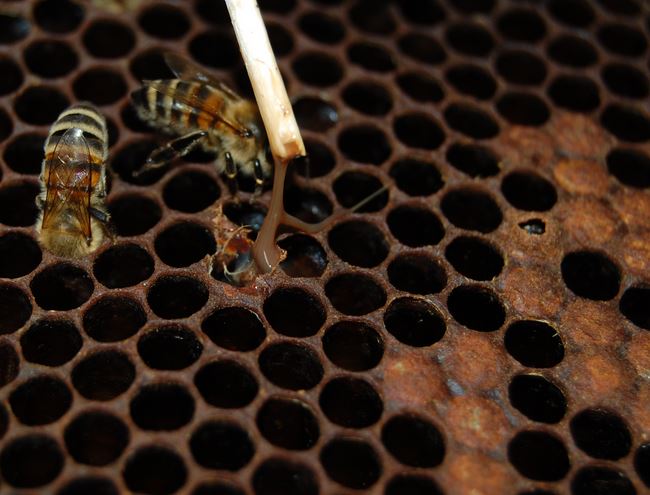
American foulbrood - stringy, dark brown, and (surprise) foul-smelling!

American foulbrood – stringy, dark brown, and (surprise) foul-smelling!

Ancient beekeepers were familiar with foulbrood. Aristotle complained that his bees were sometimes weak, dying, and had brood that smelled awful.  Such reports continued over the centuries. In 1906, two different flavours of foulbrood were distinguished – now known as European and American foulbrood. The European type is the less serious infection and can often be cured by replacing the queen and breaking the brood cycle. Although American foulbrood also originated in Europe, it was first identified by a North American scientist, hence its name: American foulbrood. AFB is much deadlier than EFB. A young developing larva dies if it ingests even a single Bacillus larvae spore. The body quickly decays and becomes a host for 100 million spores, each capable of causing the same bacterial outbreak in 100 million other larvae.

Before drugs were available in the 1940s, all colonies infected with AFB  died. If spotted early enough, the beekeeper might remove any frames with the infected brood and burn the bad combs. But the spores that had caused the infection had likely already spread throughout the hive. Good beekeepers in the 1920s and 30s sometimes found themselves out of business in weeks when foulbrood raced through their outfits.

Because foulbrood kills colonies and remedies didn’t exist for millennia, one might suppose that genetically resistant colonies would arise. Honey bees never developed reliable resistance to AFB (though some bees have more hygienic habits than others – they remove dead brood from the hive, slowing its inevitable spread). I suspect that bees survived alongside foulbrood because honey bees evolved an absconding reaction. Severely infected colonies sometimes leave their hive en masse, fly off to a new location, and start over again. The bees are able  to raise a few generations of offspring before the disease builds up to killer levels again. Although honey bees evolved this survival strategy to cope with the disease, it is no help to modern beekeepers – we can’t make honey if bees are sickly or if they abandon their hives entirely.

These days, American foulbrood is usually not a colony’s death sentence. Beekeepers control AFB with regular medicinal treatments. Better management caught on. Also, over the years, most farmers who were “let-alone beekeepers” gave up the sideline. In 1950, 2 million farms in the USA had a hive or two or more. (There were then over 6 million colonies kept in the USA.) Fifty years later, only 29,000 farmers owned beehives. Individual beekeepers began to manage thousands of hives each. With a change in beekeeping habits, AFB was under better control.

However, the control of American foulbrood in the Americas and Europe is tenuous and the disease could erupt if habits become lax again – or if antibiotics fail to protect evolving strains of the Bacillus larvae bacterium. South Africa offers an example of the devastation that may result when AFB is not fought effectively.  In April of this year, South African officials announced that an outbreak of American foulbrood had killed 40% of all the bees in the West Cape area. This is a big deal – the Cape is an important agriculture district where bee-pollinated crops valued at $1.5 billion (US) are grown. Without bees, the West Cape farmers are in trouble.

Killer bees are notoriously tough. )

Killer bees are notoriously tough.
(Credit: Wikipedia)

How did this happen? The arrival of AFB is recent. The disease appeared in a single province in 2009. Six years ago, a beekeeper spotted AFB and began losing colonies. Since then, it has spread. An article in South Africa’s Mail and Guardian suggests that South African beekeepers are generally rather cocky in their attitude towards bee diseases.

We are informed that nobody worries much about pests and diseases because the African bees are notoriously tough and hardy. But not, it appears, when they are confronted by the microscopic spores of American foulbrood. Although harmless to humans, AFB spores found in honey will infect bee larvae.  It is suspected that tainted honey was imported into South Africa in 2008, introducing the malady.

Besides a cavalier attitude on the part of some beekeepers, South Africa seems to have an ineffective bee inspection program. From the Guardian article again, it seems that there are adequate inspection regulations. But – claims the news story –  there’s a paucity of inspectors and compliance. The country seems to lack bee inspectors of the type Pennsylvania once had – inspectors willing to face the occasional shotgun in the face as part of their job. Unless South African beekeepers and their government proactively fight American foulbrood, it will destroy the country’s honey bees. But North American beekeepers should take the African experience as a reminder and a warning – the same could happen here again, too.

Posted in Beekeeping, Commercial Beekeeping, Diseases and Pests, Genetics | Tagged , , | 5 Comments

Smoky Bees

Calgary - a smoker's haven.

Calgary – a smoker’s haven.

My home town – Calgary – is under a smoke advisory. The sky is hazy with smelly gray smoke from the trees, grass, and homes that are on fire down in Washington state.

Those fires are about 700 kilometres (500 miles) away and on the other side of the Rockies, but you can see from the picture that the smoke has drifted to us. Considering the large number of fires in the drought-stricken Pacific Northwest and coastal areas, we have been lucky that the smoke has avoided us until today.

Smoke WarningI was wondering what effect such smoke has on honey bees. Here at home, I see no bugs of any sort out this morning. A few days ago, they were really active, but they seem to have gone into hiding. I am not at the moment near any apiaries, so I can’t comment directly on what is happening in the field – but the thick smoke must be slowing the bees’ foraging. However, I contacted a friend with a large home apiary. He told me that his bees appeared less active than they were a few days ago, but suggested that this might be due to a recent light spotty frost – though it is warm again and flowers are still secreting nectar. As with all aspects of beekeeping, it’s hard to separate out the multiple factors at play.

In addition to a potential decrease in foraging, I’m concerned that the smoke will infiltrate supers and permeate combs. I have tasted some smoky-smelling honey which resulted when a desperate and frightened beekeeper tried to calm irate bees with massive amounts of smoke. Smoke can affect honey. Also, smoke from a smoker usually has tiny specks of black soot. Surely almost harmless, but those black specks sometimes float in honey jars, spoiling an otherwise pristine product.

1892 smokerHowever, smoke is the beekeeper’s best friend when used in judiciously small puffs. I dread looking at bees without a smoker in hand. I would much rather approach a hive in a honeybee swimsuit and a smoker than approach suited in bee armor and no smoker.

Smoke has been the beeman’s friend for a long time. For unknown millennia, prehistoric tribes have used smoky torches to chase bees off combs. Similarly, an Egyptian tomb painting from 3,500 years ago shows a beekeeper with a smoker. The behaviour of honey bees that are exposed to smoke has enabled modern beekeeping – including queen breeding and moving colonies for pollination.

It usually takes just a small puff to disarm a colony. My father smoked a pipe – just so he’d always have something handy to calm rowdy bees. (It worked equally well on kids, too.) In the bee yard, too much smoke can cause all sorts of grief – spoiled honey (as mentioned earlier), confused and gasping bees, and unhealthy lungs for the beekeeper. But let’s assume you are careful and use your smoker properly. What is happening when bees encounter your smoke? Is it the same response as during a forest fire?

We are lucky that honey bees have a ‘smoke response’. Bees are alarmed when a smelly human arrives at their apiary, lifts the lid on their home, and shakes their boxes. The human is a threat. Evolution has favoured creatures that defend themselves against threats. (Individuals lacking defenses against deadly threats die – they don’t reproduce and their docile genes are erased from their species’ genome – unless humans intervene and select for docility, of course.)

Irritated bees emit pheromones such as isopentyl acetate (from the stinger shaft) and 2-heptanone (from mandibular glands). These strong-smelling chemicals evoke an alarm response in other nearby honey bees, which in turn produce more of the same pheromones. Soon all the bees are agitated and ready to fight the threat. The beekeeper’s smoker masks the bees’ emitted pheromones by reducing the electroantennograph (EAG) response at the bees’ antennae. Although it suppresses the bees’ alertness to their fellow bees’ alarm scents, the masking lasts for only about 15 minutes after the air has cleared. and leaves no known residual problems for the bees.

smokeSmoke has another benefit for the invading beekeeper. It triggers an imbibing response in bees, distending their abdomens because of their gluttonous engorging. This makes it hard for the bee to curl up and poke its stinger into the beekeeper’s skin. I have heard beekeepers say that the gorging is because the bees are preparing to abscond in face of the coming fire and the bee is tanking up for a long flight. I don’t think this true. I have seen entire apiaries burned – bees and all. It seems unlikely the bees in every hive forgot to leave.

The honey-imbibing must have another purpose. In nature, many wild swarms survive forest fires when the fire sweeps through the grass and brush near ground level. Bees in trees above the fire are (sometimes) able to survive. They may even crawl further up in the tree’s hollow, leaving their wax and honey to melt and trickle away. After the fire has rushed by, flowers are scorched and bees may need to search for a new home – somewhere with unscorched nectar supplies. Honey bees take a few days to scout for a new home and to reach a relocation consensus.  Meanwhile, the queen is too heavy to fly easily, but during the relocation planning phase, she stops laying eggs for a day or two and becomes more mobile. (This is another reason they don’t abscond while the fire is raging.) Soon the engorged bees move to their next home. My theory may be wrong and the honey bees’ imbibing response to smoke may have some other cause. Nevertheless, it is a boon to the beekeeper as it certainly reduces stings.

I realize that some beekeepers avoid smoke entirely. They are worried that smoke – even in tiny amounts – will hurt their bees. I appreciate the sentiment. Unfortunately, without smoke, any hive examination is precarious. When Betty Bee alarms Henrietta and Anna who then alarm their four best friends who tell sixteen others about an intrusion, thousands of bees may go wild in a minute. Not only will the beekeeper suffer a lot of stings, but so may nearby pets and even neighbours. The key is to learn to use the smoker in very carefully placed doses. This is something learned from experience. Such experience is best acquired from old-timers who have kept bees for 30 years. Of course, avoiding smoke around bees is ideal, but today – in southern Alberta – the distant forest fires are making that impossible.

A little smoke from a little smoker

Just a little smoke from a little smoker.

Posted in Beekeeping, Honey | Tagged , , , , , | 5 Comments

Thistle Bumblebees

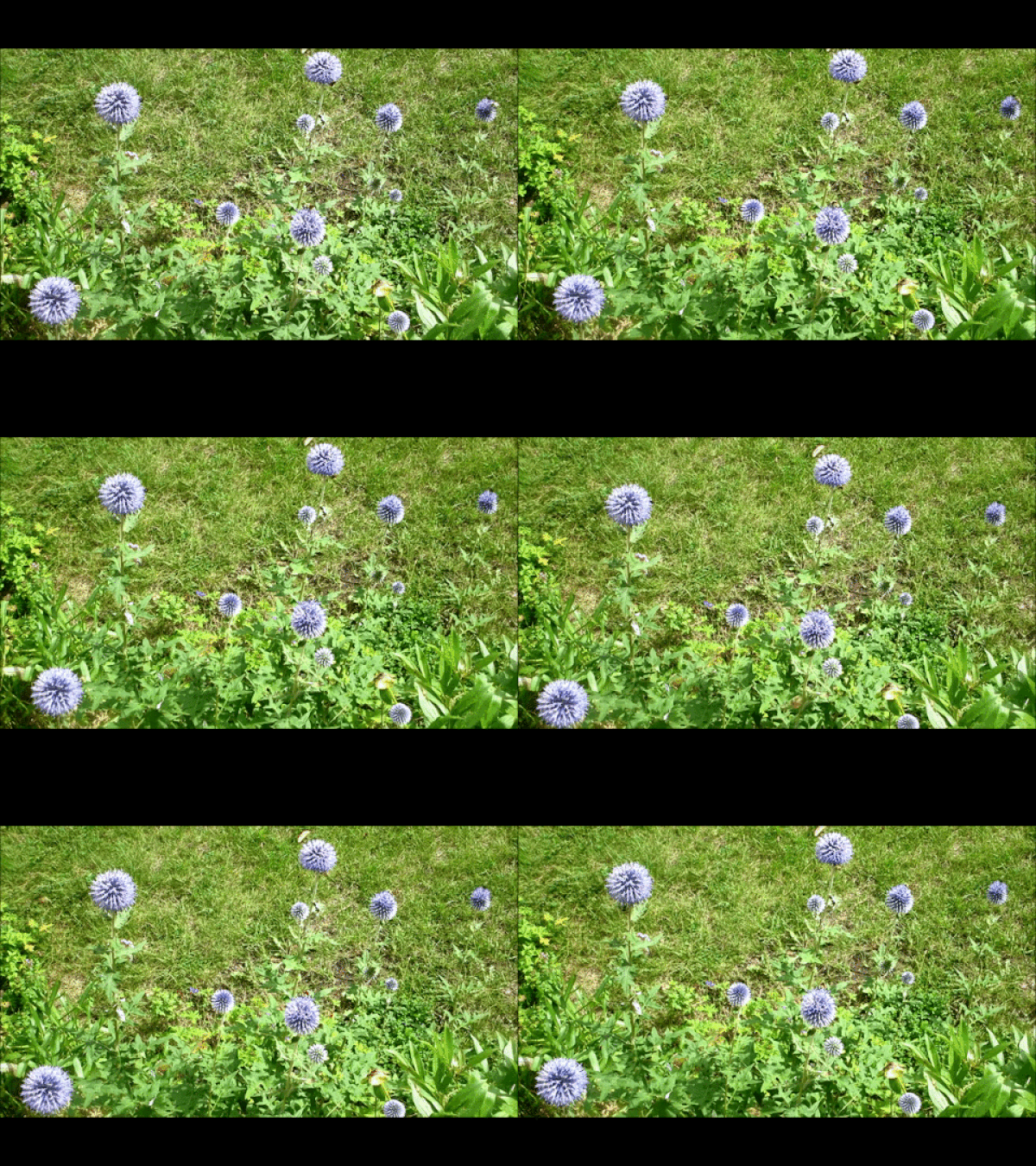
4 bumble bees

Can you spot all 6 bumblebees in this picture?

Although I have mentioned many times that honey bees are not going extinct (there are actually more kept hives of honey bees today than 10 years ago), I am concerned about wild and native species of bees. Loss of habitat, climate change, and pesticides are terminating many of them. So I was delighted to see a nice population of bumblebees tirelessly working the wild thistle which we allowed to grow on the edge of our flower garden.

Over a period of ten days, the bees were on the thistles steadily from about ten until dusk. We would see about 6 or so on the 14 heads of thistle near our deck at any one moment. They were busy flitting about, so it was hard to really know the full number – but I would guess that several dozen (probably from the same clandestine nest) were coming and going. I finally decided to film them so I could get a better count and watch their activities over and over again in slow mode.

2 bumble bees niceOn my video, I counted as many as 7 in view at any one moment, sharing but not apparently competing for the same 14 thistle heads. Each individual spent an average of 18 seconds on each flower. An old-time beekeeper once told me that if a bee (he was talking honey bees, of course) spends more than 5 seconds on a flower, then the flower has little nectar as it is taking the bee too much time to search individual florets and get a fill. I don’t know about that for sure, but I have seen bees on citrus and sweet clover flowers (which are each tremendous honey plants) take about two seconds to fill up. In the case of the bumblebees on our backyard thistle, the bees spent a few seconds in one position, then moved on the same flower and continued.

Interestingly, there was very little pollen on these workers’ corbiculae. This could be because so many bees are working the flowers that the pollen production rate doesn’t keep up with the foragers. Or it might be because it is getting late in the season and the bumblebee nest contains fewer larvae needing pollen, hence most of the collectors are going after nectar. Or there are other reasons – I don’t know. All I do know about this is that I was glad to see the busy bumblebees and encouraged that at least this one species has found something nourishing in our yard.

Posted in Ecology, Honey Plants, Save the Bees | Tagged , | 2 Comments

Fair Honey

Fairly good honey: the best at the fair

Good fair honey: Actually, the best fair honey at the Millarville Fair!

As a beekeeper, I have always been troubled with the disposal of honey. Invariably, we produced more than we could eat, especially since I ran as many as 2,000 hives. We had to get rid of the excess. Some went to friends as gifts and to bee yard landlords as payment for our right to trespass. I would guess that over the years I handled a couple million pounds of honey,  passing it through uncappers and extractors and dumping it into steel drums and half-pound jars. But I never thought of myself as a honey person, just a beekeeper.

A friend, Stephen, inspects honey for blemishes. <br>Nice light Canadian honey, eh?

A friend helps inspect honey for blemishes.
The honey sits atop a flashlight and Stephen is holding a magnifying glass. Nice light-coloured Canadian honey, eh?

Nevertheless, some folks here in the Calgary area have decided that my proximity to honey implies that I know something about the stuff. I have been drafted into the role of honey judge. I don’t mind handing out blue ribbons, but I do not have the best personality for such work. A good honey judge, I think, has a persnickety character. Someone with the disposition of a snobby wine connoisseur. The ideal honey judge is both meticulous and impartial. Impartiality is my long suit, if I may be permitted that biased opinion. But I’m not as meticulous as many of my close acquaintances. So I was grateful that several people assisted in Friday night’s Millarville Fair honey judging event. It made everything flow more smoothly.

The Priddis and Millarville Fair (now in its 108th year) attracted a respectable number of honey entries this year. The three categories – creamed honey, dark honey, and light honey – each had superior samples vying for attention. This was my 5th chance to judge at this fair and it complements the judging I’ve done at the Calgary Beekeepers’ annual honey competition. In a moment, I am going to tell you a bit about how the honey judging is done here. If you ever have a chance to enter one of the contests in our area, you’ll know what awaits when your own honey sits in judgement.

stuffyFirst, I’ll warn readers living in places rife with persnickety judges (and I’m looking at you, England) that our homegrown, western frontier Canadian honey competitions may make your eyes roll, or possibly moisten. I can appreciate that. We don’t have the centuries of tradition nor the established rules that make your honey judging a fine art. However, when I drew up our Calgary area rules, I borrowed heavily from published handbooks written in the British Isles. I also stole unabashedly from Florida’s Dr Tom Sanford who gave me great judging suggestions. I used other’s ideas and made modifications for things that are more relevant to our climate (much drier honey) and culture (pragmatism is boss out here).

So, if you want to enter honey in one of the local competitions (Calgary, Chestermere, Millarville), I’ll walk you through the things you should keep in mind. At the end, I’ll  mention a really big problem with western Canadian honey and what you might try to do to overcome it. But first, some basics.

We score on a 100 point system. Everyone automatically gets 100 points. But as soon as we look at your honey, your score begins to drop. Maybe quickly. Below are the qualities we look at and the maximum possible points for each:

1. CONTAINER – 10 POINTS
2. BRIGHTNESS – 10 POINTS
3. FREEDOM FROM CRYSTALS – 15 POINTS
4. ACCURACY OF FILLING – 10 POINTS
5. FLAVOUR/AROMA – 20 POINTS
6. HONEY DENSITY (VISCOSITY) – 15 POINTS
7. CLEANLINESS AND FREEDOM FROM FOAM OR AIR BUBBLES – 20 POINTS

Here are some of the details:

Container is judged on suitability of the jar, container imperfections, and lid/container cleanliness. We actually look for mars, scuffs, and even glass imperfections. Suitability of container is also important, so you’ll lose a lot of points for using pickle jars. One reason we penalize mason jars (though personally, I like them) is they are really difficult to compare with standard honey jars. When you have 10 entries in identical containers and a few in unusual vessels, it becomes hard to compare brightness and accuracy of fill, for example.
Brightness is obviously preferred – as opposed to a dull appearance which might indicate wax or crystalline impurities. We compare jars by placing them atop a strong flashlight, as you can see in the pictures above and below.
Accuracy of filling requires headroom of 1.25 to 2.5 cm (½ to 1 inch). Do not under fill – there should be no visible honey-to-cap gap (no air space) visible. On the other hand, if the judge gets sticky because you have overfilled the jar and honey is gobbed under the lid and leaking down the side… the judge will notice and revenge will be swift and furious.
Flavour and aroma are restricted to carmelization and fermentation traits. We see both offenses most years as some beekeepers always over-heat their honey, causing slight burning, or they harvest honey that is not properly cured by the bees and it has high moisture content. On the other hand, judges do not rate honey by how much they personally like the floral source. Honey might be minty, bland, sharp, or mellow and that would be OK. But it had better not be burnt or sour (or both – one year I wanted to give a special award to an unusual entry that managed to hit both taboos at the same time).
Freedom from crystals means that the honey is not granulating. Every year we receive a few entries that look like a wayward chemistry experiment. (This happens in Alberta because of the nearly ubiquitous presence of fast-granulating canola.) You want to show us liquid honey free of crystals, unless you’ve entered it as ‘creamed’, in which case the smoother and more uniformly crystallized, the better!
Density (or viscosity) of liquid honey will be judged either by a timed bubble test or refractometer. Since honey in western Canada can be really, really low in moisture, we use a graded scale and award more points for drier honey. Some entries have run as low as 13% moisture. Refractometers cost around $100 these days. I know that’s still a chunk of change, but sometimes hobby beekeepers team up to buy a gadget. It’s useful even if you are just selling out of the door to your neighbours. Honey over 18.6% moisture gets zero points from us when we judge it because it may spoil and because above that water content, it is no longer legal to sell it as “honey”.
Cleanliness is next to blue-ribbon-ness. Honey is food. Food must be clean. Crystals, foamy air bubbles, and cleanliness is partly comparison-based. The full 20 points is usually not awarded because we almost always find some unusual material floating in home-made honey. Even if it is benign wax, pollen, foam, or granulation crystals, it still detracts from the pristine nature of pure honey. Often – using a magnifying glass – we find a few tiny black specks (smoker soot) and fibers that likely unraveled from some honey-filtering material. These are nearly microscopic and nearly impossible to avoid. But you should check your entry yourself before submitting it and remove a candidate that has such floaters.

Inspecting with persnicketiness.

Inspecting with persnicketiness.

I promised to address a problem that plagues every beekeeper entering competition with low moisture, light-coloured honey. Here is your dilemma: You want the honey to be free of specks, fibers, and suspended air bubbles but these things almost never drift to the surface in thick, low-moisture honey. They stay suspended. However, you have likely discovered that you can get rid of all these problems by heating the honey. Then everything floats to the top and the warm honey can be filtered through really fine cloth to make it extra nice. Unfortunately, too much heat darkens honey and gives it an awful caramelized flavour. So, you either enter honey with suspended air bubbles (losing points for dullness and perhaps granulation) or you heat the honey too much (losing points by burning it).  However, there is a delicate balance that you may achieve with patience and experience.

If you want to keep honey from granulating and want to remove air bubbles, you may need to heat it. If you do, make the honey rather hot, but only for a few minutes. Stir the honey, let it sit a bit, skim the surface, then filter it into a new clean container. Immediately place the new container of hot honey into a tub of ice-cold water to cool the honey off. Skim the surface again. Heat damage is a function of both the amount of heat (Never boil the stuff!) and the amount of time that it stays hot. If you keep honey at 40º C (104º F) for days, you may do as much damage as heating it to 70 C (160 F) for a few minutes. Experiment, but a temperature of about 55 C (130 F) is about right for a few moments – but then chill the honey quickly. Done correctly, this makes lovely clean and sparkling honey for sale or home use with minimal (perhaps no) perceptible heat damage.

Posted in Culture, or lack thereof, Honey | Tagged , , , , , , | Leave a comment

Honey Bee Highways

This is how Canadians set out baskets of flowers along the road for bees.

This is how Canadians set out baskets of flowers for bees.

Norway – the 2nd most liveable country in the world* – has yet another feather in its woolly cap. Or super on its hive, if you will. The Norwegians have a Honey Bee Highway.  That’s a trail of flower pots brimming with bee-friendly plants. (As opposed to bee-unfriendly plants like venus flytraps.) But no highway is ever perfectly paved, so there is a website which Oslo residents may visit to learn where the gaps in the beeway are. (The site is hosted by little Polli Pollinator, a nondescript creature who introduces herself with: “Hei! Jeg er Polli Pollinator!“)   The idea of the bee highway is to provide bees with natural pollen at stations located no more than 250 meters apart.

Very well, then. Norway’s honey bee highway is strewn with stuff that Polli is expected to love. The Oslo Garden Society apparently felt that roving bands of peripatetic wild bees might feel hungry and distressed in Norway’s capital. Members of the garden club have been setting out pots of blooming nourishment at helpful intervals to prevent starvation as the bees maraud the city. (I wonder, is anyone doing the same thing for the hungry visiting reindeer?)  Polli the Bee is not only demanding free food, but is also asking for overnight accommodation and insect hotels and hostels (overnattingssteder humlekasser og insekthotell). Polli is what many of us would call an aggressive bee.

I like the interactive map that the friends of Polli the Pollinator have placed on the internet, and I hope you will check it out. It looks perfect for wild bees with internet access. Sitting around the hive on date night, wondering where to eat, wild bees might pull up this web page and discover that a lovely box of flowers is waiting on the northwest edge of the city. There are no Yelp!-like reviews, but the pictures are worth a thousand raves. Here is a pollinatorpassasjen map with flower spots and a sample menu:

Oslo flowers

I don’t know about you, but I doubt the wild bees will get very excited about a dried floral arrangement. But the Oslo garden club deserves credit for thinking of the bees and developing the program and its accompanying website. However, I’m not sure that their method will be as successful as the one that Josephine and Earl Emde used in northern Saskatchewan – a cold, far north place in Canada that’s not remarkably different from Norway.

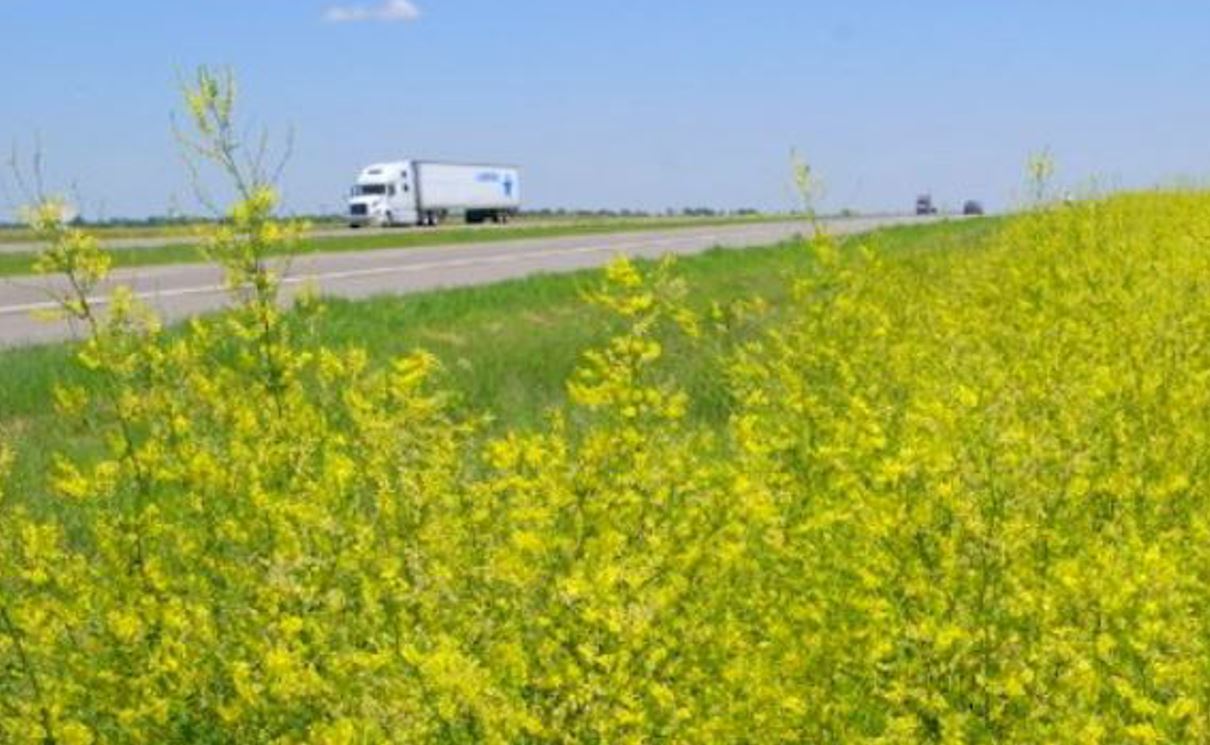
The Emdes were elderly friends of mine back in the ’80s. They ran 500 hives of bees near Big River, a town that started where the paved road ended in those days (it’s surfaced now). Josephine drove their big 3-ton flatbed while Earl sat on the back, legs dangling over the edge, seed sower on his lap. He spun the crank and sweet clover seeds shot out alongside the highway while Jo slowly drove in the predawn darkness. They probably planted a million flowers which then re-seeded themselves and still add to Saskatchewan’s scenery. I’m sure descendants of those first biennials continue to delight bees thirty years later. If you are going to make a “honey bee highway” then use a real highway and for goodness sake, use flowers that bees actually like to visit.

Roadside sweet clover - the sort Jo and Earl Emde planted.

Roadside sweet clover – the sort of bee-friendly plant Jo and Earl Emde once let loose in northern Saskatchewan.

*Norway is number two.  Stories about the most liveable country in the world can be seen here.

Posted in Culture, or lack thereof, Ecology, Friends, Honey Plants, Humour, Save the Bees | Tagged , , , , | 2 Comments

How Honey Bees Discovered Vaccines

vaccine shotLast week, the popular press was claiming that honey bees discovered vaccines millions of years before humans did. It makes great lead paragraphs for news stories, but the tale is slightly off the mark. Honey bees don’t have scientists. They have queens, drones, and workers. They don’t invent things in the way Discovery.com (Queen Bees Vaccinate All of Their Babies) may have us believe.

Even the staid Washington Post gets rather silly on this story: “Humans like to brag about their brilliant advent of vaccinations to prevent diseases, but bees just roll their eyes and shrug. After all, they’ve been doing it naturally for much longer.”  I have to admit, the thought of honey bees rolling ten thousand compound eyes in unison made me smile, even if the idea is creepy. So, thanks, Washington Post, for that image.

kid in mud

Acquiring natural immunity.

The news story that bees have developed ‘vaccines’ comes from research (done by humans) published last week in PLOS Pathogens. The three authors title their paper Transfer of Immunity from Mother to Offspring Is Mediated via Egg-Yolk Protein Vitellogenin. You will notice that they do not use the word ‘vaccine’ – probably because we aren’t really talking about vaccinations here. What is happening is that the mother (the queen bee) passes some immunity response through proteins in the offspring egg. It seems that this is not so different from human mothers passing along immunity to human babies. And perhaps not far removed from children acquiring immunity from allegens and bacteria when they are allowed to wallow like pigs in mud.  Only once in 12 pages is the word vaccine used – and that’s in the context of potentially maybe someday developing an application using the protein vitellogenin (Vg): “Vg-mediated transfer of pathogenically inactive bacterial fragments could provide a platform for the development of vaccines for beneficial insects.” In other words, humans might make vaccines for insects by feeding inert pathogens to expectant mom-insects who would pass resistance to offspring. Maybe. Someday.

How the immunization process works: In the case of the honey bee, workers encounter pathogens which get mixed into the food they serve to their majesty, which gets into the queen’s liver (actually ‘fat bodies‘ in bees), which combines the pathogen in a protein called vitellogenin, which enters the queen’s blood stream and migrates to eggs as they are laid. This ultimately may give the offspring immunity to some pathogens. But, as we will see, it doesn’t work on one of the honey bees’ worst diseases.

strong_hiveWhen you consider that 50,000 individual bees are crammed into a smallish hot damp hive, it is amazing that pathogens don’t decimate colonies within minutes. The discovery of the mother-to-child immunization process may explain how the developing larvae usually survive and mature in conditions that pathogens love. Unfortunately, this does little to alleviate things like foulbrood (AFB and EFB), viruses, nosema, chalk brood, sac brood, nor syndromes such as Colony Collapse Disorder, and mite infestations. However, perhaps there are other pathogens which would thrive in the hive if the vitellogenin-immunization system didn’t exist.

American foulbrood, major scourage of beekeeping

American foulbrood, major scourge of beekeeping

The researchers found that gram-negative E. coli is transferred to the egg, but surprisingly, so is Paenibacillus larvae – the gram-positive bacterium causing American foulbrood disease (AFB). Obviously, this transfer system is not stopping the development of AFB, a major killer of honey bees. I am not sure if this means the immunity transfer is not always effective or if Paenibacillus larvae is somehow different. However, the presence of AFB – which will destroy a colony within weeks – suggests that the ‘vaccine’ the queen provides her offspring is far from effective. This implies that the researchers may have discovered the way pathogens can be transferred to offspring – infecting the unborn rather than protecting them. An anti-vaccine, at least in the case of AFB, spreading disease instead of stopping it.

What will become of this research? According to the published paper and subsequent news reports, vitellogenin-mediated transfer of pathogenically inactive bacterial fragments might provide a platform for the development of vaccines for beneficial insects. Or, as in the example of AFB, perhaps some equivalent pathogen could be slipped into a pest insect’s vitellogenin pathway, infecting its progeny and spreading disease among pesky bugs. This might replace pesticides in some cases. The researchers claim, “In sum, such applications could be highly beneficial in agriculture.” It will likely take years to create such applications, but you can be sure someone is working on it at this moment.

Posted in Bee Biology, Diseases and Pests | Tagged , , , , , | 3 Comments

Uncommon Ancestory

Honey bees and bumblebees are genetically less similar than dogs and cats.

Honey bees and bumblebees have more genetic differences than dogs and cats.

Creatures change with time. You might believe that God controls, guides, or designs those changes or you may have the opinion that random acts in the environment create mutations which change a species. The former idea is accepted by the majority of Christians while the latter is the basis of modern evolutionary biology. You might even combine these ideas (as many people do) and believe that God intelligently engineers genetic changes through radiation and chemicals, which mutates creatures and causes evolution. Either way, you are with the majority that agrees that species change with time.

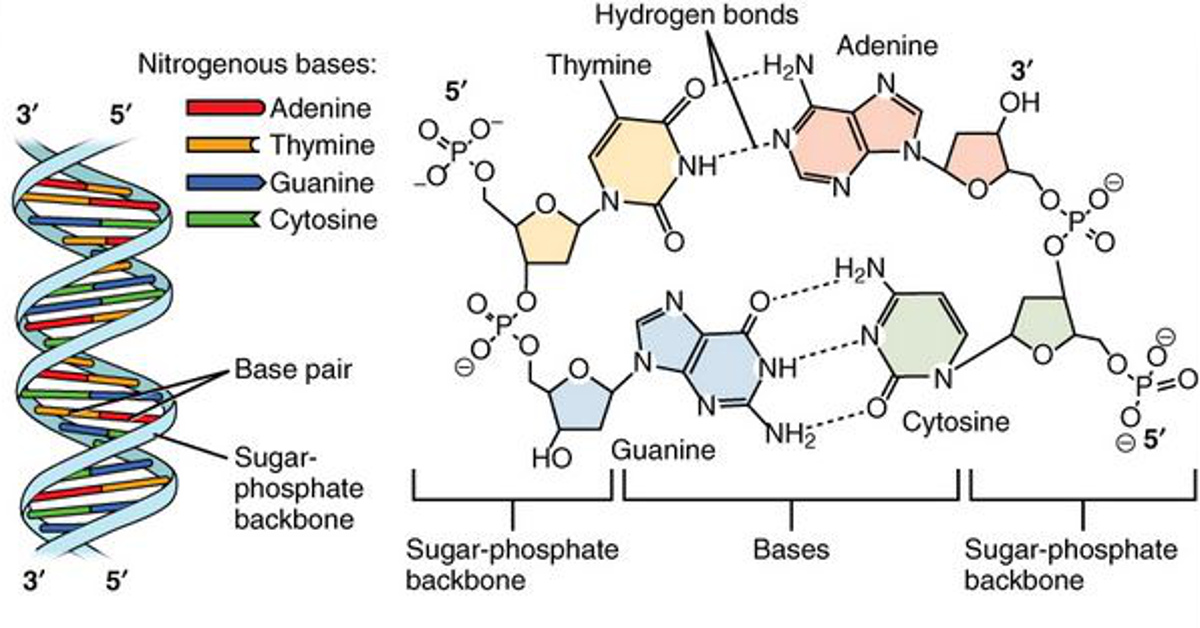
Part of the idea of the evolution of species is that similar creatures had common ancestors at some point in the past. The date of common ancestry can be calculated by looking at the differences in the DNA between two species and counting the number of bases (T, A, G, C) that are different. Through controlled experimentation, biologists have found that out of each set of 30 million DNA base pairs, roughly one mutates each generation. (At this rate, humans accumulate a total of 200 to 300 mutated base pairs each generation.) Most of these mutations occur in bits of DNA material that (as far as biologists can determine) have no function. They help create RNA which builds 3-base codons that do not produce any proteins –  they are like the white space on a printed page.

RNA codonOther mutations in a base pair may change the RNA’s codon into one which makes a protein identical to the non-mutated codon. This is really common, too, because many of the triple-groups of base nucleotides (codons) create the same protein. For example, both CCA and CCG are codons that make the same protein, proline. So if a mutation causes the final ‘A’ in that string to be replaced by a ‘G’, the resulting protein would nevertheless be the same. That particular mutation would have no effect on the offspring.  But other mutations may be detrimental. They result in new codons that make a protein that may cause a nervous system to lack connections or a stomach to lack a lining, for example. Such killer mutations end up in non-viable offspring, believed to cause roughly one-half of spontaneous  miscarriages in mammals. If a creature survives with a disadvantaged mutation, it likely will have few (if any) offspring and the bad mutation may die out.

DNA structureThis leaves a small number of mutations that occur in important stretches of DNA where a change can result in a permanent positive difference in the offspring. In recent decades, scientists have learned how to accelerate such changes by irradiating millions of seeds and then germinating them, observing the mutated plants that result (many will never germinate or will die early, due to detrimental mutations). The genetic engineers will occasionally find some plants with desired new traits – pest or drought resistance, for example. They save seeds from those offspring. The seeds of the mutated offspring continue to carry the mutation. It is now a permanent part of the DNA sequence of all future generations. In this way, new colours of begonias were developed and frost-resistant tomatoes have been created.

There is more to this story and the development of genetic diversity than I have just covered. I haven’t mentioned how the detrimental mutations are washed from the present DNA data set nor have I indicated the ways in which mutations may be accelerated in nature. A great starting point for a better explanation of how scientists have calculated the rate of species diversification is found in Genomic clocks and evolutionary timescales by S. Blair Hedges and Sudhir Kumar, a highly readable article available free in PDF format.

Darwin's Original Sketch of the Tree of Life, 1837

Darwin’s Original Sketch of the Tree of Life, 1837

The theory that genetic alteration occurs at a predictable rate has been tested and observed thousands of times. Mutations cause permanent changes in offspring and those changes are occasionally helpful to offspring survival. By examining the DNA of any two creatures – let’s say European honey bees (Apis mellifera) and bumblebees (Bombus distinguendus) – we can count the number of differences in a bit of DNA and calculate how long it would have taken the two species to have diverged from a common ancestor. In the case of a bumblebee and a honey bee, the two had a common ancestor about 108 million years ago. This is according to results of observations by 5 different research teams at 5 different labs, doing DNA examinations between 2007 and 2011. They did not all get the exact same result – Chenoweth, et al. calculated 90 million years while Litman et al. found it took 121 million years for the observed mutations to occur. The other three research teams had intermediate results. The consensus based on all five is 108 million years (the median of the 5 studies is 93 million years). This tells us a couple of things. It took an awful long time for the changes to add up. And there must be a heck of a lot of differences between these two insects. Surprisingly, there are more observed DNA differences between bumblebees and honey bees than between dogs and cats. (Dogs and cats had a common ancestor 55 million years ago – they have only half the genetic changes in their DNA as honey bees and bumblebees.)

In the past decade, there have been thousands of independent calculations made for various species divergences. I recommend the website The Time Tree of Life which has categorized 2,000 studies and 50,000 different creatures. They operate an interesting and informative site with an easy to use interface where you can enter your favourite creatures and find out the amount of time that has passed since those creatures had a common ancestor.  Using data from their site, here are a few other species and the calculated time (in millions of years) of their last common ancestry:

Last Common Ancestry between Honey Bees and various other Species

common name species million years ago
Asian honey bee Apis cerana 18.5
great yellow bumblebee Bombus distinguendus 108
leaf cutter bee Megachile rotundata 122
house fly Musca domestica 348
European bee-eater bird Merops apiaster 847
alfalfa Medicago sativa 1,515 (1.5 billion years)
AFB (American foul brood) Paenibacillus larvae 4,290 (4.3 billion years)

Posted in Bee Biology, Genetics, Science | Tagged , , , , | Leave a comment

Mr Holme’s Bees

Sherlock Holmes is more than an ordinary beekeeper – as you’ll find out in this summer’s new movie, Mr Holmes. I watched it at a Calgary theatre with my wife this evening. I’m glad we went. We don’t get out enough and generally find films too loud, too violent, too silly, or too sappy. Mr Holmes was none of these.

mr holmes78-year-old actor Ian McKellen (recently the wizard Gandalf in the Lord of the Rings trilogy) plays 93-year-old Sherlock Holmes, a long-retired detective. As many of you know, author Sir Arthur Conan Doyle forced Sherlock Holmes into a beekeeping retirement in the south of England. According to Doyle, Holmes toiled at bee farming and even wrote a popular beekeeping manual. The drama-mystery movie Mr Holmes (2015, BBC Films, et al.) stays quite true to beekeeping. The last film I’d seen that ties bees so nicely and accurately into the thread of a drama was Ulee’s Gold (1997, Orion Films). If you’re a beekeeper you will appreciate the finer details – the distinction between wasps and honey bees, the mystery of some disappearing bees, and the way Holmes lights his bee smoker with a roll cut from an old burlap sack. At one point in the movie, Sherlock Holmes took a book from his shelf and removed a significant photograph of a young woman. The book was Root’s 1945 ABC & XYZ of Beekeeping. I recognized it – I have the same edition in my own home library.

But don’t let me mislead you. This is not a beekeeping documentary. Or even a beekeeping movie. It is mostly a story of the redemption of an old man who regrets many of the things of his past and who is struggling to revive old memories. It’s a touching, well-acted drama. It’s not likely to stay in the theatres long, so get out and enjoy it with a friend or spouse before its run is over.

Posted in Culture, or lack thereof, Movies, People | Tagged , , , | 2 Comments

Bees Prey at Church

In one of the most clever news headlines I have ever seen, editor Darcy Cheek of Ontario’s Recorder.ca writes: Honey bees go to Lyn church to prey. Any editor/reporter who can come up with a lede-line like that deserves mention. It caught my attention.

Here’s his story: Last week, a swarm settled into an Anglican parish church in farm country, Ontario. The priest’s assistant called for help. With approval from Ontario’s Ministry of Environment and Climate Change (yes, folks, climate change is real enough to have a ministry), the bees were exterminated.  That’s right – killed, destroyed, poisoned, and made dead. Later, a local beekeeper named Debbie Hutchings of Debbee’s Bees near Newboro, Ontario, heard about the honey bee liquidation event. She was upset. Ms Hutchings felt that more of an effort could have been made to save the bees. She is likely right.

European dark bees, photographed by Miksha in Ireland, 2005.

European dark bees, photographed by Miksha in Ireland, 2005.

I have a couple of thoughts on this. First, Ms Hutchings sounds like the sort of beekeeper we all want to know. She runs a small bee farm and sells bee supplies and honey. She rescues bees. She cares about bees. Her great-grandfather’s ancestors were beekeepers and brought bees with them in the mid-1800s when they took a slow boat from England to Canada.

I have to admit that I scoffed when I read that she told reporter Darcy Cheek that she still has honey bee stock that has been in the Hutchings family for 195 years. Of course not, I thought. Two hundred years ago, the bees that her ancestors imported (probably without CFIA approval) would have been black in colour, small in size, and would have had trouble wintering in Ontario, but if they survived, they would build up quickly in the spring. These bees are sometimes called black bees, European dark bees, or Apis mellifera mellifera. Almost everywhere in North America, they have been replaced by more productive Carniolan, Caucasian, and Italian races. The last time I saw the European dark bees in North America was in 1976, along the Pee Dee River at the apiary of a remote South Carolina beekeeper, a friend of mine who kept about ten gum boxes stocked with black bees. It seemed highly improbable that Ms Hutchings had such bees. But I am wrong.

Debbie Hutchings describes her bees on her website:

“[My grandparents] brought the honeybees with them from England. I can’t say that within the last 100 or so years the Hutchings bee hasn’t interbred with other breeds of honeybees, but we have not intentionally cross bred them. I still put my best breeder hives in the basement of the old homestead when winter comes a knocking, just like my Grandfathers did.  They are gentle, little dark bees that winter in small clusters that explode when spring comes.

Sounds like European dark bees to me. Kudos to Debbie Hutchings for recognizing this and keeping the bees going in the traditional way.

johnbaptistcereal

John the Baptists’ breakfast cereal. Available at fine churches everywhere.

And speaking of traditions… The church in Lyn, Ontario, that had the bees destroyed is Saint John the Baptist Anglican parish church. I’ve read the Bible. Twice, in fact. John was the wildman who lived in the desert. He survived (according to The Book) by eating locusts and honey.  I think the Ontario church missed a great opportunity to cash in on the amazing miracle of the honey-dripping ceiling. Churches these days are struggling to survive. Attendance is way down. But even I would go to a church that handed out little bowls of locusts and then queued worshipers under a dripping ceiling where fresh honey drizzled down on the locusts. For a really authentic experience, they could even offer camel-skin robes. But alas, the bees were killed. What would John the Baptist say about that?

Posted in Culture, or lack thereof, Humour, Save the Bees, Strange, Odd Stuff | Tagged , , , , | 1 Comment

Timeless

I was in England last week and saw some of the usual sights: Stonehenge, the Magna Carta at Salisbury Cathedral, King’s College along the river Cam, JRR Tolkien’s grave. To me, these represent timelessness. Tolkien, sleeping in eternity. The stones of Stonehenge, eroding forever. Even our creations – Salisbury’s statement of democracy; Cambridge’s seven hundred years of learning – are perhaps no less enduring. And everywhere I went, I saw bees.

Spot the bee?

Spot the bee? (She’s flying front and center.)

Bees are nearly ubiquitous, yet so ephemeral. Their time is brief. At first blush, they don’t have the agelessness of rocks and institutions. Bees come and go. The bumblebees which I saw flittering between clovers at Stonehenge build a summer nest of a hundred workers, then, in late autumn, most of the bees abruptly die.

One (or a few) mated queens find solitary wintering sites, wait for spring, then start anew. I want to believe that at least a few queen bumblebees shelter each winter alongside a Stonehenge rock where the igneous doleritic bluestone meets the soil. A bees’ time is brief – a few months – but starting anew each spring has been repeated for millions of years. On the Salisbury Plain, bees have been drawing nectar and raising brood almost forever.

And yet, we know that nothing lasts forever. Although bees may have brooded a hundred million summers (as some scientists believe), they and their environment have changed dramatically. Worshipers  erected rocks at Stonehenge almost 5,000 years ago. Before that, ice covered much of the northern hemisphere and bees were forced south, following the receding flowers. Much further back in time, North America and Europe were attached and the Caledonian mountain range stretched from Scotland to Alabama. Eventually the continents parted (in a final Pangean breakup, about 60 million years ago) and still later, our favoured honey bees, relative late-comers,  arose in the Middle East. (This is why bumblebees are found in the Americas and Europe while honey bees, speciated after the Atlantic formed, were isolated from America. The continents had separated before honey bees arose.  The American continents didn’t have any honey bees until humans carried them as livestock in the 16th century, but earlier bee species had spread before the continents parted.)

JRRT beeLater in England, at JRR Tolkien’s cemetery, I found an entirely different hymenoptera working a yellow rose blossoming atop the great writer. Some sort of wasp, I suppose. Or perhaps one of the 23,249 species of bee which I don’t recognize. Such creatures, it seems, are everywhere.

Tolkien, whose grave is across the road from an Oxford guesthouse we slept in last week, will be dead forever. Perhaps death is the thing that endures. Yet, even in death the body is restless and changing. Tolkien signed a 50-year contract (costing $2,000) to keep his cemetery plot for half a century. Unless someone renews that contract – made between the city of Oxford, the Wolvercote Cemetery, and Professor Tolkien – his spot will be sold to someone newly dead. It is likely that the great writer’s heirs will renew the agreement and Tolkien will remain at peace for at least another 50 years. Else, like the eroding stones at Stonehenge, Tolkien himself will be moved to other soil, allowing even more roses to blossom.

It all has to do with time. For the humans who drafted the documents at the Wolvercote Cemetery, fifty years is long enough for most people to be remembered. And then forgotten – unless one is perhaps JRR Tolkien.

Posted in Books, Culture, or lack thereof, Ecology, People, Strange, Odd Stuff | Tagged , , , | Leave a comment