Naturally Imperfect

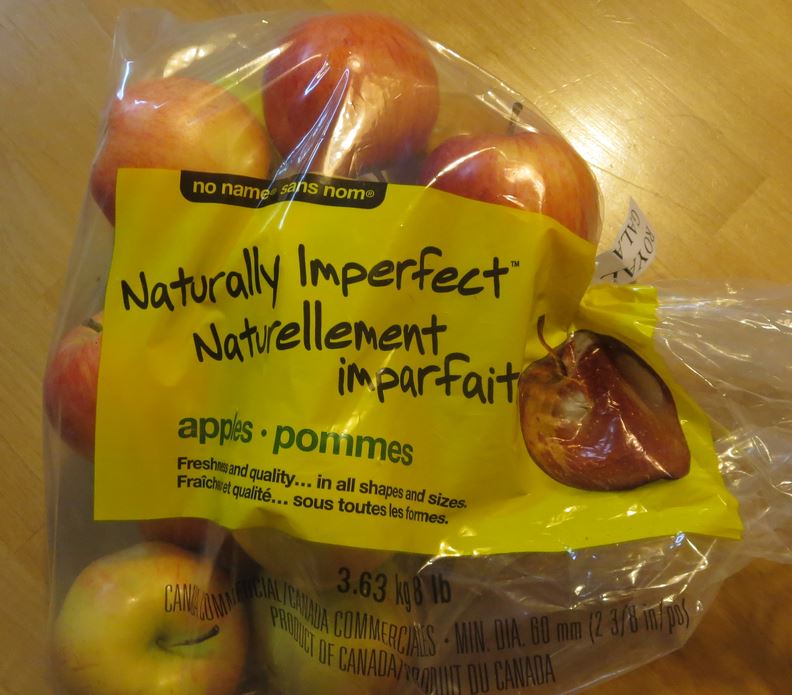
imperfect applesThis might be old stuff to you, but our local grocer has started selling imperfect apples. It’s about time. My kids, who are properly brain-washed, love the smallish bruised apples and understand that these specially priced (Cheaper!) fruits are better than apples of perfection. I know that some readers are thinking “Yea, but I’ve been shopping at the farmers markets and get plenty of spotted apples.” We like the markets, too, but they aren’t open year-round here and apples don’t grow locally (except domesticated crab apples – which we have in our yard).  It’s nice to see this alternative for city folks.

Imperfection will save bees. The demand for spotless fruits is satisfied by tonnes of spray. But to be fair to the farmer, it is hard to keep a monoculture crop alive when mites, worms, and fungi jump easily from tree to tree. And though the apples we bought are imperfect, I am aware that they are not organic. Apples are likely the most sprayed of all commercial fruits. USDA data shows that 98% of American apples have residue from at least one of 48 pesticides – even after washing! But buying some small, odd-shaped, bruised and battered apples that may have a scab, worm hole, or fungus ring helps farmers reduce chemicals. It’s a step towards the right finish line.

Sales room on the family farm. You should be able to see the dark jars of goldenrod honey, and to the left, a crate of freshly pruned cabbages.

Sales room on the family farm. You can see the dark jars of
goldenrod honey, and to the far left, a crate of freshly pruned cabbage.

I grew up on a farm that had a vineyard, apricots, chestnuts, peaches, and about 200 apple trees in its orchard. People would come to the farm to buy these, as well as potatoes, tomatoes, peppers, and cabbage. I was about 10 when I realized that we sold more cabbage when we peeled off the brownish outer leaves. Give people less and they’ll buy more, it seemed to me at the time. Of course, our customers liked to see the solid green and white heads with all the cabbage worms removed. It seems that consumers are easily fooled. Maybe that’s finally changing. Can we learn to say “Yuck” to perfect apples, knowing they carry unseen chemicals, and embrace the less pretty ones? We can try.

scabby appleThere is a movement to honour, praise, and eat so-called ugly apples. An apple afflicted with flyspeck fungus, for example, looks especially unappetizing, but the blotches and scabs do not affect the safety or taste of the apple. In fact, it is likely safer than most apples without the fungus.

I think the idea is catching on here.  Hopefully the Naturally Imperfect line won’t become so popular that the price will go up or the crates will empty out.  Imperfection, though, shouldn’t run out – the grocery store can always use a bat to beat up some of the shiny apples.  But I think we’ll know the difference.

Posted in Culture, or lack thereof, Ecology, Pesticides, Save the Bees | Tagged , , | 1 Comment

Staying the Course

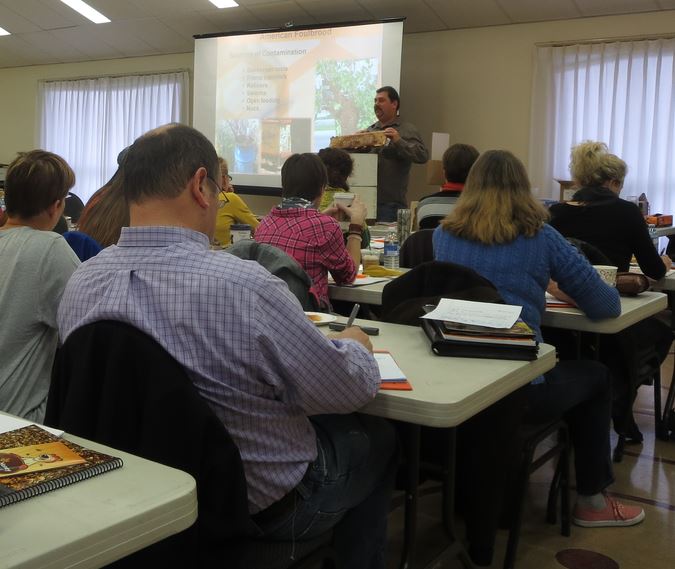
Bert's beginning with bees lecture

Bert’s beginning with bees lecture

I had a great time helping teach Beginning Beekeeping to 40 new beekeepers this weekend. Our local bee club, Calgary and District Beekeepers, organized the 2-day event. I was invited to speak for three hours about Spring and Summer Hive Management, followed with Honey: Harvesting and Fun-with-Honey.

Liz, talking wintering

Liz, teaching wintering

Well, of course, the second lecture wasn’t really called Fun-with-Honey, or anything even remotely similar. But it’s hard to indicate processing, grading, storing, using, and selling in one succinct title. Other teachers covered things like starting with bees, bee biology, diseases and pests, and fall/winter management. I guess I don’t need to say that it was a lot of material to cover in one weekend. I felt sorry for the newbees in the classroom. It was an incredible amount of information, all presented in the wacky vernacular of bee-people-speak. But the end-of- class evaluations given to us by the students were almost all excellent. And in the spring, the participants will be taken to an apiary for a refresher and for some hands-on practical experience.

Although I have been messin’ in bees since I was a kid and became enthused in a big way around age 17, I learned a lot from my fellow teachers, Liz, Bert, and Neil.  That’s one of the nicest things about beekeeping – you can work with bees for years and years and still learn a lot. My introductory bio told participants that I have been working with bees for over 40 years, raised thousands of queens, and made a lot of honey. I wanted the students to know that I still have a lot to learn, so I used a story I heard once from another beekeeper.

When you first start to keep bees, you think you know everything. You do this, and the bees do that. You do this other thing, and the bees react this other way. After a year or two, you have made a bit of honey and you have grown comfortable in the beeyard. But then the bees surprise you. And as time goes on, you begin to realize that you don’t know everything. “Beekeeping,” said my friend, “is one of those things where you start out knowing everything and as time goes on, you know less and less until finally you realize that you don’t know anything at all.”  Well, it’s not quite that bad. But the beekeeper who brags the most and acts the smartest is almost invariably the least experienced amid any party of beekeepers.

Neil, explaining bee diseases and control

Neil, explaining bee pests and disease control

Posted in Culture, or lack thereof, Outreach | Tagged , , | 1 Comment

Bees on a Caffeine Buzz

     Video:  Dr Couvillon shows that caffeine tricks honeybees into working harder.

It seems bees may suffer from the same drowsy morning moods and weary fatigued afternoons as their human cousins. And it may be similarly cured with a jolt of joe.  For bees, the caffeine kick is sometimes provided by shrewd flowers that may cheat them out of copious volumes of nectar by supplying the mildly addicting drug instead. That’s right, some flowers may be tricksters that offer coffee instead of sugar in their nectar. The bees love it.

It takes substantial resources for a plant to secrete nectar. Nectar is largely fructose, glucose, and sucrose. Those sugars are expensive to assemble – plants use sunlight, carbon, hydrogen, and oxygen drawn from the environment and manufactured into nectar that attracts pollinators. A few plant species cleverly lace nectar with a little caffeine. This keeps the bees coming back to sip the spiked nectar and inadvertently pollinate blossoms.

Dr Roger Schurch bee collecting caffeine

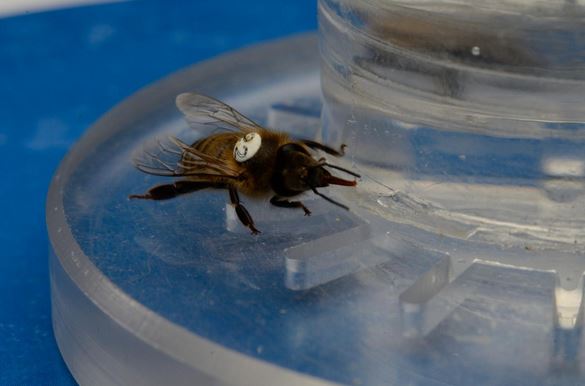
Part of the caffeinated nectar experiment. Photo: Roger Schürch

This might not be so bad, but it’s the insect world’s equivalent of spending the grocery money on booze. Addicted and unrepentant, the honey bee keeps heading back to the flower’s caffeine bar – even if the flower has quit secreting nectar. In a recent paper, researchers tell us that the plants’ tactics may result in 14.5% less honey production for the bees. To make things worse, the Swiss and UK researchers have discovered that honey bees get so hyped up on caffeine that they perform a wildly enticing waggle-dance, drawing four times the number of bee recruits towards the flowers with drugs than flowers without. Even more fascinating, earlier research has shown that caffeine significantly increases a bee’s memory, helping her find her way back to the garden drug pusher a lot more easily.

The scientists show that honeybees on caffeine are tricked into foraging harder for poorer nectar quality (lower sugar content) and tricked into recruiting more bees to forage caffeinated nectar than decaf. The full paper, Caffeinated Forage Tricks Honeybees into Increasing Foraging and Recruitment Behaviors, by Margaret Couvillon, Roger Schürch, and colleagues, can be found here, at Current Biology.

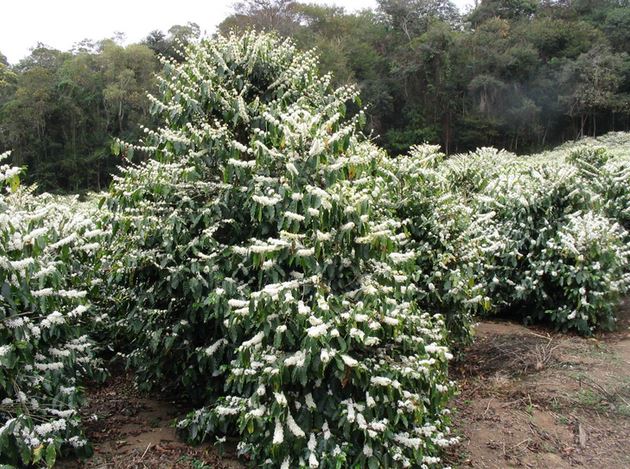
coffee tree in bloomYou may be wondering about coffee bean trees. They have flowers. The flowers secrete nectar. The plant needs pollinated. If caffeine is so seductive to bees, why isn’t the tropical world covered in coffee beans? Well, too much of a good thing can be a turn-off. The nectar from coffee plants carries a heavy bitter flavour which repels bees more than the drug attracts them. But an Italian foundation has been funding a project in Colombia with the goal of helping small producers supplement their green bean income with coffee honey. The program began its pilot project in 2011. Chemical analysis of the honey harvested from those Colombian coffee trees show it has more than 60% coffee pollen, making it eligible for unifloral marketing. However, although there are millions of acres of coffee plantations in the world, coffee bean honey hasn’t been generally available in the past. That’s because bees really don’t like working flowers with overly caffeinated nectar.  Bees, though, love the blossoms on citrus trees which offer both sufficient nectar and very discrete amounts of caffeine in a balanced and insect-friendly blend.

So, what’s the message here? Flowers are capable of becoming nasty tricksters in order to get what they need. But bees can be rather sly, too. If a flower’s floral tube is too long, the bee may chew through the side of the blossom, steal nectar, and by-pass pollination entirely. And in here in cowboy country, we regularly see a similar activity when honey bees work alfalfa, which has a rude habit of whacking a bee’s head with pollen as the bee tries to gather nectar. Smarter than the average legume, our honey bees quickly learn to sneak around the painful pollen trap, gathering nectar by the bucketful without doing the alfalfa any favours.

Posted in Bee Biology, Ecology, Honey Plants, Pollination | Tagged , , , | 1 Comment

Chinook Honey and Mead

Friends of ours have a honey-wine shop in the town of Okotoks, just a few minutes  south of Calgary. They make their own mead from their own honey. They do it really well. Art retired from flying commercial airliners to spend time with his bees. He and Cherie built a store to sell their honey products – the wine making business just sort of happened. Now they produce thousands of bottles of internationally acclaimed award-winning mead.

You can jump over to Chinook Honey’s web site and see their business up-close. I’m not going to write a lot about their outfit got started and grew – you can read about that on their website. As far as the products go, I was at their shop yesterday and I figure a few of the pictures I took could do the talking for me.

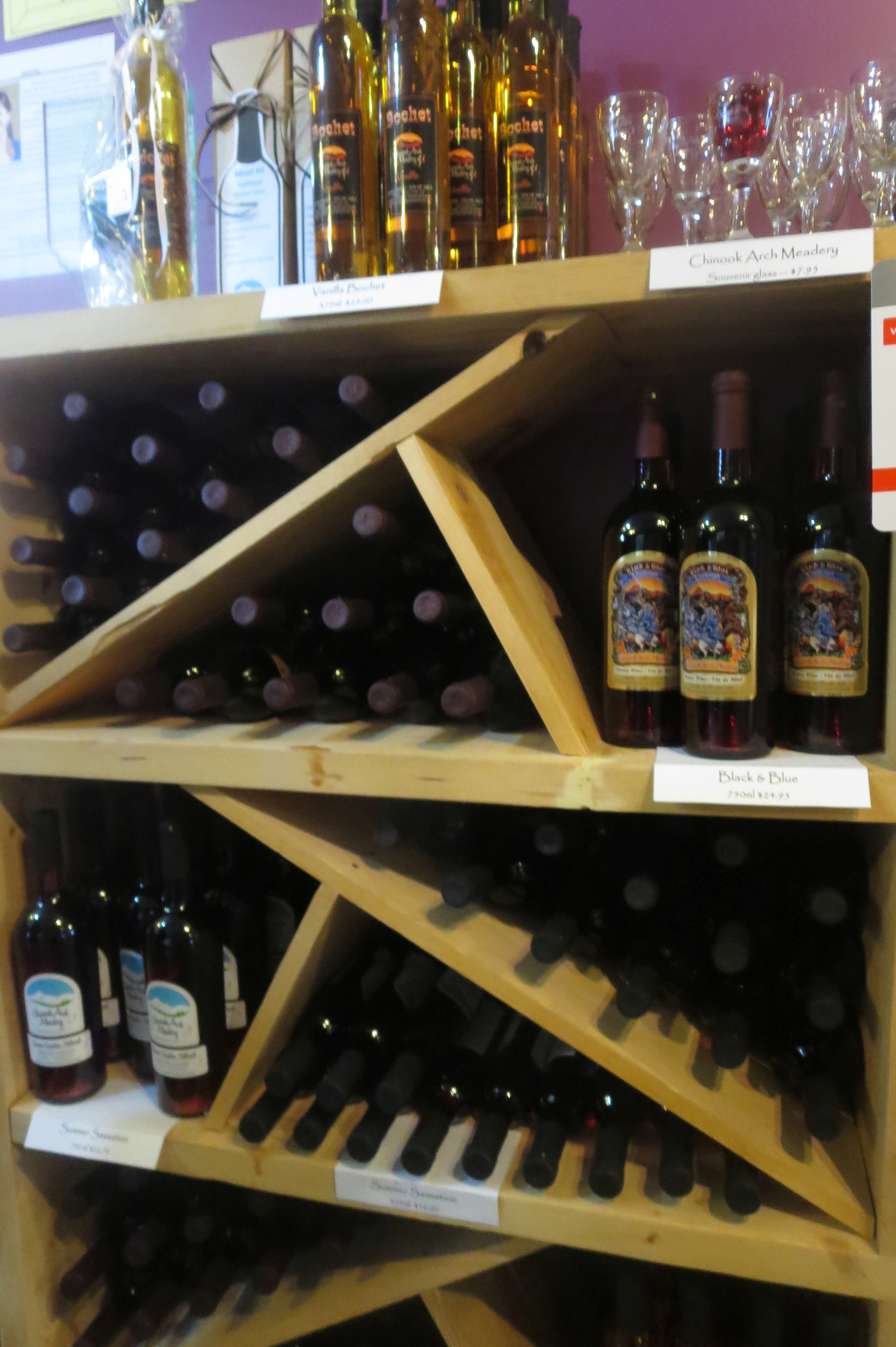
Honey wine (mead) is basically honey, water, and yeast. But it’s not easy. Making mead takes an incredible amount of care and hard work.   Extra ingredients like saskatoon berries, cherries, and spices  make the specialty flavours. Here is part of the sales room display.

much wine

I had a peak in the back room where the wines do their wining. Here’s the master, Art.

Art in Meadery-2

More great wine. Everything is done right here – honey making and extracting, wine making and bottling. It’s a fascinating business.

honey wine on display

Chinook Honey, of course makes and markets honey, too. They sell all sorts (including raw honey still in the comb) along with health products like lip balm and supplements like pollen, propolis, and royal jelly. Here’s some pure Canadian honey. I can’t take credit for this picture – I’m not that good a photographer!

chinook honey bottle

If you are running a small honey business and are looking at expansion ideas, consider the retail store and meadery model. Be warned – it’s a lot of work. But it seems like an interesting business. Especially if you’re the sort who likes to wine a bit.

Wine a bit

Posted in Friends, Hive Products, Honey | Tagged , , , , | 1 Comment

Bees: The World’s Pollinators

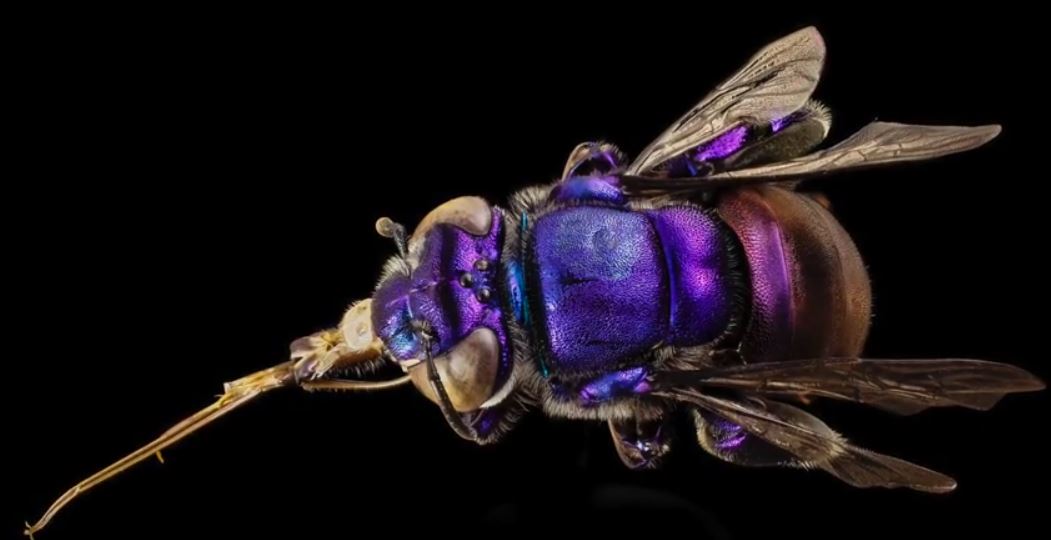
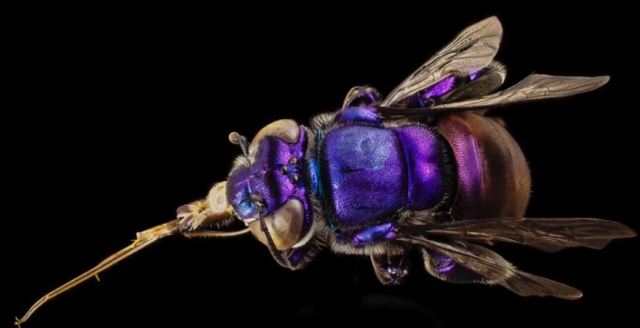
Euglossa species, Orchid Bee - Guyana, South America

Euglossa, an Orchid Bee found in Guyana, South America

There are thousands of species of bees in the world. Our favourite, the honey bee, is just one of the estimated 25,000.  It’s not even the cutest, friendliest, or most interesting. Those qualities go to some fascinating creatures you will discover in a lovely new book,  Bees: An up-close look at pollinators around the world.

The book is jammed with full-colour close-up photographs of wild bees – especially in their role as the world’s pollinators. Examples from around the world are arranged by continents into 7 chapters. Antarctica isn’t represented, but 7 regions/continents are still there because Central America and the Caribbean are given their own section. The isthmus and islands deserve the coverage. There are some stunning bees in that area.

The North America section covers 18 species, including a gentle Bombus griseocollis (Brown-Belted Bumblebee) collected in Washington, D.C., and an affable Anthophora affabilis from the South Dakota Badlands. The latter, a gray/white badlands bee, is found world-wide (except Australia), so you may have already encountered a subspecies of this fluffy burly Flower-Lover. The one shown below has an enormous tongue, adapted to reach nectar found deep inside a species of an abundant badlands flower.

Anthophora affabilis, or Friendly Flower-Lover, South Dakota Badlands National Park, USA

Anthophora affabilis, Friendly Flower-Lover – South Dakota Badlands National Park

Bees: An up-close look at pollinators around the world is a handsome 160-page book of stunning close-up images of wild bees photographed against solid black backgrounds. Details of wing veins, segmented antennae, and hair follicles make this an amazing coffee table book. But it’s more than a great collection of art. Along with each of the hundred or so species there are a couple of descriptive paragraphs which include species’ names, common names, and native locations. The text itself is nicely written. As an example, I’ve lifted a couple of sentences that begin the summary about the Valdivian Forest Forked-Tongue bee, which is shown below.  The authors tell us:

“Southern Chile has a wonderful temperate rain forest. Many of the plant and animal species from this region are found nowhere else in the world. This specialness also holds true for their bee species. The Valdivian Forest Forked-Tongue is restricted to this region and, as a generalist, pollinates many of the woody plants in the forest. These woody plants are also unusual in that they have a much higher dependence on insect pollinators than similar plants found outside this region, which often depend on wind pollination or, only secondarily, on insect pollinators.”
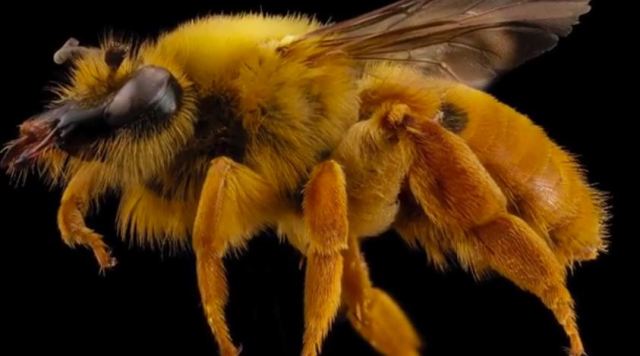
Diphaglossa gayi, the Valdivian Forest Forked-Tongue Bee - southern Chile's temperate rain forest

Diphaglossa gayi, the Valdivian Forest Forked-Tongue Bee
– from southern Chile’s temperate rain forest

 The authors of Bees: An Up-Close Look at Pollinators Around the World, Sam Droege (United States Geological Survey) and Laurence Packer (Toronto Biology Professor at York), have produced a stunning volume. I especially like how they advocate for the citizen scientist. They share camera tips that resulted in their gorgeous photographs. We are told that their camera is no big deal – many amateur photographers have the same equipment. They used a Canon EOS 5D with a 65 mm 1-5x lens.  A direct flash at the subject would have resulted in a stark contrast so (I like this!) they use an inverted Styrofoam beer cooler to bounce a more diffuse light towards the bees.

I won’t give all the details, you can read their book, but one of the things that makes the bee photography so stunning is the slight (5-power) magnification. As any of you who have peered through a microscope know, a down-side to magnification is the very narrow range of what stays in focus. To see more of your subject, you have to move the lens and refocus so that a different part of your specimen is sharp and clear. But the pictures in this book have a wide range of detail, all nicely in focus. To achieve this, they photographed a series of images, each with the lens slightly shifted, then they used over-the-counter image merging software. It was obviously a lot of work. The results are brilliant.

I have a few complaints about this book, but they are minor:

The book lacks an index so it is hard to quickly look up a favourite creature.

Almost all the North American species were from Maryland or the US east coast.

The North American section includes Apis mellifera, our common honey bee. The honey bee is certainly widespread and important in North America, but it is an introduced (just 400 years ago) invasive species which has uprooted and displaced native North American pollinator bees. The authors should have at least pointed out that honey bees are not North American natives.

Nevertheless, don’t let these issues detract from the quality of this lovely, well-designed book. It will make a great holiday gift for any beekeeper or naturalist on your shopping list.
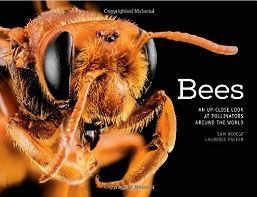
BEES CoverYou may like to check this 1-minute video, narrated by author Sam Droege, to learn more or to simply enjoy the photography. You might also take a peek at Droege’s Flickr page which features more of his brilliant photography.

You can order your own copy of this engaging book either through the publisher, Quarto, or from Amazon.com  in the USA or Amazon.ca  in Canada.

Posted in Books, Pollination | Tagged , , , | 5 Comments

The Kentucky Bee Man

When you are the 8-year-old child of beekeepers and you’re helping stick foundation into frames, your pay is the soft translucent paper that keeps the wax sheets from sticking together. It was the closest thing to tracing paper that I’d see as a kid. I would set the paper atop a picture on a page of the National Geographic and make the sloppy outline of a giraffe or a skyscraper or something.

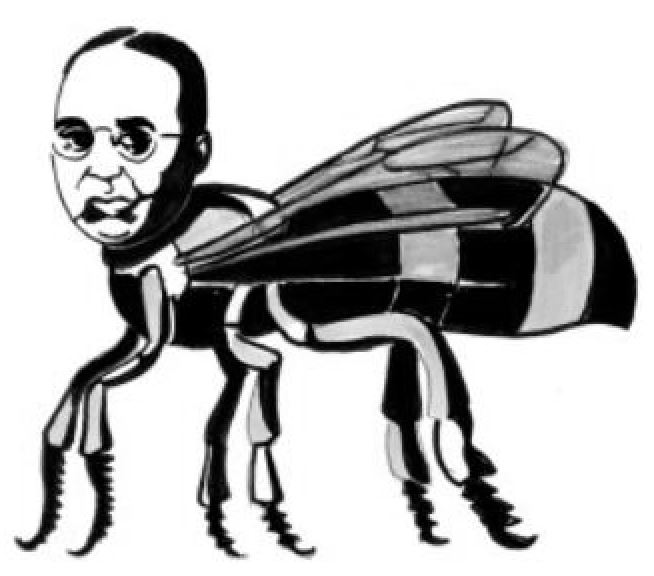
It was exciting when the cardboard boxes of smelly wax were first opened. Even better when all that free paper went into a special stack for kids. But the outsides of those boxes of wax were creepy. They featured a bee with a man’s head. It was The Bee Man, Walter T. Kelly.

I’d pull apart the sheets of foundation, wondering how the man had turned into a bee. It reminded me a bit of a 1950s horror movie about a man who turned into a fly because he stood too close to some radiation. That movie played in the 60s on our black and white television set, also when I was eight. Between The Fly Man and The Bee Man, I had some restless nights.

The years passed and we ended up buying a lot of equipment from the Kentucky Bee Man. Foundation, frames, smokers. The Kelley Bee Veil was popular at our farm. I never met Mr Kelley, but I spoke to him once by phone. I quizzed him about his Kelley Boiler and Uncapper system, but I kept imagining that I was talking to a Bee Man. The childhood image was unnerving. Then, in my early 20s, I left the eastern states and ended up on the Saskatchewan prairie, running my new bee outfit. I was in Canada, 2,000 miles from Clarkson, Kentucky. With the international border and the distance, I quit buying bee equipment from Walter T. Kelley.

Walter T Kelley, 1897-1986

Walter T Kelley, 1897-1986

But I wondered what had become of his business. From the ads in the bee journals, it was obvious that the company was still very much on the go. I was glad for that. Kelley had worked hard to build it up. Born in 1897, he served in the Army during the Great War, then went to Michigan State University, earning an Apiculture degree in 1919. That was followed by a couple of years with the USDA. In 1926, Kelley settled in Louisiana to raise and sell queens. Cypress wood was plentiful, so he manufactured and sold pre-cut bee equipment. I’m not sure why he moved to Kentucky, but his factory was there by the 1950s.

Now known as Kelley Beekeeping, the business is still one of the largest bee equipment suppliers in America. That’s a huge market. To keep supplying such an enormous sector, the company has just now committed to staying in Clarkson and building a new 100,000 square foot factory. That is a $7.5 million  investment and it will need an additional 50 people to make all the bee stuff. This is a big deal for Clarkson, a town of just 225 families. Kelley Beekeeping, of course, is the biggest employer.

Walter T. Kelley was active with the company for decades. He died at age 89, in 1986. Kelley excelled at marketing and promotion. In the 1950s, he self-published a small book, How to Keep Bees and Sell Honey, which has sold nearly one hundred thousand copies. The book was a marketing tool, it is great at convincing people to keep bees. I have a copy. It’s well-written, even if the author was a man with a stinger, wings, and six legs.

The Bee Man

The Bee Man

Posted in Beekeeping, Culture, or lack thereof, History, People | Tagged , , , , , , | 4 Comments

What Do a Million Bees Look Like?

million bees

I hate to sound prickly and petulant,  but the news media has done it again.  Today, say the news folks, ONE MILLION BEES were removed from an Austin church. That’s a stupid statement.

Someone working at the scene must have talked to a news outlet and said, “I don’t know… looks like a million bees were in that church.” And that’s OK. That’s one person, at the scene making a comment, probably as a joke, to one reporter who reported it. But then dozens copied the headline. Sometimes news people are shameless in their copycat reporting. Do reporters have a Share button in their newsrooms, modeled after Facebook’s sharing scheme? Seems like it.

What puzzles me is that no one who encountered the one million number which was bouncing from news office to news office around the world gave it any thought before repeating it. You would think that at least one budding entomologist or hobby beekeeper exists somewhere in the newsroom – someone who could say, “Whoa. That ain’t right.”

It’s not right. A big strong wild swarm (such as the one preying at the Austin church) might have 50,000 bees. But that’s pushing it for a wild swarm.  So, a million bees would need 20 individual over-sized swarms to make a million bees. It is impossible for that many swarms to have been in that church. Just can’t happen. You are talking about the entire contents of a small commercial apiary. And the bees would never merge into a 20-queen super-swarm to create what the bee-removers called a single hive.  Bees are not friendly enough to combine swarms – one queen dominates and kills all rivals. Even if 2 swarms somehow merged in the church (that would be 100,000 bees) soon there would be just one queen and the population would drop back down to 50,000 again. That’s the way it works. There are never a million bees in a single hive.

So, here’s the really disturbing thing. If the news folks don’t do their own reporting but instead rely on some central aggregator which gets things sensationally wrong, then how much of the other news which we see each day is also disturbingly wrong?  I am not so irritated that the headlines erroneously read “ONE MILLION BEES”.  That’s a mistake, but it’s not a big deal. However, I am very irritated that no one realized the number is radically wrong. No one did their homework. No one retracted. No one fixed the news.

My advice? Quit reading news presented by the ‘reputable’ news agencies and switch to getting all your information from blogs. Like this one.

Posted in Bee Biology, Culture, or lack thereof, Queens, Strange, Odd Stuff, Swarms | Tagged , , , | 1 Comment

Stinging Science

I wrote about this fellow last year. He likes to get stung for science. Below, I’ve repeated my blog, The Worst Place to Get Stung, from September, 2014. The big news is that the research scientist – intent on finding the worst body part to collect a stinger – has just been awarded some sort of Nobel Prize.

It’s an Ig Nobel Prize, given to Michael L. Smith of Cornell University at a fancy-pants gala. His experiment is described below. The Ig Nobel is a playful concept – an award for real science that recognizes humorous experimentation. It’s hard to think of bee stings as a form of humor, unless one gets walloped by a bee on the funny bone, of course.  Smith describes the nostril sting as “so painful it’s like a whole body experience.” He’s right about that.

Where is the worst place to get stung? The correct answer is not “on the picnic table.” According to Cornell University graduate research scientist Michael L. Smith, in a study funded by the United States National Science Foundation, the worst place to take a sting is either the nostril or the upper lip. He places both within the same range of scientific error, though he admits that the nose sting was tearful. Smith’s neurobiology paper, Honey bee sting pain index by body location, does not miss a single body part.

The folks at Dadaviz, a cool website that makes charts and graphs out of all sorts of weird data, sent me their data visualization for Smith’s bee sting pain study. I reproduced their chart above, and you can see all the detail clearly by either clicking on the chart, or clicking here and going straight to the data at dadaviz.com. (Once you arrive there, you can click on the data visualization and it will expand to fill your screen.) I encourage you to take a close look, then come back here and I’ll tell you how these data were collected.

I had imagined that a team of white-jacketed doctors at Cornell experimented on hundreds of volunteer grad students, inflicting each with an exquisite sting. Turns out, it was not done that way. If you read the original research paper, you will learn that Mr. Smith self-inflicted 75 honey bee stings to gather the data. He stung himself (well, actually, he let bees sting him) five times daily between 9 and 10 o’clock each morning. Each location was stung 3 separate times, on different days. The researcher then rated the painfulness of each location’s sting. It seems the softer body parts (his nose, lips, and, yes, genitals) hurt the most following a sting. The nose stings, reported Smith, “were especially violent, immediately inducing sneezing, tears and a copious flow of mucus.” Not surprisingly, the least painful spot to take a sting was on the skull. We are hard-headed for a reason.

I know you are wondering where the thesis advisor was during all of this. That leads to one of the many interesting parts of this research paper. Smith wrote, “Cornell University’s Human Research Protection Program does not have a policy regarding researcher self-experimentation, so this research was not subject to review from their offices. The methods do not conflict with the Helsinki Declaration of 1975, revised in 1983. The author was the only person stung, was aware of all associated risks therein, gave his consent, and is aware that these results will be made public.”

In my last blog post, I wrote about Beetox. What about Bee-agra? Alas, Smith reported only the pain levels, not the amount of swelling. No photographs were available in the research paper.


.

.

Posted in Humour, Stings, Strange, Odd Stuff | Tagged , | Leave a comment

Every Day is Labour Day

In Canada and the USA, a lot of people get a day off from work today. Unless your job is in a store, hospital, police station, prison, theatre, restaurant, hotel, airport, the military, or nuclear power plant. Or if you operate a farm or bee business. Otherwise, you may have slept a little later and enjoyed a leisurely coffee this morning. For that you can thank people who lived over a hundred years ago.

Six-year-old girls at South Carolina cannery in 1911.

Six-year-old girls at a South Carolina cannery in 1911.

It’s an old holiday. In the USA, it was first celebrated 121 years ago. A New York City labour leader visited Toronto and saw workers’ day celebrations. When he returned to the USA, he pushed for a day to honour America’s labourers.  Congress anonymously passed the bill making Labor Day a legal holiday in 1894. Since then, the western world has vastly improved working conditions. Once, children as young as six picked coal from fast-moving belts while folks in their 40s and 50s died of fatigue, injury, and emphysema during 80 hour work weeks.

Things have not improved as much for many business owners. One of my brothers works in his greenhouses from 3 each morning until 7 each evening. He keeps this 16-hour workday pace from February through June, then slows down to 12-hour days the rest of the year. Greenhouse chemicals and concrete floors have taken a toll on him – it’s exhausting work. He never takes vacations – he has a business to run. It was similar for me with my bees – I ran a thousand hives for fifteen years, working in a similar way. I was young and didn’t realize that extracting until two in the morning, sleeping on a cot until six, and pulling honey all day were unusual ways to squander one’s youth.  And then there are the tireless worker bees.

While conditions for most human labourers have improved, conditions for honey bees are worse than they were a hundred years ago. Although sulphur, DDT, lead arsenic, and cyanide are not encountered on flowers anymore, other chemicals have taken their place with sometimes dire consequences. Equipment is more efficient for the beekeepers, but generally less comfortable for the honey bees. And migratory beekeeping has prevented millions of bees from suffering cold winters, but in place of months of winter-time rest, honey bees bounce along highways to holding yards in warm locations.  There they meet billions of other bees. In such places, diseases and pests spread like epidemics.

Although people in advanced countries now earn a minimum wage, honey bees are still receiving the same paltry nothing that they have always been given. What if honey bees were paid?

$120,000 jar of honey?

$120,000 for a jar of honey?

Bees visit about two million flowers to make 500 grams (about a pound) of honey. This may require 200,000 separate flights and 600,000 kilometres of flying. A really successful colony may make 100 kilograms (220 pounds) of honey for harvest in a year. This production comes from about 250,000 individual workers who have lived and died in the colony during the year.

I’ve done the math and it turns out that about two million bee work-hours are involved in gathering, processing, and storing a season’s honey. This includes the labour of building combs and feeding and educating the young bees that replace their exhausted older sisters. We are getting a sweet deal from our bees.  If they were paid a human’s minimum wage for their work, a single pound of honey would cost $120,000 in labour.

Posted in Commercial Beekeeping, Culture, or lack thereof, History, Honey, Strange, Odd Stuff | Tagged , , | 1 Comment

English lady with bad teeth reportedly steals honey

From the Manchester Police Twitter feed:

From the Manchester Twitter feed

Police in Manchester, England, are looking for a woman with big-hooped earrings and bad teeth. They say she may have stolen three jars of honey. The honey jars were priced at £46 each – that’s about $90 per jar. Those were either really special honeys, or very big jars.  The bad-toothed lady allegedly ran off with about $300 worth of honey.

Not bad for English teeth.

Not bad for English teeth.

It’s interesting that the store clerks noticed the lady’s bad teeth. After all, this happened in England. The people of the Isles have a reputation for unkept teeth. I’ve been to England a few times and I disagree. I didn’t notice an excess of bad teeth. Maybe the rumour is a heritage stereotype, harking back to the days when sugar first hit the grocers’ shelves a few centuries ago in Britain. In the 17th century, refined sugar became the cultural rage there.  Folks let their teeth blacken and rot to show that they were affluent and trendy enough to afford massive amounts of tooth-decaying sugar. How sweet is that?

There is more to England’s sugar tale. The enormous popularity of sugar peaked when it was prohibitively expensive. Before long, sugar lost its allure as a symbol of trendy status. The first-ever boycott, instigated by the radical left in 1792, was a protest against West Indies sugar companies which were fueled by the labour of slaves kidnapped in Africa and hauled across the Atlantic to cruelly work the Caribbean cane fields. The boycott gained momentum when drawings of slave ships were published, showing people packed in the hulls of the slave traders’ vessels.  Sugar was suddenly tainted by the obscenity of slavery. By 1800, sales of the white powder fell from 5 pounds per family per week to half as much. Temporarily. The English protests and boycotts worked, English involvement in the slave trade ended, and sugar consumption climbed again. Not that conditions actually improved for the slaves, of course.

Throughout the great sugar boycotts, honey continued to be popular. Since it was produced by rustic countryside bees and craftsmen, it avoided the brutal history of its sugary rival. Honey prices temporarily soared during the boycott. And teeth became whiter – an old tooth-whitening treatment included wine, vinegar, and honey. [Which I don’t recommend.] All of this makes us wonder about the lady with bad teeth, accused of lifting honey from that trendy shop in downtown Manchester. Be cautious. If you see a bad-toothed female wearing turquoise jeans and large hoopy earrings, don’t tackle her alone. Call the Manchester men in blue. After all, the whole episode may be nothing more than a sting operation.

Posted in Culture, or lack thereof, Honey, Humour, Strange, Odd Stuff | Tagged , , | Leave a comment