Dandy Season

Dandelions make their grand appearance

A few weeks ago, I wrote that spring had arrived and pollen (plus a little nectar) was coming into the hives – mostly from willow and crocus. I also wrote that the main spring flow here in western Canada (along the Rocky Mountain foothills) is from the lowly dandelion, and it doesn’t reach peak bloom until around May 25th. After I posted those words, the weather turned startlingly warm (it set a record high) and masses of dandelions started to open three weeks early. So, I figured that I got my guess wrong (wouldn’t be the first time). Then it snowed. We had a week of cold weather. Now, finally, on May 25th, the dandelions are making their grand appearance.

In much of North America, the despised dandelion is the beekeeper’s best spring-time friend. Rather than sprinkling the lawn with Ortho® Weed-B-Gon MAX® Weed Killer For Lawns, the beekeeper is more likely to collect dandelion seeds and quietly spread them by helicopter at night. It’s a communing with nature sort of thing.

The battle between lovers and haters of dandelions got me wondering about when and how people got so uptight about their lawns. By people, I mean mostly northern Europeans and their cultural descendants in North America, Australia, and New Zealand. The rest of the world is a bit more relaxed about the state of their greens. For example, over the years, I have spent several months in central Europe. Flower baskets and public gardens are everywhere. But yards around family homes tend to be left a bit natural. A bit ragged. Grass may reach knees while dandelions and their associates live safe comfortable lives. It’s different further north – our word for lawn comes from an Old French word (launde) which means barrens or heath. A dead place – or at least a place of little vitality.

Somehow, keeping a barrens around the house has become a middle class pursuit among those of us lucky enough to be middle class members of the world’s wealthier nations. It messes with our minds when stray yellow dots break through the green monotony of the well-tended lawn. Meanwhile, many of us with the nicest yards and the snarkiest sneers for the untidy neighbour are also wondering what is happening to nature’s little pollinators. We bemoan the loss of butterflies and fuzzy bumbling bees, wishing they would drop by to enjoy our neatly manicured lawns. But they seem to be missing.



							
Posted in Climate, Ecology, Honey Plants | Tagged , | Leave a comment

Elementary Beekeeping

Proof of Sherlock Holmes’s residence

Today is the world’s most famous detective’s birthday. No, not James Bond. Sherlock Holmes, if he ever lived at all, would have been well over 150 years old today. Or, at least, his creator, Sir Arthur Conan Doyle would be – he was born May 22, 1859.

You likely know some of the old Sherlock Holmes stories. With incredible wit, problem-solving skills, tenacity, deduction, and plain old-fashioned stubbornness, the detective solved the most complicated and beguiling mysteries. So what does such a witty, smart, and stubborn person do in retirement? He becomes a beekeeper, of course.

We are told that Holmes retired to the countryside to make his living from bees. The detective never had much money – Watson helped with his rent at 221B Baker Street – so he probably didn’t notice a big drop in income when he became a retired gentleman selling honey at the farm in Sussex Downs. I am thinking he continued wearing tweeds and certainly his pipe would double as a handy smoker. His bees would have worked wildflowers and made batches of dark pungent honey for the master detective.

One wonders why author Sir Doyle chose to outfit Holmes with a hivetool when he could have left him teaching at Scotland Yard, sharing his tricks with future generations of detectives. Doyle seems mum on this. He doesn’t divulge his thoughts, he just retires his star character to a small holding near a small village and he puts him to work keeping bees. Perhaps it was because Holmes was suffering from a touch of rheumatism near the end of his career (according to Doyle) and bee stings have always been rumoured good for stiff joints.

The bees are introduced rather shyly. There are no long passages describing the bees or any misadventures of the detective prowling among the garden hives, harvesting honey. Quite the contrary. Here is the sum total of the bee references in Holmes’s retirement story, His Last Bow, taking place in the first decade of the twentieth century:
Says Watson: “But you have retired, Holmes. We heard of you as living the life of a hermit among your bees and your books in a small farm upon the South Downs.”
Holmes replies: “Exactly, Watson. Here is the fruit of my leisured ease, the magnum opus of my latter years!”
He picked up the volume from the table and read out the whole title, Practical Handbook of Bee Culture, with Some Observations upon the Segregation of the Queen.
Holmes continues:“Alone I wrote it. Behold the fruit of pensive nights and laborious days when I watched the little working gangs as once I watched the criminal world of London.”

Thus we learn that the great Sherlock Holmes had written a practical beekeeping guide in his retirement. If I find a copy, I’ll do a book review for you.

Sherlock Holmes’s retirement house, near Tiger Inn, East Dean, England.

Posted in Books, History, People, Strange, Odd Stuff | Tagged , | Leave a comment

A Swarm of Biblical Proportions

The headline reads:
Swarm of bees that turned sky over British town black
was like “something out of the bible”

OMG: Straight from the Bible!
Bees blacken the sky over Farnham!

Biblical. That’s the way frightened victims in the English town of Farnham reportedly reacted when their daily ritual of buying nappies and playing snookers in the establishments edging the village square was interrupted by a swarm of bees that “Came from nowhere.” and “Blackened the sky.” If indeed the insects “came from nowhere” then the hand of God was certainly involved. Only God can make an entire swarm of, say, 40,000 bees appear instantly from thin air – as he has done on at least one prior occasion. (I looked it up in my huge Bible Concordance – there was the incident of bees forming in the carcass of a lion.)

Curiously, if you go to the news/gossip site reporting the incident, you will see a 30-second video filmed from an office suite. The camera is pointed outside and – if you look very closely – you will see a few dozen bees dotted around the bright clear blue sky. The sky is not blackened, Armageddon did not happen in Surrey County yesterday.

Not to downplay the horror and distress that a swarm of unexpected bees inflicts upon a village, but swarms are usually very tame. And swarms are quite natural – they are God’s way of fighting colony collapse disorder, so they may actually be ‘biblical’, too. It’s too late to give advice to the Farnhammites of Surrey County, but if a swarm ever blackens your sky, here is what you should do. Be calm. Don’t swing your arms around the air (that’s an invitation to fight). Slowly retreat to the doorway of the Black Swan, or any other place that helps you blend into the scenery. And by all means, stiffen the upper lip and continue with the snookers game.

Posted in Strange, Odd Stuff, Swarms | Tagged , | Leave a comment

May Flowers and May Frosts

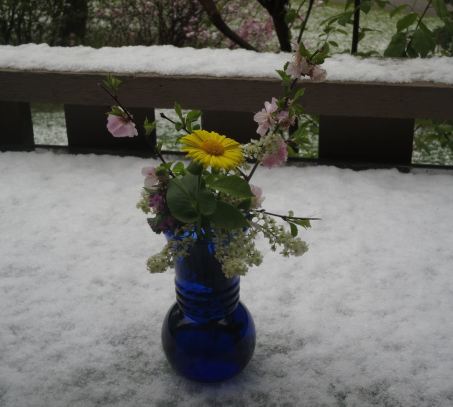
May Flowers in the Snow

My kids picked these flowers as a Mother’s Day gift for my wife. All the blossoms were collected from the yard around our house. Nice bouquet, eh? There is not much in the vase that a honey bee would find attractive (except for the apple and cherry blossoms) but the kids’ mother really liked the little bouquet. The flowers were picked on Saturday, the day before Mother’s Day. It was 21° C (70° F). Then it snowed. A big heavy snowfall with gigantic flakes. Made me wonder about those flowers still out on the shrubs and trees.

They were OK. It turns out there is a difference between a frost and a freeze. We had a frost. The air temperature, despite the snow and its skiff of accumulation on the ground, stayed above freezing. The ground cooled, of course, but it was breezy and humid so the air temperature stayed mild enough to prevent damaging our future crop of crab apples. It is often like that in this part of the world in the spring. On the other hand, autumns are almost always rather dry here. Many years, the honey season ends abruptly on cold August or September nights when the dry air and lack of cloud cover combine with still calm air. On those sort of nights, the thermometer plunges five or more degrees below freezing. The clover and alfalfa blossoms turn black the next day and the bees are irritable and suddenly without nectar.

There is another dimension to the frost-freeze issue. Weather, as just described, is clearly important (Clear calm nights are bad; breezy cloudy nights are sometimes OK), but obviously the type of flower is important, too. Some plants can produce flowers and keep them blooming even in rather frigid conditions. I assume they are fortified by some sort of natural antifreeze. Flowers such as crocus, willow, skunk cabbage, and asters are quite cold-resistant. On the other hand, many species of plants native to tropical climates are injured in cool weather – even if it stays well above the freezing point. For generations, researchers have tried to breed plants that can survive ambient temperatures cooler than the plant’s comfort zone. But breeding for cold weather tolerance has largely failed.

However, geneticists have recently isolated some of the genes responsible for weathering the cold. In the case of rice, as many as 242 different genes interact to invigorate hardiness in cooler weather. One March, while I traveled in northern Vietnam, in an area near Hanoi, I saw the delayed planting of rice while 1200 kilometres south, near Ho Chi Minh City (Saigon) the first of three sequential harvestings was starting. Stretching the season could feed millions. But modifying even some of the more critical genes out of 242 is a huge challenge. The goal of researching the genetics of frost is motivated by the need to more efficiently feed people. In Vietnam, three crops are grown on each plot in the south; just two in the north. A third crop in the paddies near Hanoi would not require tilling more scarce land; it would require a faster maturing, cold-resistant variety of rice. I would not want delicate begonias blooming in mid-winter in our yard, and would object to research that made such an ugliness of such a beautiful flower possible. We are quite happy with the natural bouquet that our kids picked this spring. On the other hand, if the people with tiny plots of land near Hanoi could each harvest one extra tonne of rice, I would not want to prevent the research that would make it happen.

Posted in Climate, Genetics, Honey Plants | Tagged , | Leave a comment

Mother’s Day at the Hive

All bees are mothers – see the video.

Biologists have been debating the role that mixed genetic heritage plays in your beehive. As children, we learned that there are three castes of honey bees – queen, workers, and drones. [That’s wrong – it’s two castes (queen/worker) and two genders (male/female) – but, thanks to those grade-school teachers, I sometimes still mess this up sometimes!]

Queens are mothers (Happy Mother’s Day), drones are males, and workers do all the work. A genetic quandary grew out of the recognition that few animals willingly tend the offspring of others – it makes no sense from a purely evolutionary-biology perspective. Yet, worker bees are perpetual spinsters, devoting themselves to the care, feeding, training, and safety of their younger sisters. According to modern genetics theory, that probably shouldn’t be happening.

It wasn’t until the 1960s that the idea of eusociality (the social activity of the caste division in animals) was more generally understood and the odd behaviour was explained. Biologists have come to learn that sister creatures with haploid fathers (as drones are) are extremely closely related – each sister shares 75% of the same DNA. (In humans and most other animals, the relatedness between sisters is 50%). So, by caring for many sisters, a worker is assured that much of her own DNA is passed along for another generation.

But there is another aspect to the genetic success of the honey bee, and that’s the idea that the colony itself is a live organism – each bee is a tiny unit, each bee acts effectively like an individual cell. Groups of bees make up organs in a manner similar to cells making up organs – within the colony, there are groups of bees that work together to feed, clean, circulate air, build new tissue (wax), defend against intruders, and care for offspring. Unlike cells in a body, of course, bees are almost identical and can move from one organ-activity to another. Seen in this context, the colony represents an individual which reproduces by swarming. As a unit, the colony’s DNA is preserved and spread.

Relatedness and eusociality are fascinating parts of the honey bee’s natural history. Eusociality has been described by Suzanne Batra (1966), and later E.O. Wilson, to include the social structure of creatures such as ants, wasps, and bees (Hymenoptera) and termites (Isoptera) which practice communal living where (1) generations overlap, (2) there is a reproductive division of labour (sterile and non-sterile members), and (3) cooperative work occurs, including foraging and raising of brood. There is much more to this, including the idea of super-sisters, or blocks within the colony which are extremely closely related, and the controversial aspect of kin selection, but those stories will wait for a future posting. Until then, Happy Mothers’ Day to all the bees in the hive. (Except for those lazy, inept, and mostly useless drones, of course.)

Posted in Bee Biology, Queens, Strange, Odd Stuff | Tagged , | Leave a comment

Searching for Flowers

The long-awaited bling-bling of spring

The long-awaited bling-bling of spring

I had a road trip earlier this week and was struck by the paucity of natural bling-bling. It’s almost May. Where are the flowers? I ask this lachrymose question every spring, especially after we’ve had a pleasant string plus 20 °C (70F) days. It takes a long time for the ground to warm up, though at this time of year we already have sunshine from 6 am to 9 pm – with quite a long dawn and dusk atop that. So, the slow emergence of flowering plants is always an annoyance. Bees have been sporadically gathering sanguine flakes of pale pollen from crocus and willow blossoms, but our main spring nectar and pollen flow is still a month away. Typically, we expect billions of dandelions to yellow our yards and alfalfa fields around the 25th of May. Good colonies and good weather can result in 40 pounds of honey from dandelion in the Calgary area.

I mentioned that I had driven around Calgary and the surrounding region on a floral scavenger hunt a few days ago. I was quite surprised when I returned to our drive and saw a little sapling tucked away at a hidden southeast corner of our house. That’s today’s picture, the fruit tree with white 5-petal flowers, weighing upon it like late spring snow. There may be a lesson in this somewhere – stay home and smell your own flowers, for example – but I will do my best to ignore any implied trenchant messages.

Posted in Climate, Honey Plants | Tagged , | Leave a comment

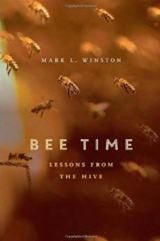
Bee Time Again: Lessons from the Hive

It’s Bee Time!

A few months ago, I had high praise for Mark Winston’s latest book, Bee Time: Lessons from the Hive. Now I have heard that Winston’s book has been awarded the prestigious Canadian Science Writers Association recognition as 2014’s best “science and society” book. This is a great accolade: the 5 members of the short list were outstanding books. It was nice to see Winston’s Bee Time chosen from well-written books about such diverse subjects as memory and Alzheimer’s, the science of work hazards, and Canadian space-walking astronauts. If you have not yet read Bee Time, I encourage you to get a copy.

Bee Time is a personal story. I especially appreciated the last segment of the book, the Epilogue – Walking Out of the Apiary. But I will quote from the penultimate section, from Winston’s chapter called Lessons from the Hive. It’ll give you a bit of the flavour of the book:

“Bees can be the richest of guides to the most personal understandings about who we are and the consequences of the choices we make in inhabiting the environment around us. Conversations with beekeepers about how they are affected by their time in the bee yard show a remarkable consistency. Words like “calming,” “peaceful,” and “meditative” come up over and over again, and beekeepers visibly relax when talking about their bees.”     – Mark Winston, 2014

Posted in Books | Tagged , | Leave a comment

Solving the World’s Problems

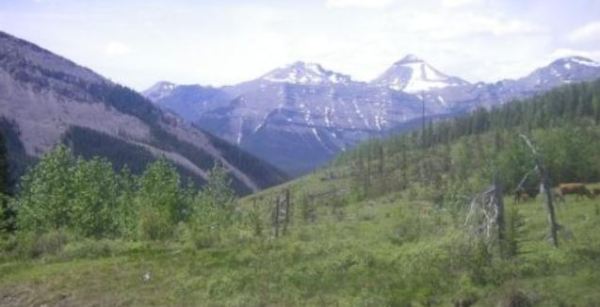
Closing in on the Rockies, near Bragg Creek, Alberta

For the past short while I’ve enjoyed meeting some beekeeping friends each month. We have a two-hour coffee and try to figure out how we can fix the world. Well, actually, we get together to talk about building stuff and about beekeeping. I look forward to these rambling discussions. I don’t get out enough – too often, I stay home and talk to myself. I am a good audience for myself, but tend to be a bit weak on objectivity while talking to the wall. The two guys I’ve been meeting up with are able to pull my chain back to earth and help me examine my thoughts a little more rationally. So here is my suggestion to you for the day: find a group or two to regularly bounce ideas off. It is worth a lot. If you are stuck in a box of your own making, the only way out is through the help of friends. I originally met these guys at the local bee club, and you should be able to encounter some idea-bouncers of your own in a similar venue. Meetings are great for mixing and learning, but a two-hour coffee with just a couple of friends creates opportunities you don’t get at structured formal bee meetings.

We didn’t solve any of the world’s worst problems, the planet is too messed up for even us to fix in a single day. So instead we talked about the drippy hippy honey-tap hive (Sorry, we voted it down on mechanical and ethical grounds.) and we talked about how package bees are installed and how to best prepare hives for winter. (I know, it’s spring here, but you can never start planning too early for a Canadian winter.) Over the three cups of coffee and two hours of chatting, I was reminded that there are a lot of really interesting beekeeping ideas out there. And those ideas usually need adapted to fit our climate and geography. That’s another way that gabbing with beekeeping friends can help. They often have faced the same stubborn location-specific issues as you and they can offer suggestions or commiserate with your struggles. So, I urge you to find your own mini-group to discuss your bee issues. If you do, I hope you can find as great a meeting place as we had today – our coffee shop was in Bragg Creek, in the foothills of the Rockies. My buddies live near there. For me, it was just a 50 kilometre drive west of my city, through rolling farmland then up into the alpine forest. The Rockies were gorgeous with glistening late spring snow while the air was fresh and warm. Made me happy to talk bees, even if we ended our session with some of the world’s problems unresolved.

Posted in Beekeeping, Friends | Tagged | Leave a comment

A 60-year-old Image Problem

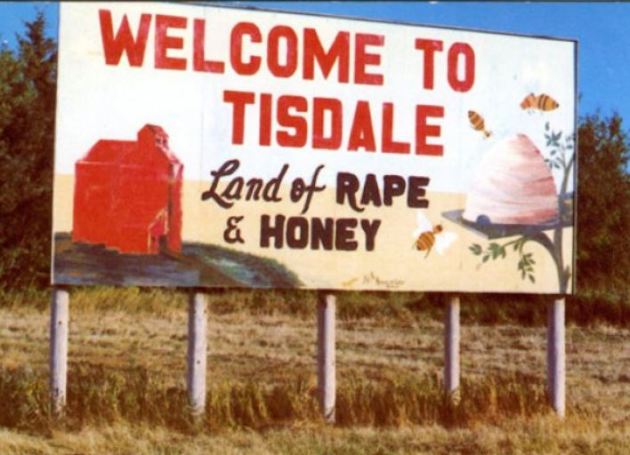
Tisdale’s eye-catching sign

After 60 years, the good people of Tisdale, Saskatchewan, are thinking of changing their slogan from “Land of Rape and Honey” to . . . something else. Well, it’s about time. Every town and village should reconsider logos, symbols, signs, and slogans that have been around for 50 or 60 years. Shake things up a bit.

Apparently, the old slogan made sense at the time. Tisdale, up in the northeast part of Saskatchewan’s black soil district was a great place for farmers and beekeepers sixty years ago. There was so much honey produced in the area that a big co-op warehouse was built to handle, process, and export several million pounds of the sweet stuff every year. Rape seed – genetically engineered and rebranded as canola – was the biggest cash crop. When I kept bees in northern Saskatchewan in the 1980s, canola was just catching on. Farmers loved the stuff – it grew well on freshly deforested parkland, and it sold for a fair price. (It is remarkable to realize that new farmland was still opening up by the thousands of acres a year, just thirty years ago in Canada.) Farmers loved canola, but they still called it rape. Just as the 60-year-old slogan in Tisdale still does.

Tisdale is thinking about changing with the times. The obviously crude slogan became even more crude when rape disappeared and canola took its place in the fields of Saskatchewan. Meanwhile, the farmers’ vocabulary remained stagnant. The town held a survey 20 years ago, trying to decide if it was time for an update back in 1992, but the vote was evenly split, so the slogan stayed. But times change. Today, less than one percent of the local cropland is planted in rapeseed. So the change-the-words campaign is holding another vote and is inviting submissions for a new slogan. “A Great Place to Bee” and “Hub of the Northeast” seem to be front runners. But “Less Rape and More Honey” will probably be the winner.

Posted in Humour, Strange, Odd Stuff | Tagged , | Leave a comment

Beekeepers’ Problems Solved

Tew’s Problem Solver

A publisher sent a new beekeeping book to me. As usual, I promised to read and review it – but warned the publisher that I am an awfully slow reader, and even worse – I can be awkwardly honest. (As you may have noticed in my reviews of the movie Bee People and the “Honey Tap Hive” – both of which I’d avoid like mites and measles.) I am never paid for spewing my inner beekeeper on these pages – but if I am going to review your book or movie, you should send me a free copy, else my basal ganglia’s inertia may prevent me from ever buying your Tolstoyesque tome. If you do send me a review copy, I’ll remind you that I am a slow reader and an honest critic. But if I like the work, I’ll gush the truth, as I will do here with James Tew’s new book.

The Beekeeper’s Problem Solver, was sent to me by Quarto Publishing of Minneapolis (USA). It was written by James Tew, a veteran beekeeper (over 40 years behind the veil). Tew sports an entomology PhD and a way with words (see his semi-eponymous blog, onetew.com). His new book is very nicely arranged. Each left-hand page lists a Problem, followed immediately by the Cause (as Tew perceives it), and then a lengthy Solution. These are supported by colour photographs, inset boxes with side-issues, and enough detail in the text to resolve the problem. It’s a friendly format.

I could try to convince you to buy a copy for every beekeeper you know (especially a NewBie). I could easily persuade you, simply by referring to Dr Tew’s willingly dispersed largesse of experience and his commitment to bees and beekeepers. Instead, I will show you what his book offers. Tew tackles issues as diverse as the serious (My apiary has flooded), the practical (My hive equipment doesn’t match), and the unusual (My neighbour has found bee droppings on their car). You will have to buy Professor Tew’s book to get his answers to these.

I will, however, give one example from among his hundred problems:

The Problem: “I’m unsure how to guarantee varietal sources”

The Cause: “Honey is frequently promoted by varietal source, such as orange blossom, blueberry, or basswood. In reality, it is difficult to guarantee what percent of the extracted crop is specifically from the source listed in the name. Normally it is not an issue, so long as the source is not a popular type of honey such as Melaleuca or Sourwood.”

The Solution: I’ll paraphrase part of Dr Tew’s answer. He points out that a conclusive guarantee is usually not possible. Large packers may send samples off for pollen and ‘DNA profiling’. For average beekeepers’ needs, Tew gives advice on timing of supering and harvesting. He points out that not all honey can perfectly match the label, just as “from similar areas there are good and not-so-good varieties of wine, yet they are all from the same area. The consumer is the final judge.”

As James Tew says about honey varieties, I will likewise say about bee books. “The consumer is the final judge.” You will have to decide if this book is worthwhile. I think it is. The book is very good and quite attractive, but not perfect. For example, in the example just given, Dr Tew refers to Melaleuca honey as ‘popular’ – it is if you like vile honey that looks, smells, and tastes like motor oil. I suspect that Tew intended to write Manuka, not Melaleuca. Manuka is touted as an antioxidant honey from New Zealand and its pedigree is important to justify its high price. However, such slips are rare in this book. If you’d like a copy, you’ll find a place to order it at the end of this sentence.

Posted in Beekeeping, Books, Honey | Tagged , | Leave a comment