Rustic Hive

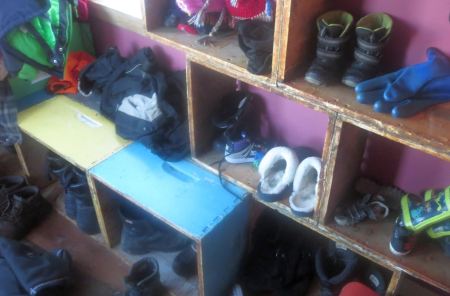
Furniture catalogs may have to add a new line – Rustic Hive. If you are like most commercial beekeepers, you’ve used bee boxes for desks, boot organizers, and book shelves. When I was a child, we kept bees on the family farm, so hive furniture was vogue there, too. In fact, when the twins were born, their home-birth was a month early and my little sisters spent their first few days in a make-shift beehive crib – an empty rim with a cover nailed on the bottom. As you might guess, my siblings don’t suffer much from allergies.

Empty deep supers were my first furniture when I left home when I was a teenager. But Rustic Hive is for grownups, too. Maybe it’s hereditary – my daughter has this same great look in her farm house. That’s where I took these pictures last week. If you – beekeeper or non-beek – want in on this kitschy new trend, drop me a line and I’ll tell you how you may buy your very own Rustic Hive space organizers. (But don’t tell Martha Stewart.)

Rustic Hive Storage: In the kid’s library.

Rustic Hive Storage: In the kid’s play area.

Rustic Hive Storage: In the mud room.

Posted in Friends, Hives and Combs | Tagged | Leave a comment

Is Grocery-Store Honey Safe?

Is it or isn’t it?

A school chum sent me this: “With everything we hear about honey these days, how do we know how to pick out real honey at the grocery store?”

I answered his question and thought I’d share some of my thoughts here.

You have a reason to be concerned about some of the honey found in grocery stores. As much as one-third is believed to be either mixed with cheaper and less healthy products such as HFCS (high-fructose corn syrup) and sucrose (beet/cane sugar) or the honey may be contaminated with agri- cultural pesticides – sometimes drifting in from farmers’ spraying. As of yet, I have not heard of any adult becoming ill from honey contaminants, though low-levels of unwanted chemicals from any and all food sources may have a cumulative effect.

You have probably heard that “germs can’t live in honey”. This is true for most bacteria which find the mild acidity and hygroscopicity (ie, water-sucking quality) of honey deadly. Imported honey is rigorously sampled and inspected by USDA/Customs inspectors. Unfortunately, domestic American honey is not inspected except in rare circumstances when it is already on the store shelf. Nevertheless, honey purchased in stores is almost always safe when consumed by people over the age of 2. So, the issue is really more about food quality than food safety.

The quality of most honey in stores is fine. But how can you recognize which is the real honey and which is adulterated by HFCS or sucrose? You can’t, unless it is clearly labeled as a “honey blend” as shown in this picture. (By the way, this example is legal and probably tastes fine. It sells for $2.65 US for 12 ounces, or $3.53/lb) – but a honey blend is obviously not pure honey. To be sure that most honey on US grocery shelves is good, a tiny sampling is randomly pulled off shelves in most states and is run through a battery of tests. If found adulterated, the honey is recalled and the packer is usually hit with a fine and some embarrassment.

To complicate things:

  • Honey has a range of colours. It is almost black if the floral source is buckwheat and almost white if it is high-prairie alfalfa. Goldenrod, common in the eastern states, is dark yellow – we promoted it as golden. Other flower sources yield the whole spectrum of colours. An odd colour has nothing to do with adulteration or contamination.
  • Honey has a variety of flavours and scents. Just as every flower smells different, the flowers’ nectars give differently flavoured honey. Again, this is not a good way of selecting honey – unless the honey smells fermented. Fermentation (eventually leading to vinegar or mead) happens if honey has more that 18.6% water content. Packers avoid mixing too much water with the honey they pack because it might spoil and the shopkeeper will demand a recall. Honey sold in stores is usually 18 to 18.6% moisture. Nectar from flowers is 90% water, so the busy bees remove the excess by fanning their wings inside the hive, drying the nectar.
  • Honey granulates. Usually. You have seen “sugared” or “crystallized” honey. This happens to most pure natural honey. As noted above, honey naturally contains water, making it a supersaturated solution. With time, solids crystallize. However, some honey never crystallizes – for example, the famous tupelo honey from the rivers banks of north Florida. (Watch the movie Ulee’s Gold, starring Peter Fonda, for more about that.) Granulation correlates with a higher fructose/glucose ratio. Crystallized honey can be made liquid by heating a jar in the microwave or in hot water. (Too much heat can “cook” the honey, ruining its flavour and darkening it, so be careful.)
  • Pollen in honey. Raw, locally produced honey usually has a bit of healthy local pollen in it. Some buyers use this as a test of quality, thinking that honey without pollen is not real honey. They are wrong about this. Others claim pollen in honey is a contaminant – so far governments have not seen pollen as an impurity. Most honey sold in stores has been filtered to remove pollen, but it is still honey. The amount of pollen in raw, unfiltered honey varies but is too small to detect without a microscope. Some consumers feel that those extremely low doses of pollen helps their resistance against allergies.

The real deal

Bottom line? If you can find a local beekeeper, check out his/her shop and buy direct from the producer. The honey and shop will not be inspected, but if the outfit looks clean, neat, and organized, it is probably better than the majority of (um, rather messy) honey businesses I have seen across the USA.

You might also consider buying old-fashioned comb honey. Comb honey is not processed in any way – it is taken straight from the hives in the form it is created. No suspicious mixing or handling by potentially dirty equipment. If you do use comb honey, then you can squeeze it or carefully melt it to get the liquid honey out. Or just eat the honey, natural beeswax and all. As a disclosure, my daughter’s honey farm specializes in comb honey. (She and her husband bought our Canadian farm a few years ago.) She ships all over the world. (Believe it or not, China is a big customer of Canadian comb honey!)

But I think you still might like to find a local producer to support. Check out the farmers markets and ask the vendor if you could drop by at their farm and pick up some honey. I also would not totally ignore the grocery stores. Honey in retail shops is often cheaper, convenient, and as I mentioned, even if it falls into the adulterated and contaminated group, it is ‘probably’ not going to be harmful. However, if you want to be sure it is real and imbues health, check out the local beekeepers.

Post Script: That sums up how I answered my friend, a non-beekeeper, when he asked about buying honey from a grocery store. If you are a beekeeper or honey packer reading this, let me know if you think I’ve missed something important and I’ll pass it along to readers.

Posted in Comb Honey, Honey | Tagged , , , | Leave a comment

Cold Bees

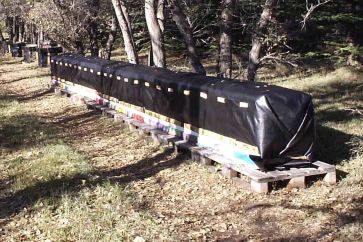
Long lines of hives are not recommended,
but upper vents definitely are.

It’s not the cold, it’s the humidity. We hear people say this a lot. That’s one reason 20º Fahrenheit (-7º C) in the eastern US can feel a lot colder than -20º in Montana. Generally, it’s the humidity that makes a colony of bees suffer the most through winter, too. As bees eat honey they physically convert some of the honey’s calories into heat, keeping the center of their nest far above the ambient temperature. You might remember that when animals eat, sugars combine with oxygen and carbon dioxide and water are respired. Remember that honey is about 17% water. If the bees eat 50 pounds of honey, over 8 pounds of water is released. If that moisture doesn’t leave the bees’ nest, it rises, condenses above the bees, and drips back down on the cluster. That is deadly.

The reason so many successful beekeepers keep upper entrances open during the winter is to allow excess moisture to drift out and away from the hive. You have probably heard the recipe for a good bee location – among other things, southern exposure, sloping landscape, and good air flow are usually cited. These all help keep the air around the bee yard dry. But first the water has to exit the colony. In addition to upper vents, I have even seen wintered hives supplied with burlap sacks draped over the top bars and extended out beyond the cover, thus serving as a moisture-wick. The wee bit of exposed burlap tends to stay dry and a capillary effect sets in, drawing moisture out of the hive. I have not seen this used out here in the dry west, but upper vents are almost always supplied.

Does the cold kill bees? Of course it does. A small cluster of bees exposed to minus 20º for a few hours will die. This is one reason package shippers don’t like to send 2-pound packages off to northern states in March. Nor should you install a package in bitterly cold weather. But large clusters of bees inside insulated hives typically survive even the longest coldest winters. That’s why beekeeping can be successful in the far north. The bees hug tightly for months, then quickly build strong spring populations and gather honey 16 hours a day during the long summertime flower feasts.

It’s not the cold, it’s the humidity. Seems to be true for bees, too. A Swedish beekeeper once told me that in his country a beekeeper’s success is not measured by pounds of honey produced but by the number of colonies that survive the winter. And, he told me, “I always expect 100% of the colonies to be good in the spring.” I have never had such good results in the north, but I always felt that any losses greater than 15% meant I was doing something wrong. Perfect wintering may be almost impossible to achieve in a larger outfit, but anything over one hive in six dead probably means some part of your wintering system needs to be fixed.

Posted in Beekeeping, Climate, Hives and Combs, Tools and Gadgets | Tagged , | Leave a comment

Here Comes the Sun

If you are in the far north, your bees are not quite at mid-point in their winter marathon. But days are getting longer. It is amazing how bees – and flowering plants – recognize even a few minutes of extra light. I kept bees in Florida for about a dozen winters and was always surprised by the maples and willows during the first week of January. The trees were already waking up from their three-week winter drowse. Buds were swelling and maples were producing pollen in early January. In central Florida, days are 9 minutes longer now than on the shortest day of the year. The plants notice. And the bees, of course, notice the plants.

Central Florida has seasons. Some trees loose leaves; there might be frost. And after six months of shortening daylight, the winter’s brief pause, and then slowly lengthening days, flowers like to blossom. Central Florida – home to some of the country’s best queen breeders – experiences a genuine spring. But some places don’t enjoy such a reawakening. I heard that queen breeders on Hawaii’s big island may take some colonies part way up Mounts Kea or Loa (which rise over 13,000 feet or 4,000 metres above sea level) so the bees enjoy a touch of winter. A few weeks later, they move the dormant bees back to the eternal gardens below the looming mountains, having tricked the bees into believing spring has arrived. The advantage to all this mischievous chicanery by the queen breeders is that the bees raise more drones, and queen cell production is easier. The bees think it is spring – and they do what bees are supposed to do in the spring.

Meanwhile, here in western Canada, a few hours north of Montana, the days are also getting longer. Once again we have survived the worst that the tilted Earth can throw at us. Our shortest day had less than 8 hours but already we’ve won back a delightful amount of sunshine. But the Canadian flowers – buried under snow – don’t seem to know it yet.

Posted in Climate, Queens | Tagged , , | Leave a comment

Older Blog Posts

Dear Readers!

This new WordPress blog site has posts from badbeekeeping.com, a site I’ve been running for about twenty years. If you’d like to read my older posts, please head over to the old site. I will eventually close it and move the stories from there to here, so over the next few weeks you will see this place get fatter. Until then, I apologize for the clutter.

If you are “Following” this blog, thank you!  But I apologize in advance that as I add material here, you may be getting a lot of e-mail from WordPress telling you that there are new postings at this Bad Beekeeping Blog. Things will slow down in a couple of months, when I have finished transporting and updating.

Regards,

Ron

Posted in Outreach | Leave a comment

Honey Bee Sauna: “Keeps Bees from Roaring”

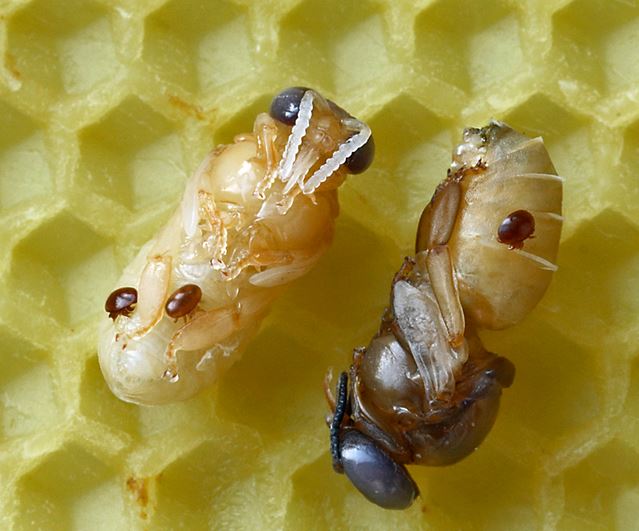
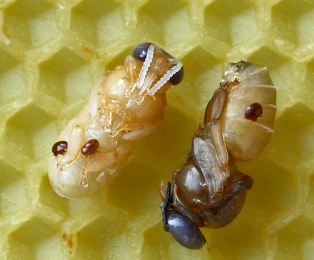
Mites on brood

Varroa mites on brood

Varroa, the destroyer

 A German “crowd sourcing” fund wanted 10,000 Euros to build honey bee saunas. Within a few weeks, they had over 60,000 Euros in pledges – that’s about $75,000. I guess that the contributors don’t realize bees can die in a sauna. Back to that in a minute.

Varroa, hitching a ride and sucking blood

Varroa mites kill bees. To eat, the nasty mite-creatures grab hold of bees and suck up their insides. Eventually, all colonies with booming varroa mite infestations die. That’s why beekeepers try to poison varroa mites – usually treating their bees with pesticides. Pesticides can leave trace chemicals inside the hive and become dangerous to bees and bee handlers. Further, the mites may evolve resistance against the poisons. Unfortunately, various chemical treatments seem to be the only currently effective and widespread weapon against the deadly varroa mites. But other methods are being tested.

Just as mites evolve to resist chemicals, honey bees may evolve to resist mites. This is the idea behind the celebrated Russian bee. Honey bees found in eastern Russia seemed to have evolved to live with mites. The claim is that most untreated honey bees will die, but a small subset will have some genetic quirk that will allow them to survive varroa attacks.

Genetically quirked bees will reproduce and repopulate the ecological niche lost by their vanquished sisters. This may have happened in isolated areas, such as Siberia. Unfortunately, when the Russian bee was brought to North America, its genetic advantage was quickly diluted by other honey bees already extant in the hives of commercial beekeepers. You see, queen and drone bees fly many kilometres to clandestine rendezvous hangouts where they indiscriminately mate. This evolved habit prevents honey bees from becoming inbred and fosters genetic diversity – within the same colony any two randomly selected co-working workers are likely to be half-sisters, not full sisters. Although this diversity gives many advantages to a colony, it almost kills the idea of maintaining pure-bred naturally mated lines of pest-resistant bees. It takes a good queen breeding program to maintain stock that keeps a line of honey bees imbued with hygienic behaviours and other qualities that suppress varroa populations. There are such queen breeders around and it can be done – but without discipline and diligence, varroa will creep back into an operation.

So, if chemical treatments eventually fail and genetic solutions are hard to maintain, what might be done to fight the dreaded varroa mites? Some beekeepers have lured mites to drone brood, then discarded the comb; others have reported some success dusting powdered (icing) sugar on bees to extricate mites. Greasy vegetable oil sprayed on the bees may slow down mite infestations. A completely different idea – heat – has been occasionally promoted and seems to be going through a bit of a popularity renaissance. Varroa mites, it seems, can’t cling to honey bees if the temperature is hot. This has led to a number of schemes that warm the inside of a hive (or a cage of bees) until the mites fall off. Unfortunately, this does not kill the varroa mites, it just dislodges them – chances of success are likely pretty sketchy using this system.

The USDA studied this idea 15 years ago. You can read their report at this link. Here’s the problem: at temperatures of 40ºC (104ºF) and higher, mites slowly fall off honey bees but bees begin to suffer heat stress. Honey bees, as you likely know, try to keep their nest temperature at about 35ºC (95ºF). Way back in 1791, Francis Huber discovered that even on the hottest summer days, bees did not allow their nest to rise above 99ºF. Remember, mites fall off at 104ºF. So it is hard to get a high enough temperature inside a hive to dislodge varroa mites. The bees will fan and evaporate water and reduce the hive temperature so they do not die of heat exhaustion and so their wax home doesn’t melt into a candle-like blob. High air temperatures dislodge mites if the temperature is warm enough for a long enough period of time. Higher temperatures (over 45ºC or 113ºF) will make the mites fall in just a few minutes, but will also kill honey bees more quickly. The USDA study shows that bees get crispy if they are exposed to too much heat – or even a little heat for too long a time. Quoting the USDA 2001 study: Overall, heat treatment is a risky procedure. Even 40ºC, the lowest temperature that can remove all the mites is perilously close to temperatures that kill bees.”

With these potential problems in mind, I was surprised to see that a German Crowd Sourcing Fund was able to quickly raise a huge amount of money to build a Bee Hive Sauna. The crowd sourcing goal was 10,000 Euros. They have over 60,000 Euros in pledges – that’s about $75,000. Their self-promotion site includes the non-Einstein quote (“…if all the bees die, in 4 years you will too…”) and it includes lots of Wir retten Bienen (“We save Bees”) subtexts. So, the promoters know how to appeal to the heart-strings of the misinformed. My guess is that the contributors/donators/funders don’t realize that bees can die in a sauna. The trick that keeps the bees alive, according to the inventor, is that (with his Bienen Sauna) “The Bees do not roar.” (OK, maybe it’s the Google Translator. The original German is Die Bienen brausen nicht.) I have never heard of roaring bees, but roaring seems like a problem to be solved. I will probably get the story wrong, so let’s allow the inventor, Engineer Richard Rossa, to explain:

“The bees do not roar.” “In my trials I came to the realization that roar of bees is not caused by a slow heating of the ambient temperature, but by increased CO2 content of the air. However, this effect does not occur in the treatment with the bees sauna. If necessary, fresh air is supplied at any time. This is done controlled so that no draft is produced. “Holding the air temperature constant between 40°C and 42°C, all Varroa mites, which are long enough exposed to this temperature, irreversibly damaged. Should any of Varroa mites survive, they are so damaged that they can no longer reproduce. Broodless colonies are treated for 45 to 60 minutes. Those with brood take two hours because it takes longer to warm through the brood cells. Then the device switches off automatically. In the entire time temperature and humidity are constantly monitored and regulated in the hive.”

It appears that by ridding CO2 from the hive, the bees won’t roar. If you read their website, you will see that (for about $1,000 per unit) it will be just the varroa mites that do the roaring. Rossa says that the temperature inside the hive/sauna will be kept at 40 to 42ºC. As we have already seen, this is a good bit warmer than the bees like, so I suspect some energy will be wasted by the bees as they gather water and circulate air to get the hive temperature down to their preferred 35ºC. Or I could be wrong. It could be that I am just an old-fashioned cynic who is spouting off about any product that has been tried in a number of commercially available guises over the past few years (see the Mite Zapper and the Varroa Controller).

Maybe I am cynical because some gullible people will quickly fund any cool yuppish idea – even if the procedure has been shown problematic by USDA researchers. However, I do not have a PhD in “Co-operative Communication Strategies for Politics and Media”, whereas Richard Rossa’s partner, Dr Florian Deising does. He was “a management consultant, financial manager [who] led international projects in large corporations… [But 2 years ago, he] got out to make as it were full time our world a better place”. I suppose these guys have their heart in the right place and they obviously know how to work a crowd for money. And perhaps they know how to keep bees from roaring in the sauna. It would be great if some sort of well-engineered hot-hive can actually kill varroa mites without hurting bees. That would eliminate chemical treatments. But at almost $1,000 for each device, the Bee Sauna will probably meet limited success. Personally, I think the long-term future for varroa control will be in genetic manipulation, not in heat. But check out the Bee Sauna at wir-retten-bienen.org (“WE SAVE BEES.ORG”) for yourself and make your own informed decision.

Richard Rossa, inventor of the Bee Sauna


Posted in Bee Biology, Diseases and Pests, Genetics, Tools and Gadgets | Tagged , , , , , | 18 Comments

15 Amazing Incredible Uses for Honey!

It’s good.

I came across a list. It’s one of those “7 Amazing Habits of the World’s Most Successful Dogs” sort of lists. But this one is about honey and the title wasn’t written as run-of-the-mill click bait (such as today’s headline on my blog), but it is more subtle: “15 Household Uses For Honey“.

Fall is honey-using season. But now the autumn holidays (Rosh Hashanah, Thanksgiving, Halloween) and the final honey harvests are behind us. We realize that honey sells better and disappears from pantries more quickly in the fall. Winter is just days away. Still, beekeepers can initiate a few extra sales during the upcoming cold and flu season. To that end, the Mother Earth Living’s piece (“15 Household Uses For Honey”) deserves a visit.

I am not going to list all ’15 household uses’ for honey. Several on the list are redundant. Burn Balm and First Aid, for example, both encourage spreading honey on ailing body parts as an antiseptic and as a healing home remedy. Home remedies, in fact, make up 8 of the 15 Household Uses for Honey – including treatments to fight drunken hangovers, sore throats, nervous tummies, stubborn coughs, and persistent pimples. Somehow, I doubt revelers will be looking for honey on January 1st, but it’s worth mentioning.

Of the fifteen honey uses (you can think of more) only two are appetizing (drizzle on cheese; dab on fruit), one recommends honey as an energy food (“Workout Booster”), and four are beauty-bath and handsome-hair regimes. This breaks down honey’s advantages to culinary, medicinal, energizing, and beautifying. Not a bad bunch of attributes. (In a very old bee journal I saw a whole new category – automotive maintenance… it seems a Model T radiator will not freeze up in winter if a judicious amount of honey is mixed in with the water.)

I am of a mixed-mind when it comes to making these sorts of honey-use recommendations. I think a beekeeper can appear rather flaky if he/she pulls out a long list of miracles that honey performs. I do think that most of the list is valid and accurate – anecdotally, I have witnessed honey healing nasty burns and settling anxious stomaches – but as a consumer, I am always leery when any food or supplement is touted as all-inclusive. It suggests that either some exaggeration or some desperation is going on. However, I think it is useful for the salesperson-beekeeper to know these uses and be able to respond to each in an informed way. Any valid application that encourage honey consumption (and is beneficial to the customer) is worth knowing about – even if it is best not heralded as part of a sales pitch.


Posted in Comb Honey, Honey, Strange, Odd Stuff | Tagged | Leave a comment

Our Pig

We bought a pig. We will keep it in Africa. It wouldn’t be fair to make our pig live in our house in the city. So Wilbur will be staying with a family in Africa.

As I am sure you have figured out, our family made a contribution to a charity. Our kids (ages 12 and 8) broke open their piggy banks and we all put a few dollars towards this ungulate project. $90 buys a (married?) couple which goes to a family that will benefit from the boars.

The charity that will provide the porkers is Plan Canada. It has been around for about 80 years. Other Plan Canada projects include the anti-malaria Spread the Net program, Because I Am Girl, and a variety of community programs. The thing I like about this outfit is that they try to break the cycle of poverty by providing tools to families. Those tools may include a couple of pigs which (in theory) are not to be eaten but rather will be used to raise more pigs, some of which may be sold or, well, maybe cooked. But you get the idea. You can donate money for sheep, goats, chickens, or seeds, shovels, and hoes. These are intended to enhance economic security, but Plan Canada also provides wells for clean water, builds schools, and makes sanitation systems for villages. The group also sponsors women and girls’ education in a big way.

In past years, Plan Canada would also provide beehives if that’s where you wanted your money to go. Their blurb mentioned pollination, “saving the bees”, honey, wax, and self-sufficiency – but their accompanying photograph was of a modern, white, two-storey Langstroth hive. I had trouble with the idea and didn’t donate to it. I thought Plan Canada should find a way to help local beekeeping by offering local equipment. Our western hive-style might work in some places, but maintenance of such equipment would be a hassle in many parts of the world. Plan Canada seem to have agreed.

Anyway, if you would like to help, Plan Canada seems a worthy outfit. If you live in the USA or elsewhere, I think Plan Canada is part of Plan International so you could contact them. If you are not keen on farm animals and clean water, there are other groups that provide famine and emergency relief for the truly desperate. It seems Plan Canada is trying to use donations responsibly with the goal of helping families become self-sufficient. And who wouldn’t love to buy a pig – and keep it at someone else’s house?

Posted in Friends | Tagged | Leave a comment

Beehives vs Drunken Elephants

Elephant with an attitude (Image CC-SA by Vikram Gupchup)

Drunken elephants have been a problem for as long as I can remember. Elephants are known to booze-up, get rowdy, and attack farmers – sometimes even entire villages. A herd of elephants got drunk on rice beer in Assam, India, and then looted and destroyed a nearby community. Reportedly, they were mostly young elephants and were just looking for more beer. But unfortunately, four people were killed in the ensuing skirmish. Worldwide, over 100 people are killed each year by irritated elephants. The worrisome fact is that not all the elephants are drunken beasts during their murderous escapades – many of the killers are stone-cold sober.

Some environmentalists are (at least partially) excusing the elephants’ riotous behaviour, suggesting it is in retaliation for human activity which continually encroaches upon elephant land. I think the environmentalists have a point. But no species has the right to take the law into their own hands – and revenge is a slippery, retaliatory slope which can only lead to an escalation of the Hatfield and McCoy sort. However, if the elephants are fed up with us, they certainly have their reasons.

Goons have been poaching and slaughtering elephants for generations, turning elephant legs into drums and flower pots and tusks into trinkets. Elephants are migratory mammals, traveling long distances as they follow seasonal changes for healthy dietary variations and for meet ups at watering holes and salty mineral springs. There they may share stories or even fall in love. But we have taken most of their rangeland for our own growing population, turning their trails into our roads and their meadows into our fields. The forest elephant in the Republic of Central Africa lost 60% of its population to poaching – the ivory is sold to fund human wars and, in other parts of Africa, terrorism. Elsewhere, humans in Laos, Sri Lanka, India, and 37 African nations have expanded cropland to prevent their own starvation. In the process, elephant numbers have plunged in the past few decades – the African elephant population, for example, has fallen from 4 million (1930) to 300,000 today.

Some well-behaved elephants:

Farmhand (1855)

Executioner (1868)

Circus performer(1880)

General Labourer, 1946

Temple duty (2010)

For centuries, humans have used elephants for work, warfare, and entertainment.  As you can see in the pictures below, elephants have been employed in temples as living totems of Ganesha and executioners in India (the second image below is fuzzy, but it is an 1868 sketch of an elephant being forced to kill the man whose head is on the block). Elephants have given us circus entertainment in North America (as in Dumbo and Jumbo among thousands of others) and they have worked as draft animals throughout southeast Asia and general labourers in Europe (the last photograph below was shot by a US service man in Hamburg in 1945 – the elephant is cleaning up WWII debris after Allied bombing).

We have been abusive. But human women, children, and farm peasants pay the price when marauding elephants trample conventional fences and destroy crops. Elephants have learned to lift latches on gates and they have sought weak spots in wire and wooden fences when gates are locked. Subsistence farmers are sometimes ruined when elephants trash fields. But the pachyderms recognize beehives and steer clear of potential stings. So, a very bright Oxford scientist, Dr Lucy King, came up with a potential solution. It is based on the fact that elephants are afraid of bees.

For inventing a fence of beehives that reduces clashes between humans and elephants, the United Nations presented Dr King with the prestigious Conservation of Migratory Species award. She received the recognition because her fence is innovative, uses local resources, provides farmers with honey and wax, and because it actually works. First tested in 2008, it has stopped 84 out of 90 attempted raids in three different regions. It seems to fit culturally – three different African tribes have adopted the system. Beekeepers reading this will also recognize that the hive is elevated on posts and suspended by wires. This prevents nasty brood-eating mammals (as well as ants) from accessing the bee colonies. African bees typically nest in trees so these hanging hives are accepted by the bees – I suspect unoccupied boxes would attract swarms. (Since the elephants have learned to recognize the units as hives, dummy hives can be hung among populated hives – these are equally effective at barring the elephants.) Beekeepers will also recognize the construction shown here is a TBH (Top Bar Hive), which uses local materials, but Langstroth hives (as nucs) can also be used.

I think this is a brilliant idea. It satisfies the defensive needs of the local people without killing the endangered migratory elephants (they simply skirt the bees and the crops and continue ambling along their way). Dr King has placed a manual (which she wrote) on the internet so other groups may adopt her idea. Meanwhile, testing, refinement, and distribution of the beehive fence continues. You can – and should – visit elephantsandbees.com to learn more. You may also contribute to this effort by going to the Elephants and Bees donor page or through the UK’s Save the Elephants charity. We are told that “100% of funds will go towards project-running expenses.”

Kenyan beehive fence, with Dr King
(photo from Beehive Fence Construction Manal


Posted in Bee Yards, Ecology, Hives and Combs, Strange, Odd Stuff | Tagged , , , | Leave a comment

Sterile Radioactive Bugs Arrive in Croatia


A sterile radioactive kibbutz bug (Image PD by FAO)

Why did a kibbutz in Israel ship 380 million sterile, radioactive fruit flies to Croatia? That might be the most unusual introduction this blog has ever used. Here’s the backstory…

Ceratitis capitata – the lovely but insidious Mediterranean Fruit Fly – is indigenous to the fruit belt surrounding the Mediterranean Sea. This includes Croatia. Normally, the Medfly does not wander far, so it spreads slowly. Unless it’s boxed up in a crate of tangerines. Or figs, apples, peaches, blueberries, pomegranates, grapefruit, or some other wormy but nutritious carton of fruit. That’s how the Medfly reached the States, New Zealand, Chile, and (I think) Australia. In Chile, New Zealand, California, Texas, and Florida, the bug was successfully eradicated. Hawaii is still fighting it. If you don’t like worms in your oranges, it needs fought. The bug’s life cycle prompts it to poke holes into ripening fruit and deposit eggs under the fruit’s skin. The eggs hatch and the larvae (worms) eat, grow, and pupate. Even those of us who are free-range omnivores find the results a bit disgusting.

Not fussy – Medfly larvae enjoy a healthy variety of fruit
– including peaches and figs.

The Medfly can be sprayed into oblivion. That’s how California eventually ridden itself of the scourge. Back in 1989, Governor Jerry Brown resisted aerial spraying on environmental principles. He authorized a ground assault, but the Medfly moved ahead of the program. Reluctantly (and almost too late), Brown agreed on blanket sprays which finally destroyed the fruit flies. (By the way, Brown is again governor. He is 76 years old now. He took over a bitterly divided, bankrupt state (only partly due to Arnold the ex-terminator, who was formerly in charge). California, under Brown, has recovered remarkably. There is finally a government surplus – The Economist says Brown is “so tight-fisted he is not above eating off other people’s plates.” Potentially a bit disgusting, but I digress.) In the end, helicopters sprayed malathion at night while the California National Guard inspected vehicles fleeing infested areas. Later, entomologists released sterile Medflies to seduce any holdout Ceratitis capitata.

This brings us back to Croatia and the friendly kibbutz. In 1934, Jewish settlers from Germany began the Sde Eliyahu religious colony. They built their stockade and tower settlement near the Sea of Galilee at 200 metres (660 feet) below sea level where malaria swamps and summer heat affected the early settlers and their precarious crops. They persevered, transforming their worthless tract of land into an agricultural oasis. Today the kibbutz and its 750 residents are entirely dependent on farm-related activities. Here is what Sde Eliyahu says about itself: “Many of our field crops and fruit are special in that they are cultivated according to the principles of organic agriculture. We were real pioneers in this sphere in Israel fighting for the exclusion of toxic fertilizers and sprays. To replace the latter, natural enemies of pests have to be found and activated.” Pursuing natural solutions led to the establishment of BioBee, which is mainly involved in bumblebee pollination within greenhouses, and Bio-Fly, which raises indigenous Mediterranean fruit flies and sterilizes them.

Bio-Fly, a subsidiary of BioBee, was founded “for the purpose of developing and supplying biological control solutions for the Mediterranean fruit fly (Medfly) and other pests, using the Sterile Insect Technique,” according to the outfit’s website. The newspaper Haaretz says that the Israeli Atomic Energy Commission supervises the radioactive sterilization of the fruit flies while the kibbutz has a collaborative agreement with the Palestinian Authority, Jordan, and several Mediterranean governments for the distribution of the sterile flies. The company has a mass rearing facility and supplies sterilized male pupae, as well as sterile male flies for dispersal in agricultural fields. The latest swarm of flies were scattered along the border areas of Croatia and Bosnia. Normally, about 15 million sterilized pupae are produced each week at Bio-Fly. The sale to Croatia was over a third of a billion flies, so perhaps production has ramped up recently. (The 380 million flies were weighed, not individually counted.) By the way, the reason that only male fruit flies are sold is that it prevents a potential disaster if some flies are not effectively sterilized – no egg-layers are shipped abroad. The sterile males successfully mate with indigenous females who then remain infertile their entire week-long adult life.

Croatian fruit and veggie stand (photo – Miksha)

I was surprised that the Croatian tourist haven has a big tropical fruit industry. The coast is mostly craggy with mountains that encroach upon the sea. Almost everywhere along the coast, there isn’t much more than a skinny (but inviting) beach. But when I approached the Croatian coast from Sarajevo, driving south through Bosnia, a friend and I found ourselves on the broad Neretva Delta – a warm lowlands of rich soil and dense gardens and groves. It was quite a switch from the barren stone-filled hills to the north. Until the moment Neretva’s river valley opened before me, I was unaware of Croatia’s huge citrus industry. But as a Mediterranean country, Croatia’s burgeoning fruit-producing area suffers from the Medfly. (For more, and some great pictures, see the UN’s FAO report about Croatia’s fruit fly pests.)

Despite the flies, I was enthralled with the orange groves – something I missed since my Florida beekeeping days. Seeing all these small acreages owned by independent farmers who peddle their fruits and veggies at roadside stands was a slightly nostalgic trip back in time. I didn’t see any honey bees in the groves, but my trip was in October, not March, so the trees were not blooming. Migratory beekeepers would have moved their colonies north in early summer. The bees would not have been back until perhaps November. But when they did return, the beekeepers would not have to deal with clouds of malathion drifting over their bees, thanks to 380,000,000 imported radioactive male fruit flies.

Croatia’s fruit delta, along the Neretva River (photo – Miksha)


Posted in Bee Biology, Ecology, Pesticides, Strange, Odd Stuff | Tagged , , , , , , | Leave a comment