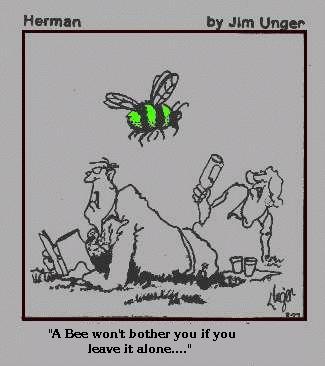
Bee Stings and Bathtubs

Our thanks to the late, and great, Canadian cartoonist, Jim Unger

Well, the bees are getting a bad rap in Britain. Here’s a headline from a Herald Sun newspaper this month that shouts, “BEE stings kill as many people in the UK as terrorist attacks do”. We don’t doubt the veracity of this story because the article’s subtitle headline adds, “a government watchdog report claimed today.” Government watchdogs?  Dobermans or Rat-Terriers engaged in the bee-sting body count business? I’m not surprised. Actually, the government watchdog is David Anderson, aka the Independent Reviewer of Terrorism Legislation. His official report lumps wasps, hornets, and a hundred species of bees into the group responsible for five “bee” sting deaths in 2010 – in all of the United Kingdom (home to 63 million people). Five unfortunate fatalities – some municipalities would ban bees on the basis of this perceived excessive danger. But baths are even more deadly, hence many Brits have banned bathtubs and showers from their homes already, best I can judge from several trips on the London tube* – Bathroom dangers were the source of 29 deaths in 2010.

(* Just kidding about the Brits on the subway! In a recent survey of Europeans, the Brits place ahead of the French in baths per week.)

British bathtubs are six times more dangerous than bumbling bees and their wasp-ish cousins. Over the past two years, no Brit was killed by a terrorist.  Zero. So, the hundreds of millions spent on watching terrorists may be over-kill, so to speak, according David Anderson, the government-paid watchdog who will probably be losing his job soon. But maybe spending those millions prevented attacks by fundamentalist loonies of all stripes and saved four or five deaths each year. We will never know. It should be noted, says the article, that the Director General of MI-5 (whose funding would be reduced if Britain’s conservative government took this report seriously) is pleading quite the contrary to the watchdog report. Claiming instead that “at least 200 known Britons were currently receiving terrorist training at militant camps in the Middle East.” Here in Canada, we can be grateful we have a Conservative government (elected by 39% of voters) who came into office on a platform of austerity and reduced spending. They are not likely to squander money on excessive terrorist-watching, mega-prisons, war planes, tributes to foreign royalty, or other nonsense. OK, maybe Canadian Conservatives are as likely to squander our money as conservatives everywhere are…

Finally, let me note that the difference between the dangers of bees and the dangers posed by terrorist fundamentalists are palpable. The terrorists are contributing nothing to society, are generally unremorseful (think of the smirking Anders Behring Breivik of Norway), and have the intention of murder. The bee has no evil intent. Unlike the fundamentalist, as everyone knows, a bee won’t bother you if you leave it alone.

Posted in Culture, or lack thereof, Humour, Stings, Strange, Odd Stuff | Tagged | Leave a comment

May Swarming

A friend sent this to me:

“Spring has sprung,
But the bees are not swarming…
Could this be due to global warming?”

I like this little ditty – it works on so many levels. It’s May. Here in Calgary, finally, belatedly, ‘Spring has sprung” – the leaves are justnow opening on the willows and poplars. Pollen has been blowing for only a week or so. A late spring is normal for us at Calgary’s high elevation and latitude. It is May and there is still a chill in the air; yet, in a few weeks it will be too hot to polka in the street. I think climate change is like that – too cool, then much too hot. Global warming is certainly a reality. The ice cap that once formed a stylish toque over the globe’s bald head is melting – watery-eyed earth is about to get really wet. It has happened before, many times, but this round is on us and our myriad chemicals and exhausts. I guess if we treat our air and oceans as garbage dumps, we deserve what we’re going to get. But it’s too bad that the other animals on the planet have to suffer for our indulgences and indolences. However, I think the bees will eventually be OK, even if we are not.

Posted in Climate, Culture, or lack thereof, Save the Bees, Swarms | Tagged | Leave a comment

Package Bee Express

In my meagre effort to stay informed about bees, beekeeping, and beekeepers, I occasionally creep around the internet, stalking new ideas, and sometimes marveling at the bad beekeeping I find in cyberville. Here is an amazing statement from a hobby beekeeper, a Yuppy type, perhaps a very nice human, but possibly lacking any discernible connection to practical reality. I saw this statement on the organic beekeepers group, over at Yahoo.

“I picked up my package this past Saturday and it was about an hour away.
My daughter had it on her lap on the front seat.
I have a Mazda RX7 sports car. They calm down.
We even had a loose bee in the car and my daughter
had it on her finger and was talking to it.”

…the new RX7 Bee Truck

To which an experienced beekeeper replied, “Right. And it never occurred to you that if you got into a fender bender and the air bag went off, the package would have been crushed and your daughter would have been stung hundreds of times …”

I include this blog entry not to show contempt for the artsy-fartsy crowd which squanders the Earth’s resources on sports cars, but rather I am trying to point out shallow-thinking syndrome. The beekeeper – even the hobby beekeeper – needs to think clearly all the time, or things will go wrong – people may die. It’s so easy to make a mistake; so hard to fix one. Whether deciding to requeen, to split hives, to add supers, to harvest early or late, or to allow a young passenger to balance a package of bees on her lap at 120 kilometres an hour, the beekeeper’s ability to make smart choices is important. Or maybe not – sometimes bees do stupendously well, regardless of how poorly the beekeeper performs. However, it’s the beekeeper who drives the conspicuously consumptive sports car, not the bee.

Posted in Beekeeping, Culture, or lack thereof, Strange, Odd Stuff | Tagged , , | Leave a comment

Apitherapy Day

A Healthy Honey…

On March 30, we usually celebrate World Apitherapy Day at our house by eating fried drone brood seasoned with dandelion pollen and buckwheat honey, while receiving a few intentional bee stings on our finger tips. What a fun day! World Apitherapy Day is celebrated on March 30 because that’s my birthday. And, coincidentally, Filip Terc, considered the Father of Modern Apitherapy, shares my birth date. But he was born in 1844, and I was not, so we are not the twins most people think we are. And my sporadically produced blog is more current than his. Terc spent much of his scientific career in Maribor, Slovenia, exploring the benefits of bee-sting therapy on patients of rheumatoid arthritis and other disorders. He was mostly successful with his sting therapies. He published his results in 1888 in a Vienna medical journal. The first modern scientific account of apitherapy.

A lot of people take the apitherapy concept very seriously. Mostly because it can be successful treating ailments that conventional medicine has failed to cure. Normally, we think apitherapy means bee stings. (Or “bee bites”, among people who don’t know much about bees.) But in addition, apitherapy also includes beehive goodies such as royal jelly, pollen, beeswax, propolis, brood, and (of course) honey. All of which have some real health benefits, albeit perhaps exaggerated benefits.

One of the nice things about apitherapy – it is almost universal. Unlike odd seed pods from the Himalayas or poison from Amazonian red-eyed tree frogs, the honey bee and her medicines can be found nearly everywhere. A person can usually find someone to apply bee stings to swollen joints or propolis tinctures to open sores. And just as discoveries are yet to be made in exotic locales, the full potential of bee products has not yet been uncovered. If you are lucky enough to live in my beautiful home town of Calgary, you could visit our friends, Art and Cherie. They operate a beekeeping business just south of the city which includes many apitherapy products among their honeys and honey wines.

One apitherapy product which is under-rated as a health food is comb honey. Delicious, of course, but healthy, too. Natural, unprocessed, unfiltered – untouched by humans or machines. Eat comb honey. Regularly. It will reward you. With regularity.

Posted in Apitherapy, Comb Honey, History, People | Tagged , , | Leave a comment

February Bee Blues

Got the mid-winter missin’ messin’ with them bees blues? Me too. So, here’s a link to a great video, Beekeepers of Kenya, that should help you survive this dismal season. The film shows beekeepers using western-style hives, keeping bees in Africa. Watch the whole video, and you will see the harvest being filtered into pails. Beautiful stuff. I suspect – and sincerely hope – that Africa will one day be a prosperous continent. Reform, followed by prosperity, has followed quickly behind the growth of beekeeping in other places, too.

Like most North Americans and European kid-beekeepers, I grew up believing that most honey is produced in July, after a long cold winter had ended. It did not occur to me that the upside-down people had their seasons reversed and were warming up their humming extractors in February. It’s true that much honey is gathered in Canada, Russia, central Europe, the northern USA.

However, honey making has spread far beyond areas mimicking the honey bees’ original climate zones. In a remarkable testimonial to the bees’ fantastic adaptability, the honey bug prospers in Brazil, Australia, Mexico, Vietnam, India, and Belize. These are not the native homelands of our honey bee, Apis mellifera subspecies – yet today, more honey is produced in the jungles of these hot climates than on the prairies of the north. As an example, Canada makes around 25 thousand tonnes a year (50 million pounds), but Iran 36, Ethiopia 44, and Mexico 56 thousand tonnes of honey. The hottees have it.

Posted in Beekeeping, Climate, Honey | Tagged , | Leave a comment

Zombie Bees

More bad news: a deadly fly parasite was spotted for the first time on honey bees, reported researchers at San Francisco State University in 2012.  The fly, Apocephalus borealis, deposits its eggs into a bee’s abdomen. After the honey bee dies, fly larvae “push their way into the world from between the bee’s head and thorax”.  (I hope you’re not eating breakfast right now.) After the parasitic fly has laid those eggs, the bees abandon their hives in “a flight of the living dead” and hang out near lights. See if you are following this: bad fly lays eggs in honey bee’s bottom, which hatch into worms, which creep out from inside the bee, which is driven mad and flies off with the parasites at night to hang out under street lamps. These zombie bees frequently carry the deformed wing virus and Nosema ceranae fungus, according to John Hafernik, Andrew Core, and Geraldine Lindsay, who have been studying this phenomenon. There are a number of unanswered questions about the parasites and the affected bees, so the researchers say they will radio-tag the bees and use video cameras to monitor them in their next round of study.

Posted in Diseases and Pests, Strange, Odd Stuff | Tagged , , , | 1 Comment

Mexico

Ron Miksha

Ron, on Acumel Beach in Mexico,
waiting for another nut to fall…

To get through our frigid Canadian winter, we usually slip down to Mexico  for a few days. This year, we ended up in Acumel, north of the Belize border. When I was young, I knew a gentleman in Florida who owned a couple thousand hives in Central America. The Yucatan Peninsula is honey-heaven for tens of thousands of colonies of Apis mellifera. The neighbouring nominally English-speaking country of Belize (formerly British Honduras) shares the nectar-rich Yucatan with Mexico, so it would not be surprising to learn that an enterprising young American might set up a honey farm there. The thing that surprised me, though, was the beekeeper would routinely leave his Florida ranch and drive down to Central America in his truck to check on his more southerly bees. That’s about 3500 kilometres (2300 miles) – the same distance I was hauling my bees from Lake County, Florida, to Saskatchewan, Canada at that time. His trip seemed a lot more exotic to me than mine…. But that was a long time ago – I doubt he’s making that trek any more. (And my long-haul own adventure ended thirty years ago.)

At an open-air market in Mexico this winter, I was approached by a Mayan couple who had a few jars of fresh pollen in hand. Not all Mayans speak Spanish, but these folks did, so I learned that the pollen was from the city of Merida. They had bought it from a beekeeper, repacked it, and wanted to sell a small jar to me for twenty dollars. Ten dollars. Five? They quickly bartered downwards while I waited silently in my wheelchair. I was impressed by their courage – they were wandering around the market, had no booth, so they could be evicted at any moment. They approached this Gringo in a wheelchair without apparent trepidation. I wish I could have helped them out, but I wouldn’t take any raw food products from Mexico to Canada – raw bee pollen can carry exotic bee pathogens. I left them, but wanted to suggest they change their sales pitch. Not mention buying the pollen from a commercial beekeeper a hundred miles away. Without that honest information, a tourist such as I might imagine that they hand-picked the stuff themselves, in a forest where huge parrots and tiny monkeys watched them plucking the pollen from wild comb while killer Africanized bees hovered around their faces.

Posted in Beekeeping, Hive Products | Tagged , | Leave a comment