A couple of evenings ago, I Zoomed into a Western Apicultural Society mini-conference. This is a new monthly affair for the 43-year-old educational organization. The mini-conference is one of the few positive results of the dreadful Covid lockdown. Virtual conferences such as this have sprung up among civic groups, and I’m grateful to the Western Apicultural Society (WAS) president and leader, Jerry Bromenshenk of the University of Montana, for his tireless dedication to WAS. Jerry and a small group within WAS organize these well-attended monthly conferences. You can still watch any that you missed – WAS has archived a dozen conference videos on YouTube.
The mini-conference panelist musings will be posted next week on the WAS Video page. Meanwhile, I’ll write a bit about why I tuned in. Although my question was not directly addressed, I was keenly curious about the financial well-being and long-term prospects of printed bee media. With free beekeeping information available on podcasts, blogs, and free papers, will our favourite beekeeping magazines be around forever? (American Bee Journal is already 160 years old!) Of course, my question was intended to get the editors talking about the future and how they might adapt. But, as I said, my submitted question wasn’t tackled.
I did, however, glean a bit (albeit indirectly) from the conversation. The bee publishing industry is apparently healthy. Subscription numbers are similar to levels I remember seeing many years ago. I suspect that people are continuing to purchase magazines for two principle reasons: 1) Trust; and 2) Contact.
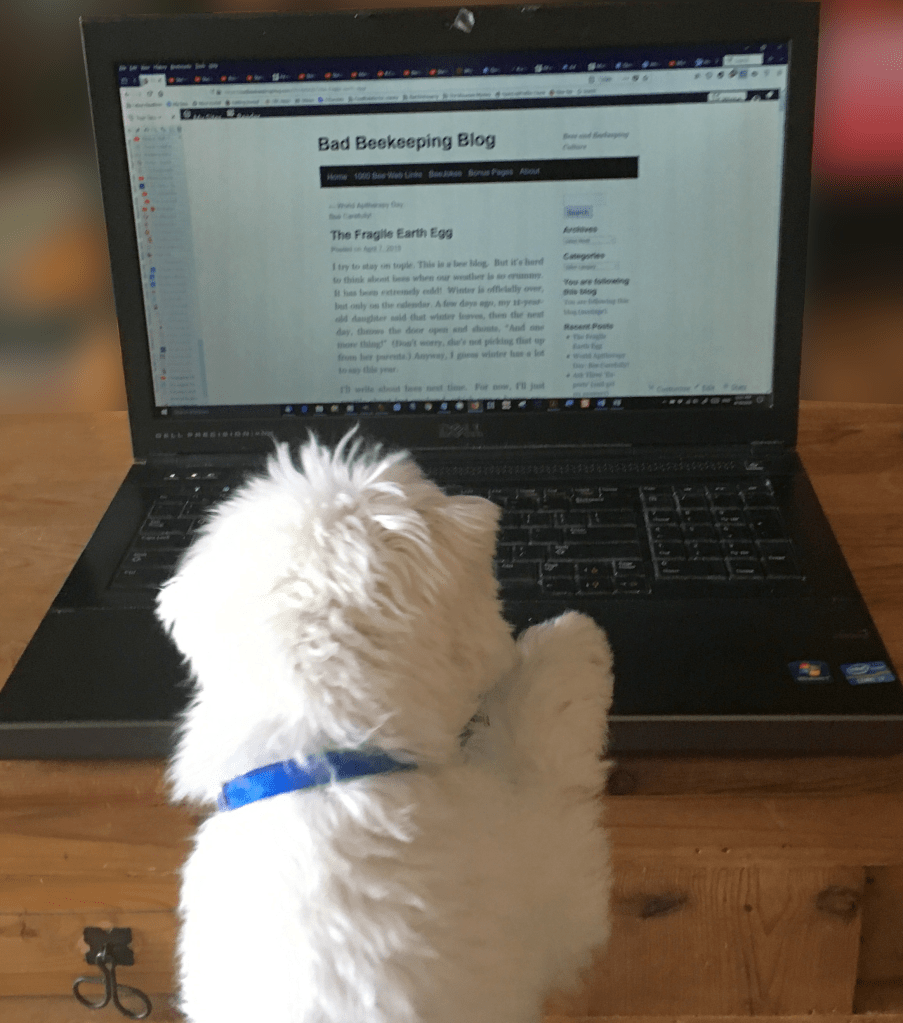
We trust a bee magazine where expert experienced beekeepers are the editors. They are gatekeepers who reject unsound articles (or relegate them to the ‘letters to the editor’ pages). Unfortunately, there are no sentries stationed atop YouTube channels or blogposts. Without a second opinion, a monitor, a referee, or informed judge, anyone can write anything for anyone on the internet. I know because I get a lot of notes from new beekeepers who have been persuaded by some really peculiar advice and then refuse to take the truth for an answer. Nevertheless, there is some good information on the web. But it’s not curated information – it is up to you to curate the authors. That can be a lot of work. Sometimes you think that you’ve found a good source but it turns out to be a dog that’s doing the typing.
Purchasing a subscription to a magazine gives a special contact, or connection, to a bee communicator. You don’t always get the same feeling from a keyboard and monitor. Paying for a magazine is a bit like joining a club. Your money helps pay the editor’s salary and the fee given to authors. You are not just a guest, but a co-owner. (Admittedly, my own blog’s viewers number in the tens of thousands each month and many have become ‘net friends and regular commentators.)
The other form of contact is purely tactile. One of the editors during the WAS discussion mentioned that he likes holding a magazine. Probably most people do, though I prefer reading from screens. However, I still get great pleasure from hoarding printed books and magazines. Nevertheless, I figured that most people are moving towards digital, but one panelist on the WAS program indicated that only 600 or so buy digital – that would be well less than 10% of the subscribers. I was quite surprised at the low number.
My conclusion is that bee magazine publishing is a healthy industry and may be around for a long time. Beekeepers’ habits are slow to change and we tend to be loyal customers. We will keep buying bee journals. In fact, the advent of the current windfall of free beekeeping information – with its biased foibles and irregular quality – may actually convince many people that a small investment in a magazine subscription is the safest way to stay up-to-date.
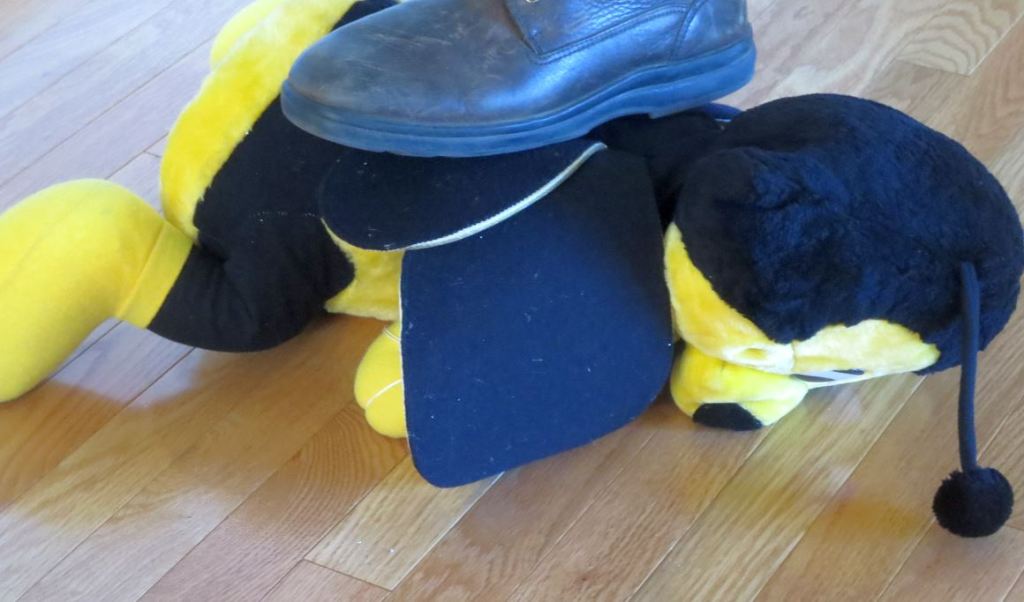
Today is a special day. It’s Nikola Tesla Day. But, it’s also the anniversary the first day of the “Scopes Monkey Trial”, which started on a sultry Tennessee morn, almost 100 years ago. And it’s Don’t Step on a Bee Day – let’s see if we can keep that up all week!
Also, on this brilliant July Tesla-Scopes-Don’t-Step-on-a-Bee Day, I am breaking my long self-imposed blogging hiatus. I’m doing that with an important public-service announcement.
Many of you know that I have a motor neuron disorder (similar to ALS). For me, typing, guitaring, walking, and singing Verdi’s La Traviata have become increasingly difficult. You’d think that would be enough of a challenge, but in late May, I decided to have a heart attack. For extra drama, I scheduled it on my wife’s birthday, following a lovely meal of our favourite East Indian take out. (Restaurants were still Covid-closed at the time, so we ate at home with the kids.)
Here’s my PSA. If you’ve just had a delicious dinner with family and you start to have serious heart burn, maybe it’s something else. After our dinner, I felt awfully unwell – dizzy and weak with uncomfortable chest pains. The birthday girl suggested that we visit the hospital, but I wasn’t interested in going anywhere. I was sure I had overeaten, and in half an hour, I was feeling better and shuffled off to bed. However, I had barely touched the pillow when I had a painful jolt to the chest, neck, and arms. No one in my large family had ever had a heart attack, so I quickly ruled that out. However, I was feeling quite badly and agreed to go to the hospital. Within half an hour, I was wired up and blood tests were happening. Then I had the third heart attack of the evening. It was very serious. A few hours later, doctors placed a stent in a primary artery entering my heart – it was almost completely clogged with bacon grease.
So, my PSA-warning to everyone reading this. Even if you and your ancestors have no history of heart issues, even if you are not overweight, even if your last cholesterol blood work was fine, you need to know the signs of a heart attack and be prepared to expect the unexpected. Some of the signs which I ignored were long-term fatigue and swollen feet. That had been going on for months. The immediate signs which took me to the hospital were severe pain in my chest and arms. Don’t be a Ron. Take these signs as deadly serious warnings.
I am still recovering and have reduced my work, but I hope to get back to blogging about bees regularly again. Today is a start. Meanwhile, pay attention to your body – and don’t step on a bee, either.
The link to this video came to me from Gorazd Pavčnik, who lives in the land where two of my grandparents were born. These Slovenian singers have incredible harmony. Singing and beekeeping are national pastimes in Slovenia – here they combine sweetly. Hope you enjoy the sound (and the scenes of beekeeping in the little Alpine country). Volume up!
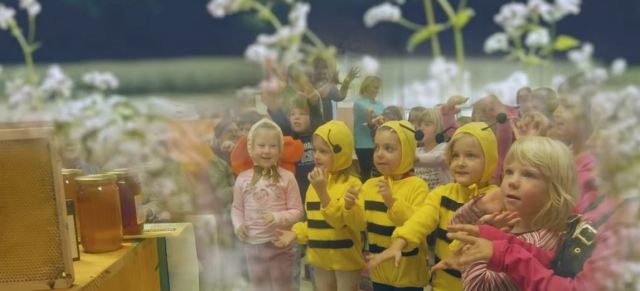
World Bee Day, 2021: World Bee Day is on May 20 of each year. It’s not just about honey bees. Although the idea arose in Slovenia, a little country that’s really big on honey-bee keeping, it’s also a celebration of all the world’s bees – about 20,000 species – made up of several trillion individuals.
Bees of all sorts are the chief pollinators of the world’s flowers. The flowers that attract bees reseed meadows and forests with progeny that build soil, feed grazing animals, and provide us – the humans – with much of the beauty we see in nature and the food we eat.
Today, two popular sites have picked up my voice about the under-rated non-honeybees of the world. Vitamina Bee, an Italian bee blog, featured my recent American Bee Journal article about Bee-washing, the unfortunate phenomenon of making money by exaggerating the benefits of keeping a beehive atop an asbestos plant’s office tower – or doing some equally preposterous antics to advertise a corporation’s green credentials.
The other place amplifying my messages on biodiversity and bees is Twinkl, a website dedicated to helping teachers and parents. At that site, the Twinklers are celebrating World Bee Day 2021 by describing the importance of bees, giving tips on helping bees, and printing comments from Planet Bee, Linda’s Bees, and me. You can see Twinkl’s full 2,000-word resource at The Importance of Bees: An Easy Guide.
In a future post, I’ll come back to both Vitamina Bee and Twinkl with more details on Bee-washing and on the importance of bees. Meanwhile, I’m reprinting some of my pieces from World Bee Days of the past. Be sure to read my brief history of World Bee Day (below), which arose from the tiny European country of Slovenia and celebrates bees of all types while commemorating the work of the pioneering beekeeper, Anton Janša.
Dogwood tree in full glory
From 2020: Looking at things from a practical, but dysfunctional, utilitarian perspective, we might wonder if we really need 20,000 kinds of bees. Aren’t honey bees enough? They pollinate our foods – almonds and apples and so on – while many important foods (rice, wheat, corn) are wind-pollinated. Yet we have a vast array of bees that are not honey-makers. Some of the many ‘extra’ bee species are specialists. For example, the dogwood tree, genus Cornus, are kept alive in part by three rare species of miner bees, the Andrena. Take away the dogwood, with its bold early flash of spring brightness, and the Appalachians would be a more dreary place. In the years when I drove truck loads of honey bees from Florida to Saskatchewan, white and pink dogwoods and yellow forsythia were harbingers of the birth of a new year’s honey cycle. The irony is not lost on me – I carted millions of honey bees (which originated in Europe) from Florida’s orange trees (originally from southeast Asia) to prairie alfalfa (a native of the Middle East). Yet, during my 4,000-kilometre migration, one of the most beautiful sights was the blossoming native dogwood, sustained by a tiny native bee.
We might dismiss the role of the other (approximately) 19,999 species of bees as long as we are keeping our favoured western honey bee functioning. But every species has a role to play in our ecology. The loss of a few kinds of bees (some species have recently gone extinct) may seem trivial. They may pass unmourned, except by the plants which relied on them for transferring their pollen, and the animals which survived off those plants. The interconnection of the web reminds me of the centuries-old proverb which begins, “For want of a nail, the shoe was lost; for want of a shoe, the horse was lost…” and continues until the entire kingdom was lost.
The BBC, in a little piece about World Bee Day, recounts the 17 bee species which have gone extinct in England’s southeast and the plight of 25 more species that are threatened. The article recognizes the interconnected state of biodiversity and ecology and illuminates the importance of a day for the bees.
So, on this year’s World Bee Day, I’m thinking of the ‘other’ bees as well as those two colonies of honey bees in my back yard. Meanwhile, I’m ending this note with a bit more about bee day, including a bit (published over the past few years) about how World Bee Day came into existence.
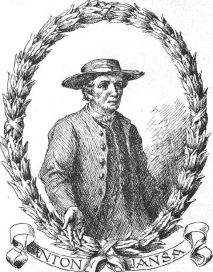
From 2019: May 20th should be a big date on the beekeeper’s social calendar. It’s World Bee Day. Why did I mention 1734? That’s the year Anton Janša was born. He was baptized on May 2oth, the closest date we know to his actual birthdate. Some say that Janša was the first modern beekeeper. You can learn more about him later in this blog post.
As an added bonus, May 20 is also another famous beekeeper’s memorial day. Charles Dadant, the scion of the infinite Dadant and Sons progression of beekeepers was born in France in 1817. Dadant thought he’d be a revolutionary back in the day, in France, but he ended up in America. (You can read his story in my piece celebrating his 200th year.) Charles Dadant, born on May 20, 1817, ended up in western Illinois where he wanted to grow grapes for wine. Lucky for us, his beehives did much better than his vineyards.
World Bee Day was initiated in Slovenia, Europe, and has been quickly catching around the world. For example, German Chancellor Angela Merkel concluded a major speech Wednesday with a rousing endorsement of World Bee Day, telling members of the Bundestag to do something good for the bees:
“I want to finish with something that some may consider insignificant but is actually very important: on May 20 is the first World Bee Day. On this day we should really think about biodiversity and do something good for the bees.”
World Bee Day became World Bee Day after a successful campaign by the country of Slovenia (Anton Janša’s birthplace) to promulgate the message. Their petition to the United Nations was accepted in December 2017, so this year marks the first official World Bee Day. I’ve been following (and promoting World Bee Day) ever since I heard the effort was underway a couple of years ago, so below you’ll see some of my earlier posts.
Well, a great big congratulations to the Slovenian promoters of World Bee Day. You made it happen on the world stage! And beekeepers, it’s your job to go out and spread the good word and “do something good for the bees”. If you need some further inspiration, watch this World Bee Day video to fortify your resolve – it’s about the first hive of honey bees kept at the United Nations in New York City.
FROM 2017: May 20 is World Bee Day. Seems an appropriate day to celebrate the bee. (So was yesterday; tomorrow would be good, too.) It’s spring north of the equator. I don’t want to neglect our friends south of Earth’s belt, but honey bees began their world-wide conquest by expanding from the northern hemisphere. For most of us in the higher (positive) latitudes, May is a fantastic bee month. Colonies expand, swarm, and maybe even make a little honey.
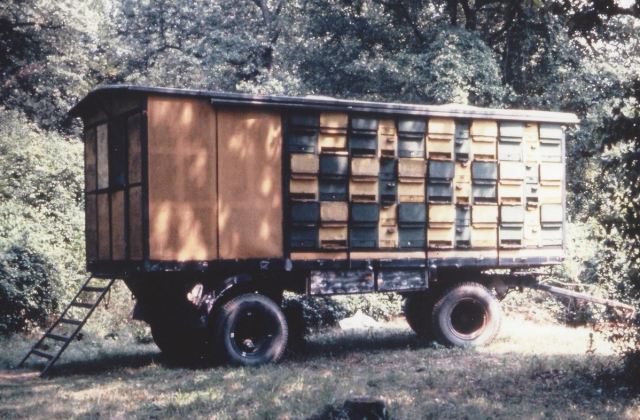
Portable apiary in Slovenia. (Photo by David Mikša)
May 20th is also the celebrated birthdate of Anton Janša (1734-1773), the first teacher of modern beekeeping. (It’s ‘celebrated’ on May 20th, which was his baptism date. We don’t know the exact day of his birth.) Anton Janša was Slovenian (hence the funny little squiggle over the ‘s’ in his name). He was so talented that Habsburg Empress Maria Theresa appointed him headmaster at the world’s first beekeeping school, which she built for Janša in Vienna. It’s remarkable that he chose to be baptized on the same day that we would pick centuries later as World Bee Day. That date was chosen and promoted by beekeepers in Janša’s native Slovenia – do the coincidences never end? Now here I am, Ron Mikša (anglicized to Miksha), a bee blogger with grandparents who were born in that part of the world, encouraging you to do a wiggle dance in celebration of World Bee Day this Sunday. Get out and do something beely.
FROM 2016: There’s a small country in Central Europe, a very beautiful alpine country, called Slovenia. Slovenia has only two million people, but this tiny country is very big in beekeeping. Tucked between Italy and Austria, it has both mountains and Mediterranean sea coast, creating enticing niches for bees and beekeepers.
Every Slovene family has at least one beekeeper. I think beekeeping might be enshrined in their constitution. I visited before Slovenia adopted the Euro and I paid for a Laško with coins that had images of bees, not presidents or queens. Beekeeping is taken so seriously that the nation’s unofficial motto is “Land of the Good Beekeepers“. The country produces gourmet honey, offers beekeeping tourism, and likes to point out that the Slovenes – the wealthiest Slavic nation in the world – takes its work ethic from the honey bee. On top of all this, I’m proud to say that two of my grandparents were born in Slovenia! What a remarkable place, eh?
Slovenia convinced the world to recognize World Bee Day, a day for the bees, on the presumed birthday of their most famous beekeeper, Anton Janša.
Janša (pronounced YAN-shah) is a Slovenian national hero and a beekeeper. We don’t really know his birth date – his parents were illiterate farmers and probably wouldn’t have even known (or cared) what year it was. But their church kept track. He was baptized on May 20 in 1734.
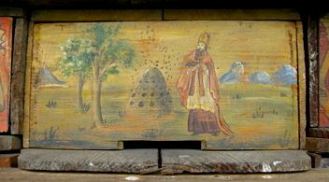
Beehive entrance plate, painted by Janša.
The Janša family was impoverished, but three Janša brothers built an art studio in a barn, got noticed by the village priest, and were whisked off to Vienna, the capital of the Hapsburg Empire, which controlled Slovenia at the time. One of the brothers became an arts professor. Another became a beekeeper. The royal beekeeper.
Anton Janša was the beekeeper.Empress Maria Theresa recognized his skill and appointed him as the queen’s own bee man. Janša created the world’s first beekeeping school, wrote a couple of important beekeeping books, and introduced modern apiary management. He championed expanding hive boxes to hold extra honey and he encouraged migratory beekeeping, moving hives toward the foothills in the spring to collect acacia (black locust) honey, the Alps in the summer for honeydew from the pines, and into lower pastures in the fall. He was among the first to realize that drones are not water-carriers, but instead mated in the air with queen bees. This latter discovery pre-dates Francois Huber’s similar observation by a few decades but was not generally known when Huber rediscovered it. Janša did all this before he turned 40 – he was only 39 when he died suddenly from a fever, likely the result of an infection.
Here’s a lovely, short video of what the Slovenes want you to know about World Bee Day:
World Bee Day is a great idea. The exhibition “Save the Bees” will be opening at the historic Ljubljana castle, on May 20. The Slovene embassy in Washington DC had a big party. Elsewhere, awareness and round tables on “Bees and Sustainable Development” and bee memorials abound. World Bee Day is intended as a day to reflect upon the much maligned and threatened bees. A delegation of the European Union is also meeting May 20 with luminaries of the American bee world at a World Bee Initiative, which you can read about here.
World Bee Day is immensely important. Maybe that’s why there are two world bee days. A group of Americans petitioned the USDA to create a World Bee Day of their own – on August 20th. While the Americans worked their idea through the US Congress, the Slovenes asked the United Nations to recognize May 20th as World Bee Day. I’m not sure how all this will play out, maybe the two world bee days will merge and be observed sometime in June or July. But I suppose both world bee days will persist, one on a world-scale, the other in the USA. As they say back at the bee lodge, “You can’t have too many World Bee Days, eh?”
I’m in western Canada, near the Rockies. We have long, cold winters. Spring comes late. So, I’ve always kept honey bee hives wrapped late into the spring. That used to be a real chore 20 years ago when hives were packaged in scratchy pink insulation shrouded in black building paper. Eventually, a beekeeper grows tired of all the fuss and puts away the material by about May first.
These days, with polystyrene hive bodies and/or easily installed winter jackets, it’s much simpler to remove wraps, work hives, then redress the colonies. Since this process takes just a few minutes, we can keep hives wrapped a lot later. How much later?
I recall friends in northern Saskatchewan who forgot one of their forty yards until early July, when the farmer/landlord called to ask if they planned on unwrapping their bees. That yard was in excellent shape, with beards covering all the winter wraps. I was told it was their best yard that year. Maybe it was a combination of luck, lack of mites, lots of feed, and all that insulation that helped the bees do so well. They didn’t do this unintended experiment again, and I wondered why. Is it because “it’s not what beekeepers do” or was it a recognition that they were just lucky? Next year, the planets might not align the same way.
One of the best rules-of-thumb for northern beekeepers on the American continent is an adage I’ve heard from other beekeepers: “Honey bees aren’t safe until the dandelion flow.” Until that time, a cold snap can chill brood and a long, lingering cool spell can lead to adult attrition – “spring dwindling” as it used to be called.
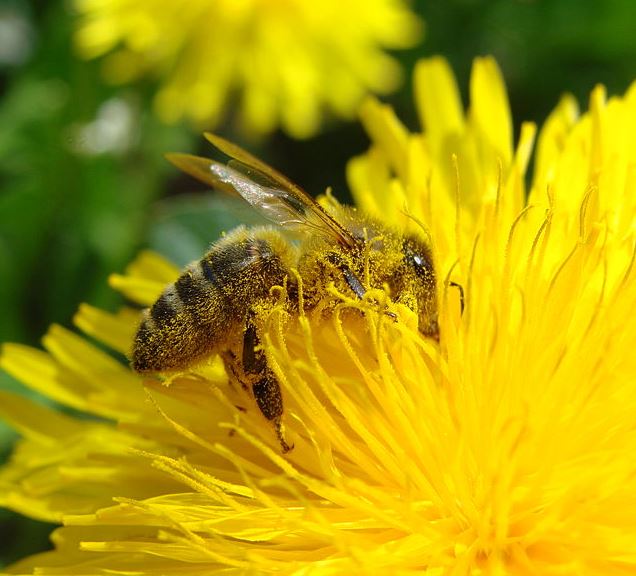
So, we have a clear milestone for unwrapping the hives and sleeping well at night: dandelion time. Depending on weather, dandelions bloom with intensity sometime between mid-April to late May.
For many years, here in Calgary, the peak dandelion flow was a few days either side of May 25. I used to teach this in our beginning beekeeping course. Then, a few years ago, peak dandelion was April 28. That year, the bloom was followed by strong sunshine and lack of rain, putting an end to the early flow. In thirty years of living and beekeeping in Calgary, I had never seen it come and go so quickly.
I started tracking peak dandelion and quit assuming it would occur on May 25. Now, thirty years on, it looks like May 15 is a better guess. An earlier dandelion flow is not necessarily a good thing. It might lengthen the dearth between spring flowers and dandelion and the typical start to sweet clover – unless, of course, sweet clover also begins to bloom earlier in these days of rapid climate change.
I have a few years of observations, but my records are nothing to boast about, especially compared to the longest-running ecological observations in the world.
Since 812, monks in Kyoto, Japan, have been meticulously observing peak cherry-tree blossoming every year. That’s 1200 years of notes. This year, 2021, peak cherry blossom happened on March 26, the earliest date ever recorded. Especially troubling is the trendline, below, which shows blossoms much earlier than in the past. (I created this chart from data kept at Osaka University. You can download your own copy here.)
The blue dots, above, are recorded peak blossoming dates while the red line is the polynomial trend line that best fits these data. If this trend continues into the future and is seen where you keep bees, be prepared for some unusual honey seasons. Already, here in southern Alberta, we have gained 17 growing days in the past 70 years. Whether you think a longer growing season in the area surrounding Calgary is good or bad, it certainly is different than it used to be.
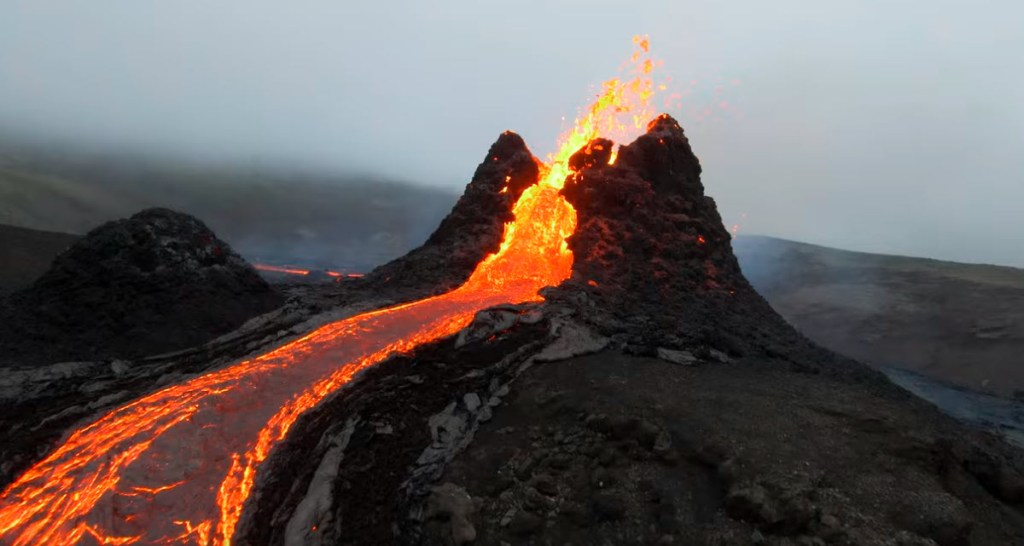
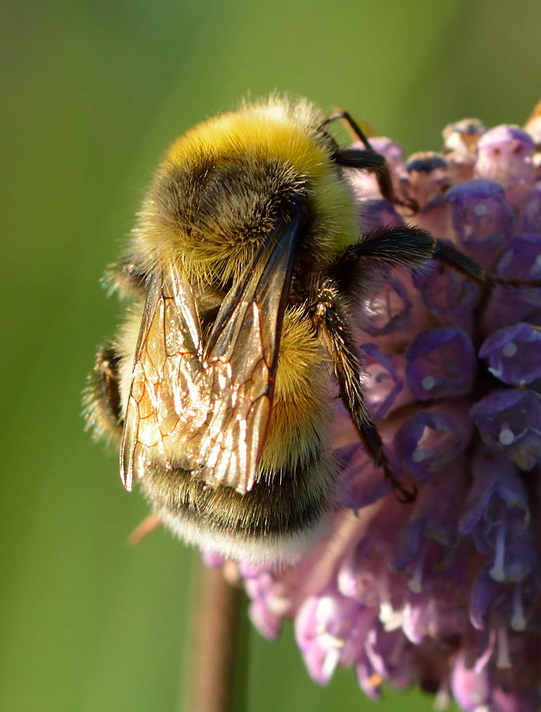
Iceland is more than spectacular volcanoes, ground quakes and rupturing continents. It has bees, too. Some say that the first founder bumble bee blew in with the wind. Others think that Iceland’s first bumble bee hitched a ride aboard a Viking ship, hidden among hay, ponies, and sheep on the 1,000-kilometre journey from the north of the British Isles. Bee DNA shows that the first bumble bee, Bombus jonellus, likely arrived on two distinct occasions, so both theories may be right. More recently, between 1959 and 2010, four other bumble bee species were found in Iceland. All these species are well-represented throughout northern Europe and likely arrived as stowaways.
Bombus jonellus, Iceland’s first bee Photo by Ivar Leidus
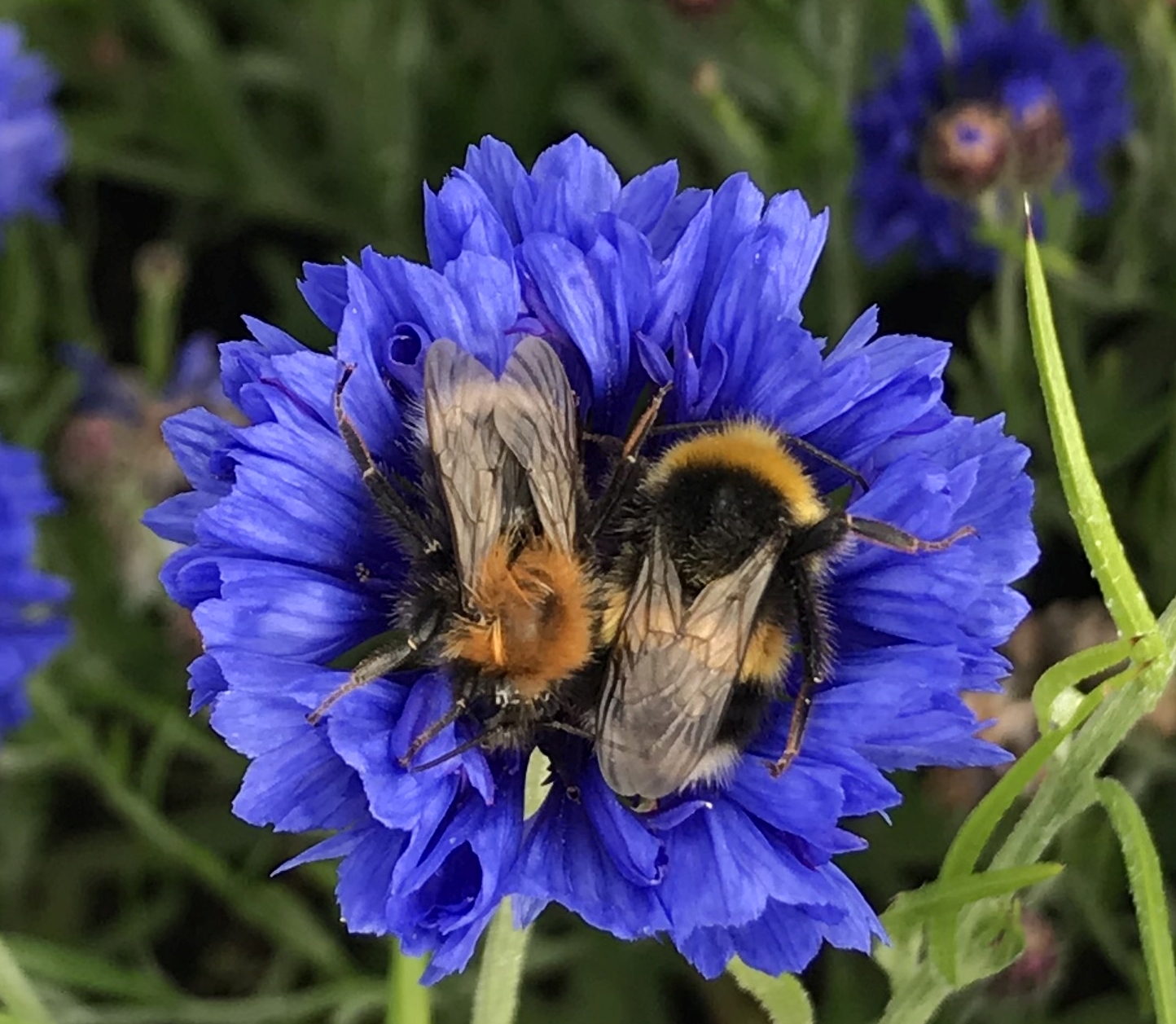
I have some problems identifying things. I am badly colour-blind. Also I often mistake my wife for a hat, so Dr. Anselm Kratochwil of the University of Osnabrück has kindly identified the species for me. The following photographs were taken in Reykjavik by family members and me.
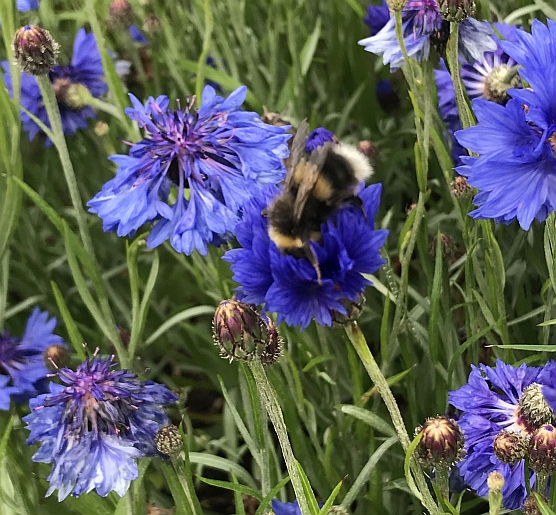
This is my favourite photo. It was taken on a cool rainy summer morning in the hilltop gardens at Hallgrímskirkja (Hallgrímur’s Church). The bees had been foraging the night before and camped out overnight. In the morning, they began twitching their muscles to warm up as soon as the rain ended and the sun shone. On this Centaurea cyanus (bachelor’s button) are Bombus hypnorum, left, with brown thorax hair and black abdomen, and on the right, Bombus lucorum, the White-tailed bumble bee. These are different bee species, of course, so their placid sharing of a bed was quite surprising.
Here’s another Bombus lucorum, foraging on Centaurea cyanus:
Yet another B. lucorum. It’s important, of course, to not frighten the bee.
The next bee, Bombus hypnorum, is the newest accidental arrival in Iceland. Once restricted to continental Europe, in the past 20 years it has colonized Britain and Iceland. Typically, Bombus hypnorum has a dark ginger thorax (mid-section) but this one has an unusual black thorax. She is visiting flowers of Syringa vulgaris (lilac).
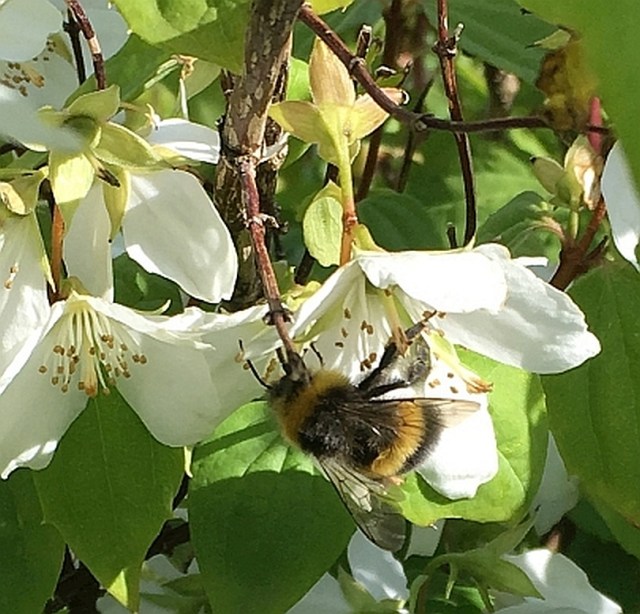
By now, Bombus lucorum’s thorax of light-yellow and black bands of hair and its abdomen of light-yellow and black bands followed by a white tail is familiar to you. The plant species is Philadelphus coronarius, which we call mock orange.
Thanks again to my sister, Jane, who took the best of these photos and to Anselm Kratochwil for all the identifications. I regret that I didn’t see honey bees in Iceland (another non-native insect on the island), but perhaps next time.
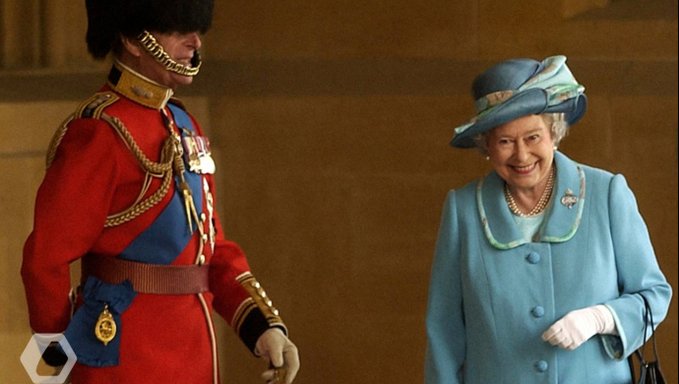
Well, I fell for this, too. It was too cute. And the story – Prince Philip dresses as a palace guard to prank the Queen of England – was enchanting. But completely wrong. Seems a swarm of bees descended on a royal ceremony, perhaps the birth of Saint Ambrosia.
The photo of the Queen giggling with Prince Philip involves bees, say Snopes and the BBC.
In the wake of the Duke of Edinburgh’s death, a photo from 2003 emerged of Queen Elizabeth II laughing with the Duke. Chris Young, the photographer who took the picture, spoke with the BBC about the day, and Snopes also says it was due to a swarm of bees at Windsor Castle during a review of the Grenadier Guards. Photo via @PAImages
No, Elizabeth and Philip aren’t laughing because he pranked her by dressing as a palace guard. They’re actually giggling at a sudden bee swarm causing a ruckus during a ceremony. “As colonel of the regiment, the duke was standing in full uniform, as he prepared to accompany Her Majesty.” – BBC News
The situation was not caused by a prank, but a swarm of bees. Also, Prince Philip wasn’t dressed as a palace guard.
The swarm settled under one of those little folding wooden chairs that guests are forced to sit on when they attend events such as this. You can see the swarm and the Beekeeper to the Rescue on the BBC website, here.
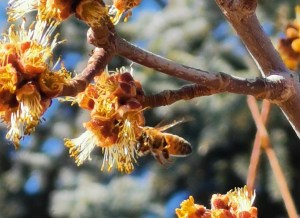
In mid-March, Stevo Sun, a Calgary resident, sent some gorgeous pictures of honey bees foraging on silver maple. Maple is an ornamental here, at our elevation and latitude. But for less than $250, you can pick up a young tree and drop it into your Calgary yard. I’ve seen some nice maples, now approaching 20 or 30 years in age – so, with care, they can survive our dry climate, short summers, and long cold winters. It may surprise some readers that maples don’t grow in every corner of Canada. There are parts of Canada where the maple appears only on flags, not in every front yard. For ubiquitousness, the bumble bee would have been a better symbol on our flag.
The maple and bee photographs were taken March 16, two weeks ago. That was a mild day, but not warm. (It was around 14 °C, 57 °F.) Our local internet chat group was buzzing with reports of pollen sightings. Optimism swept the city. But after that pleasant respite, the temperature fell far below freezing. Natural pollen didn’t return for ten days. The I saw tiny dots of pollen in one bee’s baskets, but I didn’t want to embarrass the little worker by taking a picture of her and her sad dab of pollen.
Pollen supplement: Saving the bees?
Because our spring is always slow arriving here in Calgary, I began feeding pollen supplement on March 26. Some readers may have begun in February. Today, the temperature here is a few degrees warmer than it had been in mid-March when the first pollen arrived. Colonies are brooding up quickly, with a several frames of open brood in each, but nary a speck of stored pollen. I placed some large pollen cakes (15% pollen with vegetable proteins) right above the brood. I have no doubt that this will be eaten within ten days and then I’ll be adding the next pollen supplement.
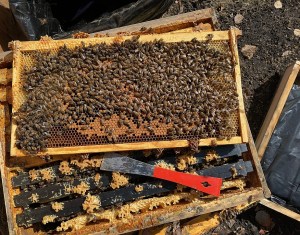
We recommend that beekeepers continue feeding pollen supplement (and honey or sugar, too) continuously until after the main spring flow starts and the weather is stable. A break in pollen supplement accompanied by a few days of bad weather may result in worker honey bees killing and eating much of their brood due to the lack of protein to feed it. In the next two pictures, you can see how nice the brood was on March 26, but looking closely, note the absence of pollen near the brood. Honey stores (about four frames) were nearby, but being consumed quickly. These bees needed food and I gave it to them.
Nice brood for our area in March.
Close-up: note the absence of pollen and honey stores.
Here in the Calgary area, we feed pollen supplement at this time of the year because spring weather isn’t reliably mild. The first teaser of natural pollen may be followed by days of freezing temperatures (it was this year). Honey bees aren’t flying enough to bring in the massive amounts of protein it takes to build their population. But I have another reason for feeding pollen supplement to honey bees. It might surprise you.
In most locations, it is almost impossible to overstock an area with honey bees during the peak flow. But before and after that brief time, there might not be enough pollen for all the bees in the area, resulting in stiff competition among bee species for a limited amount of food. This is especially true in the spring, when honey bees and native bees are building their brood nests. An overwintered honey bee hive will expand from almost no brood and ten thousand bees to ten frames of brood and forty thousand bees in two months. Observant beekeepers tell us that it takes one frame of pollen and one frame of honey to grow each frame of brood.” This would require about thirty or forty pounds of pollen to build the colony’s spring population.
Back-of-the envelope math suggests that if one colony of honey bees consumes thirty pounds of pollen, they will need to find 40 to 60 billion grains of pollen. With an estimated 50,000 pollen grains per flower, honey bees visit something like one million flowers to achieve this. Grain size and a flower’s pollen production rate will add a lot of variation to this number, of course. But you already see the point – supplying honey bees with pollen supplement will reduce a colony’s use of wildflowers and perhaps lessen its impact on native bees.
Today is World Apitherapy Day. And it’s my birthday. Coincidence? Maybe.
Apitherapy, which means using bee stuff for health, can include eating pollen, propolis, wax, royal jelly, bee larvae, and honey – or rubbing them on your face. But for many, apitherapy is bee sting therapy. Stings are sometimes promoted as a treatment for autoimmune disorders, like MS and rheumatism. Less frequently (but with more notice), bee venom is an ingredient in skin creams – as you can read here. (And here, here, and here.) However, a recent death due to a bee sting administered as apitherapy is newsworthy.
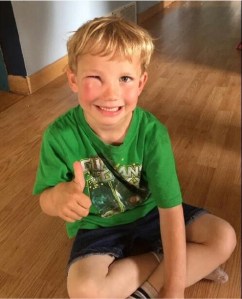
Just winking?
I don’t want to deflate the World Apitherapy Day balloon, but if you’re not careful, bee sting therapy can be fatal therapy. Most long-time beekeepers have been stung thousands of times (That’s not an exaggeration.) without adverse effects. But for some people, a bee sting can be much worse than a bit of swelling, redness, and pain. A single bee sting can kill. Although bee sting therapy may work wonders on some auto-immune syndromes, stings might send a patient into systemic shock. That’s what reportedly happened to a woman in Spain.
She had been treated without incident on several earlier occasions, but this time, the woman went into shock and never regained consciousness. She later died from organ failure at hospital. Such bee-therapy fatalities are rare. Only one other treatment is known to have ended a life. However, a meta-analysis of several hundred studies showed that a significant number of therapies have caused serious reactions. The figure given in the analysis (Risk Associated with Bee Venom Therapy: A Systematic Review and Meta-Analysis) indicated that 12% of people undergoing bee venom therapy from live stings (as opposed to physician-administered controlled injections of bee venom) experience serious reactions.
In two of the courses which I help teach – Making Money from Honey and Beginner’s Beekeeping, We always show a slide about bee sting therapy. For the beginners’ group, I mention it because many new beekeepers know the health benefits of a jab of bee venom, as seen on YouTube. We try to be sure that they understand the risks involved. For more advanced beekeepers, I mention bee sting therapy as something they may have considered as a source of income (and a way to help people). In both courses, I strongly advise against applying stings on anyone. Intentionally inflicting bee venom so that a client may gain health benefits might be considered “practising medicine without a license.” And you could kill someone.
This leads me to look again at the role of bee-sting therapy as a treatment for Covid-19.Back in June 2020, I wrote about scientists in Wuhan, China, who claimed that beekeepers in the area didn’t get the virus. They claimed that bees had protected the beekeepers:
“In Hubei province, the epicentre of COVID-19 in China, the local beekeepers association conducted a survey of beekeepers. A total of 5115 beekeepers were surveyed from February 23 to March 8, including 723 in Wuhan, the outbreak epicentre of Hubei. None of these beekeepers developed symptoms associated with COVID-19, and their health was totally normal.”
I was skeptical. In fact, I wrote: “I have limited confidence in their study because it has grandiose statements and is a one-off. But it was allowed on the US government’s National Institute of Health website, so maybe it carries some truth. I’ll leave it to you to decide, but I still don’t fully trust it. The paper makes bold claims about the extreme effectiveness of bee stings as protection against Covid-19. In short, it seems too good to be true.”
It looks like I’m not the only one who had doubts about the report from China. Maybe honey bee stings aren’t really working against the Covid virus. A peer-reviewed paper, Beekeepers who tolerate bee stings are not protected against SARS-CoV-2 infections, published six months after the Chinese study, disagreed with the earlier report. In the new study, German researchers contacted the German-beekeeping community requesting information on beekeepers who had been in contact with Covid. Based on Germany’s population (82 million), and the percent who are beekeepers (0.2%), along with the number of people exposed to the corona virus during the study period, the researchers calculate that about 540 beekeepers in Germany were in direct contact with the virus. They managed to find 234 of them. Of those 234, 2 died and 45 became quite sick from the virus. Remember, the Chinese scientists claimed that out of 5115 Wuhan-area beekeepers, none died nor became ill. The German researchers reject the Chinese findings:
“The study shows that beekeepers are not immune to infections caused by the novel coronavirus SARS-CoV-2. Especially, our data do not support the hypothesis that beekeepers are not affected by SARS-CoV-2 due to their exposure to bee stings and the associated immunity. The severity of the disease was not influenced by various variables like how long they had been a beekeeper, total number of bee stings received, number of bee stings received in the year 2020 and potentially allergic reactions to bee stings.”
This doesn’t mean that bee sting therapy has no use in medicine. But it does remind us to be cautious and question what we hear or read. Maybe the German study isn’t perfect, either. However, my blue-pill aversion swings into overdrive whenever anything sounds too good – or any study shows extremely confident numbers, as the Wuhan study did.
Filip Terč, Father of Apitherapy 1844-1917
You may wonder why March 30 is World Apitherapy Day. Today is not only my birthday, but it’s also the birthdate of the most important early promoter of healthy bee stings, Filip Terč, whom you see glaring at you adjacent to this sentence. Terč practiced medicine in Maribor, Slovenia, over a hundred years ago. As a young man, he suffered badly from rheumatoid pain until, at age 22, he was accidentally stung by an defensive mob of irritated honey bees. It changed his life. His pain was gone.
Terč began a serious study of the effects of bee venom therapy. He published the first clinical trials of the therapeutic effects of bee stings in the 1888 publication “Report on the Peculiar Connection between Bee Stings and Rheumatism”. He presented the results of treating 680 patients with the collective application of 39,000 stings. (An average of 60 stings/patient, administered over several months.) He claimed that 82% experienced a complete cure, 15% had partial recovery, and just 3% had no relief from their rheumatoid condition. Although his work was published over a hundred years ago and his results have not been disputed, the medical profession is still cautious about the link between rheumatism, auto-immune dysfunctions, and some of the elements of bee venom. With immune disorders ranging from multiple sclerosis to allergies on the rise, the use of apitherapy treatments are finally becoming more accepted and generally more widely available. So, with cautious caveats, celebrate World Apitherapy Day. (And send regards to all those beekeepers with birthdays today).
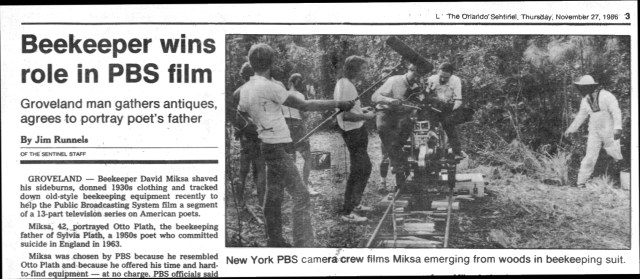
I discovered Sylvia Plath in the ’80s. PBS asked my oldest brother to pose as Sylvia’s father in their documentary of the great American poet. PBS was looking for a man who resembled Sylvia’s father, a German immigrant named Otto Plath. PBS also needed a set that would pass as Otto Plath’s Massachusetts. Finally, they wanted bees that resembled the bumble bees that Dr Plath studied. PBS chose Florida to play Massachusetts and my non-German brother as Otto, the bumble bee scientist who was Sylvia Plath’s father.
Otto Plath was an entomologist, specializing in bumble bees. At home, he kept a few hives of honey bees. Donning a beekeeper’s uniform, my brother comes and goes throughout the documentary, as Otto Plath himself seemed to, in the eyes of young Sylvia. Otto died when Sylvia was eight. This had an indelible effect on her life.
I found the PBS documentary on YouTube. Here is a very short clip that shows my brother, David, as the ephemeral Otto, as Sylvia remembered him.
Watch the series, on YouTube, beginning with the first segment here. The hour-long documentary is comprised of six short pieces. I hope that you will watch the entire story of a beekeeper’s daughter.
If you haven’t read any of Sylvia Plath’s confessional poetry, please do. It may be difficult for us, during this dismal pandemic, to disappear into the dark world of this brilliant young lady who died on her final suicide attempt, aged just thirty, 58 years ago today. But reading Plath is something we can do in her memory. And it will make us better.
Plath struggled for years with her severe depression. And with her unconventional perspective on the landscape of our lives. And with her sheer brilliance and talent. A 160-IQ can be hard to focus. Her paintings won awards. Posthumously, she was honoured with a Pulitzer for her poetry. An over-achiever, she had worked as a successful model and had kept a journal from age 11. Near the end of her brief life, she kept honey bee hives in her English garden. Finally, she was mum to her children, Frieda and Nicholas.
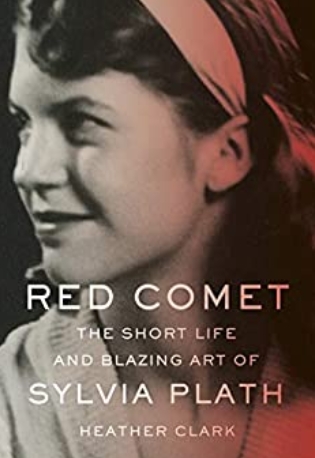
The definitive biography of Sylvia Plath was published this fall. Red Comet: The Short Life and Blazing Art of Sylvia Plath, by Heather Clark, takes its title from Plath’s poem called “Stings”, which Sylvia Plath wrote from the perspective of a woman who sees herself as a red comet, a bee, flying against an expansive blue sky. The woman shows bravery – handling the bees barehanded, just as the male bee-seller who had brought her the hive. Then, she begins worrying about the hive, wondering if it even has a queen. All, of course, symbolizes the real Sylvia Plath, worried, weak, strong, destined. Heather Clark’s 1,114-page biography, Red Comet, was celebrated at its October release:
“The full, complex scope of poet Sylvia Plath’s life and writing is given a bracingly thought-provoking reexamination in this massive—and massively absorbing—biography.” —The Christian Science Monitor
“Mesmerizing . . . Comprehensive . . . Stuffed with heretofore untold anecdotes that illuminate or extend our understanding of Plath’s life . . . Clark is a felicitous writer and a discerning critic of Plath’s poetry . . . There is no denying the book’s intellectual power and, just as important, its sheer readability.” —Daphne Merkin, The New York Times
“One of the most beautiful biographies I’ve ever read.” —Glennon Doyle
“Revelatory . . . Plath’s struggles with depression and her marriage to Ted Hughes emerge in complex detail, but Clark does not let Plath’s suicide define her artistic achievement, arguing with refreshing rigor for her significance to modern letters. The result is a new understanding and appreciation of an innovative, uncompromising poetic voice.” —The New Yorker
Several of Sylvia Plath’s signature poems are about her father, bees, and beekeepers. Here’s one of my favourites.
The Bee Meeting, by Sylvia Plath
Who are these people at the bridge to meet me? They are the villagers—
The rector, the midwife, the sexton, the agent for bees.
In my sleeveless summery dress I have no protection,
And they are all gloved and covered, why did nobody tell me?
They are smiling and taking out veils tacked to ancient hats.
I am nude as a chicken neck, does nobody love me?
Yes, here is the secretary of bees with her white shop smock,
Buttoning the cuffs at my wrists and the slit from my neck to my knees.
Now I am milkweed silk, the bees will not notice.
Thev will not smell my fear, my fear, my fear.
Which is the rector now, is it that man in black?
Which is the midwife, is that her blue coat?
Everybody is nodding a square black head, they are knights in visors,
Breastplates of cheesecloth knotted under the armpits.
Their smiles and their voices are changing. I am led through a beanfield.
Strips of tinfoil winking like people,
Feather dusters fanning their hands in a sea of bean flowers,
Creamy bean flowers with black eyes and leaves like bored hearts.
Is it blood clots the tendrils are dragging up that string?
No, no, it is scarlet flowers that will one day be edible.
Now they are giving me a fashionable white straw Italian hat
And a black veil that molds to my face, they are making me one of them.
They are leading me to the shorn grove, the circle of hives.
Is it the hawthorn that smells so sick?
The barren body of hawthorn, etherizing its children.
Is it some operation that is taking place?
It is the surgeon my neighbors are waiting for,
This apparition in a green helmet,
Shining gloves and white suit.
Is it the butcher, the grocer, the postman, someone I know?
I cannot run, I am rooted, and the gorse hurts me
With its yellow purses, its spiky armory.
I could not run without having to run forever.
The white hive is snug as a virgin,
Sealing off her brood cells, her honey, and quietly humming.
Smoke rolls and scarves in the grove.
The mind of the hive thinks this is the end of everything.
Here they come, the outriders, on their hysterical elastics.
If I stand very still, they will think I am cow-parsley,
A gullible head untouched by their animosity,
Not even nodding, a personage in a hedgerow.
The villagers open the chambers, they are hunting the queen.
Is she hiding, is she eating honey? She is very clever.
She is old, old, old, she must live another year, and she knows it.
While in their fingerjoint cells the new virgins
Dream of a duel they will win inevitably,
A curtain of wax dividing them from the bride flight,
The upflight of the murderess into a heaven that loves her.
The villagers are moving the virgins, there will be no killing.
The old queen does not show herself, is she so ungrateful?
I am exhausted, I am exhausted—
Pillar of white in a blackout of knives.
I am the magician’s girl who does not flinch.
The villagers are untying their disguises, they are shaking hands.
Whose is that long white box in the grove, what have they accomplished, why am I cold.






 Since 812, monks in Kyoto, Japan, have been meticulously observing peak cherry-tree blossoming every year. That’s 1200 years of notes. This year, 2021, peak cherry blossom happened on March 26, the earliest date ever recorded. Especially troubling is the trendline, below, which shows blossoms much earlier than in the past. (I created this chart from data kept at Osaka University. You can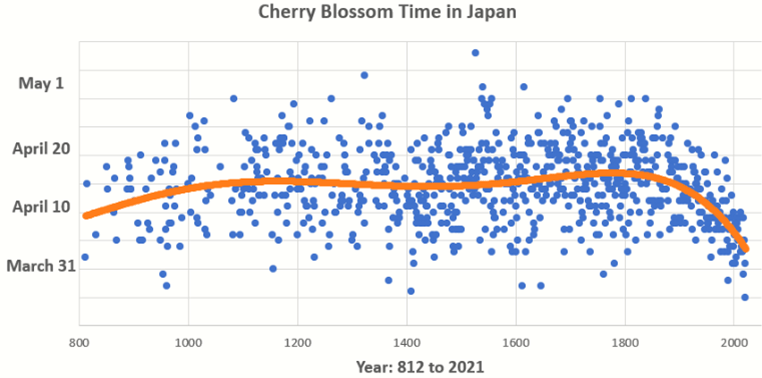



 The maple and bee photographs were taken March 16, two weeks ago. That was a mild day, but not warm. (It was around 14 °C, 57 °F.) Our local internet chat group was buzzing with reports of pollen sightings. Optimism swept the city. But after that pleasant respite, the temperature fell far below freezing. Natural pollen didn’t return for ten days. The I saw tiny dots of pollen in one bee’s baskets, but I didn’t want to embarrass the little worker by taking a picture of her and her sad dab of pollen.

 In most locations, it is almost impossible to overstock an area with honey bees during the peak flow. But before and after that brief time, there might not be enough pollen for all the bees in the area, resulting in stiff competition among bee species for a limited amount of food. This is especially true in the spring, when honey bees and native bees are building their brood nests. An overwintered honey bee hive will expand from almost no brood and ten thousand bees to ten frames of brood and forty thousand bees in two months. Observant beekeepers tell us that it takes one frame of pollen and one frame of honey to grow each frame of brood.” This would require about thirty or forty pounds of pollen to build the colony’s spring population.


 Plath struggled for years with her severe depression. And with her unconventional perspective on the landscape of our lives. And with her sheer brilliance and talent. A 160-IQ can be hard to focus. Her paintings won awards. Posthumously, she was honoured with a Pulitzer for her poetry. An over-achiever, she had worked as a successful model and had kept a journal from age 11. Near the end of her brief life, she kept honey bee hives in her English garden. Finally, she was mum to her children,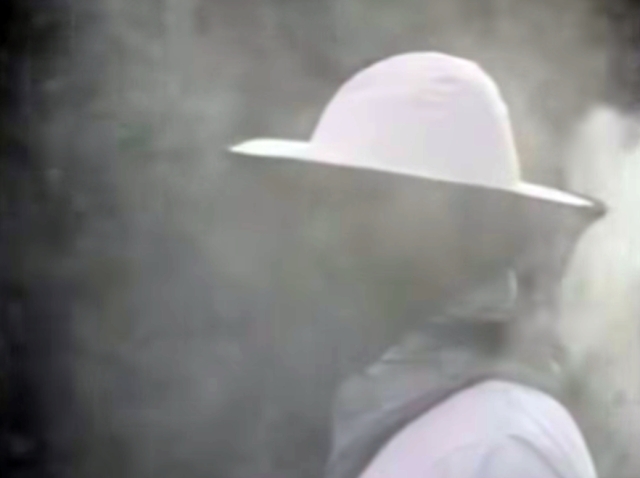
 Bad Beekeeping Blog