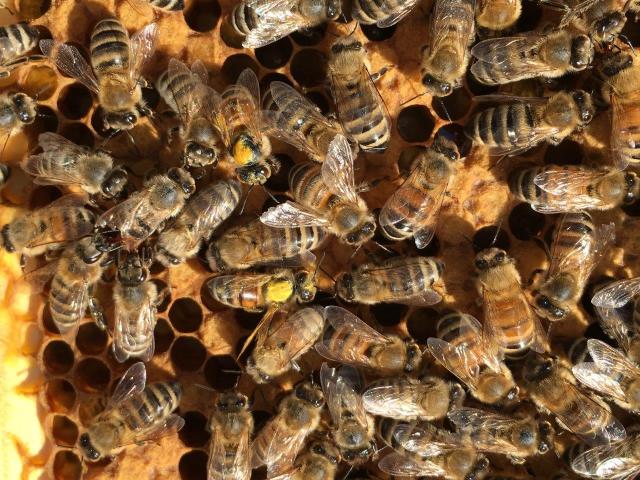
My friend Stephen was helping a new beekeeper when they spotted these spotted honey bees. It almost looks like someone was doing a science experiment using marked bees. It’s probably sticky pollen that got glued to the bees’ blind spots – the spot where a bee can’t reach to scratch her itch or her stuck pollen. Stephen says there were five or six of these bees. Have you ever seen anything like this?
Yellow-dusted honey bees. A new species? Freaks of nature? Supernatural phenomena? What do you think? (Photo credit: Stephen Bennett)
Originally posted on LSE Bees: Can you spot anything wrong with the book cover shown below? (The answer is below the picture.) Yes, the insect in question is a fly, not a bee. In a similar vein, a Guardian article about bees published…
Whatever happened to the Killer Bees? Killer Bees – more accurately, hybrids of European and African honey bees – were supposed to destroy the world, or at least kill a lot of people trying. They started out in Brazil, not far from the Olympics venues. So why didn’t they show up at the games? Brazil was plagued with slimy water, fires in athletes’ dorms, robberies, a presidentialimpeachment, bullets in bus windows, doping scandals, ticket scandals, a gas station scandal, and, on the last day, an indignant Mongolian coach who stripped off his clothes and threw them at the judges.
I was sure that a massive swarm of eight million killer bees would drop from the sky during closing ceremonies. But along with the massive numbers of local volunteers who didn’t show up, massive amounts of bees were also no-shows.
What does this mean for Brazil’s reputation on the world stage when its own killer bees boycott the event? News reporters ignored bees altogether. That wasn’t the way it was in Brazil a few years ago.
Here’s the backstory. African honey bees arrived in Brazil in 1956. They were brought by a geneticist who was trying to develop a better bee for Brazilian farmers. Brazilian farmers had been using stock which was brought to Brazil from Portugal centuries earlier. Those bees were not well-adapted to the tropical climate. African bees are hardier, healthier, and better producers than European stock, especially in tropical climates. So, 26 queen bees from Tanzania arrived in Brazil to help Brazil’s honey production and pollination. How did that work out? Actually, very well for the beekeepers and the country’s agriculture.
The African bee turned into the Africanized bee in 1957 when the local European bees interbred with the new arrivals. This was supposed to happen in a controlled project over a few years, but a technician helping with the breeding program mistakenly removed wire screens from the pure African queens’ hives, allowing them to escape. This ruined the bee breeding program. The new hybrid Africanized strain became feral, populating the surrounding rain forest. Eventually, the Africanized genes spread throughout the American tropics, creating a hybrid which is more aggressive than the generally docile European strain. The new strain has been called the Africanized Honey Bee (AHB), though the press dubbed the offspring Killer Bees following reports that beekeepers and by-standers were being killed by the new bee-blend.
As the AHB’s genetic stock approached the northern hemisphere, stories about the bees’ attacks on people became more and more sensational. There were some disturbingly inaccurate pseudo-science documentaries. Some showed that the bees were a communist plot to destroy America, or at least were a notice from God that He’s irritated with us all. The excitement climaxed in horror movies that delighted voyeuristic viewers.
Killer Bees (1974), The Swarm (1978), Deadly Invasion: The Killer Bee Nightmare (1995), Killer Bees! (2002), and Killer Bees (2008) all had their charms, of course. The most successful of the lot, Arthur Herzog’s The Swarm, imagined killer bee attacks that claimed 37,000 lives, instigated the explosion of a nuclear power plant, and lit the entire city of Houston with a fireball of Armageddon proportions. The movie starred Henry Fonda, Micheal Caine, Olivia de Havilland and other big names, but it still hit the list of worst films ever made. The recurring theme of deadly bees running amok and attacking and killing with little warning reinforced the common dreadful fear that honey bees have an unpredictable dark side.
Well, with all those reports of Assassin Beesoverrunning the country, we figured it was game over for Brazil’s fledgling honey industry. But a funny thing happened on the way to death and destruction. Brazilian beekeepers got used to the bad bees. They learned to manage them. European bees were outpaced by the new African arrivals. It seems that tropical bees perform better in the tropics than non-tropical bees. Brazil’s annual honey production quickly rose from 15 (pre-AHB) to over 110 million pounds (post-AHB). This was noticed by some of the American media. In 1994, L.A. Times headlined: “Brazil’s honey production has soared since the ornery invaders took over beekeepers’ hives”.
I don’t want to trivialize the tragedies that happen when people stumble across Africanized bee nests. Although the bees can be kept and managed by beekeepers, they are much more defensive than the European stock we typically keep in the north. Instead of a few stings from a hive, the Africanized bees may defend with a few hundred stings. Venom overload can kill – about 50 known deaths due to massive stinging have occurred since the bees arrived in the 1950s, but the actual total may be twice that. (Though still short of The Swarm’s 37,000 deaths.)
Regardless the predictions (some of them made by notable bee scientists), Africanized bees did not destroy North American agriculture. Although they’ve been in the USA since 1990, they didn’t reach Washington D.C. by 1995 as many expected. Africanized bees barely spread past Louisiana in 20 years. Some that arrived on cargo ships in Florida years ago haven’t expanded very far nor have they interfered much with normal beekeeping and farming in the sunshine state. Africanized bees roamed around a bit more on the west coast, but millions of out-of-state hives continue to arrive each winter to pollinate the almonds – and they apparently head back to Maine and Montana and elsewhere non-Africanized. In short, the hype was mostly hype.
Meanwhile, in the original homeland of the hybrid bee, Brazil’s Africanized bees didn’t make pre-game chatter even when the announcers were so bored that they resorted to discussing one athlete’s favourite books. The bees were far below international radar. To be fair, when it became apparent that the killer bees would be a no-show, Brazil did manage to conjure up millions of Zika-infested mosquitoes, partly redeeming the reputation of the country’s miscreant insects.
Please folks, don’t feed honey to babies. Just like spinach and sandbox bugs, honey may (rarely) contain botulism spores.
Today I heard about a huge celebrity bash in Washington, D.C., for a one-year-old’s birthday. It bugged me that the birthday treats included a frozen cake made of all-natural fruit juice (which is probably OK) and honey smeared on posts where party-goers could lick it. You can read the details here.
Just because the National Zoo serves honey to little Bei-Bei on his first birthday, that doesn’t mean you can give honey to little Jacob-Jacob on his. In fairness to the zookeepers, pandas probably have different tummies than people. And the panda’s mom ate most of the honey.
Neil Bertram apiary – Saturday at the Hive visitors
I live in Calgary, Alberta, Canada. It’s a remarkable city. Economist magazine ranks us as the world’s fifth-best city (they place Vancouver and Toronto as 3rd and 4th) while the international agency the Mercer Group says Calgary has the cleanest environment of any city on Earth – clean air, clear glacial water, tidy streets. Both Economist and Mercer failed to mention that Calgary also has the best beekeepers’ club in the world.
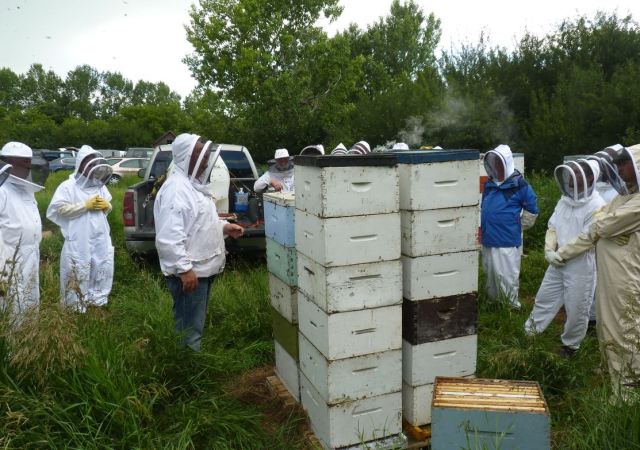
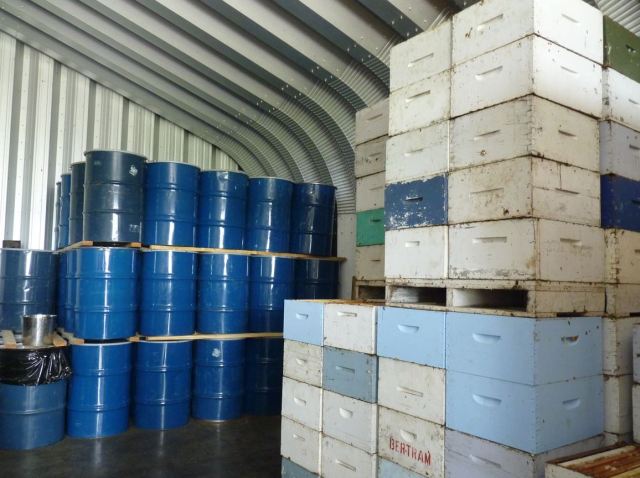
I’ve spilled many a pixel raving about the Calgary Bee Club and its education programs, school outreach, swarm collection, bee community projects, honey shows, and diverse meetings, so I won’t do that again today. Instead, I have a few photos (thanks to Liz Goldie) from one of our club’s weekly summertime “Saturday at the Hive” events. A couple of weeks ago, my friend and fellow bee instructor Neil Bertram invited 35 of his closest friends to see his bees and tour his off-grid honey shop in central Alberta. Neil runs a bit over 300 producing hives and makes about 60,000 pounds of honey almost every year. He wholesales most of it and he keeps his costs down by doing his own building, repairing, beekeeping, and extracting.
Neil Bertram enthusiastically shares what he knows. Hundreds of beekeepers have become better beekeepers because of Neil’s commitment and his living example of better beekeeping. I’d better add this disclosure, too: Neil co-stars in our hit program Making Money from Honey. Without his work and support on that project, Money from Honey wouldn’t be nearly as good as it is.
Photos on this page were graciously provided by my bee buddy, Liz Goldie.
Saturday at the Hive, Alberta style:
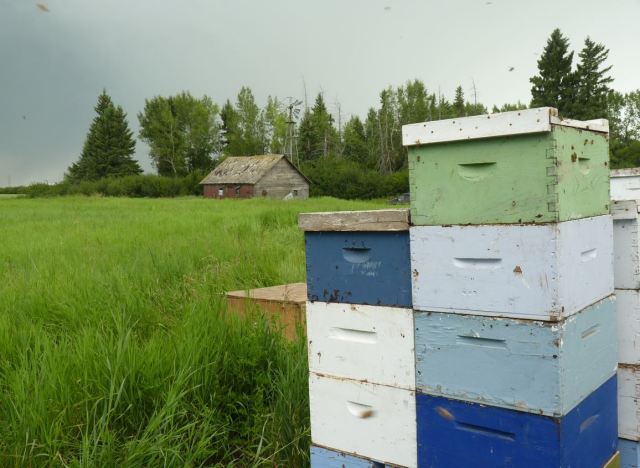
Neil keeps several typically scenic Canadian apiaries.
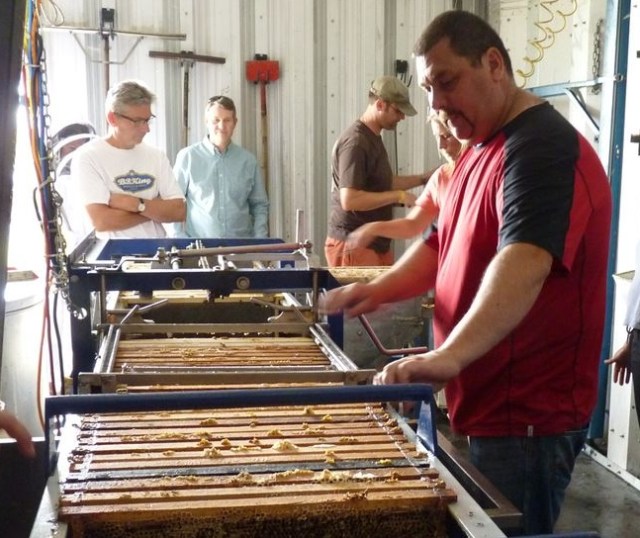
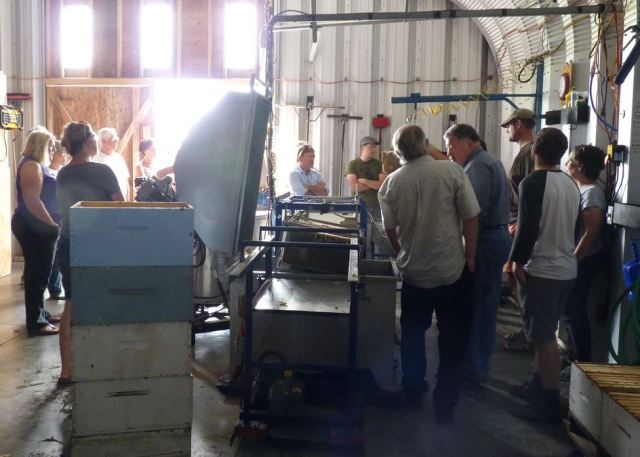
Neil demonstrates his extracting line.
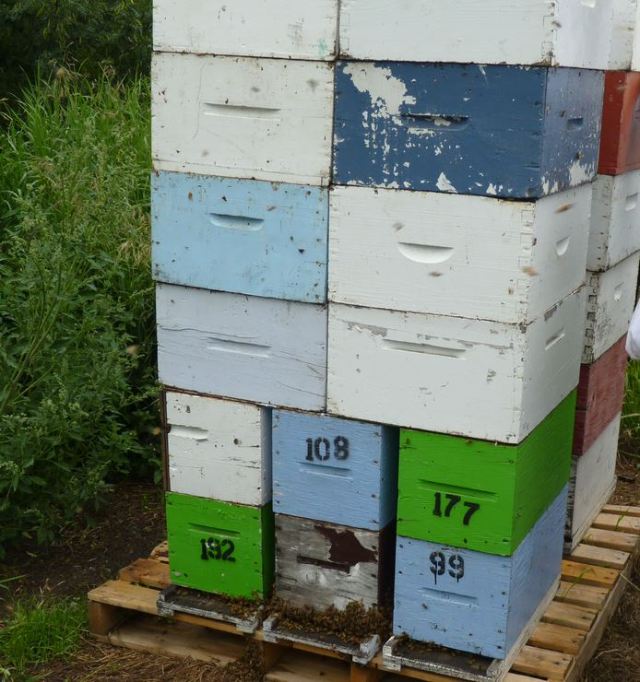
Some of Neil’s crop comes from his 3-way splits, housed in the nucs at the bottom. The bees share the honey supers, stacked above.
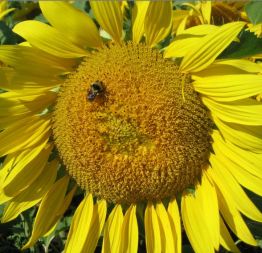
Recording bee visits on domesticated sunflowers in Alberta, Canada.
It can feel a little creepy, sitting on a bench on the edge of a sunflower forest with your back to the sun. In that position, all the sunflowers are looking at you. If it’s morning.
The marvel of the ‘sun’ flower didn’t escape the notice of North American natives. Various pre-Columbian cultures domesticated sunflowers about 5,000 years ago. Mexico’s Aztec adopted the sunflower as a religious symbol, as have some new-ager cults. It’s a sun symbol because of its solar shape and colour, not because it ‘follows the sun’ across the sky.
Not only are a sunflower’s eyeless- and lipless-heads creepy, but math profs tell us that the flower goes out of its way to creep them out, too. Its florets form a Fermat’s spiral, building a 137.5° angle that is related to da Vinci’s golden ratio, because 137.5° is 55/144 of a (360°) circle and the numbers 55 and 144 are Fibonacci rabbit numbers.
Most of us think that the huge sunflower flower always twists toward the sun, but most of us are wrong most of the time. We cheerfully live with the sunflower misconception – until it’s interrupted by Wikipedia or some other reliable source. As it turns out, sunflowers do face east to catch the morning sun and rotate west as the day progresses (here’s a video)- but they only do this while they are young and gaining height. Once mature, the sunflower blossom gets stuck facing east. Bee scientists think that the flowers are stalled on “east” once their heads mature because the massive flower collects solar heat, which enhances nectar secretion, which attracts pollinators.
A Dakota beekeeper told me that he liked to place his bees on the east side of big acreages of sunflowers so that his bees would see the flowering heads first thing in the morning and they wouldn’t waste time flying around to the other side of the plant, which they’d have to do if he put his colonies in a different spot. (He was a fussy beekeeper.)
My friend favoured sunflowers because, in his area, they make a nice bit of honey – usually about 30 kilos (60 pounds) per hive per year. Most of that honey comes on warm July days, though up here in Alberta the flowers peak in early August. Each head has about 1,500 florets. The first to open seem to offer the most nectar. From first flowering to last withering sunset, about three weeks passes. With staggered timing of seeding and individual plant variations, beekeepers may have a four or five week sunflower nectar flow. When given a choice though, beekeepers in my part of the world (western Canada) prefer sweet clover and alfalfa – sunflower honey is darker and it granulates quickly because of its high glucose content. But the plant is a fun flower and some mystic types off folks like to eat honey from the symbol of the sun, so the stuff sells well.
The sunflower does, in fact, spin around as it chases the sun across the sky, but only when the plant is gaining height.
This was discovered years ago. The side pf the stem receiving more sunlight grows a tiny bit faster, hence twisting the plant as the day goes on. It’s the twisting that makes the immature sunflower follow the sun. When growth stops, the flowery faces face east.
The biggest mystery is the immature sunflower’s nightly backward twist. Returning to the east where it waits for sunrise. Turns out that domesticated sunflowers (Helianthus annuus) have a circadian clock that tells the plant when to return to the east. This idea was established in a sealed lab where sunflowers were raised with constant light but no sunshine. For a few days, young lab sunflowers continued twisting towards the east every twelve hours, but with the constant light, they got smart and the habit died.
All of this – circadian rhythms, internal clocks, memory – reminds me that plants are people, too, and should be treated with respect. Unless we’re hungry.
Fly laying eggs inside a honey bee. The first step in zombee-ification. (Credit Wiki)
I wish I had good news. Canada’s first confirmed case of zombees has appeared – on Vancouver Island, out in the Pacific. Hundreds of kilometres from my home in Calgary. Zombie zombees, like the human kind, are undeads who are unalive and have little control over their bodies. Zombees would like to cluster and enjoy family time in the evening, but their inner demon forces them to fly out of the hive and head towards street lamps as soon as it grows dark.
(Trigger warning: Yuck stuff ahead.) Zombees are ordinary honey bees whose bodies have been invaded by the larvae of a small parasitic fly. The Apocephalus borealis deposits eggs into a bee’s abdomen. These hatch into worms that live inside the bee. Honey bees with parasitic worms end up out of control. They are doomed to die miserable deaths and seem compelled to visit porch lights at night. Eventually maggots erupt from the honey bee, escaping near the spot that the bee’s thorax and head join. Not a good time for the bee.
I first wrote about Zombees over four years ago, when they were discovered in honey bees in California. Since then, a few have appeared in Vermont, the Dakotas, and now Nanaimo, British Columbia. Researchers believe that the parasitic fly normally uses other bee types as hosts and their move to honey bees may be new. This is possible. To me it may indicate that native bees are stressed and have reduced populations, making them harder for Apocephalus borealis to find and infest. As a result, the much more common honey bee has become their occasional target. It’s also quite possible, I think, that we’ve only now begun to pay attention to bees around lights at night. That would explain why there are few cases and why they are scattered around the continent. We tend to only find things if we look for them. (If you think you’ve made your own zombee sighting, you can report it on the ZomBee Watch website.)
Zombee map: Red confirms zoms – including Vancouver Island. (Credit: ZomBee Watch)
Hopefully, zombees will not be a serious problem. Beekeepers don’t need another pest. It’s likely that this parasitic fly, which is native to North America, has been mixing it up with various bee species for a long while. The rarity of Zombie bees is likely to remain. Perhaps they will be such an uncommon novelty that we will want to buy Apocephalus borealis kits to infest a few bees at children’s birthday parties or at the local bee club’s pub night. For amusement.
All of my life I have assumed that when a poet writes about nature, he/she is just winging it. To me, “…As trod the crimson twilight’s face…” is just a pleasant concatenation brewed in a dark basement by a moody wordsmith. It’s delightful to learn that some poets actually describe their environment with details that a keen sleuth can turn into a biodiversity record that indicates the decline of the Red-shanked Carder. Thanks, Jeff Ollerton, for your post. It was enjoyed! And now it’s shared…
John Clare is one of the most celebrated English poets of rural landscapes and nature in the 19th century. To quote his biographer, Clare was “the greatest labouring-class poet that England has ever produced. No one has ever written more powerfully of nature”. Not only that, he was born and lived for much of his life in my adopted county, hence his epithet as “The Northamptonshire Peasant Poet”.
One of his less well-known poems is called Wild Bees and is a stunning example of Clare’s ability to make detailed observations of the natural world and to translate those observations into poetry. So good are those observations that, as I show below, it’s possible to identify Clare’s bees from the descriptions he gives. First of all, here’s the full poem:
Wild Bees
These children of the sun which summer brings
As pastoral minstrels in her merry train
Pipe rustic ballads upon busy wings
I’ll never understand vandalism. Theft I understand. I don’t like it, I don’t condone it, I’ve been victimized by it. But I can understand how it might sometimes happen. Vandalism, however, is strange. And stupid.
Vandalism is nothing new. The very word comes from the Vandal people, a fifth-century Germanic tribe. The Vandals sacked and looted Rome. They also allegedly defaced artwork and statuary, lending their name for all time to idiots who vandalize. When I was a kid, we experienced the occasional apiary vandalism. Someone would enter one of our bee yards at night and flip over a hive or two. I suspect there was always more than one vandal involved – there would be little joy in hive flipping (or cow tipping or Smart Car flipping) if you are out in the dark by yourself, vandalizing alone. No, I’m rather certain its a participation sport. When I kept bees in the badlands of southern Saskatchewan, my hives were vandalized just once. Three ranch boys lifted two hives from one of my yards at night, planning to drive into town to dump the bees off the back of their truck. They didn’t make it. But they learned that the cover of darkness provides the worst time to abuse bees.
With the steady decrease in crime of all sorts in North America, vandalism also seems on the decline. So I was surprised to hear that a dozen colonies were wrecked by vandals in southern Alberta, about two hours from my home. Southern Alberta is a religious, family-farm, small-town sort of place. I was dismayed to learn that idiots are in their midst – but no place has immunity from the stupid.
It happens everywhere: These hives were vandalized near San Francisco. (The owners need help: see their site.)
News reports (here and here) describe the vandalized colonies as being on pallets, pretty much ruling out hobby bees. The area is home to several big commercial operators who keep hives near hay fields and canola farms that fill the rich farmland. Twelve commercial colonies were destroyed at a loss of $9,000. That’s $750 per hive. Maybe that sounds high, but this happened at the start of the honey flow which would have brought $400 worth of honey from each hive. Replacement packages cost $150 and won’t make any money this year, but still need care, attention, and investment to build up for next season. New boxes, frames, drawn-out combs, lids, pallets and the like aren’t cheap, either. And there’s the cost of cleaning up the mess.
If the culprits are found and if I were the judge, I think I’d take away their truck, charge them $9,000, and then force them to work as commercial beekeepers so they suffer for the rest of their lives.
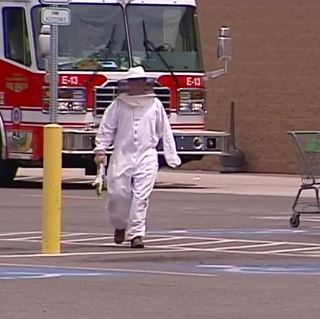
Sounds like a drug deal gone wrong. They met at a Walmart parking lot to do their business, the public panicked and three bystanders ended up at hospital. It turned out to be a sting operation.
Hero beekeeper mops up stray bees and saves shoppers. (KOCO News)
The deal was a Saturday morning bee hive sale. The bystanders were stung and taken to a hospital. I suppose that the guys making the swap thought the Oklahoma City Walmart parking lot was a safe and convenient place to do some beekeeping. Definitely convenient, but apparently three hives were changing hands when something went dreadfully wrong. Bees got loose, people were stung, and the fire department was alerted. The guys with hoses called guys with veils as reinforcement. The Walmart had to close until the situation was secure. I watched the news videos – it looks like fire trucks, an EMSA van, several beekeeping trucks, and assorted police and emergency people were involved. Along with the hospital care for the sting victims and the big box store’s lost business, this must have cost everyone a few thousand dollars. There really are no other details about this weekend’s mishap, but you can read the story here, if you must.
I’ve done some similarly dumb things that sounded sensible during the planning stage. This one is pretty embarrassing. And I don’t want to sound mean, but it’s people like this who make the Walmart experience bad for everyone. In other news, the city of Philadelphia is asking residents not to swim in trash dumpsters.



 impeachment, bullets in bus windows, doping scandals, ticket scandals, a gas station scandal, and, on the last day,
  Regardless the predictions (some of them made by notable bee scientists), Africanized bees did not destroy North American agriculture. Although they’ve been in the USA since 1990, they didn’t reach Washington D.C. by 1995 as many expected. Africanized bees barely spread past Louisiana in 20 years. Some that arrived on cargo ships in Florida years ago haven’t expanded very far nor have they interfered much with normal beekeeping and farming in the sunshine state. Africanized bees roamed around a bit more on the west coast, but millions of out-of-state hives continue to arrive each winter to pollinate the almonds – and they apparently head back to Maine and Montana and elsewhere non-Africanized. In short, the hype was mostly hype.



 A Dakota beekeeper told me that he liked to place his bees on the east side of big acreages of sunflowers so that his bees would see the flowering heads first thing in the morning and they wouldn’t waste time flying around to the other side of the plant, which they’d have to do if he put his colonies in a different spot. (He was a fussy beekeeper.)
 The sunflower does, in fact, spin around as it chases the sun across the sky, but only when the plant is gaining height.

 I first wrote about Zombees over four years ago


 Someone would enter one of our bee yards at night and flip over a hive or two. I suspect there was always more than one vandal involved – there would be little joy in hive flipping (or

 Bad Beekeeping Blog