Bees: The World’s Pollinators

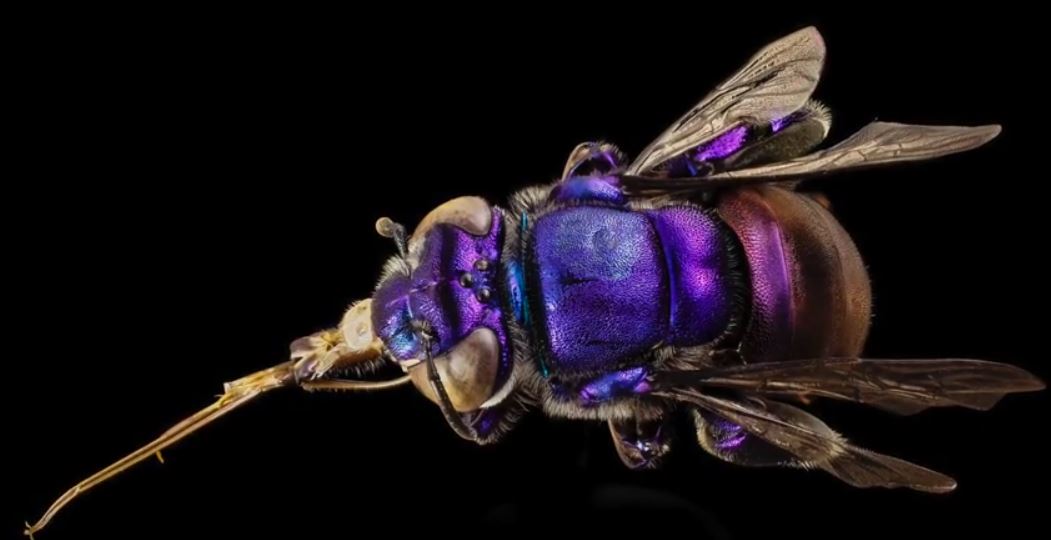
Euglossa species, Orchid Bee - Guyana, South America

Euglossa, an Orchid Bee found in Guyana, South America

There are thousands of species of bees in the world. Our favourite, the honey bee, is just one of the estimated 25,000.  It’s not even the cutest, friendliest, or most interesting. Those qualities go to some fascinating creatures you will discover in a lovely new book,  Bees: An up-close look at pollinators around the world.

The book is jammed with full-colour close-up photographs of wild bees – especially in their role as the world’s pollinators. Examples from around the world are arranged by continents into 7 chapters. Antarctica isn’t represented, but 7 regions/continents are still there because Central America and the Caribbean are given their own section. The isthmus and islands deserve the coverage. There are some stunning bees in that area.

The North America section covers 18 species, including a gentle Bombus griseocollis (Brown-Belted Bumblebee) collected in Washington, D.C., and an affable Anthophora affabilis from the South Dakota Badlands. The latter, a gray/white badlands bee, is found world-wide (except Australia), so you may have already encountered a subspecies of this fluffy burly Flower-Lover. The one shown below has an enormous tongue, adapted to reach nectar found deep inside a species of an abundant badlands flower.

Anthophora affabilis, or Friendly Flower-Lover, South Dakota Badlands National Park, USA

Anthophora affabilis, Friendly Flower-Lover – South Dakota Badlands National Park

Bees: An up-close look at pollinators around the world is a handsome 160-page book of stunning close-up images of wild bees photographed against solid black backgrounds. Details of wing veins, segmented antennae, and hair follicles make this an amazing coffee table book. But it’s more than a great collection of art. Along with each of the hundred or so species there are a couple of descriptive paragraphs which include species’ names, common names, and native locations. The text itself is nicely written. As an example, I’ve lifted a couple of sentences that begin the summary about the Valdivian Forest Forked-Tongue bee, which is shown below.  The authors tell us:

“Southern Chile has a wonderful temperate rain forest. Many of the plant and animal species from this region are found nowhere else in the world. This specialness also holds true for their bee species. The Valdivian Forest Forked-Tongue is restricted to this region and, as a generalist, pollinates many of the woody plants in the forest. These woody plants are also unusual in that they have a much higher dependence on insect pollinators than similar plants found outside this region, which often depend on wind pollination or, only secondarily, on insect pollinators.”

Diphaglossa gayi, the Valdivian Forest Forked-Tongue Bee - southern Chile's temperate rain forest

Diphaglossa gayi, the Valdivian Forest Forked-Tongue Bee
– from southern Chile’s temperate rain forest

 The authors of Bees: An Up-Close Look at Pollinators Around the World, Sam Droege (United States Geological Survey) and Laurence Packer (Toronto Biology Professor at York), have produced a stunning volume. I especially like how they advocate for the citizen scientist. They share camera tips that resulted in their gorgeous photographs. We are told that their camera is no big deal – many amateur photographers have the same equipment. They used a Canon EOS 5D with a 65 mm 1-5x lens.  A direct flash at the subject would have resulted in a stark contrast so (I like this!) they use an inverted Styrofoam beer cooler to bounce a more diffuse light towards the bees.

I won’t give all the details, you can read their book, but one of the things that makes the bee photography so stunning is the slight (5-power) magnification. As any of you who have peered through a microscope know, a down-side to magnification is the very narrow range of what stays in focus. To see more of your subject, you have to move the lens and refocus so that a different part of your specimen is sharp and clear. But the pictures in this book have a wide range of detail, all nicely in focus. To achieve this, they photographed a series of images, each with the lens slightly shifted, then they used over-the-counter image merging software. It was obviously a lot of work. The results are brilliant.

I have a few complaints about this book, but they are minor:

The book lacks an index so it is hard to quickly look up a favourite creature.

Almost all the North American species were from Maryland or the US east coast.

The North American section includes Apis mellifera, our common honey bee. The honey bee is certainly widespread and important in North America, but it is an introduced (just 400 years ago) invasive species which has uprooted and displaced native North American pollinator bees. The authors should have at least pointed out that honey bees are not North American natives.

Nevertheless, don’t let these issues detract from the quality of this lovely, well-designed book. It will make a great holiday gift for any beekeeper or naturalist on your shopping list.
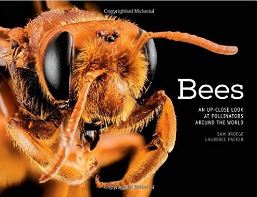
BEES CoverYou may like to check this 1-minute video, narrated by author Sam Droege, to learn more or to simply enjoy the photography. You might also take a peek at Droege’s Flickr page which features more of his brilliant photography.

You can order your own copy of this engaging book either through the publisher, Quarto, or from Amazon.com  in the USA or Amazon.ca  in Canada.

Posted in Books, Pollination | Tagged , , , | 5 Comments

The Kentucky Bee Man

When you are the 8-year-old child of beekeepers and you’re helping stick foundation into frames, your pay is the soft translucent paper that keeps the wax sheets from sticking together. It was the closest thing to tracing paper that I’d see as a kid. I would set the paper atop a picture on a page of the National Geographic and make the sloppy outline of a giraffe or a skyscraper or something.

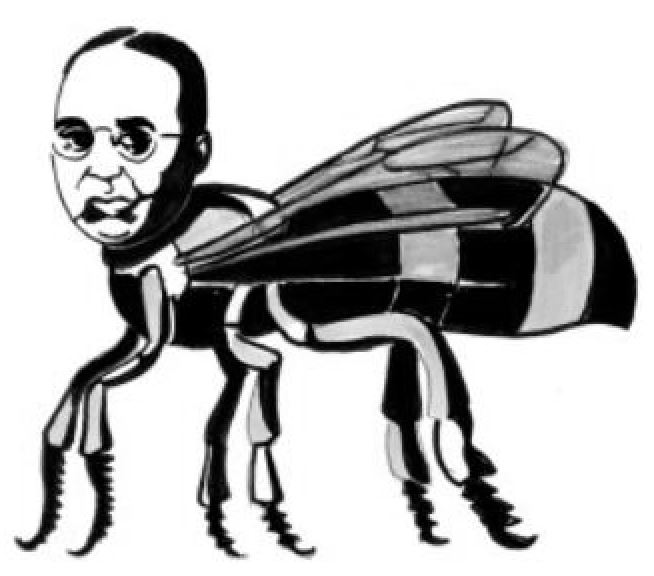
It was exciting when the cardboard boxes of smelly wax were first opened. Even better when all that free paper went into a special stack for kids. But the outsides of those boxes of wax were creepy. They featured a bee with a man’s head. It was The Bee Man, Walter T. Kelly.

I’d pull apart the sheets of foundation, wondering how the man had turned into a bee. It reminded me a bit of a 1950s horror movie about a man who turned into a fly because he stood too close to some radiation. That movie played in the 60s on our black and white television set, also when I was eight. Between The Fly Man and The Bee Man, I had some restless nights.

The years passed and we ended up buying a lot of equipment from the Kentucky Bee Man. Foundation, frames, smokers. The Kelley Bee Veil was popular at our farm. I never met Mr Kelley, but I spoke to him once by phone. I quizzed him about his Kelley Boiler and Uncapper system, but I kept imagining that I was talking to a Bee Man. The childhood image was unnerving. Then, in my early 20s, I left the eastern states and ended up on the Saskatchewan prairie, running my new bee outfit. I was in Canada, 2,000 miles from Clarkson, Kentucky. With the international border and the distance, I quit buying bee equipment from Walter T. Kelley.

Walter T Kelley, 1897-1986

Walter T Kelley, 1897-1986

But I wondered what had become of his business. From the ads in the bee journals, it was obvious that the company was still very much on the go. I was glad for that. Kelley had worked hard to build it up. Born in 1897, he served in the Army during the Great War, then went to Michigan State University, earning an Apiculture degree in 1919. That was followed by a couple of years with the USDA. In 1926, Kelley settled in Louisiana to raise and sell queens. Cypress wood was plentiful, so he manufactured and sold pre-cut bee equipment. I’m not sure why he moved to Kentucky, but his factory was there by the 1950s.

Now known as Kelley Beekeeping, the business is still one of the largest bee equipment suppliers in America. That’s a huge market. To keep supplying such an enormous sector, the company has just now committed to staying in Clarkson and building a new 100,000 square foot factory. That is a $7.5 million  investment and it will need an additional 50 people to make all the bee stuff. This is a big deal for Clarkson, a town of just 225 families. Kelley Beekeeping, of course, is the biggest employer.

Walter T. Kelley was active with the company for decades. He died at age 89, in 1986. Kelley excelled at marketing and promotion. In the 1950s, he self-published a small book, How to Keep Bees and Sell Honey, which has sold nearly one hundred thousand copies. The book was a marketing tool, it is great at convincing people to keep bees. I have a copy. It’s well-written, even if the author was a man with a stinger, wings, and six legs.

The Bee Man

The Bee Man

Posted in Beekeeping, Culture, or lack thereof, History, People | Tagged , , , , , , | 4 Comments

What Do a Million Bees Look Like?

million bees

I hate to sound prickly and petulant,  but the news media has done it again.  Today, say the news folks, ONE MILLION BEES were removed from an Austin church. That’s a stupid statement.

Someone working at the scene must have talked to a news outlet and said, “I don’t know… looks like a million bees were in that church.” And that’s OK. That’s one person, at the scene making a comment, probably as a joke, to one reporter who reported it. But then dozens copied the headline. Sometimes news people are shameless in their copycat reporting. Do reporters have a Share button in their newsrooms, modeled after Facebook’s sharing scheme? Seems like it.

What puzzles me is that no one who encountered the one million number which was bouncing from news office to news office around the world gave it any thought before repeating it. You would think that at least one budding entomologist or hobby beekeeper exists somewhere in the newsroom – someone who could say, “Whoa. That ain’t right.”

It’s not right. A big strong wild swarm (such as the one preying at the Austin church) might have 50,000 bees. But that’s pushing it for a wild swarm.  So, a million bees would need 20 individual over-sized swarms to make a million bees. It is impossible for that many swarms to have been in that church. Just can’t happen. You are talking about the entire contents of a small commercial apiary. And the bees would never merge into a 20-queen super-swarm to create what the bee-removers called a single hive.  Bees are not friendly enough to combine swarms – one queen dominates and kills all rivals. Even if 2 swarms somehow merged in the church (that would be 100,000 bees) soon there would be just one queen and the population would drop back down to 50,000 again. That’s the way it works. There are never a million bees in a single hive.

So, here’s the really disturbing thing. If the news folks don’t do their own reporting but instead rely on some central aggregator which gets things sensationally wrong, then how much of the other news which we see each day is also disturbingly wrong?  I am not so irritated that the headlines erroneously read “ONE MILLION BEES”.  That’s a mistake, but it’s not a big deal. However, I am very irritated that no one realized the number is radically wrong. No one did their homework. No one retracted. No one fixed the news.

My advice? Quit reading news presented by the ‘reputable’ news agencies and switch to getting all your information from blogs. Like this one.

Posted in Bee Biology, Culture, or lack thereof, Queens, Strange, Odd Stuff, Swarms | Tagged , , , | 1 Comment

Stinging Science

I wrote about this fellow last year. He likes to get stung for science. Below, I’ve repeated my blog, The Worst Place to Get Stung, from September, 2014. The big news is that the research scientist – intent on finding the worst body part to collect a stinger – has just been awarded some sort of Nobel Prize.

It’s an Ig Nobel Prize, given to Michael L. Smith of Cornell University at a fancy-pants gala. His experiment is described below. The Ig Nobel is a playful concept – an award for real science that recognizes humorous experimentation. It’s hard to think of bee stings as a form of humor, unless one gets walloped by a bee on the funny bone, of course.  Smith describes the nostril sting as “so painful it’s like a whole body experience.” He’s right about that.

Where is the worst place to get stung? The correct answer is not “on the picnic table.” According to Cornell University graduate research scientist Michael L. Smith, in a study funded by the United States National Science Foundation, the worst place to take a sting is either the nostril or the upper lip. He places both within the same range of scientific error, though he admits that the nose sting was tearful. Smith’s neurobiology paper, Honey bee sting pain index by body location, does not miss a single body part.

The folks at Dadaviz, a cool website that makes charts and graphs out of all sorts of weird data, sent me their data visualization for Smith’s bee sting pain study. I reproduced their chart above, and you can see all the detail clearly by either clicking on the chart, or clicking here and going straight to the data at dadaviz.com. (Once you arrive there, you can click on the data visualization and it will expand to fill your screen.) I encourage you to take a close look, then come back here and I’ll tell you how these data were collected.

I had imagined that a team of white-jacketed doctors at Cornell experimented on hundreds of volunteer grad students, inflicting each with an exquisite sting. Turns out, it was not done that way. If you read the original research paper, you will learn that Mr. Smith self-inflicted 75 honey bee stings to gather the data. He stung himself (well, actually, he let bees sting him) five times daily between 9 and 10 o’clock each morning. Each location was stung 3 separate times, on different days. The researcher then rated the painfulness of each location’s sting. It seems the softer body parts (his nose, lips, and, yes, genitals) hurt the most following a sting. The nose stings, reported Smith, “were especially violent, immediately inducing sneezing, tears and a copious flow of mucus.” Not surprisingly, the least painful spot to take a sting was on the skull. We are hard-headed for a reason.

I know you are wondering where the thesis advisor was during all of this. That leads to one of the many interesting parts of this research paper. Smith wrote, “Cornell University’s Human Research Protection Program does not have a policy regarding researcher self-experimentation, so this research was not subject to review from their offices. The methods do not conflict with the Helsinki Declaration of 1975, revised in 1983. The author was the only person stung, was aware of all associated risks therein, gave his consent, and is aware that these results will be made public.”

In my last blog post, I wrote about Beetox. What about Bee-agra? Alas, Smith reported only the pain levels, not the amount of swelling. No photographs were available in the research paper.


.

.

Posted in Humour, Stings, Strange, Odd Stuff | Tagged , | Leave a comment

Every Day is Labour Day

In Canada and the USA, a lot of people get a day off from work today. Unless your job is in a store, hospital, police station, prison, theatre, restaurant, hotel, airport, the military, or nuclear power plant. Or if you operate a farm or bee business. Otherwise, you may have slept a little later and enjoyed a leisurely coffee this morning. For that you can thank people who lived over a hundred years ago.

Six-year-old girls at South Carolina cannery in 1911.

Six-year-old girls at a South Carolina cannery in 1911.

It’s an old holiday. In the USA, it was first celebrated 121 years ago. A New York City labour leader visited Toronto and saw workers’ day celebrations. When he returned to the USA, he pushed for a day to honour America’s labourers.  Congress anonymously passed the bill making Labor Day a legal holiday in 1894. Since then, the western world has vastly improved working conditions. Once, children as young as six picked coal from fast-moving belts while folks in their 40s and 50s died of fatigue, injury, and emphysema during 80 hour work weeks.

Things have not improved as much for many business owners. One of my brothers works in his greenhouses from 3 each morning until 7 each evening. He keeps this 16-hour workday pace from February through June, then slows down to 12-hour days the rest of the year. Greenhouse chemicals and concrete floors have taken a toll on him – it’s exhausting work. He never takes vacations – he has a business to run. It was similar for me with my bees – I ran a thousand hives for fifteen years, working in a similar way. I was young and didn’t realize that extracting until two in the morning, sleeping on a cot until six, and pulling honey all day were unusual ways to squander one’s youth.  And then there are the tireless worker bees.

While conditions for most human labourers have improved, conditions for honey bees are worse than they were a hundred years ago. Although sulphur, DDT, lead arsenic, and cyanide are not encountered on flowers anymore, other chemicals have taken their place with sometimes dire consequences. Equipment is more efficient for the beekeepers, but generally less comfortable for the honey bees. And migratory beekeeping has prevented millions of bees from suffering cold winters, but in place of months of winter-time rest, honey bees bounce along highways to holding yards in warm locations.  There they meet billions of other bees. In such places, diseases and pests spread like epidemics.

Although people in advanced countries now earn a minimum wage, honey bees are still receiving the same paltry nothing that they have always been given. What if honey bees were paid?

$120,000 jar of honey?

$120,000 for a jar of honey?

Bees visit about two million flowers to make 500 grams (about a pound) of honey. This may require 200,000 separate flights and 600,000 kilometres of flying. A really successful colony may make 100 kilograms (220 pounds) of honey for harvest in a year. This production comes from about 250,000 individual workers who have lived and died in the colony during the year.

I’ve done the math and it turns out that about two million bee work-hours are involved in gathering, processing, and storing a season’s honey. This includes the labour of building combs and feeding and educating the young bees that replace their exhausted older sisters. We are getting a sweet deal from our bees.  If they were paid a human’s minimum wage for their work, a single pound of honey would cost $120,000 in labour.

Posted in Commercial Beekeeping, Culture, or lack thereof, History, Honey, Strange, Odd Stuff | Tagged , , | 1 Comment

English lady with bad teeth reportedly steals honey

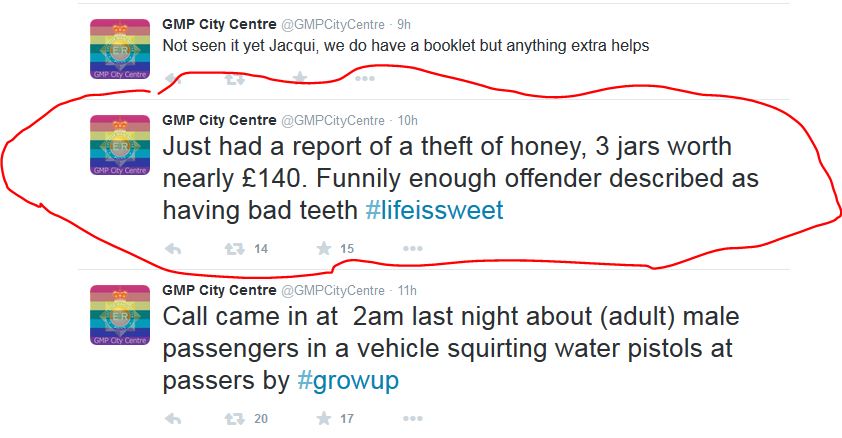
From the Manchester Police Twitter feed:

From the Manchester Twitter feed

Police in Manchester, England, are looking for a woman with big-hooped earrings and bad teeth. They say she may have stolen three jars of honey. The honey jars were priced at £46 each – that’s about $90 per jar. Those were either really special honeys, or very big jars.  The bad-toothed lady allegedly ran off with about $300 worth of honey.

Not bad for English teeth.

Not bad for English teeth.

It’s interesting that the store clerks noticed the lady’s bad teeth. After all, this happened in England. The people of the Isles have a reputation for unkept teeth. I’ve been to England a few times and I disagree. I didn’t notice an excess of bad teeth. Maybe the rumour is a heritage stereotype, harking back to the days when sugar first hit the grocers’ shelves a few centuries ago in Britain. In the 17th century, refined sugar became the cultural rage there.  Folks let their teeth blacken and rot to show that they were affluent and trendy enough to afford massive amounts of tooth-decaying sugar. How sweet is that?

There is more to England’s sugar tale. The enormous popularity of sugar peaked when it was prohibitively expensive. Before long, sugar lost its allure as a symbol of trendy status. The first-ever boycott, instigated by the radical left in 1792, was a protest against West Indies sugar companies which were fueled by the labour of slaves kidnapped in Africa and hauled across the Atlantic to cruelly work the Caribbean cane fields. The boycott gained momentum when drawings of slave ships were published, showing people packed in the hulls of the slave traders’ vessels.  Sugar was suddenly tainted by the obscenity of slavery. By 1800, sales of the white powder fell from 5 pounds per family per week to half as much. Temporarily. The English protests and boycotts worked, English involvement in the slave trade ended, and sugar consumption climbed again. Not that conditions actually improved for the slaves, of course.

Throughout the great sugar boycotts, honey continued to be popular. Since it was produced by rustic countryside bees and craftsmen, it avoided the brutal history of its sugary rival. Honey prices temporarily soared during the boycott. And teeth became whiter – an old tooth-whitening treatment included wine, vinegar, and honey. [Which I don’t recommend.] All of this makes us wonder about the lady with bad teeth, accused of lifting honey from that trendy shop in downtown Manchester. Be cautious. If you see a bad-toothed female wearing turquoise jeans and large hoopy earrings, don’t tackle her alone. Call the Manchester men in blue. After all, the whole episode may be nothing more than a sting operation.

Posted in Culture, or lack thereof, Honey, Humour, Strange, Odd Stuff | Tagged , , | Leave a comment

Foulbrood – Still Smelling Foul

bee offWith so much attention on varroa destructors and nicotine-flavoured pesticides, we sometimes forget some of the other scourges of modern beekeeping.  Not long ago,  American Foulbrood (AFB) was the worst thing that could happen to your bees. If you were caught with the disease, an inspector might set your colonies upon a pit of fire. Your equipment – and bees – would burn, then collapse into the hole where the charcoal and melted wax would be buried under moist soil. I know. I was one of the bee inspectors, deputized by the state of Pennsylvania, and I was assigned the grizzly task of destroying infected colonies. It is little wonder that I was met several times by shotguns at farmers’ fences in the remote Appalachian hills.

That was the mid-1970s – I wasn’t yet twenty years old. Antibiotics (sulfathiazole and terramycin) had been discovered 30 years earlier and those chemicals usually put an end to the symptoms of the brown rotten smelly brood that gives foulbrood its name. But not all farmers cared to check their hives or invest in the inexpensive medicines. As a last resort, irresponsibly kept apiaries with irrecoverably sick bees were given the fire treatment. The bees were nearly dead anyway. If the equipment was not destroyed, healthy bees from miles around would find the dying hives, scoop up any remaining honey, and carry the disease back to their colonies. The robbing that ensued spread an AFB epidemic. Ugly as the burn-and-bury treatment seems, it was necessary. (A diligent beekeeper might shake the infected bees into new boxes with new equipment and foundation and perhaps save the bees. But a diligent beekeeper would not allow hives to collapse to the state that required destruction. When bees were seriously infected it almost always meant they were owned by a disinterested beekeeper who would not clean up the hives and keep them healthy. They (the bees, not the beekeeper) had to be destroyed.)

American foulbrood - stringy, dark brown, and (surprise) foul-smelling!

American foulbrood – stringy, dark brown, and (surprise) foul-smelling!

Ancient beekeepers were familiar with foulbrood. Aristotle complained that his bees were sometimes weak, dying, and had brood that smelled awful.  Such reports continued over the centuries. In 1906, two different flavours of foulbrood were distinguished – now known as European and American foulbrood. The European type is the less serious infection and can often be cured by replacing the queen and breaking the brood cycle. Although American foulbrood also originated in Europe, it was first identified by a North American scientist, hence its name: American foulbrood. AFB is much deadlier than EFB. A young developing larva dies if it ingests even a single Bacillus larvae spore. The body quickly decays and becomes a host for 100 million spores, each capable of causing the same bacterial outbreak in 100 million other larvae.

Before drugs were available in the 1940s, all colonies infected with AFB  died. If spotted early enough, the beekeeper might remove any frames with the infected brood and burn the bad combs. But the spores that had caused the infection had likely already spread throughout the hive. Good beekeepers in the 1920s and 30s sometimes found themselves out of business in weeks when foulbrood raced through their outfits.

Because foulbrood kills colonies and remedies didn’t exist for millennia, one might suppose that genetically resistant colonies would arise. Honey bees never developed reliable resistance to AFB (though some bees have more hygienic habits than others – they remove dead brood from the hive, slowing its inevitable spread). I suspect that bees survived alongside foulbrood because honey bees evolved an absconding reaction. Severely infected colonies sometimes leave their hive en masse, fly off to a new location, and start over again. The bees are able  to raise a few generations of offspring before the disease builds up to killer levels again. Although honey bees evolved this survival strategy to cope with the disease, it is no help to modern beekeepers – we can’t make honey if bees are sickly or if they abandon their hives entirely.

These days, American foulbrood is usually not a colony’s death sentence. Beekeepers control AFB with regular medicinal treatments. Better management caught on. Also, over the years, most farmers who were “let-alone beekeepers” gave up the sideline. In 1950, 2 million farms in the USA had a hive or two or more. (There were then over 6 million colonies kept in the USA.) Fifty years later, only 29,000 farmers owned beehives. Individual beekeepers began to manage thousands of hives each. With a change in beekeeping habits, AFB was under better control.

However, the control of American foulbrood in the Americas and Europe is tenuous and the disease could erupt if habits become lax again – or if antibiotics fail to protect evolving strains of the Bacillus larvae bacterium. South Africa offers an example of the devastation that may result when AFB is not fought effectively.  In April of this year, South African officials announced that an outbreak of American foulbrood had killed 40% of all the bees in the West Cape area. This is a big deal – the Cape is an important agriculture district where bee-pollinated crops valued at $1.5 billion (US) are grown. Without bees, the West Cape farmers are in trouble.

Killer bees are notoriously tough. )

Killer bees are notoriously tough.
(Credit: Wikipedia)

How did this happen? The arrival of AFB is recent. The disease appeared in a single province in 2009. Six years ago, a beekeeper spotted AFB and began losing colonies. Since then, it has spread. An article in South Africa’s Mail and Guardian suggests that South African beekeepers are generally rather cocky in their attitude towards bee diseases.

We are informed that nobody worries much about pests and diseases because the African bees are notoriously tough and hardy. But not, it appears, when they are confronted by the microscopic spores of American foulbrood. Although harmless to humans, AFB spores found in honey will infect bee larvae.  It is suspected that tainted honey was imported into South Africa in 2008, introducing the malady.

Besides a cavalier attitude on the part of some beekeepers, South Africa seems to have an ineffective bee inspection program. From the Guardian article again, it seems that there are adequate inspection regulations. But – claims the news story –  there’s a paucity of inspectors and compliance. The country seems to lack bee inspectors of the type Pennsylvania once had – inspectors willing to face the occasional shotgun in the face as part of their job. Unless South African beekeepers and their government proactively fight American foulbrood, it will destroy the country’s honey bees. But North American beekeepers should take the African experience as a reminder and a warning – the same could happen here again, too.

Posted in Beekeeping, Commercial Beekeeping, Diseases and Pests, Genetics | Tagged , , | 5 Comments

Smoky Bees

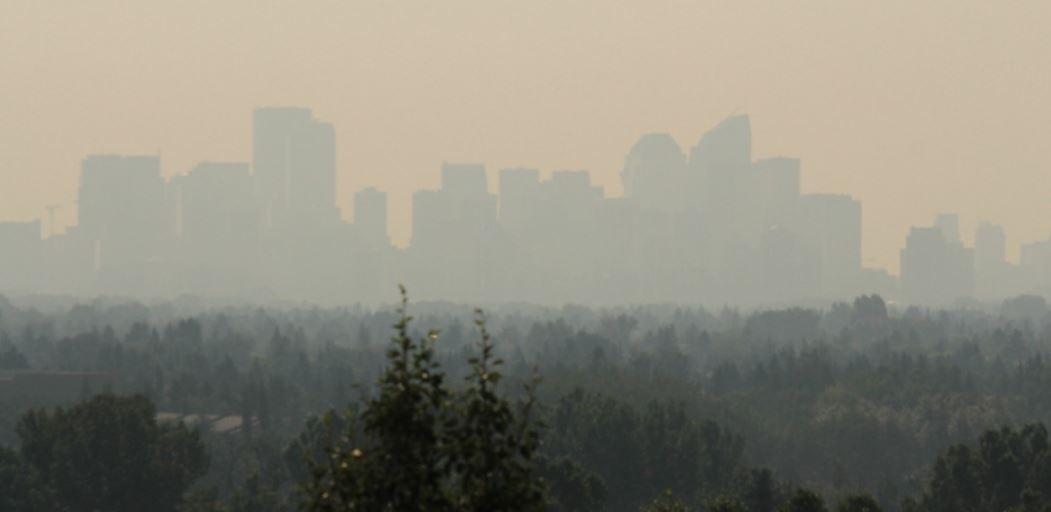
Calgary - a smoker's haven.

Calgary – a smoker’s haven.

My home town – Calgary – is under a smoke advisory. The sky is hazy with smelly gray smoke from the trees, grass, and homes that are on fire down in Washington state.

Those fires are about 700 kilometres (500 miles) away and on the other side of the Rockies, but you can see from the picture that the smoke has drifted to us. Considering the large number of fires in the drought-stricken Pacific Northwest and coastal areas, we have been lucky that the smoke has avoided us until today.

Smoke WarningI was wondering what effect such smoke has on honey bees. Here at home, I see no bugs of any sort out this morning. A few days ago, they were really active, but they seem to have gone into hiding. I am not at the moment near any apiaries, so I can’t comment directly on what is happening in the field – but the thick smoke must be slowing the bees’ foraging. However, I contacted a friend with a large home apiary. He told me that his bees appeared less active than they were a few days ago, but suggested that this might be due to a recent light spotty frost – though it is warm again and flowers are still secreting nectar. As with all aspects of beekeeping, it’s hard to separate out the multiple factors at play.

In addition to a potential decrease in foraging, I’m concerned that the smoke will infiltrate supers and permeate combs. I have tasted some smoky-smelling honey which resulted when a desperate and frightened beekeeper tried to calm irate bees with massive amounts of smoke. Smoke can affect honey. Also, smoke from a smoker usually has tiny specks of black soot. Surely almost harmless, but those black specks sometimes float in honey jars, spoiling an otherwise pristine product.

1892 smokerHowever, smoke is the beekeeper’s best friend when used in judiciously small puffs. I dread looking at bees without a smoker in hand. I would much rather approach a hive in a honeybee swimsuit and a smoker than approach suited in bee armor and no smoker.

Smoke has been the beeman’s friend for a long time. For unknown millennia, prehistoric tribes have used smoky torches to chase bees off combs. Similarly, an Egyptian tomb painting from 3,500 years ago shows a beekeeper with a smoker. The behaviour of honey bees that are exposed to smoke has enabled modern beekeeping – including queen breeding and moving colonies for pollination.

It usually takes just a small puff to disarm a colony. My father smoked a pipe – just so he’d always have something handy to calm rowdy bees. (It worked equally well on kids, too.) In the bee yard, too much smoke can cause all sorts of grief – spoiled honey (as mentioned earlier), confused and gasping bees, and unhealthy lungs for the beekeeper. But let’s assume you are careful and use your smoker properly. What is happening when bees encounter your smoke? Is it the same response as during a forest fire?

We are lucky that honey bees have a ‘smoke response’. Bees are alarmed when a smelly human arrives at their apiary, lifts the lid on their home, and shakes their boxes. The human is a threat. Evolution has favoured creatures that defend themselves against threats. (Individuals lacking defenses against deadly threats die – they don’t reproduce and their docile genes are erased from their species’ genome – unless humans intervene and select for docility, of course.)

Irritated bees emit pheromones such as isopentyl acetate (from the stinger shaft) and 2-heptanone (from mandibular glands). These strong-smelling chemicals evoke an alarm response in other nearby honey bees, which in turn produce more of the same pheromones. Soon all the bees are agitated and ready to fight the threat. The beekeeper’s smoker masks the bees’ emitted pheromones by reducing the electroantennograph (EAG) response at the bees’ antennae. Although it suppresses the bees’ alertness to their fellow bees’ alarm scents, the masking lasts for only about 15 minutes after the air has cleared. and leaves no known residual problems for the bees.

smokeSmoke has another benefit for the invading beekeeper. It triggers an imbibing response in bees, distending their abdomens because of their gluttonous engorging. This makes it hard for the bee to curl up and poke its stinger into the beekeeper’s skin. I have heard beekeepers say that the gorging is because the bees are preparing to abscond in face of the coming fire and the bee is tanking up for a long flight. I don’t think this true. I have seen entire apiaries burned – bees and all. It seems unlikely the bees in every hive forgot to leave.

The honey-imbibing must have another purpose. In nature, many wild swarms survive forest fires when the fire sweeps through the grass and brush near ground level. Bees in trees above the fire are (sometimes) able to survive. They may even crawl further up in the tree’s hollow, leaving their wax and honey to melt and trickle away. After the fire has rushed by, flowers are scorched and bees may need to search for a new home – somewhere with unscorched nectar supplies. Honey bees take a few days to scout for a new home and to reach a relocation consensus.  Meanwhile, the queen is too heavy to fly easily, but during the relocation planning phase, she stops laying eggs for a day or two and becomes more mobile. (This is another reason they don’t abscond while the fire is raging.) Soon the engorged bees move to their next home. My theory may be wrong and the honey bees’ imbibing response to smoke may have some other cause. Nevertheless, it is a boon to the beekeeper as it certainly reduces stings.

I realize that some beekeepers avoid smoke entirely. They are worried that smoke – even in tiny amounts – will hurt their bees. I appreciate the sentiment. Unfortunately, without smoke, any hive examination is precarious. When Betty Bee alarms Henrietta and Anna who then alarm their four best friends who tell sixteen others about an intrusion, thousands of bees may go wild in a minute. Not only will the beekeeper suffer a lot of stings, but so may nearby pets and even neighbours. The key is to learn to use the smoker in very carefully placed doses. This is something learned from experience. Such experience is best acquired from old-timers who have kept bees for 30 years. Of course, avoiding smoke around bees is ideal, but today – in southern Alberta – the distant forest fires are making that impossible.

A little smoke from a little smoker

Just a little smoke from a little smoker.

Posted in Beekeeping, Honey | Tagged , , , , , | 5 Comments

Thistle Bumblebees

4 bumble bees

Can you spot all 6 bumblebees in this picture?

Although I have mentioned many times that honey bees are not going extinct (there are actually more kept hives of honey bees today than 10 years ago), I am concerned about wild and native species of bees. Loss of habitat, climate change, and pesticides are terminating many of them. So I was delighted to see a nice population of bumblebees tirelessly working the wild thistle which we allowed to grow on the edge of our flower garden.

Over a period of ten days, the bees were on the thistles steadily from about ten until dusk. We would see about 6 or so on the 14 heads of thistle near our deck at any one moment. They were busy flitting about, so it was hard to really know the full number – but I would guess that several dozen (probably from the same clandestine nest) were coming and going. I finally decided to film them so I could get a better count and watch their activities over and over again in slow mode.

2 bumble bees niceOn my video, I counted as many as 7 in view at any one moment, sharing but not apparently competing for the same 14 thistle heads. Each individual spent an average of 18 seconds on each flower. An old-time beekeeper once told me that if a bee (he was talking honey bees, of course) spends more than 5 seconds on a flower, then the flower has little nectar as it is taking the bee too much time to search individual florets and get a fill. I don’t know about that for sure, but I have seen bees on citrus and sweet clover flowers (which are each tremendous honey plants) take about two seconds to fill up. In the case of the bumblebees on our backyard thistle, the bees spent a few seconds in one position, then moved on the same flower and continued.

Interestingly, there was very little pollen on these workers’ corbiculae. This could be because so many bees are working the flowers that the pollen production rate doesn’t keep up with the foragers. Or it might be because it is getting late in the season and the bumblebee nest contains fewer larvae needing pollen, hence most of the collectors are going after nectar. Or there are other reasons – I don’t know. All I do know about this is that I was glad to see the busy bumblebees and encouraged that at least this one species has found something nourishing in our yard.

Posted in Ecology, Honey Plants, Save the Bees | Tagged , | 2 Comments

Fair Honey

Fairly good honey: the best at the fair

Good fair honey: Actually, the best fair honey at the Millarville Fair!

As a beekeeper, I have always been troubled with the disposal of honey. Invariably, we produced more than we could eat, especially since I ran as many as 2,000 hives. We had to get rid of the excess. Some went to friends as gifts and to bee yard landlords as payment for our right to trespass. I would guess that over the years I handled a couple million pounds of honey,  passing it through uncappers and extractors and dumping it into steel drums and half-pound jars. But I never thought of myself as a honey person, just a beekeeper.

A friend, Stephen, inspects honey for blemishes. <br>Nice light Canadian honey, eh?

A friend helps inspect honey for blemishes.
The honey sits atop a flashlight and Stephen is holding a magnifying glass. Nice light-coloured Canadian honey, eh?

Nevertheless, some folks here in the Calgary area have decided that my proximity to honey implies that I know something about the stuff. I have been drafted into the role of honey judge. I don’t mind handing out blue ribbons, but I do not have the best personality for such work. A good honey judge, I think, has a persnickety character. Someone with the disposition of a snobby wine connoisseur. The ideal honey judge is both meticulous and impartial. Impartiality is my long suit, if I may be permitted that biased opinion. But I’m not as meticulous as many of my close acquaintances. So I was grateful that several people assisted in Friday night’s Millarville Fair honey judging event. It made everything flow more smoothly.

The Priddis and Millarville Fair (now in its 108th year) attracted a respectable number of honey entries this year. The three categories – creamed honey, dark honey, and light honey – each had superior samples vying for attention. This was my 5th chance to judge at this fair and it complements the judging I’ve done at the Calgary Beekeepers’ annual honey competition. In a moment, I am going to tell you a bit about how the honey judging is done here. If you ever have a chance to enter one of the contests in our area, you’ll know what awaits when your own honey sits in judgement.

stuffyFirst, I’ll warn readers living in places rife with persnickety judges (and I’m looking at you, England) that our homegrown, western frontier Canadian honey competitions may make your eyes roll, or possibly moisten. I can appreciate that. We don’t have the centuries of tradition nor the established rules that make your honey judging a fine art. However, when I drew up our Calgary area rules, I borrowed heavily from published handbooks written in the British Isles. I also stole unabashedly from Florida’s Dr Tom Sanford who gave me great judging suggestions. I used other’s ideas and made modifications for things that are more relevant to our climate (much drier honey) and culture (pragmatism is boss out here).

So, if you want to enter honey in one of the local competitions (Calgary, Chestermere, Millarville), I’ll walk you through the things you should keep in mind. At the end, I’ll  mention a really big problem with western Canadian honey and what you might try to do to overcome it. But first, some basics.

We score on a 100 point system. Everyone automatically gets 100 points. But as soon as we look at your honey, your score begins to drop. Maybe quickly. Below are the qualities we look at and the maximum possible points for each:

1. CONTAINER – 10 POINTS
2. BRIGHTNESS – 10 POINTS
3. FREEDOM FROM CRYSTALS – 15 POINTS
4. ACCURACY OF FILLING – 10 POINTS
5. FLAVOUR/AROMA – 20 POINTS
6. HONEY DENSITY (VISCOSITY) – 15 POINTS
7. CLEANLINESS AND FREEDOM FROM FOAM OR AIR BUBBLES – 20 POINTS

Here are some of the details:

Container is judged on suitability of the jar, container imperfections, and lid/container cleanliness. We actually look for mars, scuffs, and even glass imperfections. Suitability of container is also important, so you’ll lose a lot of points for using pickle jars. One reason we penalize mason jars (though personally, I like them) is they are really difficult to compare with standard honey jars. When you have 10 entries in identical containers and a few in unusual vessels, it becomes hard to compare brightness and accuracy of fill, for example.
Brightness is obviously preferred – as opposed to a dull appearance which might indicate wax or crystalline impurities. We compare jars by placing them atop a strong flashlight, as you can see in the pictures above and below.
Accuracy of filling requires headroom of 1.25 to 2.5 cm (½ to 1 inch). Do not under fill – there should be no visible honey-to-cap gap (no air space) visible. On the other hand, if the judge gets sticky because you have overfilled the jar and honey is gobbed under the lid and leaking down the side… the judge will notice and revenge will be swift and furious.
Flavour and aroma are restricted to carmelization and fermentation traits. We see both offenses most years as some beekeepers always over-heat their honey, causing slight burning, or they harvest honey that is not properly cured by the bees and it has high moisture content. On the other hand, judges do not rate honey by how much they personally like the floral source. Honey might be minty, bland, sharp, or mellow and that would be OK. But it had better not be burnt or sour (or both – one year I wanted to give a special award to an unusual entry that managed to hit both taboos at the same time).
Freedom from crystals means that the honey is not granulating. Every year we receive a few entries that look like a wayward chemistry experiment. (This happens in Alberta because of the nearly ubiquitous presence of fast-granulating canola.) You want to show us liquid honey free of crystals, unless you’ve entered it as ‘creamed’, in which case the smoother and more uniformly crystallized, the better!
Density (or viscosity) of liquid honey will be judged either by a timed bubble test or refractometer. Since honey in western Canada can be really, really low in moisture, we use a graded scale and award more points for drier honey. Some entries have run as low as 13% moisture. Refractometers cost around $100 these days. I know that’s still a chunk of change, but sometimes hobby beekeepers team up to buy a gadget. It’s useful even if you are just selling out of the door to your neighbours. Honey over 18.6% moisture gets zero points from us when we judge it because it may spoil and because above that water content, it is no longer legal to sell it as “honey”.
Cleanliness is next to blue-ribbon-ness. Honey is food. Food must be clean. Crystals, foamy air bubbles, and cleanliness is partly comparison-based. The full 20 points is usually not awarded because we almost always find some unusual material floating in home-made honey. Even if it is benign wax, pollen, foam, or granulation crystals, it still detracts from the pristine nature of pure honey. Often – using a magnifying glass – we find a few tiny black specks (smoker soot) and fibers that likely unraveled from some honey-filtering material. These are nearly microscopic and nearly impossible to avoid. But you should check your entry yourself before submitting it and remove a candidate that has such floaters.

Inspecting with persnicketiness.

Inspecting with persnicketiness.

I promised to address a problem that plagues every beekeeper entering competition with low moisture, light-coloured honey. Here is your dilemma: You want the honey to be free of specks, fibers, and suspended air bubbles but these things almost never drift to the surface in thick, low-moisture honey. They stay suspended. However, you have likely discovered that you can get rid of all these problems by heating the honey. Then everything floats to the top and the warm honey can be filtered through really fine cloth to make it extra nice. Unfortunately, too much heat darkens honey and gives it an awful caramelized flavour. So, you either enter honey with suspended air bubbles (losing points for dullness and perhaps granulation) or you heat the honey too much (losing points by burning it).  However, there is a delicate balance that you may achieve with patience and experience.

If you want to keep honey from granulating and want to remove air bubbles, you may need to heat it. If you do, make the honey rather hot, but only for a few minutes. Stir the honey, let it sit a bit, skim the surface, then filter it into a new clean container. Immediately place the new container of hot honey into a tub of ice-cold water to cool the honey off. Skim the surface again. Heat damage is a function of both the amount of heat (Never boil the stuff!) and the amount of time that it stays hot. If you keep honey at 40º C (104º F) for days, you may do as much damage as heating it to 70 C (160 F) for a few minutes. Experiment, but a temperature of about 55 C (130 F) is about right for a few moments – but then chill the honey quickly. Done correctly, this makes lovely clean and sparkling honey for sale or home use with minimal (perhaps no) perceptible heat damage.

Posted in Culture, or lack thereof, Honey | Tagged , , , , , , | Leave a comment