Thermo-Zapper-Gun

My 12-year-old ordered a laser gun from Amazon. Apparently it could burn your eyes out, but we are hoping not to test that. It’s a thermometer. The laser part is just a pointer, the laser actually has nothing to do with gauging heat or cold. It just helps you know you are pointing the gun at the right thing. We’ve tested it on snow (-2C), boiling water (94C here along the Rockies), armpits (34C). It seems accurate and it’s certainly easy to use. It’s not a toy. Maybe you know all about it already – I heard it’s available at Costco. (I wouldn’t know about that because I was expelled from their campus the day I cleaned out their week’s sugar supply.) This gun cost my boy less than $20, delivery included, from Amazon.ca

I can see a lot of beekeeping applications for the thermal gun. It could be a quick way of checking the temperature of honey tanks and wax melters. When people ask me about heating honey before straining it, I’d always say, “make it hot, but not too hot.” 140 Fahrenheit (60 C) is good, then strain the honey and cool it as quickly as you can. (Containers into cold water usually does the trick.) But lacking a thermometer, I’d suggest making the tank so hot you could just barely keep your hand on it – and not any hotter than that. But then I found out my palms are pretty thick and can take more heat than those of some other folks. The thermo-gun removes ambiguity. If you make a freezer to store your comb honey, you can check all the corners to see that the temp is consistent and heat is not leaking in anywhere. I am also thinking that you might use it to check your hives mid-winter. Shining the red laser beam into a hive’s top entrance should result in a temperature warmer than ambient air. You might have to do a number of hives to see if any are anomalously cold (which might be dead) or warm (the bees might already be up in the top chamber and may soon be hungry). I won’t collect a commission on this device, but you might make use of it, so here are links to (Canada) Amazon.ca and (USA) Amazon.com. If you think of some other uses, let me know.

Posted in Tools and Gadgets | Tagged | 1 Comment

Honey on tap?

In the past, I’ve written rather cynically about the various kickstarter projects aimed at people who care about bees. Entrepreneurs have been sucking up cash to “Save the Bees” and to sponsor new beehive designs for quite a few years. Here’s another. I won’t go all cynical on you yet – I’ll give these people a chance to prove themselves first. Watch their video. If for nothing else, for the inspiring music, the resurrected 1960s hippies, and the three-year-old girl dipping her finger into the honey. The video is expertly (and I guess, expensively) designed to tug at your heart and your purse. But there is a fundamental flaw in the whole scheme.

If it works at all, the honey flow beehive (www.honeyflow.com) deems to separate us yet another step away from our food supply. Rather than becoming intimate with the makers of our honey, we conceal them in a magic box – the ultimate in “Black-box Technology.” No need to get your hands dirty, to become aware of the harm – or good – you may be doing to the hive of bees as their honey is being “tapped”. (In the southern USA, where I lived for ten years, it was called “robbing the bees” which helps the beekeeper remember what his role really is during harvest.) Don’t misunderstand me – I produced over a million pounds of honey from my bees, wrestling with my little colleagues for each ounce. I care about bees, I love honey, I know how to produce it, and I have done the battle. But it was hands-on. If a hive was short of honey and didn’t have what it needed for winter, I gave the colony honey. Getting your hands dirty while harvesting gives you a chance to be sure you are not hurting the bees and over-harvesting. It helps you appreciate what the bees did for you more than turning a tap ever will. This honeyflow hive allows us to be much more casual about the process. Perhaps it would be like leading a calf into a box, pushing a lever, and watching hamburgers and hotdogs drop out the other side. OK, that was a bit cynical – I think it was the soundtrack of the video that got to me. Also Sprach Zarathustra would have been more subtle. But if you’d like to support them, “Like our Facebook page, join our mailing list, and stay in the loop,” says hive maker Cedar Anderson.

Posted in Strange, Odd Stuff, Tools and Gadgets | Tagged , | 1 Comment

The Ultimate Valentine

Honey hearts.

I know, beekeepers usually are not sentimental. For most of us, Saint Valentine was some mythical character built upon Lupercalia, an occasion observed by the Romans for three days (February 13–15) each year, and intimately connected to fertility. Like many Roman customs Lupercalia was borrowed by a start-up church in Rome almost 2,000 years ago. They used the holiday to remember a sainted martyr named Valentino who would grow a new heart every night and give his old heart to anyone who was sick, feeble, or heartless. Or maybe those were chocolate hearts for some favourite pigsneys. Anyway, that’s about all most beekeepers know about Valentine’s Day. But at least one beekeeper – someone whom I shall probably never meet – employed enormous energy and talent to make the really cool heart-shaped comb in today’s picture. I ran across it on a Polish language bee-talk forum where members were showing various comb-honey gadgets. I couldn’t understand very much of what I read on that site, but the pictures are great. (I have grandparents from Slavic countries and I studied Russian at university, but the Polish language is many degrees above my abilities.) If you have seen these heart-combs before or know the person who makes them, please drop me a note so I can credit the appropriate craftsman. Until then, maybe you can make a few of these yourself. You know, just before taking your special honey out to dinner.

Posted in Comb Honey, History, Hives and Combs | Tagged | Leave a comment

Journeys in Books

A reader of this blog asked if I would add his two books to the ones you see floating around the left edge of this page. I like beekeeping books and own several. Several hundred. A few are ancient classics, written and printed over three hundred years ago. My copy of Bee Treatise (1593) by Thomas Hill predates Shakespeare. Except for edges singed during the Great London Fire, it is in pretty good shape and makes entertaining reading. Sort of like a Shakespearean beekeeping manual. Some 15 generations of beekeepers have held this book.

My Hungarian in-laws have given me a number of central European classics: one is Méhész Naptár (1856), a prized beekeeping manual in my collection. It was printed on the exact same printing press that inked the 1848 declaration of Hungarian independence from Austria. (That revolution failed and its leaders were executed.) Among my other foreign language books is a first edition volume of Nouvelles Observations sur les Abeiles (1792) written by the blind beekeeper Francois Huber, the fellow who figured out how queen bees mate. It is a brilliant and practical book. (Huber describes an observation ‘leaf-hive’ with frames that flip like pages of a book – a precursor of Langstroth’s moveable frame hive.) For easy reading, an account of Huber’s story is told by Sara George in The Beekeeper’s Pupil (2002), a romantic novel based on the lives of Huber, his wife, and his beekeeping assistant. By the way, that paperback novel was a bit cheaper than the gilded Huber original I picked from a bin of old books on a trip long ago.

I like these unique and vintage bee books, but most of my beekeeping volumes are modern. They resemble text books and have titles like The Bee Craftsman, The Art of Beekeeping, and The Behaviour and Social Life of Honeybees. There are also dozens of specialized books on things like raising queens, producing comb honey, and diagnosing diseases of honeybees. These are all good instructive volumes, but my favourite beekeeping books are the ones that tell stories about beekeepers. That’s part of the reason that I wrote Bad Beekeeping back in 2004. I like stories about the failures and successes of beekeeping, especially when told from a personal perspective. Bad Beekeeping, released eight years ago, tells the story of my younger days as a commercial beekeeper and it (as I have been told) has become something of a minor classic in the bee literature. I am grateful for that, but I have encountered a number of much better books that tell better yarns about beekeeping of yore.

My favourite personal-account beekeeping book is Fifty Years among the Bees (1911) by C.C. Miller. That book is a true classic. Like me, Miller was from western Pennsylvania and headed west to become a commercial beekeeper. That’s pretty much where the similarities end. CC, as most people called Dr Miller, was brilliant – arguably the best beekeeper of his generation. He lived during the “Golden Age of Beekeeping” – an era about a hundred years ago when good beekeepers managed 300 hives, produced 50,000 comb sections a year, and made a comfortable living of it. CC originally trained as a physician. He gave that up because he was in constant fear of making a mistake that might kill someone. He kept bees instead. Fifty Years is a fantastic story, a very personal tale of how one can live a good life as a beekeeper. If you can’t find a decent hard-cover edition (Years ago, my father gave me his copy.), you can download it online as a PDF here at Archive.org. The book was published over a hundred years ago, the copyright has expired, and over a thousand people have likewise downloaded Dr Miller’s informative and amusing story.

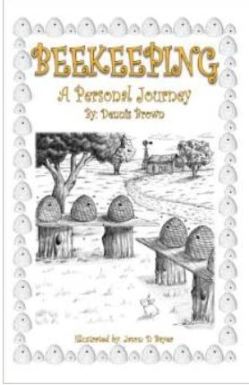
The reader of this blog who asked if I would link his work is Dennis Brown. He runs a website at Lone Star Farms and he offers two books: a question and answer collection and a personal journey tale. I can’t say if Mr Brown’s book, Beekeeping: A Personal Journey, is as good as Dr CC Miller’s Fifty Years, but the title is promising. And if you follow the link to Amazon, you can “Look Inside” and read a few sample pages. I did and I decided to order a copy of the Personal Journey so I can read the rest of the story. I hope I find it interesting. Sometimes the most useful lessons are taught by people who have made a few mistakes and then shared their experiences. It’s certainly less painful than creating one’s own stupid follies and then trying to recover from them.

Posted in Books, History | Tagged , , | Leave a comment

Rustic Hive

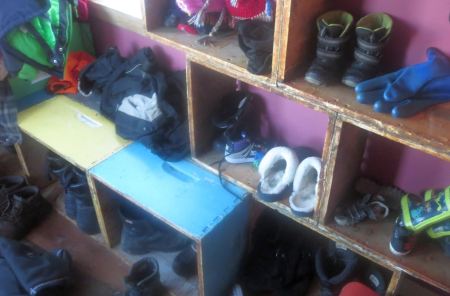
Furniture catalogs may have to add a new line – Rustic Hive. If you are like most commercial beekeepers, you’ve used bee boxes for desks, boot organizers, and book shelves. When I was a child, we kept bees on the family farm, so hive furniture was vogue there, too. In fact, when the twins were born, their home-birth was a month early and my little sisters spent their first few days in a make-shift beehive crib – an empty rim with a cover nailed on the bottom. As you might guess, my siblings don’t suffer much from allergies.

Empty deep supers were my first furniture when I left home when I was a teenager. But Rustic Hive is for grownups, too. Maybe it’s hereditary – my daughter has this same great look in her farm house. That’s where I took these pictures last week. If you – beekeeper or non-beek – want in on this kitschy new trend, drop me a line and I’ll tell you how you may buy your very own Rustic Hive space organizers. (But don’t tell Martha Stewart.)

Rustic Hive Storage: In the kid’s library.

Rustic Hive Storage: In the kid’s play area.

Rustic Hive Storage: In the mud room.

Posted in Friends, Hives and Combs | Tagged | Leave a comment

Is Grocery-Store Honey Safe?

Is it or isn’t it?

A school chum sent me this: “With everything we hear about honey these days, how do we know how to pick out real honey at the grocery store?”

I answered his question and thought I’d share some of my thoughts here.

You have a reason to be concerned about some of the honey found in grocery stores. As much as one-third is believed to be either mixed with cheaper and less healthy products such as HFCS (high-fructose corn syrup) and sucrose (beet/cane sugar) or the honey may be contaminated with agri- cultural pesticides – sometimes drifting in from farmers’ spraying. As of yet, I have not heard of any adult becoming ill from honey contaminants, though low-levels of unwanted chemicals from any and all food sources may have a cumulative effect.

You have probably heard that “germs can’t live in honey”. This is true for most bacteria which find the mild acidity and hygroscopicity (ie, water-sucking quality) of honey deadly. Imported honey is rigorously sampled and inspected by USDA/Customs inspectors. Unfortunately, domestic American honey is not inspected except in rare circumstances when it is already on the store shelf. Nevertheless, honey purchased in stores is almost always safe when consumed by people over the age of 2. So, the issue is really more about food quality than food safety.

The quality of most honey in stores is fine. But how can you recognize which is the real honey and which is adulterated by HFCS or sucrose? You can’t, unless it is clearly labeled as a “honey blend” as shown in this picture. (By the way, this example is legal and probably tastes fine. It sells for $2.65 US for 12 ounces, or $3.53/lb) – but a honey blend is obviously not pure honey. To be sure that most honey on US grocery shelves is good, a tiny sampling is randomly pulled off shelves in most states and is run through a battery of tests. If found adulterated, the honey is recalled and the packer is usually hit with a fine and some embarrassment.

To complicate things:

  • Honey has a range of colours. It is almost black if the floral source is buckwheat and almost white if it is high-prairie alfalfa. Goldenrod, common in the eastern states, is dark yellow – we promoted it as golden. Other flower sources yield the whole spectrum of colours. An odd colour has nothing to do with adulteration or contamination.
  • Honey has a variety of flavours and scents. Just as every flower smells different, the flowers’ nectars give differently flavoured honey. Again, this is not a good way of selecting honey – unless the honey smells fermented. Fermentation (eventually leading to vinegar or mead) happens if honey has more that 18.6% water content. Packers avoid mixing too much water with the honey they pack because it might spoil and the shopkeeper will demand a recall. Honey sold in stores is usually 18 to 18.6% moisture. Nectar from flowers is 90% water, so the busy bees remove the excess by fanning their wings inside the hive, drying the nectar.
  • Honey granulates. Usually. You have seen “sugared” or “crystallized” honey. This happens to most pure natural honey. As noted above, honey naturally contains water, making it a supersaturated solution. With time, solids crystallize. However, some honey never crystallizes – for example, the famous tupelo honey from the rivers banks of north Florida. (Watch the movie Ulee’s Gold, starring Peter Fonda, for more about that.) Granulation correlates with a higher fructose/glucose ratio. Crystallized honey can be made liquid by heating a jar in the microwave or in hot water. (Too much heat can “cook” the honey, ruining its flavour and darkening it, so be careful.)
  • Pollen in honey. Raw, locally produced honey usually has a bit of healthy local pollen in it. Some buyers use this as a test of quality, thinking that honey without pollen is not real honey. They are wrong about this. Others claim pollen in honey is a contaminant – so far governments have not seen pollen as an impurity. Most honey sold in stores has been filtered to remove pollen, but it is still honey. The amount of pollen in raw, unfiltered honey varies but is too small to detect without a microscope. Some consumers feel that those extremely low doses of pollen helps their resistance against allergies.

The real deal

Bottom line? If you can find a local beekeeper, check out his/her shop and buy direct from the producer. The honey and shop will not be inspected, but if the outfit looks clean, neat, and organized, it is probably better than the majority of (um, rather messy) honey businesses I have seen across the USA.

You might also consider buying old-fashioned comb honey. Comb honey is not processed in any way – it is taken straight from the hives in the form it is created. No suspicious mixing or handling by potentially dirty equipment. If you do use comb honey, then you can squeeze it or carefully melt it to get the liquid honey out. Or just eat the honey, natural beeswax and all. As a disclosure, my daughter’s honey farm specializes in comb honey. (She and her husband bought our Canadian farm a few years ago.) She ships all over the world. (Believe it or not, China is a big customer of Canadian comb honey!)

But I think you still might like to find a local producer to support. Check out the farmers markets and ask the vendor if you could drop by at their farm and pick up some honey. I also would not totally ignore the grocery stores. Honey in retail shops is often cheaper, convenient, and as I mentioned, even if it falls into the adulterated and contaminated group, it is ‘probably’ not going to be harmful. However, if you want to be sure it is real and imbues health, check out the local beekeepers.

Post Script: That sums up how I answered my friend, a non-beekeeper, when he asked about buying honey from a grocery store. If you are a beekeeper or honey packer reading this, let me know if you think I’ve missed something important and I’ll pass it along to readers.

Posted in Comb Honey, Honey | Tagged , , , | Leave a comment

Cold Bees

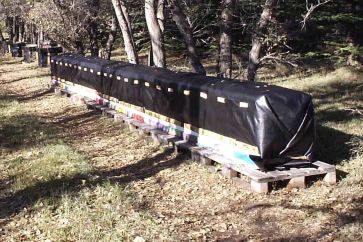
Long lines of hives are not recommended,
but upper vents definitely are.

It’s not the cold, it’s the humidity. We hear people say this a lot. That’s one reason 20º Fahrenheit (-7º C) in the eastern US can feel a lot colder than -20º in Montana. Generally, it’s the humidity that makes a colony of bees suffer the most through winter, too. As bees eat honey they physically convert some of the honey’s calories into heat, keeping the center of their nest far above the ambient temperature. You might remember that when animals eat, sugars combine with oxygen and carbon dioxide and water are respired. Remember that honey is about 17% water. If the bees eat 50 pounds of honey, over 8 pounds of water is released. If that moisture doesn’t leave the bees’ nest, it rises, condenses above the bees, and drips back down on the cluster. That is deadly.

The reason so many successful beekeepers keep upper entrances open during the winter is to allow excess moisture to drift out and away from the hive. You have probably heard the recipe for a good bee location – among other things, southern exposure, sloping landscape, and good air flow are usually cited. These all help keep the air around the bee yard dry. But first the water has to exit the colony. In addition to upper vents, I have even seen wintered hives supplied with burlap sacks draped over the top bars and extended out beyond the cover, thus serving as a moisture-wick. The wee bit of exposed burlap tends to stay dry and a capillary effect sets in, drawing moisture out of the hive. I have not seen this used out here in the dry west, but upper vents are almost always supplied.

Does the cold kill bees? Of course it does. A small cluster of bees exposed to minus 20º for a few hours will die. This is one reason package shippers don’t like to send 2-pound packages off to northern states in March. Nor should you install a package in bitterly cold weather. But large clusters of bees inside insulated hives typically survive even the longest coldest winters. That’s why beekeeping can be successful in the far north. The bees hug tightly for months, then quickly build strong spring populations and gather honey 16 hours a day during the long summertime flower feasts.

It’s not the cold, it’s the humidity. Seems to be true for bees, too. A Swedish beekeeper once told me that in his country a beekeeper’s success is not measured by pounds of honey produced but by the number of colonies that survive the winter. And, he told me, “I always expect 100% of the colonies to be good in the spring.” I have never had such good results in the north, but I always felt that any losses greater than 15% meant I was doing something wrong. Perfect wintering may be almost impossible to achieve in a larger outfit, but anything over one hive in six dead probably means some part of your wintering system needs to be fixed.

Posted in Beekeeping, Climate, Hives and Combs, Tools and Gadgets | Tagged , | Leave a comment

Here Comes the Sun

If you are in the far north, your bees are not quite at mid-point in their winter marathon. But days are getting longer. It is amazing how bees – and flowering plants – recognize even a few minutes of extra light. I kept bees in Florida for about a dozen winters and was always surprised by the maples and willows during the first week of January. The trees were already waking up from their three-week winter drowse. Buds were swelling and maples were producing pollen in early January. In central Florida, days are 9 minutes longer now than on the shortest day of the year. The plants notice. And the bees, of course, notice the plants.

Central Florida has seasons. Some trees loose leaves; there might be frost. And after six months of shortening daylight, the winter’s brief pause, and then slowly lengthening days, flowers like to blossom. Central Florida – home to some of the country’s best queen breeders – experiences a genuine spring. But some places don’t enjoy such a reawakening. I heard that queen breeders on Hawaii’s big island may take some colonies part way up Mounts Kea or Loa (which rise over 13,000 feet or 4,000 metres above sea level) so the bees enjoy a touch of winter. A few weeks later, they move the dormant bees back to the eternal gardens below the looming mountains, having tricked the bees into believing spring has arrived. The advantage to all this mischievous chicanery by the queen breeders is that the bees raise more drones, and queen cell production is easier. The bees think it is spring – and they do what bees are supposed to do in the spring.

Meanwhile, here in western Canada, a few hours north of Montana, the days are also getting longer. Once again we have survived the worst that the tilted Earth can throw at us. Our shortest day had less than 8 hours but already we’ve won back a delightful amount of sunshine. But the Canadian flowers – buried under snow – don’t seem to know it yet.

Posted in Climate, Queens | Tagged , , | Leave a comment

Older Blog Posts

Dear Readers!

This new WordPress blog site has posts from badbeekeeping.com, a site I’ve been running for about twenty years. If you’d like to read my older posts, please head over to the old site. I will eventually close it and move the stories from there to here, so over the next few weeks you will see this place get fatter. Until then, I apologize for the clutter.

If you are “Following” this blog, thank you!  But I apologize in advance that as I add material here, you may be getting a lot of e-mail from WordPress telling you that there are new postings at this Bad Beekeeping Blog. Things will slow down in a couple of months, when I have finished transporting and updating.

Regards,

Ron

Posted in Outreach | Leave a comment

Honey Bee Sauna: “Keeps Bees from Roaring”

Mites on brood

Varroa mites on brood

Varroa, the destroyer

 A German “crowd sourcing” fund wanted 10,000 Euros to build honey bee saunas. Within a few weeks, they had over 60,000 Euros in pledges – that’s about $75,000. I guess that the contributors don’t realize bees can die in a sauna. Back to that in a minute.

Varroa, hitching a ride and sucking blood

Varroa mites kill bees. To eat, the nasty mite-creatures grab hold of bees and suck up their insides. Eventually, all colonies with booming varroa mite infestations die. That’s why beekeepers try to poison varroa mites – usually treating their bees with pesticides. Pesticides can leave trace chemicals inside the hive and become dangerous to bees and bee handlers. Further, the mites may evolve resistance against the poisons. Unfortunately, various chemical treatments seem to be the only currently effective and widespread weapon against the deadly varroa mites. But other methods are being tested.

Just as mites evolve to resist chemicals, honey bees may evolve to resist mites. This is the idea behind the celebrated Russian bee. Honey bees found in eastern Russia seemed to have evolved to live with mites. The claim is that most untreated honey bees will die, but a small subset will have some genetic quirk that will allow them to survive varroa attacks.

Genetically quirked bees will reproduce and repopulate the ecological niche lost by their vanquished sisters. This may have happened in isolated areas, such as Siberia. Unfortunately, when the Russian bee was brought to North America, its genetic advantage was quickly diluted by other honey bees already extant in the hives of commercial beekeepers. You see, queen and drone bees fly many kilometres to clandestine rendezvous hangouts where they indiscriminately mate. This evolved habit prevents honey bees from becoming inbred and fosters genetic diversity – within the same colony any two randomly selected co-working workers are likely to be half-sisters, not full sisters. Although this diversity gives many advantages to a colony, it almost kills the idea of maintaining pure-bred naturally mated lines of pest-resistant bees. It takes a good queen breeding program to maintain stock that keeps a line of honey bees imbued with hygienic behaviours and other qualities that suppress varroa populations. There are such queen breeders around and it can be done – but without discipline and diligence, varroa will creep back into an operation.

So, if chemical treatments eventually fail and genetic solutions are hard to maintain, what might be done to fight the dreaded varroa mites? Some beekeepers have lured mites to drone brood, then discarded the comb; others have reported some success dusting powdered (icing) sugar on bees to extricate mites. Greasy vegetable oil sprayed on the bees may slow down mite infestations. A completely different idea – heat – has been occasionally promoted and seems to be going through a bit of a popularity renaissance. Varroa mites, it seems, can’t cling to honey bees if the temperature is hot. This has led to a number of schemes that warm the inside of a hive (or a cage of bees) until the mites fall off. Unfortunately, this does not kill the varroa mites, it just dislodges them – chances of success are likely pretty sketchy using this system.

The USDA studied this idea 15 years ago. You can read their report at this link. Here’s the problem: at temperatures of 40ºC (104ºF) and higher, mites slowly fall off honey bees but bees begin to suffer heat stress. Honey bees, as you likely know, try to keep their nest temperature at about 35ºC (95ºF). Way back in 1791, Francis Huber discovered that even on the hottest summer days, bees did not allow their nest to rise above 99ºF. Remember, mites fall off at 104ºF. So it is hard to get a high enough temperature inside a hive to dislodge varroa mites. The bees will fan and evaporate water and reduce the hive temperature so they do not die of heat exhaustion and so their wax home doesn’t melt into a candle-like blob. High air temperatures dislodge mites if the temperature is warm enough for a long enough period of time. Higher temperatures (over 45ºC or 113ºF) will make the mites fall in just a few minutes, but will also kill honey bees more quickly. The USDA study shows that bees get crispy if they are exposed to too much heat – or even a little heat for too long a time. Quoting the USDA 2001 study: Overall, heat treatment is a risky procedure. Even 40ºC, the lowest temperature that can remove all the mites is perilously close to temperatures that kill bees.”

With these potential problems in mind, I was surprised to see that a German Crowd Sourcing Fund was able to quickly raise a huge amount of money to build a Bee Hive Sauna. The crowd sourcing goal was 10,000 Euros. They have over 60,000 Euros in pledges – that’s about $75,000. Their self-promotion site includes the non-Einstein quote (“…if all the bees die, in 4 years you will too…”) and it includes lots of Wir retten Bienen (“We save Bees”) subtexts. So, the promoters know how to appeal to the heart-strings of the misinformed. My guess is that the contributors/donators/funders don’t realize that bees can die in a sauna. The trick that keeps the bees alive, according to the inventor, is that (with his Bienen Sauna) “The Bees do not roar.” (OK, maybe it’s the Google Translator. The original German is Die Bienen brausen nicht.) I have never heard of roaring bees, but roaring seems like a problem to be solved. I will probably get the story wrong, so let’s allow the inventor, Engineer Richard Rossa, to explain:

“The bees do not roar.” “In my trials I came to the realization that roar of bees is not caused by a slow heating of the ambient temperature, but by increased CO2 content of the air. However, this effect does not occur in the treatment with the bees sauna. If necessary, fresh air is supplied at any time. This is done controlled so that no draft is produced. “Holding the air temperature constant between 40°C and 42°C, all Varroa mites, which are long enough exposed to this temperature, irreversibly damaged. Should any of Varroa mites survive, they are so damaged that they can no longer reproduce. Broodless colonies are treated for 45 to 60 minutes. Those with brood take two hours because it takes longer to warm through the brood cells. Then the device switches off automatically. In the entire time temperature and humidity are constantly monitored and regulated in the hive.”

It appears that by ridding CO2 from the hive, the bees won’t roar. If you read their website, you will see that (for about $1,000 per unit) it will be just the varroa mites that do the roaring. Rossa says that the temperature inside the hive/sauna will be kept at 40 to 42ºC. As we have already seen, this is a good bit warmer than the bees like, so I suspect some energy will be wasted by the bees as they gather water and circulate air to get the hive temperature down to their preferred 35ºC. Or I could be wrong. It could be that I am just an old-fashioned cynic who is spouting off about any product that has been tried in a number of commercially available guises over the past few years (see the Mite Zapper and the Varroa Controller).

Maybe I am cynical because some gullible people will quickly fund any cool yuppish idea – even if the procedure has been shown problematic by USDA researchers. However, I do not have a PhD in “Co-operative Communication Strategies for Politics and Media”, whereas Richard Rossa’s partner, Dr Florian Deising does. He was “a management consultant, financial manager [who] led international projects in large corporations… [But 2 years ago, he] got out to make as it were full time our world a better place”. I suppose these guys have their heart in the right place and they obviously know how to work a crowd for money. And perhaps they know how to keep bees from roaring in the sauna. It would be great if some sort of well-engineered hot-hive can actually kill varroa mites without hurting bees. That would eliminate chemical treatments. But at almost $1,000 for each device, the Bee Sauna will probably meet limited success. Personally, I think the long-term future for varroa control will be in genetic manipulation, not in heat. But check out the Bee Sauna at wir-retten-bienen.org (“WE SAVE BEES.ORG”) for yourself and make your own informed decision.

Richard Rossa, inventor of the Bee Sauna


Posted in Bee Biology, Diseases and Pests, Genetics, Tools and Gadgets | Tagged , , , , , | 18 Comments