No Cheery Welcome for the Beetles

“It’s the Beetles!”

“Ladies and gentlemen, The Beetles!” **  That’s how Ed Sullivan introduced John, Paul, George and Ringo to the American public. The introduction was followed by a lot of screaming, some disruptive noise on Ed’s stage, and general hair-pulling by the audience. Not so different when The Hive Beetles entered the world stage. The latest stop on their uncelebrated global tour is southern Europe.

A friend in Europe wrote to me, wanted to know my thoughts about these new beetles. They were found this year in southern Italy. According to the Invasive Species Compendium, hive beetles (Aethina tumida) “are considered to be a minor pest in [South] Africa, but a major problem in areas where they have been introduced.” So far, the beetles have been introduced to the USA, Canada, Jamaica, Australia, Italy, and possibly Egypt. Indeed, they are on a world tour. They are not very active here in Canada – I think it is too cold, at least out on the prairies. The hive beetles either flew across the border from the states (They can fly a few kilometres at a time.); or, more likely, they arrived on imported equipment a few times, but never gained permanent residency status. I have only seen hive beetles once, on a trip to Florida. So, I am not an expert. However, I told my correspondent what I know from my perspective, but it is not from first-hand experience. (Lack of experience has never stopped me before.)

The hive beetle is certainly an ugly and nasty insect – most of the damage is done during its larvae stage – creepy, densely populated worms that cause a lot of trouble. No one wants the pest in their hives. They destroy comb equipment and make a big mess. When they were first found in the USA, beekeepers and researchers were frightened. Bee equipment was quarantined and it was difficult to get approvals to move between states. Equipment was sometimes burned by government inspectors. Scary movies were shown at beekeepers’ meetings. (I know – I sat through one such thriller here in Alberta.) Then people settled down and the hive beetle is now considered a minor (albeit grotesque) pest. But the initial infestations were an opportunity for excitement. I think it will follow a similar trajectory in Europe: initial fear and panic, oppressive regulations, then finally acceptance and control. This was precisely the story of the honeybee tracheal mite – HTM caused the initial Canadian-American border closure while some petty bureaucrats did their best to cow the beekeepers. Today no one seems to even look for HTM.

Beekeepers will learn a few tricks that will reduce the problem. Most beekeepers will be annoyed by hive beetles, but few (if any) will be put out of business. Some of my friends and family have commercial bee businesses in central Florida which has had substantial populations of the beetles for a few years. Hive beetles are not their biggest headache. Here are some of the tips they have found to keep things that way:

Keep things clean. The beetles can infest stacks of old combs – devouring pollen, tunneling, burrowing, defecating, and making a really fine mess of things. Stacks of equipment should be covered. Floors should be clean – a lot of beekeepers are sloppy, allowing wax and pollen debris to build up in the workshops – these harbour and feed the hive beetles. If you are a messy beekeeper, your days may be numbered.

Handle honey promptly. If honey is taken from the bees and the boxes and combs are allowed to sit inside a shed for a few days, hive beetles may move in. The result is a slimy mess that ruins the honey and the equipment. The beekeeper should process honey right away and not wait – that’s always good practice anyway. If you are a procrastinator, your days as a beekeeper may be numbered.

 Keep bee colonies strong. The small hive beetle does not kill bees or eat brood, but can wreck a weak colony that does not defend itself. The bees may be so distraught that they abscond (abandon) their nest. Good healthy colonies don’t have serious problems, but a few beetles may hide in hive crevices and if the colony becomes weak, queenless, or neglected by the beekeeper, the population of hive beetles swells. The best defence against hive beetles is a strong colony of bees. If you are a negligent beekeeper, your days are certainly numbered.

There are a few other tricks – beekeepers in susceptible areas may set traps, use chemicals (see the links below), or assist specific nematodes (tiny worms) in the soil in the apiary to act as guards against infiltration. For more ideas, here are a few links to follow:

  1. Wikipedia (this is actually a good reliable article): https://en.wikipedia.org/wiki/Small_hive_beetle
  2. Hive Beetle in Europe (detailed PDF information sheet) https://secure.fera.defra.gov.uk/beebase/downloadDocument.cfm?id=17
  3. Managing Small Hive Beetles (this page was written in November 2014, so it is very up to date): http://www.extension.org/pages/60425/managing-small-hive-beetles

** Yes, I know. The English Beatles misspelled their name, but indulge me, OK?
Posted in Diseases and Pests | Tagged | Leave a comment

Packing Honey Combs

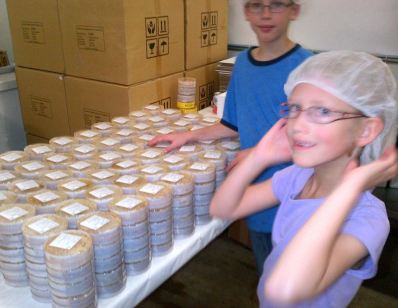
Temporary packing crew

With a break in the weather, my kids and I made a trip down to the farm. It is in Vulcan County, aptly named for heat. Vulcan can be really, really hot is the summer. But it is late fall and we’ve already seen a few days of minus 20! However, the past couple of days were pleasant, so my two youngest and I went to the countryside to give my older daughter a hand at packing honey.

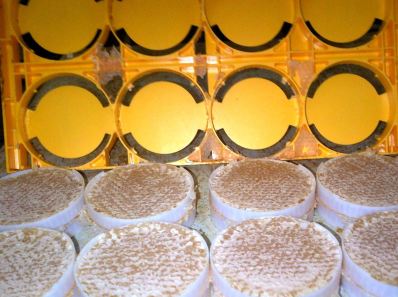
Erika and her husband have owned, managed, and operated our old farm for the past four years. This season was good. The couple are running Canada’s largest comb honey farm, producing tens of thousands of combs a year. (Sorry buyers, they are completely booked and sold out already.)

Today I am repeating some pictures I put on line last year. I didn’t take photos this weekend, but not much has changed in the past year. (Except the younger kids are taller.) These pictures will give you a tiny peak inside the comb honey packing shop.


Posted in Comb Honey, Friends | Tagged | Leave a comment

Buzzing Out-of-Sync

In-sync – and in it together photo by in CC by John Severns

If flowers bloom a month earlier than usual – as they reportedly did last year in Maryland – what does that mean for bees? According to Will Plants and Pollinators Get Out of Sync? it could mean trouble. The story appears on NASA’s website and explains how plants and pollinators have co-evolved: “the two species time their cycles to coincide, for example, insects maturing from larva to adult precisely when nectar flows begin.”

Before we consider the implications, I’d like to dismiss the notion that the species got together over beers one evening to “time their cycles.” As the NASA correspondent undoubtedly knows, cycle-timing is entirely an accident of nature, an accumulation of evolutionary mishaps that include genetic mutations and selection. Rather than coincidental planning, pollination synchronization results from an exclusionary rejection. If, for example, a plant suffers a mutation which results in early blooming (say, a rewrite of the base pair in a gene that produces a protein benefiting from heat stimulation) and if no bees are around at the new earlier flowering time, the flower simply does not reproduce. There are no seeds and there is no next generation of similarly off-sync flowering plants. However, if there is also a type of pollinator bees that coincidentally suffers a genetic mutation resulting in an ability to rapidly build a large spring population, the mutated flower will have pollinators available to “meet up” with it. That plant will produce similarly inclined seeds and the bee colony with its tendency to build an early spring population will also thrive and spawn more early-risers.

Mutations are rare, nevertheless mutual coincidental genetic disruptions happen frequently amongst the billions of creatures involved. It’s a numbers game and the numbers are big. Each year, about one in ten million of each DNA base unit is altered during replication. This happens by exposure to natural radiation or chemical hazards. If there are over a hundred million individual seeds in a field (the number of alfalfa seeds produced in a quarter-section, for example), each year ten seeds in the field will suffer genetic damage to the coding affecting the proteins that result in early flowering. So, it does happen – and at a surprisingly fast rate when we consider the billions and billions of seeds produced each season around the world. This is how plant scientists genetically alter plants (unless they are “genetically engineering” by manipulating bits of genetic code). Plant scientists expose millions of seeds to high-level radiation, resulting in accelerated rates of mutation. Then they grow the resulting plants and measure the results: A brighter colour? A longer stem? A tastier fruit? Nature plays this same game over a longer period of time. Wild flowers in meadows and seeds in fields are nature’s genetic laboratory. (If you would like to understand mutation rates, this easy article by Toronto professor Larry Moran discusses estimating the rate of human mutations – which average about 150 genetic mutations per person each generation.)

What is the effect of a warmer climate on plant pollination? First, we know that temperature is not the only factor that determines when a plant will bloom. It is not even the most important factor. Length of day is. Photoperiodism is a fascinating subject. Plants have 15 different types of cell receptor that sense light. Humans, by the way, have just 3 and ours are stuck inside our eyeballs’ retinas – a plant’s eyes cover its entire body. The thing that triggers blossoming is the period of time between the last flash of “far red” at the time of the setting sun and the next full spectrum sunshine, the following morning. Greenhouse managers know this and they sometimes toy with the plants’ transducers, forcing off-season flowering, by exposing plants to artificial light.

But for this discussion, let’s assume ambient temperature actually triggers flowering – as it does in some plants. Will flowers and bees become “out of sync” because of climate change? According to this Independent newspaper article, “Higher temperatures may result in fewer bees, scientists claim”, the future is dire. “This is because the more out-of-sync pollinators and plants become, the more difficult it will be for each to find opportunities for pollination – potentially threatening a wide variety of plants, including crops of seeds or fruits, most of which depend on pollination,” says the Independent, adding “it will raise fears that popular foods such as apples and pears could be affected.” However, those popular foods (Pears are popular? Not in our house.) will survive because the orchard managers contract beekeepers to supply honey bees. If the season slides forward, the beekeeper will adjust his schedule, developing stronger colonies earlier. This has already happened in California’s almond groves where big colonies are required in February and beekeepers react by stimulating their bees in early January. Farmers will somehow manage. The ever-popular Bartlett pear will remain a staple food (in homes other than ours*). But wild bees and birds might not be so lucky, according to both common sense and the NASA article.

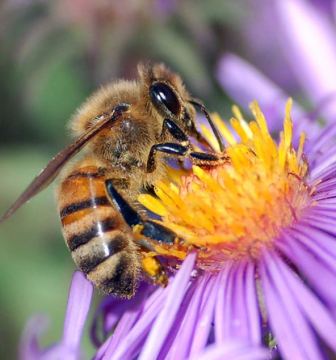
Hummingbirds are at risk. “Honeybees aren’t the only pollinators affected by climate change. Hummingbirds and other migratory pollinators may be even more susceptible if their seasonal migrations become out of sync with the flowering and nectar availability in their breeding habitat,” says NASA’s Earth Observatory website. I think the bottom line to this story is that humans, driven by profit and self-interest, will continue to enjoy juicy pears for generations to come, but the rest of the animal kingdom will be left to survive by the luck of evolutionary adaptation. Some species will adjust to the warmer climate, others will join the ranks of the extinct. Beekeepers will become more adept at manipulating colony populations to provide bees for commercially valuable crops while roadside asters (as seen in today’s photo, above) will mutate or perish. If man’s role in the changing environment fascinates you, you may like to read a piece I wrote for my Earth sciences blog, at this site.

* We do eat the occasional pear. It’s just hard to describe the fruit as popular.

Posted in Climate, Ecology, Genetics, Honey Plants, Pollination | Tagged | Leave a comment

Dead Swiss Bees

Dead pollen-collecting bees

Something odd was killing bees in Switzerland. It was sudden. It was peculiar. It was devastating. This past spring – in April, 2014 – beekeepers in the Zäziwil and Möschberg region found almost 200 colonies dying. They quickly recognized signs of poisoning. Local farmers denied using neonicotinoids or other insecticides. They were honest. They had not. Yet nearby bees were in rough shape.

Swiss investigators moved in. They demanded the farmers’ receipts. What had the farmers bought? What had they used? The investigators discovered that orchards in the area had been treated with the fungicide Folpet, which is allowed in Switzerland. Folpet is not an insecticide, it is a pesticide. The pests that it attacks are fungi. This fungicide is closely related to a much older fungicide, captan, which some of my more ancient readers will recall from their childhood. I do. I fondly remember running in a white cloud of dust, chasing after the family tractor as my father planted long rows of captan-treated seed potatoes. Because of the treatment, our potatoes did not suffer from Rhizoctonia, and neither did I. Recently, the EPA stated that captan and its sister fungicide Folpet are non-carcinogenic, except in “high doses and prolonged exposure.” Interesting. Used in orchards, captan and Folpet enhance the outer beauty of fruits – making them spot-free and shiny. This may be why I was allowed to follow in captan’s shadow when I was a child.

I have brought you no closer to finding the Swiss bees’ killers. But we’ve learned something about the fungicide Folpet. And so did the Swiss inspectors. They learned that the Folpet came from a factory is Israel. The factory also makes a non-neonicotinoid insecticide called Fipronil, which is banned in Switzerland. Just before making the Swiss batch of the fungicide, the factory had filled American and Brazilian orders for Fipronil. Allegedly there was still some insecticide in the factory’s system when the fungicide was made. It seems that the equipment was not cleaned before they started to produce Folpet. The Swiss government removed the suspect batches from their local market.

This story points out how tough it is to avoid poisoning our honey bees. The farmers were not using insecticides (or so they thought); the Swiss government had outlawed Fipronil and it could not enter the country (or so they thought); and the bees were pollinating fruit trees and collecting life-sustaining pollen (or so they thought). If this is the story in its entirety, it also suggests that even a small amount of poison (the residual left in a system when the factory switched from fungicide to insecticide) can kill a lot of bees.


Posted in Pesticides | Tagged , , | Leave a comment

A New Origin for the Bee?

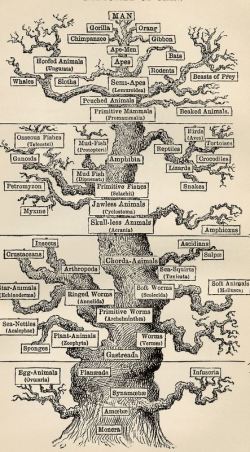
Haeckel’s 1879 Tree of Life

Years ago, we learned that honey bees developed in Africa, then spread north and evolved into different subspecies. It is not surprising that the bee could adapt to the much colder northern climates – you don’t even need to accept evolutionary science to see how that might work. With moderate genetic mutations from damaging gamma rays or localized environmental hazards, changes occur. With vast and rapidly reproducing populations such as bees, some mutations inevitably are beneficial to survival. In the presumed case of bees out of Africa, as bees slowly migrated north, the most cold-hardy descendants reproduced. From Africa’s adansonii or scutellata (or their earlier representatives), descendants became Europe’s mellifera, ligustica, caucasica, and carnica. These are the black bee, the Italian, the Caucasian, and the Carniolan respectively. But this simplified collection leaves out a host of other non-African races – the Middle Eastern anatoliaca, syriaca, lamarckii and meda, for some examples.

Did the honey bee originate in Africa? The out of Africa idea was developed a hundred years ago and was based on phenotypical traits (physically visible and measurable characteristics) and the assumed effects of geography and climate on the bees’ divergences. But now we are not so certain. In 1992, mitochondrial DNA (mtDNA) was analyzed from 68 colonies in ten different regions. The scientists found 19 different subspecies represented by the mtDNA. On the basis of their best fit “Tree of Life” model, they clumped these into three different clades, or branches. These lineages are African, Mediterranean, and European. But these scientists had a surprising result. They found that the oldest mitochondria could be traced to the Mediterranean branch while the African branch showed greater change. They surmised that the original dispersion of honey bees was from the Middle East: “The pattern of spatial structuring suggests the Middle East as the centre of dispersion of the species.” This result, from “Evolutionary history of the honey bee Apis mellifera inferred from mitochondrial DNA analysis”, published in Molecular Ecology also included the suggestion that the present subspecies divided less than one million years ago, as indicated by a 2% variation in the relevant mitochondria DNA.

The Middle East origin for honey bees was a surprising result. It went against prevailing notions, so other researchers were reluctant to accept the findings. However, in August of this year, confirming evidence was published. Using a larger sample set (140 honey bee genomes and 8.3 million SNPs) and more modern equipment, results were published in Nature Genetics in late August. Matthew Webster, researcher at the Department of Medical Biochemistry and Microbiology, Uppsala University (in Sweden) says, “The evolutionary tree we constructed from genome sequences does not support an origin in Africa.” Instead, our modern honey bee originated from common ancestors in the Near East and began a rapid dispersion about 300,000 years ago into Europe and Africa.

You may wonder if the study of the bees’ genetic tree has much relevance for today’s beekeeper. Here is something to note. Almost as a passing thought, researcher Matthew Webster adds, “In contrast to other domestic species, management of honeybees seems to have increased levels of genetic variation by mixing bees from different parts of the world. The findings may also indicate that high levels of inbreeding are not a major cause of global colony losses.” We can trust Webster on the factual part of this discovery – he is telling us that his world-wide samples of kept honey bees are more genetically diverse than other domestic species (i.e., pigs, sheep, goats, bananas, potatoes). It should then follow, he suggests, that Colony Collapse Disorder is not due to inbreeding of honey bees. Instead, it is more likely that some other factors are culpable in the disappearing disease that sporadically hits apiaries.

Posted in Genetics | Tagged , , , , , | Leave a comment

A Long Time Bloggin’

The first bee blog started in October 1995. This page was published in January 1996. It was a pre-blog blog – point form on a simple web page.

Web logs – blogs – have been around for about 20 years this month. That is according to this piece from (where else?) someone’s blog. I have been writing this bee blog – these pages about the politics and science behind beekeeping – for 19 years. I started in October 1995, and from the start, my pages included a ranting and raving page similar to a modern blog. The image above shows you what my January 1996 ‘bee blog’ looked like. When I began this exercise, I was in my 30s, had mostly dark hair, and quite a lot of enthusiasm. As best I can tell, the blog you are reading right now might be the first one ever started. In case you missed that start-up, here is a link to the Beekeeping News Page in my archives.

What good is a bee blog? There is a certain voyeuristic element to reading a beekeeping blog. It is like sneaking a peak under someone else’s hive cover. Except with a bee blog, the beekeeper is tipping the lid for you. Today there are easily 10,000 personal and business beekeeping sites and probably a thousand of those have blogs. Universities and government agencies add another thousand. Many of them are great. Part a beekeeper’s education is to study the tricks, tips, and thoughts of other beekeepers. And then borrow what makes sense. You won’t get a lot of clues from my blog here as this site is more news and opinions than practical bee culture. But if it is the latter you are after, you will find my book, Bad Beekeeping, is stuffed full of beekeeping advice. Not that any of it is good advice – but it is all interesting.

Posted in History | Tagged | Leave a comment

The Tired Honey Man

The tired honey man

Friends just back from Uzbekistan shared this photo with me. The gentleman is selling honey and he doesn’t seem too happy about it. We’ll get to that in a moment.

First, what is Uzbekistan? It’s a place on the other side of the planet. From me. If you live in Uzbekistan, then I guess I’m the one on the other side. Uzbeks were taken over by the Russian Empire 200 years ago, then fell under Soviet rule for a couple of generations. One legacy is the Cyrillic script you see almost everywhere. Another legacy is incredible pollution and general despair in daily life. The country is ruled by a “strong man” who enforces allegiance and law and order in an otherwise unruly nation. Uzbekistan has the odd distinction of having more Stans as neighbours than any other place on Earth – its five abutting Stans are Kazakhstan, Kyrgyzstan, Afghanistan, Turkmenistan, and Tajikistan. Uzbekistan is generally perceived as dusty, repressed, depressed, and difficult. I suppose that’s not entirely unfair. The country has slavery, pollution and water problems.

Uzbekistan is cursed with a near-perfect cotton-growing climate and a rotten government. Cotton is the main business in that country, but the fiber has a brutal history. It is tough to grow and in Uzbekistan, cotton is mostly picked by hand. Cotton picking, of course, contributed to slavery in America and elsewhere. In Uzbekistan, Human Rights Watch says that as many as 2,000,000 men, women, and children will be used as slaves to harvest this month’s cotton crop. The government says it is everyone’s national duty to pick cotton. Well, not everyone – just the poor. The result of their national duty is the export of over a billion dollars worth of cotton. It props up the poor country’s economy and keeps the leader in power. But people die in the fields, according to Human Rights Watch, while performing their national duty – unpaid forced labour.

Then there is the water. Cotton thrives in Uzbekistan’s desert climate – if it is irrigated and heavily fertilized. Water is diverted from entering the Aral Sea and directed into the cotton fields. This has quickly turned the world’s 4th largest salt lake into a puddle. Once half the size of England, almost all of Aral has disappeared in the past 40 years. The environmental disaster began in the era of the Russian Empire, but the Soviet overlords brought industrial-scale cotton-growing and landscape degradation to an art.

Along with pillaging the water, there is ubiquitous pollution. Typical for huge monoculture plantations, cotton is targeted by weevils and other evils. The solution is harsh poison – not systemic insecticides, but aerial and boom-spray applications of cancer-causing insecticides. Further, the continuous cropping is sustained only by industrially-produced fertilizer which has polluted what is left of rivers and lakes in the country. The air, I am told, has a stench of poison everywhere. There is little escape for ordinary folks – conscription, dust, and pollution are the reality.

Honey, including Nutella flavoured

Which leads me back to the honey man in the first picture in today’s post. He doesn’t seem very enthusiastic does he? But who could be in his position? Undoubtedly his bees have also tasted the chemicals in the air. It is hard going for Uzbekistan’s beekeepers. The government – the same one responsible for the poisons and the slavery – is expanding beekeeping by seeking bee equipment. Maybe it is some sort of 5-year plan. I imagine their plans will compete against beekeepers such as the one shown above. Last year, the government estimated honey production at about 4 million pounds. They think they can expand it. Much honey is sold in recycled containers, including the Nutella jar you see here. Plastic wrap is often used for lids. There is no fault in that – beekeepers do what they must to survive. Including gloomily retailing honey at the big Tashkent market as the honey man pictured above is doing. He may be exhausted, he may be tired. Or he may be thinking about his trip nexy week into the countryside cotton fields in the back of a big transport truck. Slave labour – the national duty – for his country’s kings of cotton.

Posted in Ecology, Honey | Tagged , , , | Leave a comment

Who is the Saint?

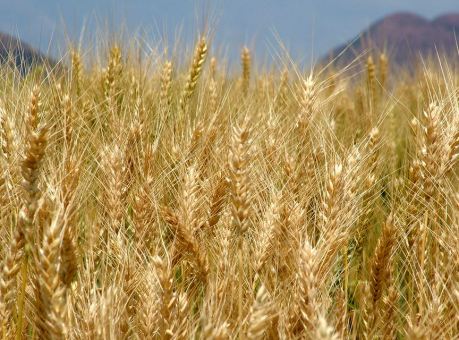
Golden wheat, but not golden rice

On this day in 1970, Norman Borlaug accepted his Nobel Peace Prize. You probably never heard of him. A few days ago, I read an interesting piece in an old New York Times column, written by author/philosopher Steven Pinker. He had a few words to say about Mr Borlaug. I’ll tell you what Steven Pinker said, but you can read the story yourself – it is at this address.

Steven Pinker was writing about how we perceive morality. He noted that if we were asked to pick the most moral person from this group – Mother Teresa, Bill Gates, and Norman Borlaug – we would almost all choose the saintly little lady who went to India. We might reject the billionaire who was accused of monopolizing software. And, about Norman Borlaug, we would likely ask “Norman who?” Mother Teresa moved from Kosovo to Calcutta, tended the poor, sick, and weak, and developed the Missionaries of Charity. She is the obvious choice and directly helped thousands. But Bill Gates adopted the problems of the developing world – malaria, among others – and has (somewhat) quietly contributed billions to find solutions. His work has possibly saved millions of lives. Then there is Norman who. His Nobel Peace Prize recognized his almost invisible work that revolutionized agriculture and invented the Green Revolution. By some accounts, Borlaug is credited with saving a billion people from cruel slow desperate deaths by starvation. A billion lives – that’s more than anyone else in history.

Of course it is unfair to ask who among the three is the most moral without presenting a definition of morality. But on the strength of saving human lives and reducing suffering, Norman Borlaug’s contributions were astounding. During the 1960s, dire predictions of the eminent tragic starvation of the majority of Chinese, Indians, and Africans was prognosticated by the most knowledgeable minds. But it didn’t happen. Norman Borlaug, an American geneticist, applied the latest ideas in bio-engineering and found a way to feed the billions. India, once deemed to decay in misery and starvation, now has 1.1 billion souls and is a net exporter of food.

In the 1950s, Norman Borlaug worked mostly with wheat, genetically dwarfing the plant so it wasn’t spindly and prone to falling over and losing its seeds in the field. He dramatically increased seeds per stalk and developed resistance to disease. The result was wheat that revolutionized food production in Mexico (where he did most of his research), and Pakistan and India which were becoming desperate for the help his wheat brought.

Why write about better farming and morality on a bee blog? Occasionally it is good to commemorate unselfish contributors such as Borlaug. Early in his career, Borlaug was employed by DuPont. He was offered twice the salary to stay with them, but he left for an NGO in Mexico instead. His young family would have appreciated the money. But he took the job that he thought could make the most impact and help the most people. It is also important to occasionally remember that without genetic manipulation and the application of science to solve a desperate problem, a billion people would have died. Today we find a vocal group of wealthy and comfortable folks (wealthy and comfortable by world standards) who are trying to stop scientific progress that could – for one example – allow a genetically altered form of rice to provide nutrition that would save a million children from blindness. Some well-off people with no risk for themselves or their children of suffering vitamin deficiency in America or Europe nevertheless campaign to prevent golden rice from being used in India. It is a twisted sense of smug self-interest that causes this tragedy. A billion people are lucky such people were not able to stop Norman Borlaug’s work fifty years ago.

Posted in Ecology, Genetics, History, Strange, Odd Stuff | Tagged , | Leave a comment

No longer almost free

At a get together with a small group of beekeepers, we all started bugging one of the fellows about the price of his honey. At $10/kilo (less than $5/pound) one lady figured we could do well buying his entire crop and selling it ourselves. She might – she’s a born sales person. Me, not so much. But it got me thinking about the price of honey. And how hard it is for a beekeeper to decide how much to get for the stuff. Many beekeepers, it seems, are embarrassed to ask for the market price for their honey. To them, almost free is almost too much.

Honey has reached a record high price in North America. It has never been worth more. US bees are increasingly diverted into pollination, leaving fewer to gather honey. Much honey is imported into the states (2/3 of all US-consumed honey is imported) but the foreign sources are getting harder to buy because of growing world-wide prosperity – countries that used to export their honey now use it locally. And some countries – such as China, for example – have begun to buy North American honey. I know, first hand, that this is true. So honey prices are up. But I was still shocked to see how big the price increases have been.

Bee Culture magazine has had a group of faithful honey vendors provide prices on a monthly basis for decades. In September 2006, one could sell packaged cases of jars at a wholesale price of $2.80 per pound. Eight years later, the average price for the honey has almost doubled, to $4.98 per pound. Of course, that is filtered and packed and labeled and ready for the store. The USDA reports that the wholesale bulk price (in drums or totes) has more than doubled – from $1.03 per pound to $2.12 per pound in 2013. So, if you are selling a few hundred pounds of your finest wares, check prices at the local stores, tell your customers that your honey is better than the store stuff (It probably is.) and don’t be shy about getting the market price for your effort.

Posted in Beekeeping, Honey | Tagged , | 1 Comment

Caught in the middle

Are they staying or are they going? The Globe and Mail, “Canada’s newspaper,” has an editorial written by Margaret Wente. She calls her piece “Caught in the Middle of the Bee War” and it is about the vanishing honey bees. This is not the first time Ms Wente has written about bees. The first such story that I can remember described her husband’s beekeeping adventures and it appeared around 2004. It was an unusual piece because it was quite funny – Margaret Wente usually shares more serious opinions about politics and economics. Yesterday’s column was fittingly Wente, commenting on the politics of disappearing honey bees.

The Globe and Mail piece surprised me. It begins with the usual “bees are going extinct” and “neonicotinoids are to blame,” but then Ms Wente seems to indicate that she believes neither. Which is refreshing, because managed colonies of bees are certainly not going extinct. Worldwide, the number of kept hives is 45% higher than it was 50 years ago. Since Colony Collapse Disorder was first noticed (around 2006), and since neonics became widespread (also around 2006), the number of bees in North America increased from 2.2 million colonies to 2.4 million today. Not exactly extinction. Nor is it likely that neonicotinoids are playing the leading role where sudden colony collapse is noticed. I say this because I live in Alberta, a place where neonics are used extensively, and Albertans have not suffered colony collapse. Not yet, anyway.

The column by Ms Wente mentions the Ontario lawsuit. The suit pits two Ontario bee outfits against Bayer, a manufacturer of neonicotinoids. But it was set up as an “opt-out” class action suit. Beekeepers are automatically part of the suit, unless they expressly ask to be left out. Here is what the Globe and Mail piece says about Alberta:

“Alberta’s beekeepers, which produce nearly half of Canada’s honey, aren’t joining the lawsuit. They say the new seed treatments actually reduce the bees exposure to harmful pesticides.”

A bit more from the Globe‘s piece:

“There’s no doubt that something is ailing the bees, or at least some of them. Ontario has been hit particularly hard by bee die-offs lately. But a lot of experts say the problem isn’t neonics. In Australia, the bee population is stable even though neonics have been in use there for years. The Australian regulator recently reported that neonics are better for crops and the environment than the products they replaced.”


Posted in Pesticides, Save the Bees | Tagged , , , | Leave a comment