Best place to keep bees?

Medhat Nasr, teaching queen breeding in Alberta

I don’t know what causes colony collapse disorder. CCD is likely due to poor nutrition, weak genetics, farm pesticides, chemicals used inside beehives, varroa mites, and viruses carried by mites and injected into whatever gooey stuff bees use as blood. CCD is complicated – that’s why it is controversial and that’s why it has been hard to predict and hard to prevent. I think one reason Alberta beekeepers have not (yet) had huge bee losses has been the extraordinary help, advocacy, and educational projects provided by Alberta’s Chief Apiculturalist, Dr Medhat Nasr and his staff. They have worked extremely hard to help Alberta beekeepers keep their bees healthy – especially in areas of nosema and varroa mite control.

Alberta has a lot going for it. Our two big cities – Edmonton and Calgary – each have a million people. Another two million Albertans live out on the land. And it is a big land – the size of Texas. This Canadian province stretches from grasslands along the Montana border to parklands bordering the Northwest Territories. And Alberta includes some gorgeous Rocky Mountains. People here live well – we have the highest per capital income in North America of any state/province – roughly $80,500 for every person. With it comes great schools, universal health care, and some pretty nice biking trails. Honey is produced everywhere in Alberta that has farms and ranches. You may have heard of the Peace River Country – that’s here, too. Honey crops in the Peace can (and often do) top 250 pounds per hive. The province has 250,000 colonies and honey crops average 150 pounds; but this includes 50,000 colonies kept mostly for canola pollination contracts – those bees aren’t expected to produce much honey. The summer climate is mild, days are really long, and there are millions of acres of alfalfa, canola, and sweet clover – all of which produce white, mild-flavoured nectar.

Alberta has a lot going for it. With the lowest taxes in North America (Seriously – you didn’t expect that from a place in Canada, did you?) and a fairly libertarian government, people are mostly left alone to make a living. And that brings us back to the role of a chief bee inspector. When I was a kid, I spent three summers as a Pennsylvania bee inspector. My job was to find American foulbrood. And burn hives. I was a skinny teenager and had to talk smoothly to inspect bees hidden on farms in Appalachian hillbilly country. Only once did I need state police backup. Even though sulfathiazole was a proven treatment for AFB, our out-dated laws mandated burning. It was an awkward job, to say the least. Much better to have a system where individuals are responsible for their own welfare but are offered free or inexpensive advice and tools to help them keep healthy bees.

Good government makes a difference. You can’t let the biggest and meanest kid on the block take advantage of everyone else. The fellow who spends the most on lawyers isn’t always right – chances are he is wrong, that’s why he hires an army of lawyers. There has to be law and order and we have to participate as helpful members of the human family. When American foulbrood was the beekeepers’ biggest problem, equipment was burned to stop the disease from spreading to neighbouring farms – even if the guilty party threatened lawsuits or violence. But that was long ago and far away. I moved to western Canada 40 years ago and have always felt like I won the lottery by being here. But back to the theme of this blog entry – part of the reason Alberta has been such a successful place for beekeepers is the good governance of the bee inspection office – the Office of Beekeeping Help and Advice.

Posted in Beekeeping, Diseases and Pests, Friends | Tagged , , , , , | Leave a comment

An indoor hive

philips indoor urban bee hive beehive

Some Indoor Honey

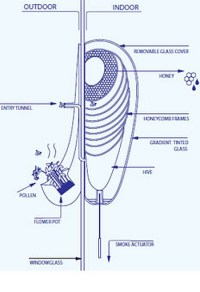
I can’t even begin to imagine the clever wit that went into designing this revolutionary beehive. What you see to your right – if you are looking at the hive-gadget rather than the demonstrator – is a new hive design developed by Philips. Philips is the smart Dutch company that makes everything from water-jet dental flossers to coffee makers and electric shavers. They have classy stuff. Their website tells us that Royal Philips Electronics is a diversified health and well-being company, focused on improving people’s lives through timely innovations. Their focus is on “sense and simplicity.” The Philips design department apparently dreams up great product ideas for modern living – sleek designs for products that they will probably never sell. Like the Urban beehive.

A Philips team of design experts came up with this idea. “Why not keep bees in the kitchen?” someone probably asked during a brainstorming session. “Yes! Yes! And have a potted flower at the end of the bees’ tube so bees can crawl through the tube, then fly down to the flower, gather some nectar, then bring it back into the hive!” said a second brainstormer. The third brainstormer would have jumped from her chair, “And we’ll have a string that the owner can pull so honey will drip out of the hive!” The idea, of course, is nothing short of brilliant. But it can’t be patented – beekeepers have been pulling strings and squeezing honey from their hives for centuries already.

To help Philips promote their product, I want to let you read their own sales literature: (By the way, I don’t take anyone’s money, I do this all for fun.)

“The design of the beehive is unconventional, appealing, and respects the natural behavior of the bees. It consists of two parts: entry passage and flower pot outside, and glass vessel containing an array of honeycomb frames, inside. The glass shell filters light to let through the orange wavelength which bees use for sight. The frames are provided with a honeycomb texture for bees to build their wax cells on. Smoke can be released into the hive to calm the bees before it is opened, in keeping with established practice.

“This is a sustainable, environmentally friendly product concept that has direct educational effects. The city benefits from the pollination, and humans benefit from the honey and the therapeutic value of observing these fascinating creatures in action. As global bee colonies are in decline, this design contributes to the preservation of the species and encourages the return of the urban bee.”

phillips indoor urban bee hive beehiveDid the ad department miss any buzz words? They mentioned natural, sustainable, environmentally friendly, therapeutic, and the (imaginary) global collapse of bee colonies. But will the hive actually work? What do you think? Observation hives work. This is the loveliest observation hive you can imagine – times ten! I like the design! I wonder if I could get 400 of these and put them in apartments and houses throughout Calgary? It would be such fun going from house to house, maybe dragging a little red wagon, and pulling all those strings while the honey drips out.

As you can see in the accompanying purple-coloured blueprints, the hive and flower pot are separated by an exterior house wall. The bees climb through the tube and find themselves outside where they could maybe work on more than a single potted flower. The only thing I can’t figure out is how the honey drips out the bottom when you pull the string. Chances are the designers of this hive have never actually kept bees or worked with honey combs. They will also be somewhat surprised to discover that when the hive is opened in the house, not only will the smoker set off the fire alarm, but the bees will be somewhat drawn to the kitchen lights and windows and the bees will, unfortunately, never, never, ever return to their hive. They will just hang out among the pots and pans. Other than that, it will probably work fine. But let me add this:

It is nice to see a big company such as Philips (one of the largest healthcare and electronics firms in the world) encouraging its designers, admen, and other folks to experiment, to think outside the (bee) box. Although this prototype will likely not be built, the training, learning, and innovation involved are really laudable. Seriously.

Posted in Culture, or lack thereof, Hives and Combs, Strange, Odd Stuff, Tools and Gadgets | Tagged | 3 Comments

Alberta deadline

A Bad Beekeeper

Sorry I was late posting this. Hope you are not in big trouble now. But Albertans who keep honey bees or who own beekeeping equipment are required – by law – to register as a beekeeper by June 29 of each year. Registration is nearly painless – previously-registered beekeepers receive a form to fill out before the deadline. New beekeepers need to ask for the paperwork. Although compliance is more difficult than buying a long-gun in Alberta (which is super easy, believe me, I know from experience), the registration process isn’t too tough. They need your name, location, and number of colonies. This is to help control the spread of bee diseases. If you are new to beekeeping, contact Dr Medhat Nasr, the provincial apiarist, and his staff will help you out. Their number is 1-780-415-2314.

How are Alberta’s bees? With the growing concern over the role neonicotinoids play in severe overwintering problems for honey bees, Alberta beekeepers should be worried, say anti-nic activists. Of course, they are right. The stuff is poison, a pesticide designed to kill sucking bugs. Alberta is Canada’s biggest honey producer (Alberta beekeepers make about 5 times as much honey each year as Ontario beekeepers.) and our main honey crop from canola. Canola grows from seeds treated with neonicotinoids and each year the farmer plants new seeds for each new canola crop. You can see where this is heading. Or maybe not. Last winter, Alberta had excellent wintering of honey bees. According to chief inspector Dr Nasr, the province lost only 10 to 15 percent of its bees. And it was a long, cold, nasty winter. In fact, the Western Producer ran a story about Alberta that beamed, “Bees come through gruelling winter in good condition” and indicated that losses averaged half of last year’s numbers. I can’t understand this. If the neonicotinoids are as bad as claimed (and maybe they are?) then Alberta should be ground-zero for death and destruction. But it is not. I know of one newish beekeeper who had pretty awful wintering this year due to nosema and wind exposure, but the vast majority had great wintering.

I have heard from a lot of Canadian beekeepers. They are worried that neonics will be incorrectly blamed for bee deaths. The beekeepers fear neonicotinoids will be banned and farmers will be back to aerial spraying which slaughtered bees by the billions back in the 1980s. But if the neonics are actually causing the massive deaths attributed to them in other places, we don’t want that either.


Posted in Culture, or lack thereof, Diseases and Pests, Pesticides, Save the Bees | Tagged , , , | Leave a comment

Glow-in-the-dark bees

Dr Schulte

Finally! Glow-in-the-dark honey bees! We’ve all been waiting for these glow bugs to complement our glow-in-the-dark radium-painted wristwatches and glow-in-the-dark jelly bean collections. Now you can have the complete set of things you probably didn’t know existed. Researchers at Germany’s Heinrich Heine University have announced they were able to add a glowing gene to a fertilized honey bee egg, feed the resulting larva enough royal jelly to create a queen, then produce drones that carry the gene. The idea was not to help scout and forager bees work more effectively at night (the Heinrich Heine Tech College is working on miniature flashlights) or to help hive bees see the waggle dance more clearly (disco balls were introduced in the 70s to accomplish that), but according to post-doc tinkerer Christina Schulte, the scientists were simply trying a “proof of concept” experiment. It worked. Glowing applications will come later.

The honey bee genome was fully decoded in 2006. That was almost ten years ago. I thought by now we would have genetically-modified stingless honey bees, honey bees that never die, and, of course, bees modified by Monsanto to be resistant to Bayer’s neonicotinoids. Science sometimes lags necessity, doesn’t it?


Posted in Bee Biology, Culture, or lack thereof, Humour, Queens, Strange, Odd Stuff | Tagged , | 4 Comments

Wild bees again

old fashioned urban beekeeping woman 1883

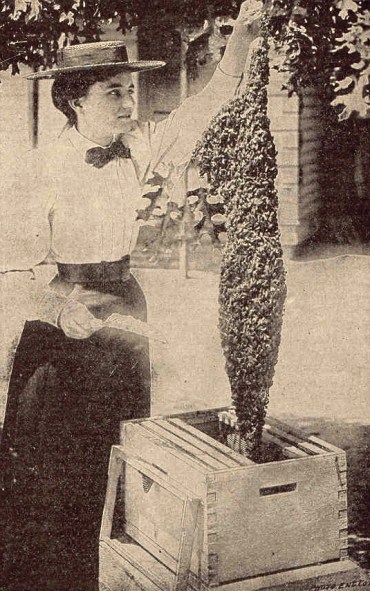
An 1883 Urban Beekeeper from AJ Cook’s Bee-keeper’s Guide

A few days ago, I wrote a snarky blog entry about one researcher’s efforts to alert us to a hazard of urban beekeeping. It is Dr Cartar’s contention that keeping bees in an urban environment robs wild native bees of food, which in turn threatens their survival.

I agree with some of the Calgary professor’s position – but I’ve not actually studied the subject in detail as Dr Cartar has. We agree that honey bees are an imported species – they are not native to North America – and thus they disrupt the natural ecological balance established by millions of years of evolution on our continent. We also agree that honey bees sometimes take nectar and pollen produced by native (and invasive) flowers that wild bees may have eaten. But I’m not sure about the severity of the problem. Nor do I know much about Dr Cartar’s premise that forage competition is the primary threat to native bees.

Research and evidence exists to show that the loss of habitat (nesting sites) in urban settings have jeopardized wild native bees, probably more than interspecies competition for food from honey bees. At this time, I think that urban honey bee keepers should be encouraged as these people are often great advocates for maintaining nesting sites and good pasture for wild bees. You can read our difference of opinion in more detail in the June 12 blog entry on this page.

When warranted, I sometimes publish letters received from informed sources. I feel that Dr Cartar deserves the opportunity to answer some of my missives, so with his permission, the bulk of his letter to me follows:

Dear Ron,

“The point of my “every joule of honey in their jars….is a joule robbed from native bees” quote is simple. At equilibrium, the density of native bees tends to be most determined by flower availability (that is, the nectar and pollen available). More flowers = more bees, in general. This is the essence of competition, and is readily observable in nature. Bee populations build up (or get smaller) based on floral availability. And the converse is true, but over longer scales (because most bees are annuals, and most flowers are perennials; more on this later). Think of this as a game of musical chairs: native bee abundance is (on average) in proportion to the chairs in the game (i.e., the flowers). Then somebody brings in a large number of players (a colony of honey bees), but there’s no change in the number of chairs. And these introduced, non-native honey bees have little chance of failing, because their keeper usually feeds the colony when foraging is insufficient to colony needs.
What you’ve done is stack the game of musical chairs against native bees, with an expected outcome (loss of local bees). Hence, “every joule of honey is robbed from native bees”…

“But there are exceptions to this too-simplistic characterization. As I noted in my email to you, in some years, bad weather (often in spring) removes many of the bees, so there’s little competition, and flowers get insufficient pollination service from natives. I see this in one year in 5 or 6, locally. In these cases, nectar accumulates in flowers. Flowers age and drop off without producing seed. You’d think that in this circumstance, adding honey bees would have little impact on natives. But the outcome depends on amount. As noted in the paper I emailed you, honey bees prefer to forage near their colony (but will fly far if necessary). So the addition of a honey bee colony, will greatly deplete nectar and pollen rewards in the local area (others have documented this, where the depletion of floral rewards makes their use by other bees unprofitable). Hence, even in the case where flowers are super-abundant relative to native bees, adding honey bees can easily push out the natives
who previously had more food than they knew what to do with. This is not an empirical observation, just one that seems reasonable. The observation that honey bees deplete flowers to levels that make them unprofitable to local native bees is reasonably well established…

“Another exception of note is that, for some flower species, the joules available depend on the rate of visitation. In these species (which are not typical), flowers resorb nectar that is accumulating unharvested, and/or produce more nectar when it is harvested more rapidly. In this case, floral rewards depend on visitation, suggesting that then number of chairs in my musical chairs analogy might change. But again, these effects are easily dominated by the sheer density of honey bees in a colony, so adding honey bees is likely to hurt natives…

“Of course, other factors determine abundance of native bees. You correctly point to one: nesting habitat. But to make the argument persuasive, you need to point to evidence of nest site limitation of population abundance in the literature. I’ve noted that abundance of floral resources is the single best predictor of bee abundance, and this obtains at 2 levels: bees visiting flowers, and bee reproductive success. To be complete, the other determinants of local population size are diseases, predators, and parasites. Along with nest sites, all of these should operate in a density-dependent manner. But don’t assume that nesting resources limit bees in Calgary, when there is such heterogeneity in human structures (bare ground for hole-diggers, tubes for cavity-nesters, vole nests and unprotected insulation for bumble bees)…

“I’m not deliberatley picking on urban beekeepers, and admire them for embracing a truly fascinating insect. I share that admiration and fascination. I’m just pointing out that ANY honey bee colony, given its enormous size (relative to local densities of native bees) and propensity for local foraging, has the potential to have big negative impacts on the local native bees. The overall impact would depend on the number of these colonies added. So one colony is too many, at least for the locals. Urban beekeeping is not a win-win (beekeeper gets free honey, plants get pollinated), unless you ignore the displaced native bees. My suggestion: DO feel guilty about keeping non-native bees, but keep your fascination with bees! Instead, consider accommodating native bees. The Xerces society provides a wonderful web resource for how to begin in this endeavour.

“Introduced, managed honey bees have negative effects, in all sorts of ways, on native bees (especially when the native bees are honey bees, like in Europe). If scientific evidence still matters in decision-making (an increasingly dubious preposition in recent years in Canada), then it’s unlikely that an urban (or rural) honey beekeeper will have no local negative effects on native bees. And the extent of the problem will increase with each increase in the extent of urban and rural honey beekeeping…

“Just because everything we do (short of suicide) has negative effects on our environment should not make us throw in the towel, and ignore the environment. Let’s be mindful of what we do, and embrace our love of and fascination with insect pollinators. Instead, let’s channel and extend that affection and fascination to our neglected native bees. When you notice native bees, and their amazing diversity, your fascination will be well-rewarded.”

Cheers, Ralph

Posted in Bee Biology, Beekeeping, Ecology, Science | Tagged , , , | 3 Comments

Giving thanks

Pure Sweet Honey Farm Inc. sponsors this year’s ALS Fundraiser!

One last look at the Calgary ALS (Lou Gehrig’s Disease) fundraising event. You may wonder what this has to do with beekeeping. I guess it reaffirms the idea that the human condition is as frail as the environment and that any beekeeper anywhere can end up with a horrible illness. It also shows that any beekeeper anywhere can help by supporting the effort to end the disease and make life as comfortable as possible for those who have ALS.

This short post is a thank you to the people and companies that supported this year’s drive. This includes my friends at Medivet Pharmaceuticals, the company that makes Fumagilin-B and other bee-healthy products; Diane Dunaway and her husband Dave at Bee Happy Honey, in BC; Calgary beekeepers Dave and Liz Goldie; and the honey-packing company Pure Sweet Honey Farm Inc, in Wisconsin. I used to sell a bit of honey to Pure Sweet many years ago and the owners have remained very close friends. Pure Sweet was one of only a few high-level sponsors (see the photo, above) for the ALS fundraiser and their sponsorship made a big impact on this year’s success. Thanks to all these great people – Ursula at Medivet, Diane & Dave at Bee Happy, Dave & Liz, and Stan and Willi at Pure Sweet Honey!

Posted in Friends | Tagged , | Leave a comment

At home in a home

A swarm of honey bees have invaded an Alberta home. Who can blame them? According to one newspaper, the bees were confused by the skep-looking geodesic dome that a rural Canadian family calls home. The bees were confused? Perhaps the news reporter was making a joke.

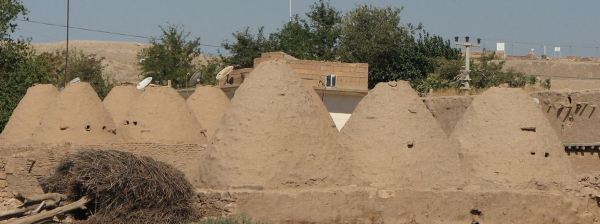
Left, A Home, not a beehive – – – Right, A 19th-Century beehive Confused? The bees aren’t.

These are beehives.

Once again, we have succumbed to our tendency to imagine that bees think like people. The Sun newspaper reporter wrote: “That’s what you get when your house happens to look like a giant beehive… the bees just seem naturally drawn to the round structure.” No, not true. Not even a little itsy-bit true. The honey bees had absolutely no idea that the house they settled in looked like the old-fashioned skep hives that haven’t been used in Canada for over a hundred years. Unless those bees had been reading some very, very old beekeeping journals, they would not have been thinking, “Hey, Betsy-bee, don’t that look like a big beehive? Let’s go fill ‘er up.” Nope. Bees don’t think like that.

“That’s what you get when your house happens to look like a giant beehive,” said the newspaper. Actually, beehives built by humans in this part of the world are rectangular white boxes – they sort of look like most of the houses on Main Street. They don’t look like geodesic domes. But the bees don’t care. With their multi-lensed eyes (and tens of thousands of receptors) they do not see what we see, they don’t recognize hives or homes as we do. Assuming that bees see the world as we do – in both the literal and figurative sense – is exercising anthropomorphism. That’s the common habit of instilling human traits on objects and creatures. It probably arises from our noble instinct of empathy, but it creates trouble when we interpret the world around us in such terms. Carried to extreme, we might place a television inside a beehive: we enjoy an occasional nature flick, surely the bees will, too.

What drew the bees to the skep-shaped house? The home-owner, Cheryl Morgan got it right when she said, “Maybe they saw it as a ready-made beehive, so they moved right in.” Scout bees see every crevasse, nook, and hole-in-the-wall as a potential “ready-made” beehive, which their swarm might call home. If it is dark, sheltered from sun, wind and rain, and has a small defendable entrance, it could definitely be used as a swarm’s castle.

Bees invading a home can be a big problem for a home owner. In this case, I think the story ends happily. The home owner found Calgary’s Urban Beekeepers’ network (Apiaries and Bees for Communities) which helped put her in touch with a local beekeeper who removed the bees. An interesting interview and more details to this story are found on CBC radio at this link.

Posted in Hives and Combs, Swarms | Tagged | Leave a comment

Going native

A bumbling bee

A Calgary University professor has this to say about urban beekeepers: “It is not as rosy as they think. Every jewel* of honey that they get on their plate or in their jars is a jewel that has been robbed from native bees.” Dr Ralph Cartar also says that urban beekeepers “swamp the world with bees and the competition becomes intense and you risk losing those native pollinators.”

 *(OK, perhaps Professor Cartar said “joule” – a unit of energy – but I heard  “jewel” – a unit of pricelessness! Since they sound the same on radio, I’m using the more poetic version of the homonym. I was kindly corrected about my mistake by Dr Cartar himself!)

How could anyone be opposed to the hobby beekeeper with a colony in the backyard? Dr Cartar, in a CBC radio interview this week, explained that honey bees are an imported species that steals (OK, he says “robs”) food from native bees. You see, our western honey bees are not native to North America. Or South America. Or Australia, New Zealand, India, China, and a whole bunch of places that depend on the bee for crop pollination and where a whole bunch of people who love ecology, nature, outdoor activities, and communion with buzzers have been keeping honey bees. Cartar tells us that “people seem to think that because they are important for some agricultural crops, they are good everywhere.” He says Calgary urban beekeeping should stop immediately.

Is he right? I have struggled with this myself. Beekeepers don’t necessarily have the high road as environmentalists. It is a fact that honey bees were introduced as an invasive species in most of the places they are fondly kept. And it may be somewhat hypocritical for us beekeepers to claim to represent the environmental movement while keeping bees. Unless we do something more than tend our artsy little hive.

Before I elaborate on my idea of a solution, I want to address some (of what I saw as) errors in Dr Cartar’s claims. In the radio interview, the professor said, “Every jewel of honey…in their jars is a jewel that has been robbed from native bees.”  This is hyperbolic nonsense. Some nectar, certainly, might have gone to a native bee. But it is not true that every drop of nectar taken by your honey bees has been stolen from the mouth of a native bee. This is because there is much, much, much, much more nectar produced than can be used by the native bees. Without honey bees, the nectar is simply lost – it does not automatically go to feed a native bee.

In Calgary, there are fewer than 300 colonies of honey bees. Calgary’s urban area covers 700 square kilometres – that means there are over 2 square kilometres for each hive. That’s 200 hectares, or one hive per 500 acres in Calgary. We usually figure that for effective pollination, you need to place 1,000 hives on 500 acres. At this rate, instead of 300 colonies, Calgary could have ten thousand and there would still be enough food for all the bees. Of course, not all the land is growing flowers – there are lawns and parking lots and skyscrapers. But Calgary has immense public parks and huge gardens, so we might calculate that a third of our land is still somewhat floral – our parks and meadows have a gazillion dandelions – plus willows, wild cherries, caragana bushes, Russian olives, goats’ beard, clovers, wild alfalfa, sweet clover, fireweed, goldenrod, asters, and I am certainly forgetting some. In his correspondence with me, Dr Cartar wrote, “If you start with the premise that populations of pollinators are best explained by floral resources (as opposed to disease, predation, weather, etc.), then a logical outcome of increasing the density of one competitor (honey bees) is to decrease the density of others.” This may be true in some situations, but probably not in the case of Calgary – the limiting factor here is not forage, but it is nesting sites for native bees. There is probably no shortage of forage for honey bees and wild bees to share. Flowers with nectar are generated with more abundance than bees can cover. It is a reproductive and survival tactic on the plants’ part.

If anything, more honey bees result in more seeds, which results in more flowering plants the next season for all the creatures. Did you ever wonder why honey bees are kept near orchards, or hauled in by beekeepers to ensure pollination? It is to try to get as many flowers in touch with bees as possible. With only a few native bees, and no honey bees, in a very natural environment, most of the flowers with nectar and pollen will never have a pollinator visit. With a saturation of bees, more seed, nuts, or fruit are produced because a greater number of flowers are pollinated. It is really, really hard to over-saturate an area with bees. That’s why commercial beekeepers often keep 50 colonies in a single 1/10th acre lot – and they all do well! I said this to Dr Cartar and suggested that if he really wanted to help native bees, we should tackle issues around the native bees’ loss of nesting sites. Native bees do not nest in man-made honey bee boxes. They most frequently nest inside the ground. Honey bees almost never nest inside the ground. I think that a single car lot or shopping plaza destroys many times more native bees than all the urban bees kept in the city. Because the problem is nesting site destruction, not floral competition, opposition to urban beekeeping is perhaps misdirected.  Or, I could be wrong.  I haven’t studied the issue rigorously, scientifically. I’m writing as a beekeeper might think about this.

Here is what I think. First, I think Dr Cartar is wrong to pick on hobby urban beekeepers. These people are allies, not enemies. We exchanged e-mails when I tried to uncover his thoughts in more detail and when I offered him a chance to backtrack a little in his animosity towards urban beekeepers. (He was unyielding.) He seems intelligent, articulate, and I suspect that he is a really nice fellow. But if one cares about wild bees, as Cartar very obviously does, then alienating a group that also finds bees fascinating is a mistake. It is true that we beekeepers are engaged in an activity that can disrupt native bees. But we are among a small group that can be encouraged to do more than almost any other group to help native bees.

Even the most strident environmentalist needs to eat and function in society in a normal way. As an environmentalist, one does not retreat to a cave, eschew clothing and fire, and scrounge for grubs and berries. The environmentalist instead tries to balance his or her carbon footprint and environmental impact by reusing and recycling, and especially by offsetting the damage we all do by contributing to carbon sequestering (eg., forests) and environmentally constructive projects. Dr Cartar wrote that it is his philosophical position that if you know something is harmful, then you simply do not do it. He has a point, but in our society everything we do is harmful to the environment. Unless we retreat naked into that cave, we are doing harm. It is more about mitigating the damage than reducing it to zero. We all want to live in a world where children have a chance to survive infancy and can have the hope of a healthy, long life. Science, technology, and even beekeeping with invasive species, has made this possible.

So here is what we can do. Set up habitat in the backyard as nesting sites for native bees. Continue to develop awareness for bees in general. Donate or invest in native bee garden projects. Plant flowers for native bees – usually these are native, non-invasive flower varieties that are not very attractive to honey bees but co-evolved with native bees and are well suited to their needs. (Dr Cartar agrees with this – he sent this link to me that can help people select appropriate flowers: The Xerces Society for Invertebrate Conservation.) Do these things to reduce your “honey bee footprint” and don’t feel guilty about keeping bees in the city. You are not part of the problem, you are part of the solution.

Posted in Bee Biology, Beekeeping, Culture, or lack thereof, Ecology | Tagged , , , , | 2 Comments

Who’s your friend?

als2014

Left, Calgary’s Mayor Nenshi with Friends – – – Right, Toronto’s Mayor Ford with Friends

My family participated in Calgary’s ALS fundraiser this weekend. It was a great success. We had a sunny and mild Sunday morning with almost 2,000 people at the North Glenmore park for this year’s walk/run. A lot of money was raised to support victims of ALS with practical daily aids – things like breathing devices, beds, wheelchair ramps – and with an active support group. ALS (sometimes called Lou Gehrig’s disease in the States and Motor Neuron Disorder in Europe) is a devastating fatal disease of unknown cause that results in paralysis and eventually suffocation when lung muscles no longer function. Support for the illness is largely through events like this annual gathering here in Calgary.

It was really nice to see our Mayor, Naheed Nenshi, at the event. He spoke about volunteerism (Our mayor used to be a university professor who taught NGO, or non-profit charity, management.) Mayor Nenshi told the assembly that everyone who participated was exemplifying unselfish good citizenship because ALS can affect anyone. This event, he said, was not just for friends or family, but was for strangers whom we will never meet. Calgary’s Mayor Nenshi is an honourable, hard-working man who believes good citizenship involves helping others. As he spoke, I couldn’t help but compare him with Toronto’s Mayor Rob Ford, a rich and spoiled self-centered man, who advocates for himself. When Toronto’s Ford is in the news, it is a good day for clowns. When Calgary’s Nenshi makes the news, it is a good day for the city. You’ve heard the old adage – you know a man by his friends. My sympathies to the folks in Toronto. Hope you can do better in the fall election.

Posted in Friends | Tagged , , , | Leave a comment

Dandy Days Indeed

Dandy Days

For three weeks, my 7-year-old daughter has been counting dandelions nearly every day. There is a large field behind our house, a city meadow of sorts. From mid-May to early June, our meadow likes to show a bit of yellow. My daughter began her list May 12th when 4 dandelions were in flower. Her numbers increased irregularly with dozens appearing in a few days, then several hundred. By the 25th of May, the blossoming dandelions were like stars on a clear night – too numerous to count. Then suddenly the yellow turned to white as heads of seeds appeared. So now, at the end of the first week of June, they are rapidly disappearing. The number of open flowers depends on heat and rainfall. It has been cooler than normal (or maybe more normal than normal – we were getting used to hot springs). With mild weather, the dandelions lasted a bit longer this year than they have during our past few springs.

Dandelions are great. The beekeeper’s friend. They are native to Europe, Asia, and the Americas, so before honey bees arrived here in the 1600s, they must have been a fantastic feast for the wild bees. Honey bees love the showy little flowers – for most northern-hemisphere beekeepers, dandelions are the first really big meal of the honey season. After the first flush of crocus, willow, and maple, which bloom when the weather is still cool and unstable, the “lion’s teeth” as the French named our “dent-de-lion” are welcome for their enormous yields of pollen and nectar. I have seen bees store 20 kilos (40 pounds) of honey in just two peak weeks of flow. I’ve also seen relatively weak hives explode in population. Dandelion season, you see, is also the real beginning of swarm season. Hope your neighbourhood bees have had their fill from this under-rated weed. And hope they have resisted their natural temptation to flee to the trees!

Posted in Honey Plants | Tagged | Leave a comment