Wild bees again

old fashioned urban beekeeping woman 1883

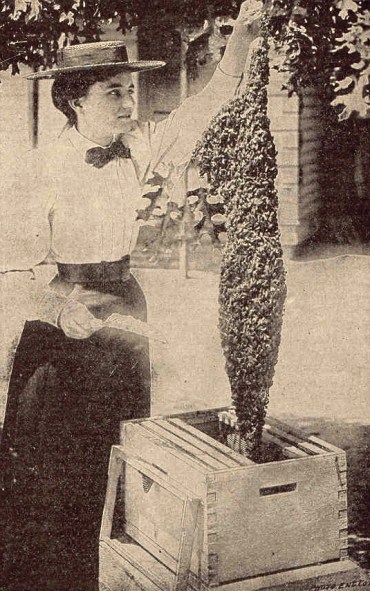
An 1883 Urban Beekeeper from AJ Cook’s Bee-keeper’s Guide

A few days ago, I wrote a snarky blog entry about one researcher’s efforts to alert us to a hazard of urban beekeeping. It is Dr Cartar’s contention that keeping bees in an urban environment robs wild native bees of food, which in turn threatens their survival.

I agree with some of the Calgary professor’s position – but I’ve not actually studied the subject in detail as Dr Cartar has. We agree that honey bees are an imported species – they are not native to North America – and thus they disrupt the natural ecological balance established by millions of years of evolution on our continent. We also agree that honey bees sometimes take nectar and pollen produced by native (and invasive) flowers that wild bees may have eaten. But I’m not sure about the severity of the problem. Nor do I know much about Dr Cartar’s premise that forage competition is the primary threat to native bees.

Research and evidence exists to show that the loss of habitat (nesting sites) in urban settings have jeopardized wild native bees, probably more than interspecies competition for food from honey bees. At this time, I think that urban honey bee keepers should be encouraged as these people are often great advocates for maintaining nesting sites and good pasture for wild bees. You can read our difference of opinion in more detail in the June 12 blog entry on this page.

When warranted, I sometimes publish letters received from informed sources. I feel that Dr Cartar deserves the opportunity to answer some of my missives, so with his permission, the bulk of his letter to me follows:

Dear Ron,

“The point of my “every joule of honey in their jars….is a joule robbed from native bees” quote is simple. At equilibrium, the density of native bees tends to be most determined by flower availability (that is, the nectar and pollen available). More flowers = more bees, in general. This is the essence of competition, and is readily observable in nature. Bee populations build up (or get smaller) based on floral availability. And the converse is true, but over longer scales (because most bees are annuals, and most flowers are perennials; more on this later). Think of this as a game of musical chairs: native bee abundance is (on average) in proportion to the chairs in the game (i.e., the flowers). Then somebody brings in a large number of players (a colony of honey bees), but there’s no change in the number of chairs. And these introduced, non-native honey bees have little chance of failing, because their keeper usually feeds the colony when foraging is insufficient to colony needs.
What you’ve done is stack the game of musical chairs against native bees, with an expected outcome (loss of local bees). Hence, “every joule of honey is robbed from native bees”…

“But there are exceptions to this too-simplistic characterization. As I noted in my email to you, in some years, bad weather (often in spring) removes many of the bees, so there’s little competition, and flowers get insufficient pollination service from natives. I see this in one year in 5 or 6, locally. In these cases, nectar accumulates in flowers. Flowers age and drop off without producing seed. You’d think that in this circumstance, adding honey bees would have little impact on natives. But the outcome depends on amount. As noted in the paper I emailed you, honey bees prefer to forage near their colony (but will fly far if necessary). So the addition of a honey bee colony, will greatly deplete nectar and pollen rewards in the local area (others have documented this, where the depletion of floral rewards makes their use by other bees unprofitable). Hence, even in the case where flowers are super-abundant relative to native bees, adding honey bees can easily push out the natives
who previously had more food than they knew what to do with. This is not an empirical observation, just one that seems reasonable. The observation that honey bees deplete flowers to levels that make them unprofitable to local native bees is reasonably well established…

“Another exception of note is that, for some flower species, the joules available depend on the rate of visitation. In these species (which are not typical), flowers resorb nectar that is accumulating unharvested, and/or produce more nectar when it is harvested more rapidly. In this case, floral rewards depend on visitation, suggesting that then number of chairs in my musical chairs analogy might change. But again, these effects are easily dominated by the sheer density of honey bees in a colony, so adding honey bees is likely to hurt natives…

“Of course, other factors determine abundance of native bees. You correctly point to one: nesting habitat. But to make the argument persuasive, you need to point to evidence of nest site limitation of population abundance in the literature. I’ve noted that abundance of floral resources is the single best predictor of bee abundance, and this obtains at 2 levels: bees visiting flowers, and bee reproductive success. To be complete, the other determinants of local population size are diseases, predators, and parasites. Along with nest sites, all of these should operate in a density-dependent manner. But don’t assume that nesting resources limit bees in Calgary, when there is such heterogeneity in human structures (bare ground for hole-diggers, tubes for cavity-nesters, vole nests and unprotected insulation for bumble bees)…

“I’m not deliberatley picking on urban beekeepers, and admire them for embracing a truly fascinating insect. I share that admiration and fascination. I’m just pointing out that ANY honey bee colony, given its enormous size (relative to local densities of native bees) and propensity for local foraging, has the potential to have big negative impacts on the local native bees. The overall impact would depend on the number of these colonies added. So one colony is too many, at least for the locals. Urban beekeeping is not a win-win (beekeeper gets free honey, plants get pollinated), unless you ignore the displaced native bees. My suggestion: DO feel guilty about keeping non-native bees, but keep your fascination with bees! Instead, consider accommodating native bees. The Xerces society provides a wonderful web resource for how to begin in this endeavour.

“Introduced, managed honey bees have negative effects, in all sorts of ways, on native bees (especially when the native bees are honey bees, like in Europe). If scientific evidence still matters in decision-making (an increasingly dubious preposition in recent years in Canada), then it’s unlikely that an urban (or rural) honey beekeeper will have no local negative effects on native bees. And the extent of the problem will increase with each increase in the extent of urban and rural honey beekeeping…

“Just because everything we do (short of suicide) has negative effects on our environment should not make us throw in the towel, and ignore the environment. Let’s be mindful of what we do, and embrace our love of and fascination with insect pollinators. Instead, let’s channel and extend that affection and fascination to our neglected native bees. When you notice native bees, and their amazing diversity, your fascination will be well-rewarded.”

Cheers, Ralph

Posted in Bee Biology, Beekeeping, Ecology, Science | Tagged , , , | 3 Comments

Giving thanks

Pure Sweet Honey Farm Inc. sponsors this year’s ALS Fundraiser!

One last look at the Calgary ALS (Lou Gehrig’s Disease) fundraising event. You may wonder what this has to do with beekeeping. I guess it reaffirms the idea that the human condition is as frail as the environment and that any beekeeper anywhere can end up with a horrible illness. It also shows that any beekeeper anywhere can help by supporting the effort to end the disease and make life as comfortable as possible for those who have ALS.

This short post is a thank you to the people and companies that supported this year’s drive. This includes my friends at Medivet Pharmaceuticals, the company that makes Fumagilin-B and other bee-healthy products; Diane Dunaway and her husband Dave at Bee Happy Honey, in BC; Calgary beekeepers Dave and Liz Goldie; and the honey-packing company Pure Sweet Honey Farm Inc, in Wisconsin. I used to sell a bit of honey to Pure Sweet many years ago and the owners have remained very close friends. Pure Sweet was one of only a few high-level sponsors (see the photo, above) for the ALS fundraiser and their sponsorship made a big impact on this year’s success. Thanks to all these great people – Ursula at Medivet, Diane & Dave at Bee Happy, Dave & Liz, and Stan and Willi at Pure Sweet Honey!

Posted in Friends | Tagged , | Leave a comment

At home in a home

A swarm of honey bees have invaded an Alberta home. Who can blame them? According to one newspaper, the bees were confused by the skep-looking geodesic dome that a rural Canadian family calls home. The bees were confused? Perhaps the news reporter was making a joke.

Left, A Home, not a beehive – – – Right, A 19th-Century beehive Confused? The bees aren’t.

These are beehives.

Once again, we have succumbed to our tendency to imagine that bees think like people. The Sun newspaper reporter wrote: “That’s what you get when your house happens to look like a giant beehive… the bees just seem naturally drawn to the round structure.” No, not true. Not even a little itsy-bit true. The honey bees had absolutely no idea that the house they settled in looked like the old-fashioned skep hives that haven’t been used in Canada for over a hundred years. Unless those bees had been reading some very, very old beekeeping journals, they would not have been thinking, “Hey, Betsy-bee, don’t that look like a big beehive? Let’s go fill ‘er up.” Nope. Bees don’t think like that.

“That’s what you get when your house happens to look like a giant beehive,” said the newspaper. Actually, beehives built by humans in this part of the world are rectangular white boxes – they sort of look like most of the houses on Main Street. They don’t look like geodesic domes. But the bees don’t care. With their multi-lensed eyes (and tens of thousands of receptors) they do not see what we see, they don’t recognize hives or homes as we do. Assuming that bees see the world as we do – in both the literal and figurative sense – is exercising anthropomorphism. That’s the common habit of instilling human traits on objects and creatures. It probably arises from our noble instinct of empathy, but it creates trouble when we interpret the world around us in such terms. Carried to extreme, we might place a television inside a beehive: we enjoy an occasional nature flick, surely the bees will, too.

What drew the bees to the skep-shaped house? The home-owner, Cheryl Morgan got it right when she said, “Maybe they saw it as a ready-made beehive, so they moved right in.” Scout bees see every crevasse, nook, and hole-in-the-wall as a potential “ready-made” beehive, which their swarm might call home. If it is dark, sheltered from sun, wind and rain, and has a small defendable entrance, it could definitely be used as a swarm’s castle.

Bees invading a home can be a big problem for a home owner. In this case, I think the story ends happily. The home owner found Calgary’s Urban Beekeepers’ network (Apiaries and Bees for Communities) which helped put her in touch with a local beekeeper who removed the bees. An interesting interview and more details to this story are found on CBC radio at this link.

Posted in Hives and Combs, Swarms | Tagged | Leave a comment

Going native

A bumbling bee

A Calgary University professor has this to say about urban beekeepers: “It is not as rosy as they think. Every jewel* of honey that they get on their plate or in their jars is a jewel that has been robbed from native bees.” Dr Ralph Cartar also says that urban beekeepers “swamp the world with bees and the competition becomes intense and you risk losing those native pollinators.”

 *(OK, perhaps Professor Cartar said “joule” – a unit of energy – but I heard  “jewel” – a unit of pricelessness! Since they sound the same on radio, I’m using the more poetic version of the homonym. I was kindly corrected about my mistake by Dr Cartar himself!)

How could anyone be opposed to the hobby beekeeper with a colony in the backyard? Dr Cartar, in a CBC radio interview this week, explained that honey bees are an imported species that steals (OK, he says “robs”) food from native bees. You see, our western honey bees are not native to North America. Or South America. Or Australia, New Zealand, India, China, and a whole bunch of places that depend on the bee for crop pollination and where a whole bunch of people who love ecology, nature, outdoor activities, and communion with buzzers have been keeping honey bees. Cartar tells us that “people seem to think that because they are important for some agricultural crops, they are good everywhere.” He says Calgary urban beekeeping should stop immediately.

Is he right? I have struggled with this myself. Beekeepers don’t necessarily have the high road as environmentalists. It is a fact that honey bees were introduced as an invasive species in most of the places they are fondly kept. And it may be somewhat hypocritical for us beekeepers to claim to represent the environmental movement while keeping bees. Unless we do something more than tend our artsy little hive.

Before I elaborate on my idea of a solution, I want to address some (of what I saw as) errors in Dr Cartar’s claims. In the radio interview, the professor said, “Every jewel of honey…in their jars is a jewel that has been robbed from native bees.”  This is hyperbolic nonsense. Some nectar, certainly, might have gone to a native bee. But it is not true that every drop of nectar taken by your honey bees has been stolen from the mouth of a native bee. This is because there is much, much, much, much more nectar produced than can be used by the native bees. Without honey bees, the nectar is simply lost – it does not automatically go to feed a native bee.

In Calgary, there are fewer than 300 colonies of honey bees. Calgary’s urban area covers 700 square kilometres – that means there are over 2 square kilometres for each hive. That’s 200 hectares, or one hive per 500 acres in Calgary. We usually figure that for effective pollination, you need to place 1,000 hives on 500 acres. At this rate, instead of 300 colonies, Calgary could have ten thousand and there would still be enough food for all the bees. Of course, not all the land is growing flowers – there are lawns and parking lots and skyscrapers. But Calgary has immense public parks and huge gardens, so we might calculate that a third of our land is still somewhat floral – our parks and meadows have a gazillion dandelions – plus willows, wild cherries, caragana bushes, Russian olives, goats’ beard, clovers, wild alfalfa, sweet clover, fireweed, goldenrod, asters, and I am certainly forgetting some. In his correspondence with me, Dr Cartar wrote, “If you start with the premise that populations of pollinators are best explained by floral resources (as opposed to disease, predation, weather, etc.), then a logical outcome of increasing the density of one competitor (honey bees) is to decrease the density of others.” This may be true in some situations, but probably not in the case of Calgary – the limiting factor here is not forage, but it is nesting sites for native bees. There is probably no shortage of forage for honey bees and wild bees to share. Flowers with nectar are generated with more abundance than bees can cover. It is a reproductive and survival tactic on the plants’ part.

If anything, more honey bees result in more seeds, which results in more flowering plants the next season for all the creatures. Did you ever wonder why honey bees are kept near orchards, or hauled in by beekeepers to ensure pollination? It is to try to get as many flowers in touch with bees as possible. With only a few native bees, and no honey bees, in a very natural environment, most of the flowers with nectar and pollen will never have a pollinator visit. With a saturation of bees, more seed, nuts, or fruit are produced because a greater number of flowers are pollinated. It is really, really hard to over-saturate an area with bees. That’s why commercial beekeepers often keep 50 colonies in a single 1/10th acre lot – and they all do well! I said this to Dr Cartar and suggested that if he really wanted to help native bees, we should tackle issues around the native bees’ loss of nesting sites. Native bees do not nest in man-made honey bee boxes. They most frequently nest inside the ground. Honey bees almost never nest inside the ground. I think that a single car lot or shopping plaza destroys many times more native bees than all the urban bees kept in the city. Because the problem is nesting site destruction, not floral competition, opposition to urban beekeeping is perhaps misdirected.  Or, I could be wrong.  I haven’t studied the issue rigorously, scientifically. I’m writing as a beekeeper might think about this.

Here is what I think. First, I think Dr Cartar is wrong to pick on hobby urban beekeepers. These people are allies, not enemies. We exchanged e-mails when I tried to uncover his thoughts in more detail and when I offered him a chance to backtrack a little in his animosity towards urban beekeepers. (He was unyielding.) He seems intelligent, articulate, and I suspect that he is a really nice fellow. But if one cares about wild bees, as Cartar very obviously does, then alienating a group that also finds bees fascinating is a mistake. It is true that we beekeepers are engaged in an activity that can disrupt native bees. But we are among a small group that can be encouraged to do more than almost any other group to help native bees.

Even the most strident environmentalist needs to eat and function in society in a normal way. As an environmentalist, one does not retreat to a cave, eschew clothing and fire, and scrounge for grubs and berries. The environmentalist instead tries to balance his or her carbon footprint and environmental impact by reusing and recycling, and especially by offsetting the damage we all do by contributing to carbon sequestering (eg., forests) and environmentally constructive projects. Dr Cartar wrote that it is his philosophical position that if you know something is harmful, then you simply do not do it. He has a point, but in our society everything we do is harmful to the environment. Unless we retreat naked into that cave, we are doing harm. It is more about mitigating the damage than reducing it to zero. We all want to live in a world where children have a chance to survive infancy and can have the hope of a healthy, long life. Science, technology, and even beekeeping with invasive species, has made this possible.

So here is what we can do. Set up habitat in the backyard as nesting sites for native bees. Continue to develop awareness for bees in general. Donate or invest in native bee garden projects. Plant flowers for native bees – usually these are native, non-invasive flower varieties that are not very attractive to honey bees but co-evolved with native bees and are well suited to their needs. (Dr Cartar agrees with this – he sent this link to me that can help people select appropriate flowers: The Xerces Society for Invertebrate Conservation.) Do these things to reduce your “honey bee footprint” and don’t feel guilty about keeping bees in the city. You are not part of the problem, you are part of the solution.

Posted in Bee Biology, Beekeeping, Culture, or lack thereof, Ecology | Tagged , , , , | 2 Comments

Who’s your friend?

als2014

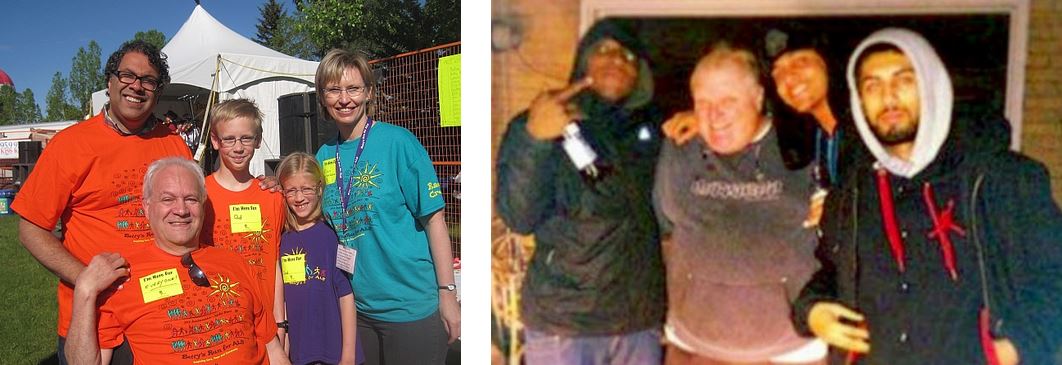
Left, Calgary’s Mayor Nenshi with Friends – – – Right, Toronto’s Mayor Ford with Friends

My family participated in Calgary’s ALS fundraiser this weekend. It was a great success. We had a sunny and mild Sunday morning with almost 2,000 people at the North Glenmore park for this year’s walk/run. A lot of money was raised to support victims of ALS with practical daily aids – things like breathing devices, beds, wheelchair ramps – and with an active support group. ALS (sometimes called Lou Gehrig’s disease in the States and Motor Neuron Disorder in Europe) is a devastating fatal disease of unknown cause that results in paralysis and eventually suffocation when lung muscles no longer function. Support for the illness is largely through events like this annual gathering here in Calgary.

It was really nice to see our Mayor, Naheed Nenshi, at the event. He spoke about volunteerism (Our mayor used to be a university professor who taught NGO, or non-profit charity, management.) Mayor Nenshi told the assembly that everyone who participated was exemplifying unselfish good citizenship because ALS can affect anyone. This event, he said, was not just for friends or family, but was for strangers whom we will never meet. Calgary’s Mayor Nenshi is an honourable, hard-working man who believes good citizenship involves helping others. As he spoke, I couldn’t help but compare him with Toronto’s Mayor Rob Ford, a rich and spoiled self-centered man, who advocates for himself. When Toronto’s Ford is in the news, it is a good day for clowns. When Calgary’s Nenshi makes the news, it is a good day for the city. You’ve heard the old adage – you know a man by his friends. My sympathies to the folks in Toronto. Hope you can do better in the fall election.

Posted in Friends | Tagged , , , | Leave a comment

Dandy Days Indeed

Dandy Days

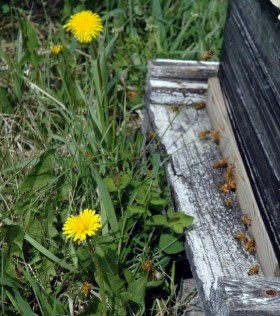
For three weeks, my 7-year-old daughter has been counting dandelions nearly every day. There is a large field behind our house, a city meadow of sorts. From mid-May to early June, our meadow likes to show a bit of yellow. My daughter began her list May 12th when 4 dandelions were in flower. Her numbers increased irregularly with dozens appearing in a few days, then several hundred. By the 25th of May, the blossoming dandelions were like stars on a clear night – too numerous to count. Then suddenly the yellow turned to white as heads of seeds appeared. So now, at the end of the first week of June, they are rapidly disappearing. The number of open flowers depends on heat and rainfall. It has been cooler than normal (or maybe more normal than normal – we were getting used to hot springs). With mild weather, the dandelions lasted a bit longer this year than they have during our past few springs.

Dandelions are great. The beekeeper’s friend. They are native to Europe, Asia, and the Americas, so before honey bees arrived here in the 1600s, they must have been a fantastic feast for the wild bees. Honey bees love the showy little flowers – for most northern-hemisphere beekeepers, dandelions are the first really big meal of the honey season. After the first flush of crocus, willow, and maple, which bloom when the weather is still cool and unstable, the “lion’s teeth” as the French named our “dent-de-lion” are welcome for their enormous yields of pollen and nectar. I have seen bees store 20 kilos (40 pounds) of honey in just two peak weeks of flow. I’ve also seen relatively weak hives explode in population. Dandelion season, you see, is also the real beginning of swarm season. Hope your neighbourhood bees have had their fill from this under-rated weed. And hope they have resisted their natural temptation to flee to the trees!

Posted in Honey Plants | Tagged | Leave a comment

Running for Betty

Ron on wheels

Ron on wheels

Professor Hawking

This weekend is Calgary’s ALS benefit. Calgary-area readers of this blog are invited (urged!) to head over to North Glenmore Park and “Run for Betty.” 20 years ago, Betty died from ALS, aka Lou Gehrig’s Disease. She was an avid runner before her illness. Like most victims of the disease, she passed away within months of her diagnosis. Her friends wanted to honour her memory, raise awareness of the disease, assist other people who become afflicted, and help search for a cure – so they started the annual fundraising-run/walk. Our mayor, Naheed Nenshi, has proclaimed June “ALS Awareness Month” here in Calgary.

You can do your part by coming out to cheer and support the runners. ALS is an incurable illness of unknown cause, always fatal, and it manifests itself with the complete loss of motor neurons. Within months, most people with ALS cannot walk, talk, use their hands, and eventually cannot breathe. Some of us have been able to hang on for years and years with slowly progressive variants – but that’s very rare. At least 90% of people with ALS do not survive past 3 years after their diagnosis. It can affect even the most active people (even beekeepers!) and even the smartest people (famously, Stephen Hawking). Do your part, if you can – hope to see you Sunday at 10 for the big event! I’ll post pictures afterwards… Meanwhile, if you’d like to support a great cause, here is a link to make it happen. I can tell you from my own experience, the ALS Society brought all sorts of equipment to my house to help me. This is a good organization.

Posted in Culture, or lack thereof, Friends | Tagged , | 1 Comment

Did I goof up, or what?

I did it again!

Last week’s blog post drew a few interesting responses. Not from Monsanto, whom I expected would be outraged because I wrote that it is perhaps justifiable to vilify “the huge multinational for all manner of environmental ills.” Instead, incredibly, the nasty letters I got were from people who seem to be environmentalists and my sin was pointing out the horrible truth that Monsanto does not manufacture neonicotinoids!

Here is what one of the letters sent to me said: “I read your misinformed post … and would appreciate if you did some fact checking prior to your future posts… Sorry your life seems to revolves [sic] around baseless bullying behind a keyboard, and refusal to correct your errors. Perhaps a post about your own bad journalism attempt is in order.” I googled the author. Turns out the note was sent to me by a school teacher! That’s why you see the picture of me, or someone who looks like I did when I was ten years old, wearing the dunce hat. I have no patience for people who resort to name-calling in any discourse – whether on the internet or in the school yard.

The same person told me to check my facts, adding that Monsanto owns Dekalb and Dekalb manufactures neonicotinoids. Dekalb is a seed company. It buys neonics and treats some (but not all) the 48 varieties of corn seed which farmers may buy from Dekalb. . . So, let us try, once more, to set the facts straight – Bayer makes neonics. Why is that so painful to hear? And why is that a reason to send rude e-mail to a real beekeeper, someone who has produced millions of pounds of honey, grafted thousands of queen cells, provided bees to pollinate billions of flowers, and has actually depended on beekeeping for a living?

But wait a minute. There is more. Another note from someone else. This time respectful, except for a little snipe at the end that said, “An honourable man would append a correction to the original blog post.” If I don’t then I am (at least in one person’s opinion) dishonourable. The correction being sought is that I should write what the correspondent would like me to write. As it turns out, the correspondent has some valid points.

In my original blog (which you can see just below), I state that Monsanto does not make neonicotinoids, Bayer does. Beyond that, I offer almost no actual facts that could be retracted. I wrote: “The March Against Monsanto trekked through the streets of Toronto hoisting the bees’ coffin.” It was Toronto, I fact-checked. I wrote that the protest “was intended as a statement against neonicotinoids, which most of the participants blame for the bee deaths.” Admittedly, I don’t know this, but the news reporter covering the story wrote “The beekeepers called for Monsanto and its subsidiaries and allied companies to stop producing GMOs and neonicotinoids.”

I do ask the question, “Why is the protest being directed against Monsanto?” when Monsanto does not make neonicotinoids. So, really, it seems that since I dare ask a question, I receive interesting fan mail. Regular readers of this post know that I take an off-the-wall approach to almost every subject. I make light of the European fad of the honey massage, I humour Prince Charles’s beekeeping (though I like the man), I question whether beekeepers are environmentalists when we propagate our invasive honey bee which displaces native local bees. To ask me to retract facts is like sending indignant letters to the Onion. As I write in my permanent side-notes on this same blog page, “Opinions expressed herein do not necessarily express anyone’s opinions – not even the author’s” and “If you strongly disagree with things you find here, send Ron a note – or keep reading as you are likely to find he also advocates an opposite point of view elsewhere on the website.” Hate mail is uncalled for.

Why was the Toronto bee protest directed against Monsanto instead of Bayer or against the poor farmers trying to keep their family businesses alive? Another writer (who I think was at the protest) patiently explained to me that Monsanto sells corn seed treated with neonics and the bees sometimes gather pollen from corn (this is rare – corn does not have nectary flowers to attract bees, but if bees are desperate they may collect corn pollen from the dangling tassels).

It should be noted that not all corn seed is treated with neonicotinoids – Dekalb, which is owned by Monsanto, offers 48 varieties of corn seed, about two-thirds have been treated by some form of neonics, the others have not. It is up to the farmer to select the variety they want to grow. Two-thirds is a similar ratio among the 300 growers of Ontario corn seed in the Chatham-Kent area. But I am off on a fact-chase here, I’ll try to control myself and continue with the idea that some of Monsanto’s corn seeds that farmers are planting in southwest Ontario (most of it over 200 kilometres from Toronto) have been treated with neonicotinoids and this insecticide kills honey bees.

But the bigger question remains – is Monsanto the cause of the horrific bee losses in Ontario? Or are these sorts of protests deflecting attention away from the real cause of the total and sudden collapse of bee colonies? Ultimately, the protests may do more damage to the bee industry than good. Now that it is assumed the bee slayer has been found, other research projects will not receive the significant attention they perhaps should.

I expect that neonicotinoids will be banned. Among the dozen e-mails sent to me on this subject, one stated that an Ontario county has already agreed to the ban. That person also told me that 99% of corn grown there has been treated by neonicotinoids. With the ban, I am wondering what those farmers will do. One alternative, of course, is they could quit farming. Or maybe they could grow tobacco, which Stompin’ Tom once told me used to be a big deal around Tillsonburg. Most likely, they will continue growing corn, then they will spray their fields with massive insecticide aerial assaults that drift across hedgerow and bee yard alike, killing everything. That’s the way it was before the neonicotinoids, and that’s the way it will be again. I had seen hundreds of colonies killed at the peak of production in a single afternoon. Unfortunately, those non-beekeepers and those name-calling school teachers with two hives of bees and no long history with beekeeping can’t imagine what this was like. But it won’t matter, they will have already moved along to the next trendy-thingy.

I want to end this blog entry with one of the e-mails I received. Fran Freeman was also at the protest. She presents a well-reasoned argument about why Monsanto was an appropriate target so, having received her permission, I am ending with her thoughts on the matter:

On 03/06/2014 9:44 AM, Fran Freeman wrote:
Hi Ron
Saw your May 25/14 Bad Beekeeping blog and was more than a little surprised that you mocked the Monsanto March/Requiem for Bees. The march is an annual event and the decision was made to make mass bee die-offs the particular focus this year. No one that day was claiming, as you allege in your blog, that Monsanto makes these systemic pesticides, rather they use them. Neonics are applied as a seed coating on approximately 90% of corn seed available in Ontario and it is Monsanto that produces this seed. By buying out other seed suppliers, Monsanto has sown up the market very tightly so that it is extremely difficult to obtain corn seed that has not been treated with clothianadin or other neonics. PMRA analysis of poisoned bee samples provide a clear causal link to both seeding in the spring and tasseling in later summer of the treated corn. Research on sublethal effects of neonicotinoids is amassing and includes impaired fertility, failure to thrive, increased susceptibility to pathogens, and increased winter mortality. Our commercial beekeeping industry in Ontario (honey production, pollination services and bee breeding particularly of hygienic bees) is being decimated. Many third- and fourth- generation beekeepers have reached the point where they feel they cannot continue beyond another year. Consequently the call May 24 was for an immediate ban on the use of neonicotinoids.
– Fran Freeman

Posted in Culture, or lack thereof, Ecology, Pesticides, Save the Bees | Tagged , , , | 1 Comment

The bees’ funeral

bees funeral

Requiem for the bees

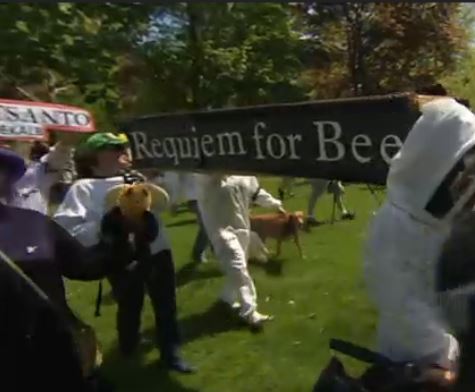
Dead bees are back on the evening news. Last night our national news broadcaster, the CBC, had relatively extensive coverage of a honey bee funeral in Toronto. These Canadian heroes, encountering death in the line of duty, were celebrated with a fitting send-off to wherever bees go when they shuffle off their mortal coils. In a headline that reads “Anti-GMO protesters rally against Monsanto – Beekeepers fill coffin full of thousands of dead bees” the CBC tells us how the third March Against Monsanto featured a “Requiem for the Bees.” Ontario beekeepers collected several million dead honey bees and dumped their bodies into a casket of sorts. The March Against Monsanto trekked through the streets of Toronto hoisting the bees’ coffin. It was intended as a statement against neonicotinoids, which most of the participants blame for the bee deaths.

But wait a minute. If the bee deaths are caused by neonicotinoids, why is the protest directed against Monsanto? Here is a little known piece of trivial, a fun fact that People Who Hate Monsanto almost invariably ignore: Monsanto does NOT make neonics. I know it is quite trendy to despise Monsanto and to accuse the huge multinational for all manner of environmental ills. Perhaps justifiably. But it makes the protest look pretty silly when the wrong monster is blamed. Bayer (the Aspirin company) manufactures neonicotinoids. If you are going to fight evil, at least know your opposing team’s dark-side forces. This is important. It is too easy for the dark side to dismiss people who care about the environment if ignorance and rage take the place of an educated and informed response. Attack the guilty parties, do it thoughtfully, with proof and fact. Know which company manufactures neonicotinoids and know how the poison is killing bees. It makes for a much stronger protest.


Posted in Culture, or lack thereof, Pesticides, Save the Bees, Strange, Odd Stuff | Tagged , , , | Leave a comment

Bee Spill

bee truck accident

Another bad spill.

Glad I’ve never had one of these. This looks bad. The 460 double-story colonies being carried from south Florida to Maine’s blueberries for pollination were spewed after the driver rolled over on an I-95 exit ramp in Delaware. The 55-year-old driver, Adolfo Guerra of Miami, was fined for carrying an “insecure” load. His cargo stung him several dozen times and was hospitalized. Police responded with traffic control, firemen hosed everything (probably drowning bees in the process) and local beekeepers arrived to rehive bees and reassemble bee boxes. The exit ramp was open 12 hours later.

Posted in Beekeeping | Tagged , | Leave a comment