Can Bees Smell Cancer?

Something for the Bees to Smell
(photo by permission Susana Soares)

This is an intriguing idea. A Portuguese designer has invented a novel system that might detect various illnesses, including tuberculosis, diabetes, and lung cancer. Susana Soares has built a lovely contraption – a glass bubble inside another bubble which holds a few well-educated honey bees and allows them to sniff out these diseases. Honey bees have an extremely keen sense of smell and they are quickly trained, Pavlov-dog style, being rewarded with sweets when they perform well. From the breath of a human with an affliction, disease is potentially revealed. It sounds odd, but a lot of things sound rather peculiar to me.

There is a British science firm, called Inscentinel, which is pioneering the research behind the device. A visit to their website is worth the look. There you will see honey bees locked in an Orwellian prison with their little heads poking out of tubes. Odors waft past and the bees are rewarded with a dab of sugar syrup. Within minutes the bees learn to expect the sugar-treat and upon smelling the training odor they immediately stick out their little tongues. When the bees encounter the scent again, they react with drooling expectation, tongues hopefully extended, indicating they have found diabetes-breath, or whatever they have been trained to detect. A clever idea, actually.

With the advent of the many honey bee health clinics around the world, this could possibly be an adjunct to other commonly offered bee therapies. In addition to honey massages and bee sting therapy, it may be possible to include screenings for sicknesses. Such a clinic would certainly be the right venue as honey bees would be involved in the clinician’s routine anyway. Does it work? I don’t know, but bees have extremely sensitive odor detectors, so perhaps it does. Is the system likely to be offered and developed? I’m not so sure as the training may be problematic. It is hard to make something like this transition into a practical application. But it is not impossible.

Posted in Apitherapy, Bee Biology, Science, Tools and Gadgets | Tagged , , | 1 Comment

Deadly Truck Crash

bee truck wreck spilled bees accident

A temporary bee yard on Interstate 75, near Macon, Georgia

One of the thousands of loads of bees heading south after the summer harvest didn’t make it. On Sunday morning, November 3, a tire blow-out on a tractor-trailer caused this crash in Georgia that killed millions. Of bees, that is. No humans were hurt in the wreck. Each fall, commercial beekeepers pull their hives out of northern clover fields and send them southbound where they can winter more easily in balmy Florida – and maybe make a bit of orange blossom honey in late winter. Semi-trucks can haul about 400 double-story hives, each with perhaps 30,000 bees in late fall. That’s 12 million bees and it is just the tiniest droplet in the river of hives (some 500,000 colonies) that are trucked to warmer climates in Florida, Georgia, Texas, and various other mild locations – every fall. The hives come from pollination and honey production in Maine or New York, Wisconsin or the Dakotas. This is in addition to hundreds of thousands of colonies moved into California each season.

This accident is a tragedy for the bees, and for the beekeeper. It is hard to recover from a mess like this. Even if there is insurance (usually there is not) it only pays for a small portion of the damaged equipment, not lost production from future queen sales, honey production, or pollination fees. I don’t know who owns the bees (hopefully not one of my relatives), but this accident reminds me of the close calls I had trucking bees when I was a youngster. For about ten years, I hauled around 1,000 colonies a season south on my own truck. I was more lucky than careful and never had an accident that hurt anyone or any bees. But I could have – driving bees is risky business. The bees need to arrive quickly, so the beekeeper-driver is likely to sit behind the wheel too many hours. These days, more and more beekeepers hire professional drivers with big flatbed rigs. Beekeepers provide the netting and the forklifts on both ends of the trip for loading and off-loading. But it is still quite a difficult logistics project.

Posted in Beekeeping | Tagged , | Leave a comment

Bees Delivering Pesticides

Looking for a better way to deliver?

This sounds so bizarre. At first. Canadian researchers have found an odd way to potentially deliver benevolent viruses, fungi, and bacteria to greenhouse vegetables. Before some lucky bees are allowed to fly inside glasshouses to pollinate peppers and cukes, they trudge across a little tray laced with organics that greenhouse growers would otherwise spray in their shops. The materials are hopefully harmless to bees, and well, since they are going to visit flowers anyway… It’s a bit like carrying the garbage out to the black bin as you leave the house for a morning jog. Or a bit like using viruses to carry meds to kill cancer cells. In the latter case, the virus is called a vector. In the greenhouse case, the insects are called bee vectors. There is even a company, Bee Vectoring Technology in Brampton, Ontario, which has developed a technique to do this. A company called Bee Vectoring Technology was apparently started to find ways to use bees to deliver organic pesticides, which are naturally occurring killers that should allow farmers to sell the resulting vegetables as organically produced food. In a “forward-looking statement” related to the acquisition of Bee Vectoring Technology by CT, a “capital pool company”, the following is announced:

“BVT and its scientific team have developed a globally patented bee vectoring technology; using bees to deliver commonly found organic fungi to flowering plants, acting as an organic pesticide as well as a fertilizer, all without water. The technology has been tested on and has been proven to effectively and organically control harmful diseases affecting important crops such as sunflowers, canola, strawberries, raspberries, pears, tomatoes, blueberries, almonds, peppers, eggplant, pumpkins, various melons, kiwi, apples and coffee, among others.”

Let’s take a close look at this statement. I deeply apologize and will immediately retract what I am writing if I have missed something here, but the entire paragraph makes no sense to me. At all. First, there is no such thing as a global patent. Each country (even North Korea, where the Dear Leader is Supreme Inventor) has its own system and if you invent something in Canada, you will need to apply for patents everywhere else. But, by the way, how does one patent the idea of forcing bees to trudge through gunk? Bee researchers at Guelph have been experimenting with bee vectors for years, so they should have precedence for the idea – as some US companies would as well. Next, how does “an organic pesticide” act as a fertilizer? Potash? Nitrogen? Sorry, I don’t get this, either. Next, the “technology has been…proven to effectively and organically control harmful diseases…” Harmful diseases? A disease such as an aphid or whitefly?

Sorry, those are not diseases, we are talking about delivering a pesticide to attack pests. Then, the list of plants. Did the company test their “globally patented” system on kiwis and coffee? Or do they otherwise somehow know that the technology works on “diseases” affecting these crops, “among others.” I went to the company’s website, clicked on their link for case studies, but it is written (at the time of this blog) in the Lorem ipsum language, which I don’t read very well. Allow me to quote, maybe you can understand this: “Sed auctor, sem et volutpat facilisis, risus leo venenatis leo, ultricies accumsan urna ante vel nisl.” That’s their case study about strawberries. (There’s more, you can go to the site and read the rest.)

Their information also states bees among sunflowers at a density of one colony per three acres (costing $43 per acre) increases commercial seed production – from 1,600 pounds per acre to 2,400 pounds (adding a value of $184 per acre). This may be true – pollination economically increases yield, as farmers have understood for at least a century. But the statement seems totally out of place, perhaps even implying that bees carrying pesticides on their tiny feet are the reason for the dramatic increase in farmers’ income. There are also statements around how the bees’ activity of delivering “Vectorite,” the carrying compound, plus the “selected bio control agent” acts as both “a pesticide eliminating disease, and a fertilizer, increasing yield.” Of course yield is increased – but I’ve never heard anyone call pollination by bees “fertilizer.” Unless there is some mysterious fertilizer in the Beauveria bassiana being applied to the flower stigmas. The system described for delivering bees to farmers is to take beehives with “300 bees per hive” to farmers’ fields at a density of one hive per acre. 300 bees per hive? They probably mean 50,000 bees per hive if they are talking about honey bees among sunflowers, which is what farmers rent for pollination. If they mean bumblebees, then they are not talking about delivering hives, but nests, and they will need more than one or two or even ten or twelve per acre. Bee Vectoring Technology and its new owners may be on to something really good, helpful, useful, and economically viable, but their information should have been reviewed more carefully before it was published.

So far the bees have been delivering Beauveria bassiana, a fungus that kills nasties like whiteflies, aphids and Lygus. And termites, bed bugs, mosquitos, various beetles, and thrips. And who knows what else? And, if the naturally occurring fungus isn’t tough enough, there is the GMO variety that could be applied to the bees’ knees. Unfortunately, a genetically modified version of the Beauveria bassiana fungus has escaped (or “leaked,” as they say) beyond its confinement area near a Christchurch university in New Zealand, much to the chagrin of the government and local farmers. I am not saying that the escaped GMO fungus is a bad thing. I’m just saying it escaped.

Where does this put us in this saga of bee vectors? Honey bees (and presumably bumblebees) can be forced to slug through natural (or GMO-modified?) fungi flakes which will stick to their paws and then get rubbed on flowers when the bees go about their pollination business. Sounds like an effective use of the bees’ energy. The stuff they carry can kill aphids, beetles, flies, and other creepies, but not hurt the bees. (I’m not sure why the bees are safe.) The farmers and greenhouse people can use fewer pesticides – instead of fogging the entire building or field, just the plants’ flowers are affected. That’s definitely a good thing. How does the public perceive the idea? Very well, it seems. CBC Windsor has an article about this research with a readers’ poll attached to the bottom. Exactly 2/3 of the 2,000 who have voted so far support the idea of bee vectors.

Posted in Ecology, Pesticides, Pollination, Science, Strange, Odd Stuff | Tagged , , | 1 Comment

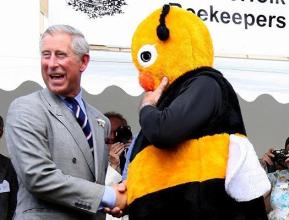
Should Prince Charles be king? Or should he be a beekeeper?

Prince Charles and the Bee

I am one of the few people I know who has taken a personal public vow of allegiance to the Queen. And all her heirs. I take my duties seriously. It is my job to offer helpful life skills to the Family whenever I should. That’s the price of loyalty. And Canadian citizenship, for immigrants. Although I pledged my allegiance twenty years ago, I suspect it is still in effect. So here comes my advice to one of her majesty’s heirs, the Prince of Wales, the reluctant future king, Charles.

I would probably get along with the guy. He seems gangly and clumsy, like me. And he likes bees, also like me. Well, that’s perhaps the limit of our similarities. But I can still contribute a few words regarding his appearance on the front page of this week’s Time magazine. In a corollary net article, Born to Be King, But Aiming Higher, author Catherine Mayer tells us why we should all appreciate this man. Mayer “found a man not, as caricatured, itching to ascend the throne, but impatient to get as much done as possible before, in the words of one member of his household, “the prison shades” close. The Queen, at 87, is scaling back her work, and the Prince is taking up the slack, to the potential detriment of his network of charities, initiatives and causes.” The future prison of being reigning monarch is what caught the world’s attention, not the fact that Prince Charles has devoted over 35 years to the 20 charities he formed, almost all centered on preserving the environment.

I don’t agree with each and every charity Prince Charles supports (and/or created). But rather than waiting around to inherit a job (Who on Earth does that anymore?), the prince decided to see if he could stay busy making a positive difference. He hasn’t been racing fast cars or buffing his abs on the beach. There is apparently no misspent youth. Instead, he raises some hundred million pounds each year and directs the expenditures. Those grants go to “Sustainability, Rain Forests, Youth Programs, and Environment,” according to Prince Charles’ own website.

So, here is my advice. On the off-chance Charles should outlive his mother, (Or, “Mummy” as he infamously called the Queen at her 75th birthday gala.), he should simply pass on the king thing. Plenty of lesser monarchs have tossed the crown for frivolous reasons. Prince Charles has his work already, and it needs him. And he has those bees behind his Clarence House residence. Why be king when you can keep bees?

The Prince’s House – and his Bees

Posted in Culture, or lack thereof, People | Tagged | Leave a comment

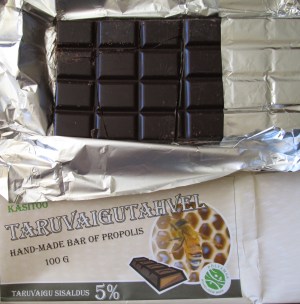
Estonian Choco-propolis

Friends bought a chocolate bar for me. Not just any bit of chocolate, of course. They were in eastern Europe and the stuff they found was really interesting. It contained propolis. And tasted like it. Eating chocolate-propolis is not for the faint-hearted. I liked it, but this particular bar was only 5% propolis – and I have been known to chomp on raw 100% pure bee glue in the bee yard. Propolis is resin from trees, collected by honey bees, dried a bit, and stuck around the hive by the bugs as part of their nationwide preventive health care program. It contains a lot of natural antibiotic properties – it kills germs, and the bees know it. So they coat crevices and untidy hollows with the goo, using the antibiotics to keep biotics away from the nest. The bees have also discovered that propolis is a great sealant. Just as our own ancestors learned to make tar from pines to seal leaky boats, the ancient honey bees discovered they can plug holes that would sink their winter plans by exposing a colony to wind and snow.

Bees can be encouraged to collect propolis if you are sloppy with bee box placement – placing supers askew (as many clueless ex-employees have done) forces the bees to jam the gaps with fresh propolis. A few companies sell gadgets that can be plopped atop the hive skyscraper in lieu of a lid – again giving the bored bees something to fetch and paste into the hive. The beekeeper scrapes the propolis off the offending hive parts (presumably using a sterilized stainless steel propolis scratcher) and carries the meds back to the shop where alchemists dice it and blend it with chocolate for future fine dining.

The company that makes this chocopropo bar, KÕLLESTE KOMMIMEISTRID, is in Estonia, a tiny country bordering on Latvia and Russia and sitting close to Finland and Sweden. The last big thing to come out of Estonia (before this propolis candy) was Skype, the web-camera phone system that indulges little Dvor and Marija if they want to see Nana when Kati skypes the old country from Australia. Kõlleste makes several types of Estonian chocolate bars – using various proportions of propolis or substituting pollen. A blend of up to 50% propolis is sold, which likely becomes something more akin to medicine than a sweet treat. The bar I was given, pictured above, cost about 3 Euros, or roughly 5 dollars for 100 grams. Its energy-factor is pretty high – the label says 500 calories (sugar is the first ingredient) but you’d have to possess rather lame taste buds to eat the whole thing in a day. Or a week.

I was curious about the factory making this chocolate bar, so I traced them online. They claim to be the first and only company in the world that figured out you can mix propolis with chocolate and make candy. This of course is ridiculous. Even I made and sold a similar product years ago. It is not a new idea, nor unique. A quick on-line search turned up a number of companies making the stuff, most probably predating the 2006 start-up of Kõlleste. There even appears to be a competitor in Estonia. Nevertheless, the company’s web site claims they are the inventors and have (they say) two patents, one for adding propolis to chocolate and the other for adding pollen. Surely they jest.

“WE ARRIVED AT THE IDEA TO MIX POLLEN, PROPOLIS AND BEEBREAD WITH CHOCOLATE IN ORDER TO BALANCE THE TASTES AND MAKE THE HEALTH-GIVING SUBSTANCES PLEASANT FOR EVERYBODY. IN THE PROCESS OF DEFENDING THIS IDEA, IT WAS DISCOVERED THAT SUCH APPLICATION IS UNPRECEDENTED IN THE WORLD. TODAY, KÕLLESTE KOMMIMEISTRID HOLDS 2 PATENTS: USE OF POLLEN IN CHOCOLATE CANDY/BARS FROM 5% TO 70% AND USE OF PROPOLIS FROM 2% TO 50%.”

The idea that something as simple as mixing two ingredients should be awarded a patent is strange and would be difficult to defend in any court. Sometimes patents are abused by companies that do not have rights (although it could be that some Estonian patent clerk actually granted a certificate to this outfit). Even worse, companies may claim patents years after they have expired. This is somewhat common and can lead to incredibly huge fines, in the USA, at least. It is against the law to place a patent number on any item sold after the patent is expired. The law exists to stop outfits from intimidating competitors after the patent has expired.

The fine is severe – $500 for each and every item sold that has ax expired patent number on it. Even big companies are guilty – major pharmaceuticals were fined millions of dollars for printing “US Patent Number 1234567890” (using the actual expired patent number) on bottles of a common pain killer. If you manufacture any neat little beekeeping product and have a “US Patent” stamp on it, you are libel for the same $500 per item sold if your beekeeping gizmo’s patent is expired. That’s $500 per item – sell ten expired patent hive covers, for example, and pay $5000 in fines – if you still have the patent number on it. Sounds brutal, but the idea is to prevent extended monopolies. Free the technology for the next entrepreneur. Obviously, I am only giving American laws here – you can read about it in this Wall Street Journal newspaper article. It is entirely possible that in Estonia, mixing chocolate and propolis can be patented. But the company would also have to try to file patents in each country where it hopes to have exclusive rights – including Australia, Serbia, Italy, Brazil, the USA, and a whole bunch others where chocolate and propolis have already met.

About that chocopropo bar… Did I mention it is good? Better than any propolis I’d ever nibbled in the bee yard.

Posted in Apitherapy, Culture, or lack thereof, Hive Products | Tagged , , , , | Leave a comment

Knowing what we don’t know

It’s easy to know a lot these days. But being smart is quite another thing. It can’t be bought or taught. Not the way facts are. The internet is the reason knowing things is all rather easy. I research for my work every day and it amazes me how much information is on the net. I don’t mean all the great conspiracy theory pages and gossip – that’s entertainment, not information. By the way, did you know that the scientist who has the cure for cancer that the government won’t let you use learned everything from aliens caged up in Roswell, New Mexico? Their spaceship crashed because Eisenhower was secretly sending low-frequency vibrations through the atmosphere so Americans would be brain-washed into thinking that jet vapour trails are harmless while they are actually seeding a genetically modified ragwort that gives off pollen that makes people have fewer children. All this is top-secret, which is why you can only learn it from the internet. But that’s not the sort of information I was talking about.
There are sources that are more reliable. I was directed to a great website recently that is trying to gather various scholarly ‘open-access’ repositories in a convenient place. This is onlineschools.org and their list appears on a page they are calling Open Access Journals. From this jumping-off spot you can access Oxford University scientific papers or Wiley’s abstracts, for example. This is a fantastic resource for the millions of us not directly connected to a university who still need peer-reviewed materials for research and writing. As a tiny example, last week I wrote a bit on this blog about the first beekeeping book, written by Reverend Charles Butler. One can go to Wikipaedia and get peer-edited information, much of it good. But keep in mind that not all writers at Wiki are as conscientious as my 11-year-old son, who has been a wiki-editor for two years. He looks for multiple sources before editing and is unbiased in his entries. Not all of Wikipaedia’s editors are as careful and trustworthy. So, it pays to dig deeper and uncover source materials. If you go to Open Access Journals, you will find a link to JSTOR, a non-profit service set up almost 20 years ago to support libraries. JSTOR scans millions of pages a year, keeps them on-line, and allows humbles like you and me to obtain a free account and access 1,300 different journals – hundreds of thousands of articles. You can’t download them, but you can read the papers while logged in. Powerful for peasant researchers. Regarding beekeeper Charles Butler, among the papers I read on JSTOR was one written by a historian in 1943 and originally published by the University of Chicago Press. It has information I’ve not seen before – because no library in Calgary has a 1943 copy of that journal.

But even science journals and scientists can make ugly self-serving gaffes. You may remember Andrew Wakefield who was accused of falsifying links between immunization shots and autism – resulting in the spread of devastating childhood illnesses (measles, mumps, rubella) while autism nevertheless developed in non-vaccinated kids. Yes, Wakefield was peer-reviewed, but his work never passed the smell test. And that’s the part you can’t get from the internet – that’s the part that you have to bring into your research yourself. It takes critical thinking, not just knowledge, or you will be like someone I know who has been telling Facebook buddies about mysterious top-secret atmosphere vibrations that are government experiments to do something evil to its citizens. Sadly, we have entered an age when people believe they know things, but don’t bother to think – or at least double-check facts. That’s the element that can’t be bought or taught.

Posted in Culture, or lack thereof, Science | Tagged | Leave a comment

The Perfect Honey Jar

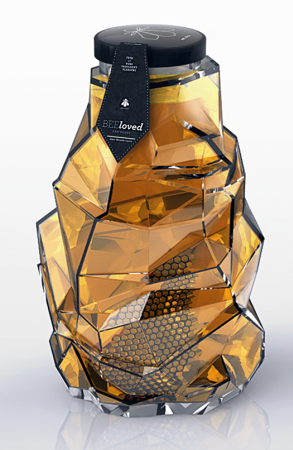
honey bottle Serbian jar design Tamara Mihajlovic

The Future of Honey Packaging?

Forget Steve Jobs and all that i-stuff. If you want to talk about design that trumps utility, then look at what Tamara Mihajlović and her co-designer Njegos Lakic Tajsic have created. This is magic. A brilliant honey container like none we’ve ever seen. Crystal-shaped, with a pyramid of honeycomb in the centre (maybe made of plastic?) it is a bright and unique way to showcase honey. Some describe it in crunchy words like “organic, crystalline, and rock-like” while others just gaze at in awe. Why did no one else think beyond dull boring glass jars and cutesy squeeze bears? This honey container is elegant, gorgeous, and totally impractical.

A pair of Serbian designers created this container as a graphic arts project, then made up a fictitious company (BEEloved Honey) to pretend to sell their beloved honey. But would anyone actually buy non-existent honey, if not for the gorgeous bottle? Certainly, I would, if I had a few thousand pounds of honey to market through gift and gourmet stores. And it would support an enterprising young couturier. Tamara Mihajlović is a 23-year-old Belgrade graphic artist studying at her university’s faculty of Art and Design. She has also been art director and a technical editor for Politikolog, a local political journal. Her other recent creations include a series of anti-Aids posters and music festival ads.

Of course it’s impractical. Granulated honey will stick to the wee little crevices and refuse to exit the bung. But that could be resolved with a quick dunk in a hot bath. Besides, the combo honey and jar looks too good to open and eat, so it is likely to remain corked on a granite countertop for years. A bigger problem is that no one will likely bother to adapt an automated packing line that could fill 5,000 of these odd-shaped bottles in a day. But that’s not the place such a container should be used. Instead, I can imagine a thousand artisanal honey makers filling a hundred of these lovely packages over a couple of weekends in their tiny shops. Then they would retail their honey in Tamara’s classy container at gift shops. No Walmarts, Walgreens, or Krogers for these beauties.

If you own a little honey house tucked in a woods, you might be wondering where you can order these lovely containers. Alas, you can’t. Not yet, anyway. Mihajlović and Tajsic are still seeking a company willing to manufacture these honey bottles. If you are that adventurous bottle-maker, this might be the i-jar you’ve been waiting for.

Posted in Culture, or lack thereof, Honey | Tagged , , | 5 Comments

Keeping ahead of the sheep

sheep

Thinking Like Sheep?

Democracies often work better than dictatorships. Democracy is based on crowd decisions, or, in the trendy new parlance, crowd sourcing. Crowd sourcing really came of age with the internet – put your question, issue, project, or some politician’s dirty laundry on the internet and wait for the responses. (If you are wondering about this site, I set it up without instant crowd feedback, but you can write to me any time at miksha@shaw.ca.) We like to think The Wisdom of Crowds, as one book calls it, is a new development. But our indefatigable honey bees have been group-thinking for millions of years.

Who, among the colony, decides where a swarm will settle? Four hundred years ago, the answer was “That big bee over there, see him? The King. He decides.” (It was the great Greek philosopher Aristotle who first declared the hive was ruled by a king bee. His mistake lasted 2,000 years. By the way, Aristotle noticed that the queen, i.e., his king, has a stinger which, in his logic, meant it was a male.) An English pastor, Charles Butler, realized the king is the queen and wrote about it in 1609 in the Feminine Monarchie, the first English language beekeeping guide, a book that went into five editions and dozens of printings. He imagined she is an Amazonian, a strong and fearless female similar to Queen Elizabeth, his patron a few years before Feminine Monarchie was written. So, is it the queen who makes important decisions in the hive?

Wrong again. The queen is not a leader, she is just a hapless overgrown egg factory, and one of the most helpless of the bees in the colony. The real leader is a worker bee named Betty Sue. She calls all the shots. She decides when to swarm and where to settle, among many other things. Lucky for the bees, there is more than one Betty Sue in each hive. Tom Seeley, in his excellent Honeybee Democracy, explains that beehive group-think results in better choices than any single individual Betty Sue might make on her own. According to Seeley, about 3% of a colony’s members are actually involved in the scouting and decision making, but that means over 1,000 bees are in that clique. This creates a lot of varied perspectives, observers, and decision-makers. Once that sub-group resolves a choice, those Betty Sue clones will buzz, shake, and rattle their compatriots into also agreeing and then venturing off to the new nest site. Apparently, witnessed by their survival since the Cretaceous, honey bees have used this as their successful ploy for a very long time.

Contrast this with what Henry David Thoreau essayed about humans in 1838: “The mass never comes up to the standard of its best member, but on the contrary, degrades itself to a level with its lowest.” That might be true among television viewers, but when working with large groups of people tasked with contributing to a project – and given a democratic opportunity to question and revise the work of others – the cumulative result is better than the achievement almost any single contributor could have produced. In The Wisdom of Crowds, author James Surowiecki uses an example of a jar of jelly beans and a classroom of bean counters. The class submits a secret ballot – guessing the number of beans in the jar – and the average of the group (for groups over twenty or so) is always better than the worst individual guesses made (mathematically, it should be). But more importantly, it is usually better than the best guess. Contrary to Thoreau, the mass is not degraded to the lowest member’s level.

Posted in Culture, or lack thereof, History, Swarms | Tagged , , , | Leave a comment

Talking about bee science

Marla Spivak Ted Talk honey bees

Marla Spivak, giving her TED Talk

Ted talks and so do bee scientists. Maybe you know Ted. TED, actually with capital letters, stands for Technology, Entertainment, Design, and the TED Talks are a series of conferences with great (entertaining) speakers. The talks are filmed and then loaded to the TED Talks website, which has over 1,500 talks (by speakers such as Bill Clinton, Bill Gates, Jane Goodall, Richard Dawkins, and a number of Nobel Prize winners) where anyone can watch them for free. Actually, the non-profit, Sapling Foundation, that hosts TED talks has released the talks into the Creative Commons, making them available for public use with a few restrictions.

You can see a really great TED Talk by Marla Spivak, one of the smartest of all bee researchers, at this link. Her 15-minute TED Talk lists three or four reasons bee colonies die off. Two of her explanations are basically aspects of the same thing – fundamental changes in agriculture, the other two are chemicals and pests.

So, here is a bit more detail on Marla Spivak’s list of the killers of bees. Very briefly (please watch her short video, Marla is a great speaker), the culprits are 1) diseases and pests – especially varroa mites, for transferring viruses and for beeing the bloodsuckers they are; 2) monoculture, which includes the collapse of the family farm and the loss of natural habitat, and has created ‘food deserts’ where only one meal is served (at most) for just a few weeks of the year; and, 3) chemicals, including insecticides, fungicides, herbicides, and the break-down chemical compounds of these complex molecules. You can see these are inter-related. Farming changed, leading to huge efficient monoculture enterprises where pests proliferate unless controlled by chemicals while varroa weakens the bees so they are more vulnerable to the problems brought by chemicals and poor nutrition. The result? Not so good for honey bees.

Posted in Beekeeping, Culture, or lack thereof, Diseases and Pests, Pesticides, Save the Bees | Tagged , , , | Leave a comment

Invasive bee hives

Bees in New Amsterdam

Dutch Hives in NYC: The First Arrived 400 Years Ago

Dutch bee hives in Manhattan? Of course. Four hundred years and counting. New York was known as New Amsterdam by its first settlers, the Dutch from Holland who arrived on lower Manhattan Island in 1614. That’s even before the Pilgrims hit the rocks in Massachusetts. New Amsterdam was the capital of New Netherlands and once claimed all of present-day New Jersey, Maryland, and Delaware, as well as much of New York, Connecticut, and Rhode Island. It was funded by the Dutch West India Company which had built settlements all over the world. The Dutch thought they’d enter the fur trade, but failed to grow their Manhattan city enough to keep ahead of the English who swooped down from New England, defeating the Dutch in the Battle of Wall Street, around 1665. The English gained control of beehives that the Dutch had brought across the Atlantic as early as 1616 or so. By then, those bees had made The Island their home for fifty years.

I am writing about this because I saw a story that got me thinking about how bees ended up in America. I’m linking to the story about some Dutch bee boxes that were noticed by Irene Plagianos, a Manhattan writer reporting from the NYC financial district. The photos of those hives, which you can view in a ‘slide show’ by jumping to this link, shows brightly coloured equipment and happy Manhattan beekeepers.

Dutch bees in Manhattan? Honey bees are an invasive species. I sometimes tire of beekeepers who claim to be ‘natural beekeepers.’ These are the folks who drive their natural SUVs out to their natural hives every weekend, light a natural steel-bodied smoker, open the hive with a natural metal hive tool and manipulate the natural top-bar frames made from western pine or southern cypress. Then they manipulate the invasive insects which were hauled into North and South America, Asia, Australia, and the Pacific Islands by boat a few hundred years ago. I doubt that many who belly-hoot the merits of their natural beekeeping realize that all beekeeping is unnatural. Attend bee meetings and bragging about natural beekeeping is committing any oxymoron. Honey bees are not natural in most parts of the world. And beekeeping – keeping bees in houses of human design – is not natural anywhere. Robbing bee trees, perhaps, but not beekeeping.

Who’s calling Who an invasive species? Whether you believe humans walked out of Africa or were chased out of Eden, either way we have done a pretty decent job of populating the planet. A frighteningly decent job. From creationists’ estimates of 2 originals (or from some evolutionists’ estimates of 10,000 people during our ‘bottleneck years’) we now number 7,000,000,000 and have set up tents almost everywhere. (Congratulations, humans.)

What do I think? Humans, the invasive species, has introduced honey bees, another invasive species. We’ve also transplanted apples and alfalfa and almonds and a thousand other things from other parts of the world. It’s what we do. What would Italian cooking be without South America’s gift of tomatoes? Or Montana honey without European bees and Asian sweet clover? As we go about the practical business of feeding seven billion souls, we have to do some unnatural things. I’d rather have the world functioning as it does than to role back to the time when Eve’s children were not reaching their 35th birthday and most children died in their first year. People live much longer and much healthier lives under this new, unnatural system. Undoubtedly, we have a lot of mess to clean up. We need strongly enforced laws around pollution and pesticides. But little of what we do with our bees is particularly natural. But that’s not a bad thing.

Posted in Bee Biology, Culture, or lack thereof, Ecology, History | Tagged , | Leave a comment