A few of us got together last night for coffee to discuss something about the United Beekeepers of Alberta. After that, one of the folks mentioned that she was preparing to meet a group in a couple of weeks to discuss public panic about bees. She had a great display which really woke me to the reason people confuse wasps with honey bees. Such confusion can create a serious problem for beekeepers. Honey bees rarely cause mischief away from their nest. They are too busy finding flowers and can’t be bothered to bother us. But wasps are meat eaters, a bit more aggressive, pack a nasty sting, and often enjoy picnics, bar-b-ques, and the faces of guests on our backyard decks.
I used to think that everyone could distinguish a honey bee from a wasp. Honey bees, we learn from a very early age, look like this:
Maybe we didn’t eat Cheerios breakfast cereal and stare at its famous cartoon bee every morning of our childhood. Nevertheless, we probably had an overly-friendly grade school teacher who emboldened our first compositions with black and yellow and black and yellow bee stamps that featured bees doing math or saying pithy things such as Bee Good or Bee Happy. Like this:
So, we get this image in our young minds of a honey bee. Bright and shiny, black and yellow. And then we see one.
So, that’s what a honey bee looks like. If they are all over our deck, it’s time to call the neighbourhood beekeeper and tell her to come and get her pesky honey bees. She tells us those are wasps, then returns with a couple of photos that look like this:
Well, surely she’s made some big mistake, hasn’t she? Those don’t look anything like the cartoon honey bees we’ve grown to love.
Sometimes it’s hard to re-educate people. But my friend with these pictures had a good way of teaching the difference. I don’t know if my friend’s infographic, below, is her own original idea. It doesn’t matter. It’s a great tool. I’ll probably make a similar one to help people distinguish gentle honey-making bugs from wasps and yellow jackets.
Today is the last day of winter in the northern hemisphere. But the temperature – here in Calgary, at least – feels spring-like. It’s been in the mid-teens (60° F) for a few days. It’s the first chance for many of us to assess the damages caused by this extended winter. (February was painfully awful. Then it fell to minus 31° here in early March.)
We won’t have nectar and pollen for another month, so we’ll feed our backyard colonies. When I peeked at the bees on an atypically mild day in mid-January, I discovered weak colonies with bees already clustered on the top bars. In January, you expect the bees to have honey, not air, above their winter cluster. We mixed up some fondant to try to keep starvation away. It seemed to work. Today, the colonies are still alive.
You may be feeding liquids by now, if your weather is mild, but when it’s cold, hard-candy is the better option. When I kept bees in Florida, fondant (or its near-cousin, candy boards) were a quick and easy way to feed and stimulate colonies in January and February, ahead of queen-breeding and citrus-blossom season. It was never particularly cold, yet we avoided the mess of sticky syrup, which could lead to robbing. Even the most careful beekeeper might end up with wild, destructive robbing – which happened to a chap I knew named James. He had bought gallon-sized canning jars, filled them with syrup, inverted them atop small holes drilled into his plywood lids, and let the bees take down the feed in one of his backwoods beeyards that stretched along the edge of an orange grove. He came back a few days later and discovered that someone had made sport of all his big glass jars – target practicing with a pistol. Thirty jars were shattered, the syrup was gone, and his apiary was rife with robbing. James switched to hard candy feed.
It’s getting late in the season to feed fondant and we will switch to division-board feeders, tucked out of sight inside the hives. But if you’d like instructions for feeding the hard candy, here’s what we did in mid-January this year to keep our two errant colonies alive.
Basic Fondant Recipe:
4 pounds of sugar
2 cups of water
1 teaspoon of vinegar
Heat to 235º F
Cool to 180º F
Stir until it turns white and creamy
Pour and chill in pie pans
Serves up to 15,000 guests
You’ll find that it takes a long time to get the temperature up to 235º F. I used a cheap infrared, hand-held thermo-gun to monitor the heat. Twenty minutes later, the slurry was hot enough. Why is vinegar in the recipe? It’s supposed to help break sucrose molecules into glucose and fructose. Better for bees’ digestion.
On the stove for 20 minutes.
Then, we cooled it to about 180º and dumped the stuff into a Mix Master.
It goes from almost clear to the white taffy-like candy below. We poured it into pie pans.
When it cools, it shrinks a little and comes out of the pan in one nice solid piece.
It took about 30 minutes to make 8 pounds of this fondant. We served it the same day it was made, but that’s not necessary. I’m sure that this kept the bees alive during the weeks of bitterly cold weather we had from late January to mid-March. There was some honey in the hives but nothing directly above the cluster.
Here’s a picture of what the bees looked like last week. It looks like quite a bit of the feed is left, but the food has been eaten from underneath, leaving the nice round upper surface and not much else.
Alberta beekeepers had smooth sailing through January. It was so mild in southern Alberta that one beekeeper wrote to ask if bees could be swarming. Swarming to the toilet, yes. Literally swarming with queen in tow, no. But the activity was enough to concern a new beekeeper, I suppose. My own two backyard hives in Calgary acted like they owned the skies and the whole world was their personal sanitation system. (It wasn’t really that bad.) I think there were some record high temperatures last month. We had a chance to peak under the covers at the bees. In my case, I was not impressed with our backyard duet. They were buzzy, but not especially well-populated.
January became February and the tropical vortex was replaced by a polar vortex. It’s lasted two weeks already. What will be the effect of prolonged arctic cold? The good news is that mountain pine beetles, which have been killing millions of Canadian trees, have finally been dealt a setback. Not permanent, but it could buy the trees another year or two of life. But what’s bad for the beetles could be bad for the bees. After the mild days of January, the bees have cancelled all their ‘swarming’ plans. They are now clustered tighter than bugs in rugs.
The picture above is interesting in a couple of ways. I’m experimenting with polystyrene hives with no extra insulation wrapped around them. Having snow on the covers could mean one of two things – either the insulation is keeping all the heat inside, or the bees are dead and there is no heat to lose. I hope it’s the first reason.
So what should a beekeeper be doing in this cold? If your hives went into winter well-provisioned, well-wrapped, and well-populated, you don’t need to do anything. The January thaw gave the bees a chance to take cleansing flights, move closer to honey stores, and let the outer-cluster bees come in and the inner-cluster bees go out. The February cold weather will delay some brooding, but that won’t be a problem yet. When If it warms up, we might start feeding. In a short while, a bit of fondant might be a good idea.
On a colder note, last week my wheelchair got stuck in the snow at the university. It was minus 25. I spend fifteen minutes, or more, trying to push my chair through the snow by turning the chair’s hubs with my bare hands. (I can’t wear gloves because some paralysis has affected my hands.) By the time I pushed myself into the building, I ended up with mild frostbite. It’s recovering nicely, likely with little lasting damage. If you’ve never seen a slight touch of frostbite, here is a picture of my right hand, taken three days after freezing. The dark areas were against the icy metal on the wheelchair for just a little too long. As soon as I could, I slathered aloe vera and honey (yes, honey) on the burns. So far, the skin hasn’t even blistered. I hope my bees are as lucky.
Image courtesy of: The Photography of Coley Ogg circa. 1919, Beekeeping Demonstration at Berea College, Kentucky.
This picture is from 100 years ago. It was late winter, 1919. An agriculture agent came to this Kentucky Appalachian farm to teach modern beekeeping. He was teaching a form of ‘modern beekeeping’ that we can easily recognize. Not much has changed in the basic bee yard.
The wooden ‘crates’ around the hives are for winter protection – those aren’t used much anymore. But the frame held by the student is exactly the same shape and size as the frame used by most beekeepers today. We might have trucks and forklifts and ventilated white suits, but the heart of our beekeeping – frames, boxes, beekeepers – are the same.
I sometimes wonder why we are using century-old equipment, but the answers are fairly clear: it works and we’re stuck. If you buy a hive, it will probably be the same size and shape as great-granddad’s. And if you ever need to sell your bees, it’s much easier to sell the stuff everyone else is using. There might be a third reason – we sometimes enjoy the comfortable familiarity of the old hive equipment. Here’s a frame from a 1902 American beekeeping journal. It looks exactly like some of the frames that are in my own hives right now.
Beekeepers are not sentimental. For most of us, Saint Valentine’s Day is a day of intense panic when male beekeepers rush out to buy something special for some darling or pigsney. (It’s not like we didn’t know February 14 was coming.)
Saint Valentine’s Day, though, wasn’t meant to be a day of loathing and dread. It comes to us from a mythical character of long ago. The love-struck saint’s day is built upon Lupercalia, a 3-day Roman holiday (February 13–15) which was intimately connected to fertility. (Luper himself was originally a lupus, or wolf-creature.) Lupercalia came from a much older spring celebration, maybe going back 10,000 years, stolen by the Romans, and then was borrowed and modified by the new Roman church just 1700 years ago. The church fathers used the old holiday to remember a sainted martyr, Valentino, who grew a new heart every night and give his old heart to anyone who was sick, feeble, or heartless. Giving out chocolate hearts is easier.
At least one beekeeper – someone whom I shall never meet – employed enormous energy and talent to make the really cool heart-shaped comb in the picture above. I ran across it on a Polish language bee-talk forum where members were showing various comb-honey gadgets. I couldn’t understand much of what I read on that site, but the pictures are great. If you have seen these heart-combs before or know the person who makes them, please drop me a note so I can credit the appropriate craftsman. Until then, maybe you can make a few of these yourself. You know, just before taking your special honey out to dinner.
Instead of a birthday anniversary, it’s a memorial for the poet Sylvia Plath. She was 30 when she made her final suicide attempt. Did she want it to succeed? Some of her biographers say no. But her preparations were elaborate and her life ended, February 11, 1962. From childhood, the poet had suffered from depression. It was over.
Sylvia Plath, the Pulitzer Prize winner (posthumously) lived like a spark. Or a short-fused stick of dynamite. Beautiful and talented, the Marilyn Monroe of American poetry sprang from a family of brilliant scholars. (Sylvia’s own IQ was an astonishing 160.) Her father was a biology professor at the University of Boston.
Otto Plath was an entomologist, specializing in bumble bees. At home, he kept a few hives of honey bees. In the mid-1980s, when PBS filmed a documentary of Sylvia Plath’s life, they invited my oldest brother, David, to play the role of beekeeper Otto Plath. Donning a beekeeper’s uniform, my brother comes and goes throughout the documentary, as Otto Plath himself seemed to, in the eyes of young Sylvia. I found the documentary on YouTube, existing in six pieces. Here is a very short clip with my brother, mimicking Otto, as Sylvia remembered him.
Watch the series, on YouTube, beginning with the first segment here. The hour-long documentary is comprised of six short pieces. I don’t know why they exist in this way, but I hope that you persist and watch the entire story of a beekeeper’s daughter.
Why watch a movie about a beekeeper’s unfortunate daughter? You’ll know after you take a few moments to read one of Sylvia Plath’s darkest poems:
The Bee Meeting, by Sylvia Plath
Who are these people at the bridge to meet me? They are the villagers—
The rector, the midwife, the sexton, the agent for bees.
In my sleeveless summery dress I have no protection,
And they are all gloved and covered, why did nobody tell me?
They are smiling and taking out veils tacked to ancient hats.
I am nude as a chicken neck, does nobody love me?
Yes, here is the secretary of bees with her white shop smock,
Buttoning the cuffs at my wrists and the slit from my neck to my knees.
Now I am milkweed silk, the bees will not notice.
Thev will not smell my fear, my fear, my fear.
Which is the rector now, is it that man in black?
Which is the midwife, is that her blue coat?
Everybody is nodding a square black head, they are knights in visors,
Breastplates of cheesecloth knotted under the armpits.
Their smiles and their voices are changing. I am led through a beanfield.
Strips of tinfoil winking like people,
Feather dusters fanning their hands in a sea of bean flowers,
Creamy bean flowers with black eyes and leaves like bored hearts.
Is it blood clots the tendrils are dragging up that string?
No, no, it is scarlet flowers that will one day be edible.
Now they are giving me a fashionable white straw Italian hat
And a black veil that molds to my face, they are making me one of them.
They are leading me to the shorn grove, the circle of hives.
Is it the hawthorn that smells so sick?
The barren body of hawthorn, etherizing its children.
Is it some operation that is taking place?
It is the surgeon my neighbors are waiting for,
This apparition in a green helmet,
Shining gloves and white suit.
Is it the butcher, the grocer, the postman, someone I know?
I cannot run, I am rooted, and the gorse hurts me
With its yellow purses, its spiky armory.
I could not run without having to run forever.
The white hive is snug as a virgin,
Sealing off her brood cells, her honey, and quietly humming.
Smoke rolls and scarves in the grove.
The mind of the hive thinks this is the end of everything.
Here they come, the outriders, on their hysterical elastics.
If I stand very still, they will think I am cow-parsley,
A gullible head untouched by their animosity,
Not even nodding, a personage in a hedgerow.
The villagers open the chambers, they are hunting the queen.
Is she hiding, is she eating honey? She is very clever.
She is old, old, old, she must live another year, and she knows it.
While in their fingerjoint cells the new virgins
Dream of a duel they will win inevitably,
A curtain of wax dividing them from the bride flight,
The upflight of the murderess into a heaven that loves her.
The villagers are moving the virgins, there will be no killing.
The old queen does not show herself, is she so ungrateful?
I am exhausted, I am exhausted—
Pillar of white in a blackout of knives.
I am the magician’s girl who does not flinch.
The villagers are untying their disguises, they are shaking hands.
Whose is that long white box in the grove, what have they accomplished, why am I cold.
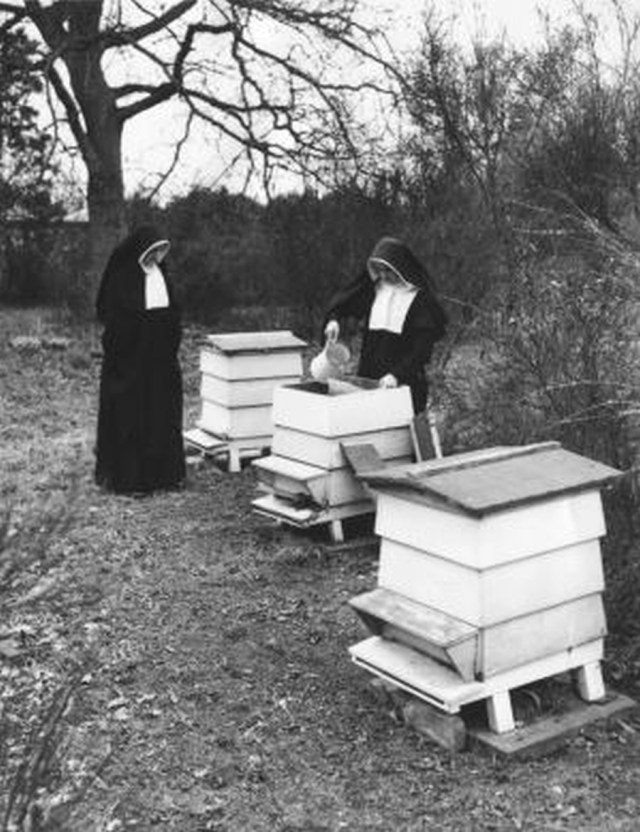
I bumped into this photo a few days ago when I was writing an article for Deutches Bienen Journal, Germany’s beekeeping magazine. I was trying to picture sisters at a convent in Quebec, tending their hives in the 1920s. This photo came up in a web search, but it was within a mass of old pictures, none of them dated or described. It’s an interesting picture, isn’t it? We can only guess at the date (nun fashion is pretty stagnant). My grandmother owned a metal pitcher similar to the one being used to feed the bees, which might take this back a hundred years. The photo image quality also suggests sometime between the ’20s and ’40s. The hives seem European, but North Americans with small, immobile apiaries sometimes use similar boxes. Where was the apiary? Obviously in some northern temperate area with enough rain to produce deciduous trees and lots of brush. Maybe it was Quebec in the 1920s. But maybe not.
It’s interesting to see beekeepers without veils, dressed in black clothing in the bee yard. It’s probably chilly and the bees are losing strength – maybe white suits and veils were used by these nuns in mid-summer. But maybe not. The colony being fed is hanging out at the entrance, so it is likely still fairly strong. Or maybe Sister Melissa kicked the hive to awaken the bees, but I doubt it. You can never guess the whole story from a single picture.
For the German beekeeping journal, I wanted to describe the Sisters of Ursuline, who mostly live in an ancient convent in Quebec City. The Quebec mission was established in 1639. The Ursulines were organized a hundred years earlier by the Italian saint, Angelica Meirici. Since its founding, its purpose has been the education of girls and care of the sick. The Ursuline convent (the Monastère des Ursulines de Québec) was the first place in North America to educate girls.
Bees were part of the mission, too. According to the March, 1921, American Bee Journal, the Ursuline Sisters kept 22 colonies of bees on the shores of Lac Saint-Jean in Roberval, where they produced 4,020 pounds of honey in 1920 – that’s a 183-pound (83 kg) average. Not bad for anyone, anywhere.
Catholic missions have long been known for their beekeepers, whose original task was to produce wax for candles, which, according to Catholic requirements, had to be purely beeswax (produced by the virgin workers of a honey bee hive). That requirement was cut to 51% beeswax for most liturgical uses around 1900. Today, beeswax is usually not required in church candles at all. But originally, many monasteries keep bees mostly for beeswax candles. Honey was a nice bonus.
I visited a Franciscan monastery a few years ago in southern Hungary where an elderly monk showed me his hives. (Here’s the full story.) The monastery colonies were lined against a wall in a courtyard. Father Celerin and his dog Pempo (Hungarian for propolis) guided me to some huge bee boxes with extra-deep frames. It was early October, the weather was mild, but the bees were settling in for winter. The hive strength, winter stores, and tight brood cluster were not extraordinary, but in the presence of the old monk, in the courtyard of the old monastery, examining hundred-year-old hives, the sense of continuity was palpable.
Father Celerin, right, the old monastic wall, and the huge hives.
I can’t believe that I missed reminding you yesterday that it was Charles Turner’s birthday. Here’s the story of the man who figured out that honey bees can think.
🐝 🐝 🐝 🐝
You probably know that Karl von Frisch figured out how honey bees use their waggle-dance to communicate. He won the Nobel Prize for that and for other studies of bee behaviour. I think it was well-deserved and his experiments withstood criticism and independent confirmation. (Although there are still a few distinguished scientists who contest the theory.) His discovery was intuitive and required hundreds of replicated experiments conducted over years of work in personally risky circumstances in Nazi Germany. (Von Frisch had some Jewish heritage.) But there is another scientist who came close to figuring out many of the things which von Frisch discovered. The other scientist did his experiments in America, decades earlier. But he’s mostly unknown, largely forgotten.
Charles Turner is likely the most important biologist you’ve never heard. Charles Henry Turner (February 3, 1867 – February 14, 1923) published at least 70 papers, mostly on animal behaviour. Years before Karl von Frisch realized that bees possess colour vision and can recognize and remember patterns, Turner had published his own results on exactly the same thing. Turner published the first research showing that insects can learn and solve problems. At the time, in 1900, it was generally believed that invertebrate activity was due to reaction to chemical and physical stimuli, without the need for neural discernment. Following Turner’s discoveries, we have seen that insects of all sorts exhibit signs of personality and certainly demonstrate problem-solving skills. Turner’s experiments created a new field of science focused on cognitive ability in insects and other invertebrates.
Turner’s father, from Canada, was a church custodian. A church custodian who was known as a master of debate and who – in the 1870s – owned several hundred books. Charles Turner’s mother, who was from Kentucky, was a nurse. Our budding scientist was born in Cincinnati where he attended public schools and graduated as class valedictorian. Charles Turner studied biology at the University of Cincinnati, graduating in 1891 – the same year he published his first paper (“Morphology of the Avian Brain”) in the Journal of Comparative Neurology. He followed that with another avian neurology paper, this time published in the prestigious magazine Science. He earned his MSc just a year later. His research moved from dissections and interpretations of bird nervous systems to spiders, river shrimp, and insects. Turner was also the first to demonstrate Pavlovian conditioning in an insect. In 1907, Turner became one of the first African-Americans to receive a graduate degree from the University of Chicago. His doctorate, “The Homing of Ants: An Experimental Study of Ant Behavior,” was emblematic of his work in the learning and thinking patterns of invertebrates.
One of Turner’s biggest discoveries involved honey bees, which he trained to recognize shapes and patterns and which – he discovered – could remember the colours of hidden trays of sugar syrup, returning to the correct colours even when tray positions were scrambled.
“Turner begins the paper with a scholarly review of the literature in which the various theories of why bees should see colors are enumerated, followed by a discussion of the limitations of the existing data.
“To investigate the problem, he studied honey bees in O’Fallon Park in St. Louis. He designed various colored disks, colored boxes,and “cornucopias” into which the bees were trained to fly. Thirty-two experiments were designed, and controls for the influence of odor and brightness were instituted. The results of his experiments showed that bees see colors and discriminate among them. It is interesting that in considering the results of his experiments, he believed that bees may be creating, in his words, “memory pictures” of the environment. The idea of memory pictures is certainly contemporary.
“The second paper of the series on honey bee learning was stimulated by the color vision paper. The methods used were identical to those in the color vision paper with the exception that various patterns were used, as were colors. The use of patterns and colors on the same target is the first use, in my opinion, of the compound-conditioning methods popular in contemporary studies of animal discrimination learning. The study contains 19 experiments and the results show that honey bees can readily distinguish patterns.”
Although he earned his PhD as a magna cum laude graduate at the University of Chicago, Turner didn’t find the sort of work that such a brilliant scientist would be expected to receive. He ended up with no laboratory to direct, no grad students to mentor, and no position at any research university. He applied to various universities, but was routinely rejected due to his race. Consequently, Turner spent most of his career as a high school science teacher at the Negro Sumner High School, conducting his experiments at a city park, paying for his spare-time research out of his own pocket.
Historian W.E.B. Du Bois wrote:
Charles Turner “became a teacher in a small colored Methodist school in South Atlanta which had at the time about a dozen college students, no laboratories and few books. He received inadequate pay and a heavy teaching load . . . but the only appointment carrying a living wage that he was able to get was in the Negro Sumner High School in St. Louis. There he stayed until he died of overwork. He was a promising scientist; with even fair opportunity he ought to have accomplished much; but his color hindered him.”
Charles Henry Turner died young from a heart attack, passing away in 1923 at the age of 55. For a comprehensive biography and an analysis of the science behind Turner’s work, I invite you to read “A Study of Inspiration” by Charles I. Abramson.
I’ve heard ‘three billion dollars’ as the ‘permanent’ cost of giving 700,000 US government workers an unexpected 35-day vacation. There were also thousands of consultants furloughed because of the federal shutdown. According to economists, who mostly look at lost income plus wage-earners’ reduced spending, $3 billion left the economy forever, causing a drop in the US GDP. Three billion is a lot of coins and that’s just the hit to direct wages plus the domino effect – for example, laid-off folks might not eat out, which causes a drop in restaurateurs’ income, which leads to reduced hours for chefs and servers, who won’t be buying gas to get to work, and on and on. However, we’ve heard reports of people in the US Coast Guard selling clothes and toys at yard sales to make ends meet, so some money was coming back into the economy. (Read that last bit with as much sarcasm as you can muster.)
The unrecorded costs of the shutdown could also end up in the billions. Research that helps everyone from farmers to physicians was stalled for over a month. In some cases, it can’t be restarted. Shutting down experimental medical cultures, cell lines, and on-going agricultural tests destroy information vital to disease control. The longest-running predator-prey study in the world (observing, tracking and counting moose and wolves in Michigan) went on for 40 years. Until this January. Scientists couldn’t enter federal lands to gather year 41’s data.
According to Dr Rush Holt, a former congressman and physicist, “Any shutdown of the federal government can disrupt or delay research projects, lead to uncertainty over new research, and reduce researcher access to agency data and infrastructure.” The unpaid scientists weren’t even able to enter closed federal lands where observations and experiments were taking place. Locked labs and buildings turned some science experiments into mould- and fungi- growing exercises.
Drippy dead bees
Three days ago, the science journal Nature reported on the shutdown, “Dead bees, dusty offices: US scientists face post-shutdown malaise”. The dead bees were stacking up at the renowned USDA bee disease research lab in Beltsville, Maryland. Here’s the way that Nature described the scene:
A refrigerator overflowing with dead honey bees and larvae greeted Jay Evans when he returned to his lab at the US Department of Agriculture (USDA) in Beltsville, Maryland, on 28 January.
Evans, an entomologist, is one of the thousands of federal scientists who were locked out of their labs during the longest US government shutdown in history. “We are very backed up,” he says of the USDA lab, which monitors bee pathogens and parasites. “And some samples were sitting at the local post office, and they are a little degraded. They’ve been sitting for a month and a half.”
The shutdown has also stung entomologist Rufus Isaacs of Michigan State University in East Lansing. Some endangered bumble bees he has collected are now “sitting in a fridge in my lab” and can’t be shipped to USDA laboratories until they reopen. He notes that a few months’ delay in agricultural research “can mean a whole year of progress is lost, because if we don’t have the answers from the recent experiments, we don’t know how to prepare for the coming growing season.”
Scientists, farmers, and physicians will carry on. But if we think the economic costs are limited to $3 billion dollars, and if we thing that the shutdown didn’t hurt people outside the federal payroll, we are likely mistaken.
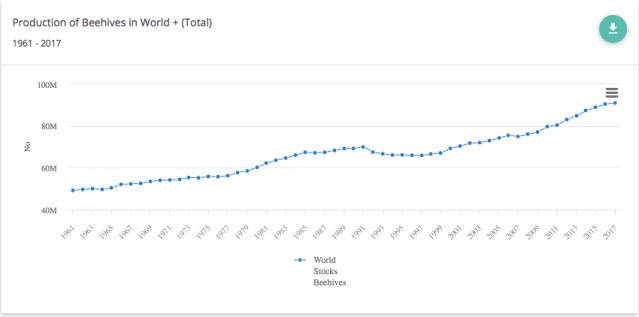
Two trillion. That’s the estimated number of honey bees that are kept in hives around the world. The following piece is reblogged from Emily Scott’s Adventures in Beeland. Now we know that the number of bee hives in the world went up again – now at 91 million kept hives and millions of feral colonies! Thanks, Emily!
A year ago I wrote a post titled ‘How many honey bees are there?‘, after a question on Quora got me intrigued about whether any kind of data exists on worldwide honey bee numbers. Would anyone really have counted?
Well, it turns out they have… sort of.
At the United Nations Food and Agriculture Organization website, FAOSTAT, you can now download the latest 2017 data on the number of managed bee hives worldwide across 125 countries (though not my own country, the UK!). The individual country data can be downloaded as a juicy detailed spreadsheet or the data can be visualised in interactive attractive graphs for you in the Visualize data section – this tells us that there was a worldwide total of 90,999,730 hives (up slightly from 90,564,654 hives in 2016).

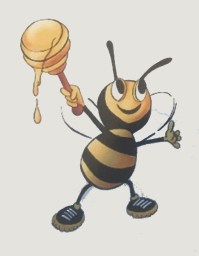
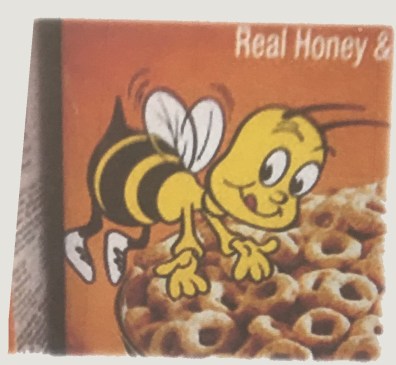
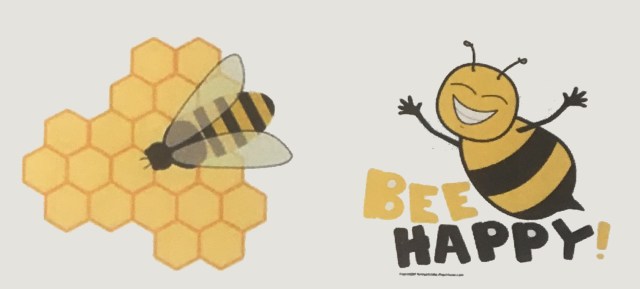

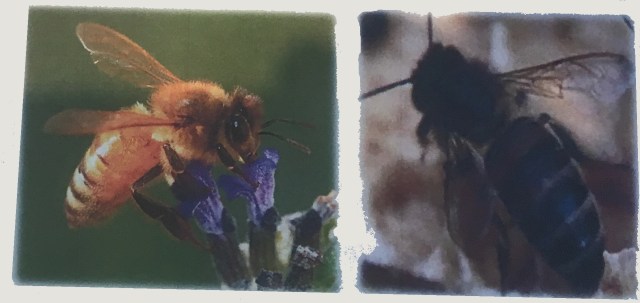

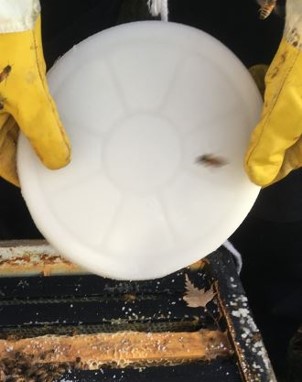


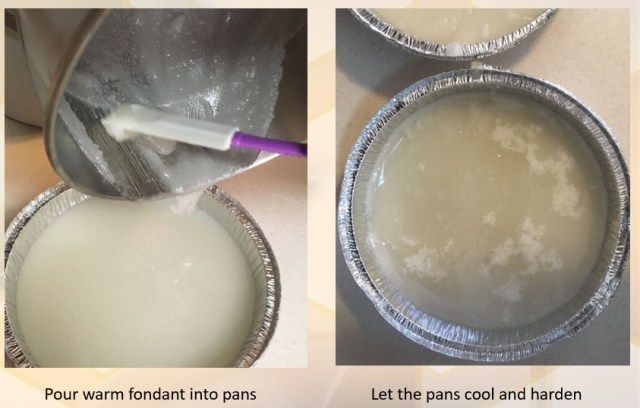
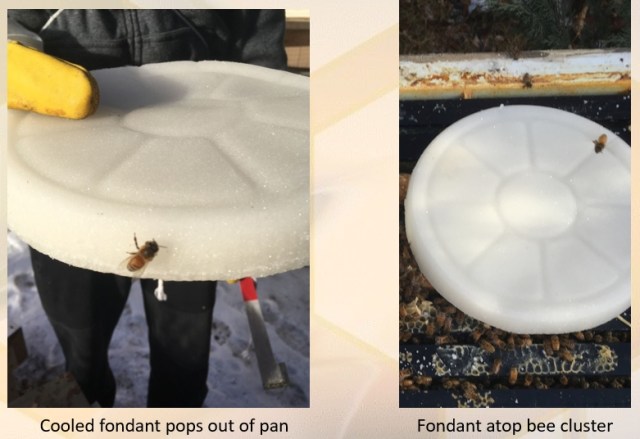
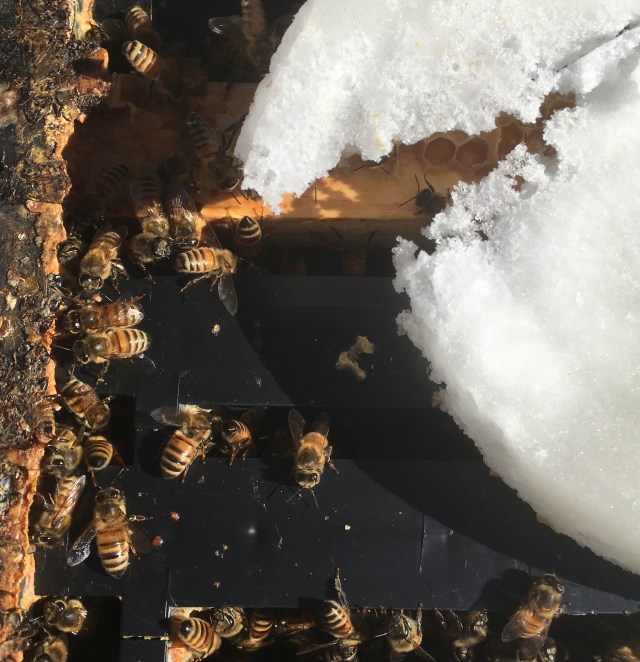

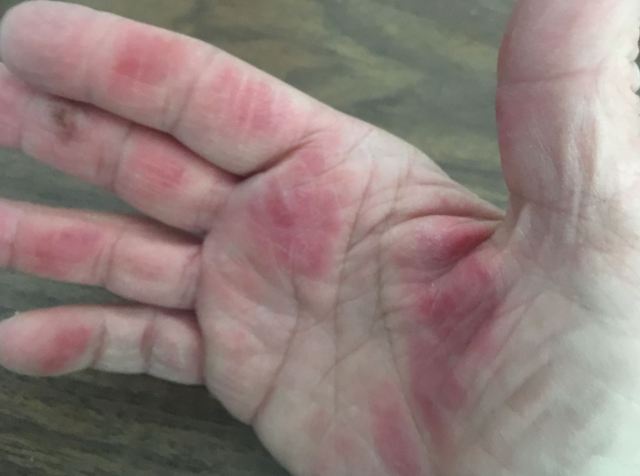
 Image courtesy of: The Photography of Coley Ogg circa. 1919, Beekeeping Demonstration at Berea College, Kentucky.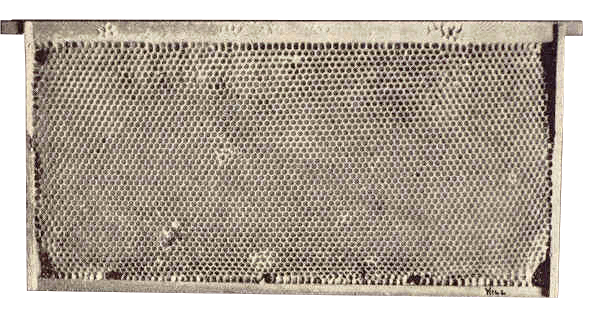
 Beekeepers are not sentimental. For most of us, Saint Valentine’s Day is a day of intense panic when male beekeepers rush out to buy something special for some darling or
  Saint Valentine’s Day, though, wasn’t meant to be a day of loathing and dread. It comes to us from a mythical character of long ago. The love-struck saint’s day is built upon

 Sylvia Plath, the Pulitzer Prize winner (posthumously) lived like a spark. Or a short-fused stick of dynamite. Beautiful and talented, the Marilyn Monroe of American poetry sprang from a family of brilliant scholars. (Sylvia’s own IQ was an astonishing 160.) Her father was a biology professor at the University of Boston.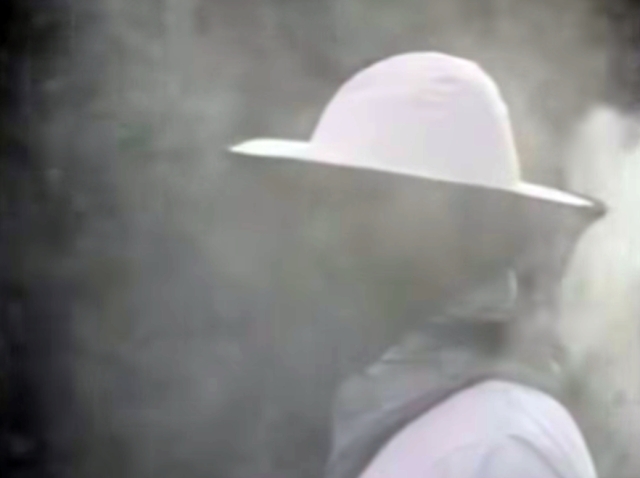

 Although he earned his PhD as a magna cum laude graduate at the University of Chicago, Turner didn’t find the sort of work that such a brilliant scientist would be expected to receive. He ended up with no laboratory to direct, no grad students to mentor, and no position at any research university. He applied to various universities, but was routinely rejected due to his race. Consequently, Turner spent most of his career as a high school science teacher at the Negro Sumner High School, conducting his experiments at a city park, paying for his spare-time research out of his own pocket.
 I’ve heard
  Three days ago, the science journal Nature reported on the shutdown,
 Bad Beekeeping Blog