
Yesterday, I started a discussion about whether beekeepers should use a smoker. (Smoke or no smoke?) I think you should use one, but you’ve got to be smart about it. I’ll write more about smart smoking tomorrow, in a piece intended for newer beekeepers. I noticed that most of yesterday’s comments were about types of smoker fuel, which is today’s subject. If you aren’t able to read yesterday’s piece, here are some of the combustibles that readers puffed about:
As for fuel, I have been using the waste paperboard egg cartons. Takes 1/2 a carton when I do light up.
– Mark
I’m new – and using pellets I purchased from a bee supply place. Difficult to get smoking and incredibly harsh smoke – if the breeze shifts direction when I’ve set it aside to work the hive – my eyes burn and I start coughing, and have to walk away.
– Valbjerke’s Blog
I use pet bedding that can be found in grocery stores or pet stores for smoking and I find it stays lit surprisingly long.
– Al
I’m also pet bedding! A huge bag of dust extracted wood chips costs £6 and will last me several years!
– Ray
Used coffee burlap bags as fuel with starter of paper that comes with foundation wax.
– Pamela
When we began we tried using a spray bottle of just water as recommended by some of the natural beekeeping folks. It did not work for us.
Then we switched to spraying sugar water. It still did not work for us except to make everything sticky including ourselves.
– The Prospect of Bees
I normally use a mixture of paper, wood pellets, and broken up dead tree branches in the smoker, and it seems to work pretty well.
– Erik, Bees with eeb
I’m a smoker! I started using egg boxes this season having always used hazel kindling before that. I got tired of chopping the kindling and find the boxes a cooler smoke the bees seem to prefer.
– acquest13
Any beekeeper who regularly uses a smoker (that’s 98% of us) will tell you that you want fuel that 1) lights easily, 2) gives cool, white smoke, 3) doesn’t make you and the bees gag, and 4) smolders for hours. That’s a long list, but there are plenty of fuels that meet the grade.
I’m going to mention what I know best, autobiographically stretching from my childhood through my rather mature current age. I was one of ten kids on a small farm on the edge of the Pennsylvania Appalachians. We grazed a cow and calf in a small pasture and occasionally bought feed. Empty burlap grain sacks became smoker fuel for our bees. Burlap is fairly common among beekeepers, and even has a tiny Wikipedia entry, which describes Hessian fabric (burlap) as “often used as smoker fuel in beehive-tending because of its generous smoke generation and ease of ignition.”
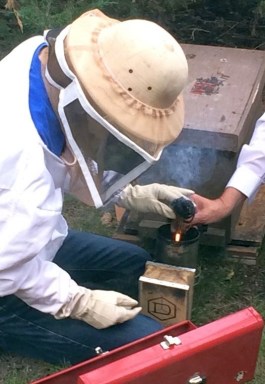
Lighting burlap.
I liked burlap’s cool white smoke. Regardless the Wikipedia description, it was occasionally hard to ignite, especially if dampened by the humid Pennsylvania climate. Some beekeepers start by lighting some newspaper. Newspaper is risky, though, as pieces get lifted by the heat’s up-current and bits of burning paper drift away and start forest fires.
One of my older brothers had a trick which I’ll share but not recommend. After stuffing burlap into the bottom of the smoker canister, he squirted lighter fluid on it, then dropped in a lit match. Basically, you get an explosion. He did this regularly, even after burning off his eyelashes and singeing the hairs under his arms.
Explosions are not necessary when lighting a smoker. Unlike my brother, I’ve never used petrochemicals to encourage flames in a bee smoker. Instead, I saved blackened, partially burned burlap from the last time I used the smoker. It ignites fairly easily, as you see in the picture here.
One of the main drawbacks with burlap is that it’s made from sisal and can smell a bit like a different weed. I discovered this at age 18. I was stopped by state troopers while I drove between bee yards. I was stopped for speeding, of course, but the nice cop asked me what I’d been smoking. I didn’t smoke, but my smoker was smoking. I showed it to him and removed some smoldering burlap. He was satisfied and suggested that I drive more slowly on his highway.

Trail into my farm in Bay Lake, Florida.
These pines grew smoker fuel for me.
I switched from burlap when I moved to Florida and started working for a couple of beekeepers, including my oldest brother, David. All the Florida beekeepers used pine straw. Since I was still a teenager, I wanted to be just like them. I used long pine needles scooped from under stands of southern pines. That was the loveliest smoke I’ve seen in my life. It blew glorious clouds which you’d be happy to have wafting around you for hours on end. It was cheap and easy to collect (but watch out for diamondbacks!). I stored it in unburnt burlap sacks. The only downside is that pines have some natural tar which can clog a smoker, but the billows from the bellows are clean and white. Unfortunately, I didn’t stay in Florida forever. Although I’ve tried other pine straw collected from other parts of the continent, I was always disappointed. Central Florida’s pines spoiled me for life.
When I kept bees in southern Saskatchewan, I knew a lot of cattle ranchers. They put up thousands of bales of hay every year. One of my best friends, Buzz Trottier, a native Cree rancher, saved his baler twine for me. He collected it from bales which fed his cattle during the winter. In turn, he let me help out on his ranch. Sometimes in winter, I’d scatter bales from the back of his pickup truck while he drove. He also let me brand cattle one spring, though that was about the limit of my cowboy experiences.

I’m using some of Buzz’s baler twine as smoker fuel.
Baler twine burned about the same as burlap but had a heavier, darker smoke. On the other hand, it lasted longer in the smoker. A lot of prairie beekeepers – from Kansas to Alberta – were recycling it in their smokers. However, in recent years, sisal has been largely replaced by plastic twine. That would be about the worst thing in the world to burn/melt inside a smoker.
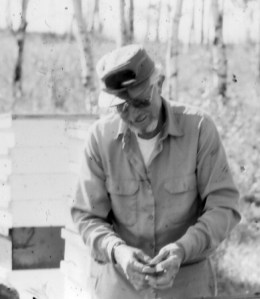
Earl, examining some fuel.
I owned two bee operations in Saskatchewan, one in the south, near Montana, the other much further north, right where agriculture ended and parkland forests began. There, I had a mentor, a semi-retired, 65-year-old beekeeper with 500 hives. Earl Emde began beekeeping in Whittier, California. As a teenager, he hauled bees around the deserts and mountains of southern California. Later, he owned 5,000 hives in Nebraska and the Dakotas, wintering those bees in Florida. His retirement project was raising queens and packages in Florida and hauling them to the north Saskatchewan bush where I occasionally helped him.
One day, Earl Emde and I were at a farm near Big River, working his bees. I’ll quote a few lines from my book, Bad Beekeeping, to describe what happened:
This apiary was fenced inside a cattle pasture. The ground was littered with dry, hard cow pies. Halfway through the beeyard, Earl did something unexpected. Normally, as fuel for his bee smoker, Earl used sawdust and tiny scraps from wood that he turned into new beehives. But I caught him hefting a dry, hard cow patty. He dropped it into his hot bee smoker. I gave him a puzzled look.
“You’re wondering what I’m doing?” he said. He puffed the bellow until thick white smoke gushed from the bee smoker.
“Seems a bit weird,” I said. “Why stick a cow pie in your smoker?”
“Well, reminds me of when I was a kid – a smell I don’t get to enjoy, except a couple times a year.”
“When you were a kid – you had a job burning manure?”
“No, I kept bees in the California desert. No trees, no wood, nothing to burn in the smoker except dried cow dung. Fifty years ago, I used this all the time.” He breathed, his lungs ballooned out.
He grinned. “Nothing like it.”
Smoker fuel has been a big part of my life. From burlap to pine straw to baler twine and cow dung. I didn’t mention that an Appalachian beekeeper taught me how he cut and dried sumac blossoms. And a prairie beekeeper kept a stack of wet cardboard, rolled into tubes which he dried. Several others whom I’ve encountered use wood chips, like Earl Emde did. To me, smoker fuel is somewhat tied to geography, though some stuff, like wood chips and burlap, are almost universal.
Now I’m in Calgary, Alberta, Canada, keeping two hives in the back yard. I’ve been experimenting with a variety of material – as long as it’s clean and food-grade. But nothing was really satisfying me. Last week, I was visiting friends at Tsuut’ina Nation, a few kilometres from my house. We were checking bees and I was running low on smoker fuel. The beekeeper said, “Wait a minute, Ron,” and disappeared into a nearby shed. She returned a few minutes later with a neatly-cut piece of burlap for my smoker. It looked and smelled every bit like the smoker fuel of my childhood.


 Humans experience satiation when we (for example) start munching a box of chocolates. The first chocolate is great, but by the time we finish all 24 in the box, we’ve had it. Our stomach might be able to hold another package or two, but our tongue and brain are hopefully telling us that we’ve had enough. However, if you were a social bee, you’d want to completely fill your honey tummy because you’re not just eating for yourself – it’s your duty to tank up with as much sweet stuff as you can hold and then pilot your blimp-body back to the hive. [A honey bee weighs 90 mg (0.0002 lb) but her stomach can hold about 50 mg of nectar – that’s like a 200-pound person eating 110 pounds of chocolates.]
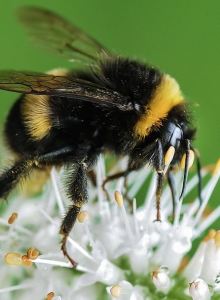 (similar to our own) that says “Sweet”. But then, a second neuron switches on and overrides the pleasure neuron. The second is an inhibitor neuron which quickly shuts itself off, allowing the first neuron to take control again, giving the bee the taste of sweetness all over again, as if it were the first time she has tasted that flower’s nectar. The intermittent (burst) firing of the second neuron prevents the bee from experiencing sweetness satiation (adaptation). This research is captured in a paper called







 Bad Beekeeping Blog