A Depleted Home

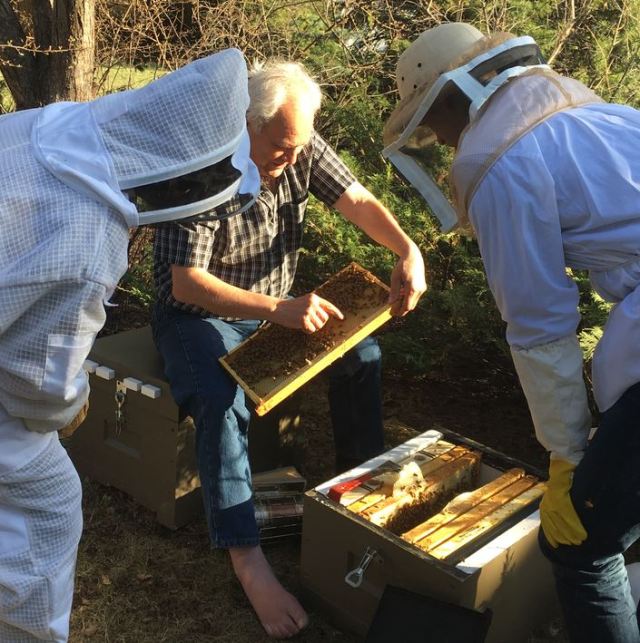
A few days ago, a friend invited me to visit her bees.  In one part of her apiary, there were three hives, neatly lined, single-storey. These hives had started the season as packages five weeks earlier. Two were excellent. They had six frames of brood and two weeks’ worth of new young bees, the offspring of the queens in the hives. I’m guessing these colonies had about 12,000 new bees each. But there were other bees in the hives. Those were the honey bees that had arrived in the package. By now, they were old. They’d spent their first few weeks in the southern hemisphere, the last five here, in Canada.

I wasn’t sure how many of the bees were the original New Zealanders and how many were new bees, born in Canada. Of course, younger bees look younger – fuzzier and plumper than the darker, weary, hairless, aging non-fuzzy bees. Almost anyone could distinguish the young from the old. But I wondered how many of each type might be in those two hives, both of which had started with a queen and about 6,400 workers from New Zealand. Were half of the original bees still alive? One-third? Quarter? None?  I got an answer of sorts when I opened the third hive. It was queenless. The only bees were old bees. The entire population consisted of the original New Zealand bees from the package which had been installed over a month ago.

Compared to the first two hives, the third one, at the far end of the line, was shockingly lethargic when I lifted the lid. Not a single bee flew up to greet my face. The bees on the tops of the frames moved slowly, mechanically. I could not help but engage in an unscientific anthropomorphism – rather than the happy buzz of her prosperous sisters, this colony whispered, “We are sad.”  These bees, aged and facing the impending demise of their colony and themselves, had no way of continuing. They had no queen.

Their listless malaise lingers in my mind. They were a defeated population. I was immediately reminded of Leo Tolstoy’s War and Peace, his scene where he compared a queenless hive with Moscow when the abandoned city was approached by Napoleon’s soldiers:

“Meanwhile, Moscow was empty. There were still people in it, perhaps a fiftieth part of its former inhabitants had remained, but it was empty. It was empty in the sense that a dying queenless hive is empty. . . In a queenless hive no life is left, though to a superficial glance it seems as much alive as other hives.”

Tolstoy, verbose yet compelling, continues on and on, accurately describing the condition of a dying queenless colony, so similar to what I saw at this moment. Some day, I will revisit Leo Tolstoy, his bees, and his wife’s concerns for his sanity (she claimed that there were times when he could not be removed from his apiary, even for meals or visitors). I wrote a few words on Tolstoy’s description of a queenless hive last year. For now, suffice to say, I had opened a hive which Tolstoy could have described as suffering negodnost. It was in trouble.

It appeared that the queen which had arrived with the package had died immediately after release in her new home. She never laid eggs. There was no sign of hatched brood. And certainly no young bees. The colony was now queenless, but strangely quiet. It was not buzzing with the discordant tones of a typical queenless hive. It was populated by the murmuring elderly. Significantly, it had no brood, no queen.

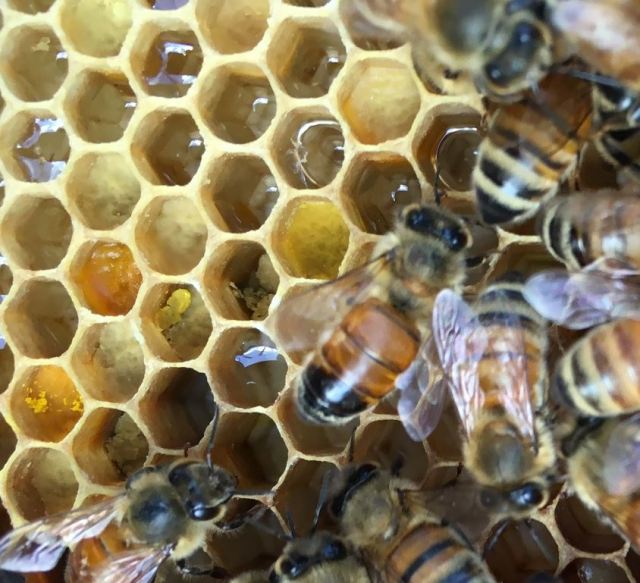
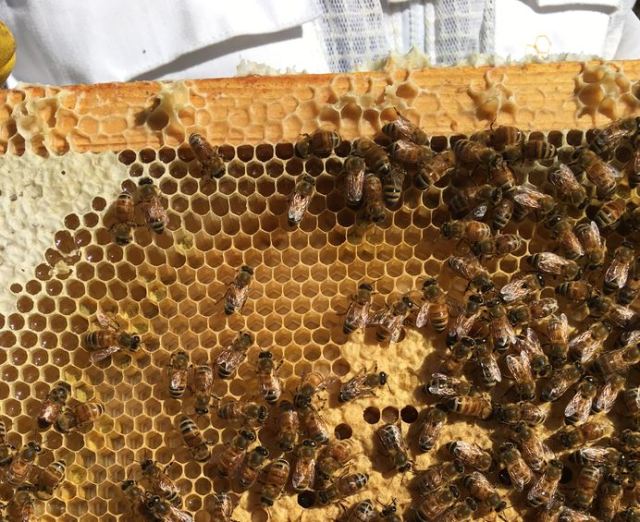
Above, you can see what such a failing colony looks like. Below, I have zoomed in and I’ve numbered a few things on the picture so you can pick out what I’m writing about.

  1.  The colony has stored some pollen, but it appears neither fresh nor enticing. Instead, the pollen is shiny, as if licked by every bee in the hive, as though glossing the food would somehow beckon hungry larvae to arise from barren cells.
  2. Number 2 marks a spot without pollen and honey. If there were a queen present, we’d see eggs or larvae in these cells.
  3. Here we see the shiny reflection of nectar in the spot where brood ought to reside.
  4. Throughout the hive, all the adult bees are dark due to their general lack of fuzz and hair. Their baldness results in a shiny metallic look which is sometimes black without the diffusion of light that would occur had the bees been hairy. You also see a likely K-winged bee (up and left of the ‘4’) which could indicate an eponymous virus. Finally, you notice that many of these workers have long, exaggerated, skinny abdomens.
  5. Looking just below all those aging workers, we see untouched pollen supplement on the top bars of adjacent frames. This was diligently offered to the colony by my beekeeper friend but it remains unused due to the lack of larvae. If you feed pollen supplement and find a hive that’s not using it, that could mean they don’t have any hungry larvae.

These are typical signs of a colony which has been queenless for a long time – scattered shiny pollen, unused pollen supplement, lethargic bees, small population, elderly bees, and, of course, no viable brood.

I took several pictures of the three frames which had bees wandering around the combs. At home, I counted the bees in the pictures. There were about 1,200. That’s a little less than one-fifth of the original number that was released in the box five weeks earlier. (But far better than Tolstoy’s Moscow analogue with just one-fiftieth of its population.)

1,200 gives me a rough estimate of how many original bees might be in a colony about a month after setting it up as a spring package. This is not a scientific test, just an observation of one hive. It’s possible that this is an unusually high number of original workers because a queenless hive doesn’t demand much work. The old bees were not gathering much pollen, didn’t need much honey, and certainly were not feeding any larvae. They were not working themselves to death. On the other hand, occupying a queenless unit, some of the old bees may have drifted into better hives, leading me to underestimate the number of old bees which would normally be in a hive five weeks after a package installation.

Nevertheless, the number (1,200) is probably representative of the population of elderly bees in a normal package on week five. Added to the new bees (12,000) that a queen-right package would generate, we have over ten times the population – 90% being new bees.

Using these numbers as a guide, I created a graph, giving us a look at the population dynamics in a hive started as a package. It shows the shift in bees as old ones die and the new queen’s young bees emerge. I’ll post it next time and explain why beekeepers should care about hive populations – and the quality of their queens.

Posted in Bee Biology, Beekeeping, Queens | Tagged , , , , | 7 Comments

Palates of Bees?

Let’s see… palates or pallets? Where do the bees go?

At the risk of irredeemably exposing my intractable pedantic nature, I have to take five minutes to admonish a gaggle of news reporters for their flawed word choice.

I just read a news item, published by the American network ABC, which discusses the movement of honey bees into California’s almond groves. As usual with major news networks, factual errors creep in when inexperienced staff members are forced to cover farm stories. That’s expected. When an enterprise which you know well (e.g., beekeeping) is examined by someone whose next assignment may be men’s swimwear or kite competitions, we shouldn’t have high hopes for an accurate  rendering. But, since the main tool of a journalist is language, we should at least anticipate correct usage of vocabulary.

The 626-word ABC article, Growing California almonds takes more than half of US honeybees, has a four person byline: Ginger Zee, David Miller, Kelly Harold and Andrea Miller. I’m guessing that all four had read the article before it went live. Or, each of the four was responsible for 157 words apiece and some NYC-based editor read their submissions, edited the drafts, and amalgamated them, though that’s not the way it usually works. Anyway, I’m about to get to my point.

Midway through an otherwise OK piece, we encounter this line:

Kutik [a beekeeper] loads his bees on flatbed trucks that hold 112 palates of beehives and sends them on a multi-day, cross-country journey.

112 palates of bees?  That’s tastefully expressed. I hope that most readers of this bee blog know that beehives are loaded on wooden platforms called pallets, not on mouth parts called palates. Nor do hives fit well on painters’ palettes, though pallets could be manufactured from wooden pellets or ground up from pallet to pellet when they’ve fulfilled their duties – potentially cycling from pellet to pallet to pellet.

I’ve printed some gaffes that can be described as serious howlers and I appreciate that readers have pointed these out to me. I try to remedy my linguistic deficiencies as quickly as possible. In defence of my occasional disgracing of our common language, I can offer that English was not my parents’ first language. I grew up with a slightly restricted vocabulary and a grammar that was influenced by some interesting European idiosyncrasies. Nevertheless, after decades of adulthood, I’ve had ample opportunities to rectify any minor disadvantages. However, I neither earn my living by writing nor do I focus my principal interest in life on publishing news articles. But I assume that people employed by ABC News do.

We expect more from national news organizations where communication and proper word choice are the tools of trade. By the way, I have sent a note to ABC, informing them of their blunder and providing them a link to an on-line dictionary. Their unpalatable use of palates was published in January 2018. Let’s see how long it takes them to correct it.

Posted in Culture, or lack thereof, Humour, Strange, Odd Stuff | Tagged | 8 Comments

Bees (of a sort) on Postage Stamps!

Canada has something called ‘permanent’ stamps. We call them “P” stamps. The first ones, issued ten years ago, had a small letter P on them, next the the Queen of England’s face. P stamps have become B stamps, at least for a little while.

You pay the current price for a postage stamp (presently 85 cents) and you get a regular, business-class stamp. The stamp can be used anytime – even twenty years from now when the post office will charge three dollars to send a letter. These stamps never expire. I think the post office figures that they can use our money now, invest in high-yield bonds, and allow us to use the stamp whenever. They are also expecting some of us to lose the stamps behind the dresser. Or, in the case of the colourful new “BEE” stamps,  the stamps will be kept as keepers by beekeepers and stampkeepers. Today, I used one of mine to mail my company’s quarterly Goods & Services Tax payment. My way of telling the tax folks to please buzz off.

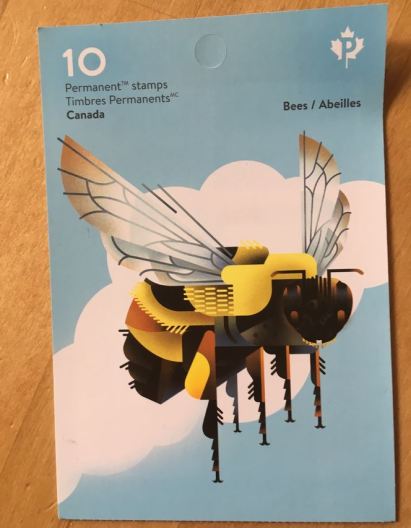
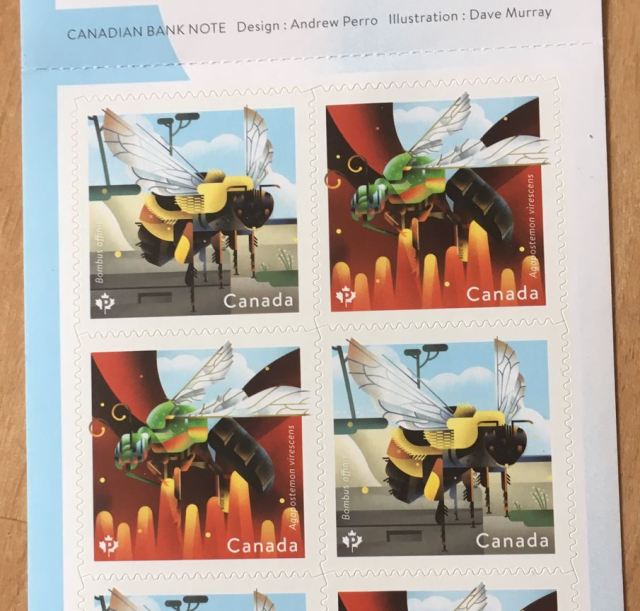
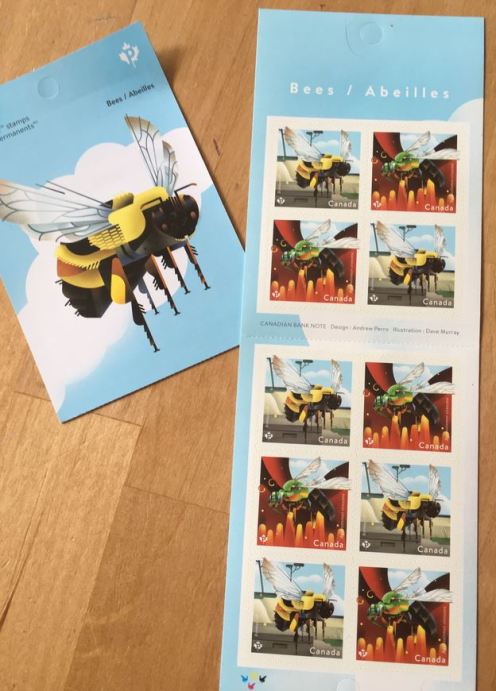
The stamps are interesting. Colourful and comical, yet ominous in portending a future where robotic bees will do our pollinating after these bees are extinct. At least, the bumble bees on these stamps look like robotic bees to me.  Nevertheless, these are “Bee” stamps, as it declares on my purchase receipt. You can decide if these images look more like robots than fuzzy buzzers, or if the artwork reflects the cubistic intent of its maker, Toronto artist Dave Murray. I’ll admit that I like the design, irregular though it may bee.

I’m not sure who made the bee species choices, but they picked Agapostemon virescens (a sweat bee) and Bombus affinis (a bumbler) to symbolize our bees. The Canadian post office didn’t use a honey bee this time. I’m happy with that decision – bumble bees and sweat bees are native Canadians while our honey bees are not. If we are doing a Canadian Bee stamp, using Canadian bees (even if the bumble bee looks robotic) is a fair choice. The bumble bee on the stamp, by the way, is the Rusty-patched Bumble Bee, a species at risk and recently classified as endangered in the USA – the first bee to earn that sad designation. The Canadian post office is well aware of the significance of this bumble bee. When the stamp was released this spring, it was unveiled “in Grand Bend, Ontario, near Pinery Provincial Park – the last known location of a rusty-patched bumble bee in Canada”.

I bought 20 of these new bee stamps. A few of them will end up gathering dust among my bee stuff. I don’t know how long the Canadian post service will be selling them, so if you’re interested, head into your community office soon. If you are not in Canada, you can still get the stamp. Just send me a crisp $20 USA bill and I’ll send you a letter with TWO of the stamps on the envelope.

Posted in Culture, or lack thereof, Outreach, Save the Bees | Tagged , , | 4 Comments

Ron on PolliNation!

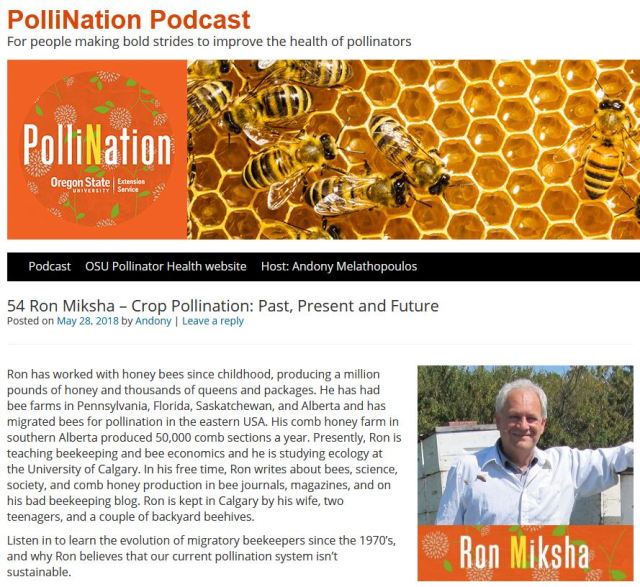
I’m so excited to share a link to PolliNation, the fantastic podcast about . . . Pollination!  This podcast episode features the show’s host in conversation with me!

Dr Andony Melathopoulos, the bee scientist running The PolliNation Podcast, invited me to discuss honey bee pollination – past, present, future.   Andony is a very knowledgeable beekeeper and a scientist at Oregon State where he works in pollination extension, research, and education.  Because of his experiences, he deftly leads this discussion about (1) the old days of pollination (before hives on pallets, bee nets, and freeways), (2) the current state of commercial pollination (which I dub ‘unsustainable’), and (3) a possible future where drone bees will be robots and cherished crops might be ‘self-fruitful’ and no longer need our bees.

I have two regrets about the podcast. This is a great subject to discuss so it would have been nice to have had a 10-hour podcast marathon. Though we got deep into it, the topic lends itself to considerable deliberation.  My second regret is technical – in this podcast, I am speaking through my computer in Calgary, Canada, and the sound (from my end only) is not crisp.  That was entirely my fault. Next time I do a podcast with Andony (hopefully there will be a next time) I’ll find a better microphone!  Having said that, I’ll hasten to add that the sound quality improved as the show went on and it’s never so bad that you’ll miss the message.

Here’s the link to PolliNation. You can listen through I-Tunes (Episode 54 – top of the charts this week!), Soundcloud, or directly through your computer by going here.

Posted in Beekeeping, Culture, or lack thereof, Friends, Outreach, Pollination | Tagged , , | 2 Comments

Peak Dandelion

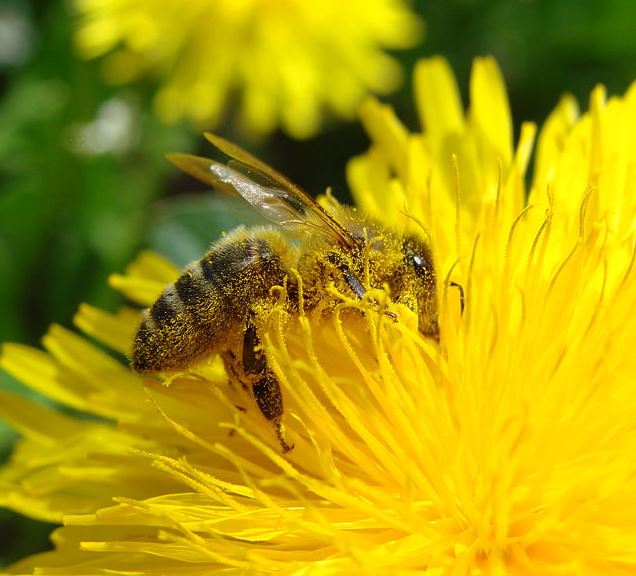
Pollen-dusted bee on dandelion (credit: Guérin Nicolas)

For a lot of temperate-climate beekeepers, dandelions are the peak of the spring season.  Their bloom marks the point where hives are finally getting much stronger, nectar is pouring in, and the dandelions’ massive gifts are giving a fine boost to hive weight.

If you are in the lower Midwest, dandelions have finished, leaving otherworldly bobbs of seeds atop hollow spikes. Most of us, as kids,  have plucked those expended dandelions and, with our breeziest breaths, launched seeds into the air. If you lived in town (I didn’t), you might have irritated Mr Wilson, the guy next door, who didn’t want your family’s seed in his ecologically-sterile green lawn.
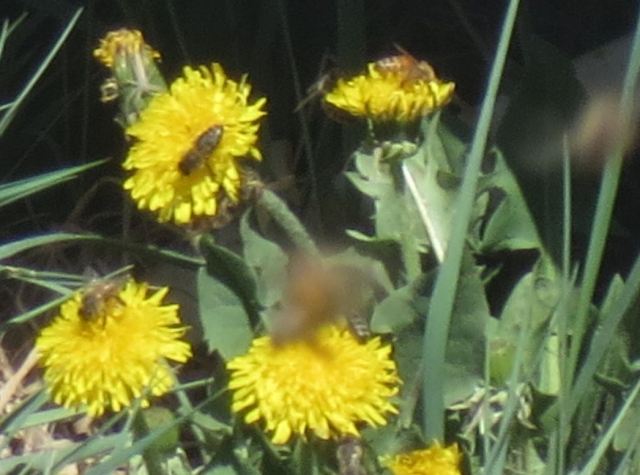
For those of us living further north, the dandelions are now peak. When I teach beginning beekeeping, I tell Calgary students to circle May 25th on their calendars.   If the weather is warm and dry, the bees will have their best day since last August. I’ve been declaring the third quarter of May as our local dandelion bee-boom event for years. Only once – in 2015 – was I completely wrong.  That year, there wasn’t much of a winter here in western Canada. February and March were mild. Dandelions blossomed in early April.  That was an exception, this year is the norm.

The combination of long days in late May, plus moisture in the soil from spring rains, pushes nectar and pollen out of the dandelions exactly when hives need them most. If you are surrounded by dandelions, as we are, the bees needn’t fly far to pick up lunch.

Common dandelions – like almost all of North America’s major honey plants – are from Europe. [We have a couple obscure varieties of native northern dandelions, but the honey dandelion arrived on the Mayflower as a medicinal herb.]  Like common dandelion, our honey bees are also from Europe. Honey bees and dandelions are old friends. Bees undoubtedly lend the lions a hand in their mission to conquer the world. I was once scolded (only half in jest) by a rancher who didn’t like the way my bees had spread dandelions through his irrigated alfalfa field. He may have had a point, though the dandelions were spreading before my bees arrived.  A photo of his field, infested with dandelions, is just below. I reminded him that my bees helped his sweet clover and alfalfa (also European imports).

Dandelions in an irrigated Saskatchewan alfalfa field.

Perhaps I’m fond of dandelions because they are the only major honey plant which my bees feasted on in Pennsylvania, which also occur here in western Canada, where I’ve spent most of my life.  In the east, where I learned to beekeep, bees experienced dandelions, black locust (acacia), tulip poplar and basswood (linden), a long summer dearth, then goldenrod and aster in the fall.  Here, it’s dandelion, then canola, alfalfa, and clover.  (There was clover in the Appalachians but it rarely yielded nectar – the soil is too acidic.)

I’m excited by the abundance of dandelions, the twenty or thirty or forty pounds of honey bees store from dandelion, and the general buzz of hive activity. But do dandelions (Taraxacum officinale) actually provide great nourishment for developing bee colonies? Compared to having an apiary without them, dandelions are wonderful. However, just like many other plants (alfalfa comes to mind) the pollen from dandelion lacks some essential amino acids needed for bee development.

Pollen provides protein which develops and maintains animal bodies. Protein is made of amino acids. There are ten amino acids which honey bee larvae need for maximum development: arginine, histidine, isoleucine, leucine, lysine, methionine, phenylalanine, tryptophane, threonine, and valine.  In the 1980s, researchers found that dandelion pollen contains seven of the ten amino acids bees need. If bee brood is fed only dandelion pollen, it can’t grow; if adult bees eat only dandelion pollen as their protein source, they die sooner than bees on a complete diet. The lesson? Bees need more than just dandelions.

So, is my excitement about my bees’ excitement misplaced? Just a little. Fortunately, for me today near the Rockies, and for the younger me in the Appalachians, there are other spring flowers. These include fruit blossoms as well as a very wide range of annuals. None of these supply the massive quantities of nectar (and pollen) that I’ve seen from dandelion, but fortunately, honey bee colonies sample from a bouquet of pollen types. Some might lament that dandelion isn’t perfect (I’m not lamenting), but somehow bees have worked this out thousands of years ago. They’ve generally adapted to find the balanced diet they need. Meanwhile, take a look at the bees on these dandelions!

Posted in Bee Biology, Climate, Ecology, Honey Plants | Tagged , , , | 3 Comments

World Bee Day: May 20, 2018

World Bee Day

Time to party like it’s 1734 all over again!  May 20th should be a big date on the beekeeper’s social calendar. It’s World Bee Day.  Why did I mention 1734? That’s the year Anton Janša was born. He was baptized on May 2oth, the closest date we know to his actual birthdate. Some say that Janša was the first modern beekeeper. You can learn more about him later in this blog post.

As an added bonus, May 20 is also another famous beekeeper’s memorial day.  Charles Dadant, the scion of the infinite Dadant and Sons progression of beekeepers was born in France in 1817. Dadant thought he’d be a revolutionary back in the day, in France, but he ended up in America.  (You can read his story in my piece celebrating his 200th year.) Charles Dadant, born on May 20, 1817, ended up in western Illinois where he wanted to grow grapes for wine. Lucky for us, his beehives did much better than his vineyards.

World Bee Day was initiated in Slovenia, Europe, and has been quickly catching around the world. For example, German Chancellor Angela Merkel concluded a major speech Wednesday with a rousing endorsement of World Bee Day, telling members of the Bundestag to do something good for the bees:

“I want to finish with something that some may consider insignificant but is actually very important: on May 20 is the first World Bee Day. On this day we should really think about biodiversity and do something good for the bees.”

World Bee Day became World Bee Day after a successful campaign by the country of Slovenia (Anton Janša’s birthplace) to promulgate the message. Their petition to the United Nations was accepted in December 2017, so this year marks the first official World Bee Day.  I’ve been following (and promoting World Bee Day) ever since I heard the effort was underway a couple of years ago, so below you’ll see some of my earlier posts.

Well, a great big congratulations to the Slovenian promoters of World Bee Day. You made it happen on the world stage!  And beekeepers, it’s your job to go out and spread the good word and “do something good for the bees”. If you need some further inspiration, watch this World Bee Day video to fortify your resolve – it’s about the first hive of honey bees kept at the United Nations in New York City.

🐝 🐝 🐝 🐝 🐝 🐝 🐝 🐝

🐝 🐝 🐝 🐝 🐝 🐝 🐝 🐝

Rather than re-write the entire story of World Bee Day, here’s the original piece which I wrote in 2016, back when Bee Day was just a twinkle in the World’s eye. If you’ve already read this and remember it all from last year, then maybe shut down your sparkly screen and go do some World Bee type stuff….

FROM 2017:  May 20 is World Bee Day. Seems an appropriate day to celebrate the bee. (So was yesterday; tomorrow would be good, too.) It’s spring north of the equator. I don’t want to neglect our friends south of Earth’s belt, but honey bees began their world-wide conquest by expanding from the northern hemisphere. For most of us in the higher (positive) latitudes, May is a fantastic bee month. Colonies expand, swarm, and maybe even make a little honey.

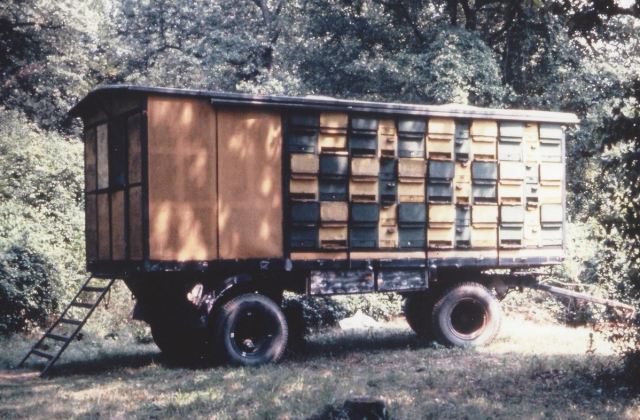
Portable apiary in Slovenia. (Photo by David Miksa)

Portable apiary in Slovenia. (Photo by David Mikša)

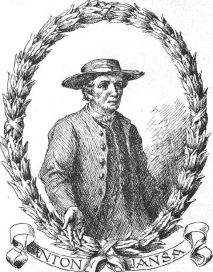
May 20th is also the celebrated birthdate of Anton Janša (1734-1773), the first teacher of modern beekeeping. (It’s ‘celebrated’ on May 20th, which was his baptism date. We don’t know the exact day of his birth.) Anton Janša was Slovenian (hence the funny little squiggle over the ‘s’ in his name). He was so talented that Habsburg Empress Maria Theresa appointed him headmaster at the world’s first beekeeping school, which she built for Janša in Vienna. It’s remarkable that he chose to be baptized on the same day that we would pick centuries later as World Bee Day. That date was chosen and promoted by beekeepers in Janša’s native Slovenia – do the coincidences never end? Now here I am, Ron Mikša (anglicized to Miksha), a bee blogger with grandparents who were born in that part of the world, encouraging you to do a wiggle dance in celebration of World Bee Day this Sunday. Get out and do something beely.

🐝 🐝 🐝 🐝 🐝 🐝 🐝 🐝

🐝 🐝 🐝 🐝 🐝 🐝 🐝 🐝

FROM 2016:  There’s a small country in Central Europe, a very beautiful alpine country, called Slovenia. Slovenia has only two million people, but this tiny country is very big in beekeeping. Tucked between Italy and Austria, it has both mountains and Mediterranean sea coast, creating enticing niches for bees and beekeepers.

Every Slovene family has at least one beekeeper. I think beekeeping might be enshrined in their constitution. I visited before Slovenia adopted the Euro and I paid for a Laško with coins that had images of bees, not presidents or queens. Beekeeping is taken so seriously that the nation’s unofficial motto is “Land of the Good Beekeepers“. The country produces gourmet honey, offers beekeeping tourism, and likes to point out that the Slovenes – the wealthiest Slavic nation in the world – takes its work ethic from the honey bee. On top of all this, I’m proud to say that two of my grandparents were born in Slovenia!  What a remarkable place, eh?
Slovenia convinced the world to recognize World Bee Day, a day for the bees, on the presumed birthday of their most famous beekeeper, Anton Janša.

Janša (pronounced YAN-shah) is a Slovenian national hero and a beekeeper. We don’t really know his birth date – his parents were illiterate farmers and probably wouldn’t have even known (or cared) what year it was. But their church kept track. He was baptized on May 20 in 1734.

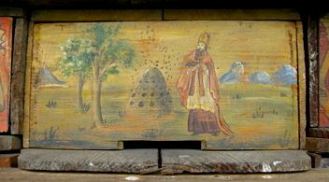
Beehive entrance plate, painted by Jansa.

Beehive entrance plate, painted by Janša.

The Janša family was impoverished, but three Janša brothers built an art studio in a barn, got noticed by the village priest, and were whisked off to Vienna, the capital of the Hapsburg Empire, which controlled Slovenia at the time. One of the brothers became an arts professor. Another became a beekeeper. The royal beekeeper.

Anton Janša was the beekeeper. Empress Maria Theresa recognized his skill and appointed him as the queen’s own bee man. Janša created the world’s first beekeeping school, wrote a couple of important beekeeping books, and introduced modern apiary management. He championed expanding hive boxes to hold extra honey and he encouraged migratory beekeeping, moving hives toward the foothills in the spring to collect acacia (black locust) honey, the Alps in the summer for honeydew from the pines, and into lower pastures in the fall. He was among the first to realize that drones are not water-carriers, but instead mated in the air with queen bees. This latter discovery pre-dates Francois Huber’s similar observation by a few decades but was not generally known when Huber rediscovered it. Janša did all this before he turned 40 – he was only 39 when he died suddenly from a fever, likely the result of an infection.

An image from the Slovene World Bee Day promotional video.

An image from the Slovene World Bee Day promotional video, visible below.

Here’s a lovely, short video of what the Slovenes want you to know about World Bee Day:

World Bee Day is a great idea. The exhibition “Save the Bees” will be opening at the historic Ljubljana castle, on May 20. The Slovene embassy in Washington DC had a big party. Elsewhere, awareness and round tables on “Bees and Sustainable Development” and bee memorials abound. World Bee Day is intended as a day to reflect upon the much maligned and threatened bees. A delegation of the European Union is also meeting May 20 with luminaries of the American bee world at a World Bee Initiative, which you can read about here.

WBDWorld Bee Day is immensely important. Maybe that’s why there are two world bee days. A group of Americans petitioned the USDA to create a World Bee Day of their own – on August 20th. While the Americans worked their idea through the US Congress, the Slovenes asked the United Nations to recognize May 20th as World Bee Day. I’m not sure how all this will play out, maybe the two world bee days will merge and be observed sometime in June or July. But I suppose both world bee days will persist, one on a world-scale, the other in the USA. As they say back at the bee lodge, “You can’t have too many World Bee Days, eh?”

Posted in Culture, or lack thereof, History, Outreach, Save the Bees | Tagged , , , | 1 Comment

Package Hive Update

Three weeks ago, we installed two packages in our backyard.  We started with mostly new equipment, though we had six drawn, white-comb, deep frames for the bees to nest in right away. I considered using 100% foundation and letting the bees draw entirely new everything but then I considered that the little bugs deserved a small luxury after flying Air New Zealand for twenty hours. Imagine bees in flight without actually flying.

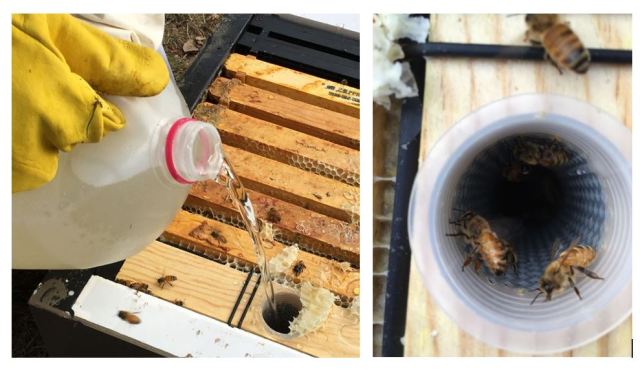
Our New Zealand packages were installed in Canada just before sunset on a Friday evening. (I described that in an earlier blog post.) Their new homes had four litres (a ‘gallon’) of sugar water, drawn combs and some foundation. I did a quick-release of the queens, opening their little cages so the queens could walk out and join their subjects. Smart beekeepers give freshly-planted packages a full week to settle before ripping the hive’s guts open, but I don’t pass as smart. I fretted that the queens might be stuck in their cages instead of monarching around on the combs, laying eggs. Worse, what if the bees are starving – unable to reach the feeders because of cool weather. So, on Day 4, I looked.

Day 4: It’s not recommended to check a package until a week has passed.
But if you do, be quick, quiet, and barefooted.

Day 4: Pointing at stored pollen. Sorry, you can’t see it from your perspective.
It’s really just one single cell with some pollen.

Day 4: The darker area, center of the comb, has eggs but no larvae.

Eggs! In both hives!  Now that’s something to report to the local radio’s noon-time farm report. The queens were laying eggs! The workers were gathering a bit of pollen.

Our Day 4 glance confirmed that the queens were alive and laying eggs and the bees were accessing feed. The bees had eaten about two pounds of sugar in their first four days. We added more syrup, then closed the hives.

We let the bees bee for a few more days, but then curiosity got me again. We opened the hives on Day 8 and here’s what we saw.  Big juicy larvae!

Day 8: Big, healthy worker larvae. The brood nest is growing!

Day 8: Suddenly, there is a surprising amount of stored pollen. On Day 4, there was almost none. Now that there are hundreds of hungry larvae (and the weather’s been mild for a few days), we see lots of pollen. I think it’s from crocus and willow flowers. Dandelions haven’t opened yet. You can see unpacked pollen pellets.

On Day 11, we saw sealed brood. Bees normally cap worker brood on the ninth, so this was on schedule, considering the queen likely started laying a day or so after release.

Day 11 for the package. Some sealed brood.

Day 11: The amount of stored pollen in the hives was amazing. In eleven days, the packages have added all this wealth to their colony – gorgeous pollen, even some sealed honey. This is as close to magic as anything I know.

We checked the bees again on Day 17. I reminded myself that every adult bee in the hives was born in New Zealand. I would guess that about one-third of the original 6,000 bees in each colony have died, from old age, by now. So, we are down to 4,000 bees, more or less. But I’ve seen both queens and they look good and are laying eggs nicely.

Bees are dying their natural death as they age, but the queens are young and should be with us a long time. I hope you can spot the queen in this picture.

The brood nests have continued to expand and the amount of sealed brood has grown a lot. I’d guess that each hive has almost two frames of sealed brood and two frames of younger brood. Deep frames hold 8,000 cells. On Day 17, it looks like brood covers over two-thirds of three frames or four frames. That means at least 16,000 workers are waiting to emerge. Considering that each hive has just 4,000 bees right now, the populations will spike upwards in the next three weeks, actually increasing four times!   (By the way, I’d also guess that the queens have been laying eggs for 16 days – that’s 1,000 eggs each day. You’ve probably heard that queens can lay over 2,000 a day. These queens have been less prolific because their colony size is small, weather was cool, and the pollen flow was light until now.)  Here’s what the inside of a hive should look like, 17 days after installing a package.

Day 17. Almost four frames of brood, each about two-thirds full.
I’d guess that there are about 16,000 brood developing.

Day 17: Four frames of brood can hold over 16,000 developing bees.

Day 21. Well, three weeks have passed. If the queens started laying eggs a day or so after the installation, the first of them might be adult worker bees emerging tomorrow. The past few days have been cool (10C, 50F) and rainy. Today is warmer and there’s some sunshine, but we won’t bother the bees until tomorrow or Sunday. If you can avoid bothering bees when it’s rainy or on the day after rain, you’ll find that they are less defensive. So we’ll wait one more day. By tomorrow, we’ll likely see a few new bees – our first Canadian-born youngsters in hives populated by immigrants.

Day 21.  It has been a bit cool and rainy the past few days. We’ll let the bees rest until we get some warmer weather, then we’ll check to see if the first new youngsters are emerging from their cells.

Posted in Bee Biology, Beekeeping | Tagged , | 8 Comments

Beekeepers becoming wary of pollination


Compared to almonds in California, blueberry pollination in British Columbia is small potatoes. But there are some similarities. Commercial beekeepers migrate long distances from cold northern prairies to the mild coast with thousands of colonies. They are paid for pollination and their bees get a boost with early pollen and mild temperatures. But beekeepers come away wondering if the hassle and stress on their bees was worth it.

Here in western Canada, several beekeepers from northern BC and Alberta have decided that the 1,200-kilometre trek to the lower mainland’s berry bushes isn’t worth it. The blueberry area near Vancouver needs at least 45,000 colonies of bees for successful pollination. The beekeepers who are rethinking the southwest migration hold about 4,000 hives. The difference – 10 percent – won’t cause a berry shortage this year. But it represents a growing concern among beekeepers that the monetary gain from hauling bees long distances isn’t compensating for the pressures and expenses involved.

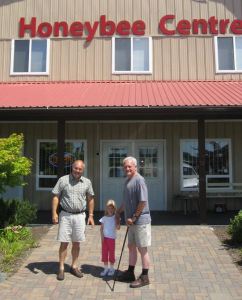
John Gibeau, left; me, right

An Alberta beekeeper – Danny Paradis – says in an interview that BC berry growers are using a new fungicide that weakened his bees, resulting in a poor summer for the colonies when they returned to Alberta after spring in BC.  But one of the biggest commercial beekeepers in the Vancouver area, John Gibeau of Honeybee Centre, disagrees. He is the country’s top blueberry-pollinator. Gibeau tells reporters that nothing has really changed in 40 years but last year was a bad-weather year, resulting in weaker hives.

I know both of these beekeepers. They are smart professional operators. Neither has an ‘axe to grind’ but they obviously have different perspectives. In the end, beekeepers will decide if the money from spring pollination balances the cost in stress, time, transportation, and effort. Blueberry rental in British Columbia’s lower mainland is relatively new. Berry farms have expanded dramatically in the past two decades. Theoretically, over half a million colonies in Saskatchewan, Alberta, and BC’s Peace River could make the thousand-kilometre migratory pollination trip. But just two percent of those ‘potential’ bees actually are taken for a ride. To me, this suggests that Canadian migratory pollination isn’t quite worth the effort – something Danny Paradis might contend.

I’m not sure what British Columbia pollination fees are this spring, but in the past beekeepers told me that they were paid as much as $130/hive.  That equals about 70 pounds of honey at recent wholesale prices. If colonies return to the prairies weak from pollination,  they can easily lose that much honey on the summer crop – and it costs money to haul bees into pollination.  (Besides, few commercial prairie beekeepers want to be on the coast and miss the local hockey and curling action. Some things are more important than money.)

Over the past fifty years, pollination fees for California almonds have gone from about $5 to $200 per hive. The colonies rented there are about twice as strong as they were in the early days of pollination, but the rental is still at least 20 times higher, per bee. But that’s still not enough to compensate beekeepers who end up with damaged colonies.

My guess is that more and more beekeepers will opt out of pollination. Meanwhile, some growers will switch to newly engineered self-pollinating crops and others will experiment with wind, mechanical pollinator-drones, or other schemes. But for the next few years, growers will offer more money – there is a huge advantage in doubling or tripling a crop by spending just a couple hundred dollars more per acre for bees. And many beekeepers will accommodate.

Posted in Commercial Beekeeping, Pesticides, Pollination | Tagged , , , , , , | 7 Comments

Mothers’ Day Honey

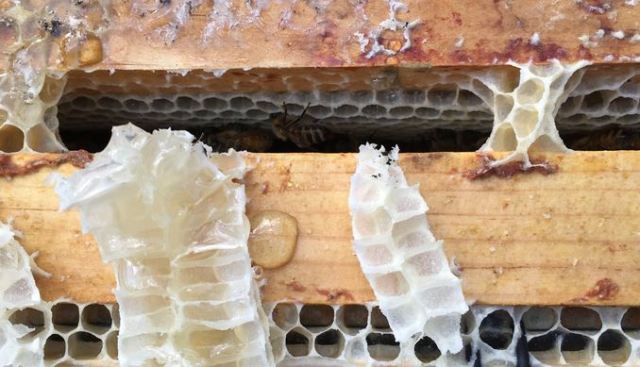
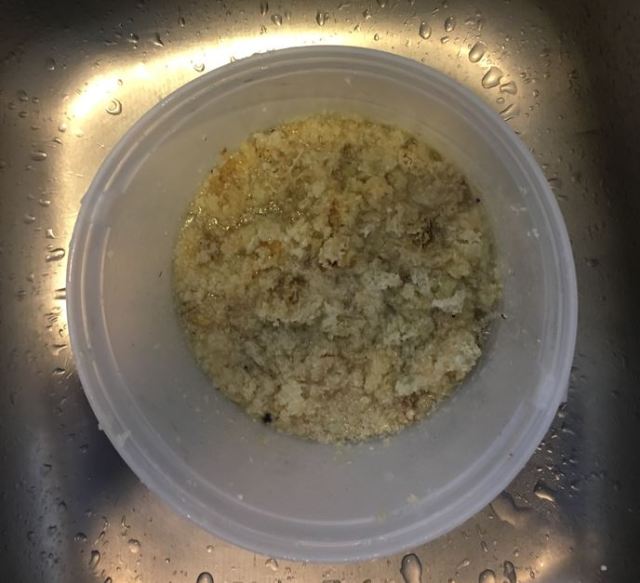
Today is Mother’s Day in North America (I think it was celebrated last week in Europe). My kids wanted to make something special for their mum. You see it in the picture above. It was pretty nice.

Save your burr comb!

We have two hives in the back yard. The weather has improved, bees have been gathering nectar and pollen, and they built a lot of burr comb because our hives have some space between the top bars and the lid (there isn’t yet a proper inner cover in place).  We had saved burr comb each time we’d worked the hives. The bits and pieces of wax had nearly filled a 4-litre (one-gallon) plastic bucket.

4-litre pail with chopped burr comb.

My daughter chopped it up and put it into the microwave where it reduced to about one-tenth its volume.  The hot mixture was pulled out every minute so the kids could stir it. The goal was to make a hot messy slurry of melted wax and honey. All of this took about five minutes.

Once melted, they dumped it, while it was hot, into a tall glass container. Wax floated to the top. The wax was poured, as a liquid, into a little bunny candle mold. The rest of the slurry was filtered through a sieve to remove bees’ knees. Next, the kids sieved the mixture into another glass container. That container, which by now was mostly honey, was plunged into ice-cold water so that the hot honey would quickly chill, preventing darkening and burning. They waited a day, skimmed debris from the the surface of the honey, and poured the remainder into the fresh clean jar you see in the pictures.  And, voilà, Happy Mothers Day!

Posted in Culture, or lack thereof, Hive Products, Honey | Tagged , , | 4 Comments

Kicked out of a farmers market

It can be hard to sell honey. Farmers markets help. Customers looking for good local produce can buy directly from farmers and beekeepers. So farmers markets are a win-win for sellers and buyers. But what if you are a beekeeper who gets kicked out of your market? Not for selling bad products. Not because the other vendors voted you out. But because you complained that some retailers are buying from food depots, coming to market, and (allegedly) misrepresenting their produce by pretending that they grew what they sold. Well, an Ontario beekeeper and few other producers were thrown out of their market by ‘the board’ because the complainers were ‘dissidents’. (Or as, the board spelled it on their anti-complainer flyers, ‘Disient Members’)

With this poorly written misspelt  propaganda, the board expected members to expel the ‘Disients’ but members didn’t.  The board responded by ignoring the vote, even though the flyer’s headline says “Choose your own outcome!”

This was on the national news here in Canada last night. A beekeeper, a berry farmer, and three others who sell at the Peterborough (Ontario) farmers market were kicked out. According to the news their ‘crime’ was that they went public with a complaint that some members of the farmers market were reselling products they were buying wholesale and allegedly misleading customers by representing the food as stuff that they grew on local farms.

If this is true, it’s pretty sad. The berry farmer and his family have been growing local produce and selling at the market for 27 years. He was expelled. The beekeeper has been packing her own honey and attending the market regularly, but she was also expelled. Allegedly, the market circulated the flyer, above, to all vendors describing the whistle-blowers as dissidents and encouraging other vendors to vote the dissidents out. That’s the way it sounds. Someone misled customers, a small group of legitimate producers called them out, but the market’s managers tossed the complainers out and kept the alleged re-sellers.  I don’t want to get this wrong, so here is what CBC reported:

The farmers market association called a vote in the winter on whether the five farmers who’d spoken out about resellers should be allowed to stay.

In a handout to members — provided to CBC by Manske — the five are described as “dissident members.” The handout warned that failure to eject them means the “campaign of malice continues.”

After the vote was held, Manske was permitted to stay. But the board later overruled that decision and sent a bailiff to each of the five farms with a letter informing the growers of their removal from the market.

Did I read that correctly? A majority of the vendors voted that the people who were defending locally grown food should be allowed to stay, even though they were portrayed as ‘dissidents’  by the market association board’s propaganda. However, the market’s board overruled the democratic decision of the members and sent the bailiff (a court officer) out to the farmers to be sure they got the message that they’d been kicked out. Sounds like a really dysfunctional organization, doesn’t it?

A lot of people go to their local market to buy local produce, thinking that they are supporting local farmers and buying food that wasn’t transported from distant commercial farms. In the case of honey, this is really important for those people who want to buy honey made by local beekeepers. These customers want local honey because it contains pollen that may fight allergies caused by local flowers.

Well, I don’t know how this will end. I don’t know if we have all the facts, but I think that the CBC would have researched this well. I know that if I lived in Peterborough, Ontario, I’d quit going to that market until the board resigned and the expelled producers were invited back. Meanwhile, if I were looking for local honey, I’d head over to the expelled beekeeper’s shop and buy directly from Astrid Manske’s OtonaBee Apiary.

Posted in Culture, or lack thereof, Honey, Strange, Odd Stuff | Tagged , , | 13 Comments