

Keeping bees on the roof is a good way to hide them from nervous neighbours.
An easy way to intimidate a new beekeeper is to read the list of requirements for a perfect apiary. Here’s my list. It’s not comprehensive. But even as a starter, it’s menacing:
Your bees should be:
In partial shade: avoid searing, scorching, blinding, bright, direct sunlight, especially in the afternoon when wax is most likely to melt, but also avoid the dark side – let the morning sun greet your hives to rouse them gently and early, Ben Franklin-style;
Facing south: when south-facing bees fly out, they have the entire top half of the globe to forage, but if you face them north, they just get polar ice caps. (I guess this is for northern-hemisphere beekeepers. If you’re a Kiwi – lucky you – just flip these instructions.);
Protected from wind: dampen your index finger, stand outside, point to the sky, and experience the wind. Arrange your hives so that they face the lee side of your finger. If the wind often switches directions, consider putting your hives on a rotating table (any discarded lazy-susan will work) and bolt a weather vane in the center so the apiary spins freely;
Near water: without actually submerging your hives, have plenty of water nearby;
On a gently-sloping hillside: this is to allow damp air to drain downhill (seriously, it says this in all the best bee manuals), but most beekeepers put their hives on a gently-sloping hillside just for the view;
Away from pesky neighbours: you might be tempted to face the hive entrances toward your meanest neighbour and then sit back to watch what happens, but this might backfire if your neighbour is careless with matches at night.
Of course there are other things to consider. Not mentioned on most lists is the comfort of the beekeeper. Let’s face it, bees are just insects and you are probably a human. Bugs can put up with mild discomfort, but why should you? Plant your bees somewhere that you’ll enjoy hanging out. If you have to struggle past thistles and thorns every time you need to scare away rabid skunks, your bees will soon be overrun by rabid skunks. Make your beekeeping afternoons a delight and you and the bees will benefit.
Most of us are stuck with what we’ve got. You might have a nice roof-top apiary, or hopefully, a back yard. It might have a slope. Or not. Maybe it gently rolls northward and gets pummeled by chill winds. Maybe it’s along the path of your city’s annual marathon, or a well-trodden horse and carriage route. You may have your sights on the perfect apiary site that’s cited in bee manuals, but probably not.
Here’s the bee spot in my own back yard. I took this picture last week. This evening my packages are flying in from New Zealand. Can you quickly spot any potential problems with my future apiary site?
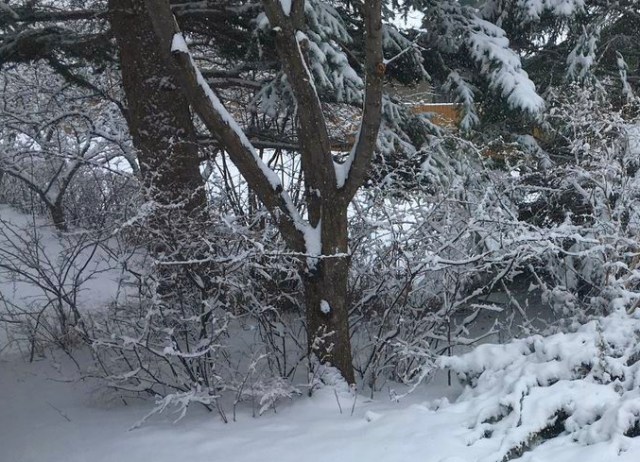
Besides the snow, which is pretty-much year-round here in Calgary, this is actually an OK bee site. The snow was a half-metre deep last weekend, but it’s melting. This spot slopes slightly southward, gets a bit of morning sun, is hidden from neighbours in our mini-forest, and best of all, it’s fairly accessible, just a hop and skip from our dog run and deck. But no bee spot is ever perfect and we have to constantly compromise. The bottom line, if there is one, is that you’ve got to work with what you’ve got – and that’s not always perfect.

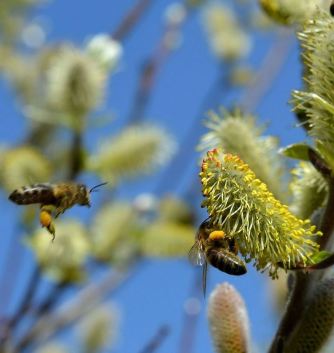 In our area, at this time of year, the pollen is mostly from crocus and willow. That’s what brightens the bare brown desolation of April in Alberta. Snow still chills the ground in icy mounds which litter our landscape, yet honey bees have found some food!
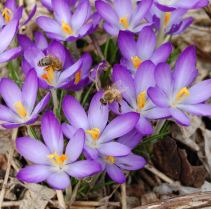 Thinking about this, the ecology seems rather puzzling. For millennia, North America had no honey bees. The continent’s native bees (bumblebees, masons, ground-nesting miners, wood-boring carpenters, hole-inhabiting leafcutters) start their season with a single, dazed queen and no workers. These bees become active later in the spring than honey bees. Our honey bees occupy nests of thousands, staying warm and active in their cluster even on cold days. In our area, they survive as a clustered, cloistered family for two hundred wintery days. When a mild spring afternoon finally arrives, hundreds of foragers race out to exploit scattered tufts of willow and rare prairie crocus blossoms. This might be a week or two before the first native bees rouse from their slumber. Honey bees have an advantage when it comes to a willow or crocus blossom. They jump it the moment it smiles.

 you see to the left. Then he spent a few hours making art and presented the result as a surprise birthday gift. As an artist, he is creative but methodical. You can see how he printed the photo in black and white, then gridded it to get the proportions. He kindly made my hair less gray but I think that he could have given me less forehead, too! You can see that he has an impressionist style, but for the forehead, he went for realism.



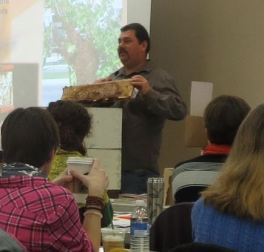 One of the panelists was
 Having three professionals on the panel, all of whom are hedging and interpreting questions differently, can be eye-opening for some new beekeepers. One of the harder things for novices to accept is that the world of beekeeping is loose and fast and everyone may be right and wrong at the same time – depending on the situation. Every question has multiple answers. Experienced beekeepers often respond with, “Well, it depends…” leaving the novice beekeeper wondering why there is no single correct answer. Although there are important “correct” concepts (“don’t kick the hive” and “bees don’t fill supers that are left in the shop”), most bee things are complicated. This is worth remembering if you are new to bees.
 Most folks I know reset their clocks last night. This is great for hobby beekeepers who race home after work to don gaudy bee suits and ignite smoker fuel, hoping to beat the setting sun. Not so fast, Beekeepster. You can slow down and still enjoy a whole extra hour of afternoon beekeeping.

 Tired of irritating your neighbours with your pesky bees? Help is on the way. A very bright professor at Oregon State,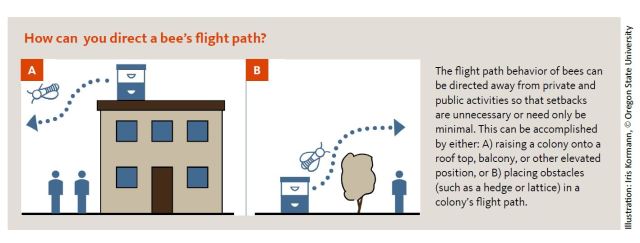






 How do you prepare to fight viruses? Rest, drink lots of fluids (chicken soup!), stay warm, and reduce stress. On a deeper level, white blood cells and the hormone interferon help you fight viruses. Similarly, honey bee colonies may shake off some viral infections if the bees are otherwise healthy, have prolific queens (the source of healthy young replacement bees), plenty of nutritious pollen, and strong populations. Spring can be a particularly vulnerable time – bee population is low, queens are aging, fresh pollen is scarce. Life-cycle stresses weaken the hive. You want strong hives. Strong colonies are more resistant to afflictions of all sorts.
 Bad Beekeeping Blog