Please Don’t Burn the Bees

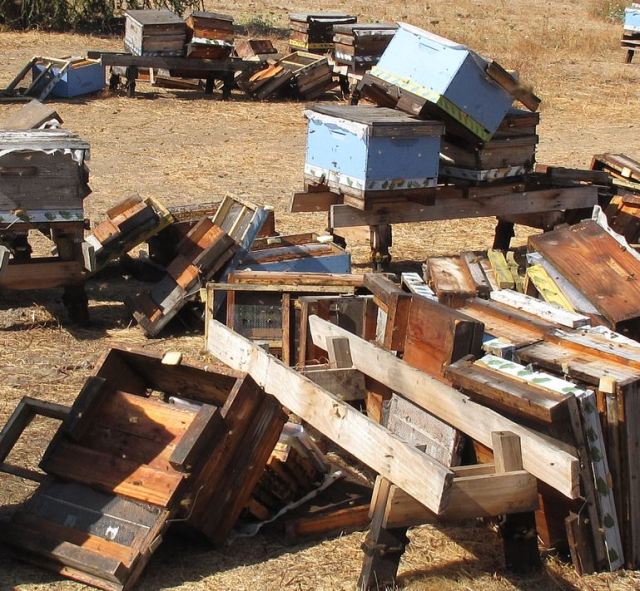
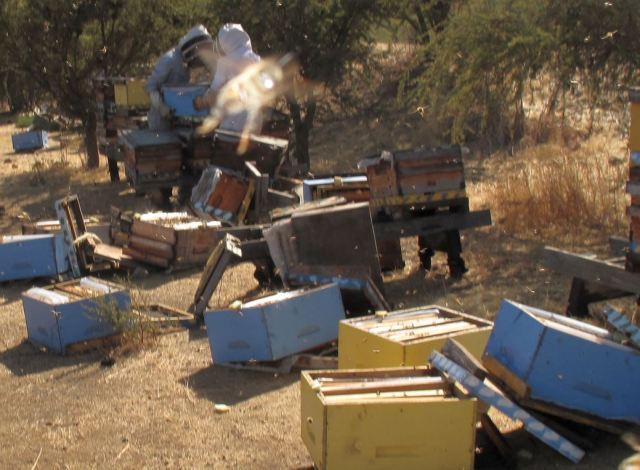
Since most people are radically pro-bee, it shocks me when I come across stories about people burning swarms to destroy them. Such arrogance. Such ignorance. Or maybe, pathetic panic is at work. There are always better options than firing your pollinators.

I’m not talking about the accidental fires started by beekeepers’ smokers. Those happen – but fortunately such fires are rare. Hot smokers, sparks, and dry grass are a dangerous combination. I’m also not talking about stories like this one, from June or this year, which may be described by police as suspicious. As the Kent (England) police tell it, 26 hives may have been incinerated in an arson that might be linked to bee thefts.

Bees aren’t the only fire-target. A couple of months ago, a Pennsylvania man burned down his house trying to smoke out possums.  (Officials say the man had issues with bees, too.) No word on how the possum family is doing. Meanwhile, here are a couple of recent stories of folks using fire to kill bees:

In Georgia, a chap set fire to a swarm that had landed on the eave of his home. What might have started out as a bad idea turned the poor fellow’s house into ashes.

Credit: Shannon Millard

Earlier this week, a Michigan gentleman tried to remove bees that had settled into his garage. It was July 4th. Patriotically, he used fireworks to do the job. The fire department couldn’t save his garage, which looks like this now.  You can see the story here.

Finally, there is this story of a Florida homeowner who melted his kids’ swing set because a swarm of honey bees landed on it. Hot photos are at the end of this link.

If you’d like to see some interesting ways of being stupid around bees, here are some instructive videos for you. The first one, called “Killing Bees with an AR-15, Gasoline, and Beer Bottles, shows how an assault rifle, gasoline, and beer bottles are used to eliminate pollinating insects when they are apparently deep in a forest and not bothering anyone.

If you’ve got the stomach for more incorrigible fire stunts, you may enjoy “Setting Bees on Fire“.  I kept thinking that the fire would spread to the dry grass nearby, giving the dude an instructive learning moment. Fortunately, though, that didn’t happen. However, it looks like the protagonist gets stung 30 seconds into the clip, so keep watching.

What should you do if a swarm lands on your house, garage, or family playground? Most readers of this blog are beekeepers. They probably already know what to do. If you’re not a beekeeper (or if you suffer from lack of common sense), call a beekeeper. They can usually collect honey bees. And they probably will not burn your house down during the rescue.

Posted in Save the Bees, Strange, Odd Stuff | Tagged , | 4 Comments

One Week with a Queenless Hive

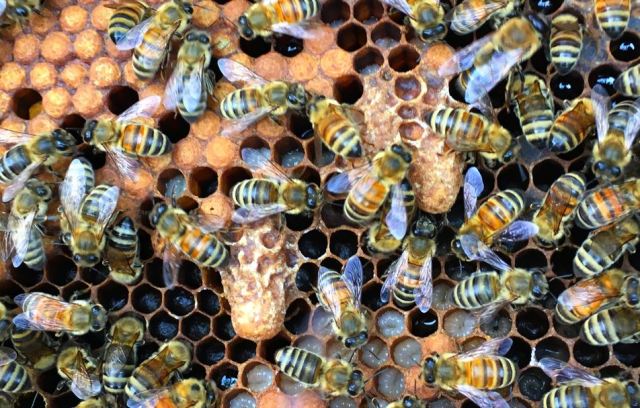
Day 6 of a queenless nuc: sealed queen cells amidst risk-taking bees.

Over a week ago, I brought a nuc into my back yard. Twelve days have passed, so there should be an emerged virgin queen inspecting the neighbourhood, looking for boys. My little nuc was intentionally built as a queenless hive. When my son (left, now a confirmed beekeeper) and I dug through the deeper chasms of the little hive, we found the cluster of queen cells captured in the image above.

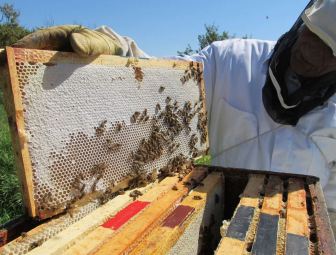
I was surprised by the fragility of this nuc’s effort to guarantee its future. Although this nuc had about 400 potential larvae of the ‘right’ age, the bees chose just three candidates, plus one suspended from bottom of the same frame. The bees could have built their new queen cells in other places among the three frames of brood and the hundreds of larvae, yet they picked this tiny number of tightly clustered incubating royals. The cells are vulnerably contiguous. They represent a tiny wager towards the entire colony’s future survival.

There is so much we don’t know about bees. Why so few cells? Evolution dictates the balance between a large number of well-fed queen cells and a risky slim number. Honey bees have survived for millions of years. Obviously, a small number is the right number. There is a cost to a hive if it raises too many of cells. Many cells require a lot of royal jelly, create a burden for the colony, reduce the number of future workers (each becomes a queen, not a foraging worker), and ultimately result in a grand battle-to-the-death for all those emerging queens. Personally, I would have directed the creation of a few dozen cells. But I’m not a bee.

When I produced and sold queens, I used to place about sixty grafted cells into a starter, transfer them to the appropriate finisher hive the next day, then take them to the field hours before the queens were expected to emerge. When I began distributing queen cells to the mating nucs, it was just one cell per hive. That’s right – just one cell per hive. I was even more frugal than my little backyard nuc!  The result? I usually had 60 to 80% of those nucs with good laying queens two weeks later. (Better queen breeders regularly get 90%, but I was a relatively bad beekeeper.) I would have improved my odds a bit if I’d put two cells in each mating box, but it takes a lot of energy to raise twice as many queen cells. The ‘missing queens’ in the nucs were not usually due to damaged or unopened cells, but due to queens getting lost on their mating flights or eaten by hovering squadrons of dragonflies. Since only one of the cells results in a mature viable virgin, multiple cells don’t reduce airborne losses.

Magpie: our local bee-eater
Photo by Connor Mah

I’m writing this a few days after I saw that little cluster of queens cells. By now, at least one of those cells has opened (the others were probably destroyed by whichever hyper-competitive queen emerged first). The victor might already be making her first flights. But I don’t know for sure. There is a chance that all the cells failed or the new queen has already disappeared into the jaws of a western magpie – many of whom already squawked their gratitude at my nuc’s arrival in their playground.  In another week, I’ll sneak a quick peek and let you know what I see.

Posted in Beekeeping, Queens | Tagged , , , | 17 Comments

Canada: More Buzzing than Ever at 150

Today is Canada’s 150 birthday,  so “it’s Canada Day, up Canada way”, as Stompin’ Tom Connors used to say. If you don’t know Stompin’ Tom, here’s your chance to rectify a serious deficiency. Connors was a great Canadian country/folk singer and song writer.  The day he died, back in 2013, my younger kids’ school day was interrupted with the principal announcing that old Stompin’ Tom had left the stage. Then the PA system let loose with Stompin’ Tom’s Hockey Song. The folk singer, who got his Stompin’ title from the way his cowboy boot kept time with his guitar, is essential Canadiana. An indelible cultural fixture. Even if you are not lucky enough to be Canadian (you can fix that), you might appreciate Connors’ Canada Day Song. So here it is:

If you’re not Canadian, but you keep bees, you might be persuaded to experience some of our famous fabulous honey crops. How would you like to make 200 pounds of water-white, smooth-as-silk honey from each of your hives every year?

If that sounds like something you’d enjoy, come on in.  (That’s a slight exaggeration. Saskatchewan, where I landed, has a 30-year average of only 186 pounds per hive.) When I immigrated to Canada in the 1970s, beekeeping as an occupation was given more points in the immigration scheme than engineering. My application wasn’t exactly rubber-stamped, but being a beekeeper helped. A lot. My interview with the Canadian consulate was pretty much over when he began by saying, “We need beekeepers.”  Is that true today? I’m not sure. But good beekeepers are always welcome almost everywhere.

What makes a good honey country? Why is Canada so good for bees? It’s not hard to explain. Perfect honey plants (alfalfa and sweet clover). extremely long days (sun’s up for 18 hours today) and great weather (sunny, warm summers) are the simple answers. Western Canada has a short and sweet honey season. But it’s intensity that counts, not a long, slow, lingering honey flow. We’ve got intensity here.

Bees arrived in Canada about 400 years ago and spread west with homesteaders. Along with cattle, sheep, horses, and hogs, bees are imported livestock. Until Europeans planted sweet clover and alfalfa as hay crops on the western prairies, honey production was small. The native wildflowers aren’t honey bee plants. Saskatchewan, for example, went from a 20-pound per hive average when bees worked only wildflowers in 1890 to nearly 200 pounds today, simply with the spread of imported bee forage.

Colony numbers across Canada grew rather slowly at first,  but then almost tripled in the past hundred years. In 1924, when Stats Canada began tracking honey production, there were just 280,000 colonies. They made 16.8 million pounds – 60 pounds per hive. At the time, Ontario led the nation in honey crops. In the early 1940s, there was a big boost in beekeeping because of sugar rationing saw during the Second World War, though many beekeepers later left for factory jobs as soon as the war ended.

By 1960, Canada’s sweet spot shifted west with the prairie provinces making twice as much honey as Ontario. Soon, new crops (such as canola) and new farmland (especially in the northern “bush” in western Canada) saw a big revival in beekeepers and honey production. Things were really blooming until the late 1980s when the federal government accidentally destroyed beekeeping in the western provinces with embargoes designed to help Ontario and Quebec beekeepers. Canada’s hive counts fell by over 200 thousand, as you can see in the graph below. However, thirty years later, as Canada turns 150, the country’s bee stocks have recovered and we now have more colonies than ever.  Also, with enormous hobbyist interest, more and more people have begun appreciating bees and living with them.

Canadian beekeeping history, just like the country’s, is largely a story of growth. It includes lots of characters with fascinating stories. Someday I’ll write a more complete history. For now, let’s celebrate 150 years as a beekeeping nation with a great future.

Posted in Culture, or lack thereof, History, Honey Plants | Tagged , , | 1 Comment

Moving the Bees

Yesterday, I wrote about nuking the bees. Today, it’s moving the bees. My nuc started out on my daughter’s farm, 130 kilometres east of my home in Calgary. That’s over an hour’s drive, out on the prairie, away from the mountains. The farm is near the Snake (as in rattlesnake) River Valley. The Snake is not much of a river, more of a valley with ephemeral spasms of moisture. It’s especially dry this year. Snake River won’t wet the underbellies of many rattlers this summer. But that’s where the farm lies, and you can see its ideal ten acres of beekeeping workshops and sheltered bee spots in the photo above.

The bees. After Justin and Erika set up my new nuc, they stapled a screen across the small round hive entrance. When I moved bees in the past, I never used screens. But a lot of people do, so they’re probably effective. My nuc has one small hole as its only entrance, the rest of the box is solidly bee-tight. Stapling a wire mesh across the entrance helps keep bees safe during a trip. In the photo, you can see the screen barrier after we partially opened it at the nuc’s new home in town. When you move a hive, bees are confused for a few days. A small entrance slows them down and forces them to realize that they are in a new place. I may keep the entrance reduced all summer (unless the weather turns really hot). A small convoluted entrance protects against wasps that sneak into small colonies and kidnap bees.

When we move big loads of bees, commercial beekeepers usually leave hive entrances open. Entrance screens aren’t typical. If it’s a really short haul (less than ten or twenty kilometres), we like to move under the cloak of twilight when it’s cool and the bees aren’t interested in flying. Thirty or forty hives are loaded in half an hour. A short drive later, we quickly set the hives off the flatbed. For long hauls, a bee net covers the load. Moving without a net is probably illegal almost everywhere, so if you’ve got a bunch of bees, buy a nice big fluorescent net.  The one shown here covers 400 double-story colonies. It cost me a few hundred dollars and weighs 100 pounds. There are cheaper and lighter ones available.  Dealers will give you details. I bought mine custom-made from A.H. Meyer in South Dakota.
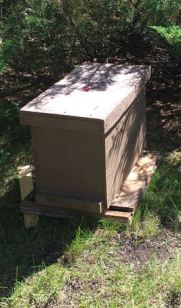
A trick.  So, here we are – 5,000 bees in a little camo nuc box. I worry about loose screens and dislodged hive lids, so here’s my trick: a large black garbage bag. Big bags perfectly encapsulate a single-story hive. I’ve stuffed dozens of colonies into such plastic bags, usually without screening or closing the hive entrance. It keeps the colony quietly in darkness, and keeps every bee inside the bag if they venture out of their box. The only caveat is a concern about heat. When I moved hives this way, it was always around 20C/70F or cooler. But when I toted this nuc on its 130-kilometre journey, I turned on the A/C in the van because it was over 27C/80F outside. I kept the van’s air conditioning set at 18C and the hive was kept shaded. Too much heat can be a killer when it comes to transporting bees.

A 66×85 cm (26×33.5 inch) 1.2 mil plastic bag perfectly swallows the nuc. The bees stay dark and bees which escape the screen (there were a few) stay inside the bag enroute to their new home, rather than crawling into the drivers’ nose. (Use an extra-large sack for bigger equipment.)  I don’t do this with hives taller than singles.

I’m not sure how much air bees need when they are sightseeing. Putting living thing into a plastic bag should make you feel queasy.  In the past, I never worried about oxygen for the bees on the big loads, not even for the colonies buried deep inside a big semi-truck load of hives, traveling for two or three days. My trip with the nuc-in-the-bag took two hours from bagging to release. There must be some oxygen requirements, but I’m not sure what they are. Recently, researcher Stefan K Hetz studied insect respiration. Here’s a piece from The American Physiological Society regarding his work:

. . . insects, which have a respiratory system built to provide quick access to a lot of oxygen, can survive for days without it.

The insect respiratory system is so efficient that resting insects stop taking in air as they release carbon dioxide, according to research by Stefan K. Hetz of Humboldt University in Berlin, Germany. This allows them to keep oxygen and carbon dioxide levels in balance. Too great a concentration of oxygen is toxic, causing oxidative damage to the insect’s tissues, just as it does in humans.

Bees consume large amounts of oxygen, and so it might be tempting to think they are panting – tiny inaudible pants. They are not, because they do not breathe through noses or mouths. Instead, insects draw in oxygen through holes in their bodies known as spiracles and pump the oxygen through a system of increasingly tiny tubes (tracheae) that deliver oxygen directly to tissues and muscles. Insects typically have a pair of spiracles for each thoracic and abdominal segment.

This system is much more efficient than the system that vertebrates evolved. Insects deliver much greater volumes of oxygen, in proportion to their size, than do mammals. They also deliver oxygen directly to the tissues, while vertebrates dissolve oxygen in blood, transport it to tissues, and then reconvert the oxygen to usable form.

“Insects are able to survive hypoxic environments,” explained Kirkton, the symposium chairman. “They can shut down and survive for hours or days. They have a low metabolic rate and can close their spiracles,” he said.

5,000 bees in a box

The bees survived two hours of bagged darkness with no audible complaints. At home, my 15-year-old was waiting for me. He off-loaded the hive. We started to peel off the bag while the nuc was still inside the parked van, but decided to leave it partly covering the box when we realized that some bees had found a way around the screen. Those strays stayed safely in the bag. We freed the nuc and the escapees, placing the hive in our yard.

Soon, the colony was quietly humming and comfortably settled.  The temporary lack of fresh air was not a problem and the van’s A/C kept the bees cool. If you are moving a single hive or two, as I did this week, consider the plastic bag.  It worked for me.

Posted in Bee Biology, Beekeeping, Commercial Beekeeping, Hives and Combs, Tools and Gadgets | Tagged , , , | 6 Comments

Nuking the Bees

Nuking some bees: shallow 3-frame queen mating nucs prepared in 9-frame boxes with dividing boards. 1 frame of brood, 1 frame of honey, 1 empty, and a queen cell. Mated queens available two weeks later.

If you’re a beekeeper, you probably already know all about nucs, the little hives from which big things are supposed to grow. If you’ve made nucs for fun or profit, then you have your own system – maybe two frames of brood, two of honey, and one for growth. Maybe you keep the nuc in the mother yard and take advantage of drift; maybe you move miles away to avoid drift. Maybe you are nuking hives for your apiary’s expansion, so you add a laying, caged queen. Or maybe you are making nucs to raise queens – you make weaker units than the ones designed for increase, and you probably insert a queen cell of your own creation.

In a minute, I’ll describe what we put into the new nuc which came to my home in Calgary a couple of days ago. But first, some etymology that entomology fans should know. The word ‘nuc’, pronounced ‘nuke’, is short for nucleus. A nucleus is the center, or core, of something bigger. Cousin words are nuclear (as in ‘nuclear family’) and nucleic (as in DNA, or deoxyribonucleic acid) – I’d argue that genetics and a core family are good things to think about when you make nucs. The nuc should hold the start of a great hive – a bee family with lineage appropriate for your area. For splitting hives, I sometimes use the action word ‘nuking’ which conjures widespread destruction – Armageddon for the hive – though it need not be quite so horrific.

The nuc which I brought home is not supposed to become a powerhouse. It was made with just two frames of brood, no queen, but plenty of honey and enough bees to keep the brood warm. (It still dips below +10C/50F here each morning.)  The box itself was designed by my son-in-law. He built a bunch of rugged 6-frame nuc boxes and painted them a rainbow of colours. From the blue, pink, yellow, white, red, and various pastel tones, I asked for something that would blend in with the shrubs and grass in my back yard. I certainly didn’t want a white hive. No sense calling attention to the box of bees in my back yard – camouflage was my choice.

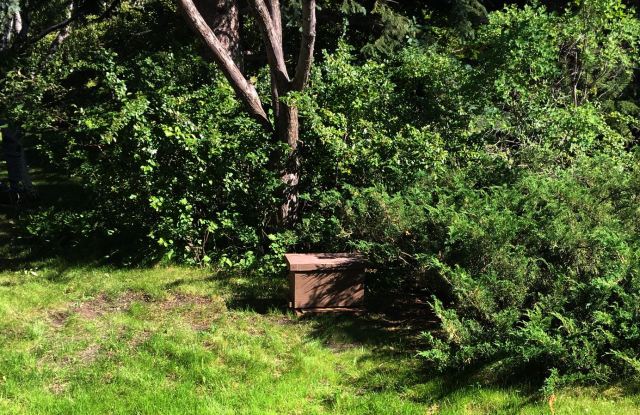
A nuc wearing camo instead of zinc-oxide white. Is this a good colour for a hive?
Is it a good colour for a tree, the bees’ natural home?

The nuc was pulled from a healthy, strong, and (most significantly), docile hive. We created it late in the afternoon so I could drive home and unload it as evening approached. How does one drive for over an hour with a hive of bees in a van? The short answer is ‘carefully’ but tomorrow I’ll post the long answer. You may be surprised with one of the tricks that I always use when I move a hive or two in a car or van. I haven’t seen the strategy described anywhere else, so maybe it’s a bad idea.

My son-in-law nuking a hive for me while my grandson spots for the queen.

Posted in Beekeeping, Hives and Combs | Tagged , , , | 6 Comments

The Bees at Times Square

New York City beekeeper Andrew Cote just captured a swarm high above Times Square. The bees were perched on a ledge and the beekeeper went to their rescue, boxing them up before they jumped to their death.  In coastal New York, swarm season is between Memorial Day (near the end of May) and the Fourth of July (near the fourth day of July).

Cote thinks that the swarm was from a nearby hotel rooftop apiary.  The free bees were on a 17th floor ledge, way up above the place where they store the big New Year’s Eve ball. This wasn’t the highest swarm he’s nabbed – that distinction goes to a swarm he collected from the 19th floor of a different Manhattan building.

Posted in Save the Bees, Strange, Odd Stuff, Swarms | Tagged , , | 1 Comment

Backstory for the Bees

Our backyard hive.

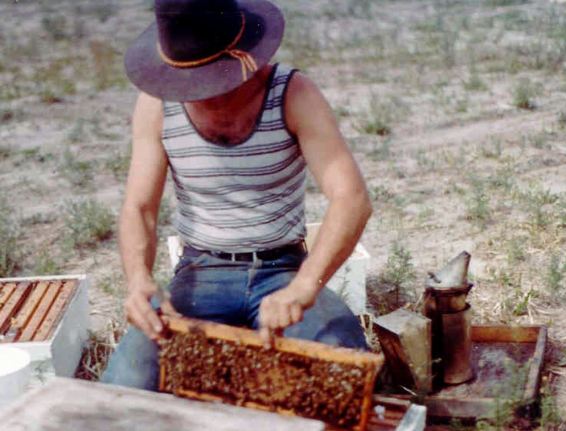
Yesterday evening, I brought a small hive of bees to my back yard. It was thrilling. That may seem odd to those of you who read this blog regularly. (Did you miss my Urban Beekeeper post?)  Surely I’ve got dozens of hives somewhere. That’s a valid assumption, considering that I write frequently for American Bee Journal, teach several beekeeping courses a year, and mentor other beekeepers around the community. But it’s true – I’ve had no hives of my own for a few years, for a variety of reasons that you’ll see in the story which follows.  Many of you have read my book, Bad Beekeeping, which describes my twenty years of commercial beekeeping in Pennsylvania, Florida and Saskatchewan, so you know how I got here. For the rest of you, here’s the Cole’s Notes summary of the book:

I was the middle kid in a big family. My parents led a self-sufficient lifestyle – building, growing, and making almost everything they needed on their 50-acre farm in the Appalachian foothills. We had cows, sheep, greenhouses, and acres of orchards, vineyards, potatoes, tomatoes, cukes, and peppers. And there were bees. My father’s original goal was to be a commercial beekeeper. He eventually reached 800 hives around 1960, when I was a pre-schooler. He couldn’t make a living from it (Pennsylvania has feeble, undependable honey flows.),  so my mother chose greenhouses and row crops as their business. She was right  – people came from as far as Pittsburgh to buy Summit Gardens’ Golden Peppers and assorted delicacies.

The bees performed a less important role on the family farm, but by then my three older brothers and I had all been thoroughly stung. David, the oldest, moved to Florida where he still operates a fine queen business. By the time I had a driver’s license, the older boys were in the army or off the farm, so I was told to care for the 300 hives that were left from my father’s previous 800. (He gave/sold the rest to the older boys.) I made a lot of mistakes, but had some modest success. I was learning a lot. At 18, already with a few years of commercial bee experience, I left home to beekeep in Florida (learning from my brother David) in the winter and Wisconsin (learning from my brother Don) in the summer. Along with producing queens and orange blossom honey in Florida and clover honey in Wisconsin, my bees pollinated West Virginia apples. A couple years later, I met a guy selling hives in Saskatchewan. No money down. I was on my way.

Production in Pennsylvania had been 50 pounds per hive. In Florida, it was about 60 (plus queens to sell), while in Wisconsin my bees averaged 100 pounds per hive. But western Canada was known for amazing crops of water-white honey. Beekeepers were making 200 pounds per hive, so I joined them. That was the best decision of my life. I arrived in Canada in the 1970s and ran a thousand hives for over ten years. My base was a cowboy town near the Montana border. During my first four years, I averaged a little over 300 pounds per hive and paid off the entire farm. Then the area had a drought. No rain for 14 months. Crops died. My honey average was 14 pounds in 1985. I drained my savings, then sold the business. I kept 300 hives and placed them near Saskatoon, where (at age 33, in 1987) I started university. Four years later, I had an honours degree in geophysics – and several job offers in Calgary. So, I drove eight hours west and started a new life. Again.

Earth science had always interested me (volcanoes, earthquakes, gravity and magnetism, rocks, fossils – what’s not to like?) but I found myself doing the less interesting work of analyzing seismic signals. Lots of math and physics. Not so much fun and fresh air. So I bought 5 hives and put them on a friend’s quarter-section. It got me out of town and I soon split them to 15. Things were going well, but in a few years, I noticed some muscle weakness. I was tripping and falling. The diagnosis was ‘probably ALS, Lou Gehrig’s disease‘. That usually causes complete paralysis within three years, followed by death. But my progression has been strangely slow. My ‘atypical ALS’ began 20 years ago, yet I still do most of the things I need to do. You never know about such things – you just have to see how it goes.

A little over ten years ago, I invited one of my older brothers to Calgary to operate a new honey farm which I wanted to build. I bought ten acres and we soon had 500 hives. It was entirely devoted to comb honey production – a beautiful product with much less heavy lifting and much more cash per hive. That seemed the right move at the time as we were in our 50s and my muscles were slowly becoming weak. But after seven years, my brother moved on, going back to the States with his wife so they could be closer to their grandchildren. Meanwhile, my illness was progressing, so I couldn’t move bees or pull honey. Besides, I was still consulting  in geophysics. My oldest daughter and her husband, both nearing 30, were interested in running the farm. So, I handed them the keys.  It hasn’t been easy for them. But they both have some of the skills that help beekeepers succeed. Erika is good at marketing and works in the shop (and sometimes in the bees) while Justin is great with woodworking and was a furnace-repair guy, so he knows mechanical things and is learning beekeeping. But it’s been a slow start for them.

That brings us to yesterday, when I visited my daughter, her husband, and their three little kids. Justin set up a queenless nuc for me. He had built some really nice nuc boxes and gave me two frames of brood (about half in pearl-stage) along with four frames of honey, pollen, and attached bees. We didn’t shake any extra bees into the nuc and we made sure that we found the queen and left her behind. I wanted a moderately weak hive which would have to raise a queen.

My goal (this year) is not to have a huge hive, but instead to intentionally keep the colony weak through occasional queenlessness and regular use of foundation. I just want to easily observe some honey bees. (I can see them from the deck while I’m writing these words!)  As a bonus, my two younger kids (ages 10 and 15) seem more excited about the bees than I am. They’re curious about nature and bugs and things.  I like that the hive also gives them a special family connection to something stretching back a century and across a continent, yet sitting in a small box in our back yard.

Finally, here’s a picture I took yesterday of my son-in-law preparing my nuc. He’s being helped by his kids (my grandkids). Over the next few days, I’ll describe how the nuc was made, transported 130 kilometres in my van, and hauled into the back yard. Oh, and I’ll need to name the hive, too. Any suggestions?

Posted in Beekeeping, Books, Commercial Beekeeping, History | Tagged , | 8 Comments

Keeping the Cougars out of your Bee Yard

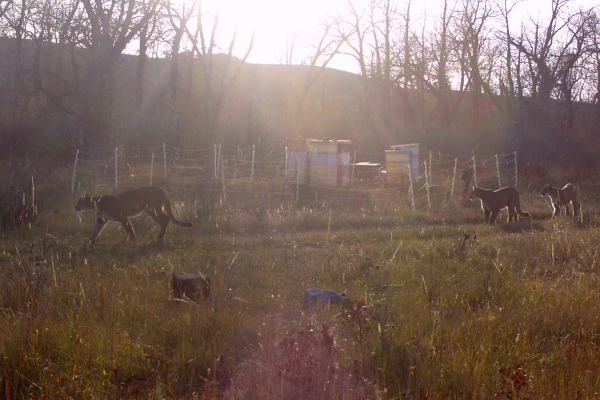
Mountain Lions, October, 2013 (photo by permission Liz Goldie, Calgary)

Ever been chased by a mountain lion? How about a cougar, panther, or puma? Me neither, but I’ve probably passed within metres of all four. (I’m told that they’re all the same speciesPuma concolor.) A new study from U of C Santa Cruz looked at the timidity of these big cats. Investigators found that cougars are particularly flighty at the sound of human voices. According to the research scientists,  the cats run most quickly when they hear the recorded banter of political pundits. They are especially nervous when exposed to Glenn Beck, Rush Limbaugh, or Rachel Maddow.

The experiment went something like what you see in the video below. Mountain lions were lured to a fresh carcass, then treated to the unexpected sound of frogs. The pumas kept eating. But when the soundtrack switched to noisy political know-it-alls, the cats fled – as should we all. The experiment was repeated again and again with the same results. This made me think of bears and bee yards.

It can be really, really hard to keep grizzlies and black bears out of bee yards. We once had a grizzly dig under a chain link fence to get into one of our apiaries. With the cheap cost and high reliability of electronics these days, I wonder if bears can be sent scrambling the same way that pumas retreat. Probably not. My brother chased a 7-foot-tall bear out of a bee yard by yelling at it, but the bear ambled slowly, then turned and stood, seeming to laugh at my brother as Don stood there, thinking that the hivetool in his hand wouldn’t be much of a defense if the bear suddenly charged.

I suspect that some non-fence systems might be as good as a string of electrified wires because bears sometimes make a hair-raising charge through the voltage. A north-Saskatchewan beekeeper told me that he regularly filled bottles with beer which he had cycled through his own body, placing urine-imbibed canisters around his bee yards. He claimed that after ‘marking his territory’, bears kept out. (That’s your beekeeping tip of the day.) Compared to the sound of Rush Limbaugh, it’s likely a less effective anti-bear ‘solution’. I have no reason to doubt the beekeeper, though I never tried it. Maybe someone can test this and let us all know if it works.

Grizzly at the bee yard, October, 2013 (photo by permission Liz Goldie, Calgary)

My friend Liz Goldie set up a Primos Truth Cam 46 at her farm south of Calgary and caught animals in these pictures. (By the way, the bear (above) eventually entered her apiary, ripping apart the electrified fence and some hives.)  Perhaps the trigger mechanism from the motion-sensitive camera which took the cougar and grizzly photos on today’s blog could be adapted to photograph the critters, then scare them away with a blast of pundit. Works for me.

Posted in Bee Yards, Beekeeping, Diseases and Pests, Strange, Odd Stuff | Tagged , , | 5 Comments

National Pollinator Week: Shrews and Mongooses, too.

Bombus Georgius Vilhelmus (photo credit: EHS Pest Services)

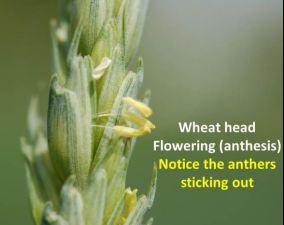
National Pollinator Week is June 19 – June 25, but summer is an odd time of year to celebrate pollinators. The big honey bee migration to California’s almonds ended in March. Bees, birds, bats, and butterflies have finished their work on spring fruit trees. Sure, zucchini buds beckon, but even Dipteran pollinators (flies) slacken visits to entomophilous flowers. Now that summer is happening, our biggest pollinator is unseen (the wind!), but it’s as busy as a bee, blowing pollen from wheat flower to flower – doing its job without much notice. (Did you know that more than two-thirds of the food we eat is pollinated by wind or gravity?)

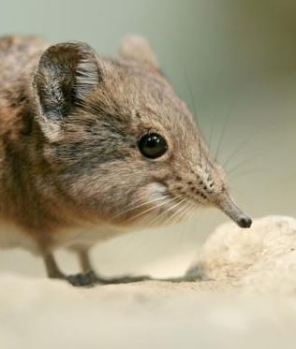
The elephant shrew, practicing on sugar before moving on to nectar.

Among the more unusual/ignored pollinators are bats, toads, and mongooses (mongeese?). The BBC has a fun page that talks about mongoslings which transport pollen while snacking on nectar (to wash the taste of cobra from their mouths, I suppose). BBC also mentions the elephant shrew which uses its elephant nose to probe flowers for pollen and nectar, spreading goodies from blossom to blossom. (Incidentally, this mouse-sized creature is genetically closer to elephants than shrews – as you can see from its face.)

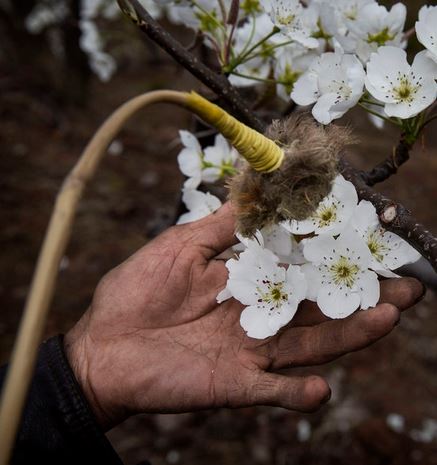
In China, some farmers carry little brushes into orchards, dusting pollen on pear and apple blossoms. In areas bordering Tibet, apple crops must be hand-pollinated by humans. These are areas so remote and rugged that it’s not possible to haul in native eastern honey bees (or any other non-human pollinators). Although wind and gravity may do some apple pollination work, Wired magazine credits local farmers with doing “100% of the pollination” – depending on variety and need for cross-pollination, that might be true. Both Wired (Will We Still have Fruit if Bees Die Off?) and Huffington Post (Startling Effect of Shrinking Bee Populations) claim that the impending extinction of bees has caused humans to hand pollinate. They are wrong. Read their articles and see for yourself.

Dusting pollen on pears in China. (Credit: HuffPost)

So, National Pollinator Week has a wide variety of pollinators to celebrate: Birds, bats, toads, butterflies, shrews, humans, gravity, and wind. We, of course, want to give due credit to bees. After all, they help pollinate our gluten-free favourites: squash and blueberries. (Not to mention apples, almonds, rambutan, mangos, kidney beans, canola, and kiwis. And a few dozen more.)

Yesterday, a friend asked me what she could do to encourage pollination in her garden. I fumbled for an answer. Do you buy a hive of bees, bring in leaf cutters, masons, bumble bees, or elephant shrews? Or do you plant flowers that will attract bees, shrews, and maybe humans to your backyard? If it’s bees you are after, you might like to look at this website: http://www.pollinator.org/guides. You’ll find excellent (really excellent) guidebooks that will help you decide what to plant to attract bees and butterflies to your own garden. Though, alas, no mention of attracting shrews, mongooses, or humans. You’re on your own with those.

Posted in Culture, or lack thereof, Honey Plants, Humour, Pollination, Save the Bees, Strange, Odd Stuff | Tagged , , , | 3 Comments

Urban Beekeeping Mug

Yesterday, Father’s Day, my family surprised me with this homemade mug. They had conspired to co-create this bit of art for the past few days. I heard the hushed tones and I saw people and things quickly disappear when I approached. My new coffee mug says “Urban Beekeeper”.  My first thought when I saw it was that the coffee cup is really sweet and cute and thoughtful.  Then I remembered John Travolta, the Urban Cowboy, and his 1980 movie. These days we have urban lumberjacks (who cut and prune city trees) and urban farmers (backlot gardeners but also landscapers and groundskeepers), so why not the urban beekeeper? An Urban Cowboy is less easy to imagine – even if the cowboy is just maintaining mechanical bulls and riding them for trophy money, as happened in the movie. Though I live in Calgary, the home of the great Calgary Stampede and the heart of Canadian cowboy culture, I couldn’t tell you if my city has even a single mechanical bull. I’ve never seen one here. Maybe they all died out in the 1980s.  Mechanical bulls may be rare, but urban bees are not.

So, shall I be an Urban Beekeeper? I’ve gone without doing much beekeeping for the past little while, just helping friends and neighbours with their own colonies. But my wife and kids are encouraging me to move a hive into our backyard, hence the coffee mug. But an urban beekeeper?  I used to be an entirely rural person – born a farm boy, I’ve owned swampland in Florida and some aspen forest in northern Saskatchewan. For quite a few years, my home was perched at the edge of a sea of grasslands on the prairie. On all of those places, I’d kept hundreds of hives.  But now I’m in a city with a million neighbours, so the moniker and a single colony is appropriate.

Calgary, with some potential bee yards

I never thought the phenom of urban beekeeping would explode as it has. It conveys the welcome message that people (even in towns of more than a million) want to connect with nature. Urban beekeepers usually encourage their hometowns to provide more greenspace, more parks, more nectar-rich flowers, and less poison  – helping their own hive or two, but especially encouraging wild native bees. Today, there are more urban beekeepers keeping bees in our huge agricultural province (Alberta) than there are commercial beekeepers. Many of these folks are conscientious keepers and are supporting apiculture in a big way.

When I get around to setting up my backyard hive, the bees will have to share their spot with rabbits, coyotes, and deer which sometimes wander through here. The hive will sit almost exactly were this fawn is in the picture below. It’s sheltered from wind, sloping, and south-facing. In our area, bees in town make less honey than those out on the range. But that’s OK with me –  massive honey production is no longer my goal. I’ll be satisfied with two or three hundred pounds from a single backyard hive every year. My biggest bonus will be the short ten-metre commute for me when I visit my urban beefriends.

Posted in Bee Yards, Beekeeping | Tagged , | 9 Comments