Does the Truth Matter?

I’m back in Canada after a week in Europe. It’s cooler here (21C today) than Hungary’s 39C. It’s been much too dry on the western Canadian prairies – that’s probably going to hurt the honey crop and maybe even the millions of acres of wheat, lentils, and canola in our area. It’s already August, so perhaps grains will fill out as they should, but beekeepers who were hoping for a late season nectar flow might be disappointed.

Things like temperatures and inches of rain are clearly factual while the effects of heat and drought on crops are conjecture. Everyone understands that. There is (for most of us) an ability to differentiate fact from fiction or speculation. But lately, we’ve seen a lot of misrepresentations posing as reality. It’s getting tedious. I’m not going to write about politics, alternative facts, or the pervasive misleading news which is numbing and dumbing us. I’ll stick to something I know – truth and exaggeration in beekeeping.

The idea of writing about beekeeping’s little white lies came to me when I was heading home from Hungary. The trigger was a newspaper story I had read in Europe. As I’ve noted in my previous posts about last week’s trip abroad, bees are taken very seriously in central Europe. So, you can expect to see newspaper filler pieces (like the one below) about the goodness of honey. The headline, “A méz időtlen“, means that honey is timeless and within the article (where I’ve circled) we’re told that honey was found in a 3,300 year-old Egyptian tomb and it is “tökéletes állapotban” – in perfect condition. Perfect nonsense.

A ridiculous meme, but its heart is in the right place.  (BTW – “they still tasted delicious” might refer to the archaeologists, not the honey.)

If you’ve been keeping bees for awhile, you probably heard this before: Archeologists break into an Egyptian tomb, find some honey pots and “the honey is as good as new”. That’s only true if the honey was black, thick as tar, and inedible when it was new. Tar-like and inedible is what the archeologists discovered. After 3,300 years, honey will no longer look or taste like honey. Lab analysis of the samples found in the tomb shows high sugar content and pollen grains from nectar-producing plants, so the gooey stuff was called “honey”.  A few years ago, I sent notes to websites where I saw the Egyptian tomb story and asked if they could provide sources. Only the National Honey Board and one blogger wrote back to me saying that they didn’t have the original reference. The NHB has since removed the anecdote.  (Some of the mummy tale comes from Howard Carter who opened King Tut’s tomb in 1922. He described an 8-inch-tall ceramic container that he thought had a residue of honey along the bottom. In that case, it turned out to be castor oil.)

[Update, March 2019: The blog Vitamina Bee has a long post on this subject. It’s worth a read.]

Dirty honey. Egyptian pharaohs aren’t the only source of dubious honey claims. I once toured a beekeeper’s shop in Florida which was, well, pretty messy. The fellow who owned it knew that I was uncomfortable when I turned down a chance to taste some awful smelling stuff from a big tank. It looked like honey, but… “Hell, Ron, what’re’ya worried about? Germs can’t live in honey.” Perhaps not. But lots of nasty stuff can fall into an open honey tank. The idea that “germs can’t live in honey” has some truth – honey is an incredibly good antiseptic. But that’s no excuse for a sloppy honey shop. Acids, hydrogen peroxide, and osmosis may kill most germs in honey. We might use this fact to promote the goodness of honey, but claiming miracles is best left to the folks working at Lourdes.

If we exaggerate the wonders of honey, we’re not doing ourselves any favours. If we stretch the truth to excuse a dirty shop, we are hurting everyone. You’ll sell more honey by keeping it wholesome and by singing its advantages over processed sugar than you will by advertising it as a panacea (or as a multi-spectrum cure-all for dementia, cancer, and dry, itchy, red-patch dandruff).

More untruths. Einstein, the poor chap who wasted thirty years of his life fighting quantum physics and trying to discover a Grand Unifying Theory of the Universe is better known today for  saying, “If bees disappear, man will survive for only four years.” He never said it.  He never said it. In all his millions of written and recorded words, bees simply never came up.

Although Albert Einstein wasn’t known to claim that human extinction would follow the collapse of honey bees, his fake quote has been useful for anyone raising money on the theme of impending extinction of the honey bee – another fallacy. This one’s a whopper. There are now billions more honey bees in the world than there were 50 years ago. The world has never had more honey bees, ever, in its entire history. Honey bees are not going extinct. This doesn’t mean that all is well in the Garden of Beedom. Pollution, climate change, pesticides, and monoculture have made beekeeping harder than ever. And the gentle bumble bee really is endangered in some areas. But honey bees? As long as they have growing economic value as pollinators and honey producers, their numbers will keep expanding.

The truth – does it matter? Exaggeration gets attention. Maybe it’s for a good cause. So what’s wrong with lying? If you honour veracity over fallacy, truthing means something to you. Credibility is valuable. There is no reason to stretch the truth with honey bees. The truth about bees and honey is fascinating enough without fabrications: Honey can be stored (without refrigeration, preservatives, or vacuum-packing) for years. Honey acts as a powerful antiseptic and is a good healthy food. Similarly, although honey bees are not going extinct, we can still vigilantly defend the environment and draw attention to those creatures which really are disappearing. But “cry wolf” without cause, as the little shepherd boy discovered, and people will eventually ignore you. Speak the truth without embellishments, and smart people will pay attention.

Posted in Culture, or lack thereof, History, Honey, Outreach, Save the Bees | Tagged , , , , | 14 Comments

When Bees Become Culture

I’m in the central European country of Hungary for a few days. It’s a family visit with no work or particular sightseeing goals. But honey bee culture is everywhere. Perhaps only Utah (“The Beehive State”) and the little alpine nation of Slovenia are more closely tied to a beekeeping heritage.

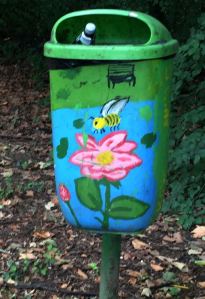
You can catch glimpses of the bee everywhere. Here’s a litter box, anonymously enhanced by a creative graffiti artist. I saw this in the Liszt Ferencz Walking Park – named for the musical genius Franz Liszt, composer of Hungarian Rhapsody Number 2, a piece which you know, but perhaps not by name.

I wonder who the waste can artist was. Other dispensers in the park were more profanely annotated than this one. Was this artwork added under cover of twilight, or was there a cheering entourage of fine arts and beekeeping enthusiasts on hand, encouraging the itinerant painter? I shall never know.

Meanwhile, a stop at our favourite ice cream cafe on a city centre plaza shows us another cultural permutation of the Hungarian honey bee – this time a culinary treat. At perhaps 2,000 calories per plate, the 690 Ft ($3.50) Maja the Bee ice cream dish is a delightful indulgence. It’s creative and tasty – I saw one of these icy bees being consumed at an alarming pace at nearby table.

If you look for the honey bee in central Europe – a place with  2,000 years of beekeeping history – you’ll see lots of examples of the winged symbol of hard work and prosperity – frescoes, statuettes carved into buildings, murals. With 0ver 15,000 beekeepers out of a population of fewer than ten million folks, one in 600 people keeps bees. That makes it ten times more likely that you’ll bump into a beekeeper on the street here than in the USA.

A Hungarian honey shop

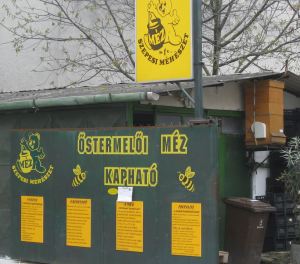
Honey shops abound. Szeged, the city of 200,000 in which I holidayed, has at least three honey stores. These are small shops, perhaps 500 square feet, on less expensive side-streets, with doors opening directly to the sidewalk. People walk in – sometimes with empty buckets in hand – and chose from ‘Mixed’ or ‘Milkweed’ or ‘Acacia’ (black locust) or other floral honeys. Customers might also pick up pollen, wax, or candles. In one shop, I was told that all the products were produced by the store-owner’s beekeeping family. Because beekeepers tend to be small-scale commercial (300-hive) operations and climate and floral distribution yields modest crops (40 to 60 pounds per year), direct marketing gives the family an edge. I wrote a bit about this for the American Bee Journal a few years ago – here’s a copy of that article (Monks, Doctors, and Little Old Ladies: The Beekeepers of Hungary) for you.

Posted in Culture, or lack thereof, Honey | Tagged , , , , , , | 4 Comments

Better Bees

Hungary, where I am today, has a long beekeeping history. Honey bees have been part of the ecology for thousands of years. Here, they are indigenous species whereas in the Americas (and Australia, New Zealand, and much of Asia), the European honey bee has immigrated to help with farm chores.  Before 1535, there were no honey bees in North America. On the other hand, Europeans have kept bees in the Old World for thousands of years. 

In Europe, bees are an ancient and integral part of the environment and culture. Although honey bees are native, regional honey bees have local advocates. This brings the idea of indigenous bees to a more specialized level. When I was in Ireland, I toured the Galtee queen breeding project – an earnest effort to replace the green isle’s Italian and mixed bee stock with indigenous ‘dark bees’ – Apis mellifera mellifera. The thought is that the European dark bee evolved to match the sometimes gloomy Irish climate and is best adapted to the locale. Within the indigenous gene pool, selection is made to reduce aggression and increase honey production.  To your left is a photo which I took in Ireland.  That’s a styro-insulated mating nuc. You can see that the bees are indeed ‘dark’.

Searching in veins for a perfect bee.

I’ve seen similar work in Central Europe where the Carniolan race (Apis mellifera carnica) has been recognized as local and superior. Near Budapest, I once toured a lab where technicians sat at stereo microscopes, counting veins on bee wings to determine racial origin of each specimen. I was told that by law, only Carniolans are permitted as bee stock in Hungary. If the specimen bee had the wrong number of veins, the technician told her manager who arranged a field visit to the errant apiary.  I’m not sure if other races were eradicated or if the purity project was dropped, but that’s what I was told by the lab director years ago.

Carniolans are definitely nice bees. They winter well and are notoriously docile. If one wishes to promote a ‘local’ bee then it’s great to have such a fine bug to endorse. Folk legend and citizen scientists tell us that this bee is gentle because for 3,000 years people kept the ancestors of today’s Carniolans next to their doorways and gardens. Aggressive bees weren’t tolerated. Mean colonies were regularly eliminated, affecting the genes of the bees in a way which most farmers would appreciate. 

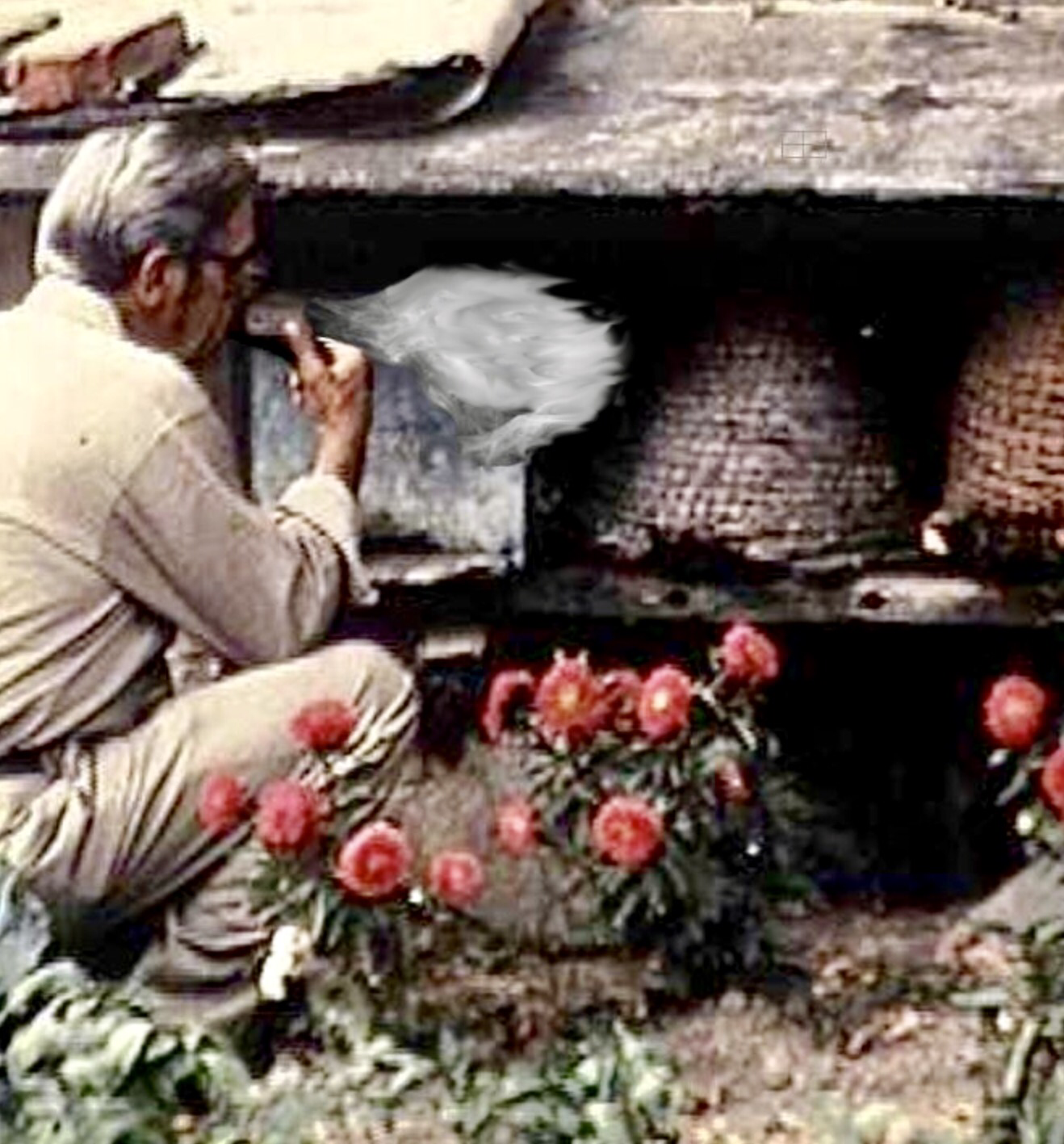
I’ll post more observations from my short holiday in this lovely land of honey bees in a few days. Meanwhile, here’s a picture of my father poking around some Carniolans in the 1980s. I think it would be hard to find hives like these around here anymore. His smoker was his pipe. Did I mention that these are among the gentlest honey bees in the world?

Posted in Bee Biology, Climate, Culture, or lack thereof, Ecology, Genetics, Science | Tagged , , , , , | 2 Comments

A Quick Note from Abroad

Did you spot the honey bee? Today, I’m in a lovely part of Europe. The weather is great – sunny and warm – but the main nectar flows (acacia/locust and rape/canola) are over. I saw a few bees working in a city park, but they weren’t collecting much.

Want to be a better beekeeper and have a lot of fun in the process? Try exploring new scenery. When I was rather young, I worked for about a dozen beekeeepers – in Pennsylvania, Wyoming, Saskatchewan, Florida, Montana, Wisconsin. Even though I grew up on a bee farm, working for others was an eye-opener. Learning how others adapted to their environments gave me ideas which I later borrowed. It surprised me that not every honey crop came from goldenrod, boneset, and aster in the fall and it was enlightening to see that bees could be kept in something other than single deeps with shallows as honey supers. The rest of the world, I discovered, was not Appalachian Pennsylvania.

I know that the old adage, “All beekeeping is local,” is broadly true. But it’s also true that “If you stop learning, you start dying.” Local is important, but fresh ideas are, too. Although Reverend Langstroth invented his moveable-frame hive in Philadelphia, I’ve seen equipment modelled on Langstroth boxes in South America, Asia, and Europe. Good ideas are portable.

I’ve been in Europe for the past few days. It’s just a quick trip, a change of scenery, a visit to extended family. This is not a beekeeping holiday.  Most years that I’ve been here, I’ve met beekeepers and bees. It might still happen, though it’s not planned. But even without seeing many bees, a change of culture, language, and climate is like hitting a reset button. 

I’m in Hungary. Our base is a lovely university city (Szeged), about two hours south of Budapest. The city is just a few kilometres from Romania and Serbia, so it is a bit of an international crossroads, down here in Hungary’s far south.  It is the hottest and sunniest place in the country. Agriculture is a big part of the economy and paprika is a well-known commodity. In fact, a Nobel Prize was awarded to a scientist at the university here when he took a mountain of local peppers and distilled Vitamin C from them – combining the best of agriculture and scientific research in one big project. When Albert Szent-Gyorgyi finished his distillation, it was the first time anyone had ever seen a vitamin!

Within this innovative agriculture, beekeeping is a star. The country has just ten million people, but over 15,000 are beekeepers.  That’s a lot more than there are in Canada. There are also a lot of colonies – over a million. That’s just under half the number as in the entire USA – yet Hungary is a much smaller country. As a result, Hungary has the greatest density of honey bees in all of Europe – perhaps in the world. There are more than 10 hives for each square kilometre (250 acres)!

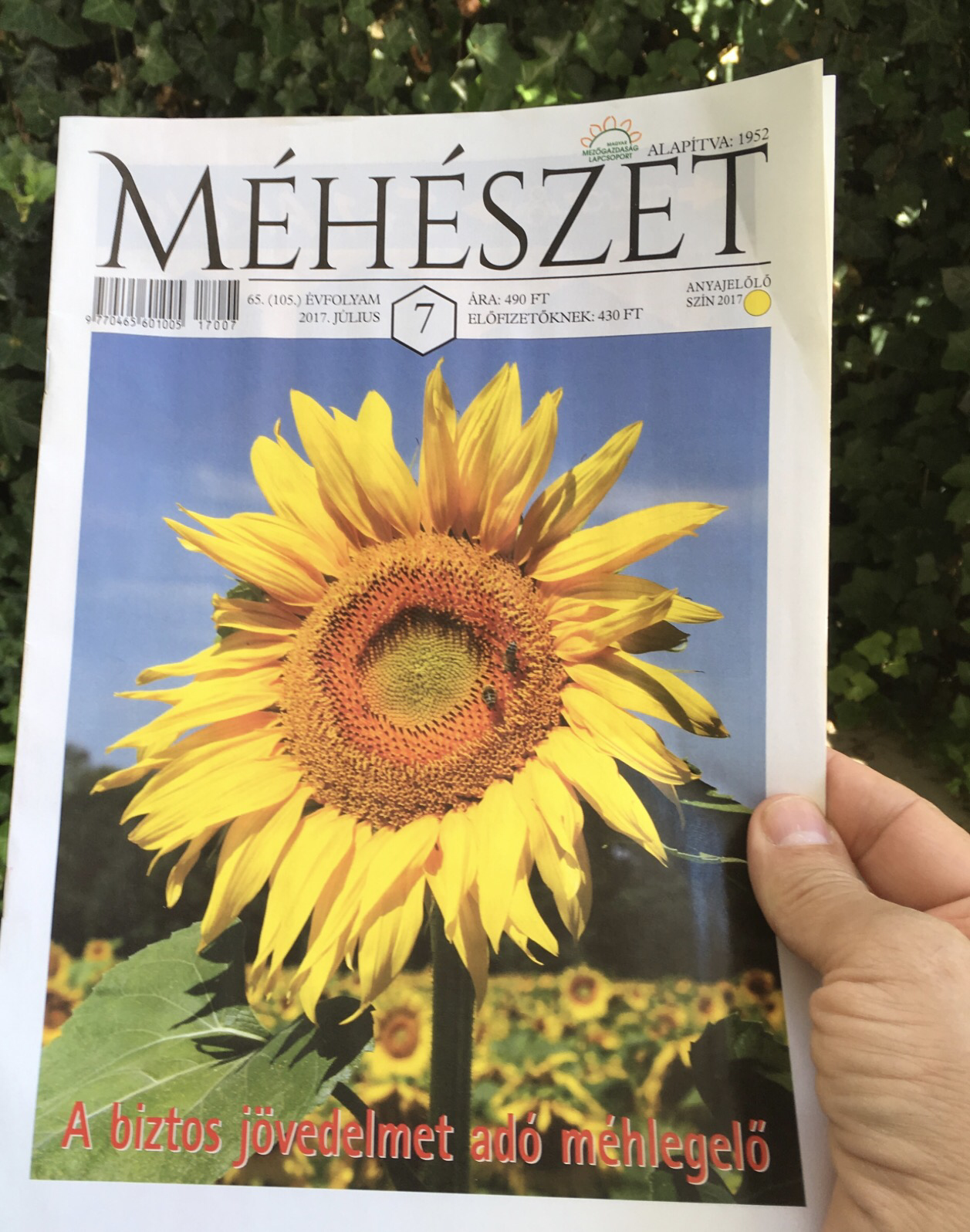
Each beekeeper has an average of 70 hives. There are few really big operators, but thousands are running a few hundred colonies and earning modest livings as beekeepers. Bees are a big deal here. It wasn’t hard to find a bee magazine at the local newsstand, occupying a slot next to national newspapers and international news magazines.

The articles in the bee journal which you see in my photo are depressingly similar to what you can read every day, in any beekeeping magazine. Mites, nosema, pesticides, short crops, low prices – these are universal beekeeping realities. 

Balanced among the despair in the journal are a few encouraging stories – this month’s issue includes a feature about the Horvath family, their 150-250 hives (the number depends on how many splits are made in the spring and how many hives are sold), and their three young kids who help with the family business. As one reads their story (a struggle, but a success), it’s easy to have a touch of nostalgia for the days when commercial beekeeping was at this scale.  Granted, this is really hard beekeeping – but it’s a family project.  

The Horvaths apparently don’t move bees between black locust (acacia), sunflowers, canola, milkweed, and fall flowers. But many Hungarian beekeepers migrate within the country to try to catch something from the relatively small and unreliable nectar flows which cumulatively yield about 60 pounds per hive per year.  It’s barely viable economically. For many Central European beekeepers, the various paths to success include unpaid family help and direct sales to customers. This is the thing I learn each time I talk to beekeepers here.  They have an expression that translates “Success at beekeeping comes only when the whole family works together.”  Such prerequisites for success are not limited to beekeeping, of course, but there aren’t many examples as good. 

A family beekeeping story: universal truths.

Posted in Culture, or lack thereof | Tagged | 7 Comments

Are You Giving It Away?

Creamed honey from the beekeepers’ co-op. Price per pound: CAN $9.00 (US $7.25)

A few days ago, I was shopping at our local co-op grocery store. As usual, I checked the price of honey. I like to use their prices as a minimum guide for honey produced by hobby beekeepers. Here in Calgary, beekeepers are beginning to extract. We make nice, mild, white honey. It’s beautiful stuff. But some of my friends give their honey away. Others price it so low that you’d think they’re not proud of what their bees have done.

So, here’s my annual admonition. Charge a lot of money for your honey. People will assume that it’s worth it. And it probably is. Certainly, it must be worth more than the stuff on the grocery shelf. Here are the prices worked out per pound for you:

Remember, this inventory was taken at just one store, on one day. Sales come and go; prices vary. But if you are cheaper than the cheapest honey at the local grocery, maybe you’re giving it away.

Gramma Bee’s was the cheapest honey at the store. It’s officially Canada #3 honey. To be #1, it has to meet a few standards (colour and moisture) which this honey likely met. But it’s ‘Never Heated, Never Filtered’ and “RAW”. Your honey, dripping from the extractor tonight, is probably similar. This honey is selling for $6.80/pound ($5.44 US).

This honey is called “McKenzie Natural White Honey”. There is no ‘McKenzie, except that the name is perhaps the most quintessential Canadian of all names.
I’ve tried this brand, it’s really good. It’s packed by some good folks in central Alberta. In the store at $8.16 per pound. ($6.53 US)

Billy Bee (now owned by McCormick foods) has promised to only retail 100% Canadian honey. Hooray for that. I once bought this brand just for the squeeze-bee. Sells here for $8.33/pound. ($7.00US)

On the top shelf, out of reach for kids and people (like me) shopping from a wheelchair, is the store’s only blatantly imported honey. It’s from the Australian packer, Capilano. (If you haven’t read my story about the defamation case involving Capilano, you’re in for a treat.) The Capilano brands shown here are the most expensive in the store – one is organic, the other is from manuka. These honeys are around $10.75/pound. ($8.50US)

Posted in Honey | Tagged , , | 11 Comments

Fireweed Attraction

Last week, fires in western Canada forced 47,000 people from their mountain homes. Over a hundred houses were destroyed. Livestock, wildlife, even bees went up in flame. Millions of stately pines and firs are now little more than spent matches on the landscape. It’s horribly destructive, but like everything, forest fires are complicated.

If you’ve lost property and had to scramble ahead of flames, then you have no sympathy for the idea of forest renewal. But forest fires are part of the natural cycle that burns old growth and allows new. For thousands of years, lightning on a hot dry summer evening was the spark that led to the destruction of huge swaths of forest. Fires kill pests and tree bugs, leading to a fresh environment for shrubs, small trees, and herbaceous colonizers. Fireweed is among the new-growth sprouts. Here in Canada, it’s sometimes called willowherb, but most of us like to call it fireweed, a name that conjures  rebirth amid destruction.

We expect to see fireweed as a wild weed that grows in remote forests after fires have scorched the ground and blackened the dormant fireweed seeds. But there is a grand fireweed blooming beside our deck in the backyard.  Ten years ago, a kind breeze blew its seed into our lives. It took root and has been a lovely addition to our eclectic floral menagerie.  

It has been a century since any fires swept through our back yard, but year after year,  our single sprig of fireweed shoots up.  It is a myth (perpertrated by beekeepers) that fireweed seeds need fire to ‘burn off their tough seed pod’ – that’s what my father told me and that’s what I tell my kids, even though I know it’s not true. Instead, fireweed is a ‘pioneer species’ that needs sunlight and wide-open meadows to get established.  After a fire, the plant can conquer huge sections.  Beekeepers sometimes haul their bugs into those fresh ranges to gather tonnes of water-white nectar. 

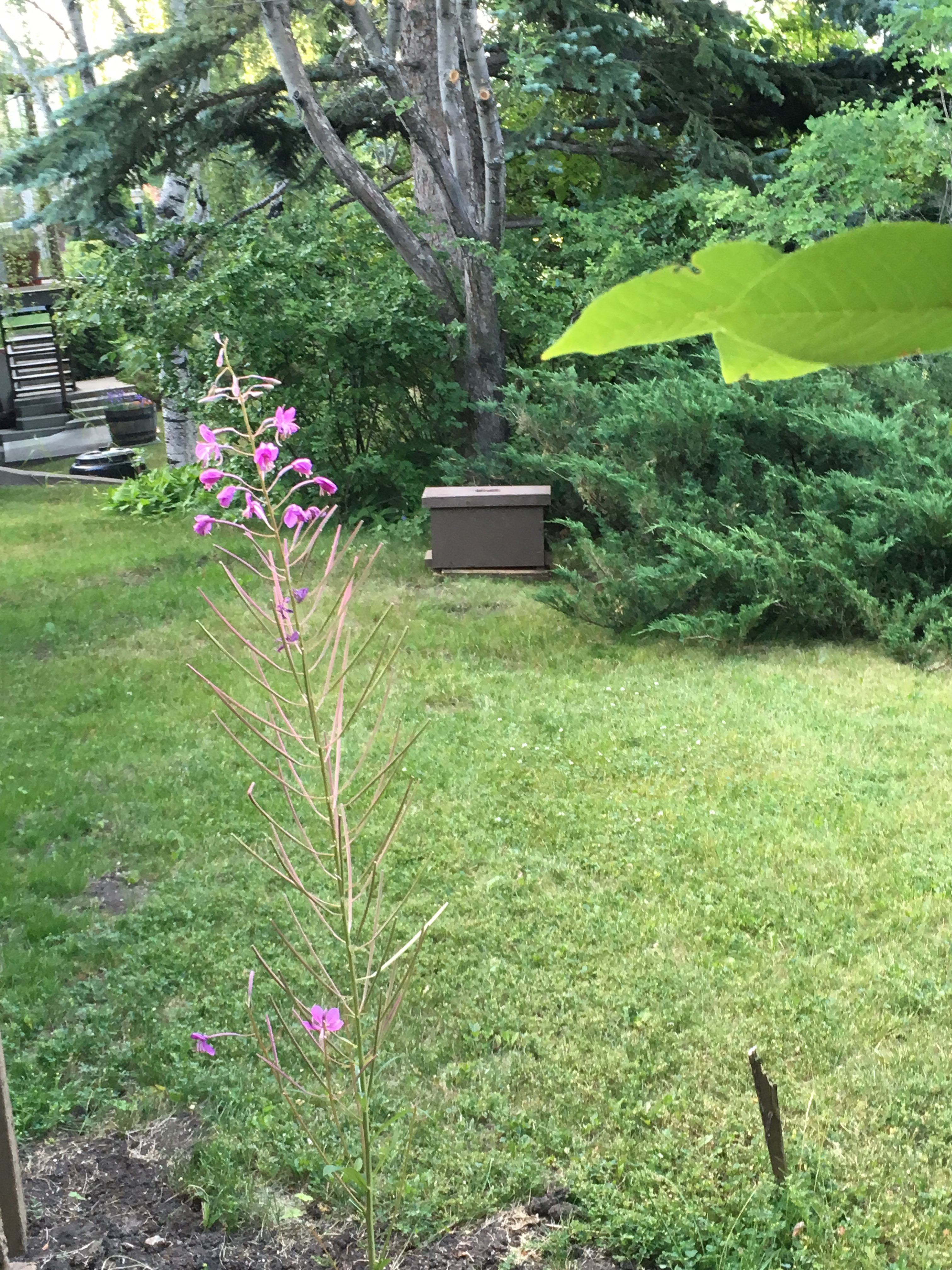
Here in my city backyard, our friendly fireweed started to bloom a couple of weeks ago. It’s covered in bees. Bumblebees, not honey bees.  In fact, I have never seen a single honey bee on our backyard fireweed, not this year nor any previous year.  This summer, the absence of honey bees on this fireweed specimen is especially odd since I recently placed a small hive just a few metres away.  

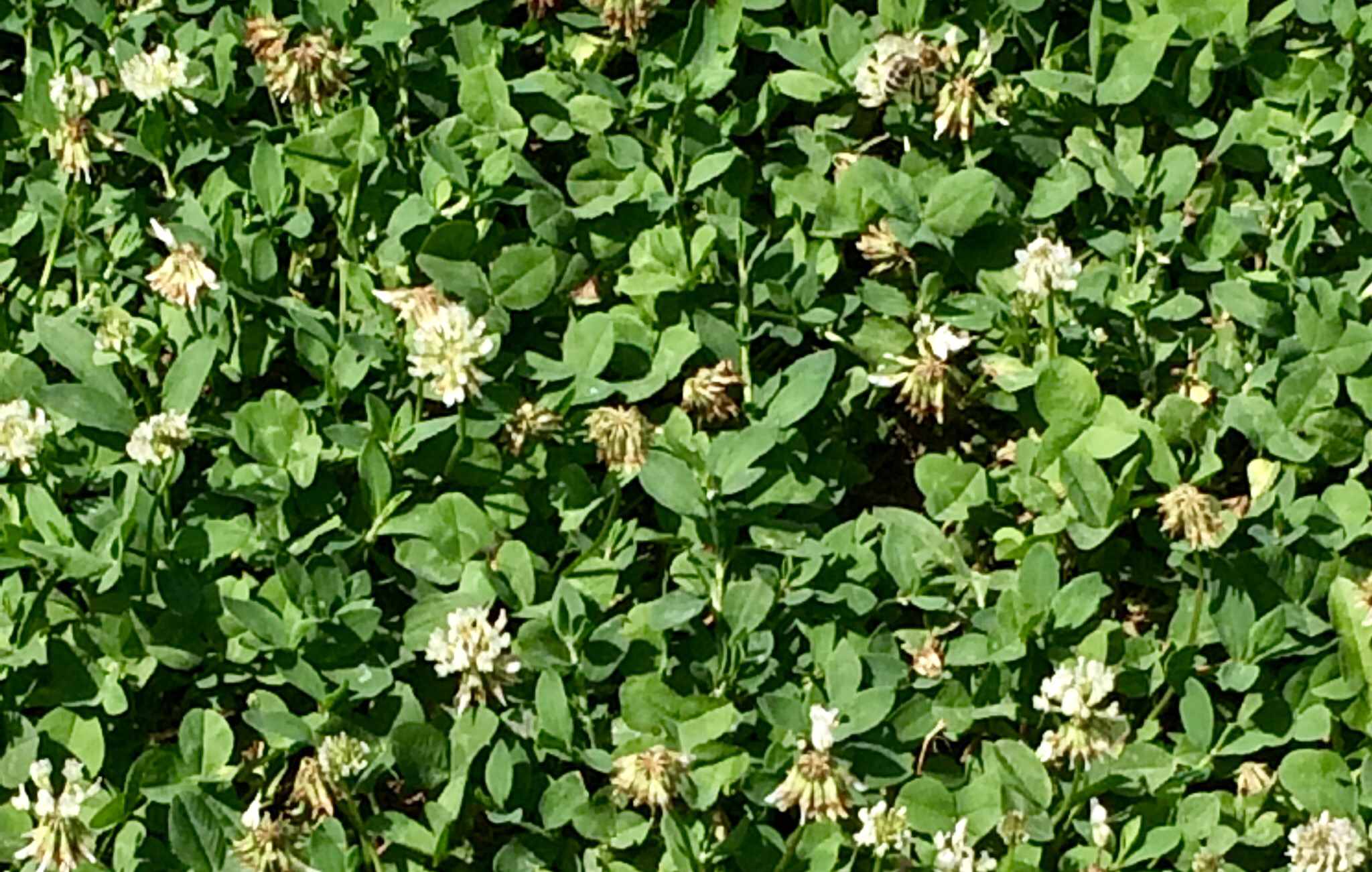
Why do honey bees shun my fireweed while a variety of native bees enjoy its blossoms? There are several reasons.  For one thing, honey bees are more likely to forage as a mob. They communicate discoveries of huge fields (near us, it’s sweet clover and alfalfa). A scout bee would be seriously ridiculed if she were to announce the discovery of a solitary sprig.  If there were thousands of fireweed plants, I’m sure that millions of bees would be having a party in our yard.  But one plant? Why bother.  

I also suspect that the workers in my nuc, which you see in the picture above, are better adapted to imported forage such as alfalfa and sweet clover while indigenous bumblebees find this indigenous variety of fireweed appealing.  Lastly, honey bees fly kilometres while gathering nectar so they aren’t as partial to their immediate surroundings. Most other bees only forage near their nests so they are stuck with lonely bouquets.  These are just guesses. It would be interesting to follow up with a project to be more certain about the reasons that I’ve never seen honey bees on this honey plant, but have watched dozens of other bees work its blossoms. 

Posted in Honey Plants | Tagged , , , | 5 Comments

YIKES! Small Hive Beetle in Alberta

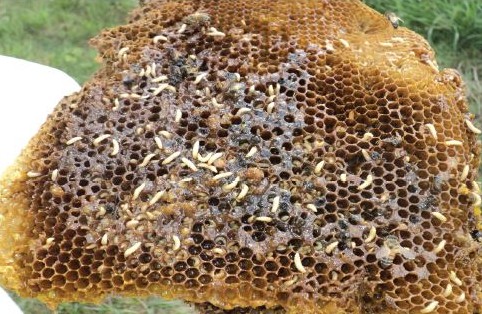
Small Hive Beetles? No, thank you.

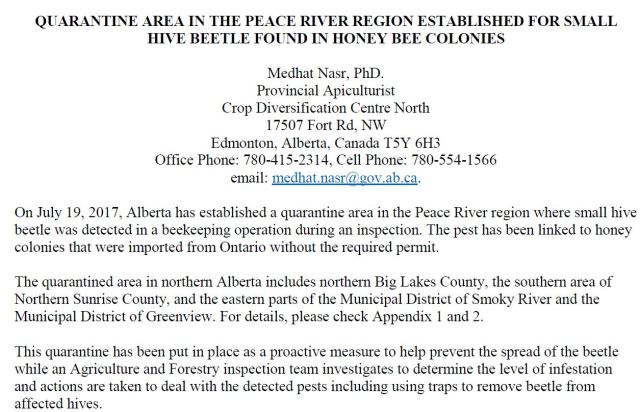
Two days ago, our apiary inspector announced the unfortunate discovery of the ugly Small Hive Beetle (SHB), species Aethina tumida, in the northern part of our province.  I think that this is the first time SHB has been found in Alberta, Canada. Our prairies are a long way north of the beetle hotspots, so the beetle didn’t arrive of its own volition. Instead, according to the government press release, it was inadvertently imported among “honey colonies that were imported from Ontario without the required permit”.  The permit would have required an inspection and the inspectors issuing the permits in Ontario (2,000 kilometres east) might have seen the beetles. Instead, the bugs are now in our pristine province and a major quarantine has been put in effect.  Here’s part of the announcement:

The SHB is a filthy little animal. It makes a mess of weak hives and unkempt honey shops, chewing honey and wax, then dropping dirty little droppings everywhere. Although the beetle is native to tropical and subtropical regions of Africa and probably won’t thrive up here in North America’s fridge, SHB could survive in heated honey shops and be a bee yard nuisance in the summer. The last time I wrote about this pest, I lamented that inspectors on our mild west coast (in British Columbia) had found the animal. So, we were wary that the beetle would arrive from the west. But this discovery was imported from the east, from Ontario.

Unfortunately, Ontario beekeepers have already exported this pest earlier this year – Ontario SHBs were discovered in New Brunswick. In that case, the beetles were hitching a ride among Ontario hives trucked to the maritime provinces to pollinate blueberries. Kevin McCully, New Brunswick’s agriculture director, was surprised to discover the beetles since the colonies were “all reported to not have any presence of small hive beetles in them,” when they were issued moving permits in Ontario. Nevertheless, the beetles were discovered among some of the 25,000 hives hauled into New Brunswick’s blueberries from Ontario.

Meanwhile, here in Alberta, the provincial government has issued a quarantine of a 15-kilometre zone around the affected hives. This means that apiaries belonging to 15 different operators in the Peace River region (about 800 kilometres north of Montana) will have a new set of rules to follow this summer – they won’t be allowed to sell or move any nucs or hives over the next 45 days, but they are allowed to produce and pull honey from hives within the quarantine.  Hopefully, this will prove to be a tiny infestation which can be eradicated quickly and permanently. But the accidental importation serves as a warning to beekeepers to be vigilante – and follow the rules about moving hives across borders.

Posted in Beekeeping, Diseases and Pests | Tagged , , , , | 7 Comments

The Beekeeper Everyone Knows

Hillary, left, and Norgay on Mount Everest, 1953

There aren’t many beekeepers that the whole world knows. No one gets famous for keeping bees. Sometimes a beekeeper becomes locally infamous, but I can’t think of any beekeeper as well-known as, say, Sir Edmund Hillary. He and his climbing partner, Tenzing Norgay, will be honoured forever as the first to scale Mount Everest.  Hillary’s day job? Beekeeping. He spent his first thirty years working on the family honey farm. Hillary, who passed away in 2008, would have been 98 years old today.

Surprisingly, when he returned from his expedition, the beekeeper who climbed the world’s highest mountain went right back to hard manual labour, working with the family’s 1,400 hives. He had a remarkable humility about his feat. Here’s Sir Hillary, in 1953.  He was 34 years old when he was interviewed in this film. He doesn’t mention his bees in this clip, but I put it here so you can see the grace and charm of the young man.

When Hillary and Tenzing climbed Everest back in 1953, most of us weren’t even around yet. Back then, technology was relatively primitive – a typical TV was bigger than a fridge. Communication was painfully slow.  It took 3 days before the world knew whether Edmund Hillary and Tenzing Norgay had reached the peak – or had died trying. The team wasn’t the first to attempt Everest, but previous efforts ended in tragedy.

I mentioned Sir Edmund Hillary’s bee farm. He wasn’t a hobby beekeeper with one hive under an apple tree in the orchard. He was a real commercial honey farmer. Hillary wrote several times that beekeeping had conditioned him physically and mentally for the challenges of mountain climbing. Here, from his book A View from the Summit are Hillary’s own words about his beekeeping experiences:

“My brother Rex was a year younger than me and he, too, was part of our family beekeeping business. Rex and I worked well together as a team. He was smaller than me but very strong and vigorous. In the friendliest fashion we competed energetically with each other, often running side by side with heavy loads of honey to pile them on our truck…we actually enjoyed the beekeeping. Our thirty-five apiaries were spread out on fertile dairy farms up to forty miles away, so we were always on the move. The spring and summer, when the bees were gathering nectar, was a time of great excitement. The weather made beekeeping a tremendous gamble, of course. Each apiary we visited could have a substantial crop of honey in its hives or almost nothing. Rex and I reveled in the hard work.”

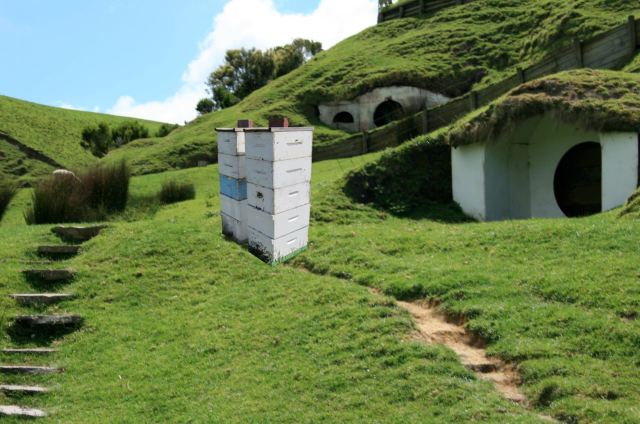
New Zealand: An amazing land of bees, hobbits, and mountain climbers.

For a few seasons after his famous conquest, Sir Edmund Hillary went back to tending the family’s 35 apiaries scattered around his island home. At the time, he didn’t think the climb was a big deal and he expected his moment of glory to fade quickly. It didn’t.

Posted in Beekeeping, Culture, or lack thereof, History, People | Tagged , , , | 18 Comments

Bees with Beards

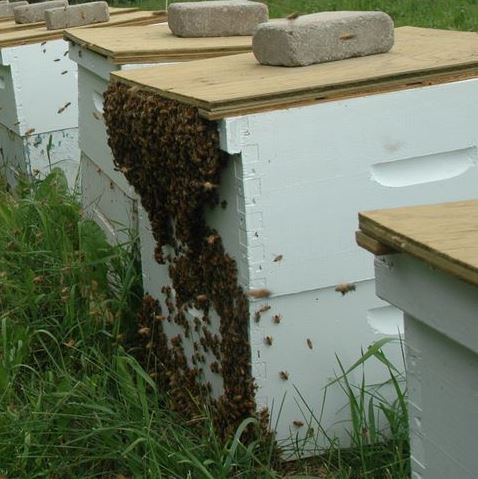
Ah, the bearded hive. With our current heatwave, beards are in fashion among beehives here in Calgary. Last week, I was called to the home of some new beekeepers. The front of their two-story hive was completely masked by a wildly unkempt beard of bees, listless workers hanging out on a warm summer’s evening.

Remarkably, the hive had developed from a package which the new beekeepers had installed just two months earlier. (Bees are amazing!)  Since the forecast predicted persisting heat and it was still earlier in our honey season, we split the hive  and inserted a third box between the two brood chambers, intermingling sheets of starter comb. Half an hour later, the beard was waning. Inside, the bees were waxing the foundation.  I wish my camera had been handy. The before and after scene was spectacular. But I have other beards to show you, so I’ve placed a few on this page.

My friend Veronica shared this image of her neatly kept backyard hive. It’s mustached rather than bearded. Bees are drawing air into the hive. An upper entrance might help.

The hive to the left caused mild alarm for another friend. She wondered if such behaviour is normal. It is. Although it was after dark and the air had cooled a bit, a few hundred bees continued to cover the upper lip of the entrance. For new beekeepers, such activity seems rather odd. The situation is usually relieved with the addition of a few honey supers and additional ventilation. Slatted bottoms, a wider, taller front entrance, and an upper entrance may be helpful.

We are having an unusual hot spell here.  Perhaps it will surprise you, but it occasionally gets very warm in Canada. While building homes for Habitat for Humanity in Winnipeg this week, former president Jimmy Carter suffered heat exhaustion. (With his work ethic and his skill with power tools, he would have been a fine beekeeper.)  Just like an active retired president, your bees need shade, plenty of water, and ventilation. You’ve probably heard all that before and you can look it up in any basic beekeeping book. I’m not going to belabour the obvious.   Hot, crowded bees will sit on the front porch. You don’t want this. Idle bees are the devil’s bees, as they say.

Bearded hive with a mop-top, just before supering. My hive has an upper entrance, that’s why the bees are hanging from the top.

It’s not only beehives that grow bee beards, but humans also fancy the fashionable. I wrote about this summery trend a few years ago. To save you the effort of following my link, I’ve repeated that post here.

🐝 🐝 🐝 🐝 🐝 🐝 🐝 🐝 🐝 🐝 🐝 🐝 🐝 🐝 🐝 🐝 🐝 🐝 🐝 🐝 🐝 🐝

Braving the Beards

An itchy growth of facial bees

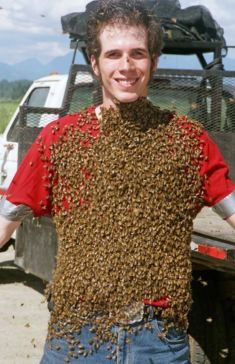
Almost anyone can grow a beard. Especially if honey bees are the nubs. The young lady in the picture to your right is showing off a sporty growth of facial bees. Surely there is some medicine or therapy that could have prevented this? A few days ago, the web master of a new beekeeping site (Beekeeping Planet) sent me a link to his site’s Top Ten Bee Beards page. So, it got me thinking about bee beards.

Perhaps a stylish bee jacket?

What is the fascination with bee beards? Not everyone likes the appearance of a shaggy face. (Although Darwin, Lincoln, Marx, and Castro all got good mileage from theirs.) And not everyone enjoys having small stinging creatures buzzing the cheeks. But combine the two, and you could make a PBS documentary. Photos of bee-bearded folks are almost as old as photography. I guess it’s because the bee beard combines the yucky, the creepy-crawly, and the daring-do in a delectable way. Having a potentially dangerous motley crew of stinging creatures hanging under one’s nose has an almost universal appeal.

Almost anyone can grow a bee beard. But I am reminded of this tragic story about a 34-year-old gentleman in Vermont: Man Has Trouble Growing Full Beard Of Bees. It seems to be true – patchiness, uneven color, itchiness, and the odd stray gray bee seem to plague the young man whose father “always had a full thick beard of bees his whole life.” There is a solution, which The Onion fake news didn’t report: some young men have been going for the full bee jacket to take attention off their lack of bee beard. It’s easier to maintain and has just as much “Wow Power” as the facial bees. However, the bee jacket is not recommended while motorcycling.

.

Posted in Beekeeping, Climate, Humour | Tagged , , | 2 Comments

Shake, Rattle, Roll: Our Little Earthquake

Hives, in Chile, toppled by an earthquake. (Photo: Rey)

I live in one of the less shaky parts of the world. I don’t think that Calgary has ever had a damaging earthquake. (Granted, the city isn’t much over a hundred years old, so it’s a short history.)  When the Rocky Mountains (50 kilometres to my left) popped out of the ground, there must have been some horrific earthquakes. However, our last tectonic jolt was millions of years ago. It’s been quiet ever since.

But Montana, just a few hours’ drive south of us, suffered a hefty shake last week.  Folks around Missoula woke up to the biggest quake they’d had in over 20 years. It measured 5.8 on the shake-me scale. That’s enough to rattle windows, close doors, smash some dishes, and mimic poltergeist behaviour. That’s the worst that Mother Earth has thrown at Big Sky Country in decades. Across the border, up here in Canada, a few people say that they felt the Earth move that night, but I didn’t.  Closer to the epicenter, beehives would not have thought much more than, “Good grief! Is that the truck taking us to almonds already?”

But it was quite a different story a few years back in one of the world’s most alluring countries – Chile. About a week after I visited in 2010, Chile experienced the sixth strongest earthquake ever recorded, anywhere on Earth. The ground bolted upwards, traveled ten feet, then crashed back down. That’s right – houses, gas stations, firetrucks, everything – lifted and flung three metres. Scientists from Ohio State used GPS to measure the movement. If you were able to leap high into the air when the quake struck, and (even more skillfully) stayed afloat for half a minute, you’d have fallen into your neighbour’s yard, which would have moved in under your feet.

The February 27, 2010, magnitude 8.8 Chilean earthquake released the energy of 240 million tonnes of TNT. A 600-kilometre wedge of oceanic Nazca Plate subducted under South America while the continent lifted and sprung westwards.  Six hundred people were killed. Fifty billion dollars was lost through damages and interrupted business. Homes, schools, bridges, and apartment buildings toppled. 125 million bottles of wine fell and broke, turning streets red in vineyard towns.

I have beekeeping friends in Chile (that’s why I was visiting). They and their families were OK. But their companies were not. They sent me chilling photographs, a few of which are on today’s post. You can see what the quake did to their businesses. Francisco Rey was in the middle of his queen rearing season. Hives and nucs were scattered everywhere, queens lost, cell-builders destroyed. Honey packer Juan Pablo Molina lost two million pounds of honey when drums were knocked over, lids popped, and honey drained.

The firms of both Srs. Rey and Molina were kilometres from the epicenter, so destruction wasn’t total. But it was still devastating. That was seven years ago. Both of my friends are still in business, but they lost a lot.  If you’d like to know how to prepare for an earthquake, or if you’d like to see a complete story about how this big one affected beekeeping in Chile, here’s a link to an article I wrote for American Bee Journal at the time. Meanwhile, we’re thankful that Montana was just slightly shaken – this time.

Drums of honey tossed and churned by the big one in 2010. (Photo: Molina)

The floor is flooded – with lost honey. (Photo: Molina)

Repairing the damage. Francisco Rey and his team went from apiary to apiary, reconstructing hives, one at a time. (Photo: Rey)

.

Posted in Friends, Honey, Queens, Science, Strange, Odd Stuff | Tagged , , | 4 Comments