The Serious Lawn

Three Hills, Alberta, Friday, June 2, 2017. Credit: Cecilia Wessels

Do we take lawn care too seriously? Whether we are wasting water on Kentucky bluegrass in the great American southwest, or soaking tonnes of weedkiller and insecticide into pleasant little villages across the continent, much of our obsession is just wrong. (And I’m not saying this simply to justify my own half-wild, unkempt backyard.)  Considering the harm we’re doing to ourselves, our neighbouring ecology, and our bees, what good comes from that perfect lawn?  Even the aesthetics are sometimes questionable. (I’ll refrain from venting about golf courses for the moment.)

On the other hand, I tip my hat to the homeowner in the photo above. He keeps a neat yard a bit north of me, up in the town of Three Hills, Alberta.  Theunis Wessels’s wife snapped this sensational picture of him finishing up lawn work while a tornado descended.  There’s much to admire in that unflappable Canadian demeanor and sense of duty. Well done, neighbour.

Posted in Ecology, Strange, Odd Stuff | Tagged , | 10 Comments

Mind the Gap!

If you travel metro in London (and many other cities) you might hear a polite admonition from the public address system, “Mind the gap!”  It’s advising you not to get your footwear stuck between the train and platform while boarding. Beekeepers have their own gap to mind and it’s here now.

The June Gap is pretty common across the northern hemisphere. (Perhaps there’s a December Gap down in Chile.) The gap is so renowned among beekeepers that someone built a wikipage called “June Gap”. It relates mostly to the UK, but we also gap here, in western Canada, too.  This is what the wiki says:

The June Gap refers to a phenomenon in which a shortage of forage available for bees occurs (typically in June) and has been observed in the United Kingdom and Ireland.

Subsequent to the massive volume of pollen and nectar produced by trees and hedges in the spring, there is a reduction in the amount of nectar available to the bees due to long grasses and dandelions suppressing many wildflowers.[1] Before the herbaceous “summer rush” of July-through-September which reinstates the high level of nectar, the high hive populations brought around by trees in the spring struggle to produce honey and may lay fewer eggs. Beekeepers need to pay special attention to the levels of honey in the hive as well as the level of water the bees use during this gap.  Annual weather patterns can cause this event to occur later or earlier.

Some plants which can help provide nectar in this gap are Cotoneaster, the closely related Pyracantha, common garden [herbs], and perennial garden plants.

That’s all the Wikipedia entry says, then a few references are cited.  The June Gap isn’t limited to England and Ireland.  We also gapped in western Pennsylvania, where I learned to keep bees. We saw a nice early flow from of willow, dandelion, and fruit blossom. Most years, black locust (Robinia pseudoacacia) straddled late May and early June followed by tulip poplar (Liriodendron tulipifera) and basswood (linden, or Tilia americana). Then there was a (summer) gap until the autumn goldenrod and aster. Farther north and west, most beekeepers on the American plains and Canadian prairies also suffer a real June Gap, a dearth between spring flows and our main summer honey flow.

A great pasture for bees: dandelions, before the gap

What happens during the gap? There is often a little pollen coming in, but rarely is there much nectar. For those of us lucky enough to live in Alberta, Canada, we may have a good flow from dandelion (this year it peaked on May 25th, which is normal) but the drop after that major source is precipitous. We have sparse flowers (goat’s beard, buffaloberry, Siberian olive, caragana) which tease the bees a bit, but we can see hives lose weight, even on sunny mild June days. Most years, we have gaps (of varying significance) from about June 5th to June 25th. During those three weeks, queens curtail egg laying. Crucial workers that will help make the late July and August part of the honey crop might not materialize in the numbers you need.

Beekeepers have taken to feeding their bees up to a few days before honey supers go on. If the dearth is severe and hives have built up strongly on the early season flows, the gap will result in less brood rearing. But the gap can be so serious that bees destroy their developing brood and then, as it continues, they may starve. It’s possible to lose hives from starvation days before the main flow starts. Leaving plenty of reserve honey in the hive will, of course, prevent such a fate. But even a well-provisioned colony usually stops egg laying when the nectar shuts off and pollen becomes scarce.

The solution? Mind the gap. Keep a couple of eyes on your hives at this time of the year. The crop (for most of us) will start flowing in less than a month. This is not the month to ignore your bees.

Posted in Beekeeping, Ecology, Honey Plants | Tagged , , | 15 Comments

Bee Man Freeman

Born in 1938,  Morgan Freeman is 79 years old today, June 1, 2017. (Happy Birthday!) You know him as the actor (Driving Miss Daisy; Shawshank Redemption; Million Dollar Baby) with the resonating voice. But did you know that Freeman resonates among the bees, too? A couple of years ago, he turned his 124-acre ranch into a “sanctuary” for honey bees, starting with 26 bee hives. (Most beekeepers start with just two or three!)

I’ve long admired Freeman as an actor, but I really began to appreciate him when I started watching his series of science documentaries on Discovery, the astrophysics lectures called Through the Wormhole. Respect for the actor is deep – he was born in Tennessee, grew up in rural Mississippi, yet became comfortable in Hollywood. To top it off, at age 65 he earned his pilot’s license and he flies a Cessna 414.  It seems almost natural that he decided to become a beekeeper a couple years ago. As you”ll see on these clips, he actually knows a little about bees.

Here are a couple of clips of Freeman the beeman on late night TV:

More bee talk, with Stephen Colbert:


.

Posted in Culture, or lack thereof, Outreach, People | Tagged | 4 Comments

Swarm Season

It’s swarm season here in the north. That will end soon enough, but right now it’s pushed by long days and a heavy dandelion flow. Hives just can’t help themselves. In the old days of skep and gum beekeeping, a whole family would run outside, banging pots and pans and shouting, “Yippee! The bees are swarming!” It meant that they’d have new bees to replace some of the colonies that had died over winter.  Fast-forward two hundred years or so and it’s not the same. “Craps! The bees are swarming!” But swarms are still cool – even if they might point out your beekeeping missteps and represent a probable loss of money.

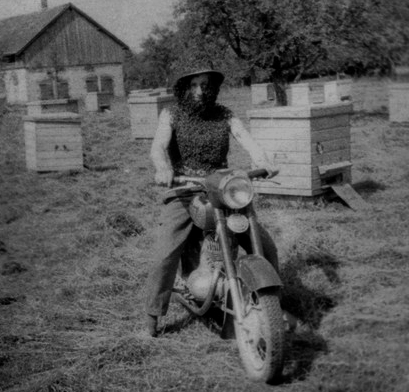
Today, I’ve got a swarm photo essay. Most of the pictures are mine, but some are vintage images from many, many years ago.

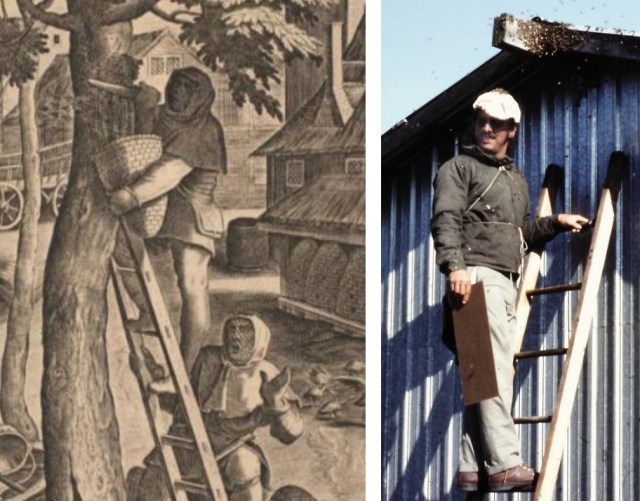
Almost 500 years separate these two images. (Left, 1500s, woodcut by Jan Van der Straet in Flanders; right, 1980, photo by me in Florida)  Not much has really changed: both beekeepers are climbing ladders, wearing veils, holding a tool.  On the right is my brother David, propped against his honey house. On the left are some folks whom I’ve never met, but their honey house is also near them.

🐝 🐝 🐝 🐝 🐝 🐝 🐝

How do you carry your swarms to your bee yard? This guy had a cool solution. From Gleanings, early last century.

🐝 🐝 🐝 🐝 🐝 🐝 🐝

OK, you’ve caught your swarm, made it home, and need to box it up.
This is how it was done in 1883.

🐝 🐝 🐝 🐝 🐝 🐝 🐝

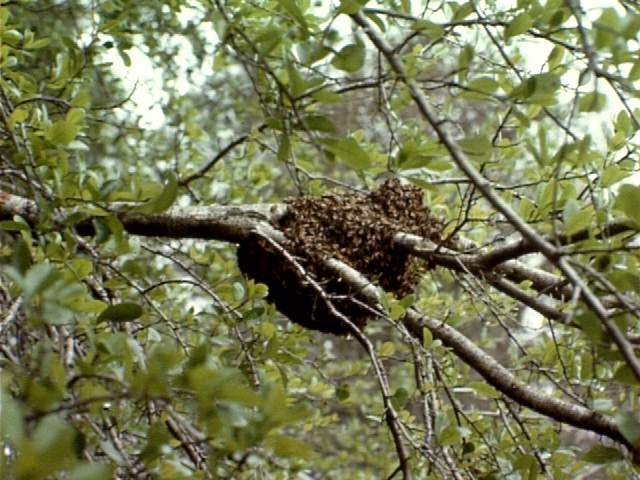
This is the first picture I ever uploaded to the internet, way back in the early 1990s. About two years later, I did a search for ‘swarms’ and found my own picture on a USDA website. It still had its original file name, SWARM_M.jpg, but no reference to Pennsylvania (where I snapped this with an SLR Minolta). By the way, in those days we had to keep file names under 8 characters. How do I feel about the American government pilfering my photo and offering it to the world? I’m cool with it. This time.

🐝 🐝 🐝 🐝 🐝 🐝 🐝

Here’s my final picture for today. This was sent to me by my friend Ursula, who manages Medivet. Medivet makes the world’s supply of Fumagillin-B, the anti-nosema medicine. Ursula met this swarm on a golf course in southern California, near the Arizona border. It’s undoubtedly populated by Africanized Honey Bees. It looks like the swarm was once much bigger but might have been going through a dearth when the picture was taken. At one time, all those (now) dry combs must have held a lot of honey.

Posted in Beekeeping, Friends, History, Swarms | Tagged , , , | 3 Comments

Bee’s Eye View

Looking down from a light aircraft gives insights you just can’t match on the ground. At 6,000 feet, you appreciate how close flowers are along a beeline from hive to field. Beeing in the air is useful for a beekeeper – I’m not going to write about the thrill of flying in a four-seater, looping around the Alberta prairies, nor will I mention that my son was at the controls for about half the flight. (Though I couldn’t resist inserting my 30-second video at the top of this page. A good friend, a seasoned pilot (and beekeeper!), sat alongside my teenager. Many, many thanks to my friend for our flight!)

Years ago, I kept bees in Florida. The owner of a private airstrip took me up in his plane. It was the first time I had a real sense for central Florida’s terrain. Citrus groves were mostly near roads, partly because harvesting trailers need to park close to the fruit. From the air, I realized that groves were often narrow strips hugging the roads. Both trees and roads prefer higher ground. Farther from the roads, I saw more pasture than I expected. The rest of Florida was cypress swamps and flooded sinkholes.  I owned forty acres of swamp, a field, and a few nice oak hammocks. My bee shed is in the center of the pasture in the picture below. The rest of my land was reserved for alligators. A real eye-opener from the air.

I really thought there were more groves in Florida!

From the air, you can select new yards and see where the competition placed their hives. You also get a sense of meandering streams, potential flood plains to avoid, and (here in western Canada) you may find remote alfalfa fields which you didn’t know existed.

I met a Montana beekeeper, Harry Rodenberg, who served as a bombardier in World War II. He told me that he kept track of his 3,000 hives from the seat of a light plane. Montana’s alfalfa fields are vast and scattered. After a bad storm, Harry sometimes flew out to check yards for blown lids or tumbled hives. Today, the Rodenberg family operates close to 5,000 hives. Piloting remains part of the family skill set.

You might already know that the first report of the Wright Brothers’ Kitty Hawk flight appeared in a bee magazine. Gleanings in Bee Culture was published by Ohio beekeeper A.I. Root. He manufactured beekeeping equipment, sold candles, made honey, and (like most good beekeepers) had an insatiable curiosity. When he heard that some boys down in Dayton, Ohio, had built a flying machine, he wrote about their adventure less than three months later. The Dayton newspaper missed it entirely, simply doing a tiny ‘Society’ piece announcing that the Wright brothers had returned from a visit to North Carolina. Aeronauts and flying machines were never mentioned. Beekeeper A.I. Root was more enthusiastic. Below is the fourth piece he published about flying machines. It’s from January, 1905, and begins, “What hath God wrought?”

A.I. Root continued writing about bees and flying machines. In 1908, he described an 8-mile flight made by the Wrights “in 7 and 3/4 minutes, which is just over a mile a minute.”  I don’t know if A.I. Root ever checked his bees from the seat of a flying machine. But I wonder why more beekeepers don’t take a flight over their bee yards. These days, with easy access to satellite images, it’s less important than it used to be. But for real-time knowledge of where the neighbouring hives are and which fields are blooming, nothing beats a spin in the air.

Posted in Beekeeping, Friends, History, People, Strange, Odd Stuff | Tagged , , , , | Leave a comment

Long Live the (New) Queen

During the past week, we looked at how to requeen a hive. On Monday, we considered the reality of queen troubles and how our hives differ from feral colonies. Tuesday was about identifying a queen’s quality from her brood pattern, then on Wednesday, we murdered the queen. Yesterday, a new queen was inserted into our failing hive. Today, we’ll consider what happens to a requeened colony and we’ll ask ourselves if all this was really necessary.

I’d like to say that the princess becomes a queen and lives happily ever after. That’s usually true. However, after you’ve done everything as correctly as you can, you may still find that some of your hives rejected replacement queens.

I’ve seen wildly different results requeening. Once, with a batch of a hundred queens, one-third rejected immediately or didn’t make the summer. Weather  or some beekeeping mistake might have been the problem. But I suspect that the issue began back at the queen breeder’s ranch. Other times almost every queen in the batch does well. Again, it might have been our own brilliance, but more likely it was a good set of properly raised and fully mature queens that we received.  As with most of our beekeeping, our best efforts may improve our success a notch or two, but even a small mistake can lead to an epic fail. (That goes for raising kids, too.)

If you’ve done everything right, you probably have a new egg-laying machine in your hive. Was it worth it? You’ll have to answer that for yourself. When I learned beekeeping from my father, we had about 300 hives. (He had once had 800 but when I was old enough to help, was cutting back to run other businesses.) My father was similar in age and life experience as Richard Taylor (whom I’ll paraphrase: when in doubt, let the bees sort it out). They used similar beekeeping tactics. Particularly, both Richard Taylor (1919-2003) and my father (1919-2002) learned about life during the Great American Depression. My father didn’t spend much money. He never requeened. Failing hives were doubled up with better ones. In the spring, he’d get numbers up again by splitting the good hives – sometimes he’d splurge on purchased queens for the divides, but often he’d just split the hive at the end of the spring flow, let the queenless units raise their own queens, and he’d usually have reasonable hives for Pennsylvania’s autumn goldenrod and aster flows. I’m not advocating this system – it wouldn’t work too well if you have an intense July/August flow, as we do here on the great plains. But that’s one way of managing the poor queen issue if you have a lot of hives and can accept some losses.

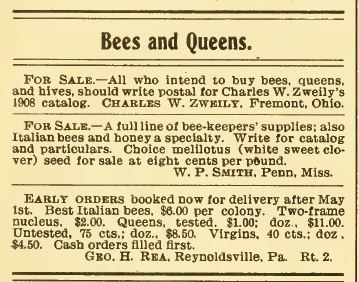
Complete hives, $6; Queens $11/dozen (in 1908)

Generally, you should requeen failing hives with new queens. The value of three pounds of bees and a queen (over CA$200 in western Canada) or 5-frame nucs (US$130 in the States) tells us that a $20-$40 queen invested in a colony at the right time saves a huge amount of money. I won’t go into the value of the honey crop and the difference a good new queen can make to a hive’s production compared with a failing one. In the end – despite some occasions when bees will sort it out – responsible beekeeping usually means requeening a colony when it’s in a death spiral. With a healthy, well-mated, new queen, most hives can recover.

Obviously, I didn’t cover everything you need to know about requeening a hive. That’s partly because I don’t know everything there is to know about beekeeping. But I hope that this review gives you some things to consider. If you are new to beekeeping, do some research, read some good magazines, and (especially) find a mentor – you’ll learn much faster and you’ll be a better beekeeper. If you are an experienced beekeeper, feel free to disagree with everything I’ve written. Let me know how wrong I am.  Either way, I’ll be back tomorrow with a short piece on scouting bee yards from 6,000 feet.

Posted in Beekeeping, Queens | Tagged | 5 Comments

Sticking the Queen In

Over the past few days, I’ve written a little about identifying poor queens by examining brood patterns. Then we discussed  finding and pinching her failing heinousnesses.  The next step in your requeening saga is inserting the caged queen.

Here in Canada, people are paying about $40 for a single queen. That’s Canadian money, so it’s really only about fifty cents in American. But for us, that hits the pocketbook hard. You don’t want to dequeen a hive, pay a day’s wages for a replacement, and then later find her dead in the cage. Since that’s such a big risk, I’d rather not tell you how to do it. Instead, I’m going to tell you what a lot of other beekeepers say. You can get mad at them if something goes wrong.

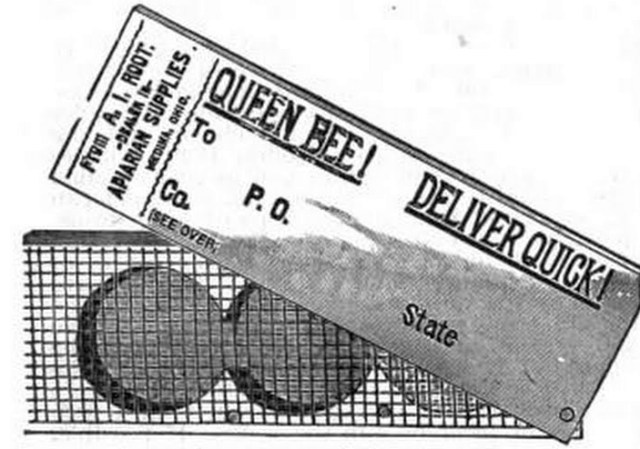
Benton mailing cages, usually made from soft basswood, have been used for almost 150 years. This one is from an 1893 magazine, The American Bee-Keeper.

A lot of beekeepers say that the caged queen can last a week or two with her attendants if you can’t install her because of weather or because you didn’t plan things ahead. During this time, give the caged bees a droplet of honey and water a couple times a day, keep them at room temperature or slightly warmer, and in a dark/dim location. It’s not a good idea to keep her majesty waiting, but if necessary, it’s possible.

A lot of beekeepers say that you should remove all the attendants from the cage before inserting it into the new hive. I always do that. It probably increases acceptance by a third – instead of having maybe 12 in 100 queens rejected, perhaps you’ll have just 8 in 100 caged queens killed by the queenless bees. (12 in 100 is just an example, not an aspiration. Individual results will vary. Time of year, strength of queenless hive, period of queenlessness, and the alignment of the planets affect acceptance rate.)

A lot of beekeepers say that you should remove the non-candy cork from the trusty Benton cage and place a finger over the hole. Whenever a worker gets close to the hole and the queen moves away, remove your finger and release the attendant. It may take a few minutes to get them all out. It pays to free the workers while you are seated in a truck with the windows rolled up. Over time, you will likely accidentally release a queen of two. You should be able to recover her from the windshield and nudge her back into the cage again. When all the workers have escaped, recap the hole with the cork. (You saved it, right?)

A lot of beekeepers say that you should wait a few days between removing an old queen and adding one in a box. I’ve made 3- and 4-way splits and put the caged queen in immediately, even before loading the nucs and driving to their new yard. But you may want to be more cautious when requeening an in-place hive with an aging population of workers. If you do requeen immediately, follow this advice from the queen breeders at Weaver’s:

When you are re-queening, you may install the new queen immediately after killing the old one or you may wait as long as four or five days before installing the new queen.  We recommend installing a new queen right after killing the old one, though we don’t recommend poking a hole in the candy to accelerate release in this case.

A lot of beekeepers say that you should remove any queen cells in the queenless hive before inserting the cage. Their theory is that the bees will feel they’ve already taken care of the problem. I don’t know if bees have feelings so I won’t comment.

A lot of beekeepers say that you should place the cage near the top bars, between two frames of brood. Face the screen out so the queen can make friends with the bees in the queenless hive. They’ll probably pass a little honey to her.

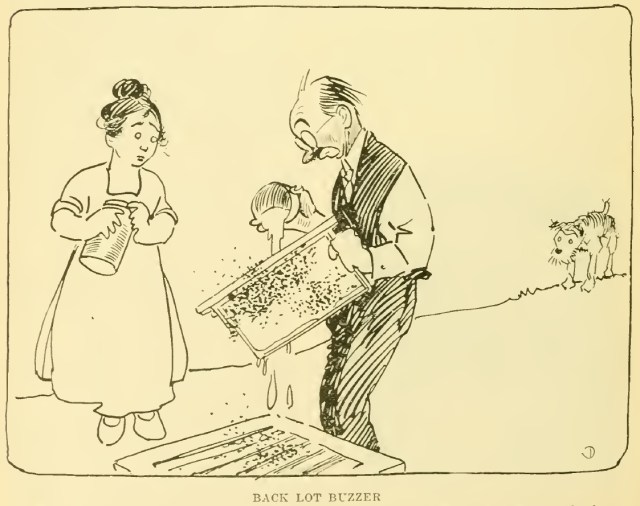
A lot of beekeepers say that you should smear honey and wax from the queenless hive onto the cage to mask the cage’s imported odor. I think that it wouldn’t hurt and it only takes a few seconds, so why not?  Some use essential oils to neutralize the mixing of bee odors. We tend to think that we invented the idea of masking queen odors, but take a look at this cartoon from 100 years ago:

The caption to this January 1920 Gleanings in Bee Culture sketch says, “…the professor says you introduce a new queen by drowning her in a cup of honey.”

A lot of beekeepers say that the only safe way to introduce a new queen is to use a ‘push-in cage’, a wire mesh stuck into the comb that confines the new queen to a very small acreage yet lets her lay a few eggs. You may want to research this as it could save a queen or two from time to time.

I’ll leave off here. This stage – inserting the queen – is usually the simplest. You’ve made your decision based on brood and you’ve eliminated the failing queen. So put the cage in already.

Posted in Beekeeping, History, Queens, Tools and Gadgets | Tagged , , | 2 Comments

Pinching the Queen

Today I’ll write a few words about finding and murdering the old queen. We’ll assume that you have decided the queen must die. Harsh as that sounds, sometimes it’s the only way to save a hive. Think of the colony as a living creature (superorganism) and the queen as the heart. Or more to the point, the ovaries. You are conducting a transplant of a vital organ when the queen is removed and replaced.

If you still aren’t completely sure that requeening is the the right thing for you, then don’t do it. Maybe the feeble brood is due to other conditions, as noted last time. My favourite beekeeper, Dr Richard Taylor, used to say, “When in doubt, let the bees sort it out.” (Or some similar Taylorism.) Unless it’s a hive with a drone-laying queen and no supersedure cells, maybe you just can let a declining queen continue her reign well past her best before date. Maybe the bees will recognize the problem and replace her. But if the brood is seriously haphazard and limited in quantity, maybe it’s time to sharpen the axe.

So, you need to find the queen. For this, all your activities must be smooth and deliberate. This is not the time to show anyone how much smoke your smoker can produce or how loudly you can drop a hive lid to the ground. To find a queen, you have to almost not be there at all. If you work quickly yet gently, the queen will almost certainly be on a brood frame. After a gentle puff of cool white smoke at the entrance, open the hive and (if it’s multi-storied), determine which box has the most bees and the happiest cluster. That’s likely where the brood is and it’s a good place to start looking.

Remove a non-brood frame near the brood nest. Experienced beekeepers can usually see where brood is without removing frames. They look straight down between the top bars to get a good idea of the brood’s position. Chances are you worked the errant hive a few days earlier and realized the queen was failing (and ordered a new queen) – if that’s the case, you should already know which box and which frames have brood.

After removing the non-brood frame near the brood nest, quickly glance at both sides of it and put that frame aside, perhaps in an empty rim or empty nuc box – somewhere that the queen (if you missed her) will not be lost in the grass. Almost as quickly, examine the next frame, which likely has brood. I’m not going to tell you that you are looking for the biggest bee in the hive and queens are not drones. That should insult your intelligence. Instead, I want to focus on technique. First, spend three seconds scanning the side of the frame facing you. If you don’t see her, spend fifteen more seconds systematically looking at the frame as if you were speed reading, moving your eyes along the length of the frame about a third of the width at a time. This is not a good time to think about what you’ll make for dinner or where you’ll go on your next winter holiday. Focus. I’ve worked with queen breeders who were consistently five times faster than me at finding and caging queens from mating nucs. They could really focus, but they also had a knack for observation. It’s likely hard-wired into the DNA, but it’s a skill that the rest of us can usually develop to an acceptable extent.

Zen-like, you ooohm your way through the brood and you find the queen. Or you don’t. You missed her. She was right there, waving her little queenly hands at you, but you saw drones or noticed how yellow this year’s pollen is. If you’ve examined (and replaced) each brood comb in the hive without finding the queen, you might broaden your search. Check empty frames, lid, bottom, the grass. By now, using 30 seconds to a minute per frame, you’ve had the hive open for five or ten minutes and you lost. The queen won. This time. Close the hive and ask yourself why you hadn’t marked the queen the last time you saw her, beat yourself up for your poor beekeeping skills, and plan to return tomorrow.  Beekeepers reading this may have better tricks and ideas and hopefully will offer advice in the comments below. But if you haven’t found the queen early in your search, it becomes exponentially harder. You might as well admit that you’re a failure. But redeem yourself next time.

If you have found the queen and have decided that she’s had a good run but now she’s an old timer, snuffing her out is your next task. If you find this hard to do, I like you already. But for the good of the hive (which may fail to replace the queen and may end up dying of despair), remember how we started this post – time for an organ transplant. Make it quick and forget about it.

Where to hide the body?  A friend of mine suggests that beekeepers should drop the dead queen into the hive so the workers will know that she’s really, really dead. He says that you will see workers surround the dead queen, fanning furiously, acknowledging to the entire hive that the queen is dead. This, I’m told, should allow better acceptance of the new caged replacement queen. He is a smart beekeeper, so I have to give his idea a moment’s thought. And then disagree. I suspect that the activity around the dead body (if there actually is any) is not a funeral ritual but instead indicates that the bees are making a last effort to spread pheromones. I’d just as soon keep the dead queen’s body in a labeled and dated matchbox and collect all the matchboxes on a display shelf. What would you do with the body?

Posted in Beekeeping, Queens | Tagged | 10 Comments

Good Queen; Bad Queen

Quite a few commercial beekeepers replace queens every second year. It’s a scheduled event, sort of like a birthday. Half the hives will get a new queen in 2017, the other half in 2018, then back to the first group again.  But hobby beekeepers may be able to watch their bees more closely, allowing a good queen to continue past her second year, or replacing a fizzled one after a few underproductive months. How can you judge queen quality and when do you sharpen the axe?

Good queen or bad queen?

First, be aware that you can seldom recognize a good queen from a bad one on sight. If I were to place one of each into a small vial and ask you to play Solomon, you’d have about a 50-50 chance of picking the best. There is an exception (to every rule), as in the example in the picture to your right. You should be able to figure out on your own whether this dead queen will be an effective egg layer for your colony.

Don’t bother to find the queen with the idea of assessing her worth. I’d once come along a slowly plodding 5-legged queen in a hive with 12 frames of brood and a booming population. She looked old. She was somehow wounded. But there was this great hive. I let her live. However, think about this: Some beekeepers claim that one in twenty summertime hives actually has two queens, usually mother and daughter, working side-by-side. Maybe that was the situation in the nice hive with the gimpy queen. I don’t know because I didn’t look for a second queen. Most beekeepers don’t. We’re so certain a hive has just one queen (it’s in all the fables and children’s books) that we never look for queen number two. This can be a problem when requeening and inserting an expensive new queen mother.

If the condition of a queen isn’t a reliable indicator of her quality, what is? Well, it’s her brood pattern. If the hive has a normal population and isn’t honey-bound, you will see nice full frames of brood in late spring. The combs should have workers developing in worker cells, not drones. There should be just one egg per cell and brood should be fairly continuous with similarly-aged brood close together. Here’s an example of a very nice frame of brood:

On the other hand, if you see a frame with a highly irregular brood pattern, like this one below, the queen is likely failing. If you could look down into the cells, you’d see eggs next to sealed next to pearl – a real mish-mash of thoughtless irregularity. The queen isn’t able to produce a consistent flow of fertile eggs.

I’d replace a queen that was this inefficient. As queens age, they may deplete their spermatheca, reducing the chances that the egg dropped has been fertilized. I’ve not seen this documented, so I could be wrong, but my hunch is that the queen physically opens the sperm bank door and assumes the egg has been properly inseminated. She does what she thinks is a successful fertilization because she is getting a signal to her brain indicating she’s done everything correctly, so she deposits the egg into a worker cell. Poor thing. Normally, a queen only places unfertilized eggs (which will always become a drone) into large, drone-sized cells. She knows what she’s doing. Fertile eggs into worker cells; unfertilized into drone cells. So, she assumes the door to the spermatheca opened, the egg is inseminated, and it belongs in a worker cell. But as the queen ages, fertilization is less certain. She unintentionally lays an infertile egg in a worker cell.  When this happens, we consider the queen to be a drone layer and we need to replace her ASAP.  Here’s what the resulting ‘bullet brood’ may look like in this situation:

Finally, one other condition to be aware of is the case of laying workers. Worker honey bees do not mate so they cannot fertilized eggs. Unfertilized eggs become drones. Hives with laying workers will end up with just drone brood and worker population will nosedive. Laying workers are likely more common than we suspect. Most hives probably have some workers laying a few eggs at any time. Remove the queen and the queen’s associated odours and the egg-laying instinct of laying workers is no longer suppressed. In a queenless hive, one-third of the workers will eventually activate their ovaries and lay eggs. The longer a hive is queenless, the greater the likelihood that laying workers will lay. Usually such a situation can not be fixed and the beekeeper eliminates the entire hive by shaking all the bees out of the equipment and letting the displaced bees enter other hives. This is a complicated issue and you’ll have to research it on your own. For some background on laying workers, you might check my blog post on how they develop by going to this page. In the meantime, look at the photos below to recognize the signs of laying workers and do not try to requeen such a hive with a freshly purchased caged queen. The laying worker hive will kill the gift you’ve given them.

Photo by Michael Palmer/Beesource.com

In the remarkable photo above (credited to Michael Palmer via Beesource.com), you see the clear evidence of laying workers. Worker bees can’t count as well as queen bees. They don’t stop at ‘one’ – some of these cells have ten eggs. Most will be removed by other workers, but in the top row, you can see at least two hatched eggs (larvae) in the cell near the middle. None of the eggs in this picture are fertilized. If they develop, they will become drones.  Another clue that workers have been at work laying on the comb above is in the third row from the top, second cell from the left. You can see the egg stuck to the cell wall instead of the cell bottom. That’s because workers have shorter abdomens than queens and can’t always reach the cell bottom to drop their eggs.  Again, when you see this, don’t waste your time and money trying to requeen. Cut your losses and eliminate the hive.

Most hives will not have drone-laying queens or laying workers.  It will be less clear to you that the queen is failing. Your clues will come from the brood – its quantity and pattern. Don’t be hasty making your decision. A hive weakened by mites, skunks, weather, foulbrood, or other maladies may have a fine queen but the brood quantity (and perhaps its pattern) may be sub-optimal. Not every hive will have the perfect pattern that you see here, to the left. There is a spectrum of brood quality and it will give you a sense for the quality of the queen. Tomorrow, we’ll assume you have decided to requeen and we’ll consider your next move.

Posted in Beekeeping, Queens | Tagged , , | 22 Comments

Long Live the New Queen

Photo Credit: SJ Bennett

Spring is typical requeening season. Sometimes you do it yourself; other times, the bees swarm or supersede. A young queen is the result.  When a queen is failing, you’re told: Kill the old queen and replace her.  Pretty straight forward, eh?

For an experienced beekeeper, requeening is as easy as pinch and insert. But if beekeeping is new to you, it might take a while to get comfortable. Over the next few blog posts, I’ll write a little of what I know about requeening. Tomorrow, we’ll start with recognizing the signs that your hive is in trouble.  After identifying queen issues, we’ll describe finding and murdering the old queen, then I’ll post about introducing a new queen. Finally, we’ll see what you should do during the reboot stage.

Today, before we dig into the business of requeening, let’s consider the natural state of affairs. Queens may sometimes (rarely) live four or five years. In a hollow tree, with just a small cavity, broodnests might be small so the queen doesn’t lay 2,500 eggs a day non-stop for four months. Egg-laying isn’t so intense. With less stress and activity, the queen can live longer.

In the past, beekeepers used smallish hives permanently perched near a garden. Today, we assure plenty of open brood space, encouraging the queen to lay. Some haul hives from flow to flow and latitude to latitude, keeping queens active and exhausting energy. Today’s environment exposes bees to synthetic chemicals. Intercontinental migration and mites spread viruses. It’s a different world for bees. Queens are living shorter lives.

In the wild, a colony swarms almost every year. That’s the way their superorganism, the colony, reproduces. It’s how new queens naturally enter the cycle. The secondary natural requeening system, supersedure, occurs when bees figure out that their old queen is failing. They build queen cells. Virgin queens emerge, execute the old queen and rival virgins, then mate and begin their egg-laying career. In swarming or supersedure, queen cells grow from well-fed young larvae. Resulting queens are very good.  Occasionally in a feral hive, the queen dies suddenly (a wasp enters the nest and catches her, or a storm knocks the treehouse over and the queen is squashed). In such events, replacement queens are hastily generated and the result is usually inferior.  Queen breeders know the difference. When they raise queens for you, they mimic swarming and supersedure conditions.

Queen cells, produced from swarm-strength cell-builder hives.

As a beekeeper, you work with hives that have a variety of queen conditions. You’ll try to prevent swarming and your queens will lay more eggs than they would if the colony were residing inside a tree. You will occasionally find a failing queen weakening your hive and you’ll need to consider a course of action. Next time, we’ll look at ways to assess the fitness of your colony’s queen.

Posted in Bee Biology, Beekeeping, Queens, Swarms | Tagged | 8 Comments