Best Site for Beekeeping?

🐝 🐝🐝🐝 🐝🐝🐝 🐝🐝🐝 🐝🐝🐝 🐝🐝🐝 🐝🐝🐝 🐝🐝

Beesker, a website based in Cambridge has created a neat resource for all of us. The folks running it check out websites from around the world, looking for what they deem to be the best in a niche. For example, they picked a seriously good website about Humphrey Bogart which is produced by a company in New York City. Beesker tells us that someone named Deborah Mele has the best site about Italian Food. The NHL is selected as owners of the best Hockey website in the world. These choices are free of financial influence or bias. Instead, the goal of the company, Beesker, is simply to grow a large, reliable, interesting database of the best websites.

You may be wondering if Beesker has chosen a ‘best website in the world’ for beekeeping. They have, and you have seen the site at least once. I was surprised when they said this about our blog and its associated information. . . let me quote them: “We have selected Bad Beekeeping Blog as the world’s very best website on Bees and Beekeeping.” That’s a nice validation for our readers who wonder if they are wasting their time here instead of looking for something better. Apparently you have already hit the jackpot.

I’m a born skeptic. I was dubious when I got the message that we’d been selected. I was wondering what it would cost. When would the shoe drop? So I dug into Beesker, researching links, checking scam advisories, and trying to find something that would caution me. But it seems totally legit. Since then, I’ve browsed the Beesker place and enjoyed reading the backgrounds to favourite website authors and bloggers. So go ahead and add Beesker to your family of go-to sites when you’re looking stuff up.  Enjoy Beesker: The best of the web from Aardvarks to Zippers.

🐝 🐝🐝

There are undoubtedly better choices for beekeeping sites – I’ve seen many marvelous bee websites and blogs – a lot of them look better than this one. But we appreciate the notice. We work hard here on this blog/hobby, trying not to sell anyone on wild ideas or useless tools and equipment.  I can be brutally honest. This has earned me a few insults.  One notable zinger accused me of hiding anonymously behind a computer in a basement somewhere. My accuser didn’t like something I’d written.  I’m not hiding from anyone. You can look me up anytime you want – there’s only one ‘Ron Miksha’ in the world and this is he. If you go to the Beesker site for beekeeping, you’ll find more about me than most of my friends know.

I’m constantly looking for interesting stories that might have escaped notice and I’ve been doing my best to offer occasional bits of science to go with your morning oatmeal and honey. I’m attempting to run a helpful site, though you might find today’s post more self-aggrandizing than instructive. I hope not.  Anyway, I’ll see you tomorrow with a post about installing replacement queens.

Posted in Culture, or lack thereof, Outreach | Tagged | 14 Comments

200 Years of Dadant

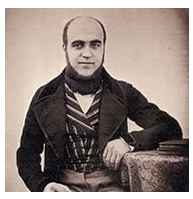
Charles Dadant, around 1900. Happy 200th birthday!

It’s May 20.  If he were alive today, we’d be celebrating Charles Dadant in a big way. Not just because he’d be exactly 200 years old today. (Though that would get some attention.) Instead, we’d want to recognize Charles Dadant as a pioneer of modern beekeeping.

Dadant was an unlikely hero in America’s bee history.  Imagine a mid-life crisis as colossal as this:  Your business fails and you go broke. You’ve got a big family, you are well into your 40s, you move to a new country where you can’t speak the language. You buy a farm which isn’t working, and you’re new business idea fails. That was Charles Dadant in 1863, age 46, shortly after arriving in Illinois from France. His vineyards of Champagne stock weren’t suited for America’s midwest prairies. But his bees were. They performed magnificently.

Dabbling in revolution

Charles had started working bees at age 12 in his native village of Vaux-Sous-Aubigny, France, about 100 kilometres from Switzerland. His first bee task was scraping combs and honey from skeps for the village priest. We’re not sure what happened, but Charles soon renounced his faith and became an idealist who dabbled in socialism. But the bees stuck. He was a hobby beekeeper in France and supported himself as a traveling salesman. As his horse and he roamed the country roads, Dadant sat at the reins, consuming books by evolutionary biologist Jean-Baptiste Lamarck and utopian socialist Charles Fourier.
I suspect that Dadant’s politics and religious views were influenced by the failed 1848 European revolutions. He would have been 31 at that time. Strikes swept central Europe and spread through France and Germany. People had grown weary of the autocracy of the aristocrats, hereditary monarchs, the old system of apprenticeships and (within the Hapsburg Empire) feudal serfdom. Riots, strikes, and some blood on the streets were quickly crushed by the soldiers of repressive governments. Young people fled. Hundreds of thousands went to America. For example, following the unrest, 57,000 young Germans settled around Cincinnati. Other parts of the US also welcomed thousands of similar refugees. These were educated, progressive people – a brain-drain for Europe which drove an economic collapse there. The ensuing depression contributed to the failure of Dadant’s business in France while the idealism of the revolution encouraged his move to America. At mid-age, Charles Dadant showed up in western Illinois.

Utopia in America

His first task in Illinois was to take over a farm owned by a French acquaintance. Dadant built a small log cabin and planted his vineyard, making things ready for his wife and kids who had stayed behind in France.  As you might guess, vineyards don’t do well in western Illinois. Before he was bankrupted by the scheme, Charles Dadant saw the potential for his lifelong hobby. Bees in America’s midlands could make 200 pounds per hive in those days. By 1865, his family had joined him from France, he had nine hives of bees, and more honey than they could eat.

At the time, his plan might have been to create a utopian community similar to several dozen others in the USA: New Harmony, Brook Farm, and the Phalanx and Harmonite groups. He didn’t, but he structured his business with his employees in mind, sharing in profits and working alongside them.

I think that Charles Dadant’s business fortunes really improved when his son, Camille Pierre (C.P.) Dadant, took over management of the family affairs. While the elder Charles was an idealistic dreamer, his son C.P. was a practical businessman. As a child, the younger Dadant was crossing the Mississippi alone on a ferry to sell honey. By age 20, C.P. was essentially running the business. He helped grow the honey farm to thousands of colonies, added a wax works and bee supply factory. Dozens of men were given jobs, important products were created for thousands of beekeepers across the country, and millions of pounds of honey were produced. And that was the real promise of utopia in America.

The visionary Charles Dadant

Meanwhile, the elder Charles Dadant continued to work with the bees and adapted the recently-invented Langstroth hive, redesigned with a larger brood cavity. It’s the Dadant design that most people use today. Charles invented a better way of making wax foundation for the frames which the Dadant factory produced. Charles realized that the European bees which the first settlers brought from northern Europe were not as easy to manage as Italian stock he’d seen in his younger days in Europe. So he imported queens from Italy.
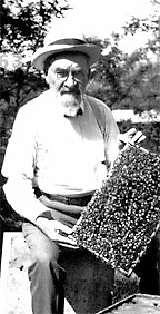
But Charles Dadant’s real passion seemed to be his books and the science of beekeeping. His contributions to the American bee literature were significant. Although he never learned to speak English fluently, he became a great writer in his adopted language. He learned to write in English by using a French-English dictionary to translate the New York Tribune every day.  As early as 1869 – just six years in America – he was a regular contributor to American Bee Journal, a magazine he eventually bought and moved to Hamilton, Illinois, where it is still published.

Charles Dadant freely shared his beekeeping experience, insights, and ideas in the journals.  Here is just one excerpt, from August 1869, from among his thousands of contributions. Here he writes about the need for lots of space in a hive. Before Dadant’s time, it was common for beekeepers to use small boxes, produce small crops, and (because of the congestion) expect regular swarms. Here are Dadant’s thoughts on that:

 Many writers have suggested that the size of the hives should be proportionate to the pasturage of the district in which they are used ; small sized hives, being best adapted to poor honey countries, and larger hives for sections yielding honey more abundantly.

My opinion differs widely from these ideas; for I think, whatever be the honey-yielding quality of the country, the capacity of the hives should be in relative proportion to the fecundity of the queens.

I have ascertained that, in the height of the brooding season, the normal fecundity of a healthy prolific queen enables her to lay three thousand eggs daily, if she is supplied with empty worker comb.  We know, also, that twenty-one or twenty-two days are required for the development of the worker bee, from the time the egg is hatched until she leaves the cell. If we now multiply 3,000 by 22, we shall have 64,000 as the number of empty cells required for the accommodation of a queen ordinarily prolific.

But there is, besides, some room required in the combs for the provisions—honey and beebread; and if we allow 20,000 cells for this purpose, we shall have the area of 84,000 cells as the necessary room inside of the frames in movable comb hives.                                          – Charles Dadant, August 1869, American Bee Journal

If you are in the USA or Canada, you know the Dadant company. Dadant & Sons, Inc is now in its seventh generation and is managed by descendants of Charles Dadant. The company manufactures beekeeping equipment, candles and wax products, and various woodenware supplies. And, true to the spirit of its founder, the company continues to spread the best beekeeping information via seminars, websites, and books – and, after 150 years, Dadant still publishes the world’s best bee magazine – the American Bee Journal.


Posted in Beekeeping, History, People, Queens | Tagged , , , | 9 Comments

May 20: World Bee Day

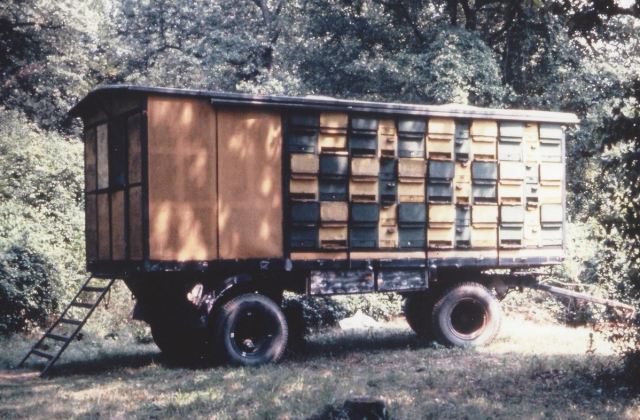
Portable apiary in Slovenia. (Photo by David Miksa)

Portable apiary in Slovenia. (Photo by David Mikša)

May 20 is World Bee Day. Seems an appropriate day to celebrate the bee. (So was yesterday; tomorrow would be good, too.)  It’s spring north of the equator. I don’t want to neglect our friends south of Earth’s belt, but honey bees began their world-wide conquest by expanding from the northern hemisphere. For most of us in the higher (positive) latitudes, May is a fantastic bee month. Colonies expand, swarm, and maybe even make a little honey.

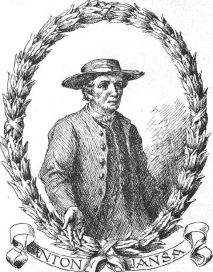
May 20th is also the celebrated birthdate of Anton Janša (1734-1773), the first teacher of modern beekeeping. (It’s ‘celebrated’ on May 20th, which was his baptism date. We don’t know the exact day of his birth.)  Anton Janša was Slovenian (hence the funny little squiggle over the ‘s’ in his name). He was so talented that Habsburg Empress Maria Theresa appointed him headmaster at the world’s  first beekeeping school, which she built for Janša in Vienna. It’s remarkable that he chose to be baptized on the same day that we would pick centuries later as World Bee Day. That date was chosen and promoted by beekeepers in Janša’s native Slovenia – do the coincidences never end? Now here I am, Ron Mikša (anglicized to Miksha), a bee blogger with grandparents who were born in that part of the world, encouraging you to do a wiggle dance in celebration of World Bee Day this Saturday. Get out and do something beely.
🐝 🐝 🐝 🐝 🐝 🐝 🐝 🐝 🐝 🐝 🐝 🐝 🐝 🐝 🐝 🐝 🐝 🐝 🐝 🐝 🐝 🐝 🐝 🐝 🐝

Last year, I wrote the following piece about World Bee Day.  Rather than sending you to the old posting to see it, I’m repeating it here for you…

There’s a small country in Central Europe, a very beautiful alpine country, called Slovenia. Slovenia has only about two million people, but this tiny country is very big in beekeeping. Tucked between Italy and Austria, it has both mountains and Mediterranean sea coast, creating enticing niches for bees.

Every Slovene family has at least one beekeeper. I think beekeeping might be enshrined in their constitution. I visited before they adopted the Euro and paid for a Laško with coins that had images of bees, not presidents or queens. Beekeeping is taken so seriously that the nation’s unofficial motto is “Land of the Good Beekeepers“. The country produces gourmet honey, offers beekeeping tourism, and likes to point out that the Slovenes – the wealthiest Slavic nation in the world – takes its work ethic from the honey bee. Now Slovenia is trying to convince the world to recognize World Bee Day, a day for the bees, which we would celebrate on the presumed birthday of their most famous beekeeper, Anton Janša.

Janša (pronounced YAN-shah) is a Slovenian national hero and a beekeeper. We don’t really know his birth date – his parents were illiterate farmers and probably wouldn’t have even known (or cared) what year it was. But their church kept track. He was baptized on May 20 in 1734.

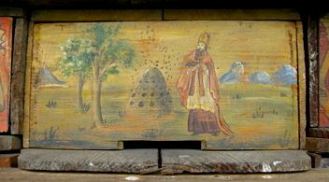
Beehive entrance plate, painted by Jansa.

Beehive entrance plate, painted by Janša.

The Janša family was impoverished, but three Janša brothers built an art studio in a barn, got noticed by the village priest, and were whisked off to Vienna, the capital of the Hapsburg Empire, which controlled Slovenia at the time. One of the brothers became an arts professor. Another became a beekeeper. The royal beekeeper.

Anton Janša was the beekeeper. Empress Maria Theresa recognized his skill and appointed him as the queen’s own bee man. Janša created the world’s first beekeeping school, wrote a couple of important beekeeping books, and introduced modern apiary management. He championed expanding hive boxes to hold extra honey and he encouraged migratory beekeeping, moving hives toward the foothills in the spring to collect acacia (black locust) honey, the Alps in the summer for honeydew from the pines, and into lower pastures in the fall. He was among the first to realize that drones are not water-carriers, but instead mated in the air with queen bees. This latter discovery pre-dates Francois Huber’s similar observation by a few decades but was not generally known when Huber rediscovered it. Janša did all this before he turned 40 – he was only 39 when he died suddenly from a fever.

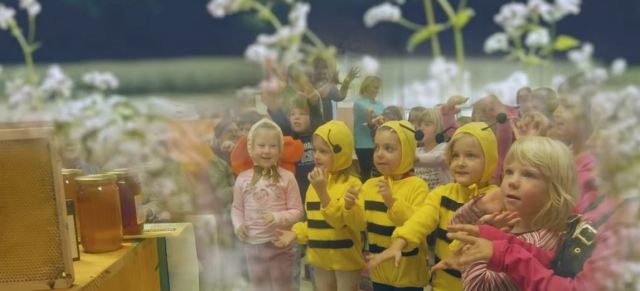
An image from the Slovene World Bee Day promotional video.

An image from the Slovene World Bee Day promotional video, visible below.

Here’s a lovely, short video of what the Slovenes want you to know about World Bee Day:

World Bee Day is a great idea. The exhibition “Save the Bees” will be opening at the historic Ljubljana castle, on May 20. The Slovene embassy in Washington DC had a big party. Elsewhere, awareness and round tables on “Bees and Sustainable Development” and bee memorials abound. World Bee Day is intended as a day to reflect upon the much maligned and threatened bees. A delegation of the European Union is also meeting May 20 with luminaries of the American bee world at a World Bee Initiative, which you can read about here.

WBDWorld Bee Day is immensely important. Maybe that’s why there are two world bee days. A group of Americans petitioned the USDA to create a World Bee Day of their own – on August 20th. While the Americans worked their idea through the US Congress, the Slovenes have been asking the United Nations to recognize May 20th as World Bee Day. I’m not sure how all this will play out, maybe the two world bee days will merge and be observed sometime in June or July. But I suppose both world bee days will persist, one on a world-scale, the other in the USA. As they say back at the bee lodge, “You can’t have too many World Bee Days, eh?”

Posted in Culture, or lack thereof, History, Outreach, Save the Bees | Tagged , , , | 5 Comments

PolliNation Podcast

Dr Andony Melathopoulos, host of PolliNation

Here’s a great new podcast. I’ve just listened to the first episode (twice!). If all the future episodes will be as good as Episode 1, PolliNation will be a great resource and a fun listen for beekeepers.  Since beekeepers spend lots of hours chauffeuring bees and boxes to their apiaries, bee podcasts are really popular. I’ve been told that podcasts keep bee folks awake during late-night long-hauls.

PolliNation’s focus is pollinators, of course. The show’s host, Andony Melathopoulos, is from my hometown, Calgary. He’s been a long-time friend. But that’s not the only reason I’m enthusiastic about his podcast. It’s seriously good, cleanly produced, and Andony’s enthusiasm and years of practical experience and research in bees shine in this venue. He’s operated his own hives, worked ten years as an apiculture research tech at Ag Canada’s Beaverlodge bee lab, and recently his investigations into the “Insect Pollination Benefits to Lowbush Blueberry” earned him a doctorate.

Andony recently accepted an assistant professorship at Oregon State where he specializes in pollinator health. Not limited to the managed species (honey bees, orchard masons, leafcutters, and alkali bees), he is tasked “to design, develop, implement and evaluate a state-wide pollinator health program” for all of the region’s pollinators. As part of the outreach for that role, Andony has created the PolliNation Podcast. It is set to excite the pod’o’sphere – at least that part of it that gets excited about bees and ecology.  (Which should be most of you.)

Episode #1, a conversation with Sussex Professor Francis Ratnieks on The Benefits of Bees in Urban Areas, mostly deals with the practical stuff which city-dwelling beekeepers need to know. You’ll hear tips on metropolitan beekeeping, selecting flowers for bees (though bees may ignore what you plant and fly 12 kilometres to fetch food from other people’s flowers, we’re told), and some safety notes regarding urban  hive keeping.

Professor Ratnieks

Professor Ratnieks knows what he’s talking about – he once kept 180 beehives, has done basic bee research, and is grounded in practical beekeeping. He helps us understand that if beekeeping is motivated by the noble desire to “Save the Bees” then the urban ecologist’s efforts might be better spent planting nectar/pollen-rich flowers rather than keeping honey bees. Ratnieks suggests eschewing lists of pollinator plants on the internet. Instead, he says, use your own eyes to see which flowers attract insects in your area. When you visit a garden centre or a neighbour’s bright blooming spot, note the plants with the most pollinators on them and consider planting those varieties.

Regarding the why-for of urban beekeeping, Ratnieks says that some people claim that cities are better than the countryside for bees. However, on average, the professor believes there is no clear advantage for your bees to live in town. In Ratnieks’ opinion, the main reason to keep bees urbanly is if you live in the city and want the joys of beekeeping close at hand. However, he adds, beekeepers probably shouldn’t be learning (and making mistakes) in a small garden behind the house.

I’ll leave it to you to listen to the entire 30-minute podcast, but here are some of the questions considered on the program:

– What are the particular challenges of a city beekeeper?
– Where are you going to put the hives?
– What if the bees become aggressive?
– How should you handle city swarms?
– If you use a lattice windbreak in the garden, will the bees fly up and over it, avoiding pedestrian traffic, or just fly thorugh the lattice holes and scare everyone?

Check out PolliNation for the scientists’ thoughts on these. Oh, and my favourite quote from Professor Ratnieks:  “A bee is a hairy vegetarian wasp. In the case of the honey bee, it’s a social hairy vegetarian wasp.”  PolliNation is available from I-Tunes or directly from Oregon State University’s home site for the program – don’t miss it.

Posted in Ecology, Friends, Outreach, Pollination, Save the Bees | Tagged , , , , , | 10 Comments

A One-Minute Mukibrain Bee Break

Here’s another delightful video from our friend at Mukibrain. Muki, a talented videographer, artist, film-maker, BMX acrobat (since age 12), and Cirque du Soleil performer, has a thing for flowers and bees.

Tempo of Bees is a short and sweet one-minute film heralding spring in Muki’s France.  Best viewedd in the morning.  See how many flowers you recognize. Most of them, I hope!

Video and music by Muki:

Posted in Culture, or lack thereof, Movies | Tagged , , | 2 Comments

Grade Six Kids’ Mite Detector Invention

What’s with kids who develop tools to attack mites and save bees?  A few weeks ago, I wrote about a group of Spanish youngsters on their way to Australia to compete in an international meet with their invention that may comb varroa off the backs of honey bees as they enter and leave hives. It’s 3-D printed and has a brilliant design.  Today, I find a bunch of American kids (in Ann Arbor, Michigan) who have a patent-pending device that can slip into a box of bees and detect mites. I’m thinking that it’s some sort of laser-carrying mini-robot, but the kids aren’t saying.

Varroa mite detection is the essential first step in any responsible mite-control program. One of the most reliable methods of mite detection involves grabbing 300 bees, drowning them in alcohol (or winter antifreeze), shaking the dead bees for a long while, then counting the displaced mites.  Less murderous methods include powdered/icing sugar rolls and sticky boards. Those also have drawbacks – the former is less accurate, the latter more expensive and time-consuming. But counting is important. Without knowing the mite count, the beekeeper may ignorantly (but blissfully) watch her bees die of mite-vectored viruses or may medicate when treatments aren’t needed, thus engaging in weapon-resistant mite farming.

If these kids have something that can quickly, easily, cheaply, and accurately count mites, they have invented a better mite trap. The kids haven’t divulged details about their almost patented system, but the president of the Southeastern Michigan Beekeepers Association field tested it and says it works.

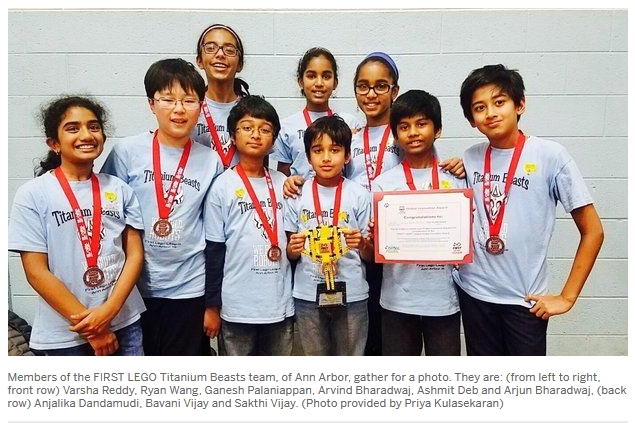
Winning their local competition, the Ann Arbor middle school students team is among just 20 groups chosen from around the world who have earned a trip to Washington, D.C., next month to compete for the FIRST LEGO League “Global Innovation Award”.

Congratulations to the rookie robotics team for inventing their BeeAlert+.  The team, called Titanium Beasts, is made up of sixth-graders Anjalika Dandamudi,  Arjun Bharadwaj, Ashmit Deb, Bavani Vijay, Ryan Wang, Sakthi Vijay, Ganesh Palaniappan and Varsha Reddy,  and third-grader Arvind Bharadwaj.

With the Spanish kids’ mite catcher and now the American kids’ mite detector, it’s reassuring that the next generation may be able to fix the problems that my older generation have been battling. Thanks, kids.

Posted in Diseases and Pests, Save the Bees, Tools and Gadgets | Tagged , | 4 Comments

Bee Rustling Undone

Stolen bees?

Ever been robbed? I have. It’s a pretty sick feeling when you realize that someone has broken in and taken your stuff.  Imagine how a Montana beekeeper felt when he entered his apiary to work his bees but almost 500 colonies were gone. Man, that’s gotta hurt.

But finally some good news from the world of bee rustling. Someone was caught. A full semi-load of bees (488 colonies) were lifted from Montana beekeeper Lloyd Cunniff’s operation while his bees visited California for almond pollination. Ag agents found the bees (estimated value $170,000) in a Fresno County cow pasture and drainage ditch. His were among ten other big bee thefts reported in seven California counties this spring.

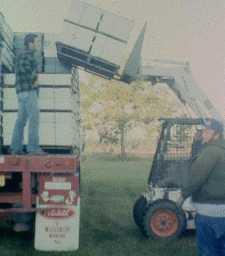
Loading my bees in Florida for a trip to Wisconsin clovers. Nothing stolen.

Pulling off a bee theft isn’t easy. At this scale, the thief has to be a commercial beekeeper with appropriate off-road forklifts, a flat-bed semi, and some bee knowledge. You can see what loading bees looks like – that’s me on the trailer in this picture. My bees and I were preparing to leave Florida, heading for northern clovers.

Big bee thefts take two or more people, and someone is always more willing to talk than go to prison. And the stolen property is usually easy to recognize. Although most beekeepers use similar Langstroth hives, most modify their equipment, many have unusual home-made pallets, operate 8-frame, or 10-frame, or double-deeps or triple-Illinois depths. Hives could be painted white, silver, camo, or rainbow. They are unique. Once stolen, beehives are hard to hide, even in drainage canals. Someone’s going to notice.  Finally, commercial guys brand their wooden equipment with a hot wood-burning tool that engraves their name, initials, or other marks. Frames, hive bodies, maybe even lids and pallets get branded.

Who owns this equipment? The name ‘MIKSHA’ burned into the wood is a clue.

My oldest brother was once stopped by state troopers while he was hauling is own bees on his own rig. The cop wanted his ‘Bill of Lading’ to identify whose bees were being trucked down the highway.

“Don’t have one. There’s no sale, so no bill of lading.  These are my own bees and hives.”

“Can you prove that?”

“Well, they are all branded.”

My brother meant that all the bee equipment was branded. The trooper thought he meant that all the bees were branded and the cop wasn’t going to start checking each one, so he let him go. Besides, maybe my brother looked honest.

Meanwhile, back in Choteau, Montana, a couple hundred miles south of my home in Calgary, Mr Cunniff reaquired most of his stolen hives last weekend. He put them in separate apiaries, away from his other hives, in case they came back to him with diseases or mites. But already he has lost a lot – he likely would have managed them better than the thief had. The Montana honey season is coming soon with alfalfa and sweet clover already opening. These bees, though finally back in their owner’s hands, won’t produce as well as his other colonies will.

Posted in Beekeeping, Commercial Beekeeping, Pollination | Tagged , , | 8 Comments

Field School at the Bees

Chinook Honey – 20 minutes south of Calgary, near Okotoks, Alberta.

Last weekend, the Calgary bee club’s introductory beekeeping course wrapped up with our field school section. After 2 full days (15 hours!) of instruction, participants had a chance to observe, study, touch, and ask questions about the innards of live hives.  We were lucky to have great weather and a great venue this year.

Instructor Neil, unveiled. Did I mention the mountains?

We (over fifty of us) met at Chinook Honey Company, an outstanding bee farm owned/operated by remarkable folks who have been into bees for about 20 years. You might remember an earlier piece I’d written about Art and Cherie Andrews. With their honey shop, store, meadery, and some healthy hives nearby,  it was the perfect place to give newbies some bee exposure.

Overwintered single-story (yes, even on our cold windy Canadian prairies!), an unwrapped hive obviously enjoying a pollen flow. Note the entrance reducer. A syrup feeder, in black,  sits under the hive cover.  (Photo credit: Laurie McClure)

A (potentially) grave aspect to leading novice beekeepers to isolated apiaries are the risks of allergic reactions and panic attacks. Holding our field discussions at an apiary in the backyard of an established bee outfit (Chinook Honey) with good cell phone reception and just five minutes from a hospital helped relieve my anxiety. You never expect problems (and there weren’t any!) but the good beekeeper is always prepared. Before starting, we checked that participants were properly white-suited and veiled. We asked if everyone was comfortable and invited the students to be aware of their fears and to alert us of any stings. We allowed cool puffs to drift from a properly lit smoker before any hivess were opened and we worked calm, relatively weak colonies. Keep these things in mind if you take friends into the depths of your own hives.

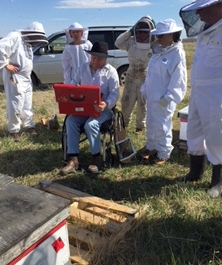
Students, left, examining a hive while Calgary bee club president Thomas gears up.

Photo Credit: Joycelyn Odney

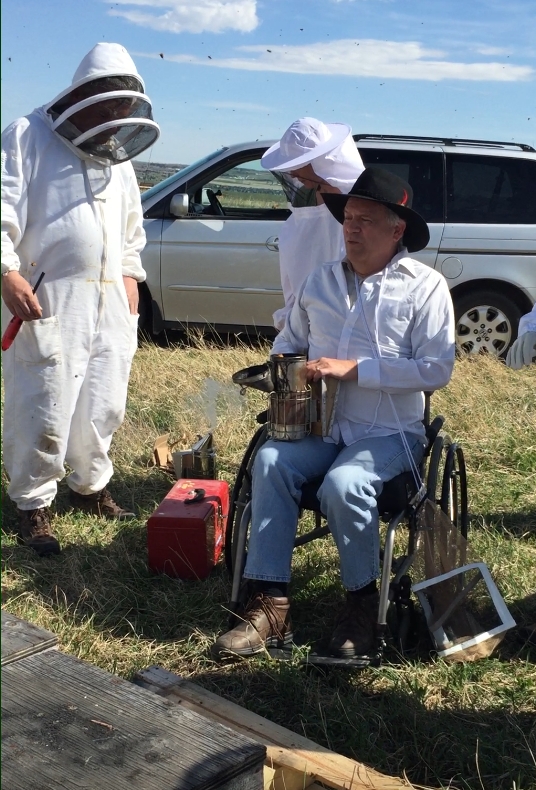
‘Tis I, to your right, in the wheelchair. I’m holding a red metal box which I picked up at Canadian Tire (a hardware/car parts chain). The box was part of our safety demonstration – 2017 is Prevent a Fire in Your Bee Yard Year.  Smoker safety is incredibly important. I haul my smoker inside the metal box where flames gasp for air and sparks fall on steel walls.  Consider such a box in your future.

After smoker-talk, we found queens. Since it’s still ‘early’ spring up here near Canada’s Rocky Mountains, the overwintered hives are just building up and queens were easy to spot. This is a thrill for new beekeepers – actually catching sight of her majesty, the mother of all bees. We discussed queen quality and techniques for releasing queens into packages  and for introducing queens in splits.  Part of the talk centered around helping the bees and queen accept each other. Young foreign queen bees are vulnerable to palace coups. This is a common issue this time of year. In a day or two, I’ll cover some of what we mentioned to the class about introducing queens.  For today, I mostly want to post photos of our day at Chinook Honey.  Enjoy!

Posted in Friends, Outreach, Tools and Gadgets | Tagged , , , , | 5 Comments

Metallica’s Beekeeper

James Hetfield: beekeeper and Metallica man

Last year, I wrote about the indomitable guitar man and bee guy Steve Vai. He’s a master of the strings and knows few equals. He’s also quite an experienced beekeeper.  Now it’s Mr Metallica, James Hetfield, who draws my beely attention. I wonder what happens to guys like these two when their wrists and fingers get lit up by defensive bees the day before a big concert. I suppose the show must go on.

Anyway, I rather like Steve Vai the Bee Guy, but was never enamoured by the loud, throbbing noise which Metallica generates. Well, not much, anyway. In moderation, I can take a little metal. (For example, I liked the Norwegian band, Miksha, but that’s mostly because they named themselves after me.)  So, it’s “Metallica in moderation”, which has a nice oxymoronic quality about it.

Nevertheless, kudos to Hetfield of Metallica. Hetfield, like thousands of other musical beekeepers, has discovered that spending time with bees can do wonders for pre-concert anxieties. It can also swell one’s ankle, as Hetfield describes in one of his bee adventures: “I had to move a hive one time… I’m in my beesuit, everything is fine… [but] one area of my ankle was exposed and, of course, I end up with about 20 bee stings.”

I like this admission from Hetfield, who had to submerge his fat foot in a bucket of ice water for a few hours. There’s something else to admire about the man with a rough childhood, a scary presence, and a long battle with alcohol. He said this about the real nature of manliness: “There’s a lot of machismo in this world, but I suppose the most manly thing you can do is face up to your weaknesses and expose them. And you’re showing strength by exposing your weaknesses to people. And that opens up a dialogue, it opens up friendships, which it definitely has done for me.”

If you need to know more about the iconic 80s metal-man, James Hetfield is the subject of a 2017 biography, So Let It Be Written. Written, not in stone, but in metallica, of course.

Posted in Culture, or lack thereof, People, Stings | Tagged , , | 4 Comments

International Workers’ Day

Worker Bee (Credit: Stephen Bennett, Bears’ Paw Honey, Calgary)

My home city of Calgary celebrated May Day (International Workers’ Day) by welcoming 1,176,334 foreign workers into our community last night, doubling our population. 196 packages of worker bees had arrived. A swarm of Calgary beekeepers greeted the immigrants. (The arriving bees were carrying New Zealand passports.)  Most beekeepers picked up just one or two cages of bees. For many, it was their first Apian experience. Dozens of newbies drove home with the seed of their first honey crop. The bees (and their attached beekeepers) will do an amazing amount of good for our community.

Package bees arrive in Calgary. 196 cages. 6,000 bees in each.

In our area, package bees grow into strong colonies in two months. By July, they blossom from their original colony of 6,000 bees to over 40,000. They will pollinate billions (yes, billions!) of flowers. The 196 packages should collectively provide ten tonnes of fresh honey this summer for the new beekeepers. They will also make enough honey to survive the winter of 2017-2018.

The future for a package?

A side-benefit of having all these new bees is that they come with a big group of new beekeepers who generally share laudable goals for our city’s health. Beekeepers encourage maintaining wild spaces and they usually favour reducing the use of herbicides and insecticides. This, in turn, assures that hundreds of millions of other bees – native bees like bumblebees, for example – will also flourish in our town.

Thomas, the Calgary bee club president, coordinated the big bee distribution. Then he arrived at my house with two of the 196 packages. In my old van, I drove all 12,000 of us to a friend’s place just outside town where Thomas and I helped some new beekeepers establish those packages. It was a chilly evening but things went smoothly. The bees were calm and appreciated their release into their new home of drawn combs with honey and pollen. I think they will do well. It’s a marvel that the two small clusters of bees and their queens will grow from no brood to ten or more frames and may make a hundred pounds of honey.

I hope that the other beekeepers who collected bees from the delivery truck last night had as much success and pleasure establishing their new responsibilities as we did.  Bee season has begun.


Posted in Beekeeping, Ecology, Friends | Tagged , , | 4 Comments