

Wax worms in a honey bee hive. (Credit)
Hundreds of diseases and pests attack honey bees. One of the oldest known hive invaders is the wax moth. Aristotle had trouble keeping them out of his hives so maybe you do, too.
 Wax moths come in two flavours – lesser and greater. They are both of the same tribe, Galleriini. (Tribe is the scientific classification between Family and Genus.) The Lesser Wax Moth is the lesser of your worries. It’s smaller and less destructive. Its bigger cousin, the Greater Wax Moth, can kill colonies so we’ll take a moment to consider it.
If you are a northern beekeeper, as we are here in Alberta, Canada, you don’t fret much about the greater wax moth. Frost kills it. Beehive equipment stored in an unheated shed receive all the treatment necessary to destroy wax moths. In a hot climate, the wax moth is repelled by strong hives and the wax moth worms never take much of a bite out of a hive. But weak hives are vulnerable, as are honey boxes stored in warm places.
 The wax moth sneaks into unoccupied comb or poorly defended hives and lays eggs. These become worms – larvae or caterpillars – which wriggle around on the combs, eating wax and pollen, weaving cobwebs, and crapping all over the place. They are nasty dirty. Not only do they eat your equipment, they leave behind a mess that can make you puke as you scrape and clean, then refit new sheets of foundation in the old frames. Welcome to beekeeping. The greater wax worm costs beekeepers millions of dollars worldwide in lost equipment, smaller honey crops, labour costs, and even defeated colonies that need restocked. But they have an upside.
Honey bees are susceptible to diseases such as American Foulbrood. A wild hive inside a hollow tree eventually picks up AFB, becomes weak, and succumbs to wax moths. The worms of the moths eat the hive’s wax, honey, and pollen while the sick colony dies. This eliminates old diseased combs that might contaminate other honey bee colonies for years.
 The greater wax moth offers another bonus. For a couple of centuries, southern fishermen have set aside an old comb or two for the moths to invade, then they’d pick off the fat juicy worms for fish bait. I’m told that bass and catfish love the treats, though I have no idea how they acquired a taste for a worm that originally lived on wax combs in hollow trees. But I don’t question a fisherman’s success. I’ve enjoyed properly prepared, pan-fried aquatic craniates lured from ponds by plump wax worms.
Now there’s another use for wax worms. Scientists recently discovered that a wax worm puree dissolves plastic bags. The same chemicals used by wax worms to decompose complex beeswax carbon molecules enable digestion of polyethylene.
We – the humans of planet Earth – produce over 300 million tonnes of plastic each year. (That’s about one and a half kilos each week for each of us.) The stuff is made from carbon (mostly from petroleum) but it doesn’t easily convert back to its original natural state once it has been fashioned into shopping bags, yogurt containers, and Barbie dolls. Those products – so essential for to our modern society – last hundreds of years in landfills or bobbing around in the sea. But, as the wax moth discovery suggests, plastic may be eaten by worms. If so, the crappy mess found in beehives might perform a delightful garbage dump chore.
 Credit for the observation that wax worms eat plastic bags goes to backyard beekeeper Federica Bertocchini, a Spanish biologist. Two years ago, she bagged some wax worms that had invaded one of her hives. An hour after incarcerating them in the baggie, they were eating their way toward freedom. This event was reported to fellow scientists at the University of Cantabria where they initiated a plastic-eating project. They soon discovered that 100 wax worms eat about 100 milligrams of polyethylene in twelve hours. A thousand such worms (not an uncommon number in a hive of bees overrun by wax moths) might eat an entire plastic bag every two days.
The next step was to figure out whether the worms were simply shredding the plastic to tiny bits (which would not really be breaking down the long carbon polymers) or converting the material into food instead (the ideal biodegradation of plastic).
 It turns out that wax worms produce an enzyme that reduces polymers to edible compounds which are no longer plastic. They evolved the enzyme during their millions of years of cleaning up diseased honey bee nests. At the molecular level, beeswax and modern polymers share a similar carbon backbone structure. Wax worms actually digest beeswax and they do the same with plastic, using the worms’ same chemicals.
In their lab, the scientists made warm wax worm soup (or Worm Puree – you can make this at home with your own blender, if you like). Smearing the liquefied worms onto plastic, they observed the biodegrading property. It works, but application is slow, awkward, and messy. And it takes a lot of dead worms, which would raise eyebrows over at PETA. So, the scientists are studying the worms’ chemical compounds and hoping to graft enzyme-producing genetic alleles into bacteria (whose advocacy group is less vocal than PETA). The goal is to spray the engineered bacteria around our landfills, quietly converting plastic bags into grease puddles. Just don’t park your Saturn SL1 too close.
Let them eat plastic.

 Professional Canadian beekeepers know the names of honey packers Jack Grossman and Paul Doyon. Jack started
 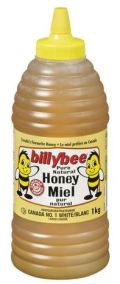 The Billy Bee man, Jack Grossman, was from Toronto. After serving in World War II, he kept a few hives behind his house. He packed honey in his garage and got into some stores. To meet demand in Ontario, he bought honey from other beekeepers. Business grew. His reputation for fairness and timely payment made him popular with beekeepers. His consistent, high-quality honey made his Billy Bee brand a big seller across Canada. Paul and George Doyon started their packing operation in 1927. I suspect that their story is similar because that’s the way you build a business. Honesty, consistency, fairness.
 As beekeepers, we depended on the Doyon and Billy Bee sales. They bought Canadian honey; sold Canadian honey. In recent years, stories of McCormick importing some foreign honey for jars of Billy Bee were disappointing, but not unexpected. Honey is cheaper when it comes from countries with lower wages and possibly lax sanitary requirements. Imported honey can be good quality (though there are some horror stories), but supporting Canadian beekeepers is the right thing to do. Besides, our beekeepers use some of their honey money to buy McCormick’s paprika, cinnamon, and ground black pepper. Keeping the money at home allows Canadian beekeepers to buy McCormick products and to keep other Canadians working – building their shops, repairing their vehicles, making their skidoos. But, most important, honey produced in Canada can be readily inspected, traced back to source, and must reach high quality standards to satisfy customers.




 America has 21.5 million university grads with science degrees. About 12 million actually work in science while the rest are retired or resigned to spend their working days doing more lucrative non-science stuff (lawyers, doctors, administrators). Of the several million with ‘science’ degrees who work as ‘scientists’ I would guess only 5 to 10 percent participated in the March. I’m a geophysicist. Though I wasn’t tinkering with seismic waves this weekend, I was tied up










 Bad Beekeeping Blog