

This weekend, we celebrate Earth Day. And why not? There are official days for glazed spiral ham (April 15), chocolate covered cashews (April 21!), and bee sting enthusiasts (March 30). So, Earth should have a day of celebration. As a professional geophysicist, I’d like more knowledge, interest, and respect for our grand old blue dot and her interconnected systems. But this year, Earth Day will be combobulated with a March for Science.
The Science March website says, “Science isn’t Democratic or Republican, liberal or conservative.” True. Scientific discovery means testing ideas and observing outcomes. Making guesses about what’s going to happen before an experiment is conducted. Attempting to separate one’s preconceived from one’s observed reality. That should be non-political. So, why is the March for Science convoluting support for science with the civil rights of marginalized people and attacking science for past failings (under-representing minorities, eugenics, unethical medical experiments)? A few weeks ago, The March declared that ISIS represents a marginalized people. Good God, one would hope so – the more marginalized, the better. The March has since retracked its implied sympathy for terrorists. But the fact that the idea would even surface within a group marching for science advocacy is discouraging, to say the least.
Officially, March for Science says it’s “a celebration of our passion for science and the many ways science serves our communities and our world.” Although ostensibly non-political, it’s apparent that the march grew from justified concern over the new president’s obvious disdain for science. Had it stopped with that symbolic (and subtle) political statement, I’d be writing quite a different piece here today.
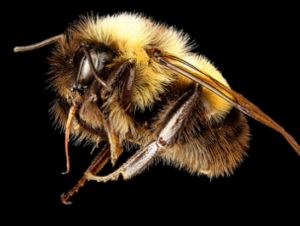
Endangered rusty patch bumblebee
(Credit: USGS)
Among the many gaffes already committed by Trump’s regime, we see muzzles on scientists, refutation of climate science, dismembering of environmental protection (EPA was started by Richard Nixon), and the delay of adding a fuzzy bumblebee to endangered status – not because its numbers have recovered, but because the cuddly as kittens creatures are apparently among animals not important enough to be urgently protected.
Entomologists will be marching. They are likely not marching in solidarity for marginalized terrorists. Instead, they are worried about the unhealthy, politicized (from both sides), under-funded state of science in today’s polarized atmosphere. It takes a lot of patrons to support research on varroa mites’ virus transmissions within a bee colony. Beekeepers don’t have ten million dollars to outfit gene sequencing gizmos, sterile incubators, and extensive apiaries dedicated to honey bee research. This takes a concerned public willing to ante up the cash that will eventually win the pot of tools that keeps pollinators alive.
Thomas Jefferson and Ben Franklin both had state of the art science labs in their homes. In the 18th century, their equipment could be bought with a few months’ wages. A lot could be learned from a kite, a key, and a thunderstorm. Even then, however, the new American government was allocating money to universities for ‘improvement of agriculture and animal husbandry’ and for pure research such as excavating the massive trove of mastodon bones at Bone Lick, Kentucky, in 1805.
Science has been the backbone of America’s strength and its progressive growth for centuries. If you are participating in the March for Science, you are showing commendable support for science and reason. Go ahead and wave your banner proudly – as long as the words on the banner convey support for science and not some confusing identity politics message. Make it a march for science. Something that conservative Christian scientists (and there are some) as well as rationalists can support. Then go back next week and march for greater equality and more diverse representation in science and society. If you can’t keep politics separate from science support, you risk alienating your potential allies. Saturday’s Earth Day March for Science should be a march for science.
🐝 🐝 🐝 🐝 🐝
PostScript: On Week Later. It’s now April 28, a week after I’d written the piece above. The March for Science bothered me a bit. I’m still grateful for support for the sciences, but my concern was for the party atmosphere that seemed to engulf the serious business of standing up for science. The shades of Huxley’s Brave New World became more clear to me when I read this article (Are We Having Too Much Fun?) in The Atlantic today. Read it yourself and you’ll see why Aldous Huxley, Neil Postman, and I are less than celebratory over the March for Science. And, there’s photographic evidence.









 “The world has been hot before; it’ll be hot again.” Have you heard that one? It’s sort of right up there with, “House fires happen; they’ll happen again.” In the distant past, a build-up of CO2 was partly responsible for polar icecap melt which resulted in higher seas, heat, humidity, and dinosaurs. High levels of carbon dioxide trap the sun’s heat and the planet’s surface warms up. It’s elementary physics and not exactly rocket science. However, most scientists are amazed at the speed of the global meltdown. We really thought we could pass this problem along to our grandkids.






 Bad Beekeeping Blog