The Perfect Honey Jar

honey bottle Serbian jar design Tamara Mihajlovic

The Future of Honey Packaging?

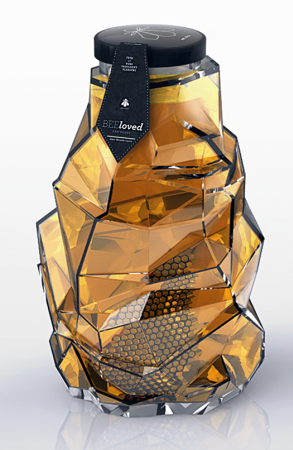
Forget Steve Jobs and all that i-stuff. If you want to talk about design that trumps utility, then look at what Tamara Mihajlović and her co-designer Njegos Lakic Tajsic have created. This is magic. A brilliant honey container like none we’ve ever seen. Crystal-shaped, with a pyramid of honeycomb in the centre (maybe made of plastic?) it is a bright and unique way to showcase honey. Some describe it in crunchy words like “organic, crystalline, and rock-like” while others just gaze at in awe. Why did no one else think beyond dull boring glass jars and cutesy squeeze bears? This honey container is elegant, gorgeous, and totally impractical.

A pair of Serbian designers created this container as a graphic arts project, then made up a fictitious company (BEEloved Honey) to pretend to sell their beloved honey. But would anyone actually buy non-existent honey, if not for the gorgeous bottle? Certainly, I would, if I had a few thousand pounds of honey to market through gift and gourmet stores. And it would support an enterprising young couturier. Tamara Mihajlović is a 23-year-old Belgrade graphic artist studying at her university’s faculty of Art and Design. She has also been art director and a technical editor for Politikolog, a local political journal. Her other recent creations include a series of anti-Aids posters and music festival ads.

Of course it’s impractical. Granulated honey will stick to the wee little crevices and refuse to exit the bung. But that could be resolved with a quick dunk in a hot bath. Besides, the combo honey and jar looks too good to open and eat, so it is likely to remain corked on a granite countertop for years. A bigger problem is that no one will likely bother to adapt an automated packing line that could fill 5,000 of these odd-shaped bottles in a day. But that’s not the place such a container should be used. Instead, I can imagine a thousand artisanal honey makers filling a hundred of these lovely packages over a couple of weekends in their tiny shops. Then they would retail their honey in Tamara’s classy container at gift shops. No Walmarts, Walgreens, or Krogers for these beauties.

If you own a little honey house tucked in a woods, you might be wondering where you can order these lovely containers. Alas, you can’t. Not yet, anyway. Mihajlović and Tajsic are still seeking a company willing to manufacture these honey bottles. If you are that adventurous bottle-maker, this might be the i-jar you’ve been waiting for.

Posted in Culture, or lack thereof, Honey | Tagged , , | 5 Comments

Keeping ahead of the sheep

sheep

Thinking Like Sheep?

Democracies often work better than dictatorships. Democracy is based on crowd decisions, or, in the trendy new parlance, crowd sourcing. Crowd sourcing really came of age with the internet – put your question, issue, project, or some politician’s dirty laundry on the internet and wait for the responses. (If you are wondering about this site, I set it up without instant crowd feedback, but you can write to me any time at miksha@shaw.ca.) We like to think The Wisdom of Crowds, as one book calls it, is a new development. But our indefatigable honey bees have been group-thinking for millions of years.

Who, among the colony, decides where a swarm will settle? Four hundred years ago, the answer was “That big bee over there, see him? The King. He decides.” (It was the great Greek philosopher Aristotle who first declared the hive was ruled by a king bee. His mistake lasted 2,000 years. By the way, Aristotle noticed that the queen, i.e., his king, has a stinger which, in his logic, meant it was a male.) An English pastor, Charles Butler, realized the king is the queen and wrote about it in 1609 in the Feminine Monarchie, the first English language beekeeping guide, a book that went into five editions and dozens of printings. He imagined she is an Amazonian, a strong and fearless female similar to Queen Elizabeth, his patron a few years before Feminine Monarchie was written. So, is it the queen who makes important decisions in the hive?

Wrong again. The queen is not a leader, she is just a hapless overgrown egg factory, and one of the most helpless of the bees in the colony. The real leader is a worker bee named Betty Sue. She calls all the shots. She decides when to swarm and where to settle, among many other things. Lucky for the bees, there is more than one Betty Sue in each hive. Tom Seeley, in his excellent Honeybee Democracy, explains that beehive group-think results in better choices than any single individual Betty Sue might make on her own. According to Seeley, about 3% of a colony’s members are actually involved in the scouting and decision making, but that means over 1,000 bees are in that clique. This creates a lot of varied perspectives, observers, and decision-makers. Once that sub-group resolves a choice, those Betty Sue clones will buzz, shake, and rattle their compatriots into also agreeing and then venturing off to the new nest site. Apparently, witnessed by their survival since the Cretaceous, honey bees have used this as their successful ploy for a very long time.

Contrast this with what Henry David Thoreau essayed about humans in 1838: “The mass never comes up to the standard of its best member, but on the contrary, degrades itself to a level with its lowest.” That might be true among television viewers, but when working with large groups of people tasked with contributing to a project – and given a democratic opportunity to question and revise the work of others – the cumulative result is better than the achievement almost any single contributor could have produced. In The Wisdom of Crowds, author James Surowiecki uses an example of a jar of jelly beans and a classroom of bean counters. The class submits a secret ballot – guessing the number of beans in the jar – and the average of the group (for groups over twenty or so) is always better than the worst individual guesses made (mathematically, it should be). But more importantly, it is usually better than the best guess. Contrary to Thoreau, the mass is not degraded to the lowest member’s level.

Posted in Culture, or lack thereof, History, Swarms | Tagged , , , | Leave a comment

Talking about bee science

Marla Spivak Ted Talk honey bees

Marla Spivak, giving her TED Talk

Ted talks and so do bee scientists. Maybe you know Ted. TED, actually with capital letters, stands for Technology, Entertainment, Design, and the TED Talks are a series of conferences with great (entertaining) speakers. The talks are filmed and then loaded to the TED Talks website, which has over 1,500 talks (by speakers such as Bill Clinton, Bill Gates, Jane Goodall, Richard Dawkins, and a number of Nobel Prize winners) where anyone can watch them for free. Actually, the non-profit, Sapling Foundation, that hosts TED talks has released the talks into the Creative Commons, making them available for public use with a few restrictions.

You can see a really great TED Talk by Marla Spivak, one of the smartest of all bee researchers, at this link. Her 15-minute TED Talk lists three or four reasons bee colonies die off. Two of her explanations are basically aspects of the same thing – fundamental changes in agriculture, the other two are chemicals and pests.

So, here is a bit more detail on Marla Spivak’s list of the killers of bees. Very briefly (please watch her short video, Marla is a great speaker), the culprits are 1) diseases and pests – especially varroa mites, for transferring viruses and for beeing the bloodsuckers they are; 2) monoculture, which includes the collapse of the family farm and the loss of natural habitat, and has created ‘food deserts’ where only one meal is served (at most) for just a few weeks of the year; and, 3) chemicals, including insecticides, fungicides, herbicides, and the break-down chemical compounds of these complex molecules. You can see these are inter-related. Farming changed, leading to huge efficient monoculture enterprises where pests proliferate unless controlled by chemicals while varroa weakens the bees so they are more vulnerable to the problems brought by chemicals and poor nutrition. The result? Not so good for honey bees.

Posted in Beekeeping, Culture, or lack thereof, Diseases and Pests, Pesticides, Save the Bees | Tagged , , , | Leave a comment

Invasive bee hives

Bees in New Amsterdam

Dutch Hives in NYC: The First Arrived 400 Years Ago

Dutch bee hives in Manhattan? Of course. Four hundred years and counting. New York was known as New Amsterdam by its first settlers, the Dutch from Holland who arrived on lower Manhattan Island in 1614. That’s even before the Pilgrims hit the rocks in Massachusetts. New Amsterdam was the capital of New Netherlands and once claimed all of present-day New Jersey, Maryland, and Delaware, as well as much of New York, Connecticut, and Rhode Island. It was funded by the Dutch West India Company which had built settlements all over the world. The Dutch thought they’d enter the fur trade, but failed to grow their Manhattan city enough to keep ahead of the English who swooped down from New England, defeating the Dutch in the Battle of Wall Street, around 1665. The English gained control of beehives that the Dutch had brought across the Atlantic as early as 1616 or so. By then, those bees had made The Island their home for fifty years.

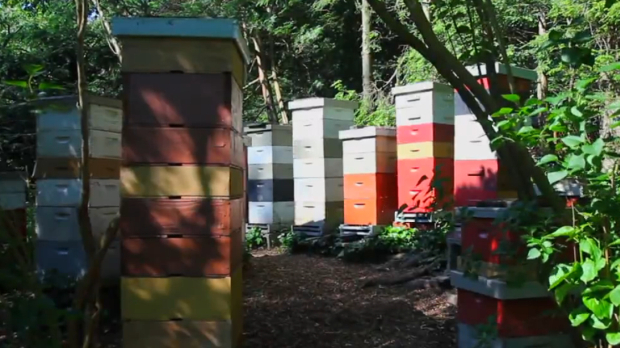
I am writing about this because I saw a story that got me thinking about how bees ended up in America. I’m linking to the story about some Dutch bee boxes that were noticed by Irene Plagianos, a Manhattan writer reporting from the NYC financial district. The photos of those hives, which you can view in a ‘slide show’ by jumping to this link, shows brightly coloured equipment and happy Manhattan beekeepers.

Dutch bees in Manhattan? Honey bees are an invasive species. I sometimes tire of beekeepers who claim to be ‘natural beekeepers.’ These are the folks who drive their natural SUVs out to their natural hives every weekend, light a natural steel-bodied smoker, open the hive with a natural metal hive tool and manipulate the natural top-bar frames made from western pine or southern cypress. Then they manipulate the invasive insects which were hauled into North and South America, Asia, Australia, and the Pacific Islands by boat a few hundred years ago. I doubt that many who belly-hoot the merits of their natural beekeeping realize that all beekeeping is unnatural. Attend bee meetings and bragging about natural beekeeping is committing any oxymoron. Honey bees are not natural in most parts of the world. And beekeeping – keeping bees in houses of human design – is not natural anywhere. Robbing bee trees, perhaps, but not beekeeping.

Who’s calling Who an invasive species? Whether you believe humans walked out of Africa or were chased out of Eden, either way we have done a pretty decent job of populating the planet. A frighteningly decent job. From creationists’ estimates of 2 originals (or from some evolutionists’ estimates of 10,000 people during our ‘bottleneck years’) we now number 7,000,000,000 and have set up tents almost everywhere. (Congratulations, humans.)

What do I think? Humans, the invasive species, has introduced honey bees, another invasive species. We’ve also transplanted apples and alfalfa and almonds and a thousand other things from other parts of the world. It’s what we do. What would Italian cooking be without South America’s gift of tomatoes? Or Montana honey without European bees and Asian sweet clover? As we go about the practical business of feeding seven billion souls, we have to do some unnatural things. I’d rather have the world functioning as it does than to role back to the time when Eve’s children were not reaching their 35th birthday and most children died in their first year. People live much longer and much healthier lives under this new, unnatural system. Undoubtedly, we have a lot of mess to clean up. We need strongly enforced laws around pollution and pesticides. But little of what we do with our bees is particularly natural. But that’s not a bad thing.

Posted in Bee Biology, Culture, or lack thereof, Ecology, History | Tagged , | Leave a comment

The economist’s bees

Bees in New Jersey

Gary Shilling’s New Jersey Bee Yard

You can be one of the smartest economists in the world, and still not realize beekeeping is a lousy investment. The celebrated author and public speaker, Gary Shilling, who writes for The New York Times, Forbes, and The Wall Street Journal, and has apparently had a British coin named after him, nevertheless persists in keeping bees in his New Jersey back yard. A news team landed in his apiary and reported “It’s An Awful Lot Of Work To Raise Honey Bees In A New Jersey Backyard.” I imagine it’s an awful lot of work writing for the Wall Street Journal, too.

This guy, by the way, is a real beekeeper. The video news clip from Business Insider begins with Mr Shilling mixing something in a five-gallon bucket, workshop door wide open, and equipment stacked all over the place. Then it shows him igniting his smoker with a wildly flaming blow torch. Love the enthusiasm. The camera next swings up to his bee yard with a gorgeous shot of the hives, stacked higher than a basketball player and painted camouflage green. Except for some nasty creepy crawlers on the bottom board, things are neat and tidy. OK, maybe he is not a real beekeeper – things are too neat and tidy.

Does Shilling find beekeeping easy? After describing how the 85-pound boxes keep his tummy muscles in shape, he goes on to say that beekeeping is amazingly intellectually challenging. But you knew that already. What does Gary Shilling do with his 4,000 pounds of honey each year? He could probably retail it for $30,000, but he gives it away instead. Are we sure he’s an economist?

Posted in Bee Yards, Beekeeping, People | Tagged , | Leave a comment

Getting away with murder

A bee-kill decision in Florida. According to The Ledger, beekeepers Barry Hart and Randall Foti lost $390,000 worth of bees and honey production when one of Florida’s largest citrus producers sprayed pesticides. (The loss does not seem exaggerated. For example, Foti’s honey production was off by 200 drums of orange blossom honey and millions of dead bees were piled in front of his hives.) According to a Florida state investigation, the spraying was illegal. The grower, Ben Hill Griffin Inc, was ordered to pay a fine. Of $1,500. That’s the fine?? Destroy two beekeepers, pay $1,500? It would be bad enough if the pesticide use had been legal and all those bees were killed. But $1,500 for an illegal application of poison resulting in this sort of damage? This sends the signal that one might spray whenever and however it best suits the grower, then shell out the trivial fine. The state pointed out that the maximum fine is $10,000 per instance of abuse. The state says pesticide laws were violated by Ben Hill Griffin Inc on February 21, February 22, March 8, and March 19. That would sort of indicate four violations and up to $40,000 in fines. According to one of the beekeepers, Randall Foti, every four days they were spraying where his bees were working. The insecticide application occurred while the orange trees were in full bloom. Millions of bees died.

This is all very interesting, but, as it turns out, there is much more to this story. The company accused of using the pesticides is a green, natural citrus grower, indicates Florida’s Natural Growers, a marketing cooperative. The fellow in charge is a fourth-generation grower – apparently a gentleman with a deep love for the environment, for the aquifer, for wildlife. According to Florida’s Natural website, the groves’ operator, Ben Hill Griffin IV, “prides his grove operation on environmental stewardship, as it helps to recharge the aquifer, generate oxygen, and provide a home for an abundance of wildlife. Many of the family’s decisions in the groves are made to accommodate both the health of the citrus trees and the land they grow from.” I could almost hear frogs croaking and birds tweeting as I read about the way oranges are grown by Ben Hill Griffin Inc. What I read were all very nice words and who can doubt what Florida’s Natural Co-op says? Certainly not I. So, I wrote to Florida’s Natural and asked how the company that stands accused by the state of Florida (and is ordered to pay the pittance of a fine) fits with the Florida’s Natural brand. Natural, right? If they write back, I’ll amend this blog entry with their information.

In reading the family biography and the Ben Hill Griffin company details on the Florida’s Natural website, I felt compassion for the corporation. They love the land. They must be heart-broken about the tragedy they have apparently caused. They have a fleet of pickup trucks painted in “Griffin Green.” Green. The clean color. The present owner started in the family business at age 11, “working with the baby trees in the family nursery.” Sigh. But Ben Hill Griffin Inc is a huge corporation. The University of Florida’s football stadium is named after the founder of that huge corporation. Ben Hill Griffin Jr, now deceased, was majority share holder of a company that owned the land the Atlantic Coast Line Railroad was built on – and various sugarcane, citrus, cattle, forestry, and sod farms. He was on the Forbes List of richest Americans. When he died, his $300,000,000 estate was bitterly contested in court by his four daughters who seemed to feel the one son (Ben Hill Griffin III), who was the sole trustee, had grabbed the bulk of the money, according to the Orlando Sentinel. In the newspaper’s story “Drama Ends With Heirs Splitting Citrus Millions,” they describe the fight as tabloid stuff: “The closet door swung open and out fell the skeletons…” This is not your average grove-owning family. Among Griffin Jr’s grandchildren are several Republican politicians – you might remember Katherine Harris, a Griffin granddaughter, who was Florida Secretary of State in 2000 when the ‘hanging chad’ issue contributed to George Bush’s election. Other members of the family have been in the Florida Senate and House. This is a powerful family. So it is really reassuring that their company is so anxious to do good things for the environment.

Beekeeper Foti has said that he saw empty containers of Montana 2F insecticide in a burn pile in the groves. If this is true, what does it say about one’s love for aquifers, the land, the wildlife? Or maybe empty canisters of Imidacloprid stacked in a burning pile are OK? I have read Montana 2F’s label. (Montana 2F is 21.4% Imidacloprid, one of the neonicotinoid class of insecticides.) Surprisingly, yes, old containers may be burned if so allowed by the state, but the label also warns: “If burned, stay out of the smoke.” Always good advice. Stay out of the smoke. The label also says:

“This product is highly toxic to bees exposed to direct treatment or residues on blooming crops or weeds. Do not apply this product or allow it to drift to blooming crops or weeds if bees are visiting the treatment area. This product is toxic to wildlife and highly toxic to aquatic invertebrates.”

In issuing its fine the Florida regulators also said that in using insecticides, “The label is the law.”

Posted in Beekeeping, Culture, or lack thereof, People, Pesticides, Save the Bees | Tagged , , , , , , | 1 Comment

China car swarmed

Does this story remind you of Hitchcock’s Birds? According to this Metro news story, a Driver’s Ed instructor and two students were trapped in his car until fire fighters were called to pressure-wash the car. I suppose the bees were killed from all that blasted water. This is just one of the ways China’s rapid industrialization is wreaking havoc on the environment. This decade, it is one car and one swarm. Next decade, it might be two swarms. And then what? Three? Four? As I read recently in the Economist, people all over the world want to share in the West’s consumptive, gluttonous habits. So expect more of this.

Posted in Humour, Strange, Odd Stuff, Swarms | Tagged | Leave a comment

Windshield bees

Road kill. In this case, it’s bees. I was out of the city yesterday, cruising the Alberta back roads at 110. (The posted speed limit was 100, so maybe that was really my speed.) I passed a few bee yards tucked into meadows within small groves of trees. On one moderately busy paved road three honey bees spit up on my windshield. Big blobs of nectar were the imprint on the glass where those unfortunate bugs made contact with my van. I spent the rest of my trip calculating how much money this collision cost the beekeeper in lost honey. Not much, it turns out. But I wasn’t the only traveler out there.

How many bees does it take to make a dollar? These days, a dollar’s worth of honey (wholesale) is about half a pound. Well, those hapless bees that damaged my windshield were fat, but there certainly was not half a pound of nectar among the lot. And nectar cures into honey at a pretty high ratio. So we are talking partial pennies, of course. (Canada ridded herself of whole penny months ago.) The math (and the guilt of ending three promising foraging careers) was making it hard for me to think about my driving, so I decided to look at this in a different way. Yesterday, about two cars a minute passed that bee yard at the same speed as my van – or faster. (Alberta’s farmers drive quickly – their grandparents all raced horses at one time or other.) At a rate of two vehicles per minute, that’s 30 each hour. If, like my van, they each kill three bees, then we’ve killed almost a hundred bees. That would be a thousand in the course of each of our very long, very sunny summer days. Over a period of thirty days of peak honey flow, that amounts to 30,000 dead honey bees. This is just an estimate, but it represents something close to half the foraging population of a producing hive for the month. The average crop here is 200 pounds, so the beekeeper – over the course of his season – has lost about 100 pounds of honey, or 5 pounds from each of the 20 colonies in that apiary. One hundred pounds of honey, at today’s prices, is $200. That’s something to notice. And, five kilometres down the road was another yard and another honey bee slaughter site.

What’s the solution? Always a believer in the benevolence of a big cumbersome government, I could advocate for highway signs and strict enforcement. Why allow drivers to speed along at 110 when there are bees at play? We should have heavy fines for offenders. Or, perhaps we could have police checkpoints where kindly RCMP officers scrape windshields or otherwise count the road kill and drivers then pay a fee, especially if they’ve been killing without a license. To be effective, the fee would be much greater than the pittance of lost honey from the few bees clobbered – a prohibitive penalty, if you like. Then there is the libertarian’s perspective. The government stays out of this particular issue. The marketplace takes over. Honey prices soar because of the reduced crop. Or beekeepers, counting all those partial pennies lost, simply move their bees to safer spots.

There is some good news in this story. The squashed bees on my messy windshield indicate the Alberta honey flow (at least in our area) isn’t over yet. And with the forecast predicting warm sunny weather, maybe it will last into September.

Posted in Beekeeping, Humour | Tagged | 1 Comment

Chinook Honey Festival

Chinook Honey Farm’s Honey Harvest Festival was today, near Okotoks, just south of Calgary. As always, Art and Cherie entertained their hundreds of guests with lots of games, demonstrations, and programs. The farm has a great meadery with a wide variety of excellent honey wines which I think they’ve been making for at least five years now. But it is also a fully functioning commercial honey farm with an interesting visitor centre/store.

We try not to miss the various Chinook Honey festivals. Something new for this year’s Honey Festival was a bee-beard demonstration. Select souls donned a few thousand bees, partly to prove that bees are not vicious savages, and partly to prove it can be done. In this case, the bearded folks were able to grow full-length whiskers in the Abe Lincoln style. Not all bee-bearded wannabees are so lucky, as we’ve seen with 34-year-old Matthew Cruikshank of Burlington, Vermont. The poor chap has been trying for years – as you can see in this national web magazine’s article: “Man Has Trouble Growing Full Beard of Bees.” Fortunately, the participants at this year’s event didn’t have such problems.

Finally, what bee event would be complete without a donkey or two dressed up as a bee? My kids found Bee-ore, the reluctant worker donkey-bee, to be a docile self-effacing creature. No rides, fortunately, but plenty of delicate nose rubs.

Posted in Culture, or lack thereof, Friends, Humour | Tagged , , , | Leave a comment

CBC discovers CCD

CBC Evening News Blames Neonics for Colony Collapse… In a touching – and sad – news program from CBC’s National, we see the story of an Ontario beekeeper who is losing his bees. View the complete video on YouTube.

CBC News seems convinced that neonicotinoids are killing bees. Quite likely. Pesticides kill insects. Bees are insects and neonics are insecticides. Bayer, the makers of the stuff, dares to offer a differing opinion. It is unfortunate that neonics, as neonicotinoids are sometimes called by the spelling-impaired, are implicated in honey bee deaths. Unfortunate because it wasn’t supposed to turn out that way. Neonics were designed to be less environmentally harsh and were expected to replace the much more damaging families of organophosphates and carbamates that can be pretty indiscriminate in their slaughter sessions. Neonics are applied mostly to corn, rice, potatoes, and canola. (It is also applied in lesser quantities on a host of other crops.) Of those crops (corn, rice, potatoes, and canola), only canola is visited by honey bees as a foraging source. Southern Alberta has hundreds of thousands of acres of canola, and bees are rented by the tens of thousands for canola pollination. Neonictinoids are used here. But we have not seen the bee deaths described by others. The same might be said for Australia, which has apparently not yet experienced colony collapse disorder and has had neonic usage by the millions of kilos for years. Other places – Scotland and British Columbia come to mind – have either banned neonicotinoids or use them very sparingly, but CCD is still a big problem.

I am NOT saying neonics are OK. They are pesticides. They kill chewing and sucking insects. And, as I’ve heard some beekeepers say, bees suck. They can’t help but be hurt by neonictinoids. But does the stuff cause CCD? Not likely. If you watch the video that I’ve linked above, you will certainly have great sympathy for the beekeeper and his wife and six kids, living in their apartment above their honey extracting plant. The man is working hard and his losses are real. But we need to consider all possible culprits for his business’s demise. As a mathematician and scientist, I get irritated when I hear generalized statements like some of those in this news clip. It is stated that 85% of the dead bees in the apiary shown had neonic residue. Well, 100% of the bees had wings. Correlations do not guarantee causation.

Posted in Culture, or lack thereof, Pesticides, Save the Bees | Tagged , , , | Leave a comment