Bud Burst

Enjoying spring?. Soon you may have even more of a good thing. According to a detailed study published by a group of geophysicists associated with the American Geophysical Union, spring will start arriving 17 days earlier in the north, if we think of spring as the time flowering trees burst into blossom. Just so you are clear on this – spring will remain March 20 or 21 in the northern hemisphere (unless the Earth rolls over on its side); spring will continue to be the day that nights are 12 hours long, and then begin to shorten as we approach summer. But some smart geophysicists used their high power computers to model Future Earth, looking ahead to 2100 and found that climate changes already occurring will force tulip poplar and linden (basswood) as well as sourwood and acacia (black locust) to flower weeks early.

Alongside articles about dipolar magnetism and low-frequency seismic waves, the journal Geophysical Research Letters cites a simulation credited to four authors who projected budburst of deciduous North American trees, finding several troubling results. With a warmer climate, trees will blossom earlier (you don’t need your Princeton PhD to understand that). But according to the research, the various trees that once bloomed over a couple of months will cluster closer together, resulting in what the paper’s abstract euphemistically calls “the potential for secondary impacts at the ecosystem level.

This means your bees, of course. Instead of a long minor honey flow, they may have a more intense, short and sweet nectar rush. The change will happen over a few decades, so your management skills will have time to adapt. The other summary point the research makes: “We expect that these climate-driven changes in phenology will have large effects on the carbon budget of U.S. forests and these controls should be included in dynamic global vegetation models,” Ominously implying that the rate of climate change will accelerate, the so-called “Snowball Effect,” or, in this case, the “No Snowball Effect.”

Posted in Bee Biology, Climate, Honey Plants, Science | Tagged , | Leave a comment

Rattled Flowers

yellow rattle flowers and bees

Yellow Rattle Wikipedia Commons

Charles Darwin was a famous geologist before he published his revolutionary evolutionary treatise. He was also a well-rounded naturalist. It was Charles Darwin who discovered that some bumblebee species gnaw into the side of deep-throated flowers, cheating their pollination obligation. These are short-tongued bees. Their excuse is that they can’t reach the nectar, so they steal. The consequence is the flower loses its nectar without the benefit of pollination. (There are other bees, long-tongued sorts, who later correct the damage, so the flower can reseed.) Flowers have been trading food for pollination services with the animal kingdom for at least 100 million years. Darwin realized that the robber bee’s activity was not within the usual evolutionary scheme. Although the flower may have evolved deeper and deeper tubes while a compatible bee evolved a longer and longer tongue, neither expected an interloper to wonder onto the scene, perhaps blown in by a windstorm many generations earlier. With enough time, the flower may develop a toxic base to discourage theft. When Darwin discovered this bad bee habit – and wrote about it in a naturalist journal – he recognized, correctly, that the bee’s behaviour was learned, not inherited.

Recently, bumblebee expert David Goulson added to Darwin’s discovery. Goulson, at Britain’s University of Sussex, spent a couple of summers with his assistants in Switzerland. There they tracked bumblebees amid alpine flowers called yellow rattle, which hides its nectar deeply. Their observations took them to 13 different mountain meadows where they spotted the bumblebees and discreetly followed them, like undercover cops witnessing crimes. After each bee was seen robbing 20 flowers, a profile was written up and filed. As it turned out, novice bumblebees watch experienced burglars – and learn their techniques. They inferred this from the fact that most bees in the meadow poke holes into the same side of the yellow flower’s base, either right or left; not both, and not randomly. If you look at the picture, above, you can see that the flowers are rather tight to the stem. From an observer’s vantage, the right side is obvious. Although there is no advantage in selecting the right (or the left) for drilling, biting, and poking through to reach the nectar, the bumblebees tend to always work the same side as other bees are working. And it may change the following year, when everyone pokes left, for example. And it can vary from meadow to meadow. The point is, some original thief makes a choice each year, sticks with it, and everyone else copies. Learned behaviour at its finest.

Posted in History, People, Pollination, Science | Tagged , , | Leave a comment

The History of British Columbia Beekeeping

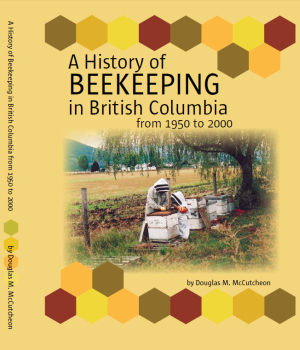
A Great New Book - BC Beekeeping History

A Great New Book – BC Beekeeping History

I found some time to read a book, A History of Beekeeping in British Columbia from 1950 to 2000, and have thoroughly enjoyed it. Like most prairie dwellers, I have trekked out through beautiful British Columbia as often as possible. So I am somewhat familiar with the areas the book delves into – places with the names Central Cariboo, Skeena Valley, East Kootenays, and Maple Ridge, among many others. These names always conjure great memories of gorgeous scenes and wonderful places. But I lingered longest among the dozen pages devoted to the Peace River Area. When I was but a teenager, I drove up to the Peace, thinking I should become a beekeeper there. The scenery is wonderful. The Peace River, a part of the Arctic-bound Mackenzie watershed, is dramatic and inspiring. But, of course, it was the rumours of 300 pound honey crops grown from packages of bees that really enticed me. As it turned out, an opportunity opened up for me in Saskatchewan, instead. But I’ve often wondered how my life might have evolved had I gone to work for Ernie Fuhr, or the Van Hans, or someone else up on the Earth’s rooftop, and then slowly began building my bee farm somewhere just off the Alaska Highway. When I read the BC Bee History and the clips about 430 pound averages, well it seems whimsical now. I’m glad that the author, Douglas McCutcheon, has collected the stories of the bees and beekeepers that belong to these places.

Part of the great beauty of British Columbia, and the great challenge in preparing a book like this, is centered on the extreme diversity of climates, agricultural regions, and environmental domains of the province. The author does a nice job of pulling it all together. From rocky-peaked mountains to foggy islands, bucolic pastures to rolling plains, BC hosts beekeepers everywhere, all with unique conditions, many with unusual forage crops, some engaged in a climate with Mediterranean bliss, others struggling in a severe continental environment. It all makes for an interesting compilation.

There is a lot to enjoy in the History of Beekeeping in BC. We tend to ignore our history too readily. And that condemns us to make blunders that might have been avoided. But the real joy in a book like this one comes from reading the dozens of sketches about the characters who were beekeepers last century. What would beekeeping be without “characters” anyway? Who would dare keep bees, if not the folks who live a tad bit differently from the rest of society? We are indebted to Doug McCutcheon and the editors and assistants at the BC Honey Producers Association who worked so hard to capture the memories, organize the stories, and publish the book. To them, many thanks.

If you would like to get a copy of this interesting book, you can order it by visiting the BC Beekeepers’ website. The book is large-format, contains 334 pages, over 100 photos, and covers a lot of interesting history. A bargain for $30. All proceeds beyond recovering the cost of production will be donated to the Boone Hodgson Wilkinson Trust Fund for Honey Bee Education and Research.

Posted in Books, History | Tagged , | Leave a comment

Honey is Honey

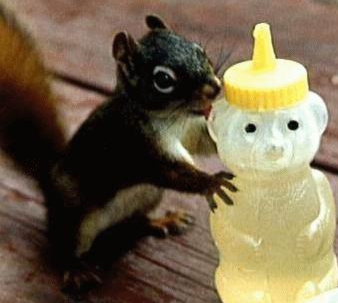
honey bear squirrel picnic

Organic Honey – (may contain a variety of organs)

Here’s a honey of a lawsuit. Target Corp has been targeted in a legal action by a Ms. Cardona, apparently of somewhere in California, who discovered from her on-line research that the $3 bottle of honey she purchased at a Target store had been filtered or processed to remove its pollen. The shopper filed a class action lawsuit claiming that the product was in violation of California laws, according to Forbes.

Target responded that the applicable federal rules provide no standard for what constitutes “honey” and that the Nutrition Labeling and Education Act requires companies to label their food products with “the common or usual name” which in this case would be honey. If Target were to call the product something like “Honey (without Pollen)” according to the presiding judge, such a label would then be in conflict with federal regulations, and would be illegal. On that basis, the suit was preempted.

Posted in Culture, or lack thereof, Honey | Tagged , , , | Leave a comment

Wild Bees

This sounds like an interesting job. You may have heard that there are about 40,000 species of bees in the world. Most are solitary, some live loosely with familiar neighbours, and a very small number, like the honey bee, are truly social insects. OK, 40,000 in the world. But how many in my backyard? Well, a Saskatchewan scientist – Cory Sheffield – has been asking the same question. During the past year, Dr Sheffield has wandered around Saskatchewan, collecting bees.

At least 200 species live in Saskatchewan. I’m a bit surprised the number is so low. If the world has 40,000 species, and many of those occur in huge territories, then I thought the number would be closer to 1,000. Sheffield also thinks there are more than 200 species. Until now, there really hasn’t been an exhaustive Saskatchewan bee-type census. Back in Nova Scotia, doing graduate work, the scientist rediscovered a bee that was thought extinct for 60 years. Sheffield found two individuals of Macropis Cuckoo Bee (Really, I’m not making that name up.) in Nova Scotia, and he is now looking for it among the bees of Saskatchewan. This type of bee once covered the eastern states and Canada by the millions – from the Carolinas to the Dakotas and back along southern Manitoba, southern Ontario and Quebec, and out to Nova Scotia. The cause of the bug’s (temporary) extinction isn’t clear. Perhaps habitat loss; perhaps some pest or pesticide.

Dr Sheffield is also trying to match up flowers to the various bees being identified in Saskatchewan. He may catalog crop-by-crop, looking at the important pollinators for each field. The only agriculturally significant types of bees known now are the leaf cutter bee (important for alfalfa pollination) and the honey bee (important for almost everything). Undoubtedly, other bees are useful, but aren’t being commercially used to the same extent. It may be that some lucky field crop will be identified as teaming with some unusual pollinators that could be caged and shackled, then exploited by the millions, labouring to reduce the cost of strawberries or canola oil or some other goodies.

Posted in Ecology, Science | Tagged , , , | Leave a comment

A Multi-player Game

wild bees

It’s a Multi-player Game

How does one get 50 different bee-specialists to work together on a project? Sounds like herding cats, if you ask me. But that’s what agricultural engineer Lucas Garibaldi of Argentina’s National University of Río Negro is doing. The fifty researchers were involved in a study of wild pollinators vs managed colonies of bees, examining the effectiveness of their pollination of 41 different crops – from almonds, cherries, grapefruit, kiwis, to zucchini cousins. The work was conducted in 19 different countries around the world. The finding was that wild bugs (bumblebees, beetles, flies, butterflies, among others) often do a better job – setting a higher proportion of flowers forming seeds and fruits.

In a task that must have involved decent eyesight, strong concentration, and an affinity towards boredom, the scientists counted visits of honeybees and wilder critters, then compared the numbers with crop yield. They found that an increase in visits by wild bugs can double the amount of fruit that a similar increase in visits by managed honeybees will have yielded. In other words, if 500 bees visit an apple’s flowering branch, then the honey bee count is increased to 700, maybe you get 6 more apples. If those extra 200 bugs are other non-honey bee pollinators, expect 12, not 6, extra apples. I’m not surprised. Different insects work under widely varying ranges of temperature, different times of day (and night) and different sorts of wind and sunlight conditions. Some flowers may be open at times that managed honeybees simply won’t get out of bed.

Now what? We may have reached a point where huge acreages of monocultured fruits and vegetables will give way to smaller groves and fields. Ecologically and environmentally, it would make a healthier world, of course. Honeybees would still be rented for optimal pollination services, but surrounding meadows and mixed woodlands would be home to co-pollinators. And the woods and meadows would also give the managed honeybees a better (more diverse) diet, keeping them healthier, and ultimately improve the grower’s pollination results even more. The paper’s abstract further states: “…visitation by wild insects and honey bees promoted fruit set independently, so high abundance of managed honey bees supplemented, rather than substituted for, pollination by wild insects.

Posted in Bee Biology, Ecology, Pollination | Tagged , , | Leave a comment

Expressing Genes

honeybee dna

A Honey Bee and her Gene Expression

What the heck is Gene Expression? Researchers working at the University of Illinois are tricking honey bees in order to learn about something called Gene Expression. As if the poor bugs don’t have enough to worry about, scientists are fooling the bees into thinking they have traveled farther through a tunnel leading to food if the tunnel’s walls are painted with tightly spaced stripes. I can imagine the poor bee: “Almost there, almost there, almost there…” as the scientists madly squeeze the little stripes closer and closer together. Actually, it sounds like a fun experiment. Here is the real key part of the research – tricking honey bees into thinking they have flown a long distance (when they actually haven’t) alters gene expression in their brains. You know that genes carry information from one generation to the next. That explains why both your neighbour and his son drag their knuckles on the ground when they walk among humans. But genes also provide information to your body on how to produce proteins and RNA. Those are important for determining how the body’s cells react to stress and change, among other things. Recently, scientists have found bugs are good models to study gene expression. One example, from research at Purdue, gene expression in termites is being studied to see how the insects digest wood. They investigated over 10,000 gene sequences in a study that might lead to using wood as a bio-fuel (in a different way than throwing another log on the fire, I suppose).

Bees and Genes. Last year, researchers showed how changing jobs within the hive results in a genetic change in each individual bee – all the way down to the DNA level. A paper by B.R. Herb in Nature Neuroscience showed how bee behaviour effects the chemicals hanging around DNA and changes their activity. The research team particularly found gene expression modified when foraging bees were forced to work as nurse bees. So did a similar joint study by Tempe’s Arizona State University Gro Amdam and John Hopkins University’s Andrew Feinberg. Gene Robinson, the scientist who did the bee-tunnel research (which is a different attack on understanding gene expression) points out that in the case of foragers doing nurse bee duties, we can’t be sure of the causal link – the research does not necessarily prove that epigenetic mechanisms cause behavioural differences.

The experiment and what it means for you and your twin sister in Kansas: Since honey bees do their famous waggle-tail figure-eight communication dance at the end of a foraging trip, the researchers made a tunnel lengthy enough that the stripes confused the foraging bee about her distance of travel. After reaching a pot of gold, or probably honey, at the other end of the tunnel, the forager raced back to the hive where she did her dance to tell other bees where to go – and crucially, how far to fly. Some lucky grad student probably got the job of watching the bee dance and making scientific notes about it. Then, I suppose, a delicate lobotomy had to be performed to see what genes were modified, or ‘expressed’ and how that compared with control-group bees. This study was led by entomology professor Gene Robinson, and paid for in part by the National Science Foundation. The ultimate result is to help us understand a huge range of behavioural traits related to changes in the way genes synthesis proteins and other chemicals that effect biology. The long-term result could be a better understanding of addiction and behaviour disorders in humans. And an explanation of why identical twins may be so different in personality, even when genes are identical at birth.

Posted in Bee Biology, Genetics, Science | Tagged , , | Leave a comment

Almonds Need Bees

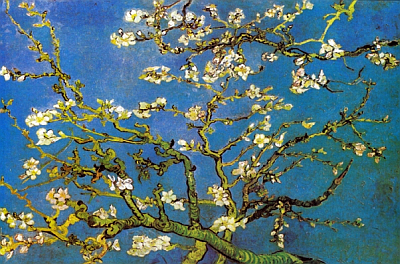
Almonds by van Gogh

Almonds need bees. And beekeepers need almonds – to pay their bills. In California – which produces about 80 percent of the world’s almonds – hundreds of thousands of acres stretch from Red Bluff to Bakersfield. Each acre ideally has 124 trees, spaced 16 by 22 feet. The Almond Board of California estimates the grower spends close to $4,000 per acre per year to grow those nutty trees. In the past, the typical pollination fee was $280/year to set the seed on one acre. It will be more this year. This is arguably the most important cash outlay the grower pays. With enough good pollinating honey bees, the harvest goes from perhaps less than a 1,000 pounds per acre to as much as 2,600 pounds per acre. With wholesale prices bouncing around $1 – $2 per pound, the gross revenue can be as low as $2,000 in a year when prices are down and bees are lazy, all the way up to $5,200 per acre when the bees, weather, and prices all hit by California’s karma. Growers need strong hives with oodles of stamen-shaking pistil-poppers available. Or, they go broke.

According to several news stories, there will be a shortage of managed beehives available for almond pollination chores this spring. With 760,000 acres of almonds, roughly two million colonies of bees need to show up for the bloated blossom fest. California has half a million. 1.5 million hives will arrive from other states – from Maine to Florida and Dakota to Dakota. Actually, from almost every state in the States. The big draw for all those bee hives which will be chained to diesel-belching flatbeds is, of course, money. Beekeepers are paid for taking care of those hives, keeping them strong and healthy against all manner of environmental threat. Hives will rent for about $200/hive this year – an all-time high – because of the bee shortage. Eric Mussen, UCLA Davis, says the reason for the higher price is a paucity of bugs this year. “Bees across the country are not in as good shape as last year,” Dr Mussen told ABC News. He says bees are under stress, hives are consequently weaker, colony count is down. Among the stresses have been droughts in the Mid-West and the conversion of land from nectar-producing alfalfa and clover into ethanol-producing corn fields (corn doesn’t give nectar to feed bees).

Almonds have been around forever – so why the problems now? It’s true. Egypt’s pharaohs, and China’s Q’ins and Hans knew about almonds. We are told that when the Biblical Aaron’s stick was stuck in the muck, almonds bloomed in Israel. From there, the Romans spread the nuts throughout their empire, so that eventually southern Europe, north Africa, and the Near East all had almond groves. By the time Vincent Van Gogh painted the theme picture on this web page for us that you see above (1889, in southern France), Franciscan priests had already brought the first almond trees to California. In all those places, almonds somehow managed to attract enough pollinators to keep their gene pool from dwindling. There were enough bees – usually feral bees – and tree densities were perhaps a handful per acre, not hundred. In such cases, bees don’t need trucked thousands of miles. Part of our problem today is the sheer density of monocultured crops.

About thirty years ago, when almond groves first began to spread like California art studios, growers started to invite thousands of hives into the Great Central Valley, recognizing that bees doubled their nutty yields. Beekeepers were paid a modest fee. Now that fewer young people can be convinced to keep bees, and now that we’ve done such a dandy job on our climate and environment, the resulting bee scarcity has jacked up rental fees. As we saw with the numbers, above, growers sometimes have a little wiggle room to pay more. But not much. The California Nut Board says the average profit has been around $400/acre, but that’s without paying for the land and property taxes and interest – and now, the increased pollination fees. At any rate, surviving beekeepers will do OK this year. Hope the same can be said for the growers.

Posted in Beekeeping, Ecology, Pollination | Tagged , , | Leave a comment

Math Bees

Figuring out all the angles.

Lining up the Hives. The University of Essex (England) Mathematics Department has teamed up with a software designer to create an app that may help beekeepers and orchard owners maximize pollination in orchards. The venture, code named “Project Beeswax” even caught the attention of the TED Talks group of brainiacs. The mathematician behind the project, Dr Abdel Salhi, is testing the feasibility of mathematical optimization theory to estimate the minimum number and the best distribution of beehives in an orchard to achieve effective pollination of apple trees.

Researchers have been out at a local orchard to investigate configuration ideas that may help with developing their mathematical models. The first phase of this study will be completed near the end of March 2013. Chief mathemagician, Dr Salhi, said “I was excited to undertake this project because it seems an ideal area to deploy mathematical methods of optimisation. The underlying problem is potentially very tricky to solve. However, good approximate solutions will be very rewarding indeed. It is also a good opportunity to work with the local farming community.”

Money (about $7700) was granted by the Technology Strategy Board to help Andrew Lewis of Simul Systems Ltd. develop the app for tablets, desktops and laptops. If successful, it will reduce the number of hives orchard growers must rent from beekeepers. Wouldn’t it be nice if beekeepers could be paid to haul in just 8 hives to a 4-acre grove, instead of 16? A lot less handling of hives, fewer stings, and less annoying money to deal with.

Posted in Pollination, Science | Tagged , , | Leave a comment

Out with the Tongue

Intelligent Tongues

Intelligent Tongues

2012 was not all about colony collapses and neonicotinoidal imidacloprid pesticides. There was some lighter news. In December, we learned that honey bees were being trained to stick their tongues out. Some top-notch scientists at Bielefeld University in Germany are teaching bees as smart as Einstein to stick out their tongues whenever their antennae encounter a particular type of material.

Very Pavlovian-dog style here:

The bees are rewarded a drop of sugar syrup (for which they naturally extend their tongue) whenever the feel of the test material is right. The smart little bugs soon start sticking their tongues out before getting fed, in anticipation of their treat. Behavioral biologist researcher Dr Dürr says, “If you can train an insect to respond to a certain stimulus, then you can ask the bees questions in the form of ‘Is A like B? If so, stick your tongue out.” Maybe Dürr can link up with Bayer and see if test results are improved with the help of the nerve toxin neonicotinoids, or not?

Posted in Bee Biology, Science, Strange, Odd Stuff | Tagged , , | Leave a comment