
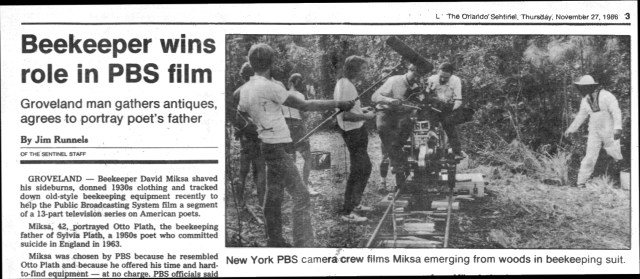
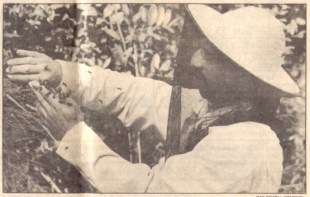
My brother David, as Otto Plath.
I discovered Sylvia Plath in the ’80s. PBS asked my oldest brother to pose as Sylvia’s father in their documentary of the great American poet. PBS was looking for a man who resembled Sylvia’s father, a German immigrant named Otto Plath. PBS also needed a set that would pass as Otto Plath’s Massachusetts. Finally, they wanted bees that resembled the bumble bees that Dr Plath studied. PBS chose Florida to play Massachusetts and my non-German brother as Otto, the bumble bee scientist who was Sylvia Plath’s father.
Otto Plath was an entomologist, specializing in bumble bees. At home, he kept a few hives of honey bees. Donning a beekeeper’s uniform, my brother comes and goes throughout the documentary, as Otto Plath himself seemed to, in the eyes of young Sylvia. Otto died when Sylvia was eight. This had an indelible effect on her life.
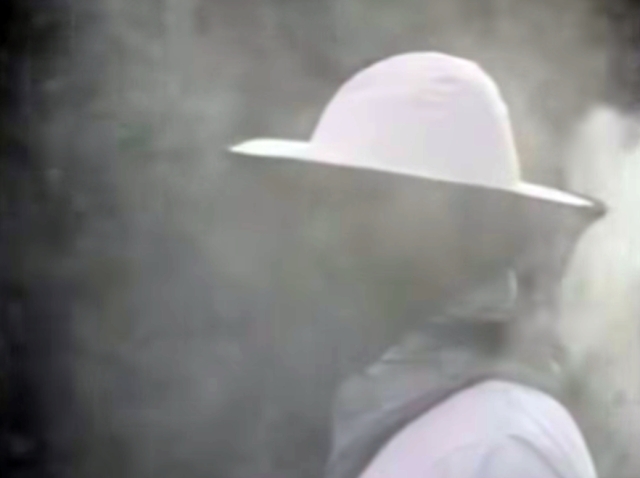
I found the PBS documentary on YouTube. Here is a very short clip that shows my brother, David, as the ephemeral Otto, as Sylvia remembered him.
Watch the series, on YouTube, beginning with the first segment here. The hour-long documentary is comprised of six short pieces. I hope that you will watch the entire story of a beekeeper’s daughter.
If you haven’t read any of Sylvia Plath’s confessional poetry, please do. It may be difficult for us, during this dismal pandemic, to disappear into the dark world of this brilliant young lady who died on her final suicide attempt, aged just thirty, 58 years ago today. But reading Plath is something we can do in her memory. And it will make us better.
 Plath struggled for years with her severe depression. And with her unconventional perspective on the landscape of our lives. And with her sheer brilliance and talent. A 160-IQ can be hard to focus. Her paintings won awards. Posthumously, she was honoured with a Pulitzer for her poetry. An over-achiever, she had worked as a successful model and had kept a journal from age 11. Near the end of her brief life, she kept honey bee hives in her English garden. Finally, she was mum to her children, Frieda and Nicholas.
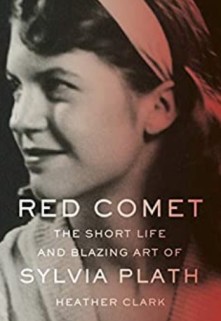
The definitive biography of Sylvia Plath was published this fall. Red Comet: The Short Life and Blazing Art of Sylvia Plath, by Heather Clark, takes its title from Plath’s poem called “Stings”, which Sylvia Plath wrote from the perspective of a woman who sees herself as a red comet, a bee, flying against an expansive blue sky. The woman shows bravery – handling the bees barehanded, just as the male bee-seller who had brought her the hive. Then, she begins worrying about the hive, wondering if it even has a queen. All, of course, symbolizes the real Sylvia Plath, worried, weak, strong, destined. Heather Clark’s 1,114-page biography, Red Comet, was celebrated at its October release:
“The full, complex scope of poet Sylvia Plath’s life and writing is given a bracingly thought-provoking reexamination in this massive—and massively absorbing—biography.” —The Christian Science Monitor
“Mesmerizing . . . Comprehensive . . . Stuffed with heretofore untold anecdotes that illuminate or extend our understanding of Plath’s life . . . Clark is a felicitous writer and a discerning critic of Plath’s poetry . . . There is no denying the book’s intellectual power and, just as important, its sheer readability.” —Daphne Merkin, The New York Times
“One of the most beautiful biographies I’ve ever read.” —Glennon Doyle
“Revelatory . . . Plath’s struggles with depression and her marriage to Ted Hughes emerge in complex detail, but Clark does not let Plath’s suicide define her artistic achievement, arguing with refreshing rigor for her significance to modern letters. The result is a new understanding and appreciation of an innovative, uncompromising poetic voice.” —The New Yorker
Several of Sylvia Plath’s signature poems are about her father, bees, and beekeepers. Here’s one of my favourites.
The Bee Meeting, by Sylvia Plath
Who are these people at the bridge to meet me? They are the villagers—
The rector, the midwife, the sexton, the agent for bees.
In my sleeveless summery dress I have no protection,
And they are all gloved and covered, why did nobody tell me?
They are smiling and taking out veils tacked to ancient hats.
I am nude as a chicken neck, does nobody love me?
Yes, here is the secretary of bees with her white shop smock,
Buttoning the cuffs at my wrists and the slit from my neck to my knees.
Now I am milkweed silk, the bees will not notice.
Thev will not smell my fear, my fear, my fear.
Which is the rector now, is it that man in black?
Which is the midwife, is that her blue coat?
Everybody is nodding a square black head, they are knights in visors,
Breastplates of cheesecloth knotted under the armpits.
Their smiles and their voices are changing. I am led through a beanfield.
Strips of tinfoil winking like people,
Feather dusters fanning their hands in a sea of bean flowers,
Creamy bean flowers with black eyes and leaves like bored hearts.
Is it blood clots the tendrils are dragging up that string?
No, no, it is scarlet flowers that will one day be edible.
Now they are giving me a fashionable white straw Italian hat
And a black veil that molds to my face, they are making me one of them.
They are leading me to the shorn grove, the circle of hives.
Is it the hawthorn that smells so sick?
The barren body of hawthorn, etherizing its children.
Is it some operation that is taking place?
It is the surgeon my neighbors are waiting for,
This apparition in a green helmet,
Shining gloves and white suit.
Is it the butcher, the grocer, the postman, someone I know?
I cannot run, I am rooted, and the gorse hurts me
With its yellow purses, its spiky armory.
I could not run without having to run forever.
The white hive is snug as a virgin,
Sealing off her brood cells, her honey, and quietly humming.
Smoke rolls and scarves in the grove.
The mind of the hive thinks this is the end of everything.
Here they come, the outriders, on their hysterical elastics.
If I stand very still, they will think I am cow-parsley,
A gullible head untouched by their animosity,
Not even nodding, a personage in a hedgerow.
The villagers open the chambers, they are hunting the queen.
Is she hiding, is she eating honey? She is very clever.
She is old, old, old, she must live another year, and she knows it.
While in their fingerjoint cells the new virgins
Dream of a duel they will win inevitably,
A curtain of wax dividing them from the bride flight,
The upflight of the murderess into a heaven that loves her.
The villagers are moving the virgins, there will be no killing.
The old queen does not show herself, is she so ungrateful?
I am exhausted, I am exhausted—
Pillar of white in a blackout of knives.
I am the magician’s girl who does not flinch.
The villagers are untying their disguises, they are shaking hands.
Whose is that long white box in the grove, what have they accomplished, why am I cold.
 You know how the mention of a name from long ago can bring back memories that you thought had slipped away forever? I had that experience recently. Browsing
  Crownvetch was “discovered” by my first-ever boss, George Sleesman, the director of Pennsylvania Plant Services. Sometime in the 1950s, the state Department of Transportation asked Sleesman to find a plant that might be a good, attractive, low-management creeper to prevent erosion on the deep roadway cuts through the Appalachians. Sleesman, the state’s chief apiary inspector, scoured the Pennsylvania hills for sturdy plants that could hold eroding road embankments in place. Crownvetch caught his eye.
 If you have a few minutes, listen to Kirsten Traynor and Calvin Ernst as they discuss the growth of interest in native plants and Ernst’s role in making such seeds available. You can download the show (Season 3, Episode 26) from your favourite podcast provider, or hear it




 to “did not meet community standards.” A beekeeping site? Not meeting community standards? There was no recourse. The badbeekeeping blog was banned from Facebook. I wrote to them, but never got an answer. I tried to post more pieces with links to this blog but they were all banned as “not meeting community standards”. Was the problem all those photos of scantily-clad bees? They wouldn’t tell me. Meanwhile, disgusting links to alt-news, anti-science, pro-fascist and antifa sites were everywhere. I saw some very ugly stuff posted by some of my Facebook ‘friends’ – but my bees were still banned.






 Bad Beekeeping Blog