A Calgary oil company’s office tower has a bee just around the corner. This beautiful wall-poster points the way to the bee. Yes, ‘the bee’ according to the sign. I would be quite embarrassed if I had allowed such a glaring grammar error to appear on an otherwise attractive sign. Bee’s, of course, means one bee, and the “bee’s new home” is nearby. Bees’ is the word they wanted. Plural possessive. Around the corner, there were about 60,000 of them. Was there no editor, no one checking spelling and grammar? Yes, folks, even here in Calgary, Canada, we are experiencing the collapse of basic knowledge of Grade 3 grammar. But alas, that’s not the only problem here.
So, there are honey bees in downtown Calgary. I suppose that there was a green statement (and a few dollars exchanged) by the folks involved. As we perpetuate the myth that honey bees are threatened, we entice landlords and corporations of all sorts to sign up for beekeeping. Bees are green. Sort of. In addition, companies are luring office workers away from their home offices in covidly-compliant backyards and on isolated sunny decks with the promise of honey bees and gardens outside the office towers that employees are expected to reenter. The New York Times has had two recent articles extolling the delights of skyscraper-beekeeping. (See here and here.)
The investment company Nuveen has spent $120 million renovating its office tower at 730 Third Avenue in Midtown Manhattan, overhauling the lobby, devoting the second floor to amenities and refurbishing a 22nd-floor terrace.
And the finishing touch? Two beehives on a seventh-floor terrace.
Following the latest trend in office perks, Nuveen hired a beekeeper to teach tenants about their tiny new neighbors and harvest honey for them to take home.
Office workers who were sent home during pandemic lockdowns often sought refuge in nature, tending to houseplants, setting up bird feeders and sitting outdoors with their laptops. Now, as companies try to coax skittish employees back to the office and building owners compete for tenants when vacancy rates are soaring, many have hit on the idea of making the office world feel more like the natural world.
The effort seeks to give office workers access to fresh air, sunlight and plants, in tune with the concept of biophilia, which says humans have an innate connection with nature. Designs that include nature are shown to promote health and wellness.
I can’t fault a company for wanting to encourage sanity among its warehoused employees. But honey bees don’t need to be part of the mix. Although honey bees may not severely injure the environment (and they are certainly required to sustain our current farming practices), honey bees interfere with the natural ecological balance of our landscapes. Instead of honey bees atop an office tower, a flock of comfort chickens might be more suitable and less environmentally invasive. Here in Calgary, where honey bees are not native and where native bees may be displaced by these honey bees, they are not needed to keep native wildflowers pollinated. That’s the job of wild, native bees.
As long-time readers of my blog know, I am not on an anti-honey-bee crusade. I love observing their model society, communication skills, and synchronized responses to the whims of nature. I was once a commercial beekeeper, dropping dozens of colonies at a time into unsuspecting meadows. Today, I keep two colonies in my backyard as a source of fascination and honey. However, setting colonies on the roof of a big-city skyscraper, in a floral vacuum where they may need fed sugar-water and where native bees struggle to survive even without competition, is a mistake.
Here’s a picture of the colonies. They are attractive, but unnecessary, additions to the building’s sterile gravel environment. Why not a potted plant to feed the wild bees instead? Seriously. It would look better.
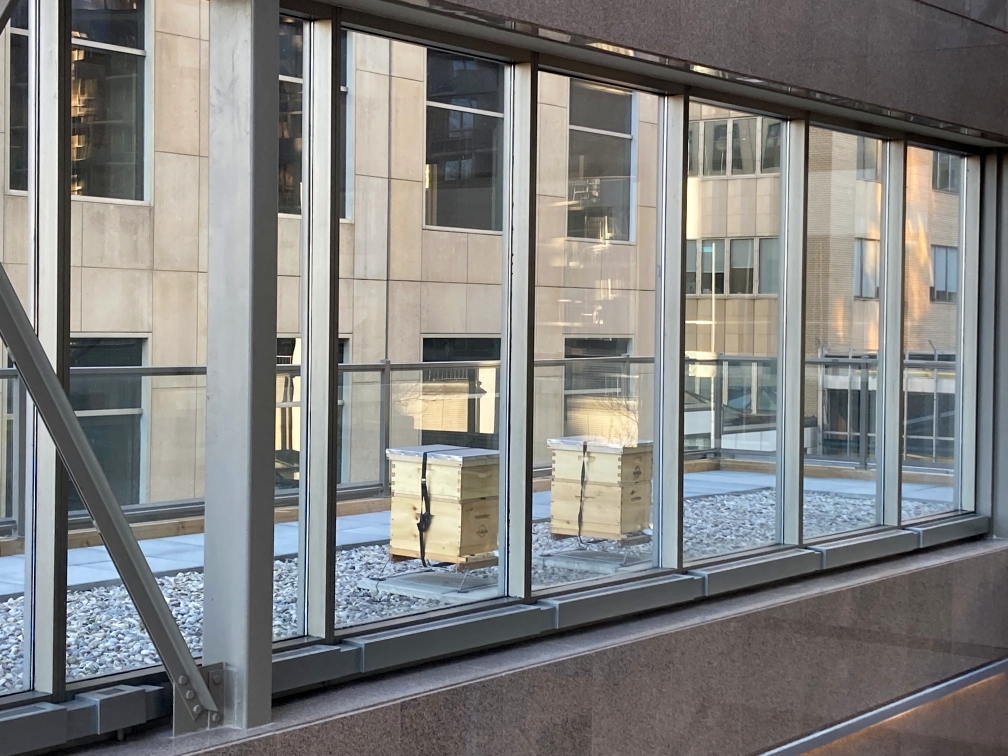
Photos are courtesy of my son, David Miksha, who passed through this office tower on October 14.