
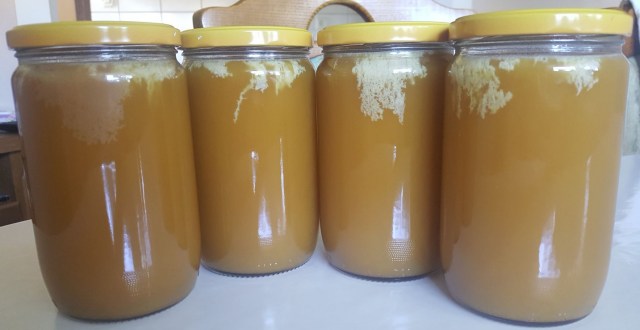
My cousin, who lives in Europe, sent me the photograph above. She was wondering what had gone wrong with her honey – and how she could fix it.
First, I have to wonder if this is something ‘wrong’. Honey with this mottled, marbled, frosted look isn’t necessarily bad. If you produce honey with moisture below 18.6%, and keep all stages of the process clean, you can almost certainly safely eat the product. However, if you hope to sell it, you may want the honey to look “normal” – you don’t want to explain anything unusual to your customers. As I child, I worked in our family’s produce stand. We sold tomatoes, peppers, squash, and such. I learned, around age seven, that trimming outside leaves from a cabbage head made it sell better. Often, there was nothing wrong with the parts peeled off, but by offering less, we sold more. It’s usually the same with honey. Filter out the wax and pollen, and it sells more easily. Maybe this is what we should do with ‘frosted’ honey – melt it and pour it back into the bottles. It will look better. That’s probably easier than educating a consumer about the higher quality of natural honey over heated honey.
What causes ‘frosted’ honey? I don’t have much experience with this, so I passed the question along to some friends. They had a range of ideas. As usual with beekeepers, my five consultants had different opinions.
Since a lot of readers are harvesting, packing, and selling their late-season honey this weekend, I figured that I’d post the responses here for everyone’s benefit. Not only will you see some answers, but you’ll see how beekeepers think about things. If you have thoughts to share, take another look at the photo above, read the paragraphs below, and add your ideas in the comments.
Here is what I asked my friends: “My cousin sent me this photo from Europe. She’s wondering why her granulated honey has two types of crystallization, how to ‘fix’ it, and how to prevent this from happening in the future.”
Answer 1) In the honey quality and defects workshop at Apimondia, the guy told us a theory I’d never heard before. He said honey contracts a tiny bit when it crystallizes and it’s that contraction that causes the “frosting.” He said honey that crystallizes quickly shows this more. He said to avoid it, one should slow down the crystallization process by keeping it at some temperature. Unfortunately I don’t remember the temperature. Based on my own experience, I’d say 14-16C, maybe as low as 12. The degree of contraction also depends a lot on the variety of honey, which is basically the sugar ratios and crystal size. Based on my own experience, I tend to agree that certain varieties of honey are much more prone to this than others. Again based on my own experience, moisture content may also play a role.
I’ve heard the air bubble theory too. In a way, they’re kind of the same thing because the white parts are where there is more air. I guess the ambiguity is whether the air is there because the honey contracted when it crystallized or whether it was in the honey before it started crystallizing. It could be a combination of both.
So Ron, I would amend your proposed solution by saying pay attention to the speed at which the honey is allowed to crystallize and aim for a moisture content of somewhere around 17.3%, keeping in mind that some varieties of honey will do this regardless of the packer’s best efforts.
Answer 2) Frosting is a component of storage temperature with increased risk if jarred honey is stored too cold, low humidity honey is at greater risk. Best storage temperature is 14-15 C. Never put jars with honey in a colder environment after jarring.
Answer 3) The whitish colored stuff is wax, pollen etc. I usually don’t filter honey. Just settle it out. When the honey granulates – the very small non-sugar stuff separates out. Some of it floats on top but we always see some of the white streaks in nearly all jars. We just stir it in before use. This retains the good flavor elements in the honey. Well that’s our thoughts.
It is a visual that makes people think it is bad – It does not look like the processed honey from commercial packers. Our food seems to need to look perfect to some commercial standards. I think that’s not a good model. When I got a chance to go to Mexico and went to the supermarket – saw all kinds of produce that was not as “pretty” as the produce here. The food was perfectly OK.
Answer 4) It could be a bit of fermentation. If not blended together and was a some trace of wet honey, it may have risen to the top as the jar settled. It could also be different nectar sources that are not well blended and crystallizing at different rates. My proposed solution, warm it liquid and shake it up well.
Answer 5) I went to a talk at Apimondia given by the company that had won the best creamed honey in the world in 2018. They called this “frosting”. The speaker said it was caused by tiny air bubbles being trapped between the honey and the sides of the jar. I guess that is why it normally forms near the top or the shoulder of the jar. I had this problem one year when I took cold jars from the basement and added my honey without warming the jars first. This “frosting” started out like your cousin’s but continued to spread over time. I heated the honey in the jars and stirred the warmed honey. Depending on how many jars she has, this will work. It looks weird but it tasted the same. Sometimes, I can get the same white coating on the top of my 50 pound honey pails where the honey/air bubbles have crystallized on the surface. It is fine when I reheat the honey.
So, a variety of opinions on the cause of frosting. Most answers focus on temperatures (of jars and of storage conditions), on air trapped in the honey, and on moisture (most said ‘too much’ but answer #2 suggested the honey’s moisture was too low.) There was also a comment on honey variety – poor blending of two different varieties, or simply the fact that some honey may be more prone to frosting because of sugar chemistry. There was also the suggestion that fermentation or excessive wax/pollen caused this, though I don’t think that’s right.
My friends’ solutions to fix the jars? Melt the honey and repackage it. Answer #4 also says that the honey should be ‘shaken’ after melting. I’d say ‘gently stirred’ to avoid introducing air bubbles.
What do you think? What causes frosting and how would you fix jars that have it? Feel free to comment below.


 So, last Saturday, I drove over to Mark Soehner’s home and rolled my wheelchair into his back yard. I arrived late – Mark had already set up some tables with bee equipment and samples of his award-winning backyard honey. Ten folks showed up, most wearing covid masks. You can see mine, left.


 This spring, I bought several 5-frame nucs. I made arrangements in early March for May delivery from coastal British Columbia (Canada’s Florida, but with fewer palms and covids). A friend drove his truck and trailer down to the coast, helped the seller prep the nucs, then drove about a hundred of them up the Fraser Valley, across the continental divide, and into Alberta’s land of honey.










 The perfect cup of tea starts with honey. At least,
  concoction – never in circles! – but slowly back and forth, like the paddle of a canoe that will never cross a lake. Oh, and never let the spoon clang against the side of the bone china while paddling or you’ll be having tea with the servants before you know what’s happened.
 Bad Beekeeping Blog