

Are those days gone forever?
A few weeks ago, I drove from Calgary to Banff and back again. It was a beautiful summer day. The mountains were spectacular, the wildflowers were in bloom, and the bumble bees were busy. When I returned home, however, something seemed strangely absent.
My windshield. No, I hadn’t lost my windshield.
What was missing was the bug juice that usually covers my windshield after a 250-km round trip.
Years ago, a trip like that almost guaranteed a stop at the gas station to scrape away hundreds of dead insects. This time I counted only three. I could have named them if I wanted to. In fact, I have more kids than I had dead bugs.
Why were there almost no splats? I was driving fast enough, 130 kph there and back. Was it better aerodynamics? Had my modern vehicle become more insect-friendly? No, I’ve been driving a Honda Odyssey for 25 years now. Were there genuinely fewer insects in the air? An insect apocalypse?
Scientists refer to something called the windshield phenomenon. While windshields themselves aren’t scientific instruments, they have prompted researchers to investigate whether flying insects are becoming less abundant. They are up here, around Calgary. I’m not the only one to notice this. Here’s a news story you might appreciate. It’s from five days ago.
The evidence is compelling.
One of the most influential studies was carried out by the Entomological Society of Krefeld in Germany. For nearly three decades, volunteers collected insects in standardized Malaise traps located within protected nature reserves. When the insects were weighed, researchers discovered that flying insect biomass had declined by more than 75 percent.
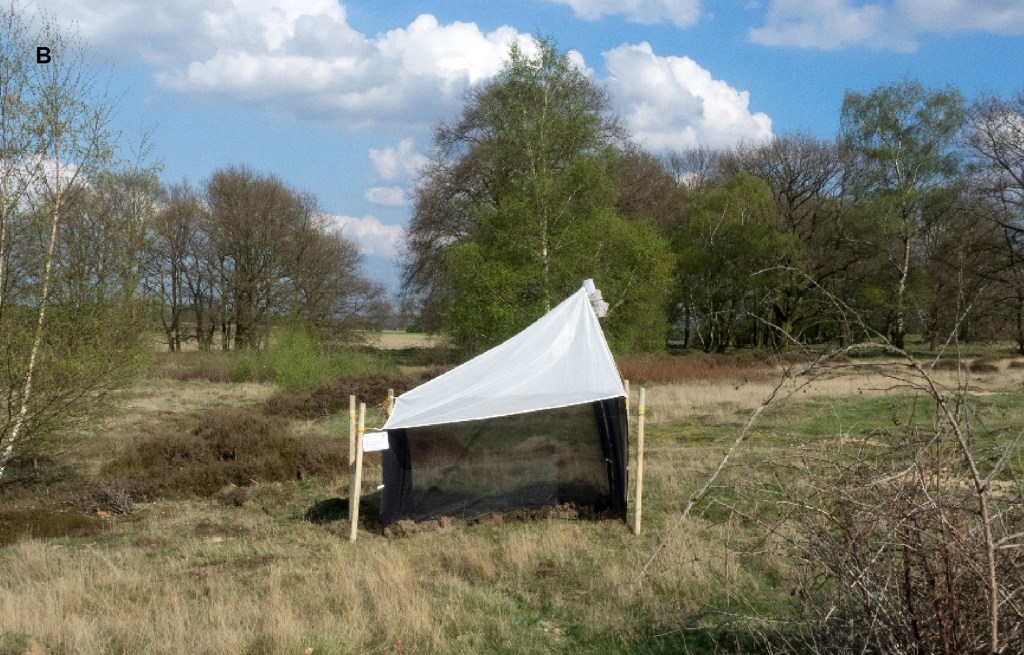
The result – a 75% decrease in insect biomass over the 27-year study – sparked worldwide discussion.
Some researchers questioned whether weather could explain much of the apparent decline. Others reanalyzed the data. The result – bugs are seriously disappearing – remain.
Still others have been conducting something like a windshield test, but it’s rigorous, repeatable, and it’s generating a huge data set. This is the Bugs Matter project in England, which reports a 60% drop in insect bodies sticking to license plates on the front of cars.
There is also a very recent (June 2026) paper from Switzerland showing a drop in insect populations over a 90-year period.
The debate continues, but remarkably, the discussion today is no longer whether insect populations are changing. Instead, scientists are asking how rapidly those numbers are falling and what is driving those changes.
The causes are complex. And overlapping.
Habitat loss, agricultural intensification, pesticide use, climate change, light pollution, and landscape simplification all appear to play a role. Different insect groups respond differently. Honey bees, managed by beekeepers, are not disappearing globally, while many native bees, butterflies, moths, and beetles continue to struggle.
The good news is that insects can recover when habitat improves.
Native prairie restoration, wetland rehabilitation, wildflower plantings, and thoughtful land management have already demonstrated encouraging results in some regions.
If this subject interests you, I have an entire podcast episode about dead bees on windshields and no dead bugs on windshields. And I try to answer the Insect Apocalypse question on that podcast.
If you’d like to know more about this, and the disappearing bugs, my About Bees, Culture, and Curiosity podcast goes into illuminating detail, so I invite you to listen and enjoy. The ideas expressed here on this blog and on the podcast are subject to refinement with my exposure to new facts.
I hope you enjoy this blog and the podcast episode! The podcast is available everywhere you get your podcasts (Spotify, Apple, Podbean, Deezer, Dasher, Donner, Prancer) . . . and online at this link:
https://podcasts.apple.com/us/podcast/about-bees-culture-curiosity/id1760959092


