
Usually, I’m the person asking the questions.
I invite someone onto About Bees, Culture, and Curiosity, turn on the microphone, and start poking around. Sometimes we stay on topic. Sometimes we disappear down a rabbit hole and emerge forty minutes later wondering how we got there.
This time, somebody else had the questions.
Brady Podloski invited me onto his podcast, Catastrophe, for an episode about honey bees, native bees, climate change, and the possibility of ecological collapse.
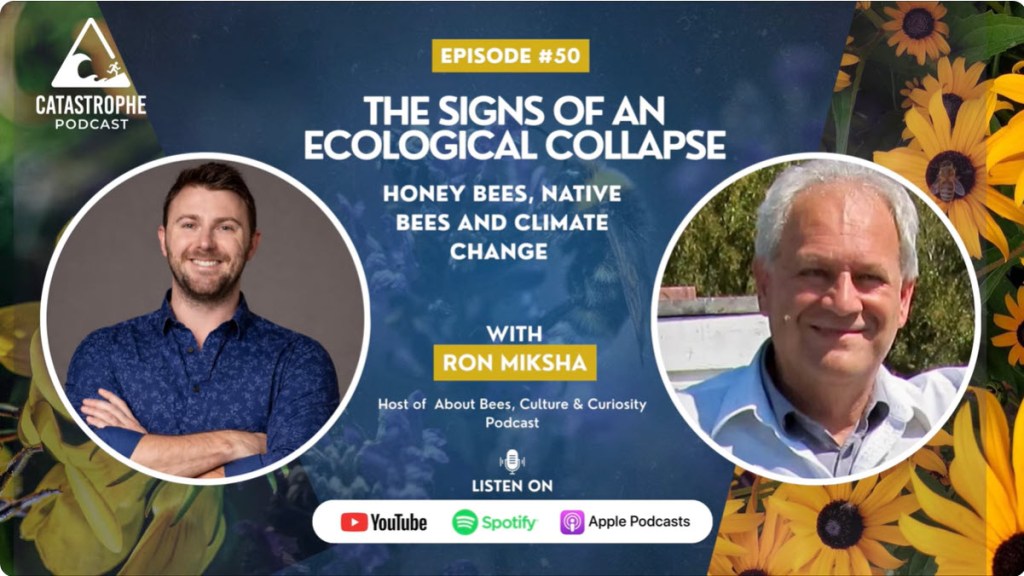
That cheerful collection of subjects, focussed on impending doom, turned into a fascinating conversation. You can hear that conversation at this link.
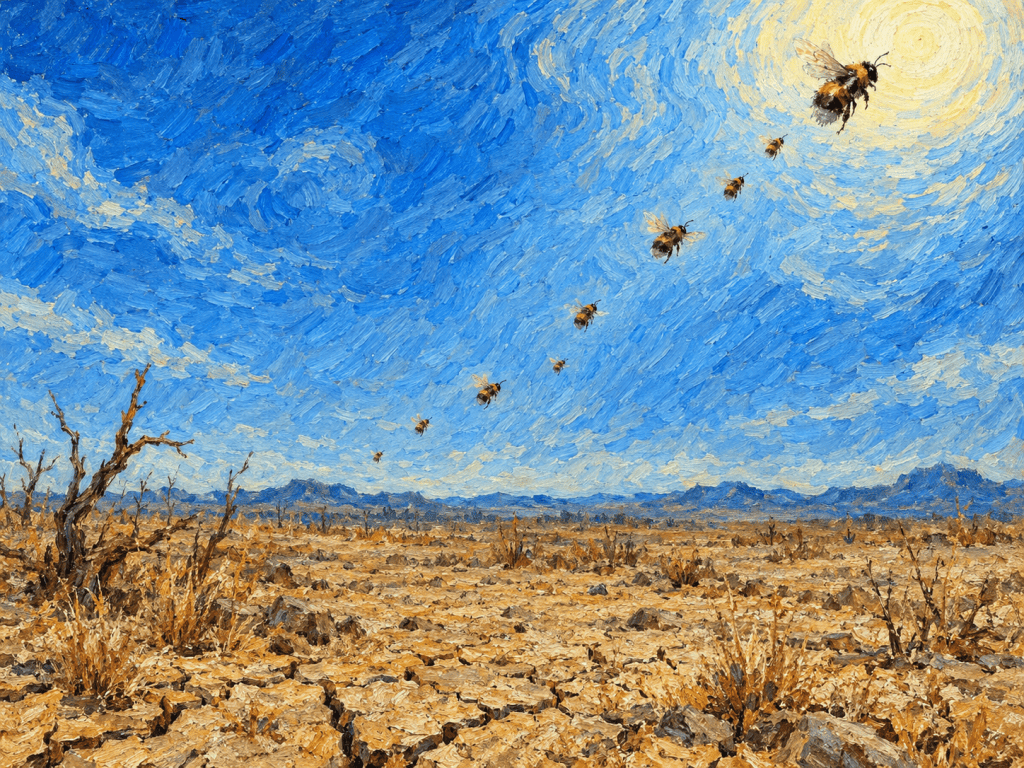
Honey bees and native bees are not the same thing. Six legs and a headful of eyeballs. That’s obvious. But that’s where the similarities mostly end. But people talk about “Saving the Bees” as though the world’s 21,000 bee species were one big happy family. A big family with all the members looking like honey bees. But they don’t.
Honey bees are remarkable agricultural animals. We can put colonies on trucks, move them hundreds of kilometres, feed them when flowers disappear, treat them for parasites, replace queens, and rebuild colonies after disaster. Beekeepers take care of honey bees.
Wild bees don’t have a beekeeper.
A bumble bee queen crawling underground for winter has nobody checking on her. A leafcutter bee developing inside a hollow rose stem doesn’t get moved to greener pastures when drought arrives.
On the podcast, Brady and I talked about farming, habitat loss, pesticides, monocultures, fires, floods and drought. Then we moved into climate change.
This is where things become especially interesting.
Bees are resilient. But they aren’t invulnerable.
They have survived enormous changes during their millions of years of evolutionary history. However, resilience is not the same thing as invulnerability.
One problem is timing. Suppose unusually warm weather arrives early. A bee emerges from her winter dormancy because the temperature tells her that spring has arrived. But the flowers aren’t ready – maybe they depend on length of day to start blooming. Or perhaps the flowers bloom early, while their pollinators remain dormant. Either way, this is trouble for both the bee and the plant.
Ecologists call this a phenological mismatch. Two organisms that evolved together suddenly find themselves working from different calendars.
How important is a balanced ecology? Does it really matter if one or two species go extinct? During our conversation, I used an orchestra as an analogy for an ecosystem.
Imagine an orchestra playing a complicated piece of music.
Remove one musician.
It still sounds pretty good.
Remove another.
Probably still fine.
But keep removing musicians and eventually the melody becomes thinner. The harmony disappears. Eventually, what remains isn’t really music at all.
An ecosystem can behave the same way.
Lose one insect species and we may barely notice. Lose enough insects, flowers, birds, frogs, microorganisms and other interconnected pieces, and eventually the system becomes something different. It won’t support the same trees, animals, or people.
The encouraging part is that there are things we can do.
Plant a diversity of flowers. Keep something blooming from spring through autumn. Leave a little untidy habitat. Don’t automatically turn over every patch of soil in the fall – you might unearth hibernating bees. Reduce pesticide use.
And perhaps most importantly, learn who the local bees actually are. To know them is to love them. To love them is to protect them.
This episode gave me the unusual pleasure of sitting on the other side of the microphone. I hope you’ll join Brady and me for the conversation.
If you’d like to know more about this, and all the catastrophes awaiting bees, my About Bees, Culture, and Curiosity podcast goes into illuminating detail, so listen and enjoy. The ideas expressed here on this blog and on the podcast are always subject to refinement with my exposure to new facts.
I hope you enjoy this blog and the podcast episode! The podcast is available everywhere you get your podcasts (Spotify, Apple, Podbean, Deezer, Dasher, Donner, Prancer) . . . and online at this link:
About Bees, Culture & Curiosity


