Remembering Eva Crane: Beekeeper and Physicist

June 12th. I have an excuse to write a bit about the amazing Ethel Eva Widdowson, born in London on June 12th, 1912. By age 30, she had defended her doctorate in nuclear physics, begun to teach at Sheffield University, married stockbroker James Crane, changed her name to Eva Crane, and took home a beehive as a gift from a wedding guest.

It may seem odd to receive honeymoon bees, but it was 1942. England was at war. Sugar was rationed. Those bees were intended to help the newlyweds through the wartime food shortages. Unexpectedly, the bees led to a whole new career for Dr. Eva Crane.

Photo from cover of the book
Eva Crane : bee scientist 1912-2007
edited by Walker and Jones

Eva Crane studied the sciences. She was one of only two women earning a maths degree at King’s College London in 1933. This was followed by an MSc in quantum mechanics in 1935 and her PhD in nuclear physics in 1937. Shortly after, she began lecturing. She could have led an outstanding life as a theoretical physicist, but alas, her bees got in the way.

In the early 1940s, she moved from the male-dominated math and physics field to an amazing career in the arguably more male-centric world of bees. Today, with about half of new beekeepers female, we forget that bee clubs in Crane’s day were completely under the thumbs of men – usually fussy old gentlemen with starched collars. They tolerated women as organizers of beekeepers’ picnics and (sometimes) as secretaries of their clubs.

To suggest women had a subservient role is to make an understatement. During the 1940s, Gleanings in Bee Culture hosted a regular column about beekeeping titled ‘Spinster Jane Says’, which I presume was written by a female writer. In Dr. Crane’s day, women also appeared in bee magazines as authors of “Home Cooking” pages, as did ‘Mrs. Benj. Neilsen’ who explained how to make Christmas fruit cake with honey in the December, 1943, issue of Gleanings.

There were rare exceptions, as Kentucky Chief Apiarist Tammy Horn Potter notes in her books Bees in America, and especially Beeconomy. In many cultures, bees are a thing that women do, but in the west during the past centuries, it’s been largely a male domain. As late as the 1970s, when I moved to Saskatchewan to beekeep, I was appalled when the Saskatchewan Chief Apiary Inspector published a piece about the woman’s role in operating a honey house. In the July, 1979, issue of the American Bee Journal, he wrote,

“I maintain that women have a penchant or inclination towards tidyness and cleanliness. It is both part of their nature and part of their training. . . One of the prime answers to an untidy, unsanitary honey extracting set-up would be to get the man out of the extracting plant and into the field and put a tidy, neat and authoritative woman in charge of the extracting, for where cleanliness has become a habit it has ceased to be a chore.” – Ed Bland, 1979.

So, in 1979, an authoritative woman might have been running a honey kitchen, but few were researching and writing about bees. For example, out of roughly 300 of the volumes in my home bee library that were published before 1960, only eleven were written by women. That’s about 4%. (I also have 550 bee books published after 1960 – 15% written by women.) My point is not to redress any historic bias against women in the western world’s beekeeping (I’m not the best person to do that!), but rather to describe the world of beekeeping when Dr. Eva Crane became part of it.

Upon receiving her beehive/wedding gift, Eva Crane subscribed to a bee journal and joined the local bee club. Three years into beekeeping, in 1945, she published an article about mead and another about honey.

True to the times, soon after acquiring her first hive, Dr. Crane became secretary of the British Beekeepers Association’s research committee. I assume they picked her because they figured that she would listen well, have good penmanship, and take notes accurately. Besides, she had a PhD in nuclear physics. Actually, I suspect that being ‘secretary’ of the BBA research committee was more akin to being the person who got things done. She quickly moved ahead.

By 1949, Dr. Crane was editing Bee World. She turned it into a prestigious place to publish. The same year, she was the founding director of the Bee Research Association, later renamed the International Bee Research Association (IBRA). From 1949 to 1962, the IBRA offices were in the Cranes’ living room in Berkshire. But it grew. The organization eventually ended up in Cardiff, Wales. Beginning in 1962, Dr. Crane edited the IBRA’s Journal of Apicultural Research, as well as Bee World (editing it from 1949 to 1984).

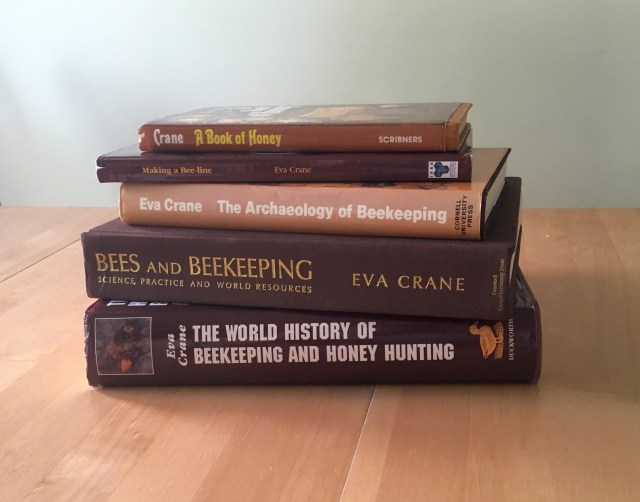
Dr. Crane not only edited bee journals but wrote hundreds of research articles herself. I used to think of her as a master librarian, a person with an encyclopedic grasp on bee literature. I saw her 700-page books (which featured hundred-page bibliographies) as the tedious and conscientious work of a sequestered bookworm. Then I discovered her travels in pursuit of bee lore. From her New York Times obituary:

For more than a half-century Dr. Crane worked in more than 60 countries to learn more and more about honeybees, sometimes traveling by dugout canoe or dog sled to document the human use of bees from prehistoric times to the present. She found that ancient Babylonians used honey to preserve corpses, that bees were effectively used as military weapons by the Viet Cong, and that beekeepers in a remote corner of Pakistan use the same kind of hives found in excavations of ancient Greece.

The meticulousness of Dr. Crane’s research showed in her examination of ancient rock images involving bees and honey. She studied 152 sites in 17 countries from a register of rock art she established herself for her book “The Rock Art of Honey Hunters” (2001).

Dr. Crane wrote some of the most important books on bees and apiculture, including “The World History of Beekeeping and Honey Hunting” (1999). In a review in The Guardian, the author Paul Theroux, himself a beekeeper, called the book a masterwork “for its enormous scope and exhaustiveness, for being an up-to-date treasure house of apiaristic facts.”

The Guardian wrote this:

Everywhere she went she sampled the life of local people, sometimes in the remotest areas of the world. She went to share her beekeeping knowledge and teach governments, NGOs and farmers, recording these travels in Making a Beeline (2003). Typically, she always claimed to have learned much more than she taught. She acquired a huge collection of beekeeping artefacts that, combined with other materials, constitute the IBRA historical collection. Some 2,000 items have now been digitally photographed and recorded while the actual items will be in an international museum, being established in Belgium.
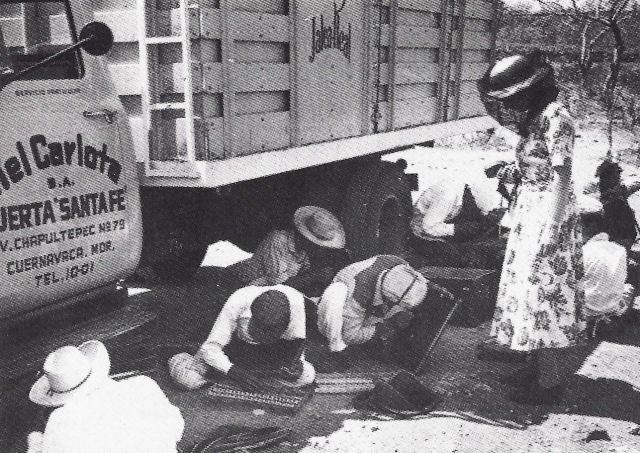
Eva Crane, 1957, at the world’s largest bee farm (Miel Carlota) in central Mexico.

From her own book, Making a Beeline, written in 2003 at age 91, Eva Crane summarizes her travels to 60 countries, always looking at bees. She recounts the people she met, the hives and flowers she saw, in Cuba (1957), the USSR (1962), Egypt (1978), India (1980), Nepal (1984), Pakistan (1993), Spain (1998), and dozens of other countries. In 1965, Dr. Crane was in my part of Canada. Here’s a small piece from Making a Beeline which will give you a bit of a taste of the way she saw the world:

In Edmonton [Alberta, Canada] we first went to the provincial TV station, where I was put on a programme “June is the ice cream month”. I was then interviewed at the national TV station, and finally gave a lecture in the university. From Edmonton I went by airbus to Calgary, then to the Federal Research Station at Lethbridge with Jack and Lorraine Edmunds. Dr. Geordie Hobbs was rearing the wild bee Megachile rotundata there, as a substitute for bumblebees which suffered too much from parasites in that area to be useful for crop pollination.

Next day I caught a plane at Calgary to fly east to Saskatchewan for yet another bee meeting and TV interview, at Saskatoon. With Doug McCutcheon the provincial apiarist and Everett Hastings, I went to Everett’s isolated queen mating apiary by Candle Lake. It was some 30 km north of the inhabited area, in forest which stretched uninterrupted to the tundra. To enter the apiary we had to disconnect the anti-bear fences from their batteries, and then unhook five separate strong wires. In the evening sunshine we also explored the edges of Candle Lake, where there were yellow water lilies that the moose liked to eat. Gulls and killdeer (a plover) were on the beach, many duck and mergansers were flying over, and a solitary loon – a diving bird– was just offshore. Moose, elk and bears all live here but none of them came our way.

Doug took me further east to Nipawin to visit Dr. Don Peer whom I had met in 1953 when he was a graduate student in Madison, Wisconsin. He had now developed large-scale beekeeping on scientific lines, and had 1,000 or more hives. He bought packages of bees each spring and made two-queen colonies from pairs of them. Each of these had 90 to 100,000 bees by July, and could store 20 kg of honey a day from the main flow – mostly from legumes, alfalfa and fireweed.

Lest we dismiss her life’s work as last century news, I would argue that the relevance of history is eternal. Dr. Crane’s endless travels, writing, and documenting played a role in understanding something of concern to almost every beekeeper today – varroa mites. During her travels in the 1960s in the USSR, she noted that western honey bees kept in Russia’s far east Primorsky Krai area (just north of Korea’s Apis cerana bees) had become hosts of varroa. The mite came from the local Asian bees which have had varroa for aeons.

You may know that varroa coexists with the cerana bees without killing Apis cerana colonies, but when the mite jumped to our western honey bee (Apis mellifera), it was devastating. Dr. Crane noticed that some Russian Apis mellifera had managed to adapt to the parasites. She wrote about it. Researchers, reviewing the bee literature when varroa arrived in the USA, noticed Crane’s article. They sent scientists to Russia and came back with the (somewhat) resistant bee which North Americans now call ‘The Russian Bee’. If you have these, you can thank Dr. Crane. (And, of course, the USDA.)

Dr. Eva Crane’s early affliction with the bee bug was total. She never recovered, remaining smitten sixty years later when she was still contributing articles to bee journals. You can access dozens of them at the Eva Crane Trust. They are free to download (but please read the rules). Articles cover subjects as diverse as Honey from different insects to English beekeeping from 1200 to 1850 and Import of Packages into Britain in 1963.

Dr. Eva Crane was 71 when she published The Archaeology of Beekeeping (1983), 78 when she released Bees and Beekeeping (1990), and 87 when her 700-page World History of Beekeeping and Honey Hunting (1999) was published. She died in 2007. By then, she had 312 publications. The last, “The beginning of beekeeping in Siberia”, was an article printed in Journal of Apicultural Research months before her death at age 95.

Posted in Books, History, People | Tagged , , , , , , , | 5 Comments

Do you know the queen colours?

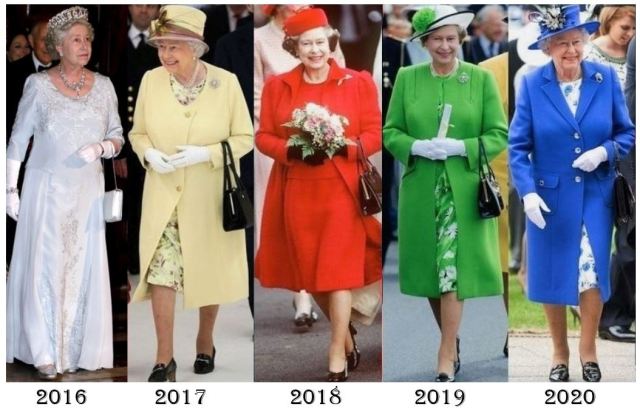
honey bee queen colours modeled by QEII

The queen fashionably models the honey-bee queen colours.

If you mark your queens, you should follow the international queen-colour code: White in 2016 and 2021, Yellow in 2017 and 2022, etc. This system has been around for decades because it’s uniform, consistent, and lets a beekeeper know the age of the queen while making it easier to spot her in a crowd. (As you can see from the picture above.)

A few weeks ago, I was showing a hive as part of a field school that I was helping teach for the Calgary and District Beekeepers. I noticed that the new hive, installed as a package in April, had a queen marked in red. I’d forgotten that this year was supposed to be green. Turns out that the queen was from New Zealand and caged in December (mid-summer there), so it was marked red by the Kiwi beekeeper who sold it. That poor queen, young though she be, will always be thought of as a year older.

Queens produced this year should be marked green. A yellow queen in your hive is growing old and a blue or white one might need to be replaced.  If you have trouble remembering the order (White, Yellow, Red, Green, Blue), here’s a mnemonic: Will You Raise Good Bees?  (Or, maybe you prefer the more graphic: Why your rotting goat barks.)

Posted in Beekeeping, Queens, Strange, Odd Stuff | Tagged | 4 Comments

Can we learn old tricks?

I have a small collection of old bee books, and I like searching them for new ideas. (If you can’t get new ideas from old books, what’s the point of history?) My favourite beekeeping books are the ones that tell stories about beekeepers. Most convey a lot of moral truth about tenacity, fortitude, and perseverance.

I like stories about the failures and successes of beekeeping, especially when told from a personal perspective. My own book, Bad Beekeeping, released fifteen years ago, tells the story of my younger days as a commercial beekeeper and it (so I’ve been told) has become something of a minor classic in the bee literature. I am grateful for that, but I have encountered a number of much better books that tell better yarns about beekeeping of yore.

One of my favourite personal-account beekeeping books is Fifty Years among the Bees (1911) by C.C. Miller.  Dr Miller (1831 – 1920) was born on this date, June 10, and had an 89-year-long kick at the honey can. He wrote a lot about beekeeping, but Fifty Years is a true classic. Like me, Miller was from western Pennsylvania and headed west to become a commercial beekeeper. That’s pretty much where our similarities end. CC, as most people called Dr Miller, was brilliant and highly successful – arguably the best beekeeper of his generation.

He lived during the “Golden Age of Beekeeping” – an era about a hundred years ago when good beekeepers, like Miller, managed 300 hives, produced 50,000 comb sections a year, and made a comfortable living of it. CC originally trained as a physician. He gave that up because he was in constant fear of making a mistake that might kill someone. When beekeeping came to him as an accident, it consumed him, became his vocation, and replaced the practice of medicine. In 1861, at age 30, his wife caught a swarm in a basket. Miller devoted the next 15 years to learning the bee craft. By then, bees had become his only source of income. By working hard and living frugally, bees supported him for the rest of his years.

Miller was humble and unafraid to expose his mistakes to the world. Unlike the many beekeepers with swollen egos, his goal was simply to make enough money from bees that he could afford to spend all his time beekeeping.  To quote his book, “It is not the yield per colony I care for, unless it should be to boast over it; what I care for is the total amount of net money I can get from bees.”

Fifty Years is a great story, a personal tale of how one can live a good life as a beekeeper. If you can’t find a decent hard-cover edition (Years ago, my father gave me his copy.), you can download it online as a PDF at Archive.org. The book was published over a hundred years ago, the copyright has expired, and over a thousand people have likewise downloaded Dr Miller’s informative and amusing story.

Here’s how the book begins:

“One morning, five or six of us, who had occupied the same bed-room the previous night during the North American Convention at Cincinnati, in 1882, were dressing preparatory to another day’s work. Among the rest were Bingham, of smoker fame, and Yandervort, the foundation-mill man. I think it was Prof. Cook who was chaffing these inventors, saying something to the effect that they were always at work studying how to get up something different from anybody else, and, if they needed an implement, would spend a dollar and a day’s time to get up one “of their own make,” rather than pay 25 cents for a better one ready-made. Vandervort, who sat contemplatively rubbing his shins, dryly replied: “But they take a world of comfort in it.” I think all bee-keepers are possessed of more or less of the same spirit. Their own inventions and plans seem best to them, and in many cases they are right, to the extent that two of them, having almost opposite plans, would be losers to exchange plans.”

You can picture this group of trail-blazing beekeepers, grumpy and provoking each other, shaving and dressing in a crowded room at a conference hotel. The book has at least as much to say about beekeepers as it does beekeeping. Sometimes the most useful lessons are taught by people who have made a few mistakes and then shared their experiences. It’s certainly less painful than creating one’s own stupid follies and then trying to recover from them. On this anniversary of CC Miller’s birth, I recommend turning a few pages of Fifty Years among the Bees. You probably won’t regret it. And you might learn some helpful old beekeeping tricks.

Posted in Books, History, People | Tagged , , , | 7 Comments

Save the People

Collins Bay Penitentiary, Kingston, Ontario

A few decades ago, most prisons had farms. Inmates grew some of their own food while learning a few basic skills. That changed for a number of reasons, partly because of the tendency to lock everyone up if they couldn’t afford a good lawyer. Just too many people in the system to consider proper rehabilitation and training.

Kingston, Ontario, has Canada’s most notorious prisons. Hardened criminals are sent there for long sentences. Recently, farms began to reappear at maximum security penitentiaries in Kingston.  Collins Bay and Joyceville Institutions each have ten colonies of bees on their farms. These are not part of a “Save the Bees” effort. It’s a “Save the People” program.

Prison Hives

Beekeeping can be so much more than a business or hobby. Handling bees can calm a person, focus the mind, and lead to keen and sustained interest in nature. Skills related to beekeeping include carpentry (making hive equipment), animal husbandry, marketing, food safety. Character traits that are fostered include self-discipline, courage, and responsibility.

Bees are non-judgmental, giving everyone an equal chance to fail or succeed in their presence. Prison farms are learning to use honey bees as a gateway to healing and reform. It’s great to see these Kingston, Ontario, initiatives.

Joyceville Institute now has bees.

Posted in Outreach | Tagged , | 3 Comments

Laying worker, new queen, or both?

Following on yesterday’s post about laying workers, I thought I should add this important caveat.  If you have a new queen (from a split which was given a young caged queen, for example), you may occasionally find multiple eggs in a few cells.  If you are sure you have a young queen (you’ve seen her), then don’t destroy the hive in the way you’d handle an actual laying worker hive.

Check that the young queen is present and eggs are attached to cell bottoms, not on cell sides. My friend Robert McBain of Worker and Hive Bee Supply sent this photo. He told me that it’s from a hive with a new queen, not a hive completely over-run by laying workers.  He’s probably right.

I used to see the occasional multi-egged cells in mating nucs when I was raising queens. I don’t know if the odd laying worker was active in the nuc (there are always many laying workers present, even in queen-right colonies), or if it was simply the work of a young queen still learning how to count to ‘one’ – either way, the issue always cleared up in a week and the new queen did just fine.

Posted in Bee Biology, Beekeeping, Queens | Tagged , | 5 Comments

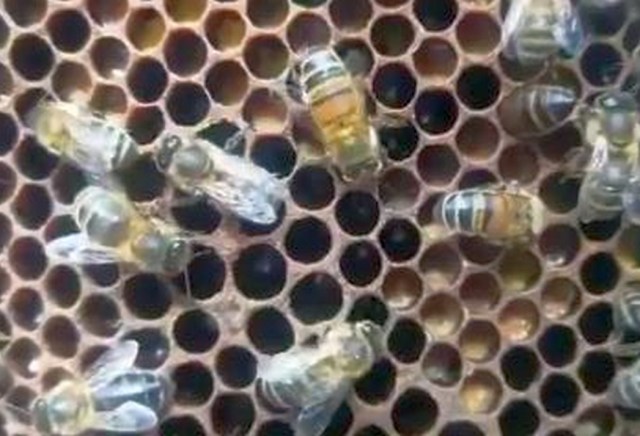
At least one of these bees is a laying worker

Can you spot the laying worker?  (Photo: Chris Manton)

At least one of the bees in the picture above is a laying worker. Can you spot her?  I can’t. But if you read this post to the end, you will have the answer – and a really nice bonus, a video clip of a laying worker laying an egg.

I wouldn’t be able to point out the laying worker, but I’ve heard people claim that “when a laying worker takes over a hive, you’ll notice her because of her long abdomen.” There’s so much wrong with that statement. I’ll explain in a moment.

First, a few words about laying workers. Although it may seem handy to have some extra egg-laying honey bees in your hive, the progeny of a worker is a drone.  Workers are females and can lay eggs. However, they can’t mate, so their eggs are never fertilized. Unfertilized eggs become drones. A colony with no queen will eventually develop laying workers but the offspring are drones, not workers, so the colony fails.

Why do laying workers exist in the bee world?  Creatures of all sorts persist for generations if they do things that produce and nourish their offspring. The present generation is a reflection of the survival strategies of earlier generations. One result has been the abundance of drones in dying colonies. Whether it’s a hive with a drone-laying queen or laying workers, failing colonies spread their genetic “seed” through drones that fly off and perhaps mate with a queen, keeping the lineage alive, even if the colony dies. The bees don’t think in these terms, of course. Instead, it’s a natural process which gets reinforced because those failing colonies that issue lots of drones will carry the genetic tendency to produce laying workers and issue lots of drones in future generations. So, it’s natural and reinforced by circumstances of survival.

Workers that begin to lay eggs are probably more common than we realize. Even in normal, queen-right colonies, the many workers lay eggs. According to Jay and Nelson, 1973, ovary development in worker bees is least common in (1) queen-right colonies with brood, but increases in occurrence in (2) queen-right colonies without brood, in (3) a colony which has some laying workers and no brood,  while the development of ovaries in workers is almost a sure bet in (4) a colony with no brood and no queen.  Obviously, to avoid laying workers, keep a queen and brood in your hive.

A few years ago, scientists found the actual chemical pathway that queen mandibular pheromone, or QMP, suppresses the workers’ egg laying. Their work was important enough to be published in the prestigious Nature. The scientists conducted experiments with adult worker bees by depriving them of QMP. In absence of the queen pheromone, they noticed that one-third of workers develop egg-laying capacity. In the presence of QMP, 5% of workers are not fully inhibited and can lay eggs. I wasn’t aware of either statistic and was surprised at how high these rates are.

If 5% of workers in a normal queen-right colony are able to lay eggs, do they? That could mean thousands of laying workers in a queen-right hive. Well, in addition to the eusocial biological control (fully developed mated queen vs unfertilized laying workers), the bees have mechanisms in place to deal with errant egg laying. Most worker-laid eggs are disposed by house-keeping bees. As queen pheromones would not be present in eggs laid by workers, other bees treat the eggs as they would treat any bits of garbage.

The other statistic – one-third of workers in queenless, broodless hives can be laying workers, is equally surprising.  I had previously assumed that “a few” workers in a queenless hive become laying workers. My assumption was based on the evidence that I’d seen – rarely are there more than a few hundred worker eggs in a depleted queenless hive. So, my hunch was that ovarian development among workers wasn’t common, even in a fully queenless hive. But the Nature journal paper tells us that “In a queen-less environment, if there is no opportunity to make another queen, approximately one-third of honeybee workers activate their ovaries and lay eggs. These eggs are unfertilized and haploid, and they generate fertile male offspring.”

For a beekeeper, laying workers are a discouraging sign. Since it’s most likely to happen in a colony with no queen and no brood, you have to blame yourself for letting the colony fall to such a low state. If you discover a laying-worker hive among your own bees, I might suggest that you give up beekeeping – except that it’s happened to me, too. And every honest beekeeper I’ve ever met will fess up. Stuff happens.

This is one of the best pictures of the result of laying workers that I’ve ever seen. If you see multiple eggs, more than one larvae in a cell, and eggs stuck to the cell wall instead of the cell bottom,  your queen is gone and laying workers have developed.
(Photo by Michael Palmer via Beesource.com)

A laying-worker hive is trouble. The situation means that you’ve lost production, the queen is long gone, and your colony is dying. It’s also a notoriously difficult problem to fix. If one-third of the bees in a queenless hive are laying workers, this highlights the challenge beekeepers face when trying to establish a new queen. Our standard advice is to move the boxes a few metres from the old stand and shake all the workers from the combs. At the old location, reuse the equipment and add some young bees, brood, and a good queen. When the bees return, they will find that you have made some changes at the old location and will generally accept this as an improvement. You won’t always be successful, but you’ve increased your odds of re-queening success to perhaps 80 or 90 percent. Other beekeepers have other tricks, but this is what I learned as a youngster and it seems to work.

Let’s get back to the mistaken statement I began with, “when a laying worker takes over a hive, you’ll notice her because of her long abdomen.” By now, you realize that a single laying worker does not ‘take over’ a hive but many laying workers arise because the important suppressive queen pheromone is missing. What about recognizing a laying worker by abdomen size?  Let’s take a look at the picture from the top of this post again:

Can you spot a laying worker?

Here’s one of the known laying workers:

We know that this is a laying worker because of the amazing video which follows, which is from Chris Manton, a UK beekeeper whom you can follow on Twitter: @ElmTreeBees.  (Go see what he’s up to.)  He deserves your attention after sharing this remarkable video of a laying worker at work:


Posted in Bee Biology, Beekeeping, Diseases and Pests, Queens, Science | Tagged , , , , , | 8 Comments

Are you listening to your bees?

Experienced beekeepers approach their hives as one might enter a church or temple. With quiet respect. Once there, we listen. That’s an important part of our role.  The listening beekeeper knows in an instant if the colony is queenless or has been defending against marauders (wasps, skunks, robber bees). From sound alone, I can’t tell if the hive will be swarming soon or if it is overrun by mites or disease. But some scientists think the information is there, in the air, audible cries of distress or joy produced by the hive.

If we could listen to a thousand hives a day, remember the pitch and rhythm, and relate that to the health and demeanour of similar hives embedded in our memory from our past experiences, we might know a lot more about our hive. This is a project that Jerry Bromenshenk, David Firth, and their associates have spent years developing. Technology and persistence have led to an app, a small computer program, which can be installed on a cell phone. The phone’s microphone picks up the sounds from a hive and analyzes the sounds against thousands of sounds heard in thousands of other hives. Using an artificial intelligence algorithm (a system that learns from its own mistakes), the phone can return the best guess possible about what’s happening in the hive.  As more and more beekeepers use the system (and report their own real-time diagnosis of hive conditions), the better the app becomes.

Your bees are calling.

This bee app is being perfected by Dr Jerry Bromenshenk and his team at Bee Alert Technologies.  Jerry is associated with the University of Montana. He presented at our big United Beekeepers of Alberta conference here in Calgary in September. At the UBA meeting, he discussed new bee technology. One of the things that Jerry described is the phone app which listens to a colony and then deduces the state of the hives’ health.  When he was in Calgary in the fall, Jerry demonstrated the system on my backyard hives. The app concluded (without opening the hives) that all was well.  The app was right – my hives survived the winter and are booming now.  This system has real potential and has been noticed around the world. Along with Bee Culture and ABJ, it has even been featured in Economist magazine.

Would you like to help get this app rolling out to the public?  The more information it analyzes, the better it gets at decoding a beehive’s health. And if you join the fundraiser (https://www.kickstarter.com/projects/beehealthguru/bee-health-guru-a-smartphone-app-for-beekeepers) within the next three days, your contribution gets you one of the first copies of the app – and the satisfaction of potentially improving the way we all keep bees. I’m excited about the prospects, but wary to over-sell the product. I doubt that it will ever be perfect. Heck, my new van sometimes has issues and it’s been 120 years in development. But it is still a step or two above a horse and wagon for my needs. This new app is likely to also be a step or two above my ears when it comes to diagnosing the well-being of my beehives. After 12 years of research and development and two years of testing, this device is ready for all of us to test.

Here’s a bit straight from Dr Jerry Bromenshenk:

On May 1, we launched a Kickstarter project to finalize Tuning of our AI-Powered, Honey Bee Health Guru app. We also intend to add Automatic Alerts and Mapping of the spread of honey bee pests and diseases.   We have just 10 days left  three days left to raise funds and recruit participants:

https://www.kickstarter.com/projects/beehealthguru/bee-health-guru-a-smartphone-app-for-beekeepers.

Kickstarter backers can get a pre-release version of the app. We are looking for 500 backers, and we are close. By the end of May, we will have an established core group of citizen scientists.

We also have a ProVersion of the app aimed at helping Professional Beekeepers improve the ease and accuracy of colony health management. Thus, we are looking for commercial beekeepers who might collaborate with us to tune the ProApp for each commercial operations unique needs. This objective is over and above the objective of the basic app. Providing new tools to improve the efficiency of bee management while reducing overall costs is a personal goal of mine.

Brief Summary of the Bee Health Guru app and the ProVersion:

Our app lets the sounds of the colony itself tell us about each colony’s health condition. Our data recording, AI-powered analyses, and inspection reports are mostly automated. Recording and analysis take less than a minute per hive. Use of the app only takes a few button clicks.   All information can be sent to a Cloud site with the click of one button.           Time, date, location, type of phone, phone operating system are automatically added. From the Cloud, we can send automated reports back to the Professional beekeeper. Have 20 crewmembers in three states? If any or all use the app and hit the upload button at the end of the day, the Professional Manager/Owner will get a summary of all hives checked with the app and a listing by hive and location those that need attention.

Also, whether a hobby, sideliner, or Pro, when app information is sent to the Cloud, we can:

1) Use that information to fine tune the performance and accuracy of the app,

2) Automatically generate alerts to the Pro, for each Pro’s beekeeping operation,

3) Automatically produce regional reports of pest and disease outbreaks and map the spread (similar to the measles outbreaks of the CDC).

Thanks for your help in getting the word out. When we launched the Kickstarter, I did not include information about the ProApp – the basic Kickstarter project might not have been funded. At this point, we have secured the initial pledge funds, so we are moving forward in these last 10 days to expand our goals – namely, the inclusion of the ProApp testing and development and the addition of automated alerts and mapping of the spread of emergent pest and disease incidents.

Sincerely,

Jerry Bromenshenk, Ph.D.,

Pres/CEO of Bee Alert Technology, Inc.

Posted in Bee Biology, Beekeeping, Diseases and Pests, Tools and Gadgets | Tagged , , , | 2 Comments

Another podcast you’ll like

I’m a steady fan of two great beekeeping podcasts. Kiwimana, produced in New Zealand, is a nice mix of practical beekeeping, bee news stories,  and interviews with beekeepers. The PolliNation podcast, made up of bee chats with Dr Andony Melathopoulos and his guests, comes from Oregon State. It focuses on research and various pollinators, including honey bees. Both podcasts, possibly desperate for material, invited me for conversations with their hosts during the past couple of years. I am interviewed at these two links: Kiwimana and PolliNation.

Recently, I became aware of a new podcast that may also be worth my time. Bloomberg (the business news firm) started The Business of Bees podcast on May 1, 2019. You can subscribe through I-Tunes or Android-friendly machines, or you can listen through your computer at this link.

It looks like The Business of Bees will be a series of interviews and analyses about bees in general and the financial burden of beekeeping in particular. Today’s release includes some general history of beekeeping – from ancient Egypt through Langstroth’s bee space. Along the way, Tammy Horn Potter, and several beekeepers, are briefly interviewed. The podcasts are well-written and informative. Rather than long interviews, Bloomberg is presenting 20-minute vignettes narrated by broadcasters Adam Allington and Dave Schultz. Last week, they discussed almond pollination and colony collapse disorder.  I don’t yet know if The Business of Bees will be a favourite podcast for me, but it’s got my attention. See if you like it: Bloomberg’s The Business of Bees.

Posted in Beekeeping, Commercial Beekeeping | Tagged , | 3 Comments

World Bee Day 2019

World Bee Day, May 20 of each year,  is not just about honey bees. Although the idea arose in Slovenia, a little country that’s really big on honey-bee keeping, it’s also a celebration of all the world’s bees. About 20,000 species – made up of several trillion individuals.

Bees of all sorts are the chief pollinators of the world’s flowers. The flowers that attract bees reseed meadows and forests with progeny that build soil, feed grazing animals, and provide us – the humans – with much of the beauty we see in nature and the food we eat.

The dogwood

Dogwood tree in full glory

From a practical, utilitarian perspective, we might wonder if we really need 20,000 kinds of bees. Aren’t honey bees enough? They pollinate our foods – almonds and apples and so on – while many important foods (rice, wheat, corn) are wind-pollinated. Yet we have a vast array of bees that are not honey-makers. Some of the many ‘extra’ bee species are specialists. For example, the dogwood tree, genus Cornus, are kept alive in part by three rare species of miner bees, the Andrena. Take away the dogwood, with its bold early flash of spring brightness, and the Appalachians would be a more dreary place. In the years when I drove truck loads of honey bees from Florida to Saskatchewan, white and pink dogwoods and yellow forsythia were harbingers of the birth of a new year’s honey cycle. The irony is not lost on me – I carted millions of honey bees (which originated in Europe) from Florida’s orange trees (originally from southeast Asia) to prairie alfalfa (a native of the Middle East). Yet, during my 4,000-kilometre migration, one of the most beautiful sights was the blossoming native dogwood, sustained by a tiny native bee.

We might dismiss the role of the other (approximately) 19,999 species of bees as long as we are keeping our favoured western honey bee functioning. But every species has a role to play in our ecology. The loss of a few kinds of bees (some species have recently gone extinct)  may seem trivial. They may pass unmourned, except by the plants which relied on them for transferring their pollen, and the animals which survived off those plants. The interconnection of the web reminds me of the centuries-old proverb which begins, “For want of a nail, the shoe was lost; for want of a shoe, the horse was lost…” and continues until the entire kingdom was lost.

The BBC, in a little piece about World Bee Day, recounts the 17 bee species which have gone extinct in England’s southeast and the plight of 25 more species that are threatened. The article recognizes the interconnected state of biodiversity and ecology and illuminates the importance of a day for the bees.

So, on this year’s World Bee Day, I’m thinking of the ‘other’ bees as well as those two colonies of honey bees in my back yard.  Meanwhile, I’m ending this note with a bit more about bee day, including a bit (published over the past few years) about how World Bee Day came into existence.

🐝 🐝 🐝 🐝 🐝 🐝 🐝 🐝🐝 🐝 🐝 🐝 🐝 🐝 🐝 🐝

From 2019:  May 20th should be a big date on the beekeeper’s social calendar. It’s World Bee Day.  Why did I mention 1734? That’s the year Anton Janša was born. He was baptized on May 2oth, the closest date we know to his actual birthdate. Some say that Janša was the first modern beekeeper. You can learn more about him later in this blog post.

As an added bonus, May 20 is also another famous beekeeper’s memorial day.  Charles Dadant, the scion of the infinite Dadant and Sons progression of beekeepers was born in France in 1817. Dadant thought he’d be a revolutionary back in the day, in France, but he ended up in America.  (You can read his story in my piece celebrating his 200th year.) Charles Dadant, born on May 20, 1817, ended up in western Illinois where he wanted to grow grapes for wine. Lucky for us, his beehives did much better than his vineyards.

World Bee Day was initiated in Slovenia, Europe, and has been quickly catching around the world. For example, German Chancellor Angela Merkel concluded a major speech Wednesday with a rousing endorsement of World Bee Day, telling members of the Bundestag to do something good for the bees:

“I want to finish with something that some may consider insignificant but is actually very important: on May 20 is the first World Bee Day. On this day we should really think about biodiversity and do something good for the bees.”

World Bee Day became World Bee Day after a successful campaign by the country of Slovenia (Anton Janša’s birthplace) to promulgate the message. Their petition to the United Nations was accepted in December 2017, so this year marks the first official World Bee Day.  I’ve been following (and promoting World Bee Day) ever since I heard the effort was underway a couple of years ago, so below you’ll see some of my earlier posts.

Well, a great big congratulations to the Slovenian promoters of World Bee Day. You made it happen on the world stage!  And beekeepers, it’s your job to go out and spread the good word and “do something good for the bees”. If you need some further inspiration, watch this World Bee Day video to fortify your resolve – it’s about the first hive of honey bees kept at the United Nations in New York City.

🐝 🐝 🐝 🐝 🐝 🐝 🐝 🐝

🐝 🐝 🐝 🐝 🐝 🐝 🐝 🐝

FROM 2017:  May 20 is World Bee Day. Seems an appropriate day to celebrate the bee. (So was yesterday; tomorrow would be good, too.) It’s spring north of the equator. I don’t want to neglect our friends south of Earth’s belt, but honey bees began their world-wide conquest by expanding from the northern hemisphere. For most of us in the higher (positive) latitudes, May is a fantastic bee month. Colonies expand, swarm, and maybe even make a little honey.

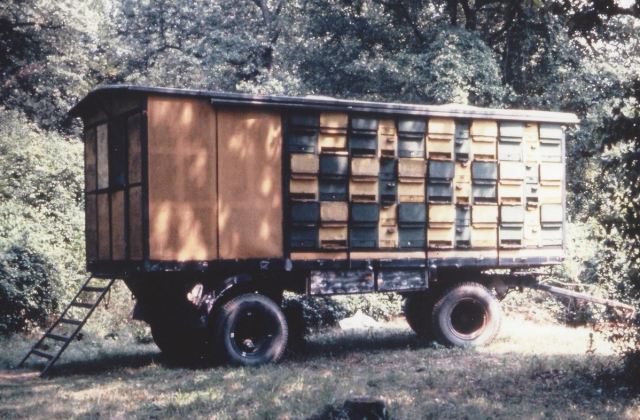
Portable apiary in Slovenia. (Photo by David Miksa)

Portable apiary in Slovenia. (Photo by David Mikša)

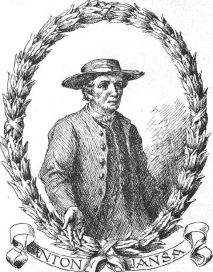
May 20th is also the celebrated birthdate of Anton Janša (1734-1773), the first teacher of modern beekeeping. (It’s ‘celebrated’ on May 20th, which was his baptism date. We don’t know the exact day of his birth.) Anton Janša was Slovenian (hence the funny little squiggle over the ‘s’ in his name). He was so talented that Habsburg Empress Maria Theresa appointed him headmaster at the world’s first beekeeping school, which she built for Janša in Vienna. It’s remarkable that he chose to be baptized on the same day that we would pick centuries later as World Bee Day. That date was chosen and promoted by beekeepers in Janša’s native Slovenia – do the coincidences never end? Now here I am, Ron Mikša (anglicized to Miksha), a bee blogger with grandparents who were born in that part of the world, encouraging you to do a wiggle dance in celebration of World Bee Day this Sunday. Get out and do something beely.

🐝 🐝 🐝 🐝 🐝 🐝 🐝 🐝

🐝 🐝 🐝 🐝 🐝 🐝 🐝 🐝

FROM 2016:  There’s a small country in Central Europe, a very beautiful alpine country, called Slovenia. Slovenia has only two million people, but this tiny country is very big in beekeeping. Tucked between Italy and Austria, it has both mountains and Mediterranean sea coast, creating enticing niches for bees and beekeepers.

Every Slovene family has at least one beekeeper. I think beekeeping might be enshrined in their constitution. I visited before Slovenia adopted the Euro and I paid for a Laško with coins that had images of bees, not presidents or queens. Beekeeping is taken so seriously that the nation’s unofficial motto is “Land of the Good Beekeepers“. The country produces gourmet honey, offers beekeeping tourism, and likes to point out that the Slovenes – the wealthiest Slavic nation in the world – takes its work ethic from the honey bee. On top of all this, I’m proud to say that two of my grandparents were born in Slovenia!  What a remarkable place, eh?
Slovenia convinced the world to recognize World Bee Day, a day for the bees, on the presumed birthday of their most famous beekeeper, Anton Janša.

Janša (pronounced YAN-shah) is a Slovenian national hero and a beekeeper. We don’t really know his birth date – his parents were illiterate farmers and probably wouldn’t have even known (or cared) what year it was. But their church kept track. He was baptized on May 20 in 1734.

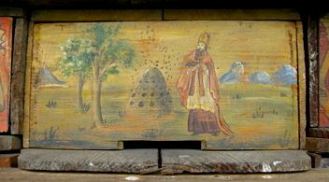
Beehive entrance plate, painted by Jansa.

Beehive entrance plate, painted by Janša.

The Janša family was impoverished, but three Janša brothers built an art studio in a barn, got noticed by the village priest, and were whisked off to Vienna, the capital of the Hapsburg Empire, which controlled Slovenia at the time. One of the brothers became an arts professor. Another became a beekeeper. The royal beekeeper.

Anton Janša was the beekeeper. Empress Maria Theresa recognized his skill and appointed him as the queen’s own bee man. Janša created the world’s first beekeeping school, wrote a couple of important beekeeping books, and introduced modern apiary management. He championed expanding hive boxes to hold extra honey and he encouraged migratory beekeeping, moving hives toward the foothills in the spring to collect acacia (black locust) honey, the Alps in the summer for honeydew from the pines, and into lower pastures in the fall. He was among the first to realize that drones are not water-carriers, but instead mated in the air with queen bees. This latter discovery pre-dates Francois Huber’s similar observation by a few decades but was not generally known when Huber rediscovered it. Janša did all this before he turned 40 – he was only 39 when he died suddenly from a fever, likely the result of an infection.

An image from the Slovene World Bee Day promotional video.

An image from the Slovene World Bee Day promotional video, visible below.

Here’s a lovely, short video of what the Slovenes want you to know about World Bee Day:

World Bee Day is a great idea. The exhibition “Save the Bees” will be opening at the historic Ljubljana castle, on May 20. The Slovene embassy in Washington DC had a big party. Elsewhere, awareness and round tables on “Bees and Sustainable Development” and bee memorials abound. World Bee Day is intended as a day to reflect upon the much maligned and threatened bees. A delegation of the European Union is also meeting May 20 with luminaries of the American bee world at a World Bee Initiative, which you can read about here.

WBDWorld Bee Day is immensely important. Maybe that’s why there are two world bee days. A group of Americans petitioned the USDA to create a World Bee Day of their own – on August 20th. While the Americans worked their idea through the US Congress, the Slovenes asked the United Nations to recognize May 20th as World Bee Day. I’m not sure how all this will play out, maybe the two world bee days will merge and be observed sometime in June or July. But I suppose both world bee days will persist, one on a world-scale, the other in the USA. As they say back at the bee lodge, “You can’t have too many World Bee Days, eh?”

.

Posted in Ecology, History, Native Bees, Outreach, Save the Bees | Tagged , , , , | 5 Comments

The reason we don’t raise April queens in Alberta

It snowed again. After weeks of sweet weather, balmy enough for T-shirts, the bees quit hauling pollen and focused on hibernation.  This is the reason so few queens are bred in Canada.  We can do it, but freaky weather gets in the way. Someday, I’m sure, there will be a big dome over my hometown of Calgary. Inside, there will be banana bushes and fig vines. Somewhere in our dome, a Drone Congregation Area will develop and our young queens will find their way to it.  Meanwhile, we are dealing with fresh snow and chilly temperatures. I’m glad that we weren’t expecting mating weather.

Coincidental to the April 28 blizzard, a few hundred honey bee packages arrived in Calgary from New Zealand. A large group of bees went to our neighbours at Tsuut’ina Nation, the rest (over 200 packages) are going to some of Calgary’s 400 active beekeepers, via the Calgary and District Beekeepers’ Association.  Regardless the snowstorm we had overnight, packages being installed now will do just fine.  In a few days, pollen will be flowing and all the snowflakes will melt into water for future flowers’ nectar.

Posted in Beekeeping, Climate | Tagged , , , , | 1 Comment