
June 12th. I have an excuse to write a bit about the amazing Ethel Eva Widdowson, born in London on June 12th, 1912. By age 30, she had defended her doctorate in nuclear physics, begun to teach at Sheffield University, married stockbroker James Crane, changed her name to Eva Crane, and took home a beehive as a gift from a wedding guest.
It may seem odd to receive honeymoon bees, but it was 1942. England was at war. Sugar was rationed. Those bees were intended to help the newlyweds through the wartime food shortages. Unexpectedly, the bees led to a whole new career for Dr. Eva Crane.

Photo from cover of the book
Eva Crane : bee scientist 1912-2007
edited by Walker and Jones
Eva Crane studied the sciences. She was one of only two women earning a maths degree at King’s College London in 1933. This was followed by an MSc in quantum mechanics in 1935 and her PhD in nuclear physics in 1937. Shortly after, she began lecturing. She could have led an outstanding life as a theoretical physicist, but alas, her bees got in the way.
In the early 1940s, she moved from the male-dominated math and physics field to an amazing career in the arguably more male-centric world of bees. Today, with about half of new beekeepers female, we forget that bee clubs in Crane’s day were completely under the thumbs of men – usually fussy old gentlemen with starched collars. They tolerated women as organizers of beekeepers’ picnics and (sometimes) as secretaries of their clubs.
To suggest women had a subservient role is to make an understatement. During the 1940s, Gleanings in Bee Culture hosted a regular column about beekeeping titled ‘Spinster Jane Says’, which I presume was written by a female writer. In Dr. Crane’s day, women also appeared in bee magazines as authors of “Home Cooking” pages, as did ‘Mrs. Benj. Neilsen’ who explained how to make Christmas fruit cake with honey in the December, 1943, issue of Gleanings.
There were rare exceptions, as Kentucky Chief Apiarist Tammy Horn Potter notes in her books Bees in America, and especially Beeconomy. In many cultures, bees are a thing that women do, but in the west during the past centuries, it’s been largely a male domain. As late as the 1970s, when I moved to Saskatchewan to beekeep, I was appalled when the Saskatchewan Chief Apiary Inspector published a piece about the woman’s role in operating a honey house. In the July, 1979, issue of the American Bee Journal, he wrote,
“I maintain that women have a penchant or inclination towards tidyness and cleanliness. It is both part of their nature and part of their training. . . One of the prime answers to an untidy, unsanitary honey extracting set-up would be to get the man out of the extracting plant and into the field and put a tidy, neat and authoritative woman in charge of the extracting, for where cleanliness has become a habit it has ceased to be a chore.” – Ed Bland, 1979.
So, in 1979, an authoritative woman might have been running a honey kitchen, but few were researching and writing about bees. For example, roughly 300 of the volumes in my home bee library were published before 1960. Of those, only eleven were written by women. That’s about 4%. (I also have 550 bee books published after 1960 – 15% written by women.) My point is not to redress any historic bias against women in the western world’s beekeeping (I’m not the best person to do that!), but rather to describe the world of beekeeping when Dr. Eva Crane became part of it.
Upon receiving her beehive/wedding gift, Eva Crane subscribed to a bee journal and joined the local bee club. Three years into beekeeping, in 1945, she published an article about mead and another about honey.
True to the times, soon after acquiring her first hive, Dr. Crane became secretary of the British Beekeepers Association’s research committee. I assume they picked her because they figured that she would listen well, have good penmanship, and take notes accurately. Besides, she had a PhD in nuclear physics. Actually, I suspect that being ‘secretary’ of the BBA research committee was more akin to being the person who got things done. She quickly moved ahead.
By 1949, Dr. Crane was editing Bee World. She turned it into a prestigious place to publish. The same year, she was the founding director of the Bee Research Association, later renamed the International Bee Research Association (IBRA). From 1949 to 1962, the IBRA offices were in the Cranes’ living room in Berkshire. But it grew. The organization eventually ended up in Cardiff, Wales. Beginning in 1962, Dr. Crane edited the IBRA’s Journal of Apicultural Research, as well as Bee World (1949 to 1984).
Dr. Crane not only edited bee journals but wrote hundreds of research articles herself. I used to think of her as a master librarian, a person with an encyclopedic grasp on bee literature. I saw her 700-page books (which featured hundred-page bibliographies) as the tedious and conscientious work of a sequestered bookworm. Then I discovered her travels in pursuit of bee lore. From her New York Times obituary:
For more than a half-century Dr. Crane worked in more than 60 countries to learn more and more about honeybees, sometimes traveling by dugout canoe or dog sled to document the human use of bees from prehistoric times to the present. She found that ancient Babylonians used honey to preserve corpses, that bees were effectively used as military weapons by the Viet Cong, and that beekeepers in a remote corner of Pakistan use the same kind of hives found in excavations of ancient Greece.
The meticulousness of Dr. Crane’s research showed in her examination of ancient rock images involving bees and honey. She studied 152 sites in 17 countries from a register of rock art she established herself for her book “The Rock Art of Honey Hunters” (2001).
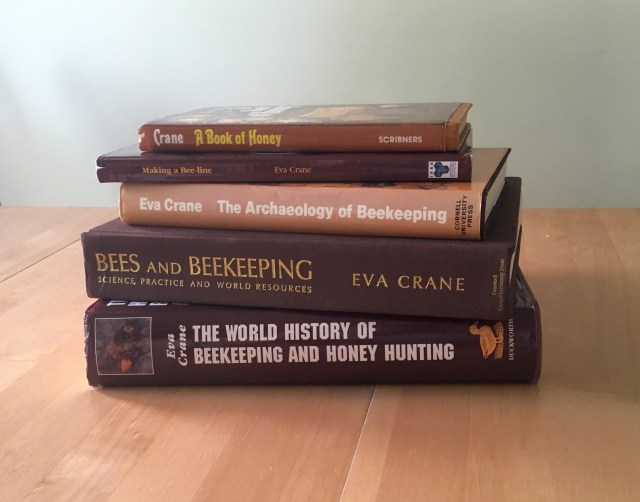
Dr. Crane wrote some of the most important books on bees and apiculture, including “The World History of Beekeeping and Honey Hunting” (1999). In a review in The Guardian, the author Paul Theroux, himself a beekeeper, called the book a masterwork “for its enormous scope and exhaustiveness, for being an up-to-date treasure house of apiaristic facts.”
Everywhere she went she sampled the life of local people, sometimes in the remotest areas of the world. She went to share her beekeeping knowledge and teach governments, NGOs and farmers, recording these travels in Making a Beeline (2003). Typically, she always claimed to have learned much more than she taught. She acquired a huge collection of beekeeping artefacts that, combined with other materials, constitute the IBRA historical collection. Some 2,000 items have now been digitally photographed and recorded while the actual items will be in an international museum, being established in Belgium.
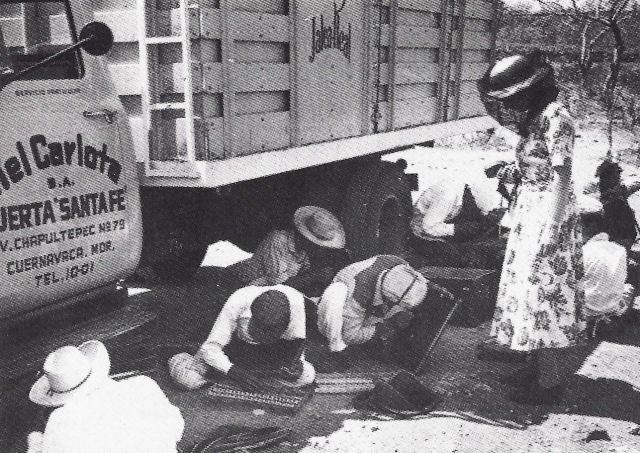
Eva Crane, 1957, at the world’s largest bee farm (Miel Carlota) in central Mexico.
From her own book, Making a Beeline, written in 2003 at age 91, Eva Crane summarizes her travels to 60 countries, always looking at bees. She recounts the people she met, the hives and flowers she saw, in Cuba (1957), the USSR (1962), Egypt (1978), India (1980), Nepal (1984), Pakistan (1993), Spain (1998), and dozens of other countries. In 1965, Dr. Crane was in my part of Canada. Here’s a small piece from Making a Beeline which will give you a bit of a taste of the way she saw the world:
In Edmonton [Alberta, Canada] we first went to the provincial TV station, where I was put on a programme “June is the ice cream month”. I was then interviewed at the national TV station, and finally gave a lecture in the university. From Edmonton I went by airbus to Calgary, then to the Federal Research Station at Lethbridge with Jack and Lorraine Edmunds. Dr. Geordie Hobbs was rearing the wild bee Megachile rotundata there, as a substitute for bumblebees which suffered too much from parasites in that area to be useful for crop pollination.
Next day I caught a plane at Calgary to fly east to Saskatchewan for yet another bee meeting and TV interview, at Saskatoon. With Doug McCutcheon the provincial apiarist and Everett Hastings, I went to Everett’s isolated queen mating apiary by Candle Lake. It was some 30 km north of the inhabited area, in forest which stretched uninterrupted to the tundra. To enter the apiary we had to disconnect the anti-bear fences from their batteries, and then unhook five separate strong wires. In the evening sunshine we also explored the edges of Candle Lake, where there were yellow water lilies that the moose liked to eat. Gulls and killdeer (a plover) were on the beach, many duck and mergansers were flying over, and a solitary loon – a diving bird– was just offshore. Moose, elk and bears all live here but none of them came our way.
Doug took me further east to Nipawin to visit Dr. Don Peer whom I had met in 1953 when he was a graduate student in Madison, Wisconsin. He had now developed large-scale beekeeping on scientific lines, and had 1,000 or more hives. He bought packages of bees each spring and made two-queen colonies from pairs of them. Each of these had 90 to 100,000 bees by July, and could store 20 kg of honey a day from the main flow – mostly from legumes, alfalfa and fireweed.
Lest we dismiss her life’s work as last century news, I would argue that the relevance of history is eternal. Dr. Crane’s endless travels, writing, and documenting played a role in understanding something of concern to almost every beekeeper today – varroa mites. During her travels in the 1960s in the USSR, she noted that western honey bees kept in Russia’s far east Primorsky Krai area (just north of Korea’s Apis cerana bees) had become hosts of varroa. The mite came from the local Asian bees which have had varroa for aeons.
You may know that varroa coexists with cerana without killing Apis cerana but when the mite jumped to our western honey bee (Apis mellifera), it was devastating. Dr. Crane noticed that some Russian Apis mellifera had managed to adapt to the parasites. She wrote about it. Researchers, reviewing the bee literature when varroa arrived in the USA, noticed Crane’s article. They sent scientists to Russia and came back with the (somewhat) resistant bee which North Americans now call ‘The Russian Bee’. If you have these, you can thank Dr. Crane. (And, of course, the USDA.)
 Dr. Eva Crane’s early affliction with the bee bug was total. She never recovered, remaining smitten sixty years later when she was still contributing articles to bee journals. You can access dozens of them at the Eva Crane Trust. They are free to download (but please read the rules). Articles cover subjects as diverse as Honey from different insects to English beekeeping from 1200 to 1850 and Import of Packages into Britain in 1963.
Dr. Eva Crane was 71 when she published The Archaeology of Beekeeping (1983), 78 when she released Bees and Beekeeping (1990), and 87 when her 700-page World History of Beekeeping and Honey Hunting (1999) was published. She died in 2007. By then, she had 312 publications. The last, “The beginning of beekeeping in Siberia”, was an article printed in Journal of Apicultural Research months before her death at age 95.

 Calgary’s biggest


 Julie Payette, NASA astronaut portrait. Photo: NASA. Public domain.


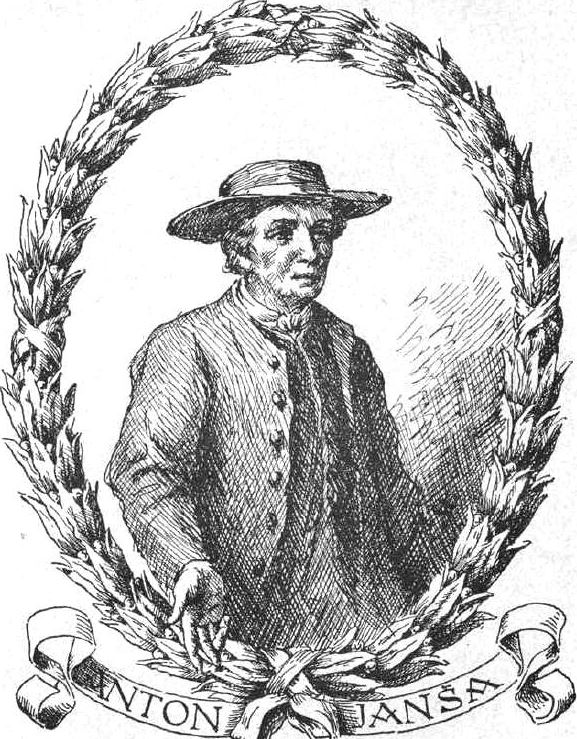 May 20th is also the celebrated birthdate of
  World Bee Day is immensely important. Maybe that’s why there are two world bee days. A group of Americans petitioned the USDA to create a
