My Failure as a Beekeeper: Part V

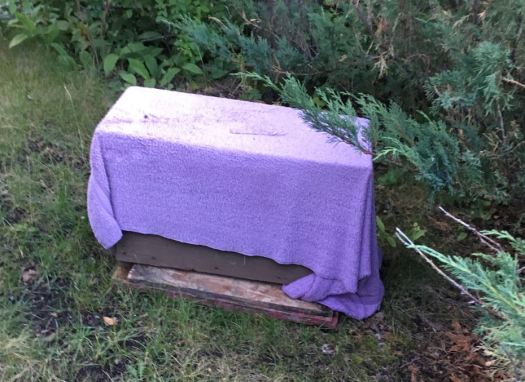
Our nuc, after losing its queen. Anarchy ensues as laying workers take over.

When a colony has lost its queen and not replaced her, the hive is almost certain to die a slow and sorrowful death. The great plans we had for this small nuc – a source of a pound or two of honey, a reliable pollinator for next spring’s crab apples and raspberries, a teaching tool for my kids – died with the queen.

A few days after returning from summer in Hungary, we opened the hive, and saw a bit of new brood. But rather than the nice neat rows of uniform workers-in-progress, we saw the random and ugly brood of poorly-forming drones growing inside cramped worker cells. Beekeepers sometimes call this ‘bullet brood’ as the cells are sealed extra high, shaped like bullets, in order to accommodate the large body sizes of drones pupating in skinny worker brood cells. Our hive had laying workers.


Not the brood we wanted.

Remember that workers are females, but they have ‘under-developed’ ovaries and few tubes, as the text books explain it. Workers can’t mate, so they lay unfertile eggs. Unfertilized eggs become drones. Hence, laying workers, having seized control of the palace, become the Snowballs and Napoleons of the Bee Farm – cunningly leading their minions to disaster.  You’d think they’d do a better job, considering their humble origins.  But once they take over, laying workers ruthlessly cling to power. Some beekeepers find it so difficult to deal with a laying-worker hive that they shake the bees into the grass some distance from the colony and insert the frames (without bees) into a better hive. Many beekeepers believe it’s futile to try to requeen a laying worker hive because the new replacement queen is often killed.

I have pondered the odd system in which a queenless hive allows workers to lay eggs, none of which has any chance of becoming a new queen. [The South African cape honey bee (Apis mellifera capensis) actually produces queens via worker-laid eggs, but that’s the stuff of magic and requires a longer blog post than this one.]  Our western (European) honey bee workers may lay eggs, but they always become drones. What’s the point to that? The hive is going to die, so why all those drones?

If you think of drones as mobile DNA tanks which can easily move to a new hive and possibly mate and carry forward the dying hive’s genetic stock, then it does make sense. From an evolutionary biology perspective, a creature’s mission is to preserve and spread its genes. The laying-worker’s drones are samples of the colony’s DNA. It’s one last chance to send genetic missives out into the world, carrying the unique code of the colony before it’s gone forever. This also explains why laying workers often destroy a queen introduced by a beekeeper. The new queen represents foreign DNA. If introduced before laying workers take charge, such a requeening may be tolerated. But afterwards, there is the obvious conflict regarding dispensation of life codes.
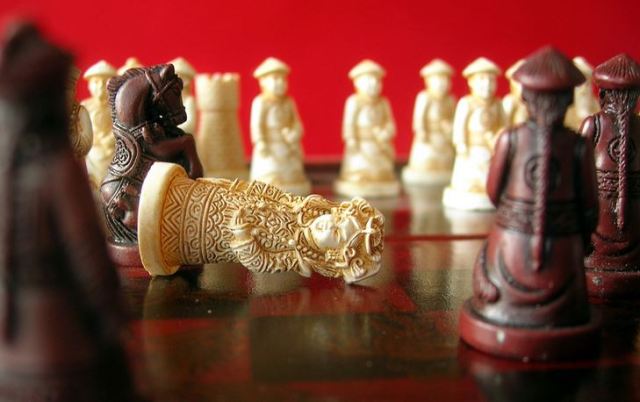
Because I discovered the laying workers in mid-August, after the season’s honey flow had ended, I knew that we’d be starting with other bees next spring. This colony was as good as dead. It was a zombie hive, perhaps still living and gasping, but in reality, very nearly dead. A hive with no future, except for those drones which would fulfill the hive’s final mission.

I knew what needed to be done. The nuc would have to go back to my daughter’s farm where it came from, the bees released and allowed to drift into strong hives in the apiary. The combs would be reused in other hives. The drones? Well, they’d carry the message forward. The idea that drones would be propagating the DNA of the gentle hive gave me some solace, but one more tragedy awaited my little hive.  I’ll write about that tomorrow.

Posted in Beekeeping | Tagged , , , , , | 5 Comments

My Failure as a Beekeeper: Part IV

Dead queen syndrome.

This is the fourth piece in my six-part description of my colossal failure as a beekeeper this summer. If you’ve been following this little series, you saw how I acquired a little queenless nuc, transported it to my home, and watched as it raised queen cells. But it appears that wasps  captured the queen during one of her mating flights, leaving the colony terminally queenless.

A hive usually recovers after being queenless. If a queen suddenly dies (crushed by a beekeeper?), the workers feed a few larvae a steady diet of royal jelly. In most cases, a new queen develops, mates, and takes over the colony’s egg-laying chore.

If something goes wrong (as in the case of my little hive where the queen developed but then disappeared before laying), the hive is in big trouble. If a beekeeper has more than one colony, she could quickly insert several more frames of brood and young bees into the dying hive, essentially creating another nuc and giving the bees another chance to raise a queen. Caught at the right time, a new laying queen might be accepted by the hive.  I might have done this, but I had just one hive so there was no back-up brood. I could have driven off to my daughter’s farm and returned with more brood, but I was in Europe, so I missed my chance.

Experienced beekeepers can guess what happened next. I’ll quote Leo Tolstoy, one of the 19th century’s best beekeepers, who compared Moscow to a queenless hive in War and Peace.

Here’s Lev Tolstoy’s description, from Chapter 20 of War and Peace:

Meanwhile, Moscow was empty. There were still people in it, perhaps a fiftieth part of its former inhabitants had remained, but it was empty. It was empty in the sense that a dying queenless hive is empty.

In a queenless hive no life is left, though to a superficial glance it seems as much alive as other hives.

The bees circle round a queenless hive in the hot beams of the midday sun as gaily as around the living hives; from a distance it smells of honey like the others, and bees fly in and out in the same way. But one has only to observe that hive to realize that there is no longer any life in it. The bees do not fly in the same way, the smell and the sound that meet the beekeeper are not the same.

To the beekeeper’s tap on the wall of the sick hive, instead of the former instant unanimous humming of tens of thousands of bees with their abdomens threateningly compressed, and producing by the rapid vibration of their wings an aerial living sound, the only reply is a disconnected buzzing from different parts of the deserted hive. From the alighting board, instead of the former spirituous fragrant smell of honey and venom, and the warm whiffs of crowded life, comes an odor of emptiness and decay mingling with the smell of honey. There are no longer sentinels sounding the alarm with their abdomens raised, and ready to die in defense of the hive.

There is no longer the measured quiet sound of throbbing activity, like the sound of boiling water, but diverse discordant sounds of disorder. In and out of the hive long black robber bees smeared with honey fly timidly and shiftily. They do not sting, but crawl away from danger. Formerly only bees laden with honey flew into the hive, and they flew out empty; now they fly out laden. The beekeeper opens the lower part of the hive and peers in.

Instead of black, glossy bees- tamed by toil, clinging to one another’s legs and drawing out the wax, with a ceaseless hum of labor – that used to hang in long clusters down to the floor of the hive, drowsy shriveled bees crawl about separately in various directions on the floor and walls of the hive. Instead of a neatly glued floor, swept by the bees with the fanning of their wings, there is a floor littered with bits of wax, excrement, dying bees scarcely moving their legs, and dead ones that have not been cleared away.

The keeper opens the two center partitions to examine the brood cells. They reek of decay and death. Only a few of them still move, rise, and feebly fly to settle on the enemy’s hand, lacking the spirit to die stinging him; the rest are dead and fall as lightly as fish scales. The beekeeper closes the hive, chalks a mark on it, and when he has time tears out its contents and burns it clean.

So in the same way Moscow was empty when Napoleon, weary, uneasy, and morose, paced up and down in front of the Kammer-Kollezski rampart….

My hive was Moscow at its worst. It was August and my story just gets worse. It was too late to fix the colony and . Tomorrow, I’ll describe the inside of my hive. It was much as Tolstoy said, “There is no longer the measured quiet sound of throbbing activity, like the sound of boiling water, but diverse discordant sounds of disorder.” That – and other sad signs of defeat – will be our subject tomorrow.

Posted in Beekeeping | Tagged , , , , , , , | 14 Comments

My Failure as a Beekeeper: Part III

The wasps were especially fierce this year.

Over the past few days, I’ve been writing about the misadventures of a small queenless hive which we placed in our back yard this summer. It dutifully raised several nice queen cells. At the time, I worried about the greedy bug-eating birds that spend a lot of time in our neighbourhood. I knew that only one queen from the cells would fly out on a mating flight. It seemed possible – but not likely – that the little nuc’s queen would end up in some hungry bird’s mouth. I was probably wrong to incriminate the magpies, but unfortunately, our queen did disappear during her mating flight. Now I suspect the culprits were wasps, not birds. I’ve never seen so many Vespidae in my life and they were especially fierce this year. They hovered in front of our nuc, snacking on bees whenever they could.

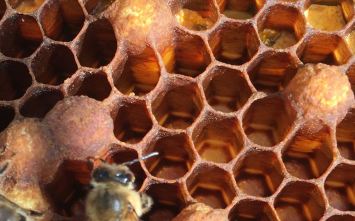
I know that virgins successfully emerged from the nuc’s cells. Below, you can see the proof. The cells came full-term, several queens emerged within hours of each other, and (I assume) mortal combat ensued between the would-be queens. One strong and fit queen bee would have eventually left the hive on her mating expeditions. She never made it back. Here are before and after photos of the cells:

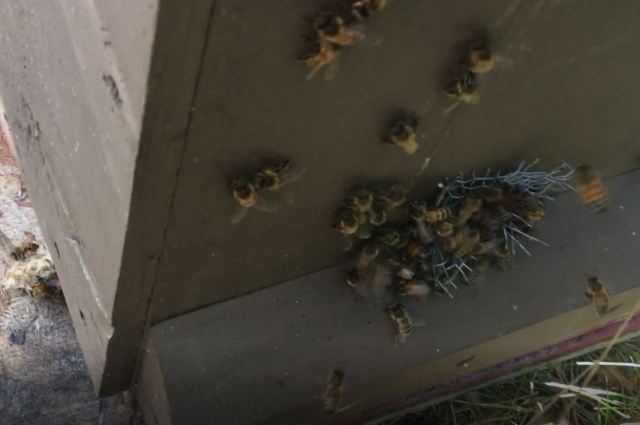
I’m blaming the queen loss on wasps. They were incredibly aggressive this year. Luckily, our nuc had a small screened entrance – it kept the wasps from getting inside the hive. But from morning through evening, dozens of wasps patrolled the area right in front of the hive. I watched as wasps picked off nectar-laden bees returning to their home. That’s probably what happened to our newly mated queen, returning home after her afternoon of frolic. Later, I caught a bit of the wasp action on a video, which is playing just below. It’s not pretty.

Other things can go wrong when a queen is supposed to be mating. The victorious virgin may be badly injured following the battle against her rivals, thus dying enroute to the drone congregation area. She might simply get lost. Both situations are rare, so that’s not likely what happened. In a pet hive, the beekeeper (me!) might disturb the queen as she prepares to mate or shortly after her nuptial flight. In such a case, the bees are unnerved by the beekeeper’s intrusion and they punish their new queen, as if she were somehow responsible for the hive’s bad luck. But I have an alibi – I was in Hungary when the queen was hooking up with the drones. This time it was not my hive examinations that led to the virgin/queen death. Instead, I tend to think the queen was ripped apart by those aggressive wasps that replaced themselves faster than our fly swatter could punish them. Wasps were really, really prolific here this summer.

So, what happens to a hive when all the brood has hatched and the only chance for raising a queen is missed?  That’s the subject of tomorrow’s blog post.

Posted in Beekeeping | Tagged , , , , , | 7 Comments

My Failure as a Beekeeper: Part II

Rural Alberta, the former home of my hive.

Yesterday, I started to describe my rather lousy year as a beekeeper. It began with an intentionally weak queenless hive. I picked it up at my daughter’s farm and brought it into my back yard, here in the city of Calgary.

Calgary, the new home for my hive.

The former home of the hive and its new home are both in western Canada but there was a big change for the bees. Not only were they moving from a big strong colony into a little 5-frame nuc, they were also leaving the bucolic wide-open prairies and settling into the big city in the Rocky Mountain foothills.

There’s lots of opportunity for hardworking ambitious bees in a bustling city like Calgary, but danger also lurks – as we found out later in the summer. However, I hoped that our clovers and wildflowers and nice sheltered yard would keep the bees happy.

Bonsai works OK for trees, but not so well for bees.

My idea was to maintain a bonsai-esque hive – an intentionally small colony, in the model of a Japanese bonsai tree. I’d prune it back whenever necessary so I wouldn’t have to deal with 50,000 bees inside a heavy, towering skyscraper-hive. Instead, I expected to have a nice, pleasant, small colony in the yard for my family to enjoy.

I hadn’t thought of the connection to “bonsai” until a reader of this blog pointed out that my small-hive experiment reminded him of that ancient Asian arbortorial craft. The reader even suggested a name for the colony: Hachi, which is Japanese for bee.

Shortly after I brought the hive to town, I asked readers of this blog to help us name him/her/it. In addition to Hachi, you came up with some good suggestions, including Phoenix which was recommended because my bee endeavours were rebirthing in a way reminiscent of the ancient bird.  Another idea was to name the nuc after a favourite rock or volcano, thus linking the hive to my geophysics profession. (My choices would have been Bridgmanite and Eyjafjallajökull, respectively.)  But I opted to leave the hive unnamed, waiting for its personality to develop before adding a permanent nomenclature. I’m glad that we waited.

Here’s the rub. After teaching bunches of students that the only way to successfully keep bees is to keep strong colonies, I renounced my own good advice and tried to keep a weak hive. Strong hives imply healthy bees, good queens, appropriate locations, a fully-functioning, healthy hive ecology. A weak hive offers less honey to mess with, no heavy boxes to lift, and fewer stinging bees. But I found out that a weak hive is harder to manage than a strong one.

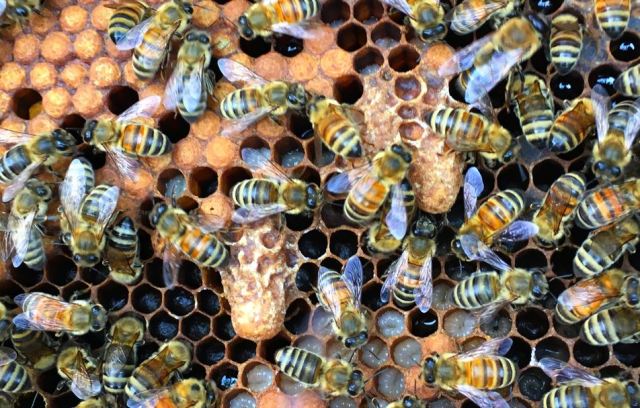
This little queenless hive started off as expected. I brought in the nuc in late June so I expected to see a new queen and fertile eggs about a month later. The bees were surprisingly gentle (not always the case with a queenless hive) and the bees began raising queen cells. Here’s what those cells looked like just after they were sealed. Tomorrow we’ll see what happened to the new queens – the aftermath of their fight for dominance and the royal crown.

Day 6 of a queenless nuc: sealed queen cells amid happy bees.

Posted in Beekeeping, Friends | Tagged , , , , , | 2 Comments

My Failure as a Beekeeper: Part I

I’ve worked with bees for almost fifty years, raising queens, pollinating crops, making oodles of honey.  I grew up in a beekeeping family (so my 50 years started really early). Over that long time period, I worked for some really good beekeepers. But, somehow, I failed to learn everything there is to know.  This year really proved that. Over the next few blog posts, we’ll look at what happened to our little backyard beehive.

We (a family decision) decided to bring a hive into the back yard here at our home in Calgary. Until now – except for a couple of years back in the ’90s – I hadn’t kept bees in the big city. Instead, my hives were rural. That was nice – it forced me to drive out into the countryside to beekeep, giving me some pastoral reality. But this spring, in late June, I parked a nuc in our yard, metres away from the deck.

Since I’d not had a hive at my home for a long while, I wanted a tiny hive. A weak hive. A queenless hive. A pathetic little cluster of bees that my teenagers and I could examine from time to time. Our little hive was a big hit with the kids. My 15-year-old was smitten by the bee bug . He and I particularly enjoyed our bee sessions.

Because it was a single and very weak colony, it seemed like a puppy or a toddler. Sweet, innocent, fragile. In fact, this little hive (population 5,000) was remarkably gentle. The bees refused to sting me, even when I deserved it. That made it especially nice to show my kids. So far, so good.

It may surprise you that I opted for a queenless nuc. My idea was that the bees would raise their own queen, giving my kids and I something especially interesting to watch. By late July, the new queen would be laying, the hive would build up, we’d winter it and have a slightly stronger colony to observe next year.

To get my hive, I drove to my daughter’s farm, over an hour from Calgary. Her husband pulled a few frames of brood, bees, and honey. These went into my new hive. To transport the bees home in my van, we slipped the nuc into a very large black plastic bag. (If you’ve never tried this trick, I’ve written about the procedure here.)  I returned to Calgary and my teenager set the nuc in place that evening, pulling the box out of its bag.

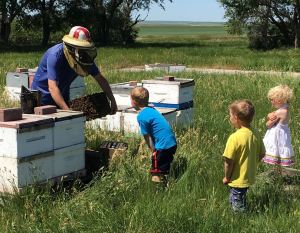
My son-in-law, Justin, is setting up my nuc out at the farm. The flock of little kids are my grandchildren. It looks like they’ll be beekeepers, too.

We thought we were set for an exciting year of miniature beekeeping. Tomorrow, I’ll describe the nuc’s first few weeks and I’ll tell you the names we considered bestowing upon the puppy/toddler/nuc. And why I’m glad that we didn’t actually name the poor little thing.

Posted in Beekeeping, Friends | Tagged , , , , | 9 Comments

World’s Weirdest Beekeeping Family

Blood Honey honey bees

You’ve probably known some weird beekeeping families – maybe you’re lucky enough to live in one. But someone out there is a member of the world’s creepiest beekeeping family. If you want to know more about the worst of the worst, there’s a movie. It’s not exactly a documentary, but a full-length horror story. A B-movie thriller flick.  Here’s the trailer. But (Trigger Warning!) this film clip contains bees, blood, honey, and some incredibly awful beekeeping.

Blood Honey has it all – death, ketchup-blood, and honey bees. My favourite line from  the trailer (“Honey is the only part of the business that still makes a profit.”) tells you how poorly informed this movie is – there’s really not much money in bees.  The movie’s bee farm is in Canada’s Precambrian shield, a place where (in real life) bees make no honey at all. The other part of the business referred to in the quote is an isolated hunting lodge where jackfish virtually leap into a fisherman’s net. If you want to make money in the north, run a fishing lodge, not a honey farm.  But the writers decided to focus on bees, not fish. I’m guessing that’s because bees are trendy this year.

Among the goofy beekeeping and erstwhile wisdom in this otherwise awful movie, we get to see a beekeeper commit suicide by taking off his veil and kicking a hive, we learn that bees in the far north make toxic honey, and (as the protagonist discovers) you really can’t go home again.

I’m a poor judge of popular culture, so this may actually be a great film. Canadian actress Shenae Grimes-Beech is a strong and capable lead. So, perhaps the movie will sell out in theatres everywhere, but I doubt it. Sorry, folks, but I can’t give this film anything higher than two out of ten bees.   🐝 🐝

Posted in Culture, or lack thereof, Killer Bees, Movies, Strange, Odd Stuff | Tagged , , | 7 Comments

I’m Not a Doctor, but…

An acquaintance – someone active in our 400-member Calgary Bee Club – reported that he had an allergic reaction to a sting.  He’s been keeping bees quite a few years and he’s had dozens (perhaps hundreds) of stings. Then, a week ago, he had a very bad allergic reaction.  He asked our group if others have had similar experiences. Several had.

I have never had a dangerous reaction to a sting, though I did have a problem once when I was unloading a couple hundred hives by hand in awfully warm weather. My brother and I had loaded the hives in Wisconsin. Alone, I drove down I-80 to Pennsylvania in the dark, but it was one of those blazingly hot late summer nights.  I had driven the 800 kilometres alone and was by myself when I removed the hives from the big van.  The overnight low was about 30C (86F), the bees left their boxes trying to cool off. I began to offload at my destination (Mercer County, Pennsylvania) as the sun was rising. My 240 hives were camouflaged by a brown carpet of crawling bees. I worked as quickly as I could, but the bees demonstrated their irritation at being trucked from Wisconsin’s clovers to Appalachian goldenrod. They were not impressed. The venom of about a thousand stings made my stomach churn. I became a bit fevered – and pretty sore. It was an overload of venom, but probably only half of a lethal dose.

Here in Calgary, my friend’s surprise sting reaction was caused by a single bee. I’ve heard of this happening – a beekeeper goes for years without incident, then gets an unexpected allergic reaction. Why?

Late summer is an especially dangerous time for beekeepers in the northern hemisphere (hives are strong but the flows may be over), so  I decided to share the info which I sent out to our bee group. You may be similarly affronted, so I’m printing it for you, too.

🐝 🐝 🐝 🐝 🐝 🐝 🐝 🐝 🐝 🐝 🐝 🐝

Here, paraphrased, are my bee-allergy thoughts:

First – and importantly, I am not a medical doctor. My comments should be construed as neither medical advice nor necessarily fully informed information.

As you know, allergies are an immune system response to a foreign allergen in a biological system. In general, continuous and mild exposure to the causative agent allows the body to regulate and balance a response to the invading allergens. If a long period elapses between exposure to the allergen, the balance can be lost (but not always) and subsequent exposures may be life-threatening.  This is why anecdotal evidence suggests beekeepers who are regularly stung usually do not develop systemic reactions whereas those who receive only infrequent stings are more at risk to systemic anaphylaxis.  If months pass between stings, the likelihood of too much immunoglobulin antibody building up increases and a reaction is more likely.  Since it takes a bit of time for the body’s allergen response to develop after an initial exposure, we don’t usually expect any systemic reaction with the first bee sting.  We sometimes hear people say, “I was stung when I was a kid, so I’ll be OK.”  In reality, the opposite may be true. That initial sting could set the body up for a huge reaction years later.  Getting stung regularly is usually the best way to keep from having a bad reaction in the future.

Children of beekeepers may be especially vulnerable. If our kids get stung, we try to prevent a second sting – months or years may pass before they get stung again, sometimes with disastrous consequences.  In addition, when ‘bee dust’ on our clothing comes into the house, it gives the kids low-level exposure to bee proteins which may result in their bodies’ development of an excess of antibodies which will react badly when they eventually get stung.

You may be surprised that I mentioned ‘bee dust’ on clothing.  Systemic bee reactions are due to allergic reactions to bee proteins, not directly from the poisons in bee venom.  In really huge quantities, venom is fatal. A person who is not allergic to bee stings will die if she gets several thousand stings. That’s poisoning from venom, not an allergic reaction.  Allergies are more closely related to a bee’s body, not its venom.   I knew a beekeeper in northern Saskatchewan who had extreme anaphylaxic shock from the bee dust in his hive equipment.  It was as severe as if he was have a reaction to a bee sting.  Before he sold his business, he wore a dust mask and gloves just to handle his frames. Bottom boards were especially a problem for him.

The allergic reaction mostly depends on the bee’s protein, not its venom.  Venom may change slightly when bees work different sorts of flowers. [Just as a cow’s milk may be bad if the cow eats milkvetch or loco weed.] When I was a teenager keeping bees in the east, I used to move a couple hundred hives into buckwheat fields each summer. After the bees had been working buckwheat for a few days, their stings became much, much more painful.  I could normally take a half dozen stings without noticing them, but a single sting when bees were on buckwheat would make me shudder.  (Even as I right this today, I get queasy just thinking about that pain!)

Wasps, alkali bees, bumblebees, honey bees, etc., all have DNA different from each other. You may have a severe allergic reaction to a bumblebee sting but no such reaction to a honey bee sting.  Or vice-versa, of course.  Similarly, if you are allergic to a honey bee’s protein, then you are allergic to all honey bees. It doesn’t matter what the bee was foraging on because its food won’t change its DNA, which, in turn, designs its proteins.    Someone asked whether the flowers “could affect the poison?” and the answer is yes, it could affect the chemical properties of the venom (See:  https://beelebanon.files.wordpress.com/2016/01/7-chemistry-and-pharmacology-of-honey-bee-venom-l.pdf) as I mentioned with the buckwheat anecdote.  But that’s different from the cause of the typical allergic reaction.  With an allergic reaction, our body is arguing with the bee’s foreign protein, not the venom itself.  (This is a simplification, of course.  Among other chemicals, venom contains peptides, enzymes, and various proteins. The proteins are from the bee. So, you are getting an injection that includes bee protein.  However, it might be useful to think in terms of a systemic reaction being a response to the stinger more than the sting.)

The idea of bees collecting nasty things on their stingers was mentioned by another person on this bee chat group. Bees normally keep their stingers covered by quadrate plates so their stingers remain retracted until deployed. I’m not sure how likely it would be for bees to pick up something nasty on their stinger.  The person added, “it sounds a little far-fetched that bees pick up stuff on their stingers” and I agree.  But anything is possible. Physicians sometimes have a rather shallow understanding of honey bees – when I had bees near the Grasslands National Park in Saskatchewan, a rancher knocked over a few of my hives with his swather. It was an open cab and he was quickly covered with bees. He was stung a few hundred times. At the hospital, the doctor instructed the nurse to pull out all the throbbing little sting sacs with tweezers. This stupidity, of course, gave the poor guy another dose of venom. When I visited him later that day at the hospital, he was swollen and in horrible pain.  Before I left, I had a discussion with the doctor.

Finally, I want to say again that I am not an expert in allergic reactions. All of the preceding is a simplification. I may have confused some terminology.  But the bottom line is that reactions to bee stings are unpredictable and can be dangerous. Having the right meds and an epipen in the truck, shop, and house are essential for any unexpected emergencies.  I can’t explain a sudden unexpected systemic reaction, but several people have pointed out that subsequent stings for them were not serious. Sometimes we get stung by other creatures and assume it was a bee. Sometimes the antibodies build up for unrelated reasons and we get a bad reaction. 

I remember another beekeeper who had a severe reaction. He took a few bees with him to the hospital, along with his epipen and antihistamines. He waited in the hospital parking lot with a friend and proceeded to sting himself. Twice. He waited an hour, then went home without needing Benadryl, epinephrine, or doctors. You never know about bees.

 – Ron

I hope this helps explain a little about why bee stings are unpredictable. If you’ve had any bad bee sting experiences (or good ones!) please feel free to share them below in the comments.

Posted in Apitherapy, Bee Biology, Beekeeping, Friends | Tagged , , | 16 Comments

Cats and Dogs, Living Together

There’s a scene in Ghost Busters where Bill Murray describes the doom awaiting the world when the captured ghosts are released: “…human sacrifice, cats and dogs living together…” It’s hard to image any fate worse for civilization, eh?

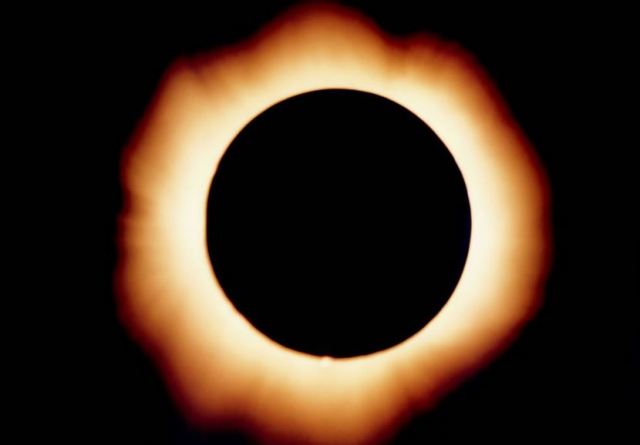
Such fear surely disturbed countless generations of superstitious humans when the gods unexpectedly hid the mid-day sun. Rumours abound of people dying of despair, birds falling silent, and bees racing home during a total eclipse of the sun.  And yes, cats and dogs living together.  Fortunately, after a few moments of lunacy, the sun shines radiantly once again.

I figured that today’s bee blog post would be eclipsed by bigger events, but I wanted to write a few words anyway. I’d love it if a beekeeping reader or two in the USA would let us all know how their bees perform during today’s eclipse. I’ll be watching bees along with you and I’ll let you know how they behave up here in Calgary. I’m not in totality’s path, but we are expecting 81% of the sun to disappear (momentarily, then we expect it to return). That’s certainly not going to be the full doomsday deal, but we should nevertheless experience some darkening around noon here.

My mother once said that she was working in one of our family apiaries when the July, 1963, eclipse passed to the north. There was 85% obstruction – the tone of the 30 hives in the bee yard changed from delight to panic. Foragers headed home. My mother said that the bees became mean and disturbed so she and my father had to quit field work for the day. I’m anxious to see if we have anything nearly as dramatic here today. I’ll write about the eclipse as a post script to this blog if the sun returns in the afternoon. Hopefully, a few of you will also give us a mini-report of the happenings in your own apiary. Especially notice if bees land heavy and/or with pollen, or if they mostly return skinny with pristine pollen knees. I’m curious to know if bees return empty – or finish foraging, then fly home.

In this crazy world of cat and dog cohabitation, a solar eclipse (now that we know what causes it) is actually a touch of normalcy in our otherwise unbalanced world. Enjoy the event. By the way, if you bought solar-viewing glasses (we didn’t), don’t throw them away! I’ve heard that they will be perfect for viewing a nuclear blast, too.

 🐝 🐝 🐝 🐝 🐝 🐝 🐝 🐝 🐝 🐝 🐝 🐝 🐝 🐝

OK! We survived the 81% eclipse! We had a bright clear day and a nice broad deck with a great view of the sun, so we had front-row seats. My teenager set up my 35-year-old old army binoculars to direct sunbeams toward a sheet of paper. It worked really well!
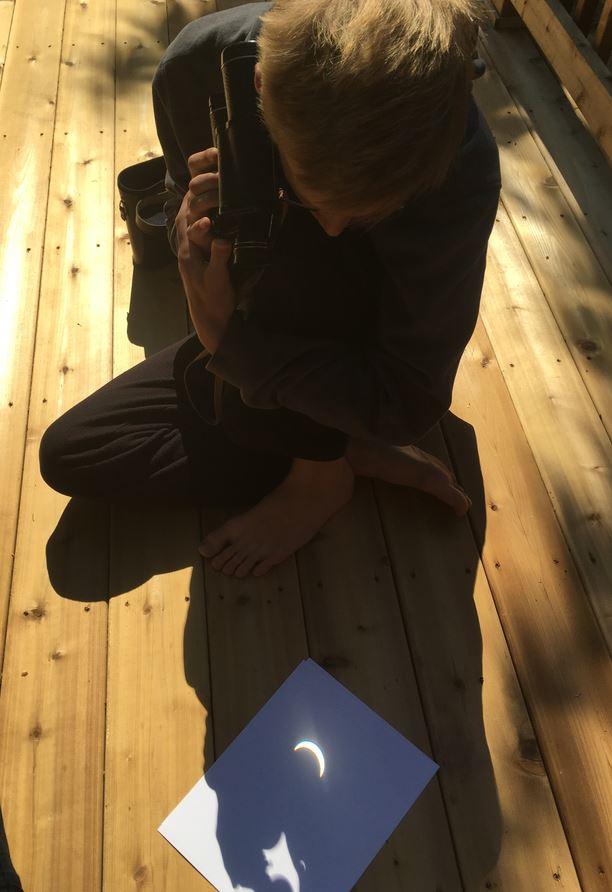

We didn’t enjoy totality, but we had an experience. The temperature dropped at least ten degrees. The sky was an eerie twilight, but without the glow of a setting sun. It actually wasn’t nearly as dark as I expected. Take away 80% of the sun and you should be in the dark, right? Nope. Here’s what 81% solar obstruction looked like in Calgary.

The absolute weirdest thing was the effect of the sun’s eclipsed light working its way through the needles of the tall spruce tree in our back yard. Instead of tiny points projected on the deck, we had dozens of amazing crescents. Here is my backyard wheelchair ramp, partly shaded, but all decked out in solar crescents.

My brother, in North Carolina, drove an hour south to experience totality. I loved his descriptions. The sudden darkness, the mesmerizing rays projecting around the edges of the moon, the bats taking flight. (Really!)

Finally, what about those bees? Well, they were a no-show! Our morning here in Calgary was rather chilly. Our bees weren’t flying when the eclipse started so we didn’t get to see what they’d do when it got dark.  But if you had active bees, please add a line or two in the comments below and let us know how they behaved.

Posted in Humour, Strange, Odd Stuff | Tagged | 6 Comments

The Lazy Bees

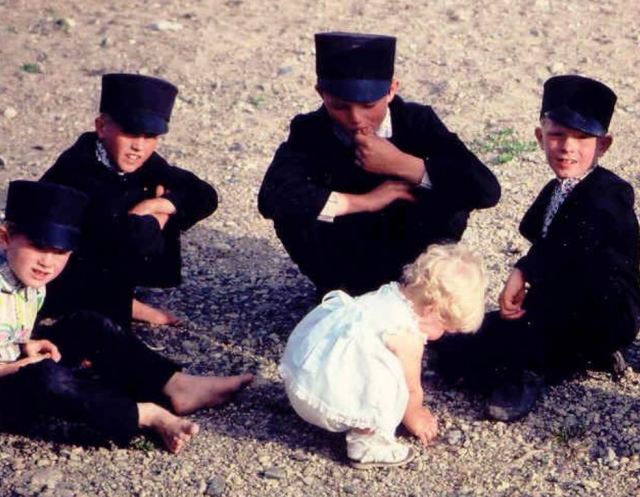
Hutterite kids, hanging out with my daughter. Not every moment is spent working.

A friend wanted to name his honey farm The Lazy Bee Apiaries. He even made the proper brand (LBA) for marking his frames and rims. But other beekeepers (including me) told him that bees aren’t lazy. Sometimes beekeepers are a bit work-averse, but never bees.  Was I right about that?

Bees have a reputation for tireless work. Their alleged ethics are borrowed by moralizers and preachers, including my friends, the Hutterites. They belong to a Mennonite-style religion started by Jacob Hutter five hundred years ago. Hutterites live communally on big farms, called colonies. Every generation, each farm ends up with too many kids for their sections of fertile farmland, so they send out a swarm of Hutterites to start another farm, which eventually splits again, after another generation. (From 400 immigrants in 1879, there are now 45,000 Hutterites in North America.) The Hutterites see parallels between themselves and the bee colony, swarms, and the bees’ extreme work ethic. These are traits which the Hutterites believe they share with honey bees.

But I don’t think bees work as hard as Hutterite farmers. In fact, I’ve come to suspect that bees can be a touch indolent. I’m not talking about drones, who are philosophically opposed to any form of labour. I’m talking about worker bees.

Mark and his hive. It looks like some of his bees aren’t working.

I fell into this train of thought when a neighbour here in Calgary invited me to take a peak at his bees. It’s Mark’s first year beekeeping. He’s doing well. His single hive, established in early May from a package, has grown from its initial single box. Now it fills four deep chambers and two shallow supers. Mark wanted my opinion on the bees’ strength, honey harvest, and winter prospects.

It wasn’t hard to tell him that his bees were doing fine. He had already harvested a super of honey, the bees had plenty of stores for winter, and the queen seemed active enough. There was no indication that they might swarm this year and their brood nest was not crowded. (You want the queen to have space in mid-August. If the brood nest is honey-bound, the queen stops laying and there aren’t enough bees for winter.) Everything was in good shape. We rearranged the order of the boxes and swapped around some foundation. Nothing dramatic.

As I mentioned, Mark is a new beekeeper. First year with bees. I like working with newbies as they often ask questions which I wouldn’t normally wonder about. For example, Mark pointed to two bees which were idle on a frame of sealed honey. They were just sitting there, perhaps chatting, but apparently doing nothing else.

“What are those bees doing?” Mark asked me.

I had no idea. How many times have I opened a hive, fumbled through some necessary manipulations, seen thousands of bees ‘hanging around’ but never stopped to wonder what a particular bee was doing at that particular moment.  I told Mark that I didn’t know. Maybe they were resting. Maybe they were disturbed by us, the beekeepers, and otherwise might have been gainfully employed. It looked like they were doing nothing.

If you quietly open any hive, give a gentle puff of smoke, and slowly remove a few frames, you’ll find hundreds of bees just hanging around. Not feeding hungry brood. Not drying and curing fresh nectar. Not constructing new comb. Not doing anything.

Are bees busy? Well, we’ve already dismissed drones as total miscreants. The queen, as we know, does a lot of work laying eggs, but she has a lot of down time, too. If you’ve ever watched her at her job (best viewed through an observation hive’s glass so she doesn’t get agitated), you’ll know that she spends less than ten seconds laying each egg. Count to ten, slowly. That’s enough time for the queen to drop an egg and move on, checking for the next cell.  A good queen may lay 2,000 eggs a day in a healthy developing hive, spending less than six hours each day working at her job. Then autumn and winter come and she has even less to do. This puts her productive hours only a little better than many office workers.

Worker bees seem to have it rather easy, too. Except during big nectar flows when a bee might forage non-stop fourteen hours a day for three or four weeks, finally retiring in death when her ragged wings shred from overuse, plunging her and her tiny droplet of freshly drawn nectar to the cold, unforgiving earth. Oh well, eh?

But that’s the romantic notion of a honey bee’s service. The vast majority never get to die for the team. In fact, the average bee’s life is mostly sedentary. Honey bees won’t fly if it’s cool (below about 10C/50F) or hot or windy, drizzly, or snowy. They don’t forage in the dark. If nectar-rich plants aren’t secreting, they don’t work even if the weather is good.

What about those two idle bees in Mark’s hive? They were too old to be housekeepers or nurses – and they were relaxing far from the brood. Other bees were gathering nectar (we side-shook a wet frame and thick nectar dribbled out). Those idle bees could have been at work, but weren’t. I guess even bees need some downtime. Hutterites, too. Whenever I would stop by at the nearest Hutterite colony, I could always find someone with a bit of time for a relaxing visit and small glass of dandelion wine – even on mild, sunny afternoons.

Posted in Bee Biology, Beekeeping, Friends | Tagged , , | 16 Comments

The Kiwi Beekeeping Podcast is Back!

Returning to the pod-waves after a two-month hiatus, Kiwimana is back. Since May 24, I’ve been suffering mana-withdrawal, but the popular beekeeping podcast released a new episode a few days ago.  So, I’ve kicked back and begun to enjoy the series again.

If you haven’t yet listened to the beekeepers who make this clever podcast, you’re in for a treat. This refreshing  podcast is broadcast from New Zealand’s north island, but we learn about good beekeeping, bees and politics, and environmental issues from all over the world. The focus is on ‘natural’ beekeeping but not to the point where credibility is lost. Gary and Margaret have lively opinions and banter to share, but most episodes also include interviews with other experienced beekeepers. For example, “Beekeeping Like a Girl” Hilary Kearney, bee health essayist Randy Oliver, Louisiana Bee Man JP, Australian commercial keeper Victor Croker, and bee blogger Rusty Burlew have all been guests on Kiwimana. Along with the interviews, the Kiwimaniacs usually discuss interesting bee news (like the time that a swarm shut down an entire school or the incident that involved a Kentucky driver who landed his car in an apiary).

Gary and Margaret have been podcasting for a few years – the newest release is Podcast #110!  That’s a lot of bee communication.  And a lot of hard production and research work from these Kiwis. If you’re looking for an interesting bee-centric way to spend a Sunday afternoon, Kiwimana may be what you want. It will especially appeal to newer beekeepers and ‘natural beekeeping’ enthusiasts, but there’s something at Kiwimana for experienced professionals, too. If you’re a commercial beekeeper, migrating hives on long treks or spending hour after hour in the extracting shop, this podcast is a pleasant way to pass some hours.

Take a listen, especially in September when Gary talks to me! Yup, he cornered me for a full hour of Rambling Ron on the Pod and we brought bad beekeeping to life. I’ll remind you when that show gets aired, but in the meanwhile, tune in to Kiwimana’s beekeeping podcast. If you like bee talk, you’ll like this.

Posted in Culture, or lack thereof, Outreach | Tagged , , | 2 Comments