I’ve written about ‘creamed’ honey before, but I think it’s time to mention it again. I don’t know what you call smooth honey – some folks call it creamed (though no dairy products are involved), spun (though no spinning is involved) or smooth (which it certainly is!). If you had a nice crop of honey this year, you might like this way to present honey. Fall is the natural time to make creamed, or spun, honey. Your main season is over, the weather is turning chilly, and cool weather helps the fine-granulation process that results in great creamed honey. And creamed honey will certainly boost your sales.
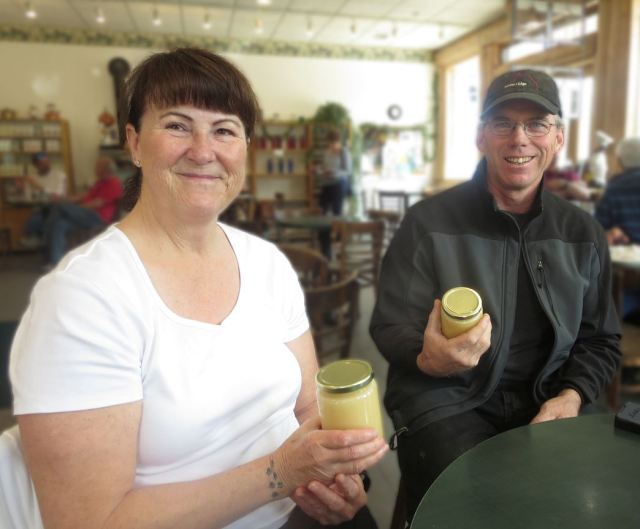
Brenda and Mike with some of their creamed honey
These friends of mine, Brenda and Mike, make great creamed honey. The bees are kept in the Rocky Mountain foothills where the honey is usually mild and light. Brenda handles the honey smoothing at her home.
I’ll give you Brenda’s recipe:

It’s actually pretty simple. Heat the honey until it’s completely liquid with no granulation crystals left in it. Cool it to room temperature and stir in some creamy ‘seed’ honey. Stir and stir and stir. Pour it into the final containers and store it in a cool place. The seed can be creamed honey from your previous batch of creamed honey. If this is your first year making the stuff, you’ll have to get some creamy (“spun”) honey at the grocery or from a friend. After that, keep some in reserve for the next crop. People use from 5 to 20 percent seed, but most add about 10 percent.

Once ‘creamed’, the honey will stay this smooth for months – or even years.
Selling granulated honey is tricky. If it crystallizes slowly, big grainy chunks form. If moisture is a bit high, the water and honey may separate after packing, with a layer of sour fermenting honey-water floating above large, unattractive grains. Because most of the honey here in Canada granulates quickly, beekeepers learned to pack it in pails with wide lids, making the honey accessible after the inevitable hardening. This became known as “real” honey while honey that stayed liquid (which was rare) was suspected of being overheated or adulterated. That’s why, even today, crystallized honey is more common that liquid honey on grocery shelves in Canada.
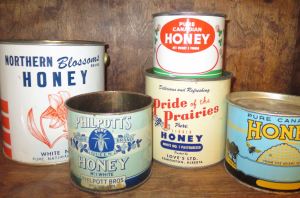 But granulated honey sometimes spoils because it’s usually not heated enough during packing to kill yeast. Another common problem is the growth of over-sized granulation crystals (if honey crystallizes slowly over several months, the crystals are bigger). Poor quality granulated honey was common in the early 1900s. At the time, most Canadian honey was packed in gallon-sized tins and sent off to England. After producing, packing, and shipping across the ocean, beekeepers sometimes weren’t paid – the buyers in London had to dump the stuff as it had soured or had a watery layer on top. A young Canadian ag-scientist, Elton Dyce, recognized the problem and spent years looking for a fix.
Dyce was working at the Ontario Agriculture College (now known as the University of Guelph). In the 1920s, he taught apiculture to farm kids who came to the school from across central Canada. They told him about the honey that went bad back on the farm. From their samples, he noticed that finer-granulated honey had less moisture-separation problems. And it generally tasted better.
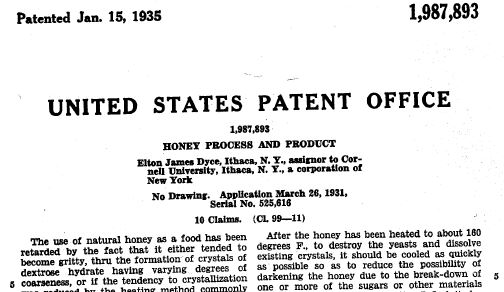
At age 28, Elton Dyce moved to Cornell University in New York to work on a Masters’ in entomology. Until he developed his system, most efforts to improve honey focused on heating it. This resulted in longer-lasting liquid honey, but Dyce felt that such honey wasn’t what consumers wanted on their tables. At Cornell, he continued to work on the Canadian honey problem. Three years later, he filed US Patent 1987893, simply called “Honey Process and Product“. He began his patent claim by stating that the use of honey is inhibited because it can be gritty and inconsistent unless heated. Then, he said, such liquid honey becomes drippy and harder to use. Dyce had a better idea. In paragraph 4 of his claims, Elton Dyce spelled out his system:
4.) A honey product made by heating honey to a temperature sufficient to destroy yeasts, quickly cooling it to a temperature below the melting point of honey crystals preferably about 75 degrees F., adding about 5% of fine grained crystalline honey, agitating the honey to distribute said nuclei uniformly thruout the honey, and controlling the temperature within a few degrees of 57 degrees F., whereby a fine-grained, fondant-like product is formed.
That’s the entire method, now known as the Dyce Process: Heat honey to destroy yeast, quickly cool it to 75 ºF, uniformly mix in fine-grained crystallized honey (‘seed’), and store it at 57 ºF. Quite soon, your honey is a smooth, fine-grained fondant. At this stage, the honey is attractive, ships well, and won’t spoil.
Dyce’s patent was issued 80 years ago and has long-since expired. Anyone may now use his technique to make perfect, tasty, smooth honey. My friends Brenda and Mike proved that to me.
*Part of the preceding is from my 2016 American Bee Journal article.


 I try to write at least one blog post every week. It’s not hard to find material. Honey production, honey chemistry, queen breeding, nectar sources, apitherapy, famous beekeepers, colony management, bee diseases, and on and on – it’s easy to find something interesting to describe. And, of course, beekeepers are always doing something horribly stupid. There’s no end to the delightful stories that can be told.
 My day job – as a geophysicist – suddenly became really hectic. I enjoy the earth science stuff that I do. Having lots of work is always great. But I was unexpectedly working more than I had in a couple of years and the work (from multiple clients) was urgent. That’s where most of my time went.

 I enjoyed the work and mental exercise. But it was challenging. Along with my family and consulting duties, I worked extremely long days pulling everything together. The last time that I took a university exam was over twenty years ago. I had to remember how to study and how to prepare. But now I feel much more informed and more competent analyzing serious research papers.






 Bad Beekeeping Blog